
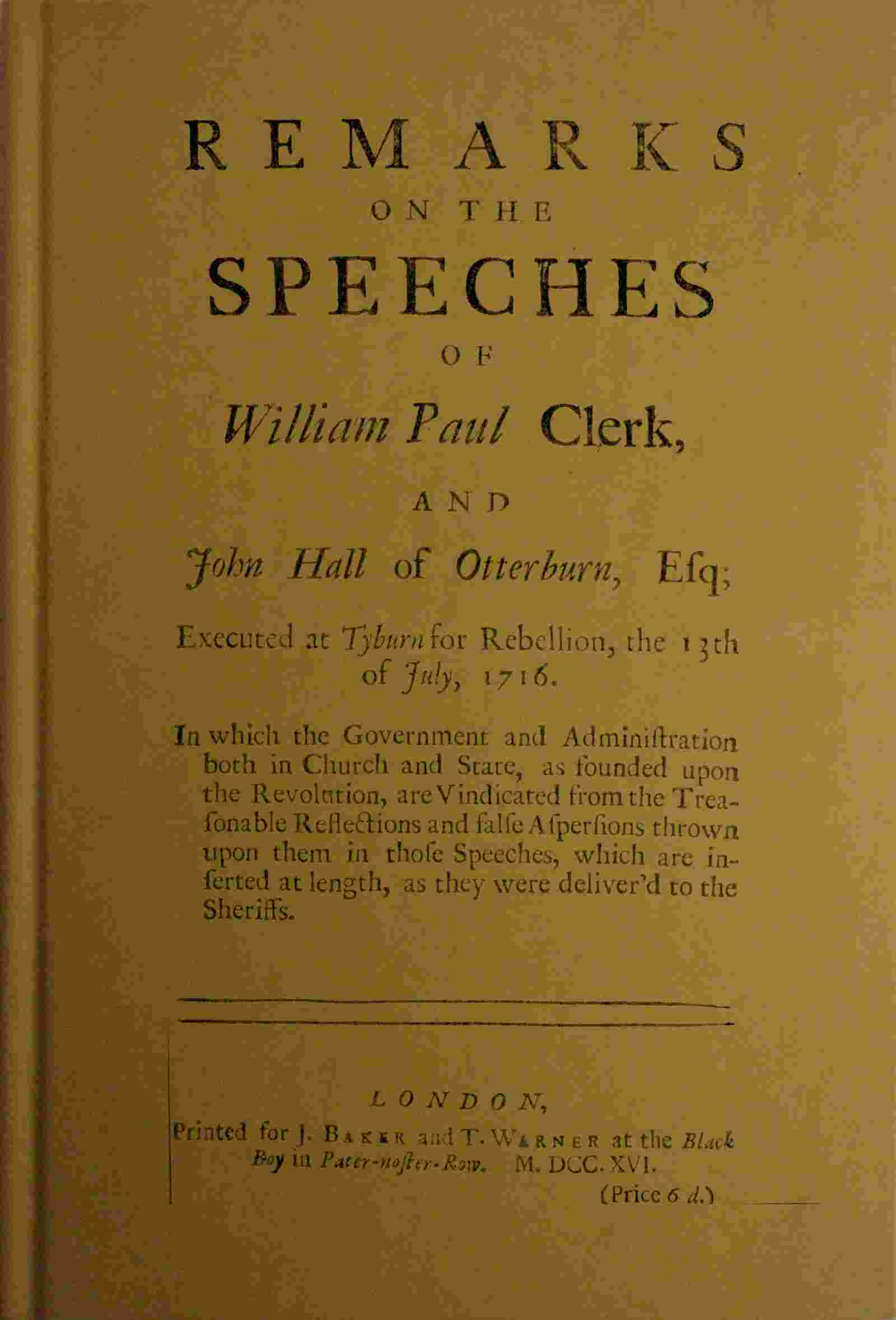
REMARKS on the Speech of John Hall, Esq;
THE last Sentiments of these two Traitors are so much alike, and there is such a Harmony betwixt them in Matter, that the Reflections on the former exhaust all that is material in the latter; so that I shall only take notice of what is peculiar in Mr. Hall’s, or that is applicable to his particular Case.
The SPEECH.
Friends, Brethren, and Countrymen; I am come here to die for the sake of God, my King, and my Country; and I heartily rejoice that I am counted worthy of so great an Honour: for let not any of you think that I am come to a shameful and ignominious End. The Truth and Justice of the Cause, for which I suffer, makes my Death a Duty, a Vertue, and an Honour. Remember that I laid down my Life for asserting the Right of my only Lawful Sovereign, King James the Third; That I offer my self as a Victim for the Liberties and Happiness of my dear Country, and my beloved Fellow-Subjects; That I fall a Sacrifice to Tyranny, Oppression and Usurpation. In short, consider that I suffer in defence of the Commands of God, and the Laws and Hereditary Constitution of the Land: and then know and be assur’d that I am not a Traitor, but a Martyr.
REMARKS.
This unfortunate Gentleman sets out with a vile hypocritical Rhodomontade: he asserts, that he came to die for the sake of God, his King, and his Country; but ’tis certain, that had his Applications to the present Government for a Pardon succeeded, he must, according to this Principle, have liv’d in such a manner as was quite opposite to what he pretended to die for: which is so horrid, that I may well be excus’d from saying any thing further about it, since the Antithesis must be obvious to every Reader.
How much he counted it his Honour to die for the Pretender’s Cause, I shall not say; but I am well assur’d, that he employ’d all his Friends to do their utmost for saving his Life, and obtested them to do it, as they had any regard to the Blessings of himself, his Wife, and five Children. And I am satisfy’d, that the Reverend Mr. Patten will own to the World, if it be requir’d, that Mr. Hall, in order to save his Life, would have had Mr. Patten declare to the Court, that he the said Mr. Hall was mad; which he thought was as good a Plea for an English Squire, as for a Scotch Earl. This makes his End truly ignominious and shameful, and shews that he had no such Opinion of the Truth and Justice of the Cause for which he suffer’d, as to make his Death a Duty, Vertue and Honour, till he found he must come to the Gallows, and there he sets up for a Hero and a Martyr.
Mr. Hall, having acted as a Justice of Peace under the present Government till the Rebellion broke out, ought to have had some knowledg of the Law; and therefore we might have expected some Reasons from the Statute Book, why he calls the Pretender his only Lawful Sovereign: but ’tis probable he knew, that ’twas not to be done, and therefore thought it enough to pawn his bare Assertion upon the Jacobite Mob for Law, as his Fellow-Sufferer the Clergyman did his for Gospel. ’Tis evident, that both their Talents were better adapted to Rail, than to Reason; otherwise, the one would have given us a Text, and the other a Statute, to prove that they suffer’d in defence of the Laws of God and the Land: but since neither of them have done it, and that none of the Party either has been, or will ever be able to do it for them, we have reason to conclude, that they dy’d Traitors, but not Martyrs.
Those who have read the Old and New Testament with Attention, must certainly be satisfy’d, that there is not one Word in either for a Divine Indefeasible Hereditary Right in any Person or Family to Government; but on the contrary, that our Saviour, the Prophets, and Apostles, taught Obedience to such Governments and human Constitutions, as were in being at the respective times when they liv’d; and laid their Followers under no other Restriction, as to their Obedience to the Superior Powers they found in the World, but to obey God rather than Man, when their Commands interfered.
As to the Laws of Great Britain, our Adversaries will never be able to prove any other Hereditary Right than what was deriv’d from those Laws; which being alterable, according to the Nature of all human Constitutions, succeeding Generations must always, according to the Laws of Nature and Reason, have the same power to alter them for their own Security, as their Ancestors had to enact them for theirs. If this be not allow’d, this Absurdity must naturally follow, that had any preceding King and Parliament made an Act that all their Successors shou’d be Pagans, Papists, Turks, or Slaves, we had been left without a Remedy.
The SPEECH.
I declare that I die a true and sincere Member of the Church of England; but not of the Revolution Schismatical Church, whose Bishops have so rebelliously abandon’d the King, and so shamefully given up the Rights of the Church, by submitting to the Unlawful, Invalid, Lay-Deprivations of the Prince of Orange. The Communion I die in, is that of the True Catholick Nonjuring Church of England; and I pray God to prosper and increase it, and to grant, if it be his good pleasure, that it may rise again and flourish.
REMARKS.
This is so much of a piece with what Parson Paul said in his Speech, that I need say little more upon it: only Mr. Hall says, that the Rights of the Church were given up by the Submission of the Bishops and Clergy to the Unlawful Invalid Lay-Deprivations of the Prince of Orange.
The Church of England used formerly, when charg’d with being Erastian in her Constitution, to alledg that it cou’d not be so, since the Sovereign of England was mixta Persona, and by consequence a Clergyman as well as Layman. But tho the High-Church has thrown up that Argument, ’tis plain from the Statutes quoted in answer to Mr. Paul, that by the Laws of England our Sovereign is made Head of the Church; and from him the Bishops and Clergy of England do immediately derive all their Ecclesiastical Power and Authority. And since it was the Parliament of England which invested our Princes with the Power of conferring that Authority, King William was as lawfully possess’d of it as any of his Predecessors.
But farther, since all the Episcopal Power which the Bishops of England can pretend to, is deriv’d from Laymen (if the King and Parliament must be call’d so) it follows in Reason, that a Lay-Deprivation is sufficient to make void a Lay-Institution, if the Deprivation be founded on a just Cause, as disowning the Government certainly is. Besides, it ought to be consider’d, that the Bishops who sit in Parliament are Clergymen; and since they consented to the Deprivation, it can’t in Justice be wholly call’d a Lay one, unless they had protested against it in Convocation, where they sit as Clergymen: and that they did not so protest, is evident to all the World.
’Tis observable, that Mr. Hall adds Catholick to Mr. Paul’s Epithet of the Nonjuring Church of England; so that at last the Justice and the Clergyman wou’d bring us to the Church of Rome, which is the only Church pretending to be Catholick, that the Nonjuring Church agrees with.
The SPEECH.
I heartily beg Pardon of all whom I have in any manner, and at any time injur’d or offended. I do particularly implore Forgiveness of God and my King, for having so far swerv’d from my Duty, as to comply with the Usurpation, in swearing Allegiance to it, and acting in publick Posts by the Usurper’s Commissions, which were void of all Power and Authority. God knows my Heart, I did this at first thro Ignorance and Error; but after I had recollected my self, and inform’d my Judgment better, I repented, and drew my Sword for the King, and now submit my self to this violent Death for his sake. I heartily pray God, my Penitence and my Sufferings may atone for my former Crime. And this I beg thro the Merits, Mediation, and Sufferings of my dearest Saviour, Christ Jesus.
REMARKS.
By this Paragraph we may see whether Mr. Hall was a sincere Member of the Nonjuring Church or not. He owns, that he had sworn Allegiance to what he calls the Usurpation, and acted in publick Posts by Commission from it. This is a plain Proof that he was an Abjuror instead of a Nonjuror, until the Rebellion broke out; and then to make himself a sincere Nonjuror, he became a Perjuror; and contrary to his Allegiance, which he had sworn from time to time while a Justice of Peace, he drew his Sword against the King from whom he held his Commission.
He pretends to excuse himself, by saying that his Submission to the Revolution Government proceeded at first from Ignorance and Error; but after he had recollected himself, and inform’d his Judgment better, he repented, and drew his Sword for the King, meaning the Pretender. ’Tis worth while to observe, how much time Mr. Hall took to recollect and inform himself better. It certainly was not much, for at the very time when the Rebellion began, he was sitting with other Justices in Commission, at the Quarter-Sessions in Northumberland; and he pretended at his Tryal, that he was taken Prisoner by the Rebels in his Return from the Quarter-Sessions. By this we may easily know what to think of his Recollection and better Information. I shall say no more to this Paragraph, but that Mr. Hall seems to have dy’d as bad a Protestant as a Subject, since he joins his own Repentance and Sufferings to the Merits and Sufferings of our Saviour, as the Foundation of his Hopes for Mercy: which, with what has been observ’d already in Mr. Paul’s Speech, may serve to convince the World what sort of Protestants our High-Church-Men are.
The SPEECH.
I do sincerely forgive all my Enemies, especially those who have either caus’d or increas’d the Destructions in Church or State. I pray God have mercy upon them, and spare them, because they are the Work of his own Hands, and because they are redeem’d with his Son’s most precious Blood. I do particularly forgive, from the bottom of my Heart, the Elector of Brunswick, who murders me; my unjust pretended Judges and Jury, who convicted, and condemn’d me; Mr. Patten and Mr. Carnaby, Evidences who swore against me at my Trial. And I do here declare, upon the Words of a dying Man (and all my Northumberland Fellow Prisoners can testify the same) that the Evidence they gave was so far from being the Truth, the whole Truth, and nothing but the Truth, that in relation to my Indictment they swore not one true thing against me, but many absolute Falshoods. I pray God forgive them, for I am sure I do.
REMARKS.
His way of forgiving his Enemies is much the same with Parson Paul’s. Here his Folly and Malice are equally conspicuous; for in this Paragraph he charges the Evidence against him with swearing falsly; whereas in that immediately preceding, he owns the Truth of what is sworn in the main, by confessing that he drew his Sword for King James, which is a sufficient Vindication of the Evidence.
The SPEECH.
Lastly, I forgive all who had any hand in the Surrender at Preston; for they have surrender’d away my Life: and I would to God that were the only bad Consequence of it. But alas, it is too plain, that the Surrenderers not only ruin’d many of his Majesty’s brave and faithful Subjects but gave up their King and Country into the Bargain. For it was then in their power to have restor’d the King with Triumph to his Throne; and thereby to have made us a happy People. We had repuls’d our Enemies at every Attack, and were ready, willing, and able to have attack’d them. On our side even our common Men were brave, courageous and resolute; on the other hand, theirs were directly the contrary: insomuch that after they had run away from our first Fire, they could never be brought so much as to endeavour to stand a second. This I think my self oblig’d in Justice to mention, that Mr. Wills may not impose upon the World, as if he and his Troops had conquer’d us, and gain’d the Victory: for the truth is, after we had conquer’d them, our Superiours thought fit to capitulate, and ruin us. I wish them God’s and the King’s Pardon for it.
REMARKS.
This Paragraph is such a fulsom and flagrant Lye, that it would seem the Devil ow’d him a shame. To publish an Untruth of this nature, in view of the Bar of Heaven, proves the poor Man, or at least his Speech-makers, to have been more than case-harden’d. What the Design of the Faction could be, in handing such a Story as this to the World, which can be contradicted by Thousands of Eye-Witnesses, and by Mr. Hall’s Fellow-Rebels as well as by the King’s Troops, is not easy to be imagin’d; unless it be to spirit up the Faction to a new Rebellion, by telling them, that their Friends were Conquerors, but unhappily betray’d into a Surrender by their Leaders. Had this been true, what Fools must their Generals Forster and Mackintosh be to fly from a Government, where they had so much Merit to plead, to another which will certainly hang them, if Mr. Hall’s Accusation obtain Belief? One would be tempted to think, that when Mr. Hall read or sign’d this Speech, he did not expect to have been hang’d, but to have been rescu’d by the Jacobite Mob, and to have set himself at their Head as General; a Post which (if he says true) he certainly deserv’d much better than Lord Derwentwater, Lord Kenmure, or Messieurs Forster and Mackintosh. But be that how it will, if the Rebels make another Attempt, ’tis probable this scandalous Reflection may put our Generals and Soldiers upon another Method of managing the War, than to content themselves with the Surrender of the Jacobites at Discretion: and of what Service Mr. Hall’s Speech may be to his Party in this Case, they themselves are left to judg.
The SPEECH.
May it please the Almighty to bless, preserve, and restore our only Rightful and Lawful Sovereign, King James the Third! May he direct his Councils, and prosper his Arms! May he bring him to his Kingdom, and set the Crown upon his Head! May he protect him from the Malice of his Enemies, and defend him from those who for a Reward would slay him innocent! May he grant him in Health and Wealth long to live! May he strengthen him, that he may vanquish and overcome all his Enemies! And finally, when it pleases his infinite Wisdom to take him out of this World, may he take him to himself, and reward him with an everlasting Crown of Glory in the next!
REMARKS.
All that I shall say to this Paragraph, is, that the Prayers of the Worshipful Justice, and the Reverend Parson, are much of the same Strain, and, no doubt, they’ll meet with the like Answer. Indeed the Justice appears to have been the better Churchman of the two, for he prays for the Church in his second Paragraph, and puts off his Prayers for the King almost till the last; and the Parson shews himself to have been a better Lawyer than the Justice, because he prays for his King first, as the Head of his Church.
The SPEECH.
These, my beloved Countrymen, are the sincere Prayers, these the last Words of me, who am now a dying Person. And if you have any regard to the last Breath of one who is just going out of the World, let me beg of you to be dutiful, obedient, and loyal to your only Sovereign Liege Lord, King James the Third: be ever ready to serve him, and be sure you never fail to use all your Endeavours to restore him; and whatever the Consequence be, remember that you have a good Cause, and a gracious God, and expect your Recompence from him.
To that God, the God of Truth and Holiness, the Rewarder of all who suffer for Righteousness sake, I commend my Soul; beseeching him to have mercy upon it, for the sake of my dear Redeemer, and merciful Saviour, Jesus Christ, our Lord. Amen. Amen. Amen.
John Hall.
REMARKS.
The Justice agrees with the Parson in his Attempts to excite the Jacobites to a new Rebellion; but the Justice has fallen upon the luckier Argument of the two, because, in a former Paragraph, he encourages them with the News of a Victory, which it seems the Parson knew nothing of, tho present in the Field of Battle, and never saw any Marks of Triumph on that account, till he and his Brother Justice came to rejoice together for it at the Triple-Tree. The Justice however dy’d the best Protestant, because he begs pardon for the sake of his Redeemer, and does not seem to rely altogether upon his own Merits, as the Parson did.
POSTSCRIPT.
I might reasonably have expected my Life would have been saved, since I had obtained five Reprieves: but I find that the Duke of Hannover, and his Evil Counsellors who guide him, have so little Virtue and Honour themselves, that they are resolv’d not to spare my Life, because I would not purchase it upon base and dishonourable Terms. I have reason to think, that at first I could have secur’d both Life and Fortune, if I would have pleaded Guilty; and I doubt not but I might since have obtain’d Favour, if I would have petition’d in a vile scandalous manner. But I was resolv’d to do nothing whereby I should have disown’d my King, and deny’d my Principles: and I thank my good God, both for inspiring me with this holy Resolution, and for giving me the Grace to perform it.
John Hall.
REMARKS.
This is so malicious and silly, that it carries its Antidote along with it. He was oblig’d to the Government for five Reprieves, and if we may believe what he says, ’tis entirely owing to himself that he did not obtain a Pardon, because he would not petition. ’Twas highly reasonable then, that when Mercy wou’d not do, Justice shou’d take place. ’Tis certain, that a Petition for Mercy cou’d be nothing so vile, as forfeiting his Life by Perjury and Rebellion. But by this we see what aukard Notions our Jacobites have of what they call Honour.
I shall conclude the whole with observing, that these two Speeches are enough to convince the World, that the Oaths of the High-Church Party are not to be trusted while living, nor their Speeches when dead.
FINIS.