
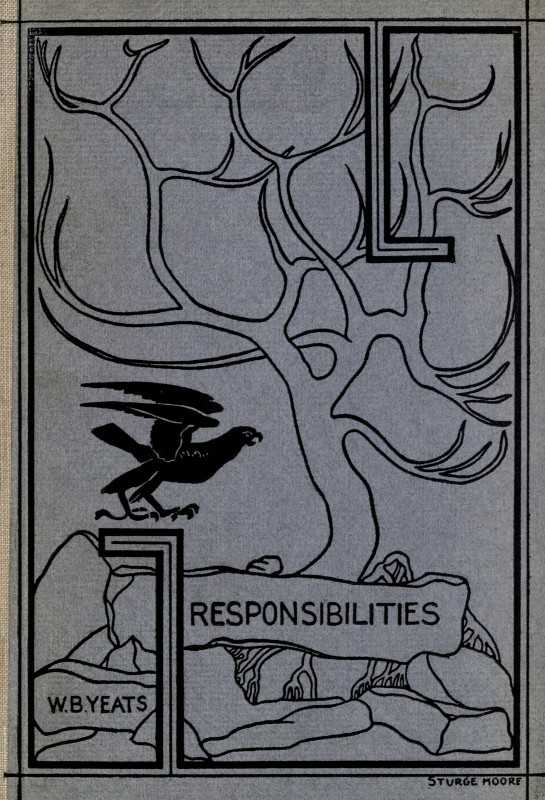
The Project Gutenberg eBook of Responsibilities, and other poems
Title: Responsibilities, and other poems
Author: W. B. Yeats
Illustrator: T. Sturge Moore
Release date: July 27, 2011 [eBook #36865]
Most recently updated: January 7, 2021
Language: English
Credits: Produced by Meredith Bach, David Garcia and the Online
Distributed Proofreading Team at https://www.pgdp.net (This
file was produced from images generously made available
by The Internet Archive/American Libraries.)
RESPONSIBILITIES
AND OTHER POEMS
THE MACMILLAN COMPANY
NEW YORK · BOSTON · CHICAGO · DALLAS
ATLANTA · SAN FRANCISCO
MACMILLAN & CO., Limited
LONDON
· BOMBAY · CALCUTTA
MELBOURNE
THE MACMILLAN CO. OF CANADA, Ltd.
TORONTO
RESPONSIBILITIES
AND OTHER POEMS
BY
WILLIAM BUTLER YEATS
New York
THE MACMILLAN COMPANY
1916
All rights reserved
Copyright, 1911
By
WILLIAM BUTLER YEATS
Copyright, 1904, 1908, and 1912
By THE MACMILLAN COMPANY
Copyright, 1916
By THE
MACMILLAN COMPANY
Set up and electrotyped. Published
November, 1916.
CONTENTS
| PAGE | ||
| Responsibilities, 1912-1914— | ||
| Introductory Rhymes | 1 | |
| The Grey Rock | 3 | |
| The Two Kings | 11 | |
| To a Wealthy Man | 29 | |
| September 1913 | 32 | |
| To a Friend whose Work has come to Nothing | 34 | |
| Paudeen | 35 | |
| To a Shade | 36 | |
| When Helen Lived | 39 | |
| The Attack on 'The Playboy of the Western World,'—1907 | 40 | |
| The Three Beggars | 41 | |
| The Three Hermits | 45 | |
| Beggar to Beggar cried | 47 | |
| The Well and the Tree | 49 | |
| Running to Paradise | 50 | |
| The Hour before Dawn | 52 | |
| The Player Queen | 59 | |
| The Realists | 61 | |
| The Witch | 62 | |
| The Peacock | 63 | |
| The Mountain Tomb | 64 | |
| To a Child dancing in the Wind | 66 | |
| A Memory of Youth | 68 | |
| Fallen Majesty | 70 | |
| Friends | 71 | |
| The Cold Heaven | 73 | |
| That the Night come | 75 | |
| An Appointment | 76 | |
| The Magi | 77 | |
| The Dolls | 78 | |
| A Coat | 80 | |
| Closing Rhymes | 81 | |
| From the Green Helmet and other Poems, 1909-1912— | ||
| His Dream | 85 | |
| A Woman Homer sung | 87 | |
| The Consolation | 89 | |
| No Second Troy | 91 | |
| Reconciliation | 92 | |
| King and No King | 94 | |
| Peace | 96 | |
| Against Unworthy Praise | 97 | |
| The Fascination of What's Difficult | 99 | |
| A Drinking Song | 101 | |
| The Coming of Wisdom with Time | 102 | |
| On hearing that the Students of our New University have joined the Ancient Order of Hibernians | 103 | |
| To a Poet | 104 | |
| The Mask | 105 | |
| Upon a House shaken by the Land Agitation | 106 | |
| At the Abbey Theatre | 108 | |
| These are the Clouds | 110 | |
| At Galway Races | 112 | |
| A Friend's Illness | 113 | |
| All Things can tempt me | 114 | |
| The Young Man's Song | 115 | |
| The Hour-Glass—1912 | 117 | |
| Notes | 181 | |
'In dreams begins responsibility.'
Old Play.
'How am I fallen from myself, for a long time now
I have not seen the Prince of Chang in my dreams.'
Khoung-fou-tseu.
RESPONSIBILITIES
[INTRODUCTORY RHYMES]
Pardon, old fathers, if you still remain
Somewhere in ear-shot for the story's end,
Old Dublin merchant 'free of ten and four'
Or trading out of Galway into Spain;
And country scholar, Robert Emmet's friend,
A hundred-year-old memory to the poor;
Traders or soldiers who have left me blood
That has not passed through any huxter's loin,
Pardon, and you that did not weigh the cost,
Old Butlers when you took to horse and stood
Beside the brackish waters of the Boyne
Till your bad master blenched and all was lost;
You merchant skipper that leaped overboard
After a ragged hat in Biscay Bay,
You most of all, silent and fierce old man
Because you were the spectacle that stirred
My fancy, and set my boyish lips to say
'Only the wasteful virtues earn the sun';
Pardon that for a barren passion's sake,
Although I have come close on forty-nine
I have no child, I have nothing but a book,
Nothing but that to prove your blood and mine.
January 1914.
THE GREY ROCK
Poets with whom I learned my trade,
Companions of the Cheshire Cheese,
Here's an old story I've re-made,
Imagining 'twould better please
Your ears than stories now in fashion,
Though you may think I waste my breath
Pretending that there can be passion
That has more life in it than death,
And though at bottling of your wine
The bow-legged Goban had no say;
The moral's yours because it's mine.
When cups went round at close of day—
Is not that how good stories run?—
Somewhere within some hollow hill,
If books speak truth in Slievenamon,
But let that be, the gods were still
And sleepy, having had their meal,
And smoky torches made a glare
On painted pillars, on a deal
Of fiddles and of flutes hung there
By the ancient holy hands that brought them
From murmuring Murias, on cups—
Old Goban hammered them and wrought them,
And put his pattern round their tops
To hold the wine they buy of him.
But from the juice that made them wise
All those had lifted up the dim
Imaginations of their eyes,
For one that was like woman made
Before their sleepy eyelids ran
And trembling with her passion said,
'Come out and dig for a dead man,
Who's burrowing somewhere in the ground,
And mock him to his face and then
Hollo him on with horse and hound,
For he is the worst of all dead men.'
We should be dazed and terror struck,
If we but saw in dreams that room,
Those wine-drenched eyes, and curse our luck
That emptied all our days to come.
I knew a woman none could please,
Because she dreamed when but a child
Of men and women made like these;
And after, when her blood ran wild,
Had ravelled her own story out,
And said, 'In two or in three years
I need must marry some poor lout,'
And having said it burst in tears.
Since, tavern comrades, you have died,
Maybe your images have stood,
Mere bone and muscle thrown aside,
Before that roomful or as good.
You had to face your ends when young—
'Twas wine or women, or some curse—
That you might have a heavier purse,
Nor gave loud service to a cause
That you might have a troop of friends.
You kept the Muses' sterner laws,
And unrepenting faced your ends,
And therefore earned the right—and yet
Dowson and Johnson most I praise—
To troop with those the world's forgot,
And copy their proud steady gaze.
'The Danish troop was driven out
Between the dawn and dusk,' she said;
'Although the event was long in doubt,
Although the King of Ireland's dead
And half the kings, before sundown
All was accomplished.'
'When this day
Murrough, the King of Ireland's son,
Foot after foot was giving way,
He and his best troops back to back
Had perished there, but the Danes ran,
Stricken with panic from the attack,
The shouting of an unseen man;
And being thankful Murrough found,
Led by a footsole dipped in blood
That had made prints upon the ground,
Where by old thorn trees that man stood;
And though when he gazed here and there,
He had but gazed on thorn trees, spoke,
"Who is the friend that seems but air
And yet could give so fine a stroke?"
Thereon a young man met his eye,
Who said, "Because she held me in
Her love, and would not have me die,
Rock-nurtured Aoife took a pin,
And pushing it into my shirt,
Promised that for a pin's sake,
No man should see to do me hurt;
But there it's gone; I will not take
The fortune that had been my shame
Seeing, King's son, what wounds you have."
'Twas roundly spoke, but when night came
He had betrayed me to his grave,
For he and the King's son were dead.
I'd promised him two hundred years,
And when for all I'd done or said—
And these immortal eyes shed tears—
He claimed his country's need was most,
I'd save his life, yet for the sake
Of a new friend he has turned a ghost.
What does he care if my heart break?
I call for spade and horse and hound
That we may harry him.' Thereon
She cast herself upon the ground
And rent her clothes and made her moan:
'Why are they faithless when their might
Is from the holy shades that rove
The grey rock and the windy light?
Why should the faithfullest heart most love
The bitter sweetness of false faces?
Why must the lasting love what passes,
Why are the gods by men betrayed!'
But thereon every god stood up
With a slow smile and without sound,
And stretching forth his arm and cup
To where she moaned upon the ground,
Suddenly drenched her to the skin;
And she with Goban's wine adrip,
No more remembering what had been,
Stared at the gods with laughing lip.
I have kept my faith, though faith was tried,
To that rock-born, rock-wandering foot,
And the world's altered since you died,
And I am in no good repute
With the loud host before the sea,
That think sword strokes were better meant
Than lover's music—let that be,
So that the wandering foot's content.
THE TWO KINGS
King Eochaid came at sundown to a wood
Westward of Tara. Hurrying to his queen
He had out-ridden his war-wasted men
That with empounded cattle trod the mire;
And where beech trees had mixed a pale green light
With the ground-ivy's blue, he saw a stag
Whiter than curds, its eyes the tint of the sea.
Because it stood upon his path and seemed
More hands in height than any stag in the world
He sat with tightened rein and loosened mouth
Upon his trembling horse, then drove the spur;
But the stag stooped and ran at him, and passed,
Rending the horse's flank. King Eochaid reeled
Then drew his sword to hold its levelled point
Against the stag. When horn and steel were met
The horn resounded as though it had been silver,
A sweet, miraculous, terrifying sound.
Horn locked in sword, they tugged and struggled there
As though a stag and unicorn were met
In Africa on Mountain of the Moon,
Until at last the double horns, drawn backward,
Butted below the single and so pierced
The entrails of the horse. Dropping his sword
King Eochaid seized the horns in his strong hands
And stared into the sea-green eye, and so
Hither and thither to and fro they trod
Till all the place was beaten into mire.
The strong thigh and the agile thigh were met,
The hands that gathered up the might of the world,
And hoof and horn that had sucked in their speed
Amid the elaborate wilderness of the air.
Through bush they plunged and over ivied root,
And where the stone struck fire, while in the leaves
A squirrel whinnied and a bird screamed out;
But when at last he forced those sinewy flanks
Against a beech bole, he threw down the beast
And knelt above it with drawn knife. On the instant
It vanished like a shadow, and a cry
So mournful that it seemed the cry of one
Who had lost some unimaginable treasure
Wandered between the blue and the green leaf
And climbed into the air, crumbling away,
Till all had seemed a shadow or a vision
But for the trodden mire, the pool of blood,
The disembowelled horse.
King Eochaid ran,
Toward peopled Tara, nor stood to draw his breath
Until he came before the painted wall,
The posts of polished yew, circled with bronze,
Of the great door; but though the hanging lamps
Showed their faint light through the unshuttered windows,
Nor door, nor mouth, nor slipper made a noise,
Nor on the ancient beaten paths, that wound
From well-side or from plough-land, was there noise;
And there had been no sound of living thing
Before him or behind, but that far-off
On the horizon edge bellowed the herds.
Knowing that silence brings no good to kings,
And mocks returning victory, he passed
Between the pillars with a beating heart
And saw where in the midst of the great hall
Pale-faced, alone upon a bench, Edain
Sat upright with a sword before her feet.
Her hands on either side had gripped the bench,
Her eyes were cold and steady, her lips tight.
Some passion had made her stone. Hearing a foot
She started and then knew whose foot it was;
But when he thought to take her in his arms
She motioned him afar, and rose and spoke:
'I have sent among the fields or to the woods
The fighting men and servants of this house,
For I would have your judgment upon one
Who is self-accused. If she be innocent
She would not look in any known man's face
Till judgment has been given, and if guilty,
Will never look again on known man's face.'
And at these words he paled, as she had paled,
Knowing that he should find upon her lips
The meaning of that monstrous day.
Then she:
'You brought me where your brother Ardan sat
Always in his one seat, and bid me care him
Through that strange illness that had fixed him there,
And should he die to heap his burial mound
And carve his name in Ogham.' Eochaid said,
'He lives?' 'He lives and is a healthy man.'
'While I have him and you it matters little
What man you have lost, what evil you have found.'
'I bid them make his bed under this roof
And carried him his food with my own hands,
And so the weeks passed by. But when I said
"What is this trouble?" he would answer nothing,
Though always at my words his trouble grew;
And I but asked the more, till he cried out,
Weary of many questions: "There are things
That make the heart akin to the dumb stone."
Then I replied: "Although you hide a secret,
Hopeless and dear, or terrible to think on,
Speak it, that I may send through the wide world
For medicine." Thereon he cried aloud:
"Day after day you question me, and I,
Because there is such a storm amid my thoughts
I shall be carried in the gust, command,
Forbid, beseech and waste my breath." Then I,
"Although the thing that you have hid were evil,
The speaking of it could be no great wrong,
And evil must it be, if done 'twere worse
Than mound and stone that keep all virtue in,
And loosen on us dreams that waste our life,
Shadows and shows that can but turn the brain."
But finding him still silent I stooped down
And whispering that none but he should hear,
Said: "If a woman has put this on you,
My men, whether it please her or displease,
And though they have to cross the Loughlan waters
And take her in the middle of armed men,
Shall make her look upon her handiwork,
That she may quench the rick she has fired; and though
She may have worn silk clothes, or worn a crown,
She'll not be proud, knowing within her heart
That our sufficient portion of the world
Is that we give, although it be brief giving,
Happiness to children and to men."
Then he, driven by his thought beyond his thought,
And speaking what he would not though he would,
Sighed: "You, even you yourself, could work the cure!"
And at those words I rose and I went out
And for nine days he had food from other hands,
And for nine days my mind went whirling round
The one disastrous zodiac, muttering
That the immedicable mound's beyond
Our questioning, beyond our pity even.
But when nine days had gone I stood again
Before his chair and bending down my head
Told him, that when Orion rose, and all
The women of his household were asleep,
To go—for hope would give his limbs the power—
To an old empty woodman's house that's hidden
Close to a clump of beech trees in the wood
Westward of Tara, there to await a friend
That could, as he had told her, work his cure
And would be no harsh friend.
When night had deepened,
I groped my way through boughs, and over roots,
Till oak and hazel ceased and beech began,
And found the house, a sputtering torch within,
And stretched out sleeping on a pile of skins
Ardan, and though I called to him and tried
To shake him out of sleep, I could not rouse him.
I waited till the night was on the turn,
Then fearing that some labourer, on his way
To plough or pasture-land, might see me there,
Went out.
Among the ivy-covered rocks,
As on the blue light of a sword, a man
Who had unnatural majesty, and eyes
Like the eyes of some great kite scouring the woods,
Stood on my path. Trembling from head to foot
I gazed at him like grouse upon a kite;
But with a voice that had unnatural music,
"A weary wooing and a long," he said,
"Speaking of love through other lips and looking
Under the eyelids of another, for it was my craft
That put a passion in the sleeper there,
And when I had got my will and drawn you here,
Where I may speak to you alone, my craft
Sucked up the passion out of him again
And left mere sleep. He'll wake when the sun wakes,
Push out his vigorous limbs and rub his eyes,
And wonder what has ailed him these twelve months."
I cowered back upon the wall in terror,
But that sweet-sounding voice ran on: "Woman,
I was your husband when you rode the air,
Danced in the whirling foam and in the dust,
In days you have not kept in memory,
Being betrayed into a cradle, and I come
That I may claim you as my wife again."
I was no longer terrified, his voice
Had half awakened some old memory,
Yet answered him: "I am King Eochaid's wife
And with him have found every happiness
Women can find." With a most masterful voice,
That made the body seem as it were a string
Under a bow, he cried: "What happiness
Can lovers have that know their happiness
Must end at the dumb stone? But where we build
Our sudden palaces in the still air
Pleasure itself can bring no weariness,
Nor can time waste the cheek, nor is there foot
That has grown weary of the whirling dance,
Nor an unlaughing mouth, but mine that mourns,
Among those mouths that sing their sweethearts' praise,
Your empty bed." "How should I love," I answered,
"Were it not that when the dawn has lit my bed
And shown my husband sleeping there, I have sighed,
'Your strength and nobleness will pass away.'
Or how should love be worth its pains were it not
That when he has fallen asleep within my arms,
Being wearied out, I love in man the child?
What can they know of love that do not know
She builds her nest upon a narrow ledge
Above a windy precipice?" Then he:
"Seeing that when you come to the death-bed
You must return, whether you would or no,
This human life blotted from memory,
Why must I live some thirty, forty years,
Alone with all this useless happiness?"
Thereon he seized me in his arms, but I
Thrust him away with both my hands and cried,
"Never will I believe there is any change
Can blot out of my memory this life
Sweetened by death, but if I could believe
That were a double hunger in my lips
For what is doubly brief."
And now the shape,
My hands were pressed to, vanished suddenly.
I staggered, but a beech tree stayed my fall,
And clinging to it I could hear the cocks
Crow upon Tara.'
King Eochaid bowed his head
And thanked her for her kindness to his brother,
For that she promised, and for that refused.
Thereon the bellowing of the empounded herds
Rose round the walls, and through the bronze-ringed door
Jostled and shouted those war-wasted men,
And in the midst King Eochaid's brother stood.
He'd heard that din on the horizon's edge
And ridden towards it, being ignorant.