
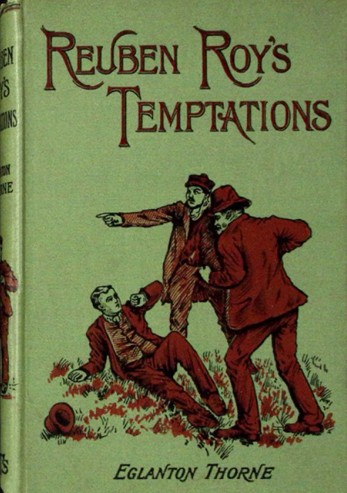
The Project Gutenberg eBook of Reuben Roy's temptations
Title: Reuben Roy's temptations
Author: Eglanton Thorne
Release date: June 13, 2025 [eBook #76282]
Language: English
Original publication: London: The Religious Tract Society, 1892
Transcriber's note: Unusual and inconsistent spelling is as printed.
"BE QUIET! OR I'LL BEAT YE INTO A JELLY!"
REUBEN ROY'S
TEMPTATIONS
BY
EGLANTON THORNE
Author of "The Fishermen's Hero," "Nathan Quilter's Fall," etc.
London
THE RELIGIOUS TRACT SOCIETY
56 PATERNOSTER ROW; 65 ST. PAUL'S CHURCHYARD;
AND 164 PICCADILLY.
BUTLER & TANNER
THE SELWOOD PRINTING WORKS
FROME, AND LONDON.
CONTENTS.
————
CHAP.
V. REUBEN SEES MORE OF OWEN GRANT
VI. REUBEN HAS THRILLING EXPERIENCES
VII. REUBEN'S STORY IS DISCREDITED
REUBEN ROY'S TEMPTATIONS.
CHAPTER I.
REUBEN WINS RENOWN.
THE dwelling which Reuben Roy called his home was neither picturesque nor commodious. It was a small whitewashed cottage, boasting but four rooms, which always seemed full of children and of clothes, in a wet or dry condition as the case might be, for Reuben's mother was a laundress and worked very hard to help her husband maintain their numerous family.
There was a piece of garden ground in front, but it was very untidy, for no one had time to give it any attention, save the little ones and they were not good gardeners. Yet flowers flourished there somehow in a way of their own, though, as often as not, they were smothered beneath pieces of wet linen laid out to bleach in the sun.
There were few leisure moments in Reuben Roy's life. When he was not working with his father in the fields, his mother kept him busy, carrying baskets of linen to and fro, turning the mangle for her, or perhaps helping with the little ones.
And Reuben was a handy lad, although some persons thought him dull and slow. If you had asked his mother about Reuben, she would have said, "Eh, he's a good lad, is Reuben. Not so sharp with his tongue, nor so quick at his books as his younger brother Robert, but a right good lad for all that."
Great quantities of strawberries were grown about Ashworth, and in the spring and summer Reuben and his father were employed in the strawberry fields. As the season advanced and the fruit ripened, there was plenty to be done. Not only had the fruit to be guarded from birds and insects, but watch had to be kept by night lest it should be carried off by marauders of a larger growth.
Reuben was not often out at night, but it happened once that hands were slack, and the fruit-grower asked Reuben to watch during the night in a small field, where some of the choicest of the fruit was just ready to be gathered.
Reuben did not look forward to his task as he took up his position in the field when the gloom of night was beginning to gather over it. His father was watching, too, in one of the fields, but too far off to cause Reuben any sense of companionship. His mother had given him a good warm plaid to wrap himself in, and there was a hole under the hedge into which he could creep for shelter. But Reuben preferred to keep moving about, and he walked up and down till he heard the church clock strike the hour of midnight.
He was just thinking that he would lie down for a bit, when he became aware of subdued voices behind the hedge. Reuben turned cold and trembled. He had a horrible foreboding of what awaited him, and did not at all like the prospect of being attacked, perhaps murdered, by desperate men. Then instantly there arose in his mind a recollection of the words he had recently heard at Sunday-school. Mr. Howe, the superintendent, was leaving the village, and in his farewell address to the scholars, he had reminded them of the need of true courage and prayerfulness in facing the difficulties and temptations of life. And with the remembrance of the words, Reuben called to mind his own resolve that he would be a man and not a coward.
Ere another thought could cross his mind, three men mounted the hedge. One leaped down close to where Reuben stood, and advanced to him.
"Look here, Reuben Roy," he said, "I know you, whether or not you knows me, and I'd have you understand that we'll do you no harm if you leave us alone. We're only going to help ourselves to a gallon or two of these strawberries, just enough to pay for our breakfast to-morrow, that's all. Your master 'll never miss them, and you'll have the satisfaction of knowin' that you've done a good turn to some poor fellows that are down on their luck. What's that you're arter? Keep quiet, I tell you, or it'll be the worse for you."
But Reuben had already drawn from his pocket the whistle with which his father had provided him, and he blew a shrill whistle ere it was struck from his hand, and he sent rolling to the earth. He tried to rise, but his assailant was upon him.
"Be quiet," he muttered, "or I'll beat ye into a jelly."
But Reuben struggled powerfully and shouted for help, in spite of his enemy's endeavours to choke him into silence. It was well for the lad that the other men took fright and dragged their comrade away.
"It's no good fighting now," they said; "let's get away whilst we can. Do you see that light yonder? The alarm has been taken. Come, there's no time to lose."
And they hurried away.
Reuben's father and the other men came up a little later, and found Reuben exhausted and shaken, but not seriously hurt. The thieves made good their escape. Reuben could not identify them. He believed the man who had attacked him to be a low, villainous tramp, who of late had been hanging about the village, but he could not be sure. The thieves had certainly shown little skill in their evil calling.
The incident of that night made Reuben somewhat of a hero in the eyes of the villagers. The owner of the fruit was pleased with him, and praised his courage. Exaggerated reports of his prowess spread through the village. It was said that he had knocked down the first robber who approached him, and the others, affrighted, had instantly fled. Reuben smiled when he heard these tales.
"Far from knocking any one down, I got knocked down myself," he said. "All I did was to whistle for father. It was not likely I should see those rogues take Mr. Brown's fruit and hold my tongue. I was bound to raise an alarm."
"You got knocked about for it, though."
"Well, yes; I got a few blows, but what of that? The fellow did not kill me, though I thought he meant to."
Reuben's midnight adventure was, however, destined to exert a considerable influence on his fortunes. It drew to him the attention of a gentleman who had taken a house at Ashworth for the summer.
This gentleman was the chief partner of a firm of metal-workers in Birmingham. He became interested in the lad, and would sometimes stop to speak to him when they met in the roads. He thought he discerned good intelligence and certain sturdy sterling qualities beneath the lad's quiet, somewhat uninteresting exterior. He questioned him concerning his occupation, and found that it was not entirely to Reuben's mind.
He could have desired something better than to be a field labourer all his days, but he saw no other prospect before him. He was greatly surprised when the gentleman offered him a place in his factory—a humble place, it is true, but with a higher wage than he was earning at Ashworth.
"Of course it means leaving home," Mr. Akenside said; "you'll have to get a lodging near the works. Your parents won't like your going away, perhaps."
"Maybe not, sir. I don't know as my mother could spare me," Reuben replied, "but I'll see. I'd like it well enough myself."
Indeed, the thought of going to Birmingham thrilled him with a novel excitement. Though Ashworth was but about twenty miles from Birmingham, and Reuben was a lad of eighteen, he had never but once been to the great city. He had not forgotten the day he spent there and his wondering vision of the bustling streets, the great houses, the eager, busy people everywhere. The idea of town life had its fascination for him, as it had for Owen Grant, one of Reuben's fellow-scholars, who had just left home to fill a situation in the great manufacturing centre.
He had laughingly advised Reuben to follow him, and "see life a bit."
Reuben was half-frightened, half-pleased at this chance of entering upon such a life.
"Well, talk it over with your parents," said Mr. Akenside, "and let me know in a day or two what you decide."
So Reuben hastened home, eager to tell his news. It created no little excitement in the family circle. The matter was not one to be decided in a moment. Reuben's parents discussed it gravely. His father saw no reason why the lad should wish to change his lot. He was doing well enough under Mr. Brown. Let him stay where he was, and let well alone. By the accounts one heard, people did not always improve their condition by moving off to town.
But Reuben's mother judged differently. She was a shrewd, sensible woman, and she loved her son with a wise, unselfish love. It seemed to her that this was a chance for Reuben which it would be wrong to throw away.
"You see," she said to her husband, "it's not like going to town with the mere hope of finding work. Here's a good master ready to engage Reuben, and I doubt not, if the lad does well, he will rise in his service. And then maybe he'll be able to help on his brothers and sisters. He's our eldest, and we must do the best we can for him."
"Ay, but what will you do without him, wife? You'll be sore set without Reuben."
"I shall miss the lad, no doubt, for he's a good lad, is Reuben. But Robert is growing up now, and ought to be able to do as much for me. It's for Reuben himself to decide, after all. But if he wants to go, we'll not say him nay."
Reuben was surprised, almost startled, at this ready consent; he had not expected the way to be made so easy. But he was glad on the whole, for of late he had begun to feel dissatisfied with his life at Ashworth. He had little thought that he would so soon be able to take Owen Grant's advice, and follow him to Birmingham.
As he heard the lamentations of his young brothers and sisters, and the regrets of the neighbours, and saw how much, though she made little ado about it, his mother felt his going, it was with mingled feelings that Reuben prepared for his departure. But he had scant time to think about it, for Mr. Akenside wanted him immediately. Only two days after the decision was made, Reuben started for Birmingham.
Owen Grant's home was a very different one to that of Reuben Roy. A pleasant, old-fashioned garden, full of sweet-smelling flowers, surrounded the house, which was very old, with a grey thatched roof, darkened by moss, and latticed windows. Such a picturesque rural dwelling, of genuine antiquity, is becoming rare in the England of to-day.
Owen's father had lived there all his days, and "his" father before him. The house, with the garden ground about it, and the bit of meadow beyond, was his own. Former generations of Grants had owned much land at Ashworth; but the fortunes of the family had dwindled, and now all that remained of their property was this small homestead.
Small as it was, however, David Grant was proud of his home. He would show to visitors with pride the old black-lettered Bible, the fly-leaves of which recorded the births, marriages, and deaths of so many departed Grants, and proved that the cottage had been the dwelling of worthies of that name for more than three hundred years. His wife would open a drawer of the old linen press and show a morsel of fine linen, almost as old as the house, spun by the skilful fingers of some good housewife of the race.
The interior of the house showed many a mark of age, but it was carefully kept. The oak flooring was skilfully repaired where it began to fall in, the whitewash frequently renewed upon the walls, and the thatch well mended. David would have done more to the place if he could, but his means were very limited.
He had great hopes, however, for the future. He believed that his son—the clever, bright lad who was his only child and the joy and pride of his life—would be sure to do well in the world, and preserve the old place from ruin.
It was rather disappointing that Owen showed so little interest or pride in the old home. He would laughingly call it an old tumbledown barn, and say that he would far rather live in one of the new red-bricked houses that were being built at Ashworth. But this, and other utterances of his which hurt his parents, they excused as the outcome of the thoughtlessness of youth. When he was older, Owen would be wiser, and would be sure to think as they did.
Owen's father and mother had married late in life, after a faithful courtship of more than twelve years and when David was already far advanced in age. Their union had been a happy one, and the child that crowned it was peculiarly dear to them. It was little to be wondered at that they were more blind than most parents to the faults of their darling, more prone to believe that no other could be compared with him.
David Grant was a hale man yet, able to work in garden and field, though his form, which had been unusually strong, was growing bent, and his hair was white as snow. His wife was a cheery little woman, not over strong, but with so much natural energy, that no one would have suspected her of failing health.
CHAPTER II.
PARTINGS.
ON the Sunday previous to Owen's departure for Birmingham, his mother's face was paler than usual, and her voice less blithe. It was a sore trial to her that on the morrow she must part with her darling son—must send him, young and untried, to face alone the perils of a great city.
Her husband had accused her of "fretting about Owen," and she had denied the charge. But, for all that, he knew her heart was full of sorrow and anxiety.
"Here he is," she said quickly, as Owen's foot was heard on the field path, and they moved to the gate to welcome him.
"Well, lad!" said his father. "And how did the prize-giving go off? Who had the prizes?"
"I came in for one," said Owen, his face bright with satisfaction as he placed the Bible he had gained in his father's hands. "I know you will be pleased, father. It's the prize for Scripture knowledge."
"Eh, that's good!" said David, with a beaming glance. "Your mother was right, after all. She would have it that you'd bring home a prize."
And then the parents looked at each other with eyes that said plainly, "Was there ever such a lad as ours?"
"I am glad they gave you a Bible," said his mother; "it will be such a nice one to take away with you. Such a beautiful cover it has!"
"Ay, it's well bound," said his father, "but I doubt it 'll not last so long as that old Bible of ours indoors. They don't make such books nowadays."
"I don't want it to last for ever," said Owen carelessly. "I'll have another when I am married—a big family Bible."
"You'll have our own family Bible," said his father, almost reproachfully. "You will never want another while that lasts. Now come inside. I am going to write in the old Bible how you won this prize at Ashworth Sunday-school on the last Sunday you spent at home before going to town to learn business."
Owen made a comical grimace behind his father's back. He thought his father rather crazed about the old Bible, but he followed him into their common living-room, a long low apartment, with heavy beams overhead, and a broad latticed window with a deep cushioned seat beneath it. Owen fetched pen and ink and stood dutifully by his father's side, ready to assist in any spelling difficulties. Whilst the old man, slowly and laboriously, for he was no ready writer, entered in the old volume the fact he desired to record.
"You'll have to enter my name here some day, my lad," he said, when he had finished, "mine and your mother's too; but she'll outlive me many years, belike."
"I hope not, David," she said softly.
"Eh, why not?" returned her husband. "You'll have your son to lean upon then."
"I wish you would not talk that way, father," said Owen uneasily; "just as I am going away, too! I am sure I hope it will be long enough ere any more entries are made in this book." He closed it as he spoke, and carried it back to its place on the side-table.
"Read us a chapter from your own Bible, lad," said his mother from the chimney corner; "the kettle won't boil for another ten minutes."
"Very well," said Owen carelessly.
"What shall I read?"
His father named Psalm 103. Owen was a good reader, and he read the grand old words in a clear, expressive manner.
"'Like as a father pitieth his children,'" repeated the old man slowly when he had ended. "My son, you'll not forget your father's God when you're away in that great city?"
"All right, father," replied Owen hastily.
And no more was said.
At an early hour the next morning Owen left his parents' roof. The station was more than a mile distant, and they did not accompany him thither. Various home duties claimed their attention, and they were people who set duty before everything else.
Owen shouldered the trunk in which his mother had packed his best suit, the garments she had made, and the socks she had knitted for him, not forgetting to find a place for his new Bible, and marched off in brave spirits. But his voice had quavered a little as he bade the "old people" good-bye.
After all, there was pain in severing himself from those who loved him so dearly.
As for his mother, she broke down, and sobbed when he had gone. "Oh, I wish we had not let him go," she cried. "Why could we not keep him with us?—Our only child."
"Nay, nay, that would not do," said her husband; "we could not keep a lad of his talents working in the fields here. It would not be right."
"I suppose not," she said, with a sigh. And for the moment, she was tempted to wish that her son was less clever, that he had been a slow, quiet lad like Reuben Roy, so that she might have kept him by her side.
"It's the best thing possible for the lad," said David Grant, speaking perhaps as much to convince himself as his wife, "to get a post in that great business house. It's but the lowest rung of the ladder, to be sure. But he'll rise, for he's a smart lad. You'll be mighty proud of him, I daresay, in a few years' time."
"But he's young," said his mother anxiously, "and there are so many temptations in a great city. If he should go wrong, David?"
"He'll not go wrong," said his father confidently; "our lad will not go wrong. Don't you go worrying yourself without cause."
"I'll not," she said, brightening up; "as you say, our lad is not like other lads. We can trust him; he'll keep right."
Ah, poor, fond, trustful parents! And yet blessed is every heart that cherishes the love that "believeth all things, hopeth all things," for such love tends towards the realisation of its own prophecies.
Owen Grant found quite a party of friends at the station, for Mr. Howe and his family were leaving by this train, and many persons had come to see them off. Reuben Roy had been sent with a parcel to the station, and he waited to see the last of his old superintendent, though he was too shy to go forward and bid him "good-bye" again.
"Hallo, Reu, you here! Have you come to see me off, old chap?" cried Owen.
"Why, no," said Reuben candidly. "I brought up a parcel for Mr. Brown, and I was waiting to see Mr. Howe start. I forgot you were going by this train."
Owen looked surprised. "I told you yesterday," he observed. "I say, Reu," he exclaimed the next moment as he examined the money in his hand, "that stupid fellow in the booking office has given me too much change. The fare was one-and-nine; I gave him half a crown, and he has given me back a shilling. What an idiot!"
"Oh, it was a mistake, of course," said Reuben; "you know he is new to the place, and has not got used to his work. You'll have time to run and set it right,—the train's not up yet."
"Bless you! I shall not trouble myself about it," said Owen, coolly putting the money in his pocket; "if he likes to make me a present of threepence, he is welcome to do so."
"But, Owen, you know he did not mean to give it to you, and he will have to make it good out of his own pocket. You can't mean to take advantage of his mistake?"
"I do mean it. He should keep a sharper look out. It will be a lesson for him."
"And you will do a dishonest thing. It's worse for you, after all."
"What do you mean? I did not steal the money."
"No, but if you keep it, when you know it is not yours, it is pretty much the same thing, I think," replied Reuben.
At that moment Mr. Howe caught sight of the boys, and came down the platform to speak to them.
"So you're leaving by this train, Owen," he said, as he shook hands with him, "and Reuben has come to see you off. That's right. But I must not stay. Good-bye to you both."
And he hurried away as the train came up.
Owen, too, moved off quickly to secure a seat. He leaned out of the carriage window to advise Reuben to make haste and follow him to town that he might get "smartened up a bit."
Then the train moved on, and as it passed out of the station, Reuben caught one last glimpse of Mr. Howe.
He went off to his day's work feeling heavy-hearted. He had lost a friend in Mr. Howe. He was sure there could never be another superintendent so good. And Owen, too, he would miss, but he was not altogether sorry that he had gone away. It was a slight shock to Reuben to discover how lax were Owen's notions of honesty. And only yesterday he had appeared as one of the best scholars in the Sunday-school! What would Mr. Howe think if he knew how Owen had kept the threepence, Reuben wondered.
CHAPTER III.
THE WAYS OF TOWN.
ABOUT a fortnight after Owen's departure, Reuben followed him to Birmingham.
The smoky atmosphere, the dingy, dusty streets were a poor exchange in the warm summer days for the fresh air and rural beauty of Ashworth. For a little while the bustle and stir of the town had the charm of novelty for Reuben. But the excitement of the change was soon over, and in the midst of crowds of workers of all descriptions Reuben's heart sickened with a dreary sense of loneliness. He would scan the faces of those he passed as he went along the streets, but every one was a stranger to him, and there was no friendliness in the glances he met.
There were hundreds of hands employed in the great human hive in which Reuben worked, but for some time he did not enter into friendly relations with any of them. Reuben was a shy, countrified lad, blunt of speech, and awkward in his bearing, and such notice as he received was not of a flattering nature. The sharper town lads found much to ridicule in him, and amused themselves at his expense by playing off on him various practical jokes, some of which were positively cruel. Reuben bore them with a stolid patience that appeared like indifference, but in truth, he felt them keenly, and they increased the sore home-sickness, which was becoming almost more than he could bear.
His work, too, was a disappointment to him. At present he was learning nothing, but was merely employed as a messenger to carry orders to the various workshops, and be at the beck and call of every one in authority. It was no easy post, however. The hours, from eight in the morning till eight at night, seemed to him very long, and he often felt far more weary when his day's work was done than he had ever felt after a day spent in the fields.
But Reuben held on bravely in spite of every discouragement, for a brave heart had Reuben Roy, and he was no stupid, though he might seem slow. It is what we think and feel in the secret chamber of our souls that determines what our lives are. Right thinking leads to right doing. Our actions are never really better than our thoughts. They may have a fair appearance, like the righteousness on which the Pharisees prided themselves, but it is the motive that gives every action its value in the sight of God, and sooner or later the insincere act will reveal itself as such to the eyes of men.
Now Reuben's thoughts were good and true, and he had that fear of God which, it has been well said, "expels all other fear." He had not forgotten the words that had impressed him as he listened to Mr. Howe's farewell address, nor his resolve that he would be strong and of a good courage in the battle of life.
That resolve was being well tested in these days. There were times when he felt as if he must throw up his new employment, and go back to the old life at Ashworth, which now seemed so dear.
He was feeling thus one warm August evening, when he had come away from his work too tired even to take a stroll through the streets. The room he hired, and for which he had to pay a considerable proportion of his weekly wage, was a very small one at the top of a house in which several of the factory hands lodged. From its tiny window nothing was to be seen but an expanse of roofs and chimney-pots.
How weary Reuben felt of the dull outlook—the smoke and griminess visible everywhere! The day had been a hard one with him. The lads at the factory had been most provoking; they had contrived to get him blamed for what was in no way his fault. He had borne the undeserved rebuke without a word—he would not be so mean as to tell of the others. But his spirit smarted under a sense of injury and injustice.
And now he felt that the difficulties of position were more than could be borne. He longed to return to Ashworth.
Why should he not? It would be throwing away his chance; it would disappoint his mother's hopes; but would she wish him to stay on if she knew how wretched he was? Surely not!
Reuben's meditations had reached this point when, rather to his surprise—for he never had visitors—some one knocked at his door.
"Come in," he said.
The door was opened a few inches, and a shock-headed girl looked in to say,—
"Reuben Roy, I've brought ye these flowers. You're from the country, so maybe you'll like them. A lady brought a lot of bunches into our room this afternoon, and she gave me two, so here's one for you."
She threw him the bunch, and was gone almost before he could say "Thank you."
There were only a few flowers—a rose or two, a "sweet-william," some pinks, and a bit of "lad's love,"—but how sweet they seemed to Reuben! How they brought the old untidy piece of garden at home before his eyes! How they sharpened to almost painful intensity his longing to return to Ashworth! Never, surely, were flowers more welcome. Reuben's eyes grew moist as he sniffed their perfume; his breast heaved with a sob of which he had no cause to feel ashamed.
The next minute he saw that a small ornamental card was attached to the bunch. It was one sent out by a flower mission, and on the card, clearly printed in gold letters, were the words, "There hath no temptation taken you but such as man can bear: but God is faithful, who will not suffer you to be tempted above that ye are able; but will with the temptation make also the way of escape, that ye may be able to endure it." ¹
¹ 1 Cor. x. 13
Reuben read the words with a thrill of pleasant surprise. Was it sent to remind him that his difficulties, his trials should not be greater than he could bear, and that God, the faithful God, would help him to endure, if he would trust in Him? It seemed so, and with the thought new courage came to Reuben Roy. Certainly, the little bunch of flowers, with its encouraging message, opened a way of escape from the gloomy despondency that had possessed him.
He began to wonder what had made the girl give him the flowers. He knew little of her, save that she lodged in the house and worked in the same factory as he did. She seemed a high-spirited, noisy, mischievous girl, a favourite with her companions, but one who often had to be reprimanded by the overseer.
She must be good-natured, he thought. Had she guessed that he was feeling lonely and home-sick, and needed something to cheer him? Well, it was good of her. It made him feel that he had a friend at hand, and Reuben whistled cheerily as he found a mug and placed his flowers in water.
As yet, Reuben had not seen Owen Grant. In his ignorance of the extent of the great city, he had imagined that he would be sure to meet Owen soon after arriving in Birmingham, and he had not thought to ask old David Grant where Owen might be found. But since Owen was employed in one of the large shops in New Street, whilst Reuben's work was in a remote manufacturing district, it was not surprising that they did not meet.
One Sunday, however, when Reuben had been many weeks in Birmingham, he was suddenly brought face to face with Owen Grant in the street. It was about eleven o'clock in the morning, and Reuben was on his way to church.
Owen obviously had no intention of attending public worship. He was standing, with several youths of his own age, outside a public-house, before which a large drag drawn by four horses was stationed. Reuben had to look twice to be sure that it was Owen, for the lad's appearance had changed considerably during the months which had passed since he left Ashworth.
He was dressed in a plaid suit, of rather a conspicuous pattern; he had a bright red tie adorned by a showy pin, a pipe was between his lips, and he flourished a smart little cane. He was talking gaily. The air of importance he had always worn was more marked than formerly. He evidently considered himself the chief person in the party, and his companions were willing that he should take the lead. He started as Reuben eagerly, suddenly halted before him, saying eagerly,—
"Owen! Is it you?"
There was some reluctance in his manner, though Reuben did not perceive it, as he responded to his greeting.
"I rather think it is. But who would have thought of seeing you, old fellow?"
"Did you not know that I had to come to Birmingham?"
"Well, now you mention it, I believe my mother did say something about it in one of her letters. It is a good move on your part, old chap. Don't you find town ever so much jollier than that stupid hole in the country?"
"No, I cannot say that I do," replied Reuben slowly. "I think the country is ever so much nicer than the town. And if you mean that Ashworth is a stupid hole, I am not of your mind."
"He's mammy sick, poor boy," said one of Owen's companions, who stood regarding Reuben with a quizzical air; "he wants to go home to his ma."
The others all laughed.
"If you like the country so much, you had better come with us," said Owen, with rather a patronising air; "we are just off to spend the day in the country."
"No, thank you; I cannot do that," said Reuben.
"Oh, do come, old fellow," returned Owen, "I am sure you will like it. The fare is only two shillings there and back. And if the money's a difficulty, I'll stand treat."
"No, thank you; I cannot come," said Reuben. Then, with an effort, he added, "I am going to church."
The statement was received with a burst of laughter, as if it were a grand joke, by all the party except Owen. He looked annoyed and uncomfortable.
"Going to church! Oh, my word! P'raps you'd like to go to church with him, Grant."
"Don't be a fool, Reu," said Owen, drawing his friend aside; "these fellows will only laugh at you if you talk about church. You can go there any Sunday. But we are not likely to get another day like this in a hurry. Do come."
It was only for a moment that Reuben hesitated. He did not like to be laughed at, nor called a fool; but it suddenly struck him that he would be a fool indeed if he suffered himself to be drawn aside from doing what he felt to be right by fear of the contempt of such fellows as these.
"Let them laugh," he said; "what do I care? Owen, you know I have always been accustomed to go to church on Sunday, and so have you. Why should we do differently now? What would your father and mother feel if they knew how you were thinking of spending Sunday? Oh, Owen, don't do it, for their sakes. Come with me. I am sure those fellows are not good friends for you."
Owen coloured and was silent. Reuben words were not without their effect upon him. But a shout from one of the other lads counteracted it.
"Hullo, there, Grant! It is time we were off. Don't let that saintly chap carry you off to church."
The feelings contending within Owen Grant gave place to a burst of anger.
"Be so good as to mind your own business, Reuben Roy. It does not matter to you how I choose to spend Sunday. I am not a child now, tied to my mother's apron strings. I am a man, and can please myself. It was all very well to go to church and Sunday-school when I was at Ashworth, but Ashworth ways won't do in Birmingham."
"So much the worse for Birmingham," said Reuben, keeping his temper, "for I think the Ashworth ways are best, Owen."
With that he walked away, whilst the others clambered up on the drag. Their ringing laughter followed him, and he caught the words "duffer," "milk-sop," "sneak," and knew that these choice epithets were being applied to himself.
But Reuben did not much mind. Their words could not hurt him. He would have been truly hurt had he sinned against his conscience by doing that which he felt to be wrong. But he was sorry about Owen. He called to mind the aged father and mother, who thought so much of their only child. The high value they set on him, and the exalted notion their fond affection had formed of his merits, had become quite a joke—a perfectly good-humoured one, however—amongst the villagers of Ashworth. Reuben sighed now at the recollection. How grieved the poor old people would be if they knew!
CHAPTER IV.
AN ENEMY.
DAY after day sped by with little to mark its flight in the life of Reuben Roy. And yet each left its impress, as each day surely does in the life of every one. The days we count memorable do not necessarily represent the most momentous hours of our history. Every day adds something to the character we are building up; every day presents to us, in some form or other, that choice between good and evil which determines our true selves.
There is no pause in the development of character. If our principles are not daily being strengthened and purified, they are becoming relaxed, impure, corrupt. Thus we need to pray daily, in the words taught us by our Lord, that we might not be "led into,"—brought into the power of—"temptation," but may be "delivered from evil."
It rarely happened that Reuben saw Mr. Akenside, though that gentleman was generally at the works. When they did chance to meet, he would speak kindly to Reuben, and inquire if he had good news from Ashworth. Reuben was under the control of the foreman of the department in which he worked, and this man seemed from the first to take a dislike to the lad, and to endeavour to make things as hard as possible for him.
Nat Savage, as he was familiarly called by the "hands" when there was no chance of his hearing them, had worked for the firm for many years, and was thoroughly respected and trusted by his employers. He was held in less favour by the workpeople, however. Smooth, sleek, and subservient in his bearing towards his superiors, he was harsh and unjust to those beneath him. Reuben found it almost impossible to please him, and the dread of his coarse, unjust faultfinding added to the troubles of the lad's lot. One day he sent for Reuben in the dinner-hour.
"Look here, my lad," he said, with a more good-natured air than he often assumed towards him, "I am going to send you on an errand. I want you to go to Aston for me."
"Very well, sir," said Reuben. "Must I start at once?"
"As soon as you have had your dinner. I shall give you a note to carry, and you must wait and bring me back an answer."
"That will take some time," said Reuben, "but I suppose I shall not lose my pay."
"Certainly not. You tell the timekeeper that you are sent on business for the firm, and he'll make it all right. But don't say anything about the business; don't say I sent you, if you should meet one of the masters, Reuben. If you are asked where you are going, say that you felt ill, and I said you might go home."
Reuben flushed hotly. He was silent for a few moments; then he said, "I can't say that, sir."
"Can't! What do you mean, you impudent young dog? What do you mean by saying that you can't do what I tell you?"
"I mean that I 'won't' do it," said Reuben bluntly. "I am not going to tell lies to please any man."
His words enraged the foreman. He broke into a storm of abuse, and advanced with clenched fist as though he would strike Reuben. But recollecting himself, he dropped his arm and turned away with a sneer.
"I suppose you are one of the pious sort. You set up for being better than any one else. I know the style. But I'd have you understand, we don't want any psalm-singing hypocrites here. You can go; I can find some one else to do my errand."
Reuben went away feeling very unhappy. He had made a brave stand for the right, but the circumstances were such as could yield him no glad sense of victory. He had the approval of his conscience, but that failed to overcome the sense of foreboding that oppressed him. There could be no doubt that he had made an enemy of Mr. Savage. He had been harsh enough before, but Reuben foresaw that in future, the foreman's treatment of him would be marked by a special vindictiveness.
And so it was. The feeling of Savage towards the lad who had dared to oppose him now amounted to positive hatred, and he watched for an opportunity of doing him an injury. He was anxious to get him ousted from the works. He spoke disparagingly of him to Mr. Akenside, intimating, with an air of regret, that the lad was so unruly and impudent that he feared he should never be able to do anything with him.
Mr. Akenside was surprised and disappointed. What he had seen of Reuben Roy had given him a very different impression. But he reflected with a sigh that one may very easily make a mistake in judging of character.
Reuben cared less about the harshness of Savage as Christmas approached, and he could look forward to spending three whole days at home. Kate, the girl who had given him the flowers, and with whom ever since he had been on friendly terms, envied him as she marked his bright look when he spoke of going home.
"You've got a good mother, I reckon," she said to him one day, "or you would not be so mighty pleased at going home."
"Ay, my mother's a right good sort," said Reuben, with a smile.
"And mine was a bad lot, but she's dead now, so I won't speak agin her," said Kate quickly. "Maybe if I'd had a good mother, I'd have been a different sort of girl. But what's the good of talking about it now? Folks must take me as I am. And if they don't like me, it's all the same to me."
With that she began to sing, accompanying her song with a kind of wild dance. Kate was never serious long. Indeed, this was the first time Reuben had seen her display any kind of feeling.
The train by which Reuben travelled to Ashworth on Christmas Eve carried Owen Grant home also. Reuben saw Owen at the station before the train started, and he fancied that Owen saw him, but he walked away to the bookstall, and stood there with his back towards Reuben, as though desirous of avoiding him. So Reuben understood the action, and accordingly, he kept out of Owen's way. But midway to Ashworth, a change of trains had to be made, and as Reuben alighted at the junction, he was brought face to face with Owen Grant, and, if either wished it, there was no chance of avoiding a greeting.
"Hullo! Reuben, old chap! Are you going down to Ashworth too? That is good luck," said Owen, with rather effusive friendliness; "I was wondering if you would be able to get away."
"Yes; the factory is closed for three days," said Reuben. "How long do you get, Owen?"
"The same time. It is not to be expected that they can give longer in such a business as ours. We have to work, I can tell you; but the pay is good."
Owen's smart appearance seemed to confirm this statement. He was Reuben's companion for the rest of the way, and talked incessantly, chiefly about himself. It was clear that he held himself in higher esteem than ever, and the tone he adopted in talking to Reuben, though friendly, had a touch of condescension.
The night was wet and cold. But when they reached Ashworth, old David Grant stood on the platform to welcome his son.
The old man's voice trembled with emotion; his beaming looks told his pride and pleasure in the smart young man, who seemed to attract the notice of everybody.
No one had come to meet Reuben Roy, nor had he expected to be met. He quietly shouldered his carpet-bag and marched homewards, attracting few glances as he went. But the welcome that awaited him when he reached the cottage—from the loving, weary mother, who had just finished her day's work and "cleaned up" the place; from the little ones, who had been allowed to stay up an hour later than usual because their brother was coming; and from his father when he came back from carrying home the last basket of linen—that warm, joyous welcome seemed to make amends for all Reuben had had to endure since he left home.
Christmas morning was bright, and both Mr. and Mrs. Grant appeared at church, accompanied by their beloved son. Reuben saw them in the churchyard when the service was over. They greeted him very kindly.
"We are so glad," said Mrs. Grant, "that you and Owen see each other sometimes in Birmingham. It is so nice for him to have an old friend near him, for he must often feel lonely when he is away from home."
Her words were rather discomposing to Reuben. He hardly knew how to reply to them.
"We are not near each other," he said abruptly.
"Mother knows that," put in Owen quickly, as if to prevent his saying more; "she knows that you live in another part of Birmingham, and it is impossible for us to meet very often."
"But you see each other on Sundays," said the old woman gently; "you go to the same church, Owen tells me."
Reuben looked up in astonishment. At the same moment he caught a warning, entreating glance from Owen. A deep blush, which might have been taken for a blush of guilt, overspread Reuben's countenance. How could Owen tell such an untruth to his mother?
Reuben said nothing, and Mrs. Grant took his silence for assent.
A little farther on their ways separated, and Reuben said "Good-day" to the Grants.
He did not see Owen again till they met at the station when they were about to return to Birmingham. Their meeting gave Reuben no pleasure, for he felt disgusted with Owen for the way in which he was deceiving his parents. Owen's self-satisfaction, however, seemed as complete as ever. He showed no consciousness of having done anything of which he should be ashamed. He regarded himself as a sharp, clever fellow, sure to get on in the world, and held Reuben but a poor creature in comparison.
As they approached Birmingham, and were about to part, Owen suddenly asked Reuben if he could lend him five shillings.
"The fact is I'm rather hard up," he said, with a magnificent air. "I've spent too much money on the old people this Christmas. I shall receive my salary in a day or two, and then I'll pay you. But don't if it's not convenient."
It was not quite easy for Reuben to spare five shillings just then. But he did not like to refuse, so he handed the sum to Owen, who thanked him, assured him again that it should be returned in a day or two, and went his way.