
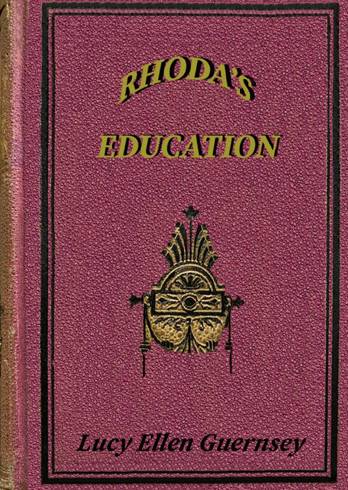
The Project Gutenberg eBook of Rhoda's education
Title: Rhoda's education
or, Too much of a good thing.
Author: Lucy Ellen Guernsey
Release date: February 26, 2025 [eBook #75471]
Language: English
Original publication: Philadelphia: American Sunday-School Union, 1873
Transcriber's note: Unusual and inconsistent spelling is as printed.
New original cover art included with this eBook is granted to the public domain.
Rhoda's Education.—Frontispiece.
"And she has written over the flyleaves
so that you can't take it back."
[The Boonville Series]
RHODA'S EDUCATION;
OR,
TOO MUCH OF A GOOD THING.
BY
LUCY ELLEN GUERNSEY
AUTHOR OF
"IRISH AMY," "COMFORT ALLISON," "THE TATTLER,"
"NELLY; OR THE BEST INHERITANCE," "TWIN ROSES," "ETHEL'S TRIAL,"
"THE FAIRCHILDS," "THE SUNDAY-SCHOOL EXHIBITION," "THE RED PLANT,"
"PERCY'S HOLIDAYS," "ON THE MOUNTAIN; OR, LOST AND FOUND,"
"CLARIBEL; OR, OUT OF PRISON," "JENNY AND THE INSECTS," ETC.
——————————
PHILADELPHIA:
AMERICAN SUNDAY-SCHOOL UNION
NO. 1122 CHESTNUT STREET.
——————————
NEW YORK: NO. 8 AND 10 BIBLE HOUSE, ASTOR PLACE.
————————————————————————————————————————————————————————————————
Entered according to Act of Congress, in the year 1873, by the
AMERICAN SUNDAY-SCHOOL UNION,
In the Office of the Librarian of Congress, at Washington.
————————————————————————————————————————————————————————————————
—————————————————
————————————————
WESCOTT & THOMSON
HENRY B. ASHMEAD
Stereotypers and Electrotypers, Philada.
Printer, Philada.
CONTENTS.
——————
CHAP.
PREFACE.
——————
IF this book does not make its own moral plain, it is a failure.
I merely wish to preclude a certain kind of criticism by saying that all
the most improbable incidents contained in the tale are literally true.
I could point out more than one Professor Sampson, and any manager
of an orphan school or any similar institution can relate stories of
conduct as heartless as that of Mr. and Mrs. Bowers. I hope the book
may be read with profit both by young people and their parents.
LUCY ELLEN GUERNSEY.
RHODA'S EDUCATION.
——————
CHAPTER I.
LITTLE BROTHER.
RHODA BOWERS stood at the east window of her own room, busily engaged in "binding off" the neck of a little baby's shirt—one of a set which had occupied all the spare minutes which she could contrive to spend in her own room for the past few weeks. They were not many, for she had to assist her mother in the housework, and yet she had contrived to knit four little shirts of the softest wool and prettiest design for the new little brother who had lately come to the household. Rhoda had taken great pains with them, and she meant, if her mother could spare her, to go down this very afternoon to Aunt Hannah's and learn of her how to crochet the scalloped edge round the tops.
"How pretty they are!" she said as she bound off the last stitch and held the little garment up before her. "I am so glad Aunt Hannah knew how to make them. I only hope mother will like them. Heigho! I wonder if my own mother used to make any such pretty things for me when I was a baby? How I do wish I could remember the least thing about her! But I don't. It seems to me that the very first thing I recollect is Mrs. Munson feeding me with little bits of cold turkey in the nursery at 'The Home.' I wonder if the old place looks at all as it used to? Some time I think I will ask mother to let me go back there for a little visit. I should like to see them all again. But I dare say it is changed since my time. I think everything and everybody changes in this world." And Rhoda's face clouded a little as she stood looking out of the window, but it cleared up again, and she gave herself a kind of shake, as if to get rid of some incumbrance.
"There, now, Rhoda Bowers! Didn't I tell you never to let such a thought come into your head again as long as you lived? What do you mean by it? Don't you know that it is high time you were off if you mean to see Aunt Hannah this afternoon? And don't you think you would be more like a rational being if you went about your business? Answer me that, now!"
Having given herself this little lecture, Rhoda put her work into her pocket, got her hat, and went down stairs to her mother's room. There was a little fire, though it was a fine, mild day in the fall, and Mrs. Bowers sat by the stove nursing her baby. She was a pretty woman of thirty or thereabouts, and would have been pleasing but for a certain peevishness and, as it were, narrowness of expression which did not promise well.
"Dear little fellow!" said Rhoda, stooping down and kissing the baby. "How he does grow, doesn't he? I am so glad he is a boy. I always did want a little brother. But sister will be almost an old woman before you are grown-up, little man."
"A great many things may happen before he is grown-up," said Mrs. Bowers, on whom Rhoda's remark seemed to grate a little. "I wish you would not be always saying such things and looking forward so, Rhoda."
"Why not?" asked Rhoda. "I think it is so nice to look forward."
"It is a good thing to look backward sometimes," said Mrs. Bowers. "Where are you going now?"
"You know you said this morning that I might go down and spend the afternoon with Aunt Hannah," said Rhoda. "She is going away so soon I may not have another chance."
"Oh, very well. I do not see what you find so very attractive in Aunt Hannah, but I suppose almost any place is better than home."
Rhoda's face clouded again, and she looked as if some sharp answer might be lurking behind her compressed lips. If so, it was not allowed to escape, for she said, gently, though with some apparent effort,—
"I have set the table, and laid the fire all ready to light, and filled the tea-kettle, but I will come back in time to get the tea if you like, or I won't go at all if you want me, mother dear. Don't you feel so well this afternoon?"
Mrs. Bowers looked a little ashamed.
"Yes, child, only I am tired and worried about something. You mustn't mind if I am cross. You are a good girl, Rhoda, and always have been—I will say that, whatever happens. There! Run along and have a good long visit with Aunt Hannah, and stay till dark if you like. As you say, you may never have another chance—not in a good long time, at least; and the old lady has always been a kind friend to you. I only wish, for your sake, she were a little better off."
"Why?" asked Rhoda.
"Oh, because—because she might leave you something one of these days," answered Mrs. Bowers, arranging the baby's dress as she spoke.
"I suppose she is pretty poor?"
"Well, no; she has her place and about three hundred a year."
"How did she come to be left so, when her brother, Uncle Weightman, is so well off?" asked Rhoda.
"I don't know the rights of it," answered Mrs. Bowers. "There were two wills, I know, and by the last one the children were to share alike, but it wasn't signed or witnessed right, or something, and so they went by the first will, which gave everything to Jacob—only this little place and Aunt Hannah's property. But, Rhoda, you must remember not to call him Uncle Weightman to his face. You know he doesn't like it."
"No fear," said Rhoda, laughing; "I don't like him well enough for that. He is so domineering and interfering, I do wonder how father puts up with his ways so patiently."
"Well, he is getting an old man now, and your father is his heir by rights; so he naturally wants to please him. He can make us all rich if he chooses."
"Yes, but he won't choose, you'll see. He will go on saving all his life, and then think to make up by leaving his money to the Bible society or some such thing, and think himself very generous because he gives away his money when he can't keep it any longer. I never can see any goodness in such bequests."
"I don't know about that. But anyhow you must be careful, for your father would be very angry if you should do anything to offend Uncle Jacob."
"I'll be careful, never fear," said Rhoda. "But don't you really want me this afternoon, mother dear?"
"No, no, child. Run along and have a good time while you can."
Rhoda kissed her mother and the baby; and putting on her hat, she walked thoughtfully down the garden, jumped lightly over the rail fence, and took the path across the meadow which led "'cross-lots" to Aunt Hannah's little brown house on the edge of the mill-pond.
Rhoda Bowers was an orphan, but she had never felt the want of a mother's care, as many children do. Till she was seven years old she had lived at the old ladies' "Home" in Milby—an excellent institution founded some thirty years ago by two wealthy old ladies "for the maintenance of twenty widows or single women of good repute who should have passed the age of sixty years, and also, should the funds prove sufficient, of no more than eight poor little girls." The property belonging to "The Home" had greatly increased in value; and as all the funds were properly employed, both the old ladies and the little girls were made very comfortable indeed.
This institution had been Rhoda's home ever since she could remember, till one day Mr. and Mrs. Bowers of Boonville, attracted by her bright gray eyes and pretty curling black hair, had adopted her for their own. Rhoda had been rather homesick at first, but she soon became reconciled to the change, and had found her life as happy as that of most children.
Mr. Bowers lived on a farm about half a mile from the little village of Boonville, and had besides an interest in one of the mills on the Outlet, as the little river was called. He could not be called rich, but neither was he poor. The farm was a good one, and the mill, taking one year with another, was fairly productive. Mr. Bowers owned a nice pair of horses, and his wife dressed well and might have kept a servant-girl if she had chosen. In short, as Aunt Hannah Weightman said, James and Martha were about as well off as anybody in the world, if they could only think so.
But that was just the thing. They could not think so as long as Uncle Jacob Weightman counted his money by hundreds of thousands—as long as Mrs. Bowers's brother-in-law, Mr. Evans, owned one of the finest places in Hobarttown, and Mrs. Bowers's sister had three new dresses to her one, and could go to the springs and the seashore, and even to Europe, every summer of her life if she chose.
Mrs. Bowers fancied that her sister Anne "felt above her," which was not true, and that Anne cared for nothing but the things of this world, which was not true, either; and when Mrs. Evans, who had lost all her own children but one little delicate boy, proposed that Rhoda should spend the winter with her and go to school, Mrs. Bowers refused her consent with some acrimony, saying to her husband afterward that she thought Anne had enough without trying to get Rhoda away from her.
"She just wants Rhoda to wait on that boy of hers," said Mr. Bowers.
"Oh no, I don't think that," answered his wife; "Anne is no hand to save in that way. But she has always liked Rhoda, and she wanted her when we first took the child; but Rhoda isn't going, and that is all about it. She is doing well enough about school here, and I don't want her set up to feel above me."
Rhoda had been a good deal disappointed by this decision:—not that she was at all dissatisfied with her present condition, but she liked Aunt Anne and Uncle Evans, and she wanted to see a little more of the world than was to be found at Boonville; and besides that, she was very desirous of getting a thoroughly good education. She had nearly exhausted the capabilities of the district school, and Mrs. Maynard, the minister's wife, who had kindly undertaken to carry her on farther in her studies, had gone away. Yes, Rhoda would have liked to go to Hobarttown. But the offer had never been renewed, and now Mr. and Mrs. Evans were going to Europe, to be absent three or four years.
It was a disappointment certainly, but there was no help for it, and there was no use in making herself miserable over it, either—so Rhoda argued with herself, very sensibly; so she put away the thought of what she might have done at Hobarttown, and set herself to accomplish as much as she possibly could at home.
There was another cloud which had lately appeared in Rhoda's sky. She had said to herself that this cloud was all in her imagination, or at least was no more than a passing mist. But this afternoon, as she walked across the fields toward Aunt Hannah's, it assumed a more definite shape and consistency than it had ever done before, and she said to herself that she would ask Aunt Hannah about it.
CHAPTER II.
AUNT HANNAH.
AUNT HANNAH WEIGHTMAN lived in a little red house near the edge of the mill-pond, as it was called, though it was little more than a widening of the Outlet, caused by the dam which supplied Mr. Francis's mills. The situation was a very pretty one. On one side of the house lay Aunt Hannah's garden, green with well-conditioned vegetables and gay with flowers, not only of the commoner but also of the rarer kinds, for she was one of those people for whom everything grows. On the other side lay three or four acres of pasture-land, enough, with some help, to keep Aunt Hannah's white cow, most wonderful of milkers both for quantity and quality, and where grew in their season the finest mushrooms in the country.
The "door-yard" of the little dwelling was crowded with lilacs and other blossoming shrubs; the plain board fence and rough stone walls were covered with Virginia creepers, clematis, and morning-glories, and the turf was so neat and green as to give rise to a report among the school-boys that Aunt Hannah dressed it every morning with a hairbrush and a fine-tooth comb. The house was dark red, with rather dusky and faded green blinds. There were three rooms besides the kitchen below and two above; and as Aunt Hannah had inherited the household goods both of mother and grandmother, there was no lack of solid, respectable, old-fashioned furniture.
"How pretty it looks!" said Rhoda to herself as she came across the pasture and stopped a moment to bestow a pat on old Snowball. "It ought to be put in a picture. One could tell who lived there by the outside of the house. It looks just like Aunt Hannah herself. What lots of button mushrooms! I shall have a fine time with them when my work is done."
As Rhoda drew near the side window, she heard within what boded no good to her pleasant afternoon—namely, the sharp, thin, and growling voice of Mr. Jacob Weightman, Aunt Hannah's brother, of whom she stood in great fear. Now I am aware that very few voices could succeed in being sharp and growling at the same time, but Uncle Jacob's accomplished this feat.
"Oh dear!" thought Rhoda. "There goes my nice visit. He will just stay and scold all the afternoon, I dare say. I wish I hadn't put on my new dress. He will be sure to say something about it. I mean to go round to the back door and wait; perhaps he will go away some time or other."
Rhoda sat down on the step at the back kitchen door, and occupied herself alternately in watching the lights and shadows on the stream and in playing with the white Persian kitten Fuzzyball, which romped about the yard, while her equally white and long-haired mother sat couched by Rhoda's side in all the calm dignity befitting a lady who had come all the way from Bombay.
As Rhoda sat on the step she could not help hearing through the window parts of Uncle Jacob's exhortation.
"It is all nonsense, Hannah," she heard him say, "perfect nonsense, for you to take up so much house-room. The house is arranged just right for two families, and it is too bad to be so extravagant. You could live in the east half, if you must keep house, and rent the other part for a dollar a week. It is quite large enough—quite."
"I don't think so," answered Aunt Hannah, quietly. "I like my house to myself and I never yet saw the roof large enough to cover two families."
"Then there is that cow," continued Art Weightman, disregarding the interruption, "Where is the sense of your keeping a cow?"
"To give milk," answered Aunt Hannah.
"To give milk, indeed!" said Uncle Jacob, in a tone as if Miss Hannah had said the cow was good to read aloud or to calculate the longitude. "As if you wanted a cow to give milk! Why, you can't use more than a quart a day at the outside, and what becomes of the rest, I want to know? I don't hear of your selling any."
Aunt Hannah did not seem to feel obliged to gratify her brother's curiosity, for she remained silent.
"Umph!" said Rhoda to herself. "Perhaps if he should ask Widow Makay and poor old Aunty Sarah, they might tell him something about the milk; though I don't exactly see what business it is of his."
But Uncle Jacob was continuing his lecture:
"The fact is, Hannah, you are no manager at all; you don't know how to save. The right way would be for you to break up housekeeping and board somewhere, for two or three dollars a week, fat and kill that old cow, and rent your house and land. Then it would bring you in a good, handsome sum, whereas now you don't get your living out of it; and you might lay up money every year. Why, you might die a rich woman if you would only be guided by me and take care of things."
"Possibly, Jacob, but I prefer living a rich woman," said Aunt Hannah. "I have enough as it is to make me very comfortable, and to help others a little, and I don't exactly see what good it would do me to die rich, unless I could take my money along with me, which does not seem very practicable. I like to have my own house over my head and my own land around me; and as I have nobody dependent upon me, I don't see that I have any particular motive for saving more money than will serve to take care of me if I should be long sick, and bury me when I am dead; and that I have done already. So you see I feel quite easy on that score."
"You might think of somebody besides yourself," said Uncle Jacob. "There is that boy of John Bowers's."
"Oh, he is likely to be well enough off," said Aunt Hannah. "If I were to save, it would not be for the boy, but for the girl."
"The girl is no relation to you, or them either," growled Mr. Weightman. "She has never done work enough to pay for her board, and she never will. It has all been a piece of nonsense from the taking of her in the first place to the present time. They ought to have taught her to work, and kept her at it, instead of sending her to school and dressing her up as fine as a lady. Why, Mr. Shepherd's bound-girl does more than half the work, and she is only twelve years old. Mrs. Shepherd says she can do quite a large washing now."
Boiling over with indignation, Rhoda jumped up and came into the kitchen, knocking down a pail as she did so and making a tremendous clatter. As she was picking it up, Aunt Hannah opened the inner door:
"Are you there, child. I thought I heard somebody come in a while ago. Have you been sitting here all the time?"
"Yes," said Rhoda. "Aunt Hannah, I didn't mean to listen, but I could not help hearing."
"Never mind, dear; there is no harm done."
"Listeners never hear any good of themselves," said Uncle Jacob, with an ill-natured sneer.
"That depends on whom they listen to, Uncle Jacob," answered Rhoda, in her vexation committing two offences—one in answering at all, and the other in saying "Uncle." "One might listen to Aunt Hannah all day, and never hear ill either of himself or anybody else."
"There! Never mind," interposed Aunt Hannah. "Don't you want to take the basket and see if you can find any mushrooms? They ought to be plenty after the rains last night. There! Never mind, dear," she whispered again, patting Rhoda's hot cheek with her soft withered hand. "Run away a little. It will be all right when you come back, and we will have a nice time together."
From her earliest childhood Rhoda had learned to obey, and she never thought of disputing with Aunt Hannah. She took the basket and went out to the pasture, followed by an exasperating laugh from Uncle Jacob which certainly did not tend to make her cheeks any cooler.
"Impudent little piece!" said he.
"She is not impudent, Jacob," answered Aunt Hannah, with more than common decision, "but she is sensitive and high-spirited, and you provoked her. Rhoda is very far above listening, or tattling, either."
"Of course she is a paragon," said Uncle Jacob, rising and taking his hat; "charity children always are, I believe, according to the Sunday-school books. Well, sister Hannah, I must bid you good-day, since you have so much more agreeable company on hand. If you make up your mind to rent your place, I can find you a good tenant. I advise you to think over what I have said."
"On the contrary, I shall forget it just as soon as I can," thought Aunt Hannah, but she did not say so; being one of those fortunate people who can keep their thoughts to themselves.
She stood looking after her brother for a moment, and then went into her bedroom and shut the door. When she came out, the cloud of vexation had passed from her fair, aged face, though she still looked somewhat sad. She put on a broad hat, and taking a basket, went out to join Rhoda in her search for mushrooms.
In the course of an hour both baskets were filled to the brim, and Rhoda's straw hat besides, and the gatherers returned to the house and sat down in the kitchen, Aunt Hannah tying on a large calico apron over her dress.
"Now I will show you how to do the edge to your shirts, and then you shall finish them while I prepare my mushrooms," said she. "These little buttons will make beautiful pickles, and the large ones will do for catsup. They are the finest we have had this year."
"Isn't it odd," said Rhoda, "that mushrooms growing in the pastures of Lake County should be helping to educate a little girl in China?"
"No more so than that silk grown in China should help to clothe a little girl living in Lake County," answered Aunt Hannah.
"Well, perhaps not. How much money have you made by your mushrooms first and last?"
"I don't know, my dear; I have it all down in a book, but I don't recollect the amount. It varies with different years. Last year was a bad season for the mushrooms, and this is a good one; but I have never failed to make my thirty dollars but once."
"What did you do then?" asked Rhoda.
"I made it up in another way."
"If you had put all that in the bank, now, you would have saved quite a sum by this time," said Rhoda, with a mischievous smile. "Why don't you?"
"I think it is safer where it is," answered Aunt Hannah, dryly. "It would never do for me to begin to save in that way; I should grow too much in earnest about it."
"You, Aunt Hannah?"
"Yes, dear. I am naturally very much in earnest and inclined to persevere in what I undertake; and besides, it is in me to be fond of money for its own sake. I should never dare to make it an object."
"But all rich people are not stingy or mean or grasping, Aunt Hannah. I am sure Uncle Evans is not."
"No, indeed. He is just the man to be rich, for he gives out to all around him. It is not the being rich that hurts people, child remember that; it is the trusting in uncertain riches that makes the entrance hard to the kingdom. It is not money, but the love of money, that is the root of all evil. The world does us no harm so long as we keep it at arm's length. It only hurts us when we let it get inside our hearts, and the poor, and especially folks in moderate circumstances, may do so, perhaps, quite as much as the rich. I know plenty of women in this little village who spend far more time and thought, and, according to their means, more money, on their dress than your aunt Evans does on hers."
Rhoda was silent, thinking that this was the case with her own mother, and wondering whether she were one of the people in moderate circumstances who were in Aunt Hannah's mind. But she quickly dismissed the idea, and began on one of the two subjects which she had, as it were, brought from home to talk over with Aunt Hannah:
"Aunt Hannah, there are two things that trouble me."
"Only two?" asked Aunt Hannah.
"Why, no—only two that I know of," answered Rhoda, considering; "only two of any importance, I believe."
"And one of them, perhaps, is not so very important," said Aunt Hannah. "Are you thinking about what you heard my brother saying this afternoon? You mustn't let that worry you."
"Oh, I don't," said Rhoda; "only I am sorry I offended him. I know he doesn't like to have me call him 'Uncle,' and I am sorry I answered him back. However, I dare say he will never think of it again; I am too insignificant to trouble him."
Aunt Hannah sighed. She was pretty sure her brother would think of it again, and she knew that nothing which crossed his wishes or designs was too insignificant to vex him.
"Since I have guessed wrong, I won't try to guess again. I will let you tell me your two troubles."
"Well, then," said Rhoda, "one of my troubles is about my education. I do so very much want an education, and I don't see how I am ever to get one without going away from Boonville, and I don't see how I go."
"What is 'an education,' Rhoda?" asked Aunt Hannah. "What do you mean by it?"
"Why, an education is—why, going to school and studying—going through a course of study," answered Rhoda, not very clearly. "I know what I mean, but I can't put it into words."
"You don't know whether you know what you mean or not unless you can put your meaning into words," said Aunt Hannah. "Suppose you bring the book on the table and let us see what this same word education really does mean. You will find it in the lower part of the bookcase."
Rhoda brought the volume on "Mental Discipline" from the east room, and running over the pages, found what she sought and read aloud:
"Education, the act of educating; the act of developing and cultivating the various physical, intellectual, and moral faculties; formation of the manners and improvement of the mind; instruction, tuition, culture, breeding."
"There you have it," said Aunt Hannah; "I suppose that is what you want. Now, the question is whether it is necessary to go away from Boonville to obtain it. What do you think?"
"Well, as to my physical faculties, they are pretty well developed already," said Rhoda, smiling. "I fancy I can walk and ride and so on, as well as any girl of my age in the county, and I am not very bad at doing housework; only mother says I forget what I am about."
"Well, how about the others?"
"I think my moral qualities have a good chance enough, considering what a nice home I have and who has always been my Sunday-school teacher," said Rhoda, with a loving glance at Aunt Hannah—"a better chance than they have improved, I am afraid. I wish you were not going away, Aunt Hannah."
"It will be only for a few weeks, my dear. Well, now for the intellectual part."
"Exactly: and there you must admit, Aunt Hannah, that I have very little chance. There isn't one bit of use in my going to school to Miss Smith any more. I only go round and round like a blind horse in a brickyard; only I don't help to make any bricks, that I see. I thought I had it all arranged so nicely, and then Mr. Maynard must go and get a call somewhere else."
"Yes, I was sorry for that. Mrs. Maynard was a very nice woman."
"And really, Aunt Hannah, I don't see how that part of my education is to come about. I should like to learn French and German and Latin, and especially music. I don't think I care so much about drawing and rhetoric and moral philosophy, and all the other things that girls learn in school."
"And I should like to have you. But, Rhoda, you need not be an uneducated person, even if you have none of these things, and you can have some of them as well out of school as in—not as easily, perhaps, but as well."
"How, Aunt Hannah?"
"By studying what you can find to study, and thinking about what you learn."
"There is one of my great troubles," said Rhoda, candidly; "I never can think on purpose—regularly, I mean. I try to do it, and the first I know my thoughts are at the ends of the earth."
"Then you had better begin your education right there, my dear," said Aunt Hannah; "for nothing more important than the art of thinking can be learned at school or anywhere else. Come, now, let me set you a task. I think you mentioned history as one of the things you wanted to learn?"
"It is one, whether I mentioned it or not."
"Very good. Now, I shall be gone about three weeks. You may take home my Rollin, and read about ten pages a day; and when I come home, I will see how much you can tell me about it. You had better take the whole set. You may want to refer from one volume to another.
"And, Rhoda, try to educate yourself in another point. Try to learn to mind what you are about, and to do your best at whatever you undertake, whether it is reading or housework, or anything else, and learn all that comes in your way, if it be no more than a mere piece of fancy-work or a new recipe for cake. You will always find some corner where such things fit in. If you want any other books while I am gone, you can come down and get them. Aunt Sarah will stay here and keep house."
"I wondered what was to become of Molly and Fuzzyball," said Rhoda. "But, Aunt Hannah, though all this is very nice, and I shall like it ever so much, it doesn't help me altogether."
"I know it, child, I understand you exactly, because I have been in the same place. At your age I was as ambitious as you are, and I would have moved heaven and earth, as the saying is, to get just such an education as you want, but it was not for me, and I had to be content without it."
"I am sure nobody would think of your wanting an education, Aunt Hannah," said Rhoda; "I think you know more things than anybody I ever saw. I mean you have more general information, as Uncle Evans says. He was talking about some young man in the college one day, and he said the boy had been to school so constantly that he has never acquired any general information."
Aunt Hannah smiled:
"Well, my dear; I never thought the fact of my having no regular school education was any reason for my not learning all I could, and it need not be so in your case. Make the best of all the opportunities that come in your way, and you will never be lacking, though you may not learn all the things you would wish to know. Above all, don't neglect the things you can do, because you are waiting to do something better. Whatever your hand finds to do, do it with your might; and, my dear, try not to fret or worry about the future, but leave it in the hands of your heavenly Father.
"'Trust in the Lord, and do good.'
"'Commit thy way unto the Lord; trust also in him; and he shall bring
it to pass.'
"Now, what is your second trouble? You said there were two."
"Well, I am not so sure about the second trouble," said Rhoda. "Sometimes I think it is only an imagination. I am afraid I am growing jealous and suspicious, Aunt Hannah."
"That would be a real trouble, certainly," said Aunt Hannah; "but why do you think so?"
"Because, Aunt Hannah, I can't help thinking that father and mother are different to me since the baby has come—that they don't treat me as they used to. There! The thing is out."
Aunt Hannah put down her pan of mushrooms and went into the next room for a moment. When she came back, she asked, quietly,—
"Why, my dear, what makes you think so? Because you have more work to do?"
"No, indeed, Aunt Hannah: that is not it at all," answered Rhoda, rather warmly. "Of course I expect to have more to do, and I only wish mother would let me do a great deal more for her and the dear baby. But I don't know—she is different somehow. She doesn't seem to like to leave me with her as she used to; and, Aunt Hannah, I am sure she does not like to have me call baby my brother. She does not say anything, but I don't think she likes it."
"Are you sure that is not a fancy?"
"I thought it was at first, Aunt Hannah, and I scolded myself for it, but I am quite sure it is so. And—" Rhoda's voice failed, and she winked very hard with both eyes as she bent over her work. "I have tried very hard to put away the thought, Aunt Hannah," she continued, after a little pause, and in a low voice; "I have striven and prayed against it, and I am sure I am not jealous of the baby: dear little fellow! It has troubled me a great deal, so at last I thought I would mention it to you."
"I am glad you have done so, Rhoda, and I will tell you what I think about it as well as I can," said Aunt Hannah. "It often happens in a family that when a new baby comes, the old one has to be turned off and put aside in a good many ways. I think this is the case with you at present. You have been baby a long time, now you are in a manner dethroned, and you must try to abdicate gracefully and be content with the place of elder daughter and sister—a much more responsible and useful position, and in the long run perhaps quite as agreeable."
"I am sure I don't mind, if that is all," said Rhoda.
"We will try to think that is all," said Aunt Hannah, cheerfully. "There are women who can never be just to other people's children when they have little ones of their own, but I do not believe your mother is one of that kind."
"I am sure she isn't," said Rhoda, with emphasis. "There! I believe these are all finished, Aunt Hannah."
"And very pretty they are. Well, my dear, as you are to learn all sorts of things, you know, you may make the fire and put on the kettle; and then, if you will get out the baking things, I will teach you how to make those cream biscuit you like so much, and you may stop on your way home and carry a plateful to Mrs. Makay. Sam likes good things to eat, and they are about the only pleasures he has sense enough to enjoy, poor fellow!"
CHAPTER III.
THE CLOUD GROWS.
THE biscuits were excellent, and Rhoda greatly enjoyed making and baking them, and afterward milking old Snowball and straining the milk.
"What beautiful rich milk she does give!" said she. "Aunt Hannah, what will you do when she dies? She is growing an old cow, you know."
"I don't borrow trouble about it, child."
"Nor about anything else, do you, Aunt Hannah?"
"Well, no, my dear, not often. I generally find I have enough as I go along. There is no need to look ahead for it."
"I never can see any use in it, anyway," remarked Rhoda. "Either the things one is worrying about don't come to pass, or they are so different from what one expects that all the contriving beforehand is thrown away. I said so to mother, and she told me it was very easy for any one to talk so who did not know what trouble was. But I am sure you know what it is."
"Yes, child, I have had my share: quite as much as I wanted, without borrowing any; and so, I dare say, will you, if you live long enough. Now, my dear, it is time for you to be going. And, Rhoda, I want you to promise me one thing: I am an old woman, and there is no telling what may happen before we meet again. I want you to promise me that, whatever happens, you will never give up your faith in God, and your trust in his goodness. Never think, however he may suffer you to be afflicted, that he can be anything but a tender Father to you. I think you love him, Rhoda, my child?"
Rhoda answered in a low voice, but without hesitation:
"Yes, Aunt Hannah, I am sure I do."
"Then, my dear, will you always remember these verses?
"'He that spared not his own Son, but delivered him up for us all, how
shall he not with him freely give us all things?'
"'Be careful for nothing, but in everything by prayer and supplication
with thanksgiving let your requests be made known unto God.'
"'Lo, I am with you alway, even unto the end of the world.'
"I have bought you a new Bible for a parting present," continued Aunt Hannah, "and I have written these verses in the beginning. Remember, whatever happens, that your Lord and Saviour has promised to be with you, that you are not to be anxious, but to let your requests, great and small, be made known unto him, and that your Father's love can never fail to give you that which is best, seeing that he spared not his own Son for you."
"I won't forget, Aunt Hannah. Oh what a beautiful book!—The nicest I ever saw. Just see! It has maps and an index, and all."
"Yes, you will find it very convenient. Now, go along, child, and God bless you!"
Rhoda left her plate of good things at Mrs. Makay's, and then walked rapidly homeward, for it was growing late.
As she entered the parlour she nearly stumbled over somebody who was sitting in the rocking-chair, for the room was quite dark.
"Take care, and mind what you are about, Rhoda!" said her mother. "You do come in, in such a headlong way."
"It is so dark coming in from out of doors," apologized Rhoda. "May I get a light, mother? I have something to show you."
"Yes, do. I have been waiting for you to come."
Rhoda lighted the lamp and came in, bringing it in one hand and her little shirts and her new Bible in the other. As she did so, she saw that the person over whom she had nearly fallen was Mr. Weightman. He laughed in his usual amiable fashion as he saw her look of discomfiture and annoyance.
"You are out rather late, I think, miss," said he. "In my time little girls stayed at home and helped do the work, instead of running about town after dark. But come, let us see this wonderful something."
Rhoda wished herself or Mr. Weightman anywhere else, but there was no help for it now, and she produced the shirts she had made for the baby.
"How very nice and pretty they are!" said Mrs. Bowers. "And how neatly you have made them! See, father, what a pretty present Rhoda has made for the baby! Who taught you, dear?"
"Aunt Hannah," replied Rhoda, her heart beating with pleasure; "but I did every stitch of them myself, and bought the wool with my own money."
"Humph! Your money!" said Mr. Weightman. "Pray, how came you by this money of yours?"
Rhoda was silent till Mrs. Bowers said, rather sharply,—
"Don't you hear, Rhoda? Why don't you answer Mr. Weightman's question?"
Then she said, briefly,—
"It is money my father gave me to spend for a new sash, Mr. Weightman."
"So that was the reason you bought the cheap sash?" said her mother. "I wondered at your changing your mind. I must say it was very nice in you, my dear. But what pretty book have you there?"
"A new Bible Aunt Hannah gave me—just what I wanted. Isn't it pretty?"
"Let me see it," said Mr. Weightman, and Rhoda put it into his hand, feeling as if his touch would profane her treasure.
He turned the book over and over, and then looked at the flyleaf where the price was marked.
"Five dollars and a half!" said he, in a tone of amazement mingled with sorrow.
"Well, if ever! Five dollars and a half! And she might have got one for nothing if she must give it away. Well, I didn't think even Hannah would do such a thing as that. She ought to be put under 'gardeens.'"
Rhoda was boiling over, but she kept silence, and only held out her hand for her precious book, which Uncle Jacob seemed no ways inclined to give up.
"I am sure it was very kind in Aunt Hannah," said Mrs. Bowers, in a deprecating tone.
"Kind? Yes! Wonderful kind! I should like to know what business she has to be so kind, as you call it?"
"She has a right to do what she likes with her own, I suppose," said Mrs. Bowers, with some spirit.
"And she has written all over the flyleaves, so that you can't take it back or exchange it for anything useful," continued Uncle Jacob: "'To my dearest niece and pupil.' Do you hear that, Maria? Rhoda is her dearest niece. Well, I must say I think charity begins at home. I think she might consider her own family a little. But I suppose you are too well off to care what your relations do with their money."
"Will you please give me my book, Mr. Weightman?" said Rhoda, in a voice which expressed more than her words, and holding out her hand for the book.
"Oh ho! So I am Mr. Weightman now, am I?" said he, still retaining the volume, and evidently enjoying Rhoda's irritation. "I was Uncle Jacob this afternoon, I remember."
"It was a mere slip of the tongue, Mr. Weightman," said Rhoda, trying hard to control her temper. "I am sure I should never call you 'Uncle' if I knew what I was saying. Will you please give me my book?"
Mr. Weightman threw it on the table:
"Take it, then, and learn manners from it, if you can. Niece Maria, I wish you joy of your adopted daughter. It is easy to see that she will get on in the world."
"You may go to your own room, Rhoda," said Mr. Bowers; "and another time don't stay away all the afternoon and leave your work for your mother as you did to-night."
Rhoda could not trust herself to speak. She took up her book and retreated, smarting under a sense of injustice such as she had never felt before. It was hard enough to be insulted in that way, but that her father should take part against her, and her mother should not say a word for her—it was almost too much to bear. She retreated to the kitchen, and busied herself in putting away the milk and preparing things for the night till Mr. Weightman went away and Mr. Bowers came into the kitchen.
"What are you doing here?" he asked, harshly. "Didn't you hear me tell you to go to bed?"
"I thought I would put things away," Rhoda began, but Mr. Bowers stopped her. "Oh yes! You thought you would do anything rather than what you were told. You have got to turn over a new leaf, Rhoda, and learn to mind, and not spend all your time running about and reading story-books. And I don't want to hear any excuses or fine speeches. Go to bed, and another time do as I tell you."
Mr. Bowers was a man of moods and tenses; and whatever the mood of the moment might be, he rarely failed to make those about him sensible of the same. Knowing this to be the case, Rhoda thought less of his words than she would otherwise have done. Girl-like, she had a good cry when she got up stairs by herself, but, girl-like, she cried away most of her trouble, and was prepared to take the best view that was possible.
"Father was worried about something," she said to herself. "I dare say Uncle Jacob—I mean Mr. Weightman—had been at him. It will be all right to-morrow. I didn't leave all the work for mother, and she knows I didn't; and anyhow, I am glad she liked the shirts."
But Rhoda did not find it all right on the morrow, nor for a good many succeeding days. She could not tell what was the matter, though she taxed herself in every way to see whether she were to blame, and told herself again and again that she was growing jealous and fanciful; but all was of no use. There was certainly a great change.
Mrs. Bowers alternated between fondness and fretfulness. One day she told Rhoda that she slighted her work, and that she ought to do more about the house; the next perhaps she found fault with her for neglecting her book, telling her that there was no saying how long she might have a chance for study. At times she seemed unwilling to have Rhoda out of her sight, and again she appeared to seek excuses for getting rid her.
Mr. Bowers was almost uniformly cold and repellent in his manners toward her, though he too now and then melted into tenderness, especially once, when Mr. Weightman had been away for several days.
"Father," said Rhoda, taking courage to speak out what was in her mind, "have I done wrong or offended you in any way?"
"No, child, no," answered Mr. Bowers, hastily; "why should you think so?"
"Because you are so different from what you used to be," answered Rhoda. "You don't seem the same person sometimes—not a bit like my father," she added, putting her arms round his neck and sitting down on his knee as she used to do when a child.
Mr. Bowers started as if stung.
"You mustn't let such notions come into your head," he said, kissing her with something of his old affection. "I have been worried about business and other things—no matter what. Nothing that need trouble you."
"I can't help being worried when I see you so different, papa," said Rhoda. "I think you ought to tell me about business now," she added, with a pretty little assumption of dignity. "I am not the baby any longer: I am the elder daughter."
Mr. Bowers's moustache twitched a little, and his voice was somewhat husky as he answered,—
"You are a dear good girl, and always have been, Rhoda. I am sure you have been the same as our own ever since you came to us."
"I never remember that I am not your own unless somebody puts me in mind of it," said Rhoda. "I never think of belonging to anybody else."
"Not even to Aunt Annie?" asked Mr. Bowers. "Didn't you want to go and be Aunt Annie's girl?"
"No, indeed!" answered Rhoda, with emphasis. "I never thought of such a thing. I would have liked well enough to go to Hobarttown to school, because I always have wanted to get a regular education, but that was all. I never dreamed of such a thing as living there. I don't believe you think you have very much of a daughter, papa dear, if you suppose she could want to run away from you as easily as that. I don't believe you would like to have me think you wanted to get rid of me."
Mr. Bowers's mouth twitched again.
"I was only joking, child. There! Run over to the post-office and see whether the mail has come in."
For three or four days all was fair weather with Rhoda once more. Her father was kindness itself, and seemed to seek out ways of giving her pleasure.
"I can't do it," Rhoda heard him say one day in answer to some observations of his wife's. "It would break my heart to part with the girl, and I don't believe it would be right."
"But if it is our duty toward the child?" said his wife.
"I don't believe it is," answered Mr. Bowers, hastily; "I don't believe the child will ever be one bit the better for it."
Rhoda knew she ought not to listen, and turned away, her heart beating between hope and disappointment. Could it be that they were thinking of sending her away to school?
As the time went on, a good many things seemed to confirm this view of the case. Her father had bought a new sewing-machine and a piece of nice muslin, and her mother had set Rhoda to making a new set of underclothing for herself. Her old dresses were all remodelled and several new ones bought, and, in short, her wardrobe was put in perfect order.
Mr. Weightman had returned, and was often at the house, but Rhoda kept out of his way and seldom saw him. When they did meet, he was uncommonly gracious to her; and once, encountering her in a store at the Springs, he actually bestowed upon her a dollar to spend as she pleased, advising her, at the same time, to buy something useful, and not to waste it all upon ribbons and laces.
Rhoda could not help wondering how many ribbons and laces Uncle Jacob supposed that one dollar would buy; but she liked to be friends with everybody, so she thanked him for his present and laid it out upon a box of initial-paper.
CHAPTER IV.
THE CHANGE.
"MOTHER," said Rhoda one evening at the supper-table, "if we should ever go to the city, I should like to go and see the old ladies' 'Home.'"
Mr. and Mrs. Bowers exchanged glances, and Mrs. Bowers said,—
"How would you like to make a little visit there?"
"I should like it ever so much, though I suppose hardly any one is left in the house that I know, except Miss Carpenter. I wonder what has become of all the children I used to play with? I hope they are all as well off as I am. But, mother—"
"Well?" said Mrs. Bowers as Rhoda paused. "But what?"
"I thought—I hoped, rather—that I was getting ready to go away to school."
"Perhaps you may go to school too," said Mrs. Bowers, again glancing at her husband.
"Perhaps some arrangement may be made for you to board at 'The Home' and go to school in the city."
"Really!" said Rhoda, with sparkling eyes.
"Mind, I said 'Perhaps,'" answered her mother. "If you go to school, you must live somewhere, you know. You can't board at home and go to school in Milby very well."
"No, of course not. But what school shall I attend?—Mrs. Anderson's?"
"We will see about that when you get there. We don't know much about the Milby schools, and shall have to consult somebody. There! Don't be all upset now, but run down to the mill and ask if Mr. Antis is going to Hobarttown to-morrow. I want to send by him if he is."
"Well, Maria, I must say you have a good deal of assurance," said Mr. Bowers when Rhoda had left the room. "I don't see how you could tell such a string of stories with such a straight face."
"I didn't tell any lies," said Mrs. Bowers. "She may go to school, for aught I know, and she may as well think she is going, and let other people think so. It will make less of a talk."
"Well, I wish I could feel sure we were doing right," returned Mr. Bowers.
"I declare, I think you are too bad, Mr. Bowers," said his wife. "You must admit that our first duty is to our own child, and you know what Uncle Jacob said. When we took Rhoda, we did not suppose we should have any of our own; and now that we have, of course the case is entirely altered. I am sure Rhoda has no cause of complaint; and besides, I don't believe she will care very much. You see how pleased she is at the mere thought of going away."
"Yes, of going away to school."
"It would be just the same if she were going away anywhere else. She would rather be at Aunt Hannah's all day long than at home."
"What do you suppose Aunt Hannah will say?"
"I don't know; I am glad she is not here. You know she is going to stay away four weeks longer. Anyhow, you can't help yourself now. You know what Uncle Jacob made a condition, and he never goes back from his word."
"No, there is no help for it now," agreed Mr. Bowers, sighing; "but do get the child ready and have it over as soon as you can."
The next week saw Rhoda and her father on the way to Milby. Rhoda parted from her mother and the baby with many tears, and Mrs. Bowers herself was a good deal affected.
"He will be a great boy before I see him again," said Rhoda as she gave him back into his mother's arms; "but I suppose I shall come back at Christmas, shall I not?"
"That will be just as the teacher thinks best," said Mrs. Bowers. "There! Hurry, child! You will make your father miss the train."
Mr. Weightman met Mr. Bowers and Rhoda on the platform of the station at the Springs, whither they went to catch the train to Milby. "Oh ho! What fine young lady is this?" he asked, glancing at Rhoda's travelling-suit, her neat bag, and strapped-up waterproof. "Where are you going, miss?"
"To Milby, Uncle Jacob—I mean Mr. Weightman," said Rhoda, correcting herself—"to Milby, to school; only I am going to make a visit at 'The Home' first, and perhaps to board there if they will take me."
The old man laughed.
"Of course they will take you," said he, "no doubt of that at all. And so you are going to school, eh? That's a very good idea of your mother's. I hope you will learn all you can. And, pray, is this fine new Saratoga trunk yours too?"
"Yes, sir; papa sent to Hobarttown for it by Mr. Antis."
"And it is full of new clothes, eh? Well, take good care of them. School-girls spoil their clothes very fast sometimes."
"You had better go into the waiting-room and sit down, Rhoda," said Mr. Bowers, who had appeared unaccountably uneasy during this conference. "It is beginning to rain a little."
Rhoda took a seat in the waiting-room, expecting her father would stay with her, instead of which, to her disappointment, he went outside, and walked up and down the platform in earnest conversation with Uncle Jacob.
"Just like him to go and spoil the last time I shall have!" thought Rhoda. "I do hope he won't go to town with us."
The two passed the window, and she heard her father say,—
"It was the least we could do to make everything as easy as possible."
"Nonsense!" was Mr. Weightman's answer. "All useless expense—money thrown away. Let her begin as she is to go on, and learn to depend on herself."
"I sha'n't depend on you, you old bear," thought Rhoda. "I dare say he is trying to persuade papa not to let me go to school, after all. I do wish papa would let him alone and not get mixed up in business with him. I know he doesn't do him any good. He just puts him up to think that nothing is of any consequence but making money and getting rich."
"Here comes the train, Rhoda," said her father, putting his head in at the door. "Come, hurry!"
"Uncle Jacob is not going, is he?" asked Rhoda, in a tone which was louder than prudent.
Mr. Weightman heard her, and answered for himself:
"Oh no, 'Uncle Jacob' isn't going. You won't be plagued with 'Uncle Jacob' again for a good long time, if ever. So you can afford to part friends."
Rhoda coloured, and then took a sudden resolution.
"Good-bye, Mr. Weightman," said she, holding out her hand to him. "I am sorry if I have ever been rude to you, and I hope you will forgive me. I am sure I had much rather be friends with you than not, for I never did you any injury, and I don't believe you ever meant to do me any."
There was no time for Mr. Weightman to answer, if he had been so disposed, for the train came up in a moment, and Rhoda and her father were hurried on board. The cars were delayed a few minutes, and to Rhoda's great, surprise, as she looked out of the window, Mr. Weightman came round and spoke to her.
"Here, child—here is some pocket-money for you," said he, putting a five-dollar bill into her hand. "Take good care of it. Money soon goes when once you change a bill."
Rhoda could not have been more surprised if one of the telegraph-poles had spoken to her. The train started on, and she showed the money to her father, saying,—
"Who ever would have thought of Mr. Weightman's making me such a present?"
"He can be liberal enough when he is in the humour," said Mr. Bowers. "Put the money away; and when you get to 'The Home,' give it to Miss Carpenter to take care of for you. There is another bill to keep it company."
"Just think!" exclaimed Rhoda. "I have really ten dollars of my own. I mean to buy some wool and make baby a nice blanket."
"You will have enough to do without making blankets for baby," said Mr. Bowers. "There! Don't talk to me. I want to read my paper."
Mr. Bowers and Rhoda reached Milby in good time, and took a carriage for "The Home."
"The street looks just as it used to," said Rhoda. "There is the very shop where Mrs. Green used to send me to buy her snuff. And this is 'The Home,' I am sure; but how much larger they have made it!"
"Yes, they built a new wing last fall. Come, child, don't stand staring in the street."
The front hall and reception room looked just as Rhoda remembered them. There was the little table with the register book, the little old, rattling, yellow-keyed piano, and the coloured chalk landscape with the heron standing on one leg in the foreground, just as he did when Rhoda used to wish he would down his other foot and walk away. There was the same pervading smell of roast beef; and when Miss Carpenter came in to welcome them, Rhoda would have said she had on the very same soft gray merino gown and lace handkerchief in which she had last seen her.
The good lady welcomed Rhoda with all possible kindness, but looked rather surprised at the sight of her large trunk and travelling-bag. Rhoda wondered if she had not expected them, but her wonder was cut short by Mr. Bowers rising and asking to see Miss Carpenter in another room for a few minutes.
Rhoda was left alone in the little reception room, where she waited till she was tired. Her father and the matron went into the room opposite, and presently Miss Carpenter came out, and returned with an elderly lady whose face Rhoda seemed faintly to remember. There was another long interval of waiting, which Rhoda endeavoured to shorten by looking out of the window, and by reading the daily paper which lay on the table.
Miss Carpenter had closed the reception room door passing, but after a long hour she heard first the door opposite and then the hall door open and shut; and glancing out, she saw her father leaving the house, apparently in a great hurry. She started forward to speak to him, but before she could reach the door, he had hailed a passing omnibus, and jumping in, was out of sight directly.
"How very strange!" thought Rhoda. But her meditations were cut short by the opening of the parlour door and the voice of the lady whom Miss Carpenter had called saying emphatically,—
"A more utterly heartless proceeding I must say I never heard of. I am only glad he has turned the girl over to us instead of doing worse by her."
Then, as she saw Rhoda standing near, she came forward and took her hand, saying, kindly,—
"And so you have come back to us, little Rhoda, after all these years? I suppose you don't remember me?"
"I remember your face, ma'am, but not your name," answered Rhoda, very much perplexed.
"Well, that is no wonder," said the lady. "Miss Carpenter, you might as well give her a room by herself for the present, as there are several empty. Don't distress yourself, child. You shall have a home here till we know what to do with you, and you may be sure we shall not turn you out."
"I don't quite understand," faltered Rhoda, feeling as if she were in a puzzling dream. "Where has my father gone?"
"She is all in the dark," said Miss Carpenter. "They have not told her anything the matter."
"Is it possible?" said Mrs. Mulford, with more indignation than before. "My dear, what did Mr. Bowers tell you he was going to do with you?"
"He told me I was going to make a little visit here, and perhaps board here and go to school," answered Rhoda. "He said he would settle that when we got here."
"And nothing was said about your adopted parents giving you up—nothing about their returning you on our hands?"
"Giving me up!" repeated Rhoda. "What do you mean?"
"My poor, dear child, it is even so," said Miss Carpenter, tenderly. "They have given you up. Your father says he has a family of his own now, and in justice to them, he cannot keep you any longer. This is your home for the present, and I grieve to tell you that you have no other."
If the solid earth had yawned to swallow Rhoda, she could hardly have been more astounded. And yet in the very first moment, she felt it was all true. A hundred hints, a hundred circumstances, were all explained to her at once. Yes, they had abandoned her. After eight years of care—eight years in which she had almost forgotten that she had ever belonged to any one else—they had left her to the mercy of a public charity.
Her head turned round, and she put out her hand blindly for help. She felt herself supported by somebody, and then the world fled from her and she sank down in a dead faint.