
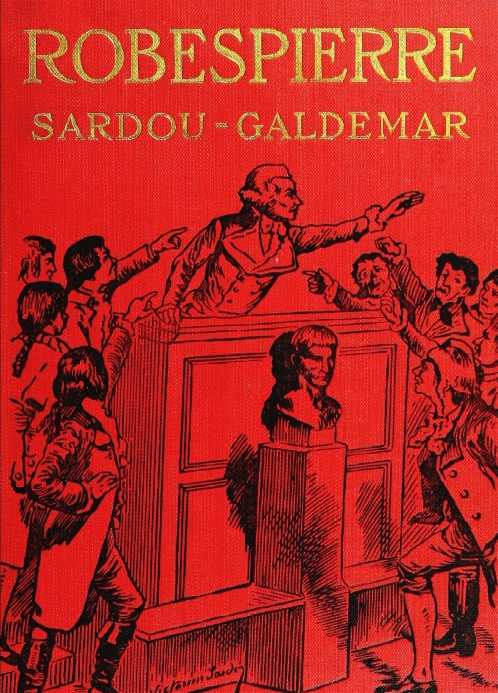
Robespierre had delivered the opening sentences of his speech. Carried away by the enthusiastic ovation of the crowd, now entirely master of himself and of his discourse, his words flowed freely and abundantly, and he declaimed without once referring to his notes, in a clear, penetrating voice. Every point was greeted with a thunder of applause as he spoke on, stimulated by a glow of satisfaction which touched the most secret fibres of his being. He felt himself to be for ever and in very deed master of France, acclaimed Dictator, solely by the people's will. Through the fumes of this mad delirium he saw the Convention vanquished, paralysed with fear and amazement.
He was thanking the French nation, who had laid aside their work to lift their thoughts and aspirations towards the Great, the Supreme Being.
"Never," exclaimed the Incorruptible, "never has this world which He created offered Him a sight more worthy of His regard. He has seen the reign of tyranny, crime, and imposture on the earth——"
But a stir was noticeable in the crowd, not far from Robespierre. A man had just made an observation in an audible whisper, attracting the attention of the bystanders. They looked at him in surprise, trying to divine his meaning, but Robespierre, who was too far off to have heard, continued—
"Frenchmen! if you would triumph over your enemies, be just, give to the Divine Being the only offerings worthy of Him—virtue, compassion, forbearance——"
"With the guillotine!" called the voice in the crowd, with a bitter laugh.
A murmur rose round the man, every one whispering out of respect for Robespierre, who continued his harangue. They questioned the man, threatened him. Voices grew louder. "Silence!" called the officials, but the disturbance went on. "He ought to be arrested!" and the words drunkard, aristocrat, chouan, were thrown at him. "What did he want? What did he say?"
"Yes, what did you say?" asked a patriot coming close to him.
"I say only what you ought all to cry out to that charlatan—'Instead of burning incense to your idol, Tyrant, burn the guillotine!'"
This daring critic, as the reader will guess at once, was Olivier.
His voice was drowned in a burst of applause which greeted the words of Robespierre encouraging him to go on with his speech.
In presence of such irony Olivier lost all self-control.
"And they can applaud him, the fools! They can applaud him!"
The fury of the multitude, now unchained, knew no bounds. Cries of "To death with him! To death!" were heard amidst the awful tumult, which completely drowned the voice of Robespierre, whose anxiety was now also aroused. Olivier, down-trodden, his clothes torn to tatters, fought and struggled in the grasp of twenty or more of the infuriated populace. "He must be killed! He is an aristocrat! A chouan! To death with him!" One of the patriots lifted a be-ribboned spike in the air, threatening to pierce his eyes. But a man armed to the teeth, dagger and pistols in his belt, pushed aside the crowd and seized the offender by the throat. He then turned and bade them make way for the officers of the peace who followed him.
"Stand back there!" he cried. "This man is to be dealt with by justice only!"
It was Héron, chief police-agent of the Committee of Public Safety.
With the assistance of his men Héron dragged the offender to the feet of Robespierre, who, being informed of the affair, had asked to see the interrupter.
But a vociferating crowd obstructed the passage. Robespierre impatiently descended the steps of the altar. The whole Convention and the cortège had moved also, wishing to see. The police forced a way in the crowd for Robespierre. At the name of the Incorruptible the multitude gave way, and Olivier appeared before him, struggling in the powerful grasp of Héron.
"Against whom does this madman, who disturbs our fête, bear a grudge?" asked Robespierre.
"Against you! hypocrite and scoundrel!" Olivier cried; "against you, who dare speak of justice and humanity on this spot soaked with the blood you have spilled!"
A horrified scream rose from the crowd, but was as soon hushed at a sign from Robespierre. Olivier tried to throw himself on him, but was held back by the police.
"Look at the soles of your shoes, you butcher!" he cried desperately. "They are red with blood!"
He was not allowed to continue.
The Incorruptible motioned the agents to remove him out of reach of the furious and exasperated crowd, who continued to cry out—
"To death with him! To death!"
Olivier turned in the grasp of his gaolers and cried—
"You can kill me, murder me, ruffians! but I have cried out, as others will cry out after me, 'Down with the scaffold!'"
His words were lost in the tumult. Robespierre reascended the steps of the statue, and tried to calm the people.
"Citizens!" he said, "let us give ourselves up to the joys of this fête, which the insults and outrages of a rebel shall not disturb! To-morrow the sword of Justice will strike with renewed ardour the enemies of our country!"
Loud plaudits followed, and cries of "Long live the Republic! Long live Robespierre! Long live the Incorruptible!"
"Down with the scaffold!" cried a faint voice in the distance.
It was Olivier, whom the police, aided by the National Guards, were carrying away in chains.
CHAPTER VIII
AN EVENING AT THE DUPLAYS'
Robespierre slowly descended the altar steps with a preoccupied air, for that last desperate cry of Olivier had struck its mark. However self-possessed he might be, he had felt the blow acutely. That voice, full of hatred and revenge, had risen from the crowd he thought entirely at one with him! In their very applause at that moment the people were protesting against an insult coming from their ranks! They were driven to defend him, when he had dreamt that the populace would receive him with instant and unanimous enthusiasm, insuring to him for ever the esteem of France!
Pale and anxious, he followed the procession to the Champ de Mars, where the fête was to close with one crowning patriotic demonstration. He felt that his supremacy was tottering, and wondered how many more discordant notes would disturb the prevailing harmony. Alas! there were already signs of jarring discord. Certain members of the Convention talked aloud in a free, sarcastic strain, on the road, openly exchanging opinions, emboldened by Olivier's public insult. Words of dark and ominous import reached the ears of Robespierre—words of hatred and scorn, of tragic foreboding, and portentous prophecy. "I despise and hate him!" said one. "There is but one step from the Tarpeian Rock to the Capitol!" said another. And a third added: "A Brutus may yet arise!" To close the mouths of these backbiters, he mentally reflected, and to save all, nothing was wanted but the vox populi, the supreme and national mandate, uprising from the assembled multitude and re-echoed through the whole of France: "Robespierre Dictator! Dictator for life!" But the Incorruptible awaited any such acclaim in vain.
The fête of the Champ de Mars which followed was wanting in the brilliancy and magnificence of the preceding festival. Every one was hot and unstrung. Robespierre again addressed the people, who, tired from having stood so long under a burning sun, were listless and absent-minded. The demonstration was drawing to its close amidst a general feeling of depression.
Nothing but confusion reigned on the march homeward. Robespierre was to return to the Tuileries to meet several of his colleagues, but instead, he hurried away, fully resolved to shut himself up in his room and open his door to no one, not even to the Duplays, who had dogged his steps the whole way back, trying to catch him up, and only succeeding at the threshold of their house, where Robespierre begged them to have their little festive party without him.
"I want rest," he said.
"The fête went very well, didn't it?" asked mother Duplay.
"Yes, very well!" replied Robespierre.
"Then you are satisfied?"
"Perfectly!"
As Cornélie began to tell him of some details which she thought had escaped him, he put her off gently, saying—
"Was it so? Indeed! Well, you will tell me that to-morrow."
"What! You will not dine with us?"
"No; I must ask to be excused."
And as she pressed him to join them, he repeated—
"No, no; I must beg you to excuse me! Au revoir till to-morrow! Au revoir!"
With these words he went up to his room and locked himself in.
Every one was in low spirits at the Duplays' that evening. They scarcely tasted their supper. No one was deceived by Robespierre's feigned indisposition; they were well aware that the fête had been a great disappointment to him, and they shared his chagrin, though they determined that this should be in no way apparent.
"We must not disturb his meditations," observed mother Duplay.
"But are we not going to see the fireworks?" asked the boy Maurice anxiously.
"We are not," declared mother Duplay. "How could we enjoy ourselves without him?"
And they went early to bed.
The house, which had awakened to joy, now slumbered silently whilst Paris was being lit up to prepare for the populace, again in holiday mood, the promised display of fireworks.
Robespierre rejoined the Duplays next day at supper. He had spent the morning and afternoon locked in his room, under pretext of working. And work he did. Alone, in sullen silence, he prepared that atrocious Prairial law, which he intended to lay before Convention forthwith—a law which aimed at nothing less than the entire suppression of the right of defence before the Revolutionary Tribunal. Moral evidence was to suffice; cross-examinations, depositions, and the testimony of witnesses were to be done away with. To be a "suspect" would itself be a proof of guilt.
Ah! he had been insulted! Well, this was his reply to the insult. He had wished to establish his dictatorship under conditions of peace, but the great pacific demonstration had not availed him. Were these cowards only to be subjugated by terror? They should have it then, with renewed vigour, in a whirlwind of tempestuous violence carrying everything before it. It should be a fearful and memorable lesson! Every trace of those stubborn, headstrong rebels should be swept away by the stroke of its formidable wing!
This law, drafted entirely by him, with its every villainy cunningly concealed, or placed in the light of a sacred duty, and as the only means of assuring public safety, Robespierre would himself lay before the Convention. The deputies, who had been insulted in the person of their President by that brawling meddler arrested on the Place de la Révolution, could not but pass the law, after such a scandalous scene. That public insult of the riotous rebel was an excellent pretext. It would help him to take them by surprise, to wring from them the vote which would place entirely at his mercy not only his rivals who had expressed their opinions so freely, but also that rude scoffer, already doomed to die.
His trial would not last long! But before his death he should be brought before Robespierre. He should lay bare the most secret recesses of his soul, denounce his accomplices, and disclose his connections and parentage. Such an insult, the cruellest Robespierre had as yet sustained, demanded an exemplary penalty. The death of the man himself would not suffice; he should pay with the heads of every one connected with him in any way—accomplices, friends, and relations. Ah! the wretch, he had sacrificed not only his own life, but the lives of all near and dear to him!
Pondering still on the cross-examination he would so soon be able to enforce, Robespierre descended into the dining-room, where the family had assembled for supper. The table had not been laid out-of-doors, partly on account of the uncertain weather, but more especially to divert Robespierre's attention, by a change of surroundings, from the remembrance of the last two days, and to turn into a fresh channel the secret thoughts of their good friend, which they felt still dwelt on the failure of his inauguration.
Robespierre found the family so bright and affable that his reappearance was not embarrassing. He had but to explain vaguely the cause of his indisposition, which was quite gone. Oh, yes! every one could see that! Why, he looked so well, so full of life! What a good thing it was, after all, to have had a day's rest!
But this conspiracy of smiles, which had put him at his ease so quickly, soon began to irritate him. The whole family racked their brains to find scraps of news and items of interest outside the one all-absorbing subject of his thoughts. When the dessert came on, however, Robespierre himself turned the conversation to the carefully avoided theme, and asked their candid opinion of the previous day's fête.
As they resorted to evasions, giving a host of details to escape the main question, he asked them plainly what they thought of his personal success.
"It was gigantic!" said Madame Duplay.
"Ah, that's a woman's answer—a mother's!" he replied sadly.
And longing for sympathy, he opened his heart to them; he had been disappointed in his dearest hopes; everything must begin over again. Lebas interrupted him.
"You exaggerate, I think."
Robespierre replied calmly—
"I am so far from exaggerating that I have passed the whole day in preparing my revenge."
Here they were interrupted by a knock at the door, and young Duplay rose to open it.
"Ah! it is Buonarotti!" they all exclaimed. "What a pleasant surprise!"
But it was not a surprise at all. The demoiselles Duplay had invited Buonarotti to supper, a valuable and ever-welcome guest, in so far that he played the harpsichord to perfection, and used to accompany Lebas, who was always ready to show his talent on the violin. Buonarotti was an original character, a Corsican by birth, claiming descent from Michaël-Angelo. He was an ardent revolutionist, and an enthusiastic admirer of Robespierre. He had begged to be excused from accepting the invitation to dinner, but promised to come in afterwards to cheer up his friend.
The family took advantage of his entrance to leave the table and move to the drawing-room, where music was soon started, in spite of the terrible longing Buonarotti had to talk politics, and to give Robespierre an account of the different opinions of the fête which he had picked up here and there. But they had dragged him coaxingly to the harpsichord, laying a sonata of Mozart before him, of which Lebas had already struck the first bars on his violin.
In no other apartment was the hero-worship of the Duplays more evident than in this drawing-room, with its furniture covered in Utrecht velvet, where portraits of the Incorruptible faced each other in every conceivable form and position—on the walls, on the tables, on the brackets, and even on the harpsichord; in crayon, water-colours, plaster-cast medallions, bronze, and terra-cotta. This was the sanctuary in which the Duplays loved to congregate under the auspices of their demigod. It was here they spent their evenings, when sometimes a few friends were admitted to the intimacy of the family circle. The young women, seated at the round table, would occupy themselves with sewing or embroidery, whilst the men conversed on one subject or another, more often suggested by some letters or reports among Robespierre's correspondence, which was usually sorted by Lebas or Duplay.
The hours were sometimes enlivened by music, and sometimes also by recitation. When there was music Lebas and Buonarotti carried off all the honours, but in recitation it was Robespierre who triumphed, for he had preserved from his youth the love of rhymed and sonorous phrases. As he had read aloud to himself long ago in his little room at the Hôtel de Pontivy the burning pages of "La Nouvelle Héloïse," so he read now, amidst these austere Republican surroundings, the tragedies of Corneille and of Racine, giving himself up to the magic sway of the rhythmic verse, a smile of appreciation on his lips.
But that evening he was quite preoccupied, and gave but little attention to the music, as he sat with his back to the mantelpiece, entirely absorbed in the voluminous correspondence which had just reached him—letters, reports, denunciations and the like. He sorted them feverishly, handing them one by one to Simon the wooden-legged, who stood near him, either to classify them or to throw them in the waste-paper basket. Mother Duplay, ensconced in a deep armchair, was indulging in her after-dinner nap, whilst old Duplay smoked his pipe, leaning on the window ledge to watch the departure of some of the workmen kept late over some pressing work. Young Maurice Duplay ran backwards and forwards from one group to another, as lively and active as a squirrel.
Buonarotti, still at the harpsichord, was now playing the hymn to the Supreme Being, by Gossec. The air fell on Robespierre's ears and brought back the previous day's fête to his memory: the procession from the gardens of the Tuileries; the affectation of the deputies in keeping so far behind him to make it appear that he had already assumed the role of Dictator; the whole plot which he felt was undermining the popular rejoicings; and the untoward scene of that final insult. All this and more was suggested by that hymn composed to celebrate his apotheosis, but reminding him to-day of his defeat. His defeat! yes, nothing less than defeat! These anonymous letters, inspired by hatred and envy, proved it only too plainly, and it was emphasised by the reports of his police agents, in whose obsequious language a certain embarrassment could be detected.
Just then Didier, the chief agent, entered, bringing the latest news, and when Robespierre asked him his impression of the fête, he declared it to have been perfect.
"You are lying!" said Robespierre.
Brought to bay by the Incorruptible's questions, the police agent owned the truth. The affair bad been a disastrous failure. It was the fault of the organisers, of Didier's own scouts. Every one, in fact, was to blame. The men hired to applaud had been imprudently paid in advance. They had drunk hard, lingered in the taverns, and only arrived on the scene when the fête was already compromised. Didier gave him other details, corroborating the reports which had just reached him, and opened his eyes to things ignored before. Robespierre was dumfounded on hearing of the audacious conduct of his enemies. He called Duplay, who was still at the window, to seek counsel with him. But Didier, emboldened by the interest which the Incorruptible took in his disclosures, ventured himself to proffer advice.
"Between ourselves," he said, "the guillotine is becoming unpopular."
And he confessed that the young fanatic's cry of "Down with the scaffold!" at the fête, seemed to have been trembling on the lips of a considerable number of the spectators, who were more than half inclined to protect the insulter from the violence of the crowd.
"They are heartily sick of it," he continued. "Another proof of this is the protest the inhabitants near the Bastille have been making against its erection there. The Committee of Public Safety had to see into the affair to-day in your absence, and have decided that the guillotine should be transported to the Barrière du Trône."
This last piece of news exasperated Robespierre beyond measure. What! His colleagues of the Committee dared to take such an important step in his absence? And that, too, the very day after he had been publicly insulted! In truth, the moment was well chosen to show themselves ashamed of the scaffold! And as Robespierre questioned Duplay on the number of prisoners condemned during the day, he was astonished to learn that there were only fifteen. Had the Tribunal then been won over by the Conspiracy of the Lenient? However, the carpenter assured him that it was simply a coincidence, for he had heard Fouquier-Tinville, the Public Prosecutor, remark at the conclusion of the sitting that if things continued at this rate there would never be an end of it. There were, it appeared, at that moment seven thousand prisoners under lock and key.
"Fouquier-Tinville is right," said Robespierre; "things move too slowly."
"But how can they go quicker?" asked Duplay, who regarded his juryman's duties as sacred.
"Have patience! I have my plans."
"May we hear them?"
"You shall know to-morrow. I must first of all make an example of that young fanatic, with whom it is time to deal."
And turning to Didier he asked—
"Where is he?"
"A few steps from here, at the police station of the Rue Saint-Florentin, where Héron has locked him up, pending your orders."
"Very well! Bid Héron bring him here; I wish to examine him instantly."
The peremptory tone admitted no reply. Didier, wishing the company good-night, left the room with Simon Duplay, whom the Incorruptible had charged with several messages, and Cornélie, taking advantage of their departure, called Robespierre to the harpsichord.
"And now, I hope you will take a little notice of us," she said, coming towards him in half petulant, half coquettish mood.
Robespierre, softening at her approach, kissed her hand. Only let him have the time to answer a letter from his friend Saint-Just, and he would be entirely at her disposal. And he seated himself at the round table to write. Only Buonarotti played now. Lebas had laid down his violin, and whilst filling his pipe asked Robespierre for news of the Army of the North, where Saint-Just then was. All was going well there. Robespierre had also good news from his brother Augustin, then at Lyons, and on the point of returning. Augustin warmly recommended to him a young general of the artillery whom he had known at Nice, and who had already distinguished himself at Toulon.
"Augustin tells me that this young man could replace, to some advantage, that drunkard Hauriot as commander of the armed force of Paris."
Buonarotti, who was still at the harpischord, turned at the mention of Toulon.
"Bonaparte?" he said.
Robespierre looked across. He knew him, then?
Yes, he knew him. They had lived together in Corsica. And as the Incorruptible asked what were the sentiments of the young soldier, he replied—
"Excellent. He is Republican to the core."
"Well, we shall see," said Robespierre, favourably inclined to a change, adverse as he was to the idea of a military commander remaining too long in the same post.
And he began his letter to Saint-Just, at the same time lending an ear to Lebas, who was telling Duplay of certain rumours coming from the army of the aspiration of some of its chiefs to the dictatorship. But Duplay interrupted him—
"Sapristi! I had almost forgotten!"
Robespierre raised his eyes inquiringly.
"I have a letter also to give you."
"From whom?" asked the Incorruptible, reassured as soon as he knew it was only a letter.
"From a prisoner, I think, who very innocently confided it to one of our spies. It was given to me just now at the Tribunal."
Duplay searched in his pockets, and having found the letter, handed it to Robespierre, who continued writing.
"Look at it with Lebas," he said.
Lebas took the letter, and going to the mantel-piece, commenced to read it by the light of a candle. Duplay, in the act of filling his pipe, looked over his shoulder.
It was Clarisse's letter to Robespierre, and read thus—
"I should not write to you if I had only my own life to plead for. But I have to protect that of two children, my niece imprisoned here with me and a son of nineteen years, who may be arrested at any moment and sent to the scaffold, and good God, by whom! CLARISSE."
Robespierre had now finished his letter to Saint-Just, and whilst closing it, asked—
"Well, and the letter?"
"It is a woman who supplicates you for her niece imprisoned with her," answered Lebas.
Robespierre, annoyed, stopped him, saying curtly that he received twenty such letters every day.
"She also supplicates you for her son," added Lebas, still perusing the note.
Robespierre simply shrugged his shoulders and sealed his letter to Saint-Just.
"Always the same refrain!" he said.
"Shall I throw it in the basket, then?"
"Yes, do, for goodness' sake!"
But Duplay took the letter from Lebas's hands, twisted it into a spill, and ignited it at the candle to light his pipe.
Robespierre now rose and went towards the harpsichord, where he was received with joyous exclamations.
"Here you are at last!"
Cornélie whispered a few words to Buonarotti, and placed a new piece of music before him.
"As a reward," she said, "Buonarotti will sing you one of his latest compositions."
"And the words are by a friend of yours," added Madame Lebas, with a mysterious air.
Robespierre, puzzled, asked the name of this friend, but Victoire wished him to guess, and when he demurred a battle of words ensued, in which his stronger will prevailed.
"Very well, then! We will tell you the poet's name."
And as he was all attention, they exclaimed in chorus—
"Maximilian Robespierre!"
The Incorruptible smiled. What were they talking about? He the author of a poem!
"Yes."
Before he had time to protest, Cornélie recited the first verse—
"Crois-moi, jeune et belle Ophélie..."
Ah, yes! They were right. Robespierre remembered the piece now. He had composed it at Arras, and read it in public before the Society of the Rosati, of which he was a member. He went on with the verse from memory, while Cornélie followed in the book—
"Si flatteur que soit ton miroir,
Sois charmante avec modestie,
Fais semblant de n'en rien savoir."
What! had Buonarotti really set that to music? Robespierre was very curious to hear it.
"With pleasure!" said the Corsican.
Madame Lebas, seated at the piano, struck the first chord of the accompaniment, and Buonarotti commenced the song. Every one had gathered round the singer.
The first verse was greeted with loud applause.
Ah, how pretty it was! How well the music chimed in with the words! What simplicity! What grace!
Robespierre, delighted, joined in the chorus of praise, congratulating Buonarotti.
Suddenly every one stopped. An ominous cry came through the open window—
"Buy to-day's list of the condemned."
It was the voice of newsvendors calling out the result of the day's sitting at the Revolutionary Tribunal. The Incorruptible showed signs of uneasiness. Buonarotti had already begun the second verse—
"Sur le pouvair de tes appas
Demeure toujours alarmée..."
But a new cry was heard—
"Winning numbers! ... Lottery of Sainte-Guillotine! Buy! Buy!"
"Shut that window!" Robespierre called out impatiently.
The boy Maurice ran to do so.
"Why!" he exclaimed, "here is Héron, and three people with him."
At Héron's name Robespierre turned round sharply, and as every one seemed surprised at the untimely visit, he explained—
"Oh, it's all right! I expected him. He is bringing the young villain of yesterday's fête."
"Ah yes," said the women, "the chouan of the Place de la Concorde!" and they looked curiously towards the door, at which the new-comers were now knocking.
"Come in!" cried Duplay.
Héron entered and bowed to every one in the room.
"Is the culprit with you?" asked Robespierre nervously.
The police-agent replied in the affirmative, and was ordered to introduce the prisoner. Héron turned and signed to two men, who appeared escorting Olivier, pale and dejected, his hands tied behind his back. The young man, no longer resisting, seemed already to offer himself as a victim.
"He is a nice-looking fellow," observed Madame Lebas, in a low voice.
Héron pushed Olivier forward, who, perfectly indifferent to his impending cross-examination, stood sullenly aside. Robespierre, always mistrustful, made a rapid survey of the young man from head to foot, keeping, however, at a safe distance from the fettered prisoner.
"What have you learnt about him?" he asked Héron.
The agent did not know much. The day before, while under arrest, the prisoner had let fall some words by which Héron understood that his mother, arrested with a young girl he loved, was threatened with the scaffold. But since his imprisonment he had been completely mute. No one had been able to draw a word from him, and things would have very likely remained thus had not Madame Beaugrand, a lodging-house keeper of the Rue du Rocher, come to the police-station for the purpose of obtaining some particulars of the arrest, the news of which had reached her. From the description of the young man she fancied he might be one of her lodgers, who had arrived the day before, and inscribed himself under the name of Germain, blacksmith's apprentice. Brought face to face with the prisoner, she exclaimed immediately, "Oh yes! it is he! most certainly!"
"And his papers!" asked Robespierre.
"He had none! Not even a passport! They had only found in his possession a set of keys, some paper-money in assignats, a pocket-book, and some small change in a purse." As he spoke, Héron placed these articles on the table.
"And no arms?" interposed Robespierre again.
The police-agent replied in the negative.
"Untie his hands. We shall see if they are a workman's."
Duplay examined them, the women watching with great interest the while. The carpenter declared it to be very possible, as the hands looked used to handling wood and iron.
"In war, most likely!" said Robespierre.
The Incorruptible then stated his suspicions more precisely. The man was perhaps a chouan, come in disguise from Vendée to stab him in the excitement of the fête!
The women cried out in horror at the thought, and added, "Of course he was not without accomplices!"
As this idea fastened in his mind, Robespierre wished to know if the young man's room had been searched. Héron had not neglected to do so, as could well be imagined! He had, however, only found a few scattered clothes and a valise, which one of his men had with him. He had brought it to open before Robespierre.
"Why didn't you say so, then? Be quick and open it!"
Héron tried a set of keys, and after some delay the valise was unlocked.
The police-agent examined its contents, and enumerated them: linen, articles of toilet, and an ivory casket mounted in silver. He took out the ivory casket, which drew a cry of admiration from mother Duplay, and passed it from hand to hand. Héron then drew forth a rather heavy roll, from which he tore the paper wrapper, disclosing a number of louis d'or. He deposited them on the table, and set to work to count them, remarking that the young apprentice was, after all, richer than himself!
Meanwhile the agent continued his search.
"Ah, some letters!" he exclaimed.
"Give them to Lebas," said Robespierre.
Lebas took the packet from the agent's hands.
"Go and examine them by the mantelpiece under the lamp," Robespierre continued, "and tell me their contents."
The curiosity of the women had now reached its height. Héron had drawn out a gold medallion, encircled with small pearls.
"Those are real pearls," observed mother Duplay.
The medallion was opened, and found to contain a lock of fair hair, with the initials M.T. The jewel was handed round, admired, and examined carefully, giving rise to all sorts of reflections, in Olivier's presence, who looked on apparently unconcerned.
Robespierre was exasperated at this indifference. He knew, however, how to restrain himself, and said mockingly—
"You will not tell me, I suppose, that there is nothing extraordinary for a sum of money like that and such jewels to be found in the possession of an apprentice?"
Héron insinuated that perhaps he had stolen them, at which Olivier simply shrugged his shoulders. Duplay endorsed Héron's opinion. In fact, he had not the slightest doubt about it. The young man had stolen them.
Olivier could bear it no longer.
"Everything there belongs to me!" he said.
And as they seemed still to doubt, he repeated in a loud voice—
"Everything belongs to me! And, since you seem so anxious about it, know that I am an aristocrat, a royalist, and a chouan!"
The men cried out almost with one voice—
"At last! He owns it!"
Olivier took up the word at once.
"Very well! Since I have owned it, why don't you get quit of me, and send me forthwith to the scaffold? I am weary of it all!"
But Robespierre calmly told him not to be in such a hurry, for he wished to know his name. As the young man defied him, saying he would have to ask elsewhere, for he should never learn it from him, Robespierre grew furious. He must have his name, and the names of his accomplices as well, for he was not single-handed; that was certain!
"And if I have no accomplice, you will find some, I'll be bound!" cried Olivier ironically. "But you shall not have my name!"
Lebas, having finished the letters, came forward, and Robespierre gave him a questioning glance. The letters, he said, revealed nothing in particular. They had been written two or three years ago, and bore no address or signatures of importance. Two signed Marie Thérèse were apparently from a young girl, the prisoner's sister or fiancée.
"Then the medallion belongs to her," put in Victoire; "M.T. are the initials on it."
But these letters revealed nothing, nor did three others signed "Your mother," couched in terms of endearment and advice. The style was most certainly that of an aristocrat. Only one letter—dated 1791—gave a slight indication, a very vague one.
Robespierre pricked up his ears—
"And the contents of that letter?" he asked.
Lebas scanned it once more. It was dated 1791, from a country place in one of the suburbs of Paris, and addressed to the young man, then a student, by his grandfather, who seemed also to be his godfather, for he says: "I shall expect you to-morrow evening, for my fête and yours, the Feast of St. Olivier."
"Is Olivier, then, his name?" inquired Robespierre, looking at the young man.
But Lebas continued reading. "The valet, my dear child, will not fetch you this time. At fifteen a lad ought to be able to travel alone."
"The letter being dated May, 1791, the young man must be now nineteen," Lebas observed.
"Nineteen! yes, just nineteen!" repeated Robespierre, as if a thought had struck him. "Go on! Go on? What comes next?"
Lebas continued: "My travelling-coach will wait for you in the Rue des Lions, before the door of the hotel."
"There can be only one Rue des Lions in Paris, the Rue des Lions-Saint-Paul?" interposed Robespierre, more and more impressed, and still looking intently at the youth.
"Just so!" Lebas answered.
"Go on with the letter! Go on!"
Lebas resumed his reading: "Benoit..."
"The concierge!" interrupted Robespierre, scarcely able to hide his emotion.
Lebas went on: "Benoit will open the shutters of the little room leading out of my study to the garden. In a bookcase, the one surmounted by the busts of Cicero and Socrates, you will find just within your reach, and will bring to me, volumes x. and xi. of a set of folios bound in red morocco, with the title..."
"Arrêts du Parlement!" exclaimed Robespierre, to the general surprise, carried beyond himself by the revelation which had suddenly burst upon him.
Olivier looked at him, in bewilderment.
"That is it! Arrêts du Parlement," repeated Lebas; "but how did you know?"
Robespierre, mastering his feelings, and without taking his eyes off Olivier, answered with assumed indifference—
"Oh! I have had those books in my hands many a time at Monsieur de Pontivy's, King's Councillor in Parliament, and that young man's grandfather."
Olivier turned deadly pale, and grasped convulsively at the back of a chair for support. His mother was lost! Exclamations of surprise and astonishment had greeted the Incorruptible's words. Then Robespierre knew his family, and all about him? And all eyes were fixed on the young man with renewed curiosity.
"Yes ... I know," ... answered Robespierre, forcing himself to appear calm, "I know ... who he is..."
"Oh, now we shall hear the whole story!" they all exclaimed, clapping their hands.
"Certainly you shall," Robespierre replied, "but in order to make sure I should like to be alone with him. We are too many here; I shall call you back presently. Let Héron and the police-agents wait in the courtyard."
Every one prepared to leave the room, looking rather disappointed, specially the women, who wondered what would be the outcome of it all.
As Lebas was passing out Robespierre stopped him.
"Don't go," he said, "I may want you."
And the three men remained alone.
The father was face to face with his son!
Robespierre's anger had all melted before this sudden revelation. He preserved, however, a stern countenance, subduing the almost uncontrollable emotion which threatened to overpower him. He was still struggling with it, trying to regain possession of himself, and, moved by a natural impulse, he told Olivier in a gentle voice to be seated.
The prisoner, however, did not heed him, and when Robespierre repeated his words even more persuasively, and in a trembling voice, Olivier still paid no attention. Seeing Lebas shrug his shoulders, intimating that Robespierre was really very good to insist, the Incorruptible explained—his eyes still fixed on Olivier—that it was but natural for him to show kindness towards the grandchild of a man whose secretary he had been for eighteen months.
The young man stared back in surprise.
"They never told you, then?" said Robespierre. "Of course not.... They loathe my very name, your people, do they not?"
But he immediately added, to Lebas's astonishment, that this was no reason why he should forget his stay in Monsieur de Pontivy's house. He could not help thinking now of the happy evenings he had spent there and the many pleasant meals of which he had partaken, side by side with Olivier's mother. That dim, sweet spirit of the past, which the young man's presence had called from its grave, had softened his heart strangely towards him.
But Olivier interrupted him harshly. Robespierre might harden his heart again, then! His life was in Robespierre's hands! He could take it if it pleased him to do so. All the family had been victims to the Revolution: his grandfather who died of grief, his uncle killed in Vendée, his father mortally wounded defending the cause of the King....
"But your mother? She is alive; you have not the right to sacrifice her life!"
Robespierre went on thus carefully, trying by well-placed insinuations and questions to wring the truth from him. If Olivier had cried "Down with the scaffold!" it was because he trembled for his mother's life? ... because she was arrested?
"Am I not right in this?" he urged, with deep anxiety. "Is she not arrested?"
But he was met by a blunt denial.
And so the struggle between father and son went on; the former impatient to learn the woman's hiding-place, the latter firm and unshaken in his refusal to betray it to one whom he regarded as a tiger seeking his prey.
Robespierre, though wounded by every syllable, continued his soft persuasions. What! was it possible Olivier could not understand his wish to protect his mother, and to place her out of harm's reach, in memory of the time he had passed so happily at her side?
Olivier smiled in bitter irony. Robespierre need not waste his words. He well knew he had too much pride to allow any such remembrance to incline him to leniency. Ah, there were memories in that sweet past, as he called it, for which his mother would pay with her head! Friendship? Robespierre's friendship! Why, it paved the road to the scaffold! All his friends had trodden that deadly path.
A cry of indignation escaped Lebas, but Robespierre quieted him in a husky voice, himself a prey to the most feverish agitation. The lad's head had been turned by the chouans! He was not responsible for what he said! Then turning to Olivier he tried, with a ring of sadness in his voice, to persuade him that had he been a tyrant he would have punished his insolence, he would not have attempted to reason with him. But Olivier remained unmoved. This kindness was assumed, he told himself, to hide some dastardly plot! Robespierre only wanted to find his mother that he might avenge her son's insult on herself. In vain the Incorruptible protested, deeply grieved and wounded. Olivier stoutly maintained his position, declaring that Robespierre was not a man to pardon any one who had publicly insulted him with such outspoken contempt and hatred.
"Wretch!" cried out Lebas.
But Robespierre signed to him to stop. Hatred? That word in the young man's mouth sounded like blasphemy. And trying to master himself, that his voice should not tremble, he asked him—
"Then you do hate me very much?"
Olivier again furiously asserted his abhorrence, and was met by the question—
"When have I ever wronged you?"
At this Olivier, losing self-control, nearly betrayed his secret.
"Wronged me! ... When have you wronged me?" the young man repeated. "Wasn't it through you that my mother was..."
But recollecting himself he stopped short.
"Arrested?" put in Robespierre.
"No!" exclaimed Olivier.
And then the struggle recommenced.
Robespierre was, however, quite sure now of the arrest. What he wanted to know was the name of the prison to which the two women had been taken, and he came near to the chair by which the prisoner was standing. Olivier instinctively recoiled a step, Robespierre, completely exhausted, made one last effort. He implored the young man to lay aside his mistrust and hatred, to help him to save those who were so dear to him.
"To help you to kill them, you mean!"
Robespierre started from his seat, exasperated beyond measure. This was going too far! Olivier must be mad! Could he not, would he not realise that the very way to kill the two unhappy women was to leave them for the executioner to do his work! Their turn would soon come.
"If yours does not come first!" interrupted Olivier.
What madness! Perhaps at this very moment they were entering the cart which was to take them to the Revolutionary Tribunal, and the next day to the scaffold. It was Olivier who was sending them to death, and all because he was too obstinate to say the word which would save them! He was a blind, unnatural son; he would kill his own mother!
Olivier, though amazed at Robespierre's persistence, remained unshaken.
"Are you so thirsty for her blood?" he cried, hurling at him this last insult.
At these words Robespierre lost all self-control.
"Fool!" he cried, "insensate fool!" as he paced the room in unrestrained excitement.
But Lebas had heard enough.
"Let us have done with this madman," he said, hurrying towards the door to call in the police-agents.
But Robespierre turned round—
"No! Not yet!..."
Lebas, pretending not to have heard, called out—
"Héron! Hér..."
Robespierre threw himself on him, and pinning him to the wall, said breathlessly—
"Don't call, I tell you! Don't call!"
Then lowering his voice he muttered in a dry whisper—
"Be quiet, man, I say! Be quiet! ... It is my son!"
"Ah!" and Lebas looked at him in stupefied amazement.
When he had sufficiently recovered from his surprise, he asked in a low voice—
"Why do you not tell him so?"
Could Robespierre tell him? Tell the lad who loathed him! Would he believe him? Olivier would say it was false, or how could he hate him so?
"Oh, no! I cannot tell him that I am his father!" he said sadly, sinking down exhausted on a chair.
Lebas took his hand and pressed it sympathetically, deeply touched.
"You are right!" he murmured.
And turning to Olivier he said aloud—
"Then let us discover the prisoners without him!"
Olivier understood that matters were becoming very serious. However, Robespierre looked discouraged. How was it possible to find the women, under their assumed names, in Vendée? But Lebas remarked that they might be in Paris. At this Olivier visibly trembled, which Lebas did not fail to notice.
"Why," he continued—"why should he be so far from them?"
The point of this remark struck Robespierre.
"Yes, to be sure; you are right," he said, and interpreting Lebas's thoughts he bade him take a carriage and drive to each prison and interview every woman that had been arrested with a young girl. Lebas, who had already put on his hat, remarked that he did not think the night would suffice; there were so many women arrested with a daughter or a younger sister. And what if Olivier spoke the truth, and his mother had been inscribed on the prison-register under another name—her husband's, for instance?
"Mauluçon," interrupted Robespierre, the name suddenly recurring to him.
Lebas took out a note-book from his pocket. Was he a soldier, or a magistrate, this Mauluçon? Robespierre could not say. All he knew of him was that among the people represented as having gone into mourning for Louis XVI. he had seen the names of Pontivy, his son-in-law Mauluçon, and his daughter Clarisse.
"Clarisse!" repeated Lebas, stopping his note-taking.
Robespierre looked at him in surprise. In what way could that name interest him? Lebas had now closed his note-book, deep in thought. Clarisse? Olivier's mother was called Clarisse? But the woman who implored Robespierre's clemency for her son, aged nineteen, the woman whose letter he had refused to read just now ...
"Was signed Clarisse?" cried Robespierre breathlessly.
"Yes," replied Lebas.
"That is his mother!"...
And pointing to the young man, who was on the brink of swooning.
"You see, it is she! Look at him; there is no mistaking, it is she!"
"She is at the prison of La Bourbe, then," said Lebas.
Robespierre could no longer hide his joy, at last he knew where to find them!
But he was interrupted by a cry of pain. Olivier, thinking his mother now irretrievably lost, had fainted away. Robespierre ran to him, and bending over tried to bring him to consciousness, gently reassuring him, swearing he was going to give the prisoners their liberty.
But Lebas, who was also bending over the young man, reminded the Incorruptible that Olivier no longer heard him. Then Robespierre, with infinite precautions, assisted by Lebas, lifted him into an armchair, and taking a bottle of scent left behind by the ladies, gently bathed Olivier's temples with the perfume. Lebas, rather anxious lest Robespierre's paternal solicitude should be discovered, remained on the watch, imploring him to be prudent.
"Some one might come in!" he urged.
Robespierre, entirely taken up with Olivier, shrugged his shoulders.
"Let them come!" he said impatiently. "I have a right surely to pardon my own son!"
Lebas recalled him to reality.
No! he had no right to pardon a chouan, who had insulted the Republic the day before in presence of the whole nation. Robespierre's enemies would seize the occasion to cite the example of Brutus sacrificing his son to the interest of his country. They would exact from him a like proof of patriotism....
Robespierre was trying to loosen Olivier's cravat, but not succeeding asked Lebas's assistance. After all, he was right, especially as his enemies on the Committee of Public Safety, out of hatred for him, would kill the lad all the quicker. Opening the collar gently, he continued the while to reason about it, saying that the only means of saving him was to throw him brutally into prison, so as to mislead them, and to get him out secretly after three days.
The young man heaved a sigh.
"He is coming to," said Robespierre, checking his speculations.
Lebas observed that it was high time to let others come in; they would wonder at the length of the cross-examining. Robespierre assented, his eyes fixed on his son, who seemed now coming to himself. As the Incorruptible bent over him to ascertain if this was so, his lips touched the pale forehead.
But he heard steps, and had only time to pull himself up, when Héron entered, followed by his men.
Héron looked straight at Olivier, who had now recovered his senses.
"What! Did he faint?" he asked.
Robespierre had regained possession of himself, and at once assumed a brutal demeanour. Yes, the scoundrel had been playing a farce, and an infamous farce too! The family now entered also, brimming with curiosity and questions.
"Has the young man made a confession?"
"No; but he has betrayed himself, and I know all that I desired."
General satisfaction was expressed. At last, then, he was caught, and his accomplices! At this moment Madame Lebas and Victoire discovered in what a sad state Olivier was. Had he been ill, then? They would have come to him; but Robespierre stopped them, assuming contempt.
"It was better," he said, "to leave the young madman alone, for he really did not deserve that any one should take interest in him."
"Monster!" Olivier groaned.
Robespierre had heard the word. He took hold of Lebas's arm, as if for support, and pressed it convulsively. Then, in a voice which he tried to render harsh, he told him to conduct Olivier to the Prison de la Force. Héron had only waited for this; and his men seized their prisoner, who at the roughness of the police-agents gave a sharp cry.
"You brutes!" exclaimed Robespierre, in a faltering voice, taking a step towards his son in spite of himself. But Lebas stopped him.
"Be careful!" he whispered.
Robespierre sat down, realising his imprudence.
Lebas again whispered to him—
"Don't be uneasy, I will watch over him."
And telling the men not to handle the prisoner too roughly, he went out with them.
Robespierre watched his son disappear, and when he had gone he felt some one take his hand. This made him tremble. It was Cornélie.
How tired he seemed! Every one was around him now. That young madman had given him terrible trouble, hadn't he?
"Yes," he replied, wiping his temple, "it was very trying! Exceedingly trying!"
Duplay remarked that, judging from the length of the cross-examination, he must have learnt something very important. Robespierre made a gesture, as if protesting. Then rising abruptly he took leave of the company, on the pretext of urgent work.
"The lad can rest assured," said Duplay, "it is his death-warrant our friend has gone to sign."
"What a pity!" observed Victoire; "the young fellow seemed so nice!"
But mother Duplay stopped her daughter indignantly, asking her if she was mad. What would the Incorruptible say if he could hear her?
CHAPTER IX
HOURS OF ANGUISH
Once in his room, Robespierre sank exhausted into a chair. At last he was alone! He could now give free vent to his long suppressed emotion. The feeling uppermost at the moment was one of dread dismay, as the terrible position rose before his mind, with all its fearful consequences. He gave no thought to the insult, it was the fate of the two women which haunted him. If he saved them it would atone for all in the eyes of his son. They had been arrested, thrown into prison, and cast for death, but he would set them free.
Who had arrested them? What had they done? Were they implicated in some seditious plot which would render it difficult to deliver them? As to Olivier's release, he would see to that. By causing things to drag a little, Olivier's trial could be put off until Robespierre had the power in his own hands, and could act as he liked towards his son. It was after all his concern, for it was he whom Olivier had insulted, and not the Republic, which he could not yet impersonate. Had he even been proclaimed dictator, and sole representative of France, he would, he supposed, have had the right to pardon. It would seem but natural that his first act on accession to power should be an act of clemency! The most important thing then at present was that Olivier should remain in prison as long as possible under the closest supervision.
But again, why had the women been arrested? By whose orders? They were perhaps at that very moment at the Conciergerie, on their trial, before the Revolutionary Tribunal. He could, no doubt, secure their acquittal, but what if the inquiry brought Olivier's name to light?
"I am wandering!" he caught himself exclaiming. How, indeed, could the name of Olivier be mentioned during the trial? The young man had nothing to do with it. He had insulted Robespierre, it was to him personally he had to answer.
The Incorruptible rubbed his eyes, unable longer to follow the thread of his own thoughts. He was suddenly reminded of the law to be submitted by him next day to the Convention, the vindictive law which would ensure conviction without proof, evidence, or even cross-examination. This law would be of twofold service to him; it would rekindle the Terror, would help Robespierre to get rid of those who were still in his way, and be the means of reducing the two women to silence, thus saving not only Olivier's life, but theirs also. Olivier would then see that Robespierre was not the monster he imagined, for he would owe the lives of his mother and of his fiancée to him, the very man he had so wantonly insulted!
Robespierre's reflections were suddenly interrupted by a knock. He started up. Some one was calling him. He listened, and recognising Lebas's voice, hastened to open the door.
"I saw a light through your window," said Lebas, "and knew you had not yet gone to bed."
"Well, what have you learnt?" Robespierre asked anxiously.
"They are still at the prison of La Bourbe."
"Both of them?"
"Yes, both of them."
"Ah!" sighed Robespierre, with relief.
"And I have given strict instructions in your name, that they were not to be allowed out, under any circumstances. I am quite satisfied on that point, since the Concierge knows that they have been arrested by your orders."
"By my orders?"
"Yes, alas!"
And he whispered to the Incorruptible, as if fearing to be heard—
"They are the two women from Montmorency."
"The women of the forest?"
"Yes!"
Robespierre leant back against his desk for support. Lebas pulled an armchair towards him, into which he sank quite overcome.
"You could not have prevented it!" said Lebas gently; "nowadays surprises of that sort are common enough. How could you know?"
The Incorruptible gave no reply, but seemed lost in a dream.
"Take some rest now.... You must feel exhausted.... I feel so myself.... Au revoir till to-morrow. After all, why should you worry? Are we not the masters?"
"That is the question!" murmured Robespierre, without lifting his eyes.
But Lebas had just closed the door, and wished him good night.
Robespierre, left alone, resumed his train of thought. He had, himself, then, ordered the two women to be arrested. This made everything clear to his mind! He now understood why Olivier had insulted him, and matters were more complicated than he had imagined. But what was Clarisse doing at Montmorency? How had she gained acquaintance with that man Vaughan, who had proposed to him the Regency in the name of England? For one moment he was vain enough to think that Clarisse had acted in conjunction with the Englishman. She had perhaps an idea of winning Robespierre over to the Royalist cause, and of rendering homage to his exalted position and power, realising all the good he could do. If this were indeed the fact, then she knew everything, was aware of the Englishman's proposals, and of the forest interview! She was in possession of his secret and could by a single word completely ruin him!
No! No! He was raving! ... Why! he was accusing the mother of his child! For she was the mother of his son! Then he alone was in fault; ... he who had her arrested for no reason! For no reason? Was that so certain? And he sought about in his mind for excuses. Yes! he was the dupe of Fate, the tool of blind Destiny! Why had Clarisse been there? Why had she been implicated with the secret interview? Why? Ah! why?
With closed eyes, still repeating that unanswered "Why?" he fell into a half sleep. Little by little the image of a cell in the prison of La Bourbe rose before him; Clarisse was there. She appeared to him, as he had seen her in her youth, at the Rue des Lions, with her sweet pale face, large blue eyes, fair silken hair, so fair ... so fair.... He began to wonder that one so young and frail should have a son so big as Olivier! His dream-thoughts became more confused.... She was now Olivier's fiancée.... He was promising her to marry them in London, through the intervention of Vaughan ... of Fox.... Fox was all powerful in England, as he, Robespierre, was in France.... His head gradually sunk on his shoulder, and he fell asleep at last.
The lamp, turned very low, shed upon him a flickering light, pale and subdued as the glow of a sanctuary lamp, softening as if in pity the stern lines of his troubled countenance, which even in sleep did not relax the painful contraction of its features. He had fallen asleep, dressed as he was, his head aslant, his arms hanging by his sides listlessly. Now and then, his whole frame would twitch and quiver nervously, and vague, incoherent words escaped his lips at intervals; harsh, guttural sounds fell from him suddenly in that silent apartment, whose curtains and drapery in the subdued light assumed the soft and delicate tints of a young girl's chamber.
Its hangings were really of damask, with designs of white flowers on a blue ground, cut out of an old dress by Madame Duplay. This was the one obvious attempt at ornament. The Incorruptible's room was otherwise very modestly furnished, containing only the armchair in which he had fallen asleep, a few cane chairs, a very simple desk, a plain deal bookcase overladen with books and fastened to the wall, and a bed of walnut-wood.
The room was situated, as already said, in a wing which connected the main building occupied by the Duplay family with an outhouse opening on the Rue Saint-Honoré. It also communicated with little Maurice's room, to whom the Incorruptible in his leisure hours gave lessons in history, and on the duties of a citizen. The child, who had been sent early to bed on the arrival of the police-agents with Olivier, now slept soundly.
At about three o'clock, the boy awoke with a start. He heard a noise in the next room, and, thinking he recognised Robespierre's voice, turned over to sleep again. It was not the first time his good friend had talked aloud in his sleep. But he was awakened again by the falling of a chair, and jumped from his bed anxiously and ran to open the door. In the flickering light of the nearly extinguished lamp he discerned the Incorruptible standing erect, still dressed, and gesticulating wildly as if pushing some one back. The boy advanced towards him, asking what was amiss. Robespierre stared at him with a frightened look, then folding him in his arms, he fell on his knees moaning. Between his groans the child could catch the words—
"My son! ... My son!"
Then the lamp went quite out.
The child gently disengaged himself. Bon ami had called him his son! Yes, he was his son, his affectionate and dutiful son. Then with tender solicitude he helped him to rise. The day was already peeping through the half-closed shutters. Maurice with some difficulty succeeded in replacing his friend on the armchair in which he had passed the night, and asked him if he wished for anything. But Robespierre had fallen asleep again.
The boy returned to his room, walking backwards on tiptoe, fearing to awaken him, and went to bed again.
At seven o'clock in the morning Robespierre opened his eyes. He remembered nothing. The fact of having slept in his clothes, and in an armchair, did not surprise him. He had often done so in the days of sore trial. He drew aside the curtains, and the room was suddenly flooded with daylight. Some one knocked. It was Maurice Duplay, asking if he could come in.
The boy's early visit surprised Robespierre.
"Are you well, bon ami?"
"Yes, why?"
"Nothing ... only ... last night ... you know..."
"Last night? Well!"
"You rather frightened me!"
"Frightened you?"
"Yes, you frightened me!"
The child then told him what had taken place in the night.
"Are you quite sure?" asked Robespierre anxiously.
"Oh! quite sure, and since you called me your son it shows you recognised me, and had not the fever so badly after all."
"Yes, you are right! It was nothing since ... as you said ... since I recognised you; ... for it was you of course I called my son: ... you are my good little son, are you not?"
And he patted his cheeks, adding—
"But you must not speak of it to anybody! not to anybody, mind! It is not worth while worrying your father and mother."
"Oh no! I have never said anything!"
Robespierre began again to feel uneasy.
"How do you mean? You have never said anything?"
"Why, it is not the first time it has happened to you."
"Have you heard me before, then?"
"Oh yes! speaking loud in your sleep."
"And what did I say?"
"Oh, I never understood anything, ... disconnected words, that's all.... And then I was so accustomed, I did not pay much attention. But last night it was too much and I got up."
"You should not have done so, it was nothing more serious than usual, only the worry and bother that upset me so."
"It was the cross-examination of the Chouan yesterday which unstrung you, I suppose?"
"Perhaps; ... it may be.... But, you see, now I am quite well."
As the lad was going he called after him.
"Now you know, and you won't give it another thought, will you? And not a word, mind, not a word! Now go, child."
He was subject to such nightmares then?
"Perhaps I don't take enough exercise," he thought, and he resolved to go out at once into the open air. A good walk to the Champs-Elysées would completely revive him. He changed his clothes, shaved, powdered and perfumed himself as usual, and had actually started, but went back and took from a drawer in his desk the draft of the new law which he had prepared the day before, and put it in his pocket. He had decided after reflection not to submit it himself, but to confide it to Couthon, one of the most faithful of his friends on the Committee with Lebas, Saint-Just, and Augustin. Couthon would read the document from the tribune, and this would leave him fresh and fit for the ensuing debate.