
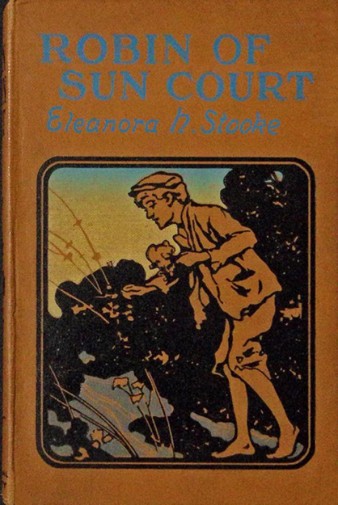
The Project Gutenberg eBook of Robin of Sun Court
Title: Robin of Sun Court
Author: Eleanora H. Stooke
Illustrator: Isabel Watkin
Release date: April 3, 2025 [eBook #75785]
Language: English
Original publication: United Kingdom: National Society's Depository, 1908
Transcriber's note: Unusual and inconsistent spelling is as printed.
"GOING TO PUT YOU IN A PICTURE?" CRIED DICK FARRANT.
ROBIN OF SUN COURT
BY
ELEANORA H. STOOKE
AUTHOR OF
"ONE CHRISTMAS TIME," "LITTLE SUNBEAM," ETC.
WITH FRONTISPIECE BY ISABEL WATKIN
LONDON
NATIONAL SOCIETY'S DEPOSITORY
19, GREAT PETER STREET, WESTMINSTER
NEW YORK: THOMAS WHITTAKER, 2 & 3 BIBLE HOUSE
1908
[All rights reserved]
PRINTED BY
SPOTTISWOODE AND CO. LTD., NEW-STREET SQUARE
LONDON
BY THE SAME AUTHOR
——————————
LITTLE SUNBEAM. Price 1s.
GRANFER, AND ONE CHRISTMAS TIME.
Price 1s.
——————————
NATIONAL SOCIETY'S DEPOSITORY
19, Great Peter Street, Westminster, S.W.
CONTENTS
CHAPTER
ROBIN OF SUN COURT
CHAPTER I
MORNING IN SUN COURT
SUN COURT was generally spoken of as one of the worst slums in Plymouth. Its name had been ill-chosen, for the sunlight only peeped into it early in the morning, and then only for an hour or so; during the rest of the day the place was dull and cheerless in the extreme. The houses surrounding the court were squalid and dilapidated for the most part. But some few looked better kept; and decorating a certain downstair window, on the May morning on which this story opens, was a wallflower in full bloom in a pot—an object of beauty in the midst of much which was unsightly, and, as the sun's rays fell on the streaky, golden-brown blooms, their delicious scent seemed to grow stronger until their fragrance filled the air.
It was said that many of the shadiest characters in Plymouth lived in Sun Court. It may have been so; but as ill weeds cannot altogether choke the growth of some hardy flowers, so were there those in Sun Court who rose above the circumstances of their lives and kept straight and honest in spite of their surroundings. One of these was the owner of the wallflower in the pot, an old cobbler called Jasper Blamey, who spent most of his days at his cobbler's bench, exactly inside the downstair window of his house.
The sun rose in a cloudless blue sky on this bright May morning, and, just as its first rays found their way into Sun Court, a big stalwart-looking man of about forty stumbled through the narrow passage which led into the court and turned into the doorway next to the cobbler's. A few minutes later there was a commotion within the house he had entered, followed by silence.
The noise in the adjoining dwelling had disturbed the old cobbler and roused him from sleep, but it had by no means alarmed or even surprised him. As it was unlikely he would sleep again, however, he decided to rise and get to work early. Half an hour later he was whistling softly to himself as he bent his head over the shoe he was re-soling, whilst the scent of the wallflower wafted through the window he had opened before taking his seat.
"I say, Mr. Blamey, did you hear the row?" asked a voice in a cautious whisper.
Jasper glanced up quickly at the speaker—a small, slight boy of about ten years of age, with a pale, pinched-looking countenance and a pair of big grey eyes—who stood outside the window, peeping in at him.
"Yes, I heard it right enough," he answered; "it woke me up, in fact."
"Father came home drunk," said the boy; "he's been out all night. Mother waited up for him till past twelve o'clock, then she went to bed. He hit her because she wasn't up and dressed ready to get his breakfast—she's getting it now."
"I hope Mrs. Burt is not hurt, Robin?" questioned the old man, in a tone of anxiety. There was an expression of deep sorrow on his kind face, and sympathy shone in his eyes—dark brown eyes they were, rather sunken, but wonderfully bright and observant.
"He struck her here," Robin answered, indicating his chest, "but she didn't make much fuss about it; you know she never does. The noise you heard was father kicking over the chairs. I thought I'd better clear out for the time or he might make for me. I say, Mr. Blamey, can't I come in and talk to you for a bit?"
"Yes, do, my boy."
In another minute Robin was seated on a three-legged stool by the cobbler's bench. He and the old man were good friends, and many were the conversations they held together.
"How lovely that wallflower is!" exclaimed the little boy, after a brief silence. "We can smell it in our house, too. Mother noticed it yesterday; she said it made her think of her old home, where she used to live when she was young, you know."
"Ay," assented Jasper, with an understanding nod; "your mother was country-bred, I take it; I never heard her say so, but I can tell."
"How can you tell?" asked Robin curiously.
"Because she loves country things, and knows so much about them—animals, and birds, and flowers. I can see she wasn't reared in a place like this."
"She was brought up on a farm. I didn't know that till a few days ago, when she got talking about the time when she was a little girl; then she told me. She hardly ever tells me anything about herself; I wish she would. Oh, Mr. Blamey, do you know what I feel when I see father hit mother?"
The question was put with a sudden change of manner, and the boy's pale cheeks flushed with fierce anger as he spoke.
"No," was the response, in a troubled tone.
"I feel that I could kill him!" Robin declared passionately. "Oh, you don't half know how bad he is—how cruel! He nearly starves mother and me, sometimes, and sells our clothes just to spend the money in drink. Mother can't keep anything for him. When she's well enough to earn a little money he gets it from her and spends that on himself, too. Oh, how I wish mother and I could run away from him and never come back again! I hate him, that I do!"
"Hush! Hush, Robin! It's wicked to hate anyone," Jasper said, looking greatly distressed—"your own father, too—"
"He isn't my own father!" broke in Robin, eagerly. "He's only my stepfather. Ah, no wonder you're surprised! I was when I found it out, and oh, wasn't I glad! He's kind enough when he's sober, but that's not often nowadays. He gets worse and worse. Mother says my own father died when I was a little chap, and then she married him—that brute! She says he promised to be good to her and me, and see how he's kept his word. Look here!" he cried, his voice growing shrill with indignation whilst he rolled up the sleeve of his jacket and indicated several bruises on his skinny arm. "That's his doing, and there are others on my shoulders and back. But he shall never hit me again now I know he isn't my father. I'll run away, that I will, and if mother won't come with me, then I'll go alone!"
"Don't talk like that, boy," advised the old man; "you'll never desert your mother, I know. No, no; you'll never let yourself be such a coward as that."
"Coward?" Robin's expression was one of doubt. "I'm not going to let him strike me again," he said determinedly; "no, never again."
"I'm sure I hope he won't attempt it, Robin. But don't threaten to run away, there's a good boy. Stick to your post of duty—that's here in Sun Court. If you ran away, you'd only bring additional trouble into your mother's life—a life that's hard enough as it is, God knows. You're as the apple of her eye, and I think if you left her, it would well-nigh break her heart."
The expression of Robin's face changed to one of extreme tenderness as the old cobbler spoke, for his mother was very dear to him. They had shared each other's joys and sorrows ever since he could remember, and, if the sorrows had greatly outweighed the joys, that fact had but served to draw them closer together.
"I wish I had left school," Robin remarked by-and-by, "then I should be able to go to work and earn money, and I'd see father didn't get it. I heard yesterday of a place where a boy was wanted to clean boots, and I tried to get the job—I thought I could do the work out of school hours—but—but—"
"Well?" Jasper interrogated gently as Robin paused with quivering lips and misty eyes.
"I went to the house, but the people wouldn't have anything to do with me because I was so ragged. I told them my father had pawned my clothes, and they said that I must belong to a bad lot; and when they heard my home was in Sun Court, they said that settled the matter and that I shouldn't suit them at all. Oh, Mr. Blamey, wasn't it hard lines?"
"Very hard lines," was the sympathetic response.
"And the worst of it is, if mother works hard at charing and gets the money to take my suit out of pawn, the same thing will happen again, perhaps. Father will sell anything he can lay his hands on when he wants money for drink. Everyone calls me Ragged Robin, and it makes me so wild. Ragged Robin, indeed! But of course I am ragged," he admitted, with a doleful glance at his clothes and a deep-drawn sigh.
"Well, cheer up, and take no notice of what folks call you," said the old man; "there are always those who will be thoughtless and unkind, but the best way is to endure in silence, my boy. And, after all, Ragged Robin is not an ugly name. It's the name of a flower, and a very pretty flower, too, deep pink in colour. Dear me, the country lanes must be gay with ragged-robins now; they come after the primroses, with the wild hyacinths and the cuckoo flowers, when the hawthorn trees are in bloom. You ask your mother if ragged-robins are not pretty flowers."
"I will," Robin answered, looking interested. "How you do love the country, Mr. Blamey! You ought to live there instead of here in Sun Court."
"No, I'd rather live in Plymouth; it has always been my home."
"Then I suppose you were born here—in Plymouth, I mean?"
"Yes. I was born and brought up in the workhouse, where my mother died when I was a baby. When I was old enough to be put out in the world, I was apprenticed to a cobbler in this very house. He was a gruff old fellow, but he treated me fairly and taught me his trade; so at his death I took on his business. Sun Court's more of a home to me than any other place would be. For all that, I enjoy a holiday in the country, and get it sometimes. But I think my Master wants me here," he concluded thoughtfully.
"Your master?" said Robin in a tone of inquiry.
"The Lord Jesus Christ. I'm well known here, and folks will listen to me sometimes when I speak to them of Him; I can tell what Jesus has been to me—just the best master and friend ever man had. He never failed anyone, and His promises are sure. 'Take my yoke upon you,' He said, 'and learn of me; for I am meek and lowly in heart: and ye shall find rest unto your souls. For my yoke is easy, and my burden is light.' Ah, Robin, how I wish Jesus was your master and friend! Perhaps He will be some day." And Jasper looked at the little boy with an expression of great tenderness in his dark eyes as he spoke.
Robin made no response. He liked and respected the old cobbler, but it always made him uneasy to hear him "talk religion," for he was not religious himself, though his mother had taught him to be truthful and honest. Accordingly, at this point in the conversation, he remarked that he thought perhaps he had better go home and have breakfast with his mother and stepfather, or the latter might take exception to his absence.
"Very well," Jasper replied, "you know best. I hope your father—your stepfather I suppose I should say—has cooled down by this time. Dear, dear, what a sad pity it is he should break out like this! And he's such a pleasant-spoken, good-tempered fellow when he's sober, too!"
"Oh, he's all right when he isn't in drink," Robin allowed. "By the way, Mr. Blamey, you haven't asked me my name—my surname I mean. It's Rodway. Don't you think Robin Rodway sounds much better than Robin Burt? I do. Mother says my own father was a real good man. I'm glad of that. Well, I must really be going, I suppose. Thank you for letting me come in and talk to you."
"I'm always glad of your company. If you don't find everything right at home you can come back again and have breakfast with me."
"Oh, thank you. Oh, there's mother calling me." Robin rose from the three-legged stool as he spoke and turned to the door. "It's sure to be all right or she wouldn't call me," he said. "Good morning, Mr. Blamey."
"Good morning, my boy," the old man returned. "So Richard Burt's only his stepfather," he muttered as his visitor disappeared; "and he's called Rodway. Surely I've heard the name 'Robin Rodway' before?"
CHAPTER II
ROBIN IN REQUEST
"MOTHER, mother, here's news—such good news!"
Robin's voice was full of joy and excitement as he hurried into the kitchen, where his mother was seated close to the window which looked into the court. It was the afternoon subsequent to the day on which Richard Burt had returned home the worse for drink and had served his wife so brutally.
"Good news?" echoed Mrs. Burt, a faint, incredulous smile flitting across her pale, careworn face. "Good news for 'us,' Robin?"
"Yes, indeed, mother. But you're ill!" he cried, in accents of concern, as he noticed her countenance bore signs of pain.
"I'm not well," she admitted; "you know, dear, I haven't felt very strong of late; I get a pain here." She pressed her hand to her side as she spoke. "No, it's not where he hit me," she continued hastily, as she observed a wrathful gleam in her little son's eyes; "he bruised me a bit, but I don't take much notice of a few bruises nowadays. Tell me your news, my dear."
"Oh, yes! You'll be so pleased, mother. Something wonderful has happened. It was like this. You know Sam Brown, and how he always bullies me just because he's older and stronger than I am? Well, I was coming home from school this afternoon when Sam overtook me and began cheeking me, calling me names, and laughing at my clothes—oh, mother you needn't look so sorry; really I didn't mind—that is, not much. A lady we met heard what Sam was saying, and she stopped and looked at him, and he cleared out as quick as he could. She was such a pretty lady, with beautiful brown eyes, and her voice sounded so kind—"
"Then she spoke to you, Robin?" Mrs. Burt interposed, her interest now thoroughly aroused.
"Yes. She put her hand on my shoulder and said, 'So they call you Ragged Robin, do they?'
"And I said, 'Yes, ma'am.'
"She looked at me very hard and smiled, and I got very red, because I was wondering what she thought of my shabby clothes.
"'I've a little boy of my own about your age,' she said. 'Where do you live?'
"I told her. She said she didn't know Sun Court, but she expected she would be able to find it, and she asked me my name and if I'd like to earn some money out of school hours. I told her I wanted to get a job, but it was very difficult to find one that I could suit, although I could shine boots and clean knives as well as any boy.
"'Well, I'll engage you for a model, and I'll pay you a shilling an hour,' she said. 'Can you come for a couple of hours twice a week? I want to put you into a picture, and you'll have to keep very still whilst I take your likeness—that's being a model, you know.'
"I was so surprised I didn't know what to say, but I felt I could have jumped for joy, and I think she saw I was very, very glad. She's coming to see you to-morrow; and, oh, mother, don't you call this good news?"
"Yes, dear, indeed it is," Mrs. Burt replied. Her face had brightened considerably whilst her little son had been talking. "Did the lady tell you her name?" she inquired.
"No. But she wrote down your name on a card, and asked me all sorts of questions about you, mother. I told her that you hadn't been well lately, and—and that father treated you badly—"
"Oh, Robin! You should not have mentioned that."
"Why not? It's true." The boy met his mother's reproachful gaze with one of defiance; then his expression softened, and he continued:
"I don't know what made me tell her, I'm sure, but she looked so kind I felt I could tell her anything. I thought if she wanted to put me into a picture she'd like me to wear better clothes, so I told her I was sorry I hadn't another suit; and then she said she meant to take my likeness just as I am. Fancy that! And fancy her offering me a shilling an hour to do nothing—only to keep still!"
"I expect you'll find it rather trying doing that," Mrs. Burt remarked with a smile; "you're usually such a restless boy."
"Anyway, I do hope I shall get the job, mother."
"I'm sure I hope so too, dear. Are you ready for tea? The kettle's on the oil-stove; it will boil directly."
"Where's father?" Robin inquired.
"Gone to Devonport to see if he can get work at the dockyard. He's ashamed of himself to-day. I haven't done much myself this afternoon; I've felt too weak and dispirited to stir about, and I haven't seen a creature to speak to but old Mr. Blamey, who came to the door to know how I was; he's always very attentive and kind."
"Yes," assented Robin; "folks say he's mazed, but I don't think he is."
"Mazed?" exclaimed Mrs. Burt. "To my mind he's a deal more sane than most people," she declared emphatically.
"They say so because he's so very religious," Robin explained.
"He's a good man, Robin, and I'm certain the love of God is in his heart, for he's always ready to put himself out of the way to do anyone a kind turn; and he's happy—so few people are that in this world!"
"He says one can't be happy without Jesus," remarked Robin, thoughtfully.
"He's right, my dear. I think there's no doubt that our old neighbour has found Jesus, and you know the Bible tells us that 'they that seek the Lord shall not want any good thing.' Mr. Blamey reminded me of that this afternoon; his words came in season, for I've been very troubled and unhappy of late, and I've kept my sorrows to myself instead of laying them before the Lord. I fear I've been a faithless woman. Ah, Robin, Sam Brown little guessed that he was doing you a good turn by jeering at you this afternoon. I expect it was really the unkind remarks he was making which drew the lady's attention to you."
"I hope she won't change her mind about me," said Robin uneasily; "perhaps she will find out that Sun Court isn't a nice place," he added, with a sigh.
"Don't meet trouble half way," advised his mother; "I've an idea that the lady will prove as good as her word."
Mrs. Burt was right in her surmise, for the following afternoon the expected visitor arrived. The old cobbler looked after her with approving eyes as she passed his window, for seldom was such a sweet face seen in Sun Court. She introduced herself to Robin's mother as Mrs. Groves, and explained that her home was at Newlyn, in Cornwall, and that she and her little son had been lodging in Plymouth for the past month, and would in all probability remain several weeks longer.
"My boy is an only child, like yours," she said, "and I think the two must be about the same age. How old is Robin?"
"Ten years and a few months, ma'am," Mrs. Burt replied.
"Gilbert—that is my little boy's name—is not quite ten. Unfortunately, he is far from being a strong child; his health has always been a cause of anxiety to me. He was very ill a short while since, and my reason for coming to Plymouth was that he might be treated by a celebrated doctor. My husband is an artist, and he has several pupils at Newlyn, so he could not possibly leave to be with us here. I am an artist, too, and the instant I saw your little son I longed to paint him. He is just the model I want. You will let him come to me, will you not?"
"Oh yes, ma'am, thank you," Mrs. Burt hastened to respond, with mingled thankfulness and gratitude in her voice, "and I do hope he'll keep still and give you every satisfaction. I'm sure he'll try to do so. He's really a very good, obedient boy, ma'am, and—and the greatest comfort I have," she concluded with a break in her voice.
"I can well understand that. He looks a dear little fellow, and he has a frank way of speaking, which I noticed at once."
Mrs. Groves did not mention Robin's stepfather, and he was not at home during her call, having been successful in obtaining work as a labourer at Devonport dockyard.
By the time Robin returned from school it had been settled that he was to present himself on Wednesday and Saturday afternoons, after four o'clock, at the house on the Hoe where Mrs. Groves was lodging, and that he was to have his tea there and serve as a model for a couple of hours afterwards.
How gratified Robin felt as he accompanied Mrs. Groves to the entrance of the court, where a cab was waiting for her. A group of boys who had stood by, staring in amazement at him and his companion, accosted him as the cab drove off.
"I say, you're looking up in the world, young 'un," remarked a big lad called Dick Farrant, with a knowing wink.
"Who's the swell, Robin?" asked another.
"A lady who's going to put me into a picture," Robin replied, in a dignified manner; "I'm to be her model. She's been to see my mother," he added, with a touch of pardonable pride in his tone.
"Going to put you into a picture!" cried Dick Farrant, sceptically. "Get on! You don't expect us to believe such an unlikely wheeze as that, do you?"
"It's quite true," declared Robin, his earnest voice carrying conviction with it; "but you can believe it or not as you like. She's an artist, and her name is Mrs. Groves, and she's the prettiest and nicest lady I ever spoke to in my life."
The boys looked at Robin in amusement and laughed derisively. Some ladies had queer fancies, they no doubt thought. The idea of anyone wanting to paint a likeness of Robin, with his pale, thin face and solemn grey eyes!
"And she's so kind and generous," proceeded Robin; "she's going to pay me a shilling an hour just to stand still and do nothing. I shall earn four shillings a week."
"Humph!" ejaculated Dick Farrant, in evident surprise. "I suppose she'll dress you up?" he suggested curiously, his eyes travelling meaningly over the little boy's shabby clothes.
Robin shook his head; whereupon the others exchanged amazed glances, then burst into roars of laughter again. It struck them all as exceedingly funny that the lady, so handsome and well-dressed herself, should be desirous of painting their insignificant neighbour in his rags.
Robin flushed angrily, but he was in too good spirits to feel annoyance long, and there was no cloud on his face when, a few minutes later, he rejoined his mother. To his delight he found her waiting for him with a smiling face.
"What do you think of her, mother?" he inquired, of course referring to their late visitor.
"I think she's a kind, good lady, my dear," Mrs. Burt replied; "she talked to me so pleasantly, and spoke so nicely of you. Who is that?" she asked, as a knock was heard at the door.
"It's Mr. Blamey," said Robin, going to look. "Oh, Mr. Blamey, do come in and let mother tell you all about the lady!" he cried excitedly, drawing the old cobbler into the kitchen and giving him a chair. "It's all been arranged," he continued; "I'm to be her model and earn a shilling an hour. Isn't it splendid?"
"Yes, indeed," Jasper responded, "and I'm very, very glad to hear it."
He sat down and listened whilst Mrs. Burt gave him an account of Mrs. Groves's visit. When she had finished, he nodded his head and said:
"I congratulate you, Robin. It won't be so easy being a model as you think, but it will teach you patience, and that's a lesson good for everyone to learn. I saw the lady, and I liked her face—it was very pleasant and kind."
"Yes," agreed Mrs. Burt, "I noticed that, too. She said that she thought her little boy was a bit taller than mine, and if so some of his cast-off clothes might fit Robin, and she promised he should have them; but she's going to paint him in the suit he has on; she says she does not want him to look spick and span in the picture. I do wonder what the picture is to be!"
"I expect I shall soon find that out, mother," said Robin; "I feel curious about it, like you."
The old cobbler now rose to go. "I think, from what I have heard, that God has raised up a friend for you," he observed, addressing Mrs. Burt.
"I am very grateful to Him for having done so," she answered earnestly.
And Robin from the depths of his heart was grateful, too.
CHAPTER III
ROBIN'S FIRST EARNINGS
"MOTHER, don't you think Robin must have finished his tea by this time? Shall I go downstairs and see? Do let me. Miss Maggs says she doesn't mind my coming into the kitchen."
Gilbert Groves, a handsome, blue-eyed boy, clad in a sailor suit, turned from the window from which he had been watching the passers-by as he spoke, and looked at his mother with an eagerness of expression which brought a smile to her face. The scene was a pleasant upstairs sitting-room in a lodging-house on the Hoe, facing the sea, where Mrs. Groves and her little son were waiting for Robin, who was having his tea downstairs, Miss Maggs, the landlady of the establishment, having readily consented to his taking that meal in her kitchen.
"Wait a few minutes longer, my dear," Mrs. Groves replied. "I don't wish the poor child to be hurried, for I daresay he is hungry. How curious you are to see him, to be sure!"
"You'll let me talk to him, won't you, mother? I want to ask him about that boy who you said was teasing him and calling him Ragged Robin."
"Oh, yes, you may certainly talk to him. But don't ask him too many questions to begin with, for I expect he'll be a little shy at first. I think perhaps now you may see if he is ready."
Gilbert did not wait to hear the conclusion of the sentence, but darted out of the room and down the stairs at a great rate. This was Robin's first visit, and as yet Gilbert had not seen him; for, acting on his mother's instructions, Robin had gone around to the back of the premises, where he had been admitted into the house by a servant and given his tea at a table in the kitchen.
Robin had nearly appeased his hunger, and was beginning to feel somewhat nervous, he scarcely knew why, when the kitchen door opened to admit a tall, spare, elderly woman, who scrutinised him for several minutes in silence, and then addressed him:
"Humph!" she ejaculated. "So you're the little boy Mrs. Groves has engaged for a model, eh? I hope you're as honest as you look."
"I—I hope so, ma'am," stammered Robin, considerably taken aback and growing crimson as he spoke.
"Have you made a good tea?" she questioned.
"Yes, ma'am, thank you!"
"You needn't thank me, child; I sha'n't be the one to pay for it. It's Mrs. Groves you have to thank. I'm only Miss Maggs, who keeps this lodging-house—Eliza Maggs, one of the hardest-worked women in Plymouth. You come from Sun Court, don't you?"
"Yes, ma'am."
"Humph! I've heard of Sun Court—nothing to the credit of the place. And you've a drunken stepfather, Mrs. Groves tells me. I pity your poor mother, that I do. Are you her only child?"
"Yes, ma'am."
"I hope you'll prove a good son to her. Ah, here comes Master Gilbert to fetch you! He'll take you upstairs."
Robin rose from his chair as Gilbert appeared, and as he met the glance of the handsome, well-dressed boy, he felt painfully shy and more than ever conscious of his shabby clothes. How smart, he thought, was the navy-blue sailor suit which Gilbert wore!
"You're Robin, I know," said Gilbert, with a most friendly smile. "If you've quite finished your tea, my mother is ready for you. Are you sure you have had enough?"
"Oh yes, thank you, that I have," answered Robin.
"Come, then."
Gilbert led the way from the kitchen, and Robin followed him silently up a flight of steep stairs into the entrance-hall, then up a wider staircase into Mrs. Groves's sitting-room. The artist greeted her model with the greatest kindness, and immediately placed him in the position in which she wished him to stand. Then she turned to her easel and set to work, whilst Gilbert took up his post at the window and began to talk volubly, for he was a regular chatterbox. By-and-by he asked Robin a question; but Robin did not like to answer it, fearing that he might not be permitted to talk. He looked at Mrs. Groves dubiously, and she met his glance with an understanding smile.
"I don't want you to be silent, Robin," she told him; "only keep your present position, that is all."
"I asked you about that boy mother heard teasing you," said Gilbert. "What is he called, and does he often bully you?"
"He's called Sam Brown, and he leads me a dreadful life sometimes," Robin admitted. "He's older and bigger than I am, you see."
"Does he live in Sun Court?" inquired Mrs. Groves.
"No, ma'am, and I'm glad he doesn't."
"I noticed several boys about the entrance of the court on the afternoon I went to see your mother," remarked Mrs. Groves. "I suppose some of them are friends of yours?"
"No," Robin replied, shaking his head. "I know them all, but I don't have much to do with them because it makes mother unhappy if I do. They use bad language and bet—at least, some of them do. There's one boy called Dick Farrant who drinks too. He's sixteen years old, but he doesn't do regular work—just picks up a living about the streets somehow."
"How can he do that?" inquired Gilbert.
"He'll sell newspapers, or drive cattle, or take around commercial travellers' samples to the shops on a handcart. Oh, he's always got money in his pocket, and if he can't earn it, he gets it all the same."
"Not by fair means, I'm afraid," said Mrs. Groves, whilst Gilbert looked decidedly puzzled.
"No, ma'am," Robin agreed. "That's what mother says. The police keep a watch on him, people say, but he's never been caught doing anything wrong yet. He lives in the house opposite ours with his father and mother and a lot of sisters and brothers; he's the eldest of the family himself."
"Are his parents respectable people?" asked Mrs. Groves.
"I don't know, ma'am. Mrs. Farrant is a great gossip, and I don't think she likes mother because mother won't let her come in and chatter whenever she likes. We have only one friend in Sun Court; he lives next door to us."
"The old cobbler I saw at work inside the window with the wallflower on the sill?" questioned Mrs. Groves, her face, which had grown very serious during the last few minutes, lighting up with a smile.
"Yes, ma'am. Jasper Blamey he's called. He's lived most of his life in Sun Court, and he's a first-rate cobbler."
"Tell us about him, do," said Gilbert.
Robin complied very willingly, explaining all he knew about the good old man. Mother and son both listened with great interest, and Robin was much gratified at being able to entertain them. By-and-by he was allowed a short rest, during which he joined the other boy at the window, and their conversation turned to the sea and ships. Gilbert pointed out the various craft in sight on the water, and told him what they were.
"You know a lot about ships," remarked Robin, regarding his companion with growing admiration and respect.
"Oh, yes," Gilbert responded carelessly. "We live at Newlyn, you know, and that's by the sea. I'm very friendly with an old sailor called Rodway, and he taught me how to tell the different vessels. A jolly old chap is Rodway!"
"Rodway!" repeated Robin. "Why, that's my name! Robin Rodway I'm called."
"Oh, how strange! Old Rodway's called Robin, too! But perhaps you're related to him?"
"I don't suppose I am."
"Oh, you might be without knowing it. I shall ask him when I get home. Mother, do you hear that Robin is called Rodway?"
Mrs. Groves acquiesced. She looked thoughtful as she stood surveying the canvas on the easel; evidently her mind was in her work, and she was paying little attention to the boys' conversation.
"I should like to be a sailor when I grow up," Gilbert said confidentially, "but I don't know if I shall be strong enough. I love the sea."
"I want to be a sailor, too," Robin acknowledged, "but I'm afraid mother won't like to part with me. Often when father's going on badly I think I'll run away and go to sea; perhaps I may some day."
"No, no," said Mrs. Groves, "that wouldn't be right. You ought to stay with your mother and take care of her; besides, you will be too young to go to sea for a long while. Come, I'm ready for you again."
Robin now returned to his former position. He would have liked to see how Mrs. Groves was getting on, but she did not offer to let him. At the end of another hour she laid her brushes aside and told him she had finished with him for the time; then she took out her purse and gave him a two-shilling piece, and he left the room the proudest and happiest boy in Plymouth. Gilbert accompanied him down to the hall, and said good-bye to him there; after which Robin descended to the kitchen, where Miss Maggs was cooking at the stove.
"Well, how do you like being a model?" she inquired, turning her hot face towards him.
"Very well, thank you, ma'am," he replied.
Miss Maggs was a plain woman, with irregular features set in somewhat grim lines, but the expression of her face was kindly as she surveyed the little boy with her head on one side.
"You don't look too well fed," she remarked, "and yet you've no sisters or brothers to share with. Times are hard with you and your mother, I guess. It's always the way when the head of a family drinks. Here, take this. I've wrapped it up ready for you. It'll make you a good supper at any rate." She placed a brown-paper parcel in his hands as she spoke.
"Oh, thank you, ma'am!" he said, gratefully, realising that it was food she had given him.
"No need to thank me," she replied. "It's the remains of a leg of mutton which my lodgers won't want sent up again. The maid and I can't eat all the scraps."
Robin hastened home as quickly as he could, feeling unusually light-hearted. He found his stepfather had returned from his day's work, and Mrs. Burt was laying the supper-cloth as he entered the kitchen. The little boy immediately unwrapped the brown-paper parcel and exhibited its contents. There was a nice cut of mutton left on the bone, and Mrs. Burt declared she had the appetite to eat a bit, whilst her husband, whose face had been looking gloomy, brightened in anticipation of a good meal.
Richard Burt was by no means a disagreeable man when he had not been drinking. He was quite sober to-night, so that whilst, during supper, Robin recounted his experiences of the last few hours, he listened with every appearance of interest.
"It's easy work being an artist's model, I should think," he remarked by-and-by; "and good pay, too!"
"Yes, but it's tiring standing still," Robin reminded him. "I got so stiff and achey, and wasn't I glad to be told that I could move!"
The little boy was rather afraid that his stepfather might want a share of his earnings, and he was greatly relieved in mind to find he did not. After supper the master of the house strolled into the court to converse with some of his neighbours; and then, being alone with his mother, Robin seized the opportunity to press his two-shilling piece into her hand.
"No, no, dear!" she cried, expostulatingly. "I cannot take it from you. You earned it and you must keep it."
"Oh, mother, I would so much rather give it to you!" he declared; and she saw he meant it. "I want you to have it because it is the first money I have earned."
She clasped him in her arms and kissed him tenderly, and then she fetched her workbox from a shelf of the dresser and locked the money away in it, "for a nest-egg," as she said. This proof of her little son's love for her touched her very deeply.
"God bless you, my boy!" she said, as she put the workbox back in its place. "Who is that?" she asked, hearing footsteps close to the window.
"Father, I think," Robin replied. He went to the window and looked out as he spoke. "Yes, he's just outside," he reported. "Oh, mother, I wish he was always like he is to-night! If only he would give up drink!"
"That is my constant prayer, Robin; maybe it will be granted some day."
CHAPTER IV
ROBIN'S PLAN
IT was Sunday afternoon, and old Jasper Blamey sat at his bench in front of the open window. His tools had been put aside out of sight on the previous night, and before him was his open Bible, from which he was reading, repeating the words in a loud whisper as was his custom.
"'God commendeth His love toward us, in that, while we were yet
sinners, Christ died for us.'"
The old man stopped suddenly, interrupted by a knock at the door, and, his finger marking the place where he was reading, said, "Come in."
The door opened immediately and admitted Robin; but ragged Robin no longer, for he was clad in a navy-blue sailor suit of clothes which was quite sound and appeared but little the worse for wear. A beaming smile was on the boy's face, and there was a colour in his thin cheeks.
"Why, how fine you look!" cried Jasper, his eyes travelling slowly over the slight serge-clad figure with mingled surprise and pleasure.
"Do I?" said Robin, much gratified. "I'm glad you think so, Mr. Blamey. Mother said the same, and I believe father thought it, too, though he didn't say. Mrs. Groves gave me this suit last night. It's one that Master Gilbert has grown out of, but it just fits me—I'm a little shorter than he is. I went to church this morning—the first time I've been for a month; I was so shabby before that I couldn't bear to be seen. I know you'll say God doesn't mind, but—" And Robin paused expressively, then looked down over himself, a moment later, with marked approval. "I'll take good care father doesn't get this suit from me," he went on; "I'll keep it under my bed at night. Feel the material, Mr. Blamey. Isn't it a good quality serge?"
"The best, I should say. Did your mother go to church with you, Robin?"
"No; she wasn't well enough. I don't know what's amiss with her; she seems very poorly, but she won't see a doctor."
"Your stepfather's been going on pretty well lately, hasn't he?"
"Pretty well. He's in regular work now, and I do hope he'll keep it. He isn't such a bad sort, you know, when he's sober, and sometimes I think he's ashamed of the way he's treated mother and me."
"He'd be a different man if he'd give up the drink altogether, Robin."
"I'm sure I wish he would; mother's asked God to make him; she told me so. But I don't believe myself that father will ever change."
"You can't tell that. God's love may reach him yet."
"Oh, he's not religious," began Robin; but the old man interrupted him:
"No, my boy, I know that well enough; but listen," and turning to his Bible, he read aloud slowly and solemnly:
"'God commendeth His love toward us, in that, while we were yet
sinners, Christ died for us.'
"I think we're apt to forget that. Sit down on the stool there and let us have a talk together."
Robin took his accustomed seat and began to speak of the picture Mrs. Groves was painting. He had served as a model for her twice a week for nearly a month, and she had made good use of the time.
"I didn't see what she was doing till last week," the little boy said, "but then she showed me. Oh, Mr. Blamey, she's got me in her picture exactly, rags and all! There I am, standing against a hedge, reaching up to pick some flowers, and what do you think the flowers are? You'll never guess, so I'll tell you. Why, they're ragged-robins. I didn't know what they were called till she told me, then I remembered what you had said about them. Oh, how I wish you could see the picture!"
"So do I," said the old man, vastly interested; "has Mrs. Groves given it a name?"
"Oh, yes. It's called 'Ragged Robins.' Mother's to go and see it one day soon, although it isn't finished; but Mrs. Groves and Master Gilbert will be leaving Plymouth before very long, for Master Gilbert's nearly well. I'm glad of that, of course, but I'm so sorry they're going, not only on account of the money. You can't tell how kind they've been to me. They live at Newlyn—"
"Newlyn?" the cobbler broke in. "You mean Newlyn in Cornwall, I suppose?"
"Yes; it's by the sea—a very pretty place, Master Gilbert says."
"So it is. I spent a week there a few summers ago; you know I always go away for a short holiday every year. There are a lot of artists at Newlyn."
"Yes, Master Gilbert told me that. He's not going to be an artist, though; he's quite made up his mind to be a sailor."
"Has he now? I thought he was very delicate?"
"Yes, but he may grow up stronger, mayn't he? He knows such a lot about ships; he says he learnt it all from an old sailor who's called the same as I am—Robin Rodway."
"Why, of course," exclaimed Jasper, a sudden light breaking across his mind; "I remember him well. I couldn't think where I'd heard the name before. Dear me, my memory must be beginning to fail. I recollect Robin Rodway now; he was a fine, hale old man with a sunburnt complexion and thick iron-grey hair. Now, I wonder—you are related to him?" he questioned.
"That's what Master Gilbert wanted to know. I told him I didn't suppose I was; but afterwards I asked mother—"
"What did she say?" the cobbler asked eagerly, as Robin paused with a slightly troubled expression of countenance.
"That it was very possible, as my father was a Cornishman and his relations were all seafaring people; then she began to cry, so I did not like to say anything more about it. Master Gilbert says he shall tell his Robin Rodway all about me when he gets home, but perhaps he will forget."
Jasper made no response. He sat with his eyes fixed searchingly on his companion's face, trying to trace a resemblance between it and the weather-beaten visage of the old Cornish sailor, but he could see none.
"Do you know, I've earned more than ten shillings," Robin proceeded after a brief pause; "Mother has the money put away for me. I gave her my first two shillings; but she says the rest must be my own, and she's taking care of it for me. Mr. Blamey, can you keep a secret?"
"I reckon I can, Robin."
"Then I'll tell you one. I'm saving my money for a holiday—a holiday for mother and me. Well go on the moor, and, oh, what a splendid time we'll have! If all's well, I shall earn a few shillings more, so we shall have plenty of money. I heard mother say the other day that she believed a breath of her native air would do her more good than all the medicine in the world; that's why I think it would be better to go on the moor than anywhere else. The farm where she lived when she was a little girl was close on Dartmoor. I haven't told her what I've planned yet, though I've been thinking of it some time."
"A long day on Dartmoor would be a rare treat for her, and no mistake," was the hearty response.
"Yes," nodded Robin; "I do hope she'll agree to go, and that she won't think it extravagant to spend the money that way."
"I don't fancy you'll want to spend all your money, for you'll be able to take excursion tickets, and they are very cheap. I'll find out all about them for you if you like."
"Oh, thank you, Mr. Blamey! I should be so glad if you would!" Robin cried, his face one broad beam of delight as he allowed his mind to dwell on the prospect of a holiday amidst the Dartmoor tors, which he had only seen in the distance.
That night the little boy confided his plan to his mother. At first she was disinclined to fall in with it, having scruples, as he had feared she would have, about spending his earnings in pleasure; but when she read the keen disappointment in his face she admitted that it would indeed be a great treat to spend a long day far away from Sun Court.
"It's years and years since I was on Dartmoor," she said wistfully. "I should like to go back there—to the little village where I used to live. My uncle who brought me up—I was left an orphan in infancy—was a small farmer; he's dead now, and I've lost touch with his family. He was always kind to me; but my aunt and cousins were not, so when I was old enough to earn my own living, I came to Plymouth and took a situation as a servant, and then I met your father, and a year or so later we were married. He was employed as a rivetter at the dockyard, and earned good wages, and we had a dear little home. I was so proud of it; and then you were born, and I thought my cup of happiness was full."
"And soon after that my father died, didn't he?" said Robin, who had been listening with the closest attention.
"Yes. He died when you were only six months old. I was nearly broken-hearted, Robin; but I was obliged to put my shoulder to the wheel, as the saying is, and earn money for our support, so I paid a neighbour who took in children to nurse to look after you by day, and went out as a charwoman. That lasted about two years; then I married again; I meant to do the best I could for myself and you, but—" She paused for a minute, an expression of intense sadness on her worn countenance. "It's no good going back over the past," she proceeded; "let us speak of the future. About your plan, Robin, now I come to think it over I don't see why we shouldn't carry it out."
"Oh, mother, I'm so glad to hear you say that. Then it's settled, isn't it?"
"Yes; that is, we'll have our holiday providing all goes well. As Richard has permanent work and is keeping steadier I see no reason why we should not give ourselves this treat. We don't owe money to anyone, for, however short things have been with us, I've always managed to keep free from debt, so I think we're justified in spending a little on ourselves. Oh, I do believe a day on the moor would do me a lot of good. Oh, Robin, my dear boy, how much we have to be thankful to God for! I hope you remember that when you kneel down to pray, and do thank Him. See the friends He's raised up for us! There's Mrs. Groves, and that kind Miss Maggs, who seems to take an interest in us, judging by the gifts she sends us every now and again. When I go to see Mrs. Groves's picture I must thank Miss Maggs—"
"She won't let you, mother," Robin broke in; "she'll say, 'No need to thank me,' or something of that sort. She told me one day that she disliked being thanked, and I believe she meant it. She's a funny old body with a queer, sharp way of speaking. I didn't understand her a bit at first, but I'm beginning to understand her now. I like her ever so much, and so does Master Gilbert. He goes downstairs in the kitchen and talks to her when she isn't busy—that's after she's cooked her lodgers' dinners—she always does that herself. I'm sure you'll get on with her, mother."
"I hope so, my dear. I feel very grateful to her. I'm sure she's a good soul."
Robin nodded. "Mrs. Groves says she's a real Christian," he said gravely; "that means she loves Jesus, doesn't it? I think people who love Jesus are always kind."
CHAPTER V
AN AWFUL BLOW
"ROBIN, I want to speak to you, my dear."
Robin, who had been holding a conversation with old Jasper Blamey through the latter's open window, turned at the sound of his mother's voice addressing him from the doorway of their home, and answered:
"I'll be in presently, mother." Then he met his mother's eyes, and became aware of the fact that she had been weeping. "I'll come at once," he added quickly, and immediately followed Mrs. Burt into the house.
"Is anything wrong?" he inquired with anxiety. "You're looking very white, and you've been crying. Are you feeling ill, mother?"
"No, dear," she answered, "and there's nothing wrong; quite the contrary. I admit I've been shedding tears, very foolishly, I know, but I've been so depressed to-day."
"Oh, you'll be in better spirits after we've had our holiday, mother," he broke in.
She sank into a chair with a weary sigh, and turned her face away from him for a minute. When she looked at him again, she had forced a smile to her lips.
"I want to tell you about a letter I've received," she said—"a letter from Newlyn."
"Oh, Mrs. Groves has written!" cried the little boy excitedly. "Fancy her writing so soon! You'll answer her letter won't you, mother? She said she would want to know how we were getting on."
It was nearly midsummer now, and Mrs. Groves and her little son had left Plymouth the week previously. Consequently Robin jumped to the conclusion that the letter his mother referred to, which she held in her hand, must be from the lady who had been so kind to him. But he was soon undeceived.
"No, I've not heard from Mrs. Groves," his mother replied, "but from—from your grandfather." Her lips trembled as she spoke and her eyes filled with tears.
"My grandfather?" echoed Robin, in amazement. "Why, I never knew—oh, mother, is my grandfather the Robin Rodway Master Gilbert talked so much about?"
"Yes, my dear, you have guessed aright. Perhaps I've been wrong in never having spoken to you about him before; but since my marriage with your stepfather, I've neither seen nor heard anything of your father's relations; that has been my fault, not theirs. When your father died, your grandfather and grandmother at Newlyn offered to take charge of you, but I couldn't give you up. I daresay that was selfish of me—"
"No, no!" broke in Robin. "You mustn't say that."
His mother's face brightened, and she regarded him almost gratefully. "No, I couldn't give you up," she reiterated, "and I hardly think your grandmother and grandfather expected it of me; but when I married secondly they repeated their offer, and I refused it again. You see, Robin, I did not guess how things would turn out."
"Of course not, mother," he responded, as she paused and looked at him deprecatingly.
"Your grandmother died soon after that. It was she who used to write to me, for your grandfather isn't much of a scholar," she explained. "Well, when I found out what your stepfather was—different from what I had thought him," she continued, speaking hesitatingly, "I was so ashamed that I let my first husband's people drop. Things went from bad to worse; sometimes Richard was in work, but oftener he was out, and then we came here to live because the rent was cheap, and of late I've kept myself to myself, and got out of touch with everyone I was friendly with during your father's lifetime. Your grandfather didn't know what had become of you and me until he heard of us from Mrs. Groves and her little son."
"What does my grandfather say in his letter?" Robin asked eagerly, the bright light of intense excitement in his grey eyes.
"The letter has evidently been written by a friend for your grandfather. It is very kindly worded. Your grandfather wishes to have you in his charge, Robin, in which case, he promises to bring you to a trade when your schooling is finished, and thus give you a fair start in life. His idea is that it would be best for you to make your home with him at Newlyn for the present."
"Then I should see Master Gilbert again, shouldn't I? And my grandfather would teach me all about ships and take me out fishing? He has a boat of his own; Master Gilbert told me so. Oh, mother, how delightful it would be And you—and you—" He broke off, regarding her dubiously.
"And I should remain here in Sun Court," she said; "but I shouldn't mind that. At least, I don't think I should, if you were happy and well cared for. I've seen lately that this is not the place for you. I daresay it would have been better if I'd given you up years ago; but I did not know then how matters would be. I hoped that Richard would be almost like your own father to you, and that was why I didn't tell you he was only your stepfather; he promised so fair. You would like to go to Newlyn to live, then, Robin?"
"Yes, mother, if you could go too," he answered.
"That is impossible, my dear," she told him—"quite impossible."
"I suppose it is," he admitted.
"It's a good thing your earnings have not been touched, Robin; they will come in useful now."
"But we must have our day on the moor together, mother. I was talking about it to Mr. Blamey when you called me; he's found out all we want to know about the trains."
"He has been most kind, as usual; but we must give up the idea of our moorland trip. If you go to Newlyn your money will be required to purchase several things you will want."
Mrs. Burt spoke with composure, though her heart was very sore at the prospect of parting from her boy; but she was unselfish enough to see what was best for him. For a long while after she had ceased speaking, he kept a contemplative silence, but at last he asked:
"What will you do if father comes home drunk, and I'm not here to stand by you? He'd be worse to you if I wasn't here; you've often said that yourself. See how quiet he became last Saturday night when I said I'd fetch the police! He knew I meant it, and that I wasn't afraid of him as I used to be. I've never let him treat me as he liked since you told me I wasn't his son. I'm growing up fast now, and I won't let him hit you any more." The boy clenched his fists and looked quite fierce as he spoke. "No, I'm not going to Newlyn," he proceeded. "I'm not going to leave you. Mr. Blamey says it's my duty to stay with you, and here I shall stop."
"Oh, Robin, my darling boy!" cried Mrs. Burt, clasping him in her arms. "I love to hear you say that, but I want you to go—yes, I wish it. That day I went to look at your picture, I told Mrs. Groves who you were, and begged her to speak to your grandfather about you, and this is the result. I want to send you away from Sun Court, so that you may have a better chance of making a good man."
"But you won't send me away if I don't wish it? And why shouldn't I make a good man here? I'll try to be good, and you know I don't tell lies and swear like the other boys in the court. Look at Mr. Blamey! He's lived most of his life in Sun Court, and you're always praising him and saying what a true Christian he is. He says if we love Jesus we're as well and safe in one place as in another; only Jesus must be in our hearts. I think he knows, don't you? He has been talking to me a great deal about Jesus lately. I used not to like listening, but I do now, and I've made up my mind I'm going to be His servant and serve Him with my whole heart. Mother, I see you're glad!"
"Very, very glad, my darling!"
"You won't send me away from you, will you?" he said, pleadingly. "I should love it at Newlyn if you were there, but I don't think I could be happy without you, mother, and I'm certain I should never be easy in my mind. Please, please don't make me go!"
"I'll think about it," Mrs. Burt replied. "I don't know what's right. I need not answer your grandfather's letter for a day or so, I daresay; so we'll weigh the matter well and discuss it again. I must ask God's guidance, too."
They were silent for a long while after that. How could he leave his mother? the little boy asked himself. His stepfather, after several weeks of sobriety, had returned home intoxicated on the previous Saturday night, and but for Robin's interference would have ill-treated his long-suffering wife. The boy had stood between the couple, and, surprised at his stepson's attitude, Richard Burt had been overcome with a sudden sense of shame and had gone quickly to bed. The next day he had been unusually subdued in his manner, and had shown regret, which had apparently been sincere, for his behaviour the night before.
Mrs. Burt watched her little son's thoughtful face with mingled feelings in her heart. She knew his grandfather to be a good, upright man, one who would command Robin's respect and love, and be very kind to him without spoiling him by indulgence, and she realised that it would be a healthier life for him in every respect at Newlyn than in Plymouth. The spiritual atmosphere in the old sailor's Cornish home was so much purer than that of Sun Court. But if Robin left her, how she would miss him! The one joy of her life would be gone. To hide the strong emotion which this reflection caused her she rose from her chair, and, remarking to Robin that she would put his grandfather's letter in safety, she moved to the dresser and took her keys from her pocket to unlock her workbox. A minute later she uttered a shrill cry of mingled horror and amazement, and stood wringing her hands in dire distress.
"What is it, mother?" questioned Robin, in alarm, hastening to her side.
"Oh, Robin, Robin!" she cried. "Look, look!"
She pointed as she spoke to her workbox, which stood in its accustomed position in one corner of a shelf on the dresser. She had put the key into the lock, but had been unable to turn it, and the briefest of examinations had disclosed the fact that the lock had been forced and Robin's earnings taken.
"What is it, mother?" Robin repeated, failing to grasp the situation.
"Oh, my poor, poor boy!" she gasped. "Oh, don't you see? Don't you understand? Your money's all gone—stolen! Someone has broken open the box! Some thief—"
She paused, her face ghastly in its pallor, her eyes full of a great horror. The only person who had known what the box contained, as far as she was aware, had been her husband. Could he, under the influence of drink, have fallen so low as to rob his stepchild? He was incapable of committing such an act in his sober senses, she was certain; but she could not answer for his conduct if he was intoxicated. The same suspicion flashed through the minds of mother and son simultaneously, and, their eyes meeting, each recognised that the other had formed the like conclusion—that Richard Burt had been the thief.
"He did it! Yes, he did it!" burst forth the boy, his voice hoarse with passion, his eyes gleaming, his face positively distorted in his ungovernable rage. "I'll never forgive him—never! I'll never see him or speak to him again! Oh, how I hate him—the wicked, cruel man!" And, without heeding his mother's pleading eyes or her wailing cry of sorrow, he made a rush for the door, and thus abruptly quitted the house.
Left by herself, poor Mrs. Burt sank into a chair, in a state of misery too great for tears. She felt as though her heart must break. This was indeed an awful blow.