
The Project Gutenberg eBook of Rockets, Missiles, and Spacecraft of the National Air and Space Museum, Smithsonian Institution
Title: Rockets, Missiles, and Spacecraft of the National Air and Space Museum, Smithsonian Institution
Author: Lynne C. Murphy
Author of introduction, etc.: Michael Collins
Release date: June 30, 2018 [eBook #57421]
Language: English
Credits: Produced by Stephen Hutcheson and the Online Distributed
Proofreading Team at http://www.pgdp.net
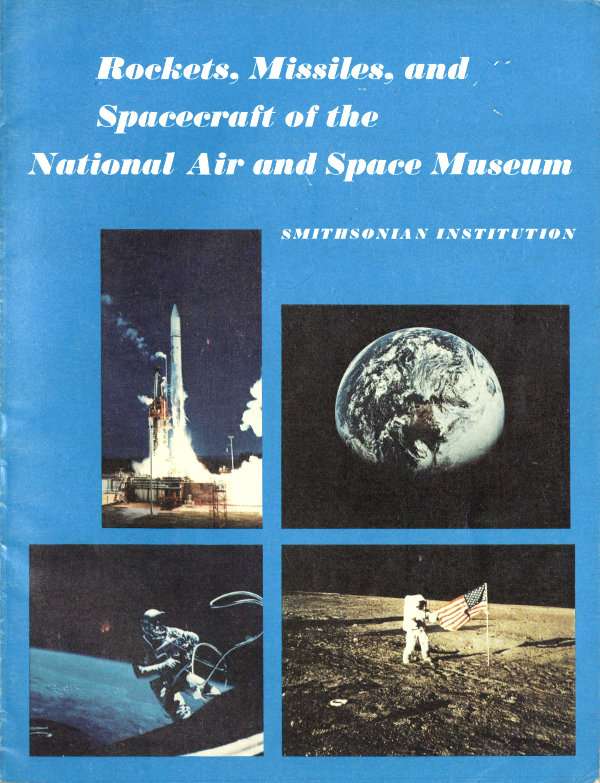
Rockets, Missiles, and
Spacecraft of the
National Air and Space Museum
SMITHSONIAN INSTITUTION
LYNNE C. MURPHY
Published by the Smithsonian Institution Press, Washington, D.C., 1976
Welcome to the National Air and Space Museum, part of the Smithsonian family. The flight of the Wrights in 1903 opened the door to ever more rapid and powerful ascents into the third dimension. This country, putting its scientific and technical talents to work, has produced an array of fascinating and complex machines. Fortunately, nearly all of the most significant ones have been preserved, and a sampling of them is included in this booklet. I hope that you will enjoy it, and that it will add to your understanding of what air and space progress has meant to all of us.
Michael Collins
Director, National Air and Space Museum
Viking 2—bound for Mars—is launched aboard Titan Centaur on September 9, 1975.
Library of Congress Cataloging in Publication Data
- National Air and Space Museum.
- Rockets, missiles, and spacecraft of the National Air and Space Museum, Smithsonian Institution, Washington, D.C. Bibliography: p.
- 1. Astronautics—United States—Exhibitions.
- 2. National Air and Space Museum.
- I. Murphy, Lynne C.
- II. Title: Rockets, missiles, and spacecraft of the National Air and Space Museum ... TL506.U6W376 1976 629.4′0973′0740153 76-6961
Printed in the U.S.A.
Designed by Elizabeth Sur
Negative numbers and photo credits
1, A-42103 (SI); 2, 74-H-1066 (NASA); 3, 74-H-1244 (NASA); 4, A-3757 (SI); 5, 72-8670 (SI); 6, 58-Explorer I-1 (NASA); 7, 62-Mariner II-34 (NASA); 8, 63-Mariner II-26 (NASA); 9, 62-MA 6-74 (NASA); 10, 62-MA6-111 (NASA); 11, 65-H-934 (NASA); 12, 65-H-937 (NASA); 13, 69-H-1199 (NASA); 14, 69-H-1367 (NASA); 15, 76-4880-81 (SI); 16, P-14054 (JPL, NASA, Pasadena, California); 17, 73-H-993 (NASA); 18, 74-H-239 (NASA); 19, 75-15926 (SI); 20, 74-H-1220 (NASA); 21, A-50483 (SI); 22, 65-H-817 (NASA); 23, 76-1706 (SI); 24, 76-1705 (SI); 25, 71-H-413 (NASA); 26, 62-NC-2 (NASA); 27, 63-ARCAS-1 (NASA); 28, 75-16094 (SI); 29, 75-16228 (SI); 30, 75-16276 (SI); 31, 61-DELTA-4-6 (NASA); 32, 66-H-223 (NASA); 33, VAN-11 (NASA); 34, 67-H-1008 (NASA); 35, 66-H-28 (NASA); 36, 60-TIROS-5 (NASA); 37, 69-H-1915 (NASA); 38, 68-H-111 (NASA); 39, 62-RELAY-17 (NASA); 40, 71-H-1414 (NASA); 41, 69-H-285 (NASA); 42, 66-H-871 (NASA); 43, 76-H-1182 (NASA); 44, 69-H-1986 (NASA); 45, 76-1704 (SI); 46, A-459994 (SI); 47, A-5293 (SI); 48, A-1085 (SI); 49, 75-11488 (SI); 50, A-4554 (SI); 51, 72-H-1240 (NASA); 52, 63-CENTAUR-15 (NASA); 53, 75-13753 (SI); 54, 76-2756 (SI); 55, 76-2687 (SI); 56, 75-H-461 (NASA); 57, 76-4479-6 (SI); 58, 62-MA6-109 (NASA); 59, 71-H-1380 (NASA); 60, 65-H-1021 (NASA); 61, A-5367 (SI); 62, 75-10232 (SI); 63, A-5073 (SI); 64, 75-16091 (SI); 65, 76-1625-11 (SI); 66, 73-733 (SI); 67, SPACE-12 (NASA); 68, 67-H-1609 (NASA); 69, 64-H-2795 (NASA); 70, 65-H-674 (NASA); 71, 76-1707 (SI); 72, 76-1708 (SI); 73, 73-H-928 (NASA); 74, 71-H-398 (NASA); 75, 68-H-423 (NASA); 76, 68-H-422 (NASA); 77, 75-H-248 (NASA); 78, 75-H-1081 (NASA); 79, 75-H-891 (NASA); 80, 75-H-1077 (NASA); 81, 71-H-525 (NASA); 82, 61-MR3-76 (NASA); 83, 65-H-2355 (NASA); 84, 72-H-734 (NASA); 85, 62-F1-2 (NASA); 86, 67-H-1205 (NASA); 87, 71-H-1416 (NASA); 88, 70-H-1392 (NASA); 89, 71-H-335 (NASA); 90, 74-H-63 (NASA); 91, S-71-45480 (NASA, Johnson Space Center); 92, 72-H-1571 (NASA).
Contents
- Introduction 6
- Milestones of Flight Gallery 100
- Robert H. Goddard’s Rockets: March 16, 1926, and 1941 7
- Sputnik 1 8
- Explorer 1 9
- Mariner 2 10
- Friendship 7 11
- Gemini 4 12
- Apollo 11 Command Module, Columbia 13
- Life in the Universe Gallery 107
- Ponnamperuma Experiments 14
- Photomosaic Globe of Mars 15
- Mariner 10 16
- U.S.S. Enterprise 17
- Satellites Gallery 110
- Goddard A-Series Rocket, 1935 18
- WAC Corporal 19
- Aerobee 150 20
- Farside 21
- Nike-Cajun 22
- ARCAS 23
- Cricket 24
- Viking 12 25
- MOUSE 26
- Agena-B 27
- Science Satellites 28
- Meteorological Satellites 30
- Communications Satellites 32
- East Gallery Gallery 112
- Lunar Module 34
- Lunar Orbiter 35
- Surveyor 36
- Rocketry and Space Flight Gallery 113
- Goddard Rockets: May 1926 and “Hoopskirt,” 1928 37
- 19th-Century Rockets: Congreve and Hale 38
- American Rocket Society: Engines and Parts 39
- H-1 Engine 40
- RL-10 Engine 41
- JATO Units 42
- LR-87 Engine 43
- Toward 2076: The Future of Rocket Propulsion 44
- Project Orion 45
- Space Suits 46
- Space Hall Gallery 114
- V-2 (A-4) 48
- V-1 49
- German Antiaircraft Missiles 50
- Jupiter-C 51
- Vanguard 52
- Scout 53
- Minuteman III 54
- Poseidon C-3 55
- Skylab 56
- Apollo-Soyuz Test Project 58
- M2-F3 Lifting Body 60
- Apollo to the Moon Gallery 210
- Freedom 7 61
- Gemini 7 62
- F-1 Engine 63
- Lunar Roving Vehicle 64
- Apollo Lunar Tools and Equipment 65
- Apollo Command Module: Skylab 4 66
- Moon Rocks 67
- Suggested Reading 68
Introduction
There is an obvious relationship between aeronautics and astronautics since the same principles of physics apply and many materials and techniques of construction are common. Nevertheless, in the decades following World War II, rocketry, guided missiles, and space flights were rapidly developing a complex history and lore quite different from that of aviation. Accordingly, in 1965, the Museum established a Department of Astronautics parallel with a Department of Aeronautics.
At that time, artifacts in categories of rocket propulsion, guided missiles, and space-flight programs were placed under curatorial control of the Astronautics Department. In 1967 the Smithsonian Institution and the National Aeronautics and Space Administration signed an agreement which provided for transfer of title to and custody of significant space artifacts by the Museum after their technical need had passed. Through provisions of this instrument the preservation and exhibit of this country’s most important spacecraft, rocket engines, launch vehicles, and missiles has been assured for posterity.
With the construction of the new Museum building on the Mall literally dozens of exciting and fascinating astronautical artifacts have been acquired, some just a few months before our opening in July 1976. All major artifacts on exhibit at the opening are described herein with brief historical summaries.
F. C. Durant III
Assistant Director, Astronautics
January 13, 1976
Robert H. Goddard’s Rockets: March 16, 1926, and 1941
1. Robert H. Goddard beside his liquid-fuel rocket prior to launch on March 16, 1926.
2. “It looked almost magical as it rose, without any appreciable greater noise or flame, as if it said, ‘I’ve been here long enough; I think I’ll be going somewhere else’....”—Robert H. Goddard.
3. Rocket with turbopumps on its assembly frame in the Goddard shop at Roswell, New Mexico, 1940.
Robert H. Goddard contributed the first major astronautical breakthrough on our way to space exploration—a liquid-propellant rocket. A replica of the first successful rocket of this type is displayed in this hall as is Dr. Goddard’s last sounding rocket design.
The first of Dr. Goddard’s successful rockets was launched on March 16, 1926. It traveled to an altitude of 12.5 meters (41 feet) powered by liquid oxygen and gasoline. Its flight lasted 2.5 seconds with an average speed in flight of about 96.6 kilometers (60 miles) per hour. Part of the rocket’s nozzle was burned away during the flight, and other parts were damaged by ground impact; however, pieces of the original rocket were reassembled and flown again on April 3, 1926.
The last and most advanced of Dr. Goddard’s liquid-propellant rockets were those tested between 1939 and 1941. This series incorporated most of the basic principles and elements later used in all long-range rockets and space boosters. Design improvements for this series included a fuel system that used turbopumps to force propellants from the tanks to the combustion chamber. The rocket on display did not fly, because a malfunction in the umbilical cord caused the engine to shut down shortly after ignition.
The March 16 rocket replica is from the National Aeronautics and Space Administration. The 1941 rocket is from Mrs. Robert H. Goddard.
Sputnik 1
4. Model of Sputnik 1, the first man-made object to be placed in Earth-orbit.
Sputnik 1, the first man-made object to be placed in orbit around Earth, was launched by the USSR on October 4, 1957.
A 29-meter (96-foot) rocket with 510,037 kilograms (1,124,440 pounds) of thrust boosted Sputnik 1 into orbit. The satellite’s orbital and radio data provided scientists with information on atmospheric and electron densities. Sputnik 1 transmitted temperature data for 22 days before its batteries ran down.
The 83.5-kilogram (184-pound) satellite reentered the earth’s atmosphere and burned up on January 4, 1958.
This Sputnik model is from the USSR Academy of Sciences.
Explorer 1
5. Trial firing of a full-size mockup of Explorer 1 on the third-stage assembly of the Jupiter-C launch vehicle.
6. On the launch pad prior to sending the first American satellite into orbit. Explorer 1, launched January 31, 1958, discovered the first two circular radiation belts surrounding the Earth.
The International Geophysical Year (1957-58) provided the impetus for the first official American satellite effort, designated Project Vanguard in 1955. Vanguard was a civilian effort that relied on a launch vehicle built especially for the project’s purposes. The launch by the Soviet Union of Sputnik 1 on October 4, 1957, caused the work on Project Vanguard to go forward under great pressure. When Vanguard Test Vehicle 3, carrying the first American earth satellite, exploded on its launch pad on December 6, 1957, United States prestige reached a low point.
On January 31, 1958, Explorer 1 became the first successful American satellite. It originated in Project Orbiter, a joint study program of the U.S. Army and the Office of Naval Research—a project that lapsed after the 1955 decision to designate Vanguard as the official American satellite effort. Following the Sputnik success, the U.S. Army Ballistic Missile Agency was instructed to proceed with its satellite plans.
Explorer 1’s launch vehicle was a four-stage Jupiter-C rocket designed, built, and launched by the Army Ballistic Missile Agency team headed by Wernher von Braun. The satellite’s instrumentation was prepared by James Van Allen and George Ludwig of the State University of Iowa under project direction of the Jet Propulsion Laboratory, California Institute of Technology.
Explorer 1 measured three phenomena—cosmic ray and radiation levels (data that led to the discovery of the earth’s radiation belts), the temperature in the vehicle (important in the design of future spacecraft), and the frequency of collisions with micrometeorites. There was no provision for data storage, and therefore the satellite transmitted its information continually.
Explorer 1 was not the only orbiting American satellite for long. In spite of the early problems, Project Vanguard succeeded in launching the second American earth satellite on March 17, 1958.
The back-up Explorer 1 on exhibit is from the National Aeronautics and Space Administration, Jet Propulsion Laboratory. California Institute of Technology.
Mariner 2
7. Artist’s conception of Mariner 2 as it flew by Venus.
The first successful interplanetary spacecraft probed the environment of Venus, Earth’s closest neighbor. Mariner 2, working flawlessly, swept by the hot and cloudy planet at a closest approach of 34,834 kilometers (21,645 miles) on December 14, 1962.
The journey began with lift-off on August 27 from Cape Canaveral atop an Atlas Agena-B launch vehicle. During the 109-day trip to the planet, Mariner’s on-board instruments sampled the environment of interplanetary space and telemetered information to Earth stations. Ground-based measurements of the Venerian surface temperature were confirmed by the probe to be around 425° C (800° F).
Mariner 2 detected no measurable magnetic field or radiation belts, indicating that Venus may have a very different history than has Earth.
Mariner 2 passed out of tracking range on January 4, 1963, when the spacecraft was about 87 million kilometers (54 million miles) from Earth. The probe is presently in orbit around the Sun.
The back-up craft on display would have been launched toward Venus if Mariner 2 had failed to reach the planet.
Prime contractor for Mariner 2 was the Jet Propulsion Laboratory, California Institute of Technology.
Mariner 2 is from the National Aeronautics and Space Administration.
8. Enlarged facsimile of coded Mariner 2 tape transmitted December 14, 1962, from the vicinity of Venus. Encircled portions show microwave and infrared coding.
Friendship 7
9. Close-up of Friendship 7 atop Atlas launch vehicle with escape tower.
10. Launch of America’s first man in orbit on February 20, 1962, from Cape Canaveral, Florida.
On the morning of February 20, 1962, a 29-meter (95-foot) Mercury Atlas launch vehicle rose from Cape Canaveral carrying John H. Glenn, Jr., in his Mercury spacecraft, Friendship 7. This was the lift-off for the first U.S.-manned orbital space flight.
In slightly more than 5 minutes the Atlas accelerated Friendship 7 to its orbital velocity of 28,230 kilometers per hour (17,540 miles per hour). Astronaut Glenn completed three orbits in 4 hours, 55 minutes. From the orbital path, which varied between 160 and 260 kilometers (100 and 160 miles) above Earth, the first American in orbit described the four sunsets he saw and reported that he was able to distinguish a ship’s wake on the ocean below.
Mercury spacecraft had been used in two previous manned suborbital flights which proved that it was a safe vehicle for manned space flights. Later orbital Mercury missions demonstrated that man could live and work in space. Friendship 7’s flight tested the performance of the pilot in weightless conditions and the interaction of the human pilot with the various automatic systems in the spacecraft.
Friendship 7 reentered the earth’s atmosphere and splashed into the Atlantic Ocean only 64 kilometers (40 miles) from the planned site. Glenn and Friendship 7 were recovered by the U.S.S. Noa near Grand Turk Island in the Bahamas.
The Mercury spacecraft consists of a conical pressure section topped by a cylindrical recovery-system section.
During flight, the Mercury spacecraft was equipped with three 454-kilogram (1000-pound) thrust solid-propellant retro-rockets mounted in a package on the heat shield. After the three rockets were fired to slow the spacecraft, the retro-rocket package was jettisoned.
Prime contractor for Friendship 7 was McDonnell Aircraft Company.
Friendship 7 is from the National Aeronautics and Space Administration.
Gemini 4
11. Gemini 4 lifts off, June 3, 1965.
12. Well over 1.6 million kilometers (1 million miles) later, Gemini 4 is hoisted from the Atlantic Ocean.
Floating at the end of a gold “umbilical cord” attached to the Gemini 4 spacecraft, Edward H. White II became the first American to have only his space suit for protection from the space environment. White directed his movements during the historic 20-minute “walk” with a hand-held maneuvering device, while command pilot James A. McDivitt took pictures from within the craft.
Launched June 3, 1965 atop 3 Titan II booster, the Gemini 4 spacecraft made 62 revolutions during the four-day flight. Although Gemini 4 failed to rendezvous with the Titan II’s second stage as planned, because the stage fell away too rapidly to catch, astronauts McDivitt and White did demonstrate that the Spacecraft could be moved in and out of its orbital plane with ease.
The crew also photographed the Earth successfully. The pictures brought back from Gemini 4 enhanced interest in photographic surveys of Earth from space.
Gemini 4 splashed down in the Atlantic at 12:12 P.M. (EST) on June 7, 1965. McDivitt and White were on the deck of recovery carrier U.S.S. Wasp in less than one hour.
The spacecraft frame is titanium and it is covered with steel and beryllium shingles. Displayed here is the basic spacecraft which includes the pressurized cabin vessel, the heat shield at the base, and the cylindrical reentry attitude-control system section on the nose.
The heat shield is a curved section of fiberglass honeycomb filled with a phenolic-epoxy resin. During reentry, the craft’s kinetic energy was converted to heat by friction with the atmosphere. The heat-shield material melted and vaporized and was blown away from the craft, carrying the heat with it. This process is called ablation.
The Gemini was a true spacecraft, capable of maneuvering widely in space, changing its configuration for different phases of the flight, and allowing the two-man crew to work both inside and outside the craft.
Prime contractor for Gemini 4 was the McDonnell Aircraft Company.
Gemini 4 is from the National Aeronautics and Space Administration.
| Length | 5.6 m. (18 ft., 4 in.) in orbit; 2.3 m. (7 ft., 4 in.) at splashdown |
| Base diameter | Adapter, 3.1 m. (10 ft.); spacecraft, 2.3 m. (7 ft., 6 in.) |
Apollo 11 Command Module, Columbia
13. Three inflated bags repositioned the spacecraft following splashdown. The astronauts watch pararescue-man shut hatch during recovery.
“That’s one small step for a man, one giant leap for mankind,” Neil A. Armstrong radioed Houston from Tranquility Base on the Moon. The first footprint had been left on the lunar surface. It was 10:56 P.M. (EDT) on July 20, 1969.
Neil Armstrong was Apollo 11’s commander, Michael Collins was command-module pilot, and Edwin “Buzz” Aldrin was the lunar-module pilot. Their journey began at 9:30 A.M. (EDT) when their Saturn 5 lifted off under 3.4 million kilograms (7.5 million pounds) of thrust.
The three-man crew made the 383,000-kilometer (238,000-mile) journey to the Moon in three days, traveling in command-module Columbia.
At 1:46 P.M. (EDT), on July 20, Armstrong and Aldrin separated the lunar module from the Columbia and began the descent to the lunar plain.
During the 2 hours and 47 minutes that the astronauts were out on the surface of the Moon, they collected samples, deployed instruments, took photographs, and explored Tranquility Base around the lunar module.
After completing their tasks on the Moon, the astronauts rendezvoused with Collins in the command module. Jettisoning the ascent stage, they began the three-day journey back to Earth.
Splashdown occurred in the central Pacific Ocean on July 24. The astronauts climbed out of this command module and were recovered by helicopters that took them to the carrier U.S.S. Hornet.
Prime contractor for Apollo 11’s command module was North American Rockwell Corporation.
The Columbia is from the National Aeronautics and Space Administration.
14. View of the Apollo 11 Command Module with Astronaut Collins aboard as seen from the Lunar Module. Terrain in background is the far side of the Moon.
Ponnamperuma Experiments
15. Equipment for Ponnamperuma Experiments.
These experimental devices were constructed by Cyril Ponnamperuma and his colleagues to show that various forms of energy may be used to produce organic molecules of the type found in living organisms.
In one experiment, electron beams were fired through a glass tube which contained a mixture of gases believed to resemble the atmosphere of primitive Earth. A number of organic molecules, including amino acids, the “building blocks” of life, were formed as a result.
In another experiment—the apparatus on display—electric spark discharges were used to add energy to a mixture of gases and water vapor contained in the device’s upper sphere. The lower sphere contained a solution of water and salts, a solution believed to resemble the slightly salty water of ancient seas. When heat and sparks were added to the gases and salty water, a number of complex organic molecules formed.
The results of these experiments supported the hypothesis that cosmic rays and other high-energy particles bombarding the primitive atmosphere could have been responsible for the origin of life on Earth.
The experimental devices were constructed and donated by Cyril Ponnamperuma and the Laboratory of Chemical Evolution, University of Maryland.
Photomosaic Globe of Mars
16. Photomosaic globe of Mars made of more than 1500 computer-corrected pictures taken by Mariner 9 in 1971 and 1972. The residual North Pole ice cap is at the top.
This 1.2-meter (4-foot) diameter globe of Mars was assembled from photographs taken by Mariner 9, an unmanned spacecraft that orbited the planet from November 14, 1971, until October 27, 1972. This globe is the first such photomosaic ever made of a planet.
Launched on May 30, 1971, Mariner 9 succeeded in photographing the entire surface of the planet. In its 349 days of orbit around Mars, Mariner 9 circled the planet 698 times and took more than 7300 photographs.
In its highly elliptical orbit, Mariner 9 obtained a sequence of overlapping wide-angle photographs. These were processed by a computer to remove the known variations in Mariner 9 camera response and geometric distortions, as well as to enhance surface detail. The mosaic made from the processed photographs is a pictorial presentation of the Martian surface which shows ridges and craters in the dark regions and on the bright polar caps with equal clarity. Surface features are in correct relationship and perspective, with only a minimum of shading difference between individual photographs.
In assembling the photomosaic, each picture was taped in place on the globe. Then, the match of adjacent pictures was assessed to determine where to trim the edges so that sharp features would not be intersected. The edges of each print were feathered so that when the prints were glued into place, the lines between pieces were almost indistinguishable. The complete globe received a thin protective coating.
This globe and copies of it enable scientists to study the geology and morphology of Mars from a perspective never before possible.
The photomosaic globe was designed and assembled at the Jet Propulsion Laboratory, California Institute of Technology, Pasadena, California.
The Mars Globe is on loan from the National Aeronautics and Space Administration.
Mariner 10
17. Mariner 10 returned data and photographs from the vicinities of Venus and Mercury.
18. This computer-enhanced image of Mercury’s surface was returned by Mariner 10 from 200,000 kilometers (124,000 miles) and 6 hours away from closest approach to Mercury on March 29, 1974.
Mariner 10 returned closeup pictures of the cloud cover around Venus and of Mercury’s sunbaked surface. Mariner 10 was the first spacecraft to photograph Mercury, the innermost planet. The spacecraft’s instruments also measured particles, fields, and radiation from these planets.
Mariner 10 flew by Venus on February 5, 1974, after a three-month, 240-million-kilometer (150-million-mile) journey that took the Spacecraft halfway around the Sun. Mariner 10 swung around the planet, taking a variety of measurements and photographs of the clouds that obscure the planet’s face. Using the planet’s gravity to “bend” its flight path, Mariner 10 flew on toward encounter with Mercury.
On March 29, 1974. Mariner sped across the night side of the little planet closest to the Sun. Only 703 kilometers (436 miles) above the rugged surface, Mariner’s cameras captured the first closeup views of the planet’s daylight hemisphere. The pictures show craters, scarps—cliffs nearly 3 kilometers (2 miles) high and stretching as far as 500 kilometers (300 miles) across the surface—basins, and hilly furrowed terrain.
After providing our first glimpse of Mercury’s surface, Mariner raced on around the Sun and back out across Venus’ orbit. With some trajectory adjustments using on-board thrusters. Mariner returned to within 48,000 kilometers (30,000 miles) of Mercury on September 21, 176 days after the first encounter, again returning pictures and data. Mariner’s orbit brought it back to the planet for a third pass in another 176 days. On-board propellant exhausted, the spacecraft continues its orbit of the Sun and innermost planet.
Mariner 10 is the first complex spacecraft designed to travel to the inner reaches of the solar system. At closest approach to the Sun, the spacecraft received five times as much light and heat as it did on leaving Earth. Thus the solar panels, which collect and convert solar radiation into electrical energy for the spacecraft’s instruments and controls, were designed to tilt more and more away from the sunlight as Mariner approached the Sun.
Mariner could transmit much more information to Earth than earlier flyby spacecraft. This higher data rate enabled the craft to send back more live pictures of the planets as it flew by them. Some information was stored on magnetic tape for later transmission. This capability permitted Mariner to collect data when it was hidden from Earth behind a planet, and send the information when it emerged.
Prime contractor for Mariner 10 was Hughes Aircraft Company.
Mariner 10 is from the National Aeronautics and Space Administration.
U.S.S. Enterprise
19. The starship Enterprise used in the filming of the “Star Trek” television series.
This studio model of an interstellar space ship was used in the filming of the science-fiction television series, “Star Trek.” Many of the series’ 78 episodes dealt speculatively with the problems and results of human contacts with extraterrestrial life forms and civilizations.
The model of U.S.S. Enterprise was designed by Walter M. Jeffries and Gene Roddenberry.
The model is from Paramount Television, a division of Paramount Pictures.
| Length | 3.4 m. (11 ft., 3 in.) |
| Diameter of disc | 1.5 m. (5 ft.) |
Goddard A-Series Rocket, 1935
20. Dr. Goddard in his workshop at Roswell, New Mexico, October 1935.
Robert Hutchings Goddard, the American rocket pioneer, was one of the first to suggest the use of the rocket to gather scientific information from high altitudes. As seamen use sounding lines to measure the depth of unknown waters, so scientists use sounding rockets to investigate the nature of our atmosphere. As early as 1917, the Smithsonian Institution agreed to fund Dr. Goddard’s studies. In 1926, he built and flew the world’s first successful liquid-propellant rocket which rose to an altitude of 12.5 meters (41 feet) over a field in Massachusetts.
After the scientist received substantial grants from the Daniel and Florence Guggenheim Foundation, he established a facility near Roswell, New Mexico, where he built and tested a series of rockets and engines between 1930 and 1942.
A-Series rockets—one on exhibit—were flown during the summer of 1935, as part of Dr. Goddard’s program to develop methods of stabilizing his rockets in vertical flight. The principles he pioneered in this area were among his greatest contributions to the field of rocketry.
The greatest height reached by an A-Series rocket was about 2130 meters (7000 feet) and the greatest speed in flight was more than 1130 kilometers per hour (700 miles per hour).
The rocket on exhibit is from Robert H. Goddard.
| Length | 4.7 m. (15 ft., 6 in.) |
| Diameter | 15.2 cm. (6 in.) |
| Fuel | Gasoline |
| Oxidizer | Liquid oxygen |
| Thrust | about 90 kg. (200 lb.) |
| Velocity | 1130 km. (700 mi.) per hr. (+ or -) |
| Altitude | 2.3 km. (7600 ft.) (+ or -) |
WAC Corporal
21. Frank Malina, project leader in the development of the WAC Corporal, stands beside the high-altitude sounding rocket.
The WAC Corporal was the first successful American sounding rocket to reach significant altitude. The first WAC Corporal, launched in 1944 from White Sands Proving Ground in New Mexico, reached a height of 71,600 meters (235,000 feet). The fin-stabilized rocket was powered by a liquid-propellant engine that burned a self-igniting fuel and oxidizer combination. Use of these propellants eliminated the need for an ignition system. By March 1946, these rockets had attained altitudes of over 72.4 kilometers (45 miles) with a booster. The WAC Corporal was later used as a second stage on a German V-2 rocket. This U.S. program, code-named “Bumper,” tested techniques for ignition and separation of stages at high altitudes.
The WAC Corporal was designed in 1944 by the staff of the Jet Propulsion Laboratory, California Institute of Technology.
The rocket on exhibit is from the California Institute of Technology.
| Length | 4.9 m. (16 ft., 2 in.) as exhibited |
| Diameter | 30.5 cm. (12 in.) |
| Fuel | Aniline-furfuryl alcohol |
| Oxidizer | Red-fuming nitric acid |
| Thrust | 680 kg. (1500 lb.) |
| Velocity | 4500 km. (2800 mi.) per hr. at burnout |
| Altitude | 72 km. (45 mi.) with a 11.3-kilogram (25-lb.) payload |