
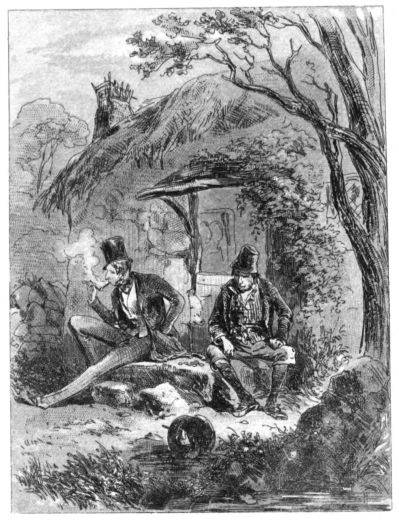
CHAPTER VI. THE SEASON OF LINTON'S FLITTING
Oldham.
Revealing so freely as we do the hidden wiles of our characters for the reader's pleasure, it would ill become us to affect any reserve or mystery regarding their actions. We shall not make, therefore, any secret of Mr. Linton's absence, nor ask of our patient reader to partake of the mystification that prevailed among the company at Tubbermore.
It so chanced, that on the evening preceding his departure he saw in a newspaper paragraph the arrival of a very distinguished lawyer at Limerick on his way to Dublin, and the thought at once occurred to him, that the opportunity was most favorable for obtaining an opinion respecting the “Corrigan Pardon,” without incurring either suspicion or any lengthened absence.
Another object, inferior, but not devoid of interest, also suggested itself. It was this: profiting by a secret passage which led from the theatre to Cashel's bedroom, it was Linton's custom to visit this chamber every day, ransacking the letters and papers which, in his careless indolence, Roland left loose upon the tables, and thus possessing himself of the minutest knowledge of Cashel's affairs. In his very last visit to this room, he perceived a cumbrous document, of which the seal of the envelope was broken, but apparently the contents unlooked at. It was enough that he read the indorsement, “Deed of conveyance of the Cottage and Lands of Tubber-beg.”
Feeling how far he himself was interested in the paper, and well knowing the forgetful habits of Cashel, who would never detect its removal, he coolly folded it up and carried it away.
At first, his intention was simply to peruse the paper at his ease, and, if need were, to show it in confidence to Cor-rigan, and thus establish for himself that degree of influence over the old man which the character of his landlord might convey. But another and a bolder expedient soon suggested itself to his mind—nor was he one to shrink from an enterprise merely on account of its hazard—and this was no less than to forge Cashel's signature to the deed; for, as yet, it was wanting in that most essential particular.
That Roland would never remember anything of the matter, and that he would always incline to believe his own memory defective, than suppose such a falsification possible, Linton was well convinced. There was but one difficulty; how should he manage for the witnesses, whose names were to be appended as actually present at the moment of signing. Here was a stumbling-block—since he could scarcely hope to find others as short of memory as was Roland Cashel. It was while still canvassing the question in his mind that he came upon the intelligence in the newspaper of the lawyer's arrival at Limerick, and suddenly it struck him that he could easily in that city find out two persons, who, for a sufficient consideration, would append their signatures to the deed. A little further reflection devised even an easier plan, which was to take along with him the Italian sailor Giovanni, and make him represent Cashel, whose appearance was quite unknown. By Giovanni's personation of Roland, Linton escaped all the hazard of letting others into his confidence, while the sailor himself, in a few days more, would leave the country—never to return.
It was with the calm assurance of a man who could put a price upon any action required of him, that Giovanni found himself, an hour after midnight, summoned to Linton's dressing-room.
“I told you some time back, Giovanni, that we might be serviceable to each other. The hour has come a little earlier than I looked for; and now the question is, are you of the same mind as you then were?”
“I know nothing of the laws of this country, signor, but if there be life on the issue—”
“No, no, nothing like that, my worthy fellow. In the present case, all I ask for is your silence and your secrecy.”
“Oh, that is easily had—go on, signor.”
“Well, I wish to go over to-morrow by daybreak to Limerick. I desire, too, that you should accompany me—as my companion, however, and my equal. We are about the same height and size, so take that suit there, dress yourself, and wait for me at the cross-roads below the village.”
The Italian took the parcel without speaking, and was about to retire, when Linton said,—
“You can write, I suppose?”
The other nodded.
“I shall want you to sign a document in presence of witnesses—not your own name, but another, which I'll tell you.”
The Italian's dark eyes flashed with a keen and subtle meaning, and leaning forward, he said in a low, distinct tone,—
“His Excellency means that I should forge a name?”
“It is scarcely deserving so grave a phrase,” replied Linton, affecting an easy smile; “but what I ask amounts pretty much to that. Have you scruples about it?”
“My scruples are not easily alarmed, signor; only let us understand each other. I'll do anything”—and he laid a deep emphasis on the word—“when I see my way clear before me, nothing when I am blindfolded.”
“A man after my own heart!” cried Linton; “and now, good-night. Be true to the time and place.” And with this they parted.
The gray mist of a winter morning was just clearing away as Linton, accompanied by Giovanni, drove up to the principal hotel of Limerick, where Mr. Hammond, the eminent barrister, was then stopping. Having ascertained that he was still in the house, Linton at once sent up his name, with a request to be admitted to an interview with him. The position he had so long enjoyed among the officials of the Viceroy had made Linton a person of considerable importance in a city where the “plated article” so often passes for silver: and no sooner had the lawyer read the name, than he immediately returned a polite answer, saying that he was perfectly at Mr. Linton's orders.
The few inquiries which Mr. Linton had meanwhile made at the bar of the hotel informed him that Mr. Hammond was making all haste to England, where he was about to appear in a case before the House of Lords; that horses had been already ordered for him along the whole line of road, and his presence in London was imperative. Armed with these facts, Linton entered the room, where, surrounded with deeds, drafts, and acts of Parliament, the learned counsel was sitting at his breakfast.
“It was but last night late, Mr. Hammond,” said he, advancing with his very frankest manner, “that we caught sight of your name as having arrived here, and you see I have lost no time in profiting by the intelligence. I have come thirty Irish miles this day to catch and carry you off with me to Mr. Cashel's, at Tubbermore.”
“Most kind, indeed—very flattering—I am really overpowered,” said the lawyer, actually reddening with pleasure; and he said the exact truth, he was “overpowered” by a compliment so little expected. For, although high in his profession, and in considerable repute among his brethren, he had never been admitted into that peculiar class which calls itself the first society of the metropolis.
“I assure you,” resumed Linton, “it was by a vote of the whole house I undertook my mission. The Kilgoffs, the MacFarlines, the Chief Justice, Meek, and, in fact, all your friends, are there, and we only want you to make the party complete.”
“I cannot express the regret—the very deep regret—I feel at being obliged to decline such an honor; one which, I am free to confess, actually takes me by surprise. But, my dear Mr. Linton, you see these weighty papers—that formidable heap yonder—”
“Meek said so,” said Linton, interrupting, and at the same time assuming a look of deep despondency. “'Hammond will refuse,' said he. 'There's no man at the Irish bar has the same amount of business; he cannot give his friends even one hour from his clients.'”
“I 'm sure I scarcely suspected the Right Honorable Secretary knew of me,” said Hammond, blushing between pleasure and shame.
“Downie not know of you!—not know Mr. Hammond!—come, come—this may do for a bit of quiz in those Irish newspapers that are always affecting to charge English officials with ignorance of the distinguished men here; but I cannot permit Mr. Hammond himself to throw out the aspersion, nor, indeed, can I suffer Meek, one of my oldest friends, to lie under the obloquy. I need not tell one so much more capable of appreciating these things than myself how every administration comes into office with a host of followers far more eager for place, and infinitely more confident of high deservings, than the truly capable men of the party. These 'locusts' eat up the first harvest, but, happily for humanity, they rarely live for a second.”
Linton leaned back in his chair, and appeared to be taking counsel with himself, and at length, as if having formed his resolve, said,—
“Of course frankness with such a man is never a mistaken policy.” And with this muttered soliloquy again became silent.
CHAPTER VII. FORGERY
Bell.
We left Mr. Linton and Mr. Hammond seated opposite each other, the former lost in seeming reflection, the latter awaiting with eager expectancy for something which might explain the few strange words he had just listened to.
“May I venture on a bit of confidence, Mr. Hammond?” said Linton, clearing his brow as he spoke; “you'll never betray me?”
“Never—on my honor.”
“Never, willingly, I well know; but I mean, will you strictly keep what I shall tell you—for yourself alone—because, as I am the only depositary of the fact, it would be inevitable ruin to me if it got about?”
“I give you my solemn pledge—I promise.”
“Quite enough—well—” Here he leaned on the other's shoulder, and putting his lips close to his ear, said: “Malone will retire—Repton will be chief—and”—here he prodded the listener with his finger—“Attorney-General.”
“You mean me, sir—do you mean that I am to be Attor—”
“Hush!” said Linton, in a long low note; “do not breathe it, even in your sleep! If I know these things, it is because I am trusted in quarters where men of far more influence are hoodwinked. Were I once to be suspected of even this much, it would be 'up' with me forever.”
“My dear friend—will you pardon me for calling you so?—I 'd suffer the torture of the rack before I 'd divulge one syllable of it. I own to you, my family and my friends in general have not been patient under what they deemed the Government neglect of me.”
“And with too good reason, sir,” said Linton, assuming the look and air of a moralizer. “And do you know why you have been passed over, Mr. Hammond? I'll tell you, sir; because your talents were too brilliant, and your integrity too spotless, for promotion, in times when inferior capacities and more convenient consciences were easier tools to handle!—Because you are not a man who, once placed in a conspicuous position, can be consigned to darkness and neglect when his capabilities have been proved to the world!—Because your knowledge, sir, your deep insight into the political condition of this country, would soon have placed you above the heads of the very men who appointed you. But times are changed; capable men, zealous men—ay, sir, and I will say, great men—are in request now. The public will have them, and ministers can no longer either overlook their claim or ignore their merit. You may rely upon it; I see something of what goes on behind the scenes of the great State drama, and be assured that a new era is about to dawn on the really able men of this country.”
“Your words have given me a degree of encouragement, Mr. Linton, that I was very far from ever expecting to receive. I have often deplored—not on my own account, I pledge my honor—but I have grieved for others, whom I have seen here, unnoticed and undistinguished by successive Governments.”
“Well, there is an end of the system now, and it was time!” said Linton, solemnly. “But to come back. Is there no chance of stealing you away, even for a couple of days?”
“Impossible, my dear Mr. Linton. The voluminous mass of evidence yonder relates to an appeal case, in which I am to appear before 'the Lords.' It is a most important suit; and I am at this very moment on my way to London, to attend a consultation with the Solicitor-General.”
“How unfortunate!—for us, I mean—for, indeed, your client cannot join in the plaint. By the way, your mention of 'the Lords' reminds me of a very curious circumstance. You are aware of the manner in which my friend Cashel succeeded to this great estate here?”
“Yes. I was consulted on a point of law in it, and was present at the two trials.”
“Well, a most singular discovery has been made within the last few days. I suppose you remember that the property had been part of a confiscated estate, belonging to an old Irish family, named Corrigan?”
“I remember perfectly,—a very fine old man, that used to be well known at Daly's Club, long ago.”
“The same. Well, this old gentleman has been always under the impression that shortly after the accession of George III. the Act of Confiscation was repealed, and a full pardon granted to his ancestors for the part they had taken in the events of the time.”
“I never knew the descendants of one of those 'confiscated' families who had not some such hallucination,” said Hammond, laughing; “they cling to the straw, like the drowning man.”
“Exactly,” said Linton. “I quite agree with you. In the present case, however, the support is better than a straw; for there is an actual bona fide document extant, purporting to be the very pardon in question, signed by the king, and bearing the royal seal.”
“Where is this? In whose possession?” said Hammond, eagerly.
Linton did not heed the question, but continued,—
“By a very singular coincidence, the discovery is not of so much moment as it might be; because, as Cashel is about to marry the old man's granddaughter—his sole heiress—no change in the destination of the estate would ensue, even supposing Corrigan's title to be all that he ever conceived it. However, Cashel is really anxious on the point: he feels scruples about making settlements and so forth, with the consciousness that he may be actually disposing of what he has no real claim to. He is a sensitive fellow; and yet he dreads, on the other side, the kind of exposure that would ensue in the event of this discovery becoming known. The fact is, his own ancestors were little better than bailiffs on the estate; and the inference from this new-found paper would lead one to say, not over-honest stewards besides.”
“But if this document be authentic, Mr. Linton, Cashel's title is not worth sixpence.”
“That is exactly what I 'm coming to,” said Linton, who, the reader may have already perceived, was merely inventing a case regarding a marriage, the better to learn from the counsel the precise position the estate would stand in towards Mary Leicester's husband. “If this document be authentic, Cashel's title is invalid. Now, what would constitute its authenticity?”
“Several circumstances: the registry of the pardon in the State Paper Office—the document itself, bearing the unmistakable evidences of its origin—the signature and seal—in fact, it could not admit of much doubt when submitted to examination.”
“I told Cashel so,” said Linton. “I said to him, 'My opinion unquestionably is that the pardon is genuine; but,' said I, 'when we have Hammond here, he shall see it, and decide the question.'”
“Ah! that is impossible—”
“So I perceive,” broke in Linton; “we then hoped otherwise.”
“Why did n't you bring it over with you?”
“So I did,” said Linton; “here it is.” And opening a carefully folded envelope, he placed the important document in the lawyer's bands.
Hammond spread it out upon the table, and sat down to read it over carefully, while Linton, to afford the more time to the scrutiny, took the opportunity of descending to his breakfast.
He stopped as he passed the bar to say a few words to the landlord,—one of those easy speeches he knew so well how to make about the “state of trade,” “what travellers were passing,” and “how the prospect looked for the coming season,”—and then, when turning away, as if suddenly recollecting himself, said:—
“By the way, Swindon, you are a cautious fellow, that a man may trust with a secret—you know who the gentleman is that came with me?”
“No, sir; never saw him before. Indeed, I did not remark him closely.”
“All the better, Swindon. He does not fancy anything like scrutiny. He is Mr. Roland Cashel.”
“Of Tubbermore, sir?”
“The same. Hush, man,—be cautious! He has come up here about a little law business on which he desired to consult Mr. Hammond, and now we have a document for signature, if you could only find us another person equally discreet with yourself to be the witness, for these kind of things, when they get about in the world, are misrepresented in a thousand ways. Do you happen to have any confidential man here would suit us?”
“If my head waiter, sir, Mr. Nipkin, would do; he writes an excellent hand, and is a most reserved, cautious young man.”
“Perfectly, Swindon; he'll do perfectly. Will you join us upstairs, where my friend is in waiting? Pray, also, give Nipkin a hint not to bestow any undue attention on Mr. Cashel, who wants to be incog. so far as may be; as for yourself, Swindon, no hint is necessary.”
A graceful bow from the landlord acknowledged the compliment, and he hastened to give the necessary orders, while Linton continued his way to the apartment where the Italian awaited him.
“Impatient for breakfast, I suppose, Giovanni?” said Linton, gayly, as he entered. “Well? sit down, and let us begin. Already I have done more than half the business which brought me here, and we may be on our way back within an hour.”
Giovanni seated himself at the table without any of that constraint a sense of inferiority enforces, and began his breakfast in silence.
“You understand,” said Linton, “that when you have written the name 'Roland Cashel,' and are asked if that be your act and deed, you have simply to say 'Yes;' a bow—a mere nod, indeed—is sufficient.”
“I understand,” said he, thoughtfully, as if reflecting over the matter with himself. “I conclude, then,” added he, after a pause, “that the sooner I leave the country afterwards, the better—I mean the safer—for me.”
“As to any positive danger,” said Linton, affecting an easy carelessness, “there is none. The document is merely a copy of one already signed by Mr. Cashel, but which I have mislaid, and I am so ashamed of my negligence I cannot bring myself to confess it.”
This tame explanation Linton was unable to finish without faltering, for the Italian's keen and piercing dark eyes seemed to penetrate into him as he was speaking.
“With this I have nothing to do,” said he, abruptly. “It is quite clear, however, that Giovanni Santini is not Roland Cashel; nor, if there be a penalty on what I have done, am I so certain that he whose name I shall have forged will undergo it in my place.”
“You talk of forgery and penalties as if we were about to commit a felony,” said Linton, laughing. “Pray give me the cream. There is really no such peril in the case, and if there were, it would be all mine.”
“I know nothing of your laws here—I desire to know nothing of them,” said the Italian, haughtily; “but if it should be my lot to be arraigned, let it be for something more worthy of manhood. I 'll sign the paper, but I shall leave the country at once.”
No words could have been more grateful to Linton's ears than these; he was, even at that very moment, considering in his own mind in what way to disembarrass himself of his “friend” when this service should have been effected.
“As you please, Giovanni,” said be, gravely. “I regret to part company so soon with one whose frankness so well accords with my own humor.”
The Italian's lips parted slightly, and a smile of cold and dubious meaning flitted across his dark features.
“We part here, then,” said he, rising from the table. “There is a vessel leaves this for Bristol at noon to-day; it is already past eleven o'clock.”
“I'll not delay,” said Linton, rising and ringing the bell; “send Mr. Swindon here,” said he to the waiter, while he opened a parchment document upon the table, and after hastily glancing over it, folded it carefully again, leaving uppermost the margin, where certain pencil-marks indicated the places of signature. “This is yours, Giovanni,” said he, placing a weighty purse in the Italian's hand, who took it with all the easy indifference of one whose feelings of shame were not too acute. “Remember what I have—”
There was no time to finish, for already a light tap was-heard at the door, and the landlord, followed by the head waiter, entered.
“We were pressed for time, Swindon,” said Linton, as he examined the pens, which, like all hotel ones, seemed invented for ruling music paper, “and have sent for you to witness the signature to this document. Here, Cashel, you are to sign here,” said he, turning to Giovanni, who-had just lighted a cigar, and was smoking away with all imaginable coolness. The Italian took the pen, and with a bold and steady hand wrote the words “Roland Cashel.”
“Mr. Swindon at this side; Mr. Nipkin's name comes underneath.”
“You acknowledge this for your hand and seal, sir?” said Swindon, turning towards Giovanni.
“I do,” said the Italian, in an accent which did not betray the slightest emotion, nor any trace of foreign pronunciation.
“All right; thank you, Swindon—thanks, Mr. Nipkin,” said Linton, as, with an elation of countenance all his efforts could not suppress, he folded up the parchment; “and now, will you order my horses at once?”
The landlord and the waiter left the room, and Linton found himself once more alone with Giovanni; the only consolation he felt being that it was for the last time. There was a pause, in which each gazed steadily at the other without a word. At last, with a long-drawn sigh, Giovanni exclaimed,—
“Perdio! but it is hard to do.” And with this he pressed his hat upon his brows, and waving a careless farewell with his hand, walked out, leaving Linton in a state of amazement not altogether unmingled with fear. Tom watched the tall and stalwart figure of the foreigner as he moved through the crowd that filled the quay, and it was with a sense of relief he could not explain to himself that he saw him cross the plank that led to the steamer, on whose deck numerous passengers were already assembled.
The bell rang out in warning of her approaching departure, and Linton kept his eyes intently fixed upon the one figure, which towered above the others around him. Already the scene of bustle portended the moment of starting, and some were hastening on board, as others, with not less eagerness, were endeavoring to get on shore; when, just at that instant, the landlord's voice was heard.
“Mr. Hammond is just going off, sir; he wants to say one word to you before he goes.”
Mr. Hammond had just taken his seat in his carriage, and sat with one hand upon the door, awaiting Linton's coming.
“I am run sharp for time, Mr. Linton,” cried he, “and have not a second to lose. I wish sincerely I could have given a little more time to that document—not indeed that any feature of difficulty exists in forming an opinion, only that I believe I could have put your friend on the safe road as to his future course.”
“You regard it then as authentic—as a good and valid instrument?” said Linton, in a low but eager voice.
“So much so,” said Hammond, lowering his tone to a mere whisper, “that if he does not marry the young lady in question, I would not give him twenty shillings for his title.”
“By Jove!” exclaimed Linton, leaning his head on the door of the carriage, as if to conceal his chagrin, but in reality to hide the exuberance of his joy; “and this is your candid opinion of the case?”
“I am willing to stake my fame as a lawyer on the issue; for, remember, the whole history of the suit is familiar to me. I recollect well the flaws in the course of proofs adduced, and I see how this discovery reconciles each discrepancy, and supplies every missing link of the chain.”
“Poor fellow!—it will be a sad blow for him,” said Linton, with admirably feigned emotion.
“But it need not, Mr. Linton; the church can tie a knot not even an equity suit can open. Let him marry.”
“Ay, if he will.”
“Tell him he must; tell him what I now tell you, that this girl is the greatest heiress in the land, and that he is a beggar. Plain speaking, Mr. Linton, but time is short Good-bye.”
“One word more. Is the document of such a nature that leaves him no case whatever? Is all the ground cut away beneath his feet?”
“Every inch of it. Once more, good-bye. Here is your parchment; keep it safely. There are few men in this city hold in their hands a paper of such moment.”
“I'll take good care of it,” said Linton, sententiously; “and so good-bye, and a safe journey to you. I 'll not forget our conversation of this morning; Meek shall hear of it before I sleep to-night. Adieu.”
“The richest heiress in the land, and Cashel a beggar,” repeated Linton, slowly, to himself, as the carriage drove off. “Charley Frobisher would say, 'Hedge on the double event,' but I 'll keep my book.” And, with this slang reflection, he sauntered into the inn to wait for his horses.
CHAPTER VIII. ROLAND DISCOVERS THAT HE HAS OVERDRAWN
If hard to take, was good when taken.
Village Worthies.
Long before the guests of Tubbermore were astir, Cashel sat in his library awaiting the arrival of Dr. Tiernay. In obedience to Roland's request, Mr. Kennyfeck was present, and affected to look over books or out of windows,—to scan over prints or inspect maps,—anything, in short, which should pass the time and shorten the interval of waiting, doubly awkward from being the first moment he had been alone with Cashel since his arrival. Cashel was silent and absorbed, and, more intent upon following out the train of his own thoughts, never noticed the various arts by which Kennyfeck affected to interest himself. The solicitor, too, bent from time to time a stealthy look on the young man, on whose features he had rarely seen the same traces of deep reflection.
At last, with a half start, as if suddenly awaking, Cashel sat up in his chair, and said,—
“Have I explained to you what Dr. Tiernay's business is here this morning? It is to make a proposition from Mr. Corrigan for the sale of his interest in Tubber-beg. He wishes to leave the country and go abroad.”
“His interest, sir,” replied Kennyfeck, calmly, “although more valuable to you than to any one else, must be a matter of small amount; for years back, he has done little more than vegetate on the property, without capital or skill to improve it.”
“I 'm not asking you to appraise it, just yet,” said Roland, snappishly; “I was simply informing you of the object of the gentleman's visit. It is the advantage of this purchase that I wished you to consider, not its cost.”
“The cost will define the advantage, sir,” rejoined Kennyfeck, “particularly as the demand may be high, and the payment inconvenient.”
“How do you mean, inconvenient?”
Kennyfeck hesitated. There was something in the hurried abruptness of the question, as well as in the excited expression of the questioner's face, that confused him; so that Cashel had time to repeat the words before he could reply.
“Is it that I am straitened for money?” said he, passionately.
“Not quite—that—sir,” replied Kennyfeck, stopping between every word. “You have resources—very great resources—untouched, and you have considerable sums in foreign securities, intact—”
“Never mind these,” broke in Roland, hurriedly. “How do we stand with those London fellows?”
Kennyfeck shook his head gravely, but without speaking.
“I pray you, sir,” said Roland, in a voice of hardly suppressed passion, “keep pantomime for another moment, or a keener interpreter of it, and condescend, in plain English, to answer me my last question.”
“There is no difficulty with Bigger and Swain, sir,” said Kennyfeck, as his cheek grew slightly red. “They will neither be pressing for a settlement, nor exacting when making it; besides, you have not overdrawn very heavily, After all.”
“Overdrawn, said you?—did you say overdrawn, Mr. Kennyfeck?”
“Yes, sir. In the account last forwarded, your debit was eleven thousand four hundred and forty pounds; since that you have drawn—but not for any large amount.”
“Overdrawn!” repeated Cashel, as though his thoughts had never wandered beyond the first shock of that fact; then rallying into something like his habitual easy humor, he said, “I am, I need not tell you, the stupidest man of business that ever breathed, so pray forgive me if I ask you once more if I understood you aright, that I have not only expended all the money I owned in these people's hands, but actually had contracted a debt to them?”
“That is the case, sir,” said Kennyfeck, gravely.
A deep groan broke from Cashel, and he sat silent and still.
“I would wish to observe, sir,” said Kennyfeck, who was shocked at the alteration a few moments had made in the young man's countenance—“I would wish to observe, sir, that if you desire a sum of money for any purpose—”
“Stay—let me interrupt you here,” said Cashel, laying his hand on Kennyfeck's arm, and using a tone whose earnest distinctness thrilled through his hearer's heart; “I should deceive you, were you to suppose that it is the want of money gives me the pain I am now suffering. That I had believed myself rich a few moments back, and now found myself a beggar, could not give one-thousandth part of that suffering which I feel here. I have braved poverty in every form, and I could brave it again; but I 'll tell you what it is that now cuts me to the soul, and lowers me to myself. It is that, in a senseless, heartless career, I should have squandered the wealth by which I once imagined I was to bless and succor hundreds. It is to think, that of all the gold I have wasted, not one memory has been purchased of a sick-bed consoled, a suffering lessened, a sinking spirit encouraged,—I have done nothing, actually nothing, save pamper vice and sensual heartlessness. I came to this kingdom a few months back, my very dreams filled with schemes of benevolence; I felt as if this wealth were given to me that I might show the world how much of good may be done by one who, having experienced narrow fortune, should best know how to relieve it in others; and now, here am I, the wealth and the high aspirations alike departed, with no tradition to carry away, save of a life passed in debauch, the friendship of worthless, the pitying contempt of good men! Hear me out I was nurtured in no school of sentiment; I belonged to a class who had too little time or taste to indulge in scruples. We were reckless, passionate,—cruel, if you will,—but we were not bad in cold blood; we seldom hated long; we never could turn on a benefactor. These are not the lessons I 've lived to learn here! It is over, however—it is past now! I 'll go back to the old haunts, and the old comrades. It will go hard with me if I quarrel with their rude speech and rough demeanor. I 'll think of gentlemen! and be grateful.”
The rapid utterance in which he poured forth these words, and the fervid excitement of his manner, abashed Kenny-feck, and deterred him from reply. Cashel was the first to speak.
“This arrangement, however, must be provided for; whatever Mr. Corrigan's interest be worth—or rather, whatever he will accept in lieu of it—I insist upon his having. But I see Dr. Tiernay coming up to the door; we can talk of these things at another time.”
When Tiernay entered the library he was heated with his walk, and his face betrayed unmistakable signs of recent irritation; indeed, he did not long conceal the reason.
“Is it true, Mr. Cashel, that Mr. Linton is your nominee for the borough of Derraheeny?”
“Yes; what of that?”
“Why, that he canvasses the constituency in a fashion we have not yet been accustomed to; at least your tenants, of whom I am one, are told that our votes are the condition on which our leases will receive renewal; that you will not brook opposition in any one who holds under you. Are these your sentiments, Mr. Cashel, or only his?”
“Not mine, assuredly,” replied Cashel, gravely.
“I said as much. I told several of my neighbors that if this mode of canvass had your sanction, it was from not knowing the privileges of an elector.”
“I neither sanctioned nor knew of it,” rejoined Cashel, eagerly.
“So much the better—at least for me,” said Tiernay, seating himself at the breakfast-table, “for I shall not lose a good breakfast, as I should have been forced to do had these been your intentions.”
“I would observe, Dr. Tiernay,” interposed Kennyfeck, mildly, “that the borough, being entirely the property of Mr. Cashel, its charities maintained by his bounty, and its schools supported at his cost, he has a fair claim on the gratitude of those who benefit by his benevolence.”
“Let him stand himself for the borough, and we 'll not deny the debt,” said Tiernay, roughly; “but if for every ten he should expend a hundred, ay, sir, or a thousand, on the village, I 'd not vote for Mr. Linton.”
“Most certainly, doctor; I'd never seek to coerce you,” said Cashel, smiling.
“Labor lost, sir. I am your tenant for a holding of twenty-two pounds a year. I have never been in arrear; you, consequently, have not granted me any favor, save that of extending your acquaintance to me. Now, sir, except that you are a rich man and I a poor one, how is even that condescension on your part a favor? and how could you purpose, upon it, to ask me to surrender my right of judgment on an important point to you, who, from your high station, your rank and influence, have a thousand prerogatives, while I have but this one?”
“I never heard the just influence of the landed proprietor disputed before,” said Kenny feck, who felt outraged at the doctor's hardihood.
“It is only just influence, sir,” said Tiernay, “when he who wields it is an example, as much by his life, as by the exercise of an ability that commands respect. Show me a man at the head of a large property extending the happiness of his tenantry, succoring the sick, assisting the needy, spreading the blessings of his own knowledge among those who have neither leisure nor opportunity to acquire it for themselves. Let me see him, while enjoying to the fullest the bounteous gifts that are the portion of but few in this world, not forgetful of those whose life is toil, and whose struggle is for mere existence. Let me not know the landlord only by his liveries and his equipage, his fox-hounds, his plate, his racers, and his sycophants.”
“Hard hitting, doctor!” cried Cashel, interrupting.
“Not if you can take it so good-humoredly,” said Tiernay; “not if it only lose me the honor of ever entering here, and teach you to reflect on these things.”
“You mistake me much,” said Cashel, “if you judge me so narrowly.”
“I did not think thus meanly of you; nor, if I did, would it have stopped me. I often promised myself, that if I could but eat of a rich man's salt, I'd tell him my mind, while under the protection of his hospitality. I have paid my debt now; and so, no more of it. Kennyfeck could tell you better than I, if it be not, in part at least, deserved. All this splendor that dazzles our eyes,—all this luxury, that makes the contrast of our poverty the colder,—all this reckless waste, that is like an unfeeling jest upon our small thrift, is hard to bear when we see it, not the pastime of an idle hour, but the business of a life. You can do far better things than these, and be happier as well as better for doing them! And now, sir, are you in the mood to discuss my friend's project?”
“Perfectly so, doctor; you have only to speak your sentiments on the matter before Mr. Kennyfeck; my concurrence is already with you.”
“We want you to buy our interest in Tubber-beg,” said the doctor, drawing his chair in front of Kennyfeck; “and though you tell us that flower-plats and hollies, laurustinus and geraniums, are not wealth, we 'll insist on your remunerating us for some share of the cost. The spot is a sweet one, and will improve your demesne. Now, what's it worth?”
“There are difficulties which may preclude any arrangement,” said Kennyfeck, gravely. “There was a deed of gift of this very property made out, and only awaiting Mr. Cashel's signature.”
“To whom?” said Tiernay, gasping with anxiety.
“To Mr. Linton.”
“The very thing I feared,” said the old man, dropping his head sorrowfully.
“It is easily remedied, I fancy,” said Cashel. “It was a hasty promise given to afford him qualification for Parliament. I 'll give him something of larger value; I know he 'll not stand in our way here.”
“How you talk of giving, sir! You should have been the Good Fairy of a nursery tale, and not a mere man of acres and bank-notes. But have your own way. It's only anticipating the crash a month or so; ruined you must be!”
“Is that so certain?” said Cashel, half smiling, half seriously.
“Ask Mr. Kennyfeck, there, whose highest ambition half a year ago was to be your agent, and now he 'd scarcely take you for a son-in-law! Don't look so angry, man; what I said is but an illustration. It will be with your property as it was with your pleasure-boat t'other day; you 'll never know you 've struck till you 're sinking.”
“You affect to have a very intimate knowledge of Mr. Cashel's affairs, sir,” said Kennyfeck, who was driven beyond all further endurance.
“Somewhat more than you possess, Mr. Kennyfeck; for I know his tenantry. Not as you know them, from answering to their names at rent-day, but from seeing them in seasons of distress and famine,—from hearing their half-uttered hopes that better days were coming when the new landlord himself was about to visit them; from listening to their sanguine expectations of benefits; and now, within some few days, from hearing the low mutterings of their discontent,—the prelude of worse than that.”
“I have seen nothing else than the same scenes for forty years, but I never remember the people more regular in their payments,” said the attorney.
“Well, don't venture among the Drumcoologhan boys alone; that, at least, I would recommend you,” said the doctor, menacingly.
“Why not?—who are they?—where are these fellows?” cried Cashel, for danger was a theme that never failed to stir his heart.
“It 's a bad barony, sir,” said Kennyfeck, solemnly.
“A district that has supplied the gallows and the convict-ship for many a year; but we are wandering away from the theme we ought to discuss,” interposed Tiernay, “and the question narrows itself to this; if this property is still yours,—if you have not already consigned it to another,—what is my friend's interest worth?”
“That will require calculation and reflection.”
“Neither, Mr. Kennyfeck,” broke in Cashel. “Learn Mr. Corrigan's expectations, and see that they are complied with.”
“My friend desired a small annuity on the life of his granddaughter.”
“Be it an annuity, then,” replied Cashel.
“By heaven!” exclaimed Tiernay, as if he could not restrain the impulse that worked within him, “you are a fine-hearted fellow. Here, sir,” said he, taking a paper from his pocket,—“here is a document, which my poor friend sat up half the night to write, but which I'd half made up my mind never to give you. You'd never guess what it is, nor your keen friend either, but I 'll spare you the trouble of spelling it over. It's a renunciation of Cornelius Corrigan, Esq., for himself and his heirs forever, of all right, direct or contingent, to the estate of Tubbermore, once the family property of his ancestors for eleven generations. You never heard of such a claim,” said Tiernay, turning to Cashel, “but Mr. Kennyfeck did; he knows well the importance of that piece of paper he affects to treat with such indifference.”
“And do you suppose, sir, that if this claim you speak of be a good and valid one, I could, as a man of honor, maintain a possession to which I had no right? No; let Mr. Corrigan take back that paper; let him try his right, as the laws enable him. If I stand not here as the just owner of this house, I am ready to leave it at this instant; but I am neither to be intimidated by a threat nor conciliated by a compromise.”
“Mr. Corrigan's claim has nothing to go upon, I assure you,” broke in Kennyfeck. “If we accept the paper, it is by courtesy,—to show that we respect the feeling that suggested it,—nothing more.”
While these words were addressed to Tiernay, Cashel, who had walked towards one of the windows, did not hear them.
“Well,” cried Tiernay, after an awkward pause, “the devil a worse negotiator ever accepted a mission than myself! When I desire to be frank, the only truths that occur to me are sure to be offensive, and I never am so certain to insult as when I fancy I 'm doing a favor. Goodbye, sir; pardon the liberties of an old man, whose profession has taught him to believe that remedies are seldom painless, and who, although a poor man, would rather any day lose the fee than the patient! You'll not treat Con Corrigan the less kindly because he has an imprudent friend. I'm sorry to think that I leave an unfavorable impression behind me; but I'm glad, heartily glad, I came here to breakfast, for I go away convinced of two things, that I was far from believing so certain when I entered,”—he paused for a second or two, and then said,—“that a spendthrift could have an unblemished sense of honor, and that an attorney could appreciate it!”
With these words he departed, while Cashel, after staring for a few moments at Kennyfeck, threw himself back in his chair, and laughed long and heartily.
“An original, sir,—quite an original,” said Kennyfeck, who, not exactly knowing whether to accept the doctor's parting speech as a compliment, or the reverse, contented himself with this very vague expression.
“He's a fine old fellow, although he does lay on his salve in Indian fashion, with a scalping-knife; but I wish he'd not have said anything of that confounded paper.”
“Pardon me, sir,” interposed Kennyfeck, taking it from his pocket, “but it might prove of inestimable value, in the event of any future litigation.”
“What! you kept it, then?” cried Cashel.
“Of course I did, sir. It is a document scarce inferior to a deed of title; for, although Mr. Corrigan has nothing to substantiate a claim at law, it is incontestable that his family were the original owners of this estate.”
Cashel took the paper from Kennyfeck's hand, and seemed to peruse it for some minutes, and then approaching the fire he threw it into the blaze, and pressed it down with a poker till it was consumed; while Kennyfeck, too much consternated to utter a word, stood the personification of terror-struck astonishment.
“You have burnt it, sir!” said he at last, in a whisper.
“Why not, sir?” cried Cashel, rudely. “Should I have made use of it against the man who wrote it, or against his heirs, if by chance they should seek one day to dispute my right?”
A deep sigh was all the reply Kennyfeck could make.
“I understand your compassion well,” said Cashel, scornfully. “You are right, sir. It was the buccaneer, not the gentleman, spoke there; but I 'm sick of masquerading, and I long for a little reality.”
Without waiting for a reply, Roland left the room, and wandered out into the park.