WeRead Powered by ReaderPub
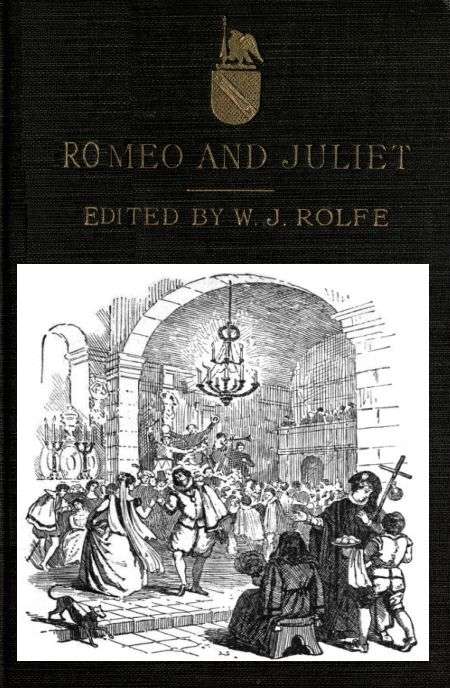
Romeo and Juliet cover

Romeo and Juliet

Chapter 15: Scene V.
Open in WeRead

About This Book

Set in an Italian city, the drama follows two young people whose secret attachment collides with a longstanding feud between their families. Rapid courtship and a clandestine vow lead to a chain of retaliations, miscommunications, and urgent plans that culminate in unintended tragedy. The work contrasts lyrical poetry with everyday speech and comic interludes, examines themes of passionate love, honor, fate versus choice, and the consequences of youthful haste, and unfolds through tightly staged scenes that escalate private emotion into public catastrophe.

Romeo. What, shall this speech be spoke for our excuse?
Or shall we on without apology?
Benvolio. The date is out of such prolixity.
We'll have no Cupid hoodwink'd with a scarf,
Bearing a Tartar's painted bow of lath,
Scaring the ladies like a crow-keeper;
Nor no without-book prologue, faintly spoke
After the prompter, for our entrance
.
But let them measure us by what they will,
10
We'll measure them a measure, and be gone.
Romeo. Give me a torch; I am not for this ambling.
Being but heavy, I will bear the light.
Mercutio. Nay, gentle Romeo, we must have you dance.
Romeo. Not I, believe me. You have dancing shoes
With nimble soles; I have a soul of lead
So stakes me to the ground I cannot move.
Mercutio. You are a lover; borrow Cupid's wings,
And soar with them above a common bound.
Romeo. I am too sore enpierced with his shaft
20
To soar with his light feathers, and, so bound,
I cannot bound a pitch above dull woe;
Under love's heavy burden do I sink.
Mercutio. And, to sink in it, should you burden love;
Too great oppression for a tender thing.
Romeo. Is love a tender thing? it is too rough,
Too rude, too boisterous, and it pricks like thorn.
Mercutio. If love be rough with you, be rough with love;
Prick love for pricking, and you beat love down.—
Give me a case to put my visage in; [Putting on a mask]
30
A visor for a visor! what care I
What curious eye doth quote deformities?
Here are the beetle-brows shall blush for me.
Benvolio. Come, knock and enter; and no sooner in
But every man betake him to his legs.
Romeo. A torch for me; let wantons light of heart
Tickle the senseless rushes with their heels,
For I am proverb'd with a grandsire phrase:
I'll be a candle-holder and look on.
The game was ne'er so fair, and I am done.
40
Mercutio. Tut, dun's the mouse, the constable's own word;
If thou art Dun, we'll draw thee from the mire
Of this sir-reverence love, wherein thou stick'st
Up to the ears.—Come, we burn daylight, ho!
Romeo. Nay, that's not so.
Mercutio. I mean, sir, in delay
We waste our lights in vain, like lamps by day.
Take our good meaning, for our judgment sits
Five times in that ere once in our five wits.
Romeo. And we mean well in going to this mask;
But 'tis no wit to go.
Mercutio.Why, may one ask?
Romeo. I dreamt a dream to-night.
50
Mercutio. And so did I.
Romeo. Well, what was yours?
Mercutio.That dreamers often lie.
Romeo. In bed asleep, while they do dream things true.
Mercutio. O, then, I see Queen Mab hath been with you.
She is the fairies' midwife, and she comes
In shape no bigger than an agate-stone
On the fore-finger of an alderman,
Drawn with a team of little atomies
Athwart men's noses as they lie asleep;
Her waggon-spokes made of long spinners' legs,
60
The cover of the wings of grasshoppers,
The traces of the smallest spider's web,
The collars of the moonshine's watery beams,
Her whip of cricket's bone, the lash of film,
Her waggoner a small grey-coated gnat,
Not half so big as a round little worm
Prick'd from the lazy finger of a maid;
Her chariot is an empty hazel-nut
Made by the joiner squirrel or old grub,
Time out o' mind the fairies' coachmakers.
70
And in this state she gallops night by night
Through lover's brains, and then they dream of love;
O'er courtiers' knees, that dream on court'sies straight;
O'er lawyers' fingers, who straight dream on fees;
O'er ladies' lips, who straight on kisses dream,
Which oft the angry Mab with blisters plagues,
Because their breaths with sweetmeats tainted are.
Sometime she gallops o'er a courtier's nose,
And then dreams he of smelling out a suit;
And sometime comes she with a tithe-pig's tail
80
Tickling a parson's nose as a' lies asleep,
Then dreams he of another benefice.
Sometime she driveth o'er a soldier's neck,
And then dreams he of cutting foreign throats,
Of breaches, ambuscadoes, Spanish blades,
Of healths five-fathom deep; and then anon
Drums in his ear, at which he starts and wakes,
And being thus frighted swears a prayer or two
And sleeps again. This is that very Mab
That plats the manes of horses in the night,
90
And bakes the elf-locks in foul sluttish hairs,
Which once untangled much misfortune bodes.
This is she—
Romeo.Peace, peace, Mercutio, peace!
Thou talk'st of nothing.
Mercutio.True, I talk of dreams,
Which are the children of an idle brain,
Begot of nothing but vain fantasy,
Which is as thin of substance as the air,
And more inconstant than the wind, who wooes
Even now the frozen bosom of the North,
And, being anger'd, puffs away from thence,
100
Turning his face to the dew-dropping South.
Benvolio. This wind you talk of blows us from ourselves;
Supper is done, and we shall come too late.
Romeo. I fear, too early; for my mind misgives
Some consequence, yet hanging in the stars,
Shall bitterly begin his fearful date
With this night's revels, and expire the term
Of a despised life clos'd in my breast
By some vile forfeit of untimely death,
But He that hath the steerage of my course
110
Direct my sail!—On, lusty gentlemen.
Benvolio. Strike, drum. [Exeunt.


Scene V.

A Hall in Capulet's House

Musicians waiting. Enter Servingmen with napkins

1 Servingman. Where's Potpan, that he helps not
to take away? He shift a trencher! he scrape a
trencher!

2 Servingman. When good manners shall lie all
in one or two men's hands and they unwashed too,
'tis a foul thing.

1 Servingman. Away with the joint-stools, remove
the court-cupboard, look to the plate.—Good thou,
save me a piece of marchpane; and, as thou lovest
10me, let the porter let in Susan Grindstone and
Nell.—Antony!—and Potpan!

2 Servingman. Ay, boy, ready.

1 Servingman. You are looked for and called for,
asked for and sought for, in the great chamber.

2 Servingman. We cannot be here and there too.
Cheerly, boys; be brisk a while, and the longer
liver take all.

Enter Capulet, with Juliet and others of his house, meeting the Guests and Maskers

Capulet. Welcome, gentlemen! ladies that have their toes
Unplagu'd with corns will have a bout with you.—
20
Ah ha, my mistresses! which of you all
Will now deny to dance? she that makes dainty,
She, I'll swear, hath corns; am I come near ye now?
Welcome, gentlemen! I have seen the day
That I have worn a visor and could tell
A whispering tale in a fair lady's ear,
Such as would please; 'tis gone, 'tis gone, 'tis gone.—
You are welcome, gentlemen!—Come, musicians, play.—
A hall, a hall! give room! and foot it, girls.— [Music plays, and they dance.
More light, you knaves; and turn the tables up,
30
And quench the fire, the room is grown too hot.—
Ah, sirrah, this unlook'd-for sport comes well.—
Nay, sit, nay, sit, good cousin Capulet,
For you and I are past our dancing days.
How long is 't now since last yourself and I
Were in a mask?
2 Capulet. By 'r lady, thirty years.
Capulet. What, man! 'tis not so much, 'tis not so much!
'Tis since the nuptial of Lucentio,
Come Pentecost as quickly as it will,
Some five and twenty years; and then we mask'd.
40
2 Capulet. 'Tis more, 'tis more! His son is elder, sir;
His son is thirty.
Capulet. Will you tell me that?
His son was but a ward two years ago.
Romeo. [To a Servingman] What lady is that, which doth enrich the hand
Of yonder knight?
Servingman. I know not, sir.
Romeo. O, she doth teach the torches to burn bright!
Her beauty hangs upon the cheek of night
Like a rich jewel in an Ethiope's ear;
Beauty too rich for use, for earth too dear!
50
So shows a snowy dove trooping with crows
As yonder lady o'er her fellows shows.
The measure done, I'll watch her place of stand,
And, touching hers, make blessed my rude hand.
Did my heart love till now? forswear it, sight!
For I ne'er saw true beauty till this night.
Tybalt. This, by his voice, should be a Montague.—
Fetch me my rapier, boy.—What dares the slave
Come hither, cover'd with an antic face,
To fleer and scorn at our solemnity?
60
Now, by the stock and honour of my kin,
To strike him dead I hold it not a sin.
Capulet. Why, how now, kinsman! wherefore storm you so?
Tybalt. Uncle, this is a Montague, our foe,
A villain that is hither come in spite,
To scorn at our solemnity this night.
Capulet. Young Romeo is it?
Tybalt. 'Tis he, that villain Romeo.
Capulet. Content thee, gentle coz, let him alone.
He bears him like a portly gentleman;
And, to say truth, Verona brags of him
70
To be a virtuous and well-govern'd youth.
I would not for the wealth of all the town
Here in my house do him disparagement;
Therefore be patient, take no note of him.
It is my will, the which if thou respect,
Show a fair presence and put off these frowns,
An ill-beseeming semblance for a feast.
Tybalt. It fits when such a villain is a guest;
I'll not endure him.
Capulet. He shall be endur'd;
What, goodman boy! I say he shall. Go to;
80
Am I the master here, or you? go to.
You'll not endure him!—God shall mend my soul!
You'll make a mutiny among my guests!
You will set cock-a-hoop! you'll be the man!
Tybalt. Why, uncle, 'tis a shame.
Capulet Go to, go to;
You are a saucy boy.—Is 't so, indeed?—
This trick may chance to scathe you,—I know what.
You must contrary me! marry, 'tis time.—
Well said, my hearts!—You are a princox; go!
Be quiet, or—More light, more light!—For shame!
90
I'll make you quiet. What!—Cheerly, my hearts!
Tybalt. Patience perforce with wilful choler meeting
Makes my flesh tremble in their different greeting.
I will withdraw; but this intrusion shall,
Now seeming sweet, convert to bitter gall. [Exit.
Romeo. [To Juliet] If I profane with my unworthiest hand
This holy shrine, the gentle fine is this:
My lips, two blushing pilgrims, ready stand
To smooth that rough touch with a tender kiss.
Juliet. Good pilgrim, you do wrong your hand too much,
100
Which mannerly devotion shows in this;
For saints have hands that pilgrims' hands do touch,
And palm to palm is holy palmers' kiss.
Romeo. Have not saints lips, and holy palmers too?
Juliet. Ay, pilgrim, lips that they must use in prayer.
Romeo. O, then, dear saint, let lips do what hands do;
They pray, grant thou, lest faith turn to despair.
Juliet. Saints do not move, though grant for prayers' sake.
Romeo. Then move not, while my prayer's effect I take.
Thus from my lips by thine my sin is purg'd. [Kissing her.
Juliet. Then have my lips the sin that they have took.
Romeo. Sin from my lips? O trespass sweetly urg'd!
Give me my sin again.
112
Juliet. You kiss by the book.
Nurse. Madam, your mother craves a word with you.
Romeo. What is her mother?
Nurse. Marry, bachelor,
Her mother is the lady of the house,
And a good lady, and a wise and virtuous.
I nurs'd her daughter that you talk'd withal;
I tell you, he that can lay hold of her
Romeo. Is she a Capulet?
120
O dear account! my life is my foe's debt.
Benvolio. Away, be gone; the sport is at the best.
Romeo. Ay, so I fear; the more is my unrest.
Capulet. Nay, gentlemen, prepare not to be gone;
We have a trifling foolish banquet towards.—
Is it e'en so? why, then, I thank you all;
I thank you, honest gentlemen; good night.—
More torches here!—Come on then, let's to bed.
Ah, sirrah, by my fay, it waxes late;
I'll to my rest. [Exeunt all but Juliet and Nurse.
Juliet. Come hither, nurse. What is yond gentleman?
131
Nurse. The son and heir of old Tiberio.
Juliet. What's he that now is going out of door?
Nurse. Marry, that, I think, be young Petruchio.
Juliet. What's he that follows there, that would not dance?
Nurse. I know not.
Juliet. Go, ask his name.—If he be married,
My grave is like to be my wedding bed.
Nurse. His name is Romeo, and a Montague,
The only son of your great enemy.
140
Juliet. My only love sprung from my only hate!
Too early seen unknown, and known too late!
Prodigious birth of love it is to me,
That I must love a loathed enemy.
Nurse. What's this? what's this?
Juliet. A rhyme I learn'd even now
Of one I danc'd withal. [One calls within 'Juliet.'
Nurse. Anon, anon!—
Come, let's away; the strangers all are gone. [Exeunt.

Capulet's Garden


ACT II

Enter Chorus

Now old desire doth in his death-bed lie,
And young affection gapes to be his heir;
That fair for which love groan'd for and would die,
With tender Juliet match'd, is now not fair.
Now Romeo is belov'd and loves again,
Alike bewitched by the charm of looks,
But to his foe suppos'd he must complain,
And she steal love's sweet bait from fearful hooks.
Being held a foe, he may not have access
To breathe such vows as lovers use to swear;
And she as much in love, her means much less
To meet her new-beloved any where.
But passion lends them power, time means, to meet,
Tempering extremities with extreme sweet. [Exit.

Scene I.

A Lane by the Wall of Capulet's Orchard

Enter Romeo

Romeo. Can I go forward when my heart is here?—
Turn back, dull earth, and find thy centre out.
[He climbs the wall, and leaps down within it.
Enter Benvolio and Mercutio
Benvolio. Romeo! my cousin Romeo! Romeo!
Mercutio. He is wise,
And, on my life, hath stolen him home to bed.
Benvolio. He ran this way, and leap'd this orchard wall;
Call, good Mercutio.
Mercutio. Nay, I'll conjure too.—
Romeo! humours! madman! passion! lover!
Appear thou in the likeness of a sigh!
Speak but one rhyme, and I am satisfied;
10
Cry but 'Ay me!' pronounce but 'love' and 'dove';
Speak to my gossip Venus one fair word,
One nickname for her purblind son and heir,
Young Abraham Cupid, he that shot so trim
When King Cophetua lov'd the beggar-maid!—
He heareth not, he stirreth not, he moveth not;
The ape is dead, and I must conjure him.—
I conjure thee by Rosaline's bright eyes,
By her high forehead and her scarlet lip,
That in thy likeness thou appear to us!
20
Benvolio. An if he hear thee, thou wilt anger him.
Mercutio. This cannot anger him; 'twould anger him
To raise a spirit in his mistress' circle
Of some strange nature, letting it there stand
Till she had laid it and conjur'd it down.
That were some spite; my invocation
Is fair and honest, and in his mistress' name
I conjure only but to raise up him.
Benvolio. Come, he hath hid himself among these trees,
To be consorted with the humorous night;
30
Blind is his love and best befits the dark.
Mercutio. If love be blind, love cannot hit the mark.—
Romeo, good night.—I'll to my truckle-bed;
This field-bed is too cold for me to sleep.
Come, shall we go?
Benvolio.Go, then; for 'tis in vain
To seek him here that means not to be found. [Exeunt.

Scene II.

Capulet's Orchard

Enter Romeo

Romeo. He jests at scars that never felt a wound.— [Juliet appears above at a window.
But, soft! what light through yonder window breaks?
It is the east, and Juliet is the sun.—
Arise, fair sun, and kill the envious moon,
Who is already sick and pale with grief
That thou her maid art far more fair than she.
Be not her maid, since she is envious.
Her vestal livery is but sick and green,
And none but fools do wear it; cast it off.—
10
It is my lady, O, it is my love!
O, that she knew she were!—
She speaks, yet she says nothing; what of that?
Her eye discourses; I will answer it.
I am too bold, 'tis not to me she speaks.
Two of the fairest stars in all the heaven,
Having some business, do entreat her eyes
To twinkle in their spheres till they return.
What if her eyes were there, they in her head?
The brightness of her cheek would shame those stars,
20
As daylight doth a lamp; her eyes in heaven
Would through the airy region stream so bright
That birds would sing and think it were not night.
See, how she leans her cheek upon her hand!
O, that I were a glove upon that hand,
That I might touch that cheek!
Juliet. Ay me!
Romeo. She speaks.—
O, speak again, bright angel! for thou art
As glorious to this night, being o'er my head,
As is a winged messenger of heaven
Unto the white-upturned wondering eyes
30
Of mortals that fall back to gaze on him,
When he bestrides the lazy-pacing clouds
And sails upon the bosom of the air.
Juliet. O Romeo, Romeo! wherefore art thou Romeo?
Deny thy father and refuse thy name;
Or, if thou wilt not, be but sworn my love
And I'll no longer be a Capulet.
Romeo. [Aside] Shall I hear more, or shall I speak at this?
Juliet. 'Tis but thy name that is my enemy;
Thou art thyself, though not a Montague.
40
What's Montague? it is nor hand, nor foot,
Nor arm, nor face, nor any other part
Belonging to a man. O, be some other name!
What's in a name? That which we call a rose
By any other name would smell as sweet;
So Romeo would, were he not Romeo call'd,
Retain that dear perfection which he owes
Without that title.—Romeo, doff thy name,
And for that name, which is no part of thee,
Take all myself.
Romeo. I take thee at thy word.
50
Call me but love, and I'll be new baptiz'd;
Henceforth I never will be Romeo.
Juliet. What man art thou that thus bescreen'd in night
So stumblest on my counsel?
Romeo. By a name
I know not how to tell thee who I am.
My name, dear saint, is hateful to myself,
Because it is an enemy to thee;
Had I it written, I would tear the word.
Juliet. My ears have yet not drunk a hundred words
Of that tongue's utterance, yet I know the sound.—
60
Art thou not Romeo and a Montague?
Romeo. Neither, fair maid, if either thee dislike.
Juliet. How cam'st thou hither, tell me, and wherefore?
The orchard walls are high and hard to climb,
And the place death, considering who thou art,
If any of my kinsmen find thee here.
Romeo. With love's light wings did I o'er-perch these walls,
For stony limits cannot hold love out,
And what love can do that dares love attempt;
Therefore thy kinsmen are no let to me.
70
Juliet. If they do see thee, they will murther thee.
Romeo. Alack, there lies more peril in thine eye
Than twenty of their swords; look thou but sweet,
And I am proof against their enmity.
Juliet. I would not for the world they saw thee here.
Romeo. I have night's cloak to hide me from their eyes;
And but thou love me, let them find me here.
My life were better ended by their hate
Than death prorogued, wanting of thy love.
Juliet. By whose direction found'st thou out this place?
Romeo. By love, that first did prompt me to inquire;
81
He lent me counsel, and I lent him eyes.
I am no pilot; yet, wert thou as far
As that vast shore wash'd with the farthest sea,
I would adventure for such merchandise.
Juliet. Thou know'st the mask of night is on my face,
Else would a maiden blush bepaint my cheek
For that which thou hast heard me speak to-night.
Fain would I dwell on form, fain, fain deny
What I have spoke; but farewell compliment!
90
Dost thou love me? I know thou wilt say ay,
And I will take thy word. Yet, if thou swear'st,
Thou mayst prove false; at lovers' perjuries,
They say, Jove laughs. O gentle Romeo,
If thou dost love, pronounce it faithfully;
Or if thou think'st I am too quickly won,
I'll frown and be perverse and say thee nay,
So thou wilt woo, but else not for the world.
In truth, fair Montague, I am too fond,
And therefore thou mayst think my haviour light;
100
But trust me, gentleman, I'll prove more true
Than those that have more cunning to be strange.
I should have been more strange, I must confess,
But that thou overheard'st, ere I was ware,
My true love's passion; therefore pardon me,
And not impute this yielding to light love,
Which the dark night hath so discovered.
Romeo. Lady, by yonder blessed moon I swear
That tips with silver all these fruit-tree tops—
Juliet. O, swear not by the moon, the inconstant moon,
110
That monthly changes in her circled orb,
Lest that thy love prove likewise variable.
Romeo. What shall I swear by?
Juliet. Do not swear at all;
Or, if thou wilt, swear by thy gracious self,
Which is the god of my idolatry,
And I'll believe thee.
Romeo. If my heart's dear love—
Juliet. Well, do not swear. Although I joy in thee,
I have no joy of this contract to-night;
It is too rash, too unadvis'd, too sudden,
Too like the lightning, which doth cease to be
120
Ere one can say it lightens. Sweet, good night!
This bud of love, by summer's ripening breath,
May prove a beauteous flower when next we meet.
Good night, good night! as sweet repose and rest
Come to thy heart as that within my breast!
Romeo. O, wilt thou leave me so unsatisfied?
Juliet. What satisfaction canst thou have to-night?
Romeo. The exchange of thy love's faithful vow for mine.
Juliet. I gave thee mine before thou didst request it;
And yet I would it were to give again.
130
Romeo. Wouldst thou withdraw it? for what purpose, love?
Juliet. But to be frank and give it thee again;
And yet I wish but for the thing I have.
My bounty is as boundless as the sea,
My love as deep; the more I give to thee,
The more I have, for both are infinite. [Nurse calls within.
I hear some noise within; dear love, adieu!—
Anon, good nurse!—Sweet Montague, be true.
Stay but a little, I will come again. [Exit.
Romeo. O blessed, blessed night! I am afeard,
140
Being in night, all this is but a dream,
Too flattering-sweet to be substantial.
Re-enter Juliet, above
Juliet. Three words, dear Romeo, and good night indeed.
If that thy bent of love be honourable,
Thy purpose marriage, send me word to-morrow,
By one that I'll procure to come to thee,
Where and what time thou wilt perform the rite;
And all my fortunes at thy foot I'll lay,
And follow thee my lord throughout the world.
Nurse. [Within] Madam!
150
Juliet. I come, anon.—But if thou mean'st not well,
I do beseech thee—
Nurse. [Within] Madam!
Juliet. By and by, I come.—
To cease thy suit and leave me to my grief;
To-morrow will I send.
Romeo. So thrive my soul—
Juliet. A thousand times good night! [Exit.
Romeo. A thousand times the worse, to want thy light.—
Love goes toward love as schoolboys from their books,
But love from love toward school with heavy looks. [Retiring slowly.

Re-enter Juliet, above
Juliet. Hist! Romeo, hist!—O, for a falconer's voice,
160
To lure this tassel-gentle back again!
Bondage is hoarse and may not speak aloud;
Else would I tear the cave where Echo lies,
And make her airy tongue more hoarse than mine
With repetition of my Romeo's name.
Romeo. It is my soul that calls upon my name;
How silver-sweet sound lovers' tongues by night,
Like softest music to attending ears!
Juliet. Romeo!
Romeo. My dear?
Juliet. At what o'clock to-morrow
Shall I send to thee?
Romeo. At the hour of nine.
170
Juliet. I will not fail; 't is twenty years till then.
Romeo. Let me stand here till thou remember it.
Juliet. I shall forget, to have thee still stand there,
Remembering how I love thy company.
Romeo. And I'll still stay, to have thee still forget,
Forgetting any other home but this.
Juliet. 'T is almost morning; I would have thee gone,
And yet no farther than a wanton's bird,
Who lets it hop a little from her hand,
180
Like a poor prisoner in his twisted gyves,
And with a silk thread plucks it back again,
So loving-jealous of his liberty.
Romeo. I would I were thy bird.
Juliet. Sweet, so would I;
Yet I should kill thee with much cherishing.
Good night, good night! parting is such sweet sorrow
That I shall say good night till it be morrow. [Exit above.
Romeo. Sleep dwell upon thine eyes, peace in thy breast!
Would I were sleep and peace, so sweet to rest!
189
Hence will I to my ghostly father's cell,
His help to crave and my dear hap to tell. [Exit.

Scene III.

Friar Laurence's Cell

EnterFriar Laurence, with a basket