
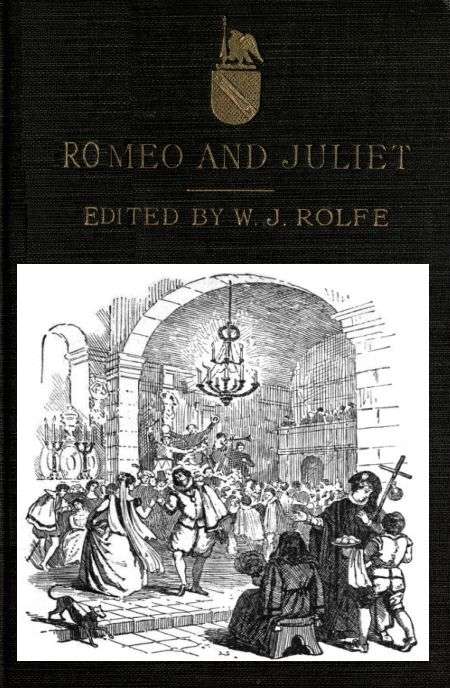
Capulet. Things have fallen out, sir, so unluckily
That we have had no time to move our daughter.
Look you, she lov'd her kinsman Tybalt dearly,
And so did I.—Well, we were born to die.—
'Tis very late, she'll not come down to-night;
I promise you, but for your company,
I would have been a-bed an hour ago.
10
Lady Capulet. I will, and know her mind early to-morrow;
To-night she's mew'd up to her heaviness.
Capulet. Sir Paris, I will make a desperate tender
Of my child's love. I think she will be rul'd
In all respects by me; nay, more, I doubt it not.—
Wife, go you to her ere you go to bed;
Acquaint her here of my son Paris' love,
And bid her, mark you me, on Wednesday next—
But, soft! what day is this?
Paris.Monday, my lord.
Capulet. Monday! ha, ha! Well, Wednesday is too soon.
20
O' Thursday let it be; o' Thursday, tell her,
She shall be married to this noble earl.
Will you be ready? do you like this haste?
We'll keep no great ado,—a friend or two;
For, hark you, Tybalt being slain so late,
It may be thought we held him carelessly,
Being our kinsman, if we revel much.
Therefore we'll have some half a dozen friends,
And there an end. But what say you to Thursday?
Paris. My lord, I would that Thursday were to-morrow.
Scene V.
Enter Romeo and Juliet
Juliet. Wilt thou be gone? it is not yet near day.
It was the nightingale, and not the lark,
That pierc'd the fearful hollow of thine ear;
Nightly she sings on yon pomegranate-tree.
Believe me, love, it was the nightingale.
Romeo. It was the lark, the herald of the morn,
No nightingale; look, love, what envious streaks
Do lace the severing clouds in yonder east.
Night's candles are burnt out, and jocund day
10
Stands tiptoe on the misty mountain tops.
I must be gone and live, or stay and die.
Juliet. Yon light is not daylight, I know it, I.
It is some meteor that the sun exhales,
To be to thee this night a torch-bearer
And light thee on thy way to Mantua;
Therefore stay yet, thou need'st not to be gone.
Romeo. Let me be ta'en, let me be put to death;
I am content, so thou wilt have it so.
I'll say yon grey is not the morning's eye,
20
'Tis but the pale reflex of Cynthia's brow;
Nor that is not the lark, whose notes do beat
The vaulty heaven so high above our heads.
I have more care to stay than will to go;
Come, death, and welcome! Juliet wills it so.
How is 't, my soul? let's talk, it is not day.
Juliet. It is, it is; hie hence, be gone, away!
It is the lark that sings so out of tune,
Straining harsh discords and unpleasing sharps.
30
This doth not so, for she divideth us.
Some say the lark and loathed toad change eyes;
O, now I would they had chang'd voices too!
Since arm from arm that voice doth us affray,
Hunting thee hence with hunt's-up to the day.
O, now be gone; more light and light it grows.
Romeo. More light and light?—More dark and
dark our woes!
Enter Nurse
Nurse. Madam!
Juliet. Nurse?
Nurse. Your lady mother is coming to your chamber.
The day is broke; be wary, look about. [Exit.
41
Juliet. Then, window, let day in, and let life out.
Romeo. Farewell, farewell! one kiss, and I'll descend. [Romeo descends.
Juliet. Art thou gone so? my lord, my love, my friend!
I must hear from thee every day in the hour,
For in a minute there are many days.
O, by this count I shall be much in years
Ere I again behold my Romeo!
Romeo. Farewell! I will omit no opportunity
That may convey my greetings, love, to thee.
50
Juliet. O, think'st thou we shall ever meet again?
Romeo. I doubt it not; and all these woes shall serve
For sweet discourses in our time to come.
Juliet. O God, I have an ill-divining soul!
Methinks I see thee, now thou art below,
As one dead in the bottom of a tomb;
Either my eyesight fails, or thou look'st pale.
Romeo. And trust me, love, in my eye so do you;
Juliet. O Fortune, Fortune! all men call thee fickle;
60
If thou art fickle, what dost thou with him
That is renown'd for faith? Be fickle, Fortune;
For then, I hope, thou wilt not keep him long,
But send him back.
Lady Capulet. [Within] Ho, daughter! are you up?
Juliet. Who is 't that calls? is it my lady mother?
Is she not down so late, or up so early?
What unaccustom'd cause procures her hither?
Enter Lady Capulet
Lady Capulet. Why, how now, Juliet!
Juliet.Madam, I am not well.
Lady Capulet. Evermore weeping for your cousin's death?
What, wilt thou wash him from his grave with tears?
70
An if thou couldst, thou couldst not make him live;
Therefore, have done. Some grief shows much of love,
But much of grief shows still some want of wit.
Juliet. Yet let me weep for such a feeling loss.
Lady Capulet. So shall you feel the loss, but not the friend
Which you weep for.
Juliet.Feeling so the loss,
I cannot choose but ever weep the friend.
Lady Capulet. Well, girl, thou weep'st not so much for his death
As that the villain lives which slaughter'd him.
Juliet. What villain, madam?
Lady Capulet.That same villain, Romeo.
80
Juliet. Villain and he be many miles asunder.—
God pardon him! I do, with all my heart;
And yet no man like he doth grieve my heart.
Lady Capulet. That is, because the traitor murtherer lives.
Juliet. Ay, madam, from the reach of these my hands.
Would none but I might venge my cousin's death!
Lady Capulet. We will have vengeance for it, fear thou not;
Then weep no more. I'll send to one in Mantua,
Where that same banish'd runagate doth live,
Shall give him such an unaccustom'd dram
90
That he shall soon keep Tybalt company;
And then, I hope, thou wilt be satisfied.
Juliet. Indeed, I never shall be satisfied
With Romeo, till I behold him—dead—
Is my poor heart so for a kinsman vex'd.—
Madam, if you could find out but a man
To bear a poison, I would temper it,
That Romeo should, upon receipt thereof,
Soon sleep in quiet. O, how my heart abhors
To hear him nam'd, and cannot come to him,
100
To wreak the love I bore my cousin
Upon his body that hath slaughter'd him!
Lady Capulet. Find thou the means, and I'll find such a man.
But now I'll tell thee joyful tidings, girl.
Lady Capulet. Well, well, thou hast a careful father, child;
One who, to put thee from thy heaviness,
Hath sorted out a sudden day of joy
That thou expect'st not, nor I look'd not for.
110
Juliet. Madam, in happy time, what day is that?
Lady Capulet. Marry, my child, early next Thursday morn,
The gallant, young, and noble gentleman,
The County Paris, at Saint Peter's Church,
Shall happily make thee there a joyful bride.
Juliet. Now, by Saint Peter's Church and Peter too,
He shall not make me there a joyful bride.
I wonder at this haste; that I must wed
Ere he that should be husband comes to woo.
I pray you, tell my lord and father, madam,
120
I will not marry yet; and, when I do, I swear,
It shall be Romeo, whom you know I hate,
Rather than Paris. These are news indeed!
Lady Capulet. Here comes your father; tell him so yourself,
And see how he will take it at your hands.
Enter Capulet and Nurse
Capulet. When the sun sets, the air doth drizzle dew;
But for the sunset of my brother's son
It rains downright.—
How now! a conduit, girl? what, still in tears?
Evermore showering? In one little body
130
Thou counterfeit'st a bark, a sea, a wind:
For still thy eyes, which I may call the sea,
Do ebb and flow with tears; the bark thy body is,
Sailing in this salt flood; the winds, thy sighs,
Who, raging with thy tears, and they with them,
Without a sudden calm, will overset
Thy tempest-tossed body.—How now, wife!
Have you deliver'd to her our decree?
Lady Capulet. Ay, sir; but she will none, she gives you thanks.
I would the fool were married to her grave!
140
Capulet. Soft! take me with you, take me with you, wife.
How! will she none? doth she not give us thanks?
Is she not proud? doth she not count her blest,
Unworthy as she is, that we have wrought
So worthy a gentleman to be her bridegroom?
Juliet. Not proud you have, but thankful that you have;
Proud can I never be of what I hate,
But thankful even for hate that is meant love.
Capulet. How now, how now, chop-logic! What is this?
'Proud' and 'I thank you' and 'I thank you not,'
150
And yet 'not proud'! Mistress minion, you,
Thank me no thankings, nor proud me no prouds,
But fettle your fine joints 'gainst Thursday next,
To go with Paris to Saint Peter's Church,
Or I will drag thee on a hurdle thither.
Out, you green-sickness carrion! out, you baggage!
You tallow-face!
Lady Capulet. Fie, fie! what, are you mad?
Juliet. Good father, I beseech you on my knees,
Hear me with patience but to speak a word.
Capulet. Hang thee, young baggage! disobedient wretch!
160
I tell thee what, get thee to church o' Thursday
Or never after look me in the face.
Speak not, reply not, do not answer me;
My fingers itch.—Wife, we scarce thought us blest
That God had lent us but this only child,
But now I see this one is one too much,
And that we have a curse in having her;
Out on her, hilding!
Capulet. And why, my lady wisdom? hold your tongue,
170
Good prudence; smatter with your gossips, go.
Nurse. I speak no treason.
Capulet.O, God ye god-den!
Nurse. May not one speak?
Lady Capulet.You are too hot.
Capulet. God's bread! it makes me mad! Day, night, late, early,
At home, abroad, alone, in company,
Waking, or sleeping, still my care hath been
To have her match'd; and having now provided
A gentleman of noble parentage,
180
Of fair demesnes, youthful, and nobly train'd,
Stuff'd, as they say, with honourable parts,
Proportion'd as one's thought would wish a man,—
And then to have a wretched puling fool,
A whining mammet, in her fortune's tender,
To answer 'I'll not wed; I cannot love,
I am too young; I pray you, pardon me.'—
But, an you will not wed, I'll pardon you;
Graze where you will, you shall not house with me.
Look to 't, think on 't, I do not use to jest.
190
Thursday is near; lay hand on heart, advise.
An you be mine, I'll give you to my friend;
An you be not, hang, beg, starve, die in the streets,
For, by my soul, I'll ne'er acknowledge thee,
Nor what is mine shall never do thee good.
Trust to 't, bethink you; I'll not be forsworn. [Exit.
Juliet. Is there no pity sitting in the clouds,
That sees into the bottom of my grief?
O, sweet my mother, cast me not away!
Delay this marriage for a month, a week;
200
Or, if you do not, make the bridal bed
In that dim monument where Tybalt lies.
Lady Capulet. Talk not to me, for I'll not speak a word;
Do as thou wilt, for I have done with thee. [Exit.
Juliet. O God!—O nurse, how shall this be prevented?
My husband is on earth, my faith in heaven;
How shall that faith return again to earth,
Unless that husband send it me from heaven
By leaving earth? comfort me, counsel me.—
Alack, alack, that heaven should practise stratagems
210
Upon so soft a subject as myself!—
What say'st thou? hast thou not a word of joy?
Some comfort, nurse.
Nurse.Faith, here 'tis. Romeo
Is banished, and all the world to nothing
That he dares ne'er come back to challenge you;
Or, if he do, it needs must be by stealth.
Then, since the case so stands as now it doth,
I think it best you married with the county.
O, he's a lovely gentleman!
Romeo's a dishclout to him; an eagle, madam,
220
Hath not so green, so quick, so fair an eye
As Paris hath. Beshrew my very heart,
I think you are happy in this second match,
For it excels your first; or if it did not,
Your first is dead, or 'twere as good he were
As living here and you no use of him.
Juliet. Speakest thou from thy heart?
Nurse.And from my soul too;
Or else beshrew them both.
Juliet.Amen!
Nurse.What?
Juliet. Well, thou hast comforted me marvellous much.
Go in, and tell my lady I am gone,
230
Having displeas'd my father, to Laurence' cell,
To make confession and to be absolv'd.
Nurse. Marry, I will; and this is wisely done. [Exit.
Juliet. Ancient damnation! O most wicked fiend!
Is it more sin to wish me thus forsworn,
Or to dispraise my lord with that same tongue
Which she hath prais'd him with above compare
So many thousand times?—Go, counsellor;
Thou and my bosom henceforth shall be twain.—
I'll to the friar, to know his remedy;
If all else fail, myself have power to die. [Exit.
Juliet at Laurence's Cell.
ACT IV
Scene I.
Friar Laurence's Cell
Enter Friar Laurence and Paris
Friar Laurence. On Thursday, sir? the time is very short.
Paris. My father Capulet will have it so,
Friar Laurence. You say you do not know the lady's mind;
Friar Laurence. You say you do not know the lady's mind;
Uneven is the course, I like it not.
Paris. Immoderately she weeps for Tybalt's death,
And therefore have I little talk'd of love;
For Venus smiles not in a house of tears.
Now, sir, her father counts it dangerous
10
That she doth give her sorrow so much sway,
To stop the inundation of her tears,
Which, too much minded by herself alone,
May be put from her by society.
Now do you know the reason of this haste.
Look, sir, here comes the lady towards my cell.
Enter Juliet
Juliet. That may be, sir, when I may be a wife.
20
Paris. That may be must be, love, on Thursday next.
Juliet. What must be shall be.
Friar Laurence.That's a certain text.
Paris. Come you to make confession to this father?
Juliet. To answer that, I should confess to you.
Paris. Do not deny to him that you love me.
Juliet. I will confess to you that I love him.
Paris. So will you, I am sure, that you love me.
Juliet. If I do so, it will be of more price,
Being spoke behind your back, than to your face.
Paris. Poor soul, thy face is much abus'd with tears.
Paris. Thou wrong'st it more than tears with that report.
Juliet. That is no slander, sir, which is a truth;
And what I spake, I spake it to my face.
Paris. Thy face is mine, and thou hast slander'd it.
Juliet. It may be so, for it is not mine own.—
Are you at leisure, holy father, now,
Or shall I come to you at evening mass?
Friar Laurence. My leisure serves me, pensive daughter, now.—
40
My lord, we must entreat the time alone.
Juliet, on Thursday early will I rouse ye;
Till then, adieu, and keep this holy kiss. [Exit.
Juliet. O, shut the door! and when thou hast done so,
Come weep with me; past hope, past cure, past help!
Friar Laurence. Ah, Juliet, I already know thy grief;
It strains me past the compass of my wits.
I hear thou must, and nothing may prorogue it,
On Thursday next be married to this county.
50
Juliet. Tell me not, friar, that thou hear'st of this,
Unless thou tell me how I may prevent it;
If in thy wisdom thou canst give no help,
Do thou but call my resolution wise,
And with this knife I'll help it presently.
God join'd my heart and Romeo's, thou our hands;
And ere this hand, by thee to Romeo seal'd,
Shall be the label to another deed,
Or my true heart with treacherous revolt
Turn to another, this shall slay them both.
60
Therefore, out of thy long-experienc'd time,
Give me some present counsel, or, behold,
'Twixt my extremes and me this bloody knife
Shall play the umpire, arbitrating that
Which the commission of thy years and art
Could to no issue of true honour bring.
Be not so long to speak; I long to die,
If what thou speak'st speak not of remedy.
Friar Laurence. Hold, daughter! I do spy a kind of hope,
Which craves as desperate an execution
70
As that is desperate which we would prevent.
If, rather than to marry County Paris,
Thou hast the strength of will to slay thyself,
Then is it likely thou wilt undertake
A thing like death to chide away this shame
That cop'st with death himself to scape from it;
And, if thou dar'st, I'll give thee remedy.
Juliet. O, bid me leap, rather than marry Paris,
From off the battlements of yonder tower;
Or walk in thievish ways; or bid me lurk
80
Where serpents are; chain me with roaring bears;
Or shut me nightly in a charnel-house,
O'er-cover'd quite with dead men's rattling bones,
With reeky shanks and yellow chapless skulls;
Or bid me go into a new-made grave
And hide me with a dead man in his shroud,—
Things, that to hear them told, have made me tremble,—
And I will do it without fear or doubt,
To live an unstain'd wife to my sweet love.
Friar Laurence. Hold, then; go home, be merry, give consent
90
To marry Paris. Wednesday is to-morrow.
To-morrow night look that thou lie alone;
Let not thy nurse lie with thee in thy chamber.
Take thou this vial, being then in bed,
And this distilled liquor drink thou off;
When presently through all thy veins shall run
A cold and drowsy humour, for no pulse
Shall keep his native progress but surcease.
No warmth, no breath, shall testify thou livest;
The roses in thy lips and cheeks shall fade
100
To paly ashes, thy eyes' windows fall,
Like death, when he shuts up the day of life;
Each part, depriv'd of supple government,
Shall, stiff and stark and cold, appear like death;
And in this borrow'd likeness of shrunk death
Thou shalt continue two and forty hours,
And then awake as from a pleasant sleep.
Now, when the bridegroom in the morning comes
To rouse thee from thy bed, there art thou dead.
Then, as the manner of our country is,
110
In thy best robes uncover'd on the bier
Thou shalt be borne to that same ancient vault
Where all the kindred of the Capulets lie.
In the mean time, against thou shalt awake,
Shall Romeo by my letters know our drift,
And hither shall he come; and he and I
Will watch thy waking, and that very night
Shall Romeo bear thee hence to Mantua.
And this shall free thee from this present shame,
If no inconstant toy nor womanish fear
120
Abate thy valour in the acting it.
Juliet. Give me, give me! O, tell not me of fear!
Friar Laurence. Hold; get you gone, be strong and prosperous
In this resolve. I'll send a friar with speed
To Mantua, with my letters to thy lord.
Juliet. Love give me strength! and strength shall help afford.
Farewell, dear father! [Exeunt.
Scene II.
Hall in Capulet's House
Enter Capulet, Lady Capulet, Nurse, and two Servingmen