
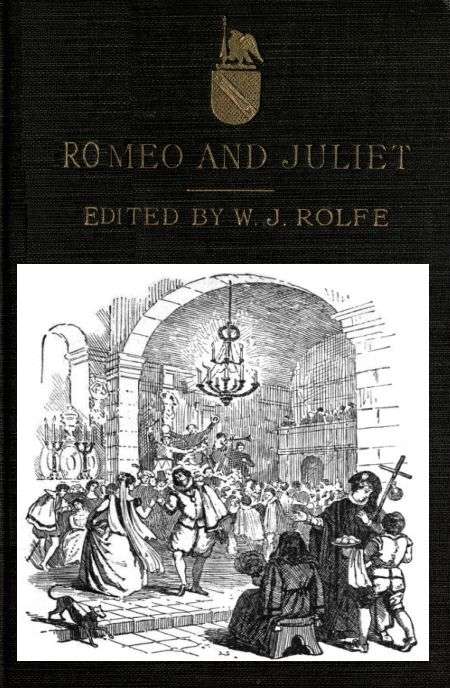
The Nurse and Peter
NOTES
Introduction
The Metre of the Play.—It should be understood at the outset that metre, or the mechanism of verse, is something altogether distinct from the music of verse. The one is matter of rule, the other of taste and feeling. Music is not an absolute necessity of verse; the metrical form is a necessity, being that which constitutes the verse.
The plays of Shakespeare (with the exception of rhymed passages, and of occasional songs and interludes) are all in unrhymed or blank verse; and the normal form of this blank verse is illustrated by the second line of the prologue to the present play: "In fair Verona, where we lay our scene."
This line, it will be seen, consists of ten syllables, with the even syllables (2d, 4th, 6th, 8th, and 10th) accented, the odd syllables (1st, 3d, etc.) being unaccented. Theoretically, it is made up of five feet of two syllables each, with the accent on the second syllable. Such a foot is called an iambus (plural, iambuses, or the Latin iambi), and the form of verse is called iambic.
This fundamental law of Shakespeare's verse is subject to certain modifications, the most important of which are as follows:—
1. After the tenth syllable an unaccented syllable (or even two such syllables) may be added, forming what is sometimes called a female line; as in the 103d line of the first scene: "Here were the servants of your adversary." The rhythm is complete with the third syllable of adversary, the fourth being an extra eleventh syllable. In iv. 3. 27 and v. 3. 256 we have two extra syllables,—the last two of Romeo in both lines.
2. The accent in any part of the verse may be shifted from an even to an odd syllable; as in line 3 of the prologue, "From ancient grudge break to new mutiny," where the accent is shifted from the sixth to the fifth syllable. See also i. 1. 92: "Canker'd with peace, to part your canker'd hate;" where the accent is shifted from the second to the first syllable. This change occurs very rarely in the tenth syllable, and seldom in the fourth; and it is not allowable in two successive accented syllables.
3. An extra unaccented syllable may occur in any part of the line; as in line 7 of the prologue, where the second syllable of piteous is superfluous. In i. 1. 64 the third syllable of Benvolio, and in line 71 below the second syllable of Capulets and the second the are both superfluous.
4. Any unaccented syllable, occurring in an even place immediately before or after an even syllable which is properly accented, is reckoned as accented for the purposes of the verse; as, for instance, in lines 1, 3, and 7 of the prologue. In 1 the last syllable of dignity and in 3 the last of mutiny are metrically equivalent to accented syllables. In 7 the same is true of the first syllable of misadventur'd and the third of overthrows. In iv. 2. 18 ("Of disobedient opposition") only two regular accents occur, but we have a metrical accent on the first syllable of disobedient, and on the first and the last syllables of opposition, which word has metrically five syllables. In disobedient there is an extra unaccented syllable.
5. In many instances in Shakespeare words must be lengthened in order to fill out the rhythm:—
(a) In a large class of words in which e or i is followed by another vowel, the e or i is made a separate syllable; as ocean, opinion, soldier, patience, partial, marriage, etc. For instance, iii. 5. 29 ("Some say the lark makes sweet division") appears to have only nine syllables, but division is a quadrisyllable; and so is devotion in iv. 1. 41: "God shield I should disturb devotion!" Marriage is a trisyllable in iv. 1. 11, and also in v. 3. 241; and the same is true of patience in v. 1. 27 v. 1. 27, v. 3. 221 and 261. This lengthening occurs most frequently at the end of the line.
(b) Many monosyllables ending in r, re, rs, res, preceded by a long vowel or diphthong, are often made dissyllables; as fare, fear, dear, fire, hair, hour, your, etc. In iii. 1. 198: "Else, when he's found, that hour is his last," hour is a dissyllable. If the word is repeated in a verse it is often both monosyllable and dissyllable; as in M. of V. iii. 2. 20: "And so, though yours, not yours. Prove it so," where either yours (preferably the first) is a dissyllable, the other being a monosyllable. In J.C. iii. 1. 172: "As fire drives fire, so pity, pity," the first fire is a dissyllable.
(c) Words containing l or r, preceded by another consonant, are often pronounced as if a vowel came between the consonants; as in i. 4. 8: "After the prompter, at our entrance" [ent(e)rance]. See also T. of S. ii. 1. 158: "While she did call me rascal fiddler" [fidd(e)ler]; All's Well, iii. 5. 43: "If you will tarry, holy pilgrim" [pilg(e)rim]; C. of E. v. 1. 360: "These are the parents of these children" (childeren, the original form of the word); W.T. iv. 4. 76: "Grace and remembrance [rememb(e)rance] be to you both!" etc. See also on ii. 4. 184 and iii. 1. 89 below.
(d) Monosyllabic exclamations (ay, O, yea, nay, hail, etc.) and monosyllables otherwise emphasized are similarly lengthened; also certain longer words; as commandement in M. of V. iv. 1. 442; safety (trisyllable) in Ham. i. 3. 21; business (trisyllable, as originally pronounced) in J.C. iv. 1. 22: "To groan and sweat under the business" (so in several other passages); and other words mentioned in the notes to the plays in which they occur.
6. Words are also contracted for metrical reasons, like plurals and possessives ending in a sibilant, as balance, horse (for horses and horse's), princess, sense, marriage (plural and possessive), image, etc. So spirit, inter'gatories, unpleasant'st, and other words mentioned in the notes on the plays.
7. The accent of words is also varied in many instances for metrical reasons. Thus we find both révenue and revénue in the first scene of the M.N.D. (lines 6 and 158), óbscure and obscúre, púrsue and pursúe, cóntrary (see note on iii. 2. 64) and contráry, contráct (see on ii. 2. 117) and cóntract, etc.
These instances of variable accent must not be confounded with those in which words were uniformly accented differently in the time of Shakespeare; like aspéct, impórtune (see on i. 1. 142), perséver (never persevére), perséverance, rheúmatic, etc.
8. Alexandrines, or verses of twelve syllables, with six accents, occur here and there; as in the inscriptions on the caskets in M. of V., and occasionally in this play. They must not be confounded with female lines with two extra syllables (see on 1 above) or with other lines in which two extra unaccented syllables may occur.
9. Incomplete verses, of one or more syllables, are scattered through the plays. See i. 1. 61, 69, 162, 163, 164, 198, etc.
10. Doggerel measure is used in the very earliest comedies (L. L. L. and C. of E. in particular) in the mouths of comic characters, but nowhere else in those plays, and never anywhere after 1597 or 1598. There is no instance of it in this play.
11. Rhyme occurs frequently in the early plays, but diminishes with comparative regularity from that period until the latest. Thus, in L. L. L. there are about 1100 rhyming verses (about one-third of the whole number), in the M.N.D. about 900, and in Rich. II. about 500, while in Cor. and A. and C. there are only about 40 each, in the Temp. only two, and in the W.T. none at all, except in the chorus introducing act iv. Songs, interludes, and other matter not in ten-syllable measure are not included in this enumeration. In the present play, out of about 2500 ten-syllable verses, nearly 500 are in rhyme.
Alternate rhymes are found only in the plays written before 1599 or 1600. In the M. of V. there are only four lines at the end of iii. 2. In Much Ado and A.Y.L., we also find a few lines, but none at all in subsequent plays. Examples in this play are the prologue, the chorus at the beginning of act ii., and the last speech of act. v. See also passages in i. 2, i. 5, and v. 3.
Rhymed couplets or "rhyme-tags" are often found at the end of scenes; as in the first scene, and eleven other scenes, of the present play. In Ham. 14 out of 20 scenes, and in Macb. 21 out of 28, have such "tags"; but in the latest plays they are not so frequent. The Temp., for instance, has but one, and the W.T. none.
12. In this edition of Shakespeare, the final -ed of past tenses and participles is printed -'d when the word is to be pronounced in the ordinary way; as in star-cross'd, line 6, and misadventur'd, line 7, of the prologue. But when the metre requires that the -ed be made a separate syllable, the e is retained; as in moved, line 85, of the first scene, where the word is a dissyllable. The only variation from this rule is in verbs like cry, die, sue, etc., the -ed of which is very rarely made a separate syllable.
Shakespeare's Use of Verse and Prose in the Plays.—This is a subject to which the critics have given very little attention, but it is an interesting study. In this play we find scenes entirely in verse (none entirely in prose) and others in which the two are mixed. In general, we may say that verse is used for what is distinctly poetical, and prose for what is not poetical. The distinction, however, is not so clearly marked in the earlier as in the later plays. The second scene of the M. of V., for instance, is in prose, because Portia and Nerissa are talking about the suitors in a familiar and playful way; but in the T.G. of V., where Julia and Lucetta are discussing the suitors of the former in much the same fashion, the scene is in verse. Dowden, commenting on Rich. II., remarks: "Had Shakespeare written the play a few years later, we may be certain that the gardener and his servants (iii. 4) would not have uttered stately speeches in verse, but would have spoken homely prose, and that humour would have mingled with the pathos of the scene. The same remark may be made with reference to the subsequent scene (v. 5) in which his groom visits the dethroned king in the Tower." Comic characters and those in low life generally speak in prose in the later plays, as Dowden intimates, but in the very earliest ones doggerel verse is much used instead. See on 10 above.
The change from prose to verse is well illustrated in the third scene of the M. of V. It begins with plain prosaic talk about a business matter; but when Antonio enters, it rises at once to the higher level of poetry. The sight of Antonio reminds Shylock of his hatred of the Merchant, and the passion expresses itself in verse, the vernacular tongue of poetry. We have a similar change in the first scene of J.C., where, after the quibbling "chaff" of the mechanics about their trades, the mention of Pompey reminds the Tribune of their plebeian fickleness, and his scorn and indignation flame out in most eloquent verse.
The reasons for the choice of prose or verse are not always so clear as in these instances. We are seldom puzzled to explain the prose, but not unfrequently we meet with verse where we might expect prose. As Professor Corson remarks (Introduction to Shakespeare, 1889), "Shakespeare adopted verse as the general tenor of his language, and therefore expressed much in verse that is within the capabilities of prose; in other words, his verse constantly encroaches upon the domain of prose, but his prose can never be said to encroach upon the domain of verse." If in rare instances we think we find exceptions to this latter statement, and prose actually seems to usurp the place of verse, I believe that careful study of the passage will prove the supposed exception to be apparent rather than real.
Some Books for Teachers and Students.—A few out of the many books that might be commended to the teacher and the critical student are the following: Halliwell-Phillipps's Outlines of the Life of Shakespeare (7th ed. 1887); Sidney Lee's Life of Shakespeare (1898; for ordinary students the abridged ed. of 1899 is preferable); Schmidt's Shakespeare Lexicon (3d ed. 1902); Littledale's ed. of Dyce's Glossary (1902); Bartlett's Concordance to Shakespeare (1895); Abbott's Shakespearian Grammar (1873); Furness's "New Variorum" ed. of Romeo and Juliet (1871; encyclopædic and exhaustive); Dowden's Shakspere: His Mind and Art (American ed. 1881); Hudson's Life, Art, and Characters of Shakespeare (revised ed. 1882); Mrs. Jameson's Characteristics of Women (several eds., some with the title, Shakespeare Heroines); Ten Brink's Five Lectures on Shakespeare (1895); Boas's Shakespeare and His Predecessors (1895); Dyer's Folk-lore of Shakespeare (American ed. 1884); Gervinus's Shakespeare Commentaries (Bunnett's translation, 1875); Wordsworth's Shakespeare's Knowledge of the Bible (3d ed. 1880); Elson's Shakespeare in Music (1901).
Some of the above books will be useful to all readers who are interested in special subjects or in general criticism of Shakespeare. Among those which are better suited to the needs of ordinary readers and students, the following may be mentioned: Mabie's William Shakespeare: Poet, Dramatist, and Man (1900); Phin's Cyclopædia and Glossary of Shakespeare (1902; more compact and cheaper than Dyce); Dowden's Shakspere Primer (1877; small but invaluable); Rolfe's Shakespeare the Boy (1896; treating of the home and school life, the games and sports, the manners, customs, and folk-lore of the poet's time); Guerber's Myths of Greece and Rome (for young students who may need information on mythological allusions not explained in the notes).
Black's Judith Shakespeare (1884; a novel, but a careful study of the scene and the time) is a book that I always commend to young people, and their elders will also enjoy it. The Lambs' Tales from Shakespeare is a classic for beginners in the study of the dramatist; and in Rolfe's ed. the plan of the authors is carried out in the Notes by copious illustrative quotations from the plays. Mrs. Cowden-Clarke's Girlhood of Shakespeare's Heroines (several eds.) will particularly interest girls; and both girls and boys will find Bennett's Master Skylark (1897) and Imogen Clark's Will Shakespeare's Little Lad (1897) equally entertaining and instructive.
H. Snowden Ward's Shakespeare's Town and Times (2d ed. 1903) and John Leyland's Shakespeare Country (enlarged ed. 1903) are copiously illustrated books (yet inexpensive) which may be particularly commended for school libraries.
Abbreviations in the Notes.—The abbreviations of the names of Shakespeare's plays will be readily understood; as T.N. for Twelfth Night, Cor. for Coriolanus, 3 Hen. VI. for The Third Part of King Henry the Sixth, etc. P.P. refers to The Passionate Pilgrim; V. and A. to Venus and Adonis; L.C. to Lover's Complaint; and Sonn. to the Sonnets.
Other abbreviations that hardly need explanation are Cf. (confer, compare), Fol. (following), Id. (idem, the same), and Prol. (prologue). The numbers of the lines in the references (except for the present play) are those of the "Globe" edition (the cheapest and best edition of Shakespeare in one compact volume), which is now generally accepted as the standard for line-numbers in works of reference (Schmidt's Lexicon, Abbott's Grammar, Dowden's Primer, the publications of the New Shakspere Society, etc.). Every teacher and every critical student should have it at hand for reference.
PROLOGUE
Enter Chorus. As Malone suggests, this probably meant only that the prologue was to be spoken by the same actor that personated the chorus at the end of act i. The prologue is omitted in the folio, but we cannot doubt that it was written by S. It is in form a sonnet, of the pattern adopted in his Sonnets. See comments upon it, p. 22 above.
2. Fair Verona. The city is thus described in the opening lines of Brooke's poem:[4]—