
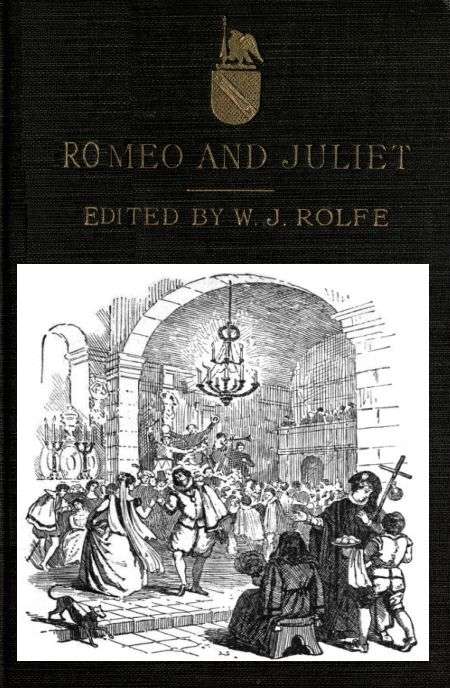
6. Star-cross'd. For the astrological allusion, cf. i. 4. 104, v. 1. 24, and v. 3. 111 below. The title of one of Richard Braithwaite's works, published in 1615, is "Love's Labyrinth: or the True Lover's Knot, including the disastrous falls of two Star-crost lovers Pyramus and Thisbe."
8. Doth. The reading of the quartos, changed by most of the modern editors to "Do." Ulrici considers it the old third person plural in -th. He adds that S. mostly uses it only where it has the force of the singular, namely, where the sense is collective, as in overthrows here. Cf. v. 1. 70 below.
12. Two hours. Cf. Hen. VIII. prol. 13: "may see away their shilling Richly in two short hours."
ACT I
Scene I.—
1. Carry coals. "Endure affronts" (Johnson). According to Nares, the phrase got this meaning from the fact that the carriers of wood and coals were esteemed the very lowest of menials. Cf. Hen. V. iii. 2. 49, where there is a play upon the expression. Steevens quotes Nash, Have With You, etc.: "We will bear no coles, I warrant you;" Marston, Antonio and Mellida, part ii.: "He has had wrongs; and if I were he I would bear no coles," etc. Dyce cites Cotgrave, Fr. Dict.: "Il a du feu en la teste. Hee is very chollericke, furious, or couragious; he will carrie no coales." He might have added from Sherwood's English-French supplement to Cotgrave (ed. 1632): "That will carrie no coales, Brave."
3. Colliers. The preceding note explains how colliers came to be a term of abuse. The New Eng. Dict. adds that it may have been due to "the evil repute of the collier for cheating." Steevens compares T.N. iii. 4. 130: "hang him, foul collier!"
4. Choler. For the play upon the word, cf. Jonson, Every Man in his Humour, iii. 2:—
"Cash. Why, how now, Cob? what moves thee to this cholar, ha?
Cob. Collar, master Thomas? I scorn your collar, I sir; I am none of your cart-horse, though I carry and draw water."
15. Take the wall. Claim the right of passing next the wall when meeting a person on the street; a right valued in old-fashioned streets with narrow sidewalks or none at all. To give the wall was an act of courtesy; to take the wall might be an insult.
17. The weakest goes to the wall. A familiar proverb.
28. Here comes two, etc. Halliwell-Phillipps remarks that the partisans of the Montagues wore a token in their hats to distinguish them from the Capulets; hence throughout the play they are known at a distance. Cf. Gascoigne, Devise of a Masque, written for Viscount Montacute, 1575:—
39. I will bite my thumb at them. An insult explained by Cotgrave, Fr. Dict. (ed. 1632): "Nique, faire la nique, to threaten or defie, by putting the thumbe naile into the mouth, and with a ierke (from th' upper teeth) make it to knocke."
44. Of our side. On our side (on = of, as often).
55. Here comes one, etc. "Gregory may mean Tybalt, who enters directly after Benvolio, but on a different part of the stage. The eyes of the servant may be directed the way he sees Tybalt coming, and in the mean time Benvolio enters on the opposite side" (Steevens).
60. Swashing blow. A dashing or smashing blow (Schmidt). Cf. Jonson, Staple of News, v. 1: "I do confess a swashing blow." Cf. also swash = bully, bluster; as in A.Y.L. i. 3. 122: "I'll have a martial and a swashing outside."
63. Art thou drawn? Cf. Temp. ii. 1. 308: "Why are you drawn?" Heartless = cowardly, spiritless; as in R. of L. 471, 1392.
69. Have at thee. Cf. iv. 5. 119 below; also C. of E. iii. 1. 51, etc.
70. Clubs. The cry of Clubs! in a street affray is of English origin, as the bite my thumb is of Italian. It was the rallying-cry of the London apprentices. Cf. Hen. VIII. v. 4. 53, A.Y.L. v. 2. 44, etc. Bills were the pikes or halberds formerly carried by the English infantry and afterwards by watchmen. The partisan was "a sharp two-edged sword placed on the summit of a staff for the defence of foot-soldiers against cavalry" (Fairholt). Cf. Ham. i. 1. 140: "Shall I strike at it with my partisan?"
71. Enter Capulet in his gown. Cf. Ham. (quarto) iii. 4. 61: "Enter the ghost in his night gowne;" that is, his dressing-gown. See also Macb. ii. 2. 70: "Get on your nightgown, lest occasion call us And show us to be watchers;" and Id. v. 1. 5: "I have seen her rise from her bed, throw her nightgown upon her," etc. It is early morning, and Capulet comes out before he is dressed.
72. Long sword. The weapon used in active warfare; a lighter and shorter one being worn for ornament (see A.W. ii. 1. 32: "no sword worn But one to dance with"). Cf. M.W. ii. 1. 236: "with my long sword I would have made you four tall fellows skip like rats."
73. A crutch, a crutch! The lady's sneer at her aged husband. For her own age, see on i. 3. 51 below.
75. In spite. In scornful defiance. Cf. 3 Hen. VI. i. 3. 158, Cymb. iv. 1. 16, etc.
79. Neighbour-stained. Because used in civil strife.
84. Mistemper'd. Tempered to an ill end (Schmidt). Steevens explains it as = angry. The word occurs again in K. John, v. 1. 12: "This inundation of mistemper'd humour."
85. Moved. That is, "mov'd to wrath" (T.A. i. 1. 419). Cf. L. L. L. v. 2. 694, J.C. iv. 3. 58, etc.
89. Ancient. Not of necessity old in years, but long settled there and accustomed to peace and order (Delius).
90. Grave beseeming. Grave and becoming. Cf. Ham. iv. 7. 79:—
92. Canker'd with peace, etc. Canker'd (= corroded) is applied literally to the partisans long disused, and figuratively to their owners. Cf. K. John, ii. 1. 194: "A canker'd grandam's will."
99. Freetown. S. takes the name from Brooke's poem. It translates the Villa Franca of the Italian story.
101. S. uses set abroach only in a bad sense. Cf. 2 Hen. IV. iv. 2. 14: "Alack, what mischiefs might be set abroach;" and Rich. III. i. 3. 325: "The secret mischiefs that I set abroach."
109. Nothing hurt withal. Nowise harmed by it. Who = which; as often.
110. While we, etc. This line, with the change of we to they, is found in the 1st quarto in iii. 1, where Benvolio describes the brawl in which Mercutio and Tybalt are slain (Daniel).
113. Saw you him to-day? This use of the past tense is not allowable now, but was common in Elizabethan English. Cf. Cymb. iv. 2. 66: "I saw him not these many years," etc.
115. The worshipp'd sun. Cf. iii. 2. 25 below: "And pay no worship to the garish sun." See also Lear, i. 1. 111: "the sacred radiance of the sun;" and Cymb. iv. 4. 41: "the holy sun." It is remarkable that no German commentator has tried to make S. a Parsee.
116. Forth. Cf. M.N.D. i. 1. 164: "Steal forth thy father's house," etc.
118. Sycamore. According to Beisly and Ellacombe, the Acer pseudo-platanus, which grows wild in Italy. It had been introduced into England before the time of S. He mentions it also in L. L. L. v. 2. 89 and Oth. iv. 3. 41.
119. Rooteth. Cf. W.T. i. 1. 25: "there rooted betwixt them such an affection," etc.
121. Ware. Aware; but not to be printed as a contraction of that word. Cf. ii. 2. 103 below.
123. Affections. Feelings, inclinations. Cf. Ham. iii. 1. 170: "Love! his affections do not that way tend," etc.
124. Which then, etc. "The plain meaning seems to be that Benvolio, like Romeo, was indisposed for society, and sought to be most where most people were not to be found, being one too many, even when by himself" (Collier). Some editors follow Pope in reading (from 1st quarto) "That most are busied when they're most alone."
127. Who. Him who; the antecedent omitted, as often when it is easily supplied.
131. All so soon. All is often used in this "intensive" way.
134. Heavy. S. is fond of playing on heavy and light. Cf. R. of L. 1574, T.G. of V. i. 2. 84, M. of V. v. 1. 130, etc.
142. Importun'd. Accented on the second syllable, as regularly in S.
148. With. By; as often of the agent or cause.
150. Sun. The early eds. all have "same." The emendation is due to Theobald and is almost universally adopted.
156. To hear. As to hear; a common ellipsis.
157. Is the day so young? Is it not yet noon? Good morrow or good day was considered proper only before noon, after which good den was the usual salutation. Cf. i. 2. 57 below.
158. New. Often used by S. in this adverbial way = just, lately. Cf. v. 3. 197 below. For Ay me! see on ii. 1. 10.
166. In his view. In appearance; opposed to proof = experience. Cf. Ham. iii. 2. 179: "What my love is, proof hath made you know," etc.
168. Alas, that love, whose view, etc. Alas "that love, though blindfolded, should see how to reach the lover's heart" (Dowden). View here = sight, or eyes.
172. Here's much, etc. Romeo means that the fray has much to do with the hate between the rival houses, yet affects him more, inasmuch as his Rosaline is of the Capulet family.
173-178. O brawling love! etc. Cf. iii. 2. 73 fol. below.
187. Rais'd. The reading of the 1st quarto, adopted by the majority of editors. The other early eds. have "made."
188. Purg'd. That is, from smoke.
191. A choking gall, etc. That is, "love kills and keeps alive, is a bane and an antidote" (Dowden).
195. Some other where. Cf. C. of E. iv. 1. 30: "How if your husband start some other where?"
196. Sadness. Seriousness. Cf. A.W. iv. 3. 230: "In good sadness, I do not know," etc. So sadly just below = seriously, as in Much Ado, ii. 3. 229.
203. Mark-man. The 3d and 4th folios have "marks-man." S. uses the word nowhere else.
206. Dian's wit. Her way of thinking, her sentiments. S. has many allusions to Diana's chastity, and also to her connection with the moon.
207. Proof. Used technically of armour. Cf. Rich. II. i. 3. 73: "Add proof unto mine armour with thy prayers;" Ham. ii. 2. 512: "Mars's armour forg'd for proof eterne," etc.
209. The siege, etc. Cf. V. and A. 423:—
See also R. of L. 221, A.W. iii. 7. 18, Cymb. iii. 4. 137, etc.
213. That when she dies, etc. "She is rich in beauty, and only poor in being subject to the lot of humanity, that her store, or riches, can be destroyed by death, who shall, by the same blow, put an end to beauty" (Johnson); or, as Mason puts it, "she is poor because she leaves no part of her store behind her." Her store may mean "beauty's store," as Dowden suggests. Cf. V. and A. 1019: "For he, being dead, with him is beauty slain."
215. In that sparing makes huge waste. Cf. Sonn. 1. 12: "And, tender churl, makes waste in niggarding."
216. Starv'd. The early eds. (except the 4th folio) have "sterv'd," the old form of the word, found in several other passages in the folio (M. of V. iv. 1. 138, Cor. iv. 2. 51, etc.) and rhyming with deserve in Cor. ii. 3. 120. Cf. Spenser, F.Q. iv. 1. 4:—
There it means to die (its original sense), as in Hen. VII. v. 3. 132.
226. To call hers, exquisite. "That is, to call hers, which is exquisite, the more into my remembrance and contemplation" (Heath); or "to make her unparalleled beauty more the subject of thought and conversation" (Malone). For question = conversation, cf. A.Y.L. iii. 4. 39, v. 4. 167, etc. But why may not question repeat the idea of examine? Benvolio says, "Examine other beauties;" Romeo replies, in substance, that the result of the examination will only be to prove her beauty superior to theirs and therefore the more extraordinary.
227. These happy masks. Steevens took this to refer to "the masks worn by female spectators of the play;" but it is probably = the masks worn nowadays. They are called happy as "being privileged to touch the sweet countenances beneath" (Clarke).
229. Strucken. The early eds. have "strucken" or "strooken." S. also uses struck (or strook) and stricken as the participle.
231. Passing. Often used adverbially but only before adjectives and adverbs. Cf. L. L. L. iv. 3. 103, Much Ado, ii. 1. 84, etc.
235. Pay that doctrine. Give that instruction. Cf. L. L. L. iv. 3. 350: "From women's eyes this doctrine I derive;" A. and C. v. 2. 31:—
Scene II.—
4. Reckoning. Estimation, reputation.
9. Fourteen years. In Brooke's poem her father says, "Scarce saw she yet full xvi. yeres;" and in Paynter's novel "as yet shee is not attayned to the age of xviii. yeares."
13. Made. The 1st quarto has "maried," which is followed by some editors. The antithesis of make and mar is a very common one in S. Cf. ii. 4. 110 below: "that God hath made for himself to mar." See also L. L. L. iv. 3. 191, M.N.D. i. 2. 39, A.Y.L. i. 1. 34, T. of S. iv. 3. 97, Macb. ii. 3. 36, Oth. v. 1. 4, etc. On the other hand, examples of the opposition of married and marred are not uncommon in Elizabethan writers. Cf. A.W. ii. 3. 315: "A young man married is a man that's marr'd."
14. All my hopes but she. Capulet seems to imply here that he has lost some children; but cf. iii. 5. 163 below.
15. My earth. My world or my life; rather than my lands, my landed property, as some explain it. It was apparently suggested by the earth of the preceding line.
17. My will, etc. My will is subordinate to her consent. The old man talks very differently in iii. 5 below.
25. Dark heaven. The darkness of night. Cf. i. 5. 47 below.
26. Young men. Malone compares Sonn. 98. 2:—
29. Female. The quartos (except the 1st) and 1st folio have the curious misprint "fennell."
30. Inherit. Possess; as in Temp. iv. 1. 154, Rich. II. ii. 1. 83, Cymb. iii. 2. 63, etc.
32. Which on more view, etc. A perplexing line for which many emendations have been suggested. With the reading in the text the meaning seems to be: which one (referring to her of most merit), after your further inspection of the many, my daughter (who is one of the number) may prove to be,—one in number, though one is no number. The quibble at the end alludes to the old proverb that "one is no number." Cf. Sonn. 136. 8: "Among a number one is reckon'd none." Dowden points thus: "Which on more view of, many—mine being one—May," etc., and explains thus: "On more view of whom (that is, the lady of most merit), many (other ladies)—and my daughter among them—may stand in a count of heads, but in estimation (reckoning, with a play on the word) none can hold a place." The general sense of the passage is clear, whatever reading or analysis we adopt. Capulet says in substance: Come to my house to-night, and decide whom you like best of the beauties gathered there; if Juliet be the one, well and good. He has already told Paris that she shall be his if he can gain her love, but discreetly suggests that he look more carefully at the "fresh female buds" of Verona before plucking one to wear on his heart.
36. Written there. Cf. Brooke's poem:—
46. One fire, etc. Alluding to the old proverb that "fire drives out fire." Cf. J.C. iii. 1. 171: "As fire drives out fire, so pity pity;" Cor. iv. 7. 54: "One fire drives out one fire; one nail, one nail," etc.
48. Holp. Used by S. oftener than helped, for both the past tense and the participle.
49. Cures with. Is cured by. S. does not elsewhere use cure intransitively. Languish occurs again as a noun in A. and C. v. 2. 42: "That rids our dogs of languish." On the passage cf. Brooke:—
52. Your plantain-leaf. The common plantain (Plantago major), which still holds a place in the domestic materia medica. For its use in healing bruises, cf. L. L. L. iii. 1. 74:—
Steevens quotes Albumazar: "Bring a fresh plantain leaf, I've broke my shin." A broken shin, like a broken head (M.W. i. 125, T.N. v. 1. 178, etc.) is one that is bruised, so that the blood runs, not one that is fractured. The plantain was supposed to have other virtues. Halliwell-Phillipps quotes Withals, Little Dictionarie for Children, 1586: "The tode being smitten of the spyder in fighte, and made to swell with hir poyson, recovereth himselfe with plantaine."
55. Not mad, but bound, etc. An allusion to the old-time treatment of the insane. Cf. C. of E. iv. 4. 97: "They must be bound and laid in some dark room;" and A.Y.L. iii. 2. 420: "Love is merely a madness, and, I tell you, deserves as well a dark house and a whip as madmen do."
57. Good-den. Printed "godden" and "gooden" in the early eds., and a corruption of good e'en, or good evening. God gi' good-den in the next line is printed "Godgigoden" in the quartos and first three folios, "God gi' Good-e'en" in the 4th folio. This salutation was used as soon as noon was past. See on i. 1. 157 above, and cf. ii. 4. 105 fol. below.
64. Rest you merry! For the full form, God rest you merry! (= God keep you merry), cf. A.Y.L. v. 1. 65, etc. It was a common form of salutation at meeting, and oftener at parting. Here the servant is about to leave, thinking that Romeo is merely jesting with him. Cf. 79 below.
66-69. Signior Martino, etc. Probably meant to be prose, but some editors make bad verse of it.
69. Mercutio. Mercutio here figures among the invited guests, although we find him always associating with the young men of the Montague family. He is the prince's "kinsman," and apparently on terms of acquaintance with both the rival houses, though more intimate with the Montagues than with the Capulets.
71. Rosaline. This shows that Rosaline is a Capulet.
74. Up. Dowden plausibly prints "Up—," assuming that "Romeo eagerly interrupts the servant, who would have said 'Up to our house.'"
82. Crush a cup, etc. A common expression in the old plays. We still say "crack a bottle."
87. Unattainted. Unprejudiced, impartial; used by S. only here.
91. Fires. The early eds. have "fire," which White retains as an admissible rhyme in Shakespeare's day.
92. Who often drown'd, etc. Alluding to the old notion that if a witch were thrown into the water she would not sink. King James, in his Dæmonology, says: "It appeares that God hath appointed for a supernatural signe of the monstrous impietie of witches, that the water shall refuse to receive them in her bosom that have shaken off them the sacred water of baptism, and wilfully refused the benefit thereof."
98. That crystal scales. The reading of the early eds., changed by some to "those," etc.; but scales may be used for the entire machine. Dyce says it was often so used by writers of the time.
99. Lady's love. Some substitute "lady-love," which S. does not use elsewhere. Clarke suggests that your lady's love may mean "the little love Rosaline bears you," weighed against that of some possible maid.
101. Scant. Not elsewhere used adverbially by S. Scantly occurs only in A. and C. iii. 4. 6.
Scene III.—
1. On the character of the Nurse Mrs. Jameson says:—
"She is drawn with the most wonderful power and discrimination. In the prosaic homeliness of the outline, and the magical illusion of the colouring, she reminds us of some of the marvellous Dutch paintings, from which, with all their coarseness, we start back as from a reality. Her low humour, her shallow garrulity, mixed with the dotage and petulance of age—her subserviency, her secrecy, and her total want of elevated principle, or even common honesty—are brought before us like a living and palpable truth....
"Among these harsh and inferior spirits is Juliet placed; her haughty parents, and her plebeian nurse, not only throw into beautiful relief her own native softness and elegance, but are at once the cause and the excuse of her subsequent conduct. She trembles before her stern mother and her violent father, but, like a petted child, alternately cajoles and commands her nurse. It is her old foster-mother who is the confidante of her love. It is the woman who cherished her infancy who aids and abets her in her clandestine marriage. Do we not perceive how immediately our impression of Juliet's character would have been lowered, if Shakespeare had placed her in connection with any commonplace dramatic waiting-woman?—even with Portia's adroit Nerissa, or Desdemona's Emilia? By giving her the Nurse for her confidante, the sweetness and dignity of Juliet's character are preserved inviolate to the fancy, even in the midst of all the romance and wilfulness of passion."
Cf. Coleridge: "The character of the Nurse is the nearest of anything in Shakspeare to a direct borrowing from mere observation; and the reason is, that as in infancy and childhood the individual in nature is a representative of a class—just as in describing one larch-tree, you generalize a grove of them—so it is nearly as much so in old age. The generalization is done to the poet's hand. Here you have the garrulity of age strengthened by the feelings of a long-trusted servant, whose sympathy with the mother's affections gives her privileges and rank in the household; and observe the mode of connection by accidents of time and place, and the childlike fondness of repetition in a second childhood, and also that happy, humble ducking under, yet constant resurgence against, the check of her superiors!"
2. Maidenhead. Etymologically the same word as maidenhood. So lustihead = lustihood, livelihead = livelihood (as in Spenser, F.Q. ii. 2. 2: "for porcion of thy livelyhed"), etc. Cf. Godhead, etc.
4. God forbid! Staunton suggests that the Nurse uses lady-bird as a term of endearment; but, recollecting its application to a woman of loose life, checks herself—God forbid her darling should prove such a one! Dyce explains it: "God forbid that any accident should keep her away!" This seems to me more probable.
7. Give leave awhile. Leave us alone; a courteous form of dismissal. Cf. T.G. of V. iii. 1. 1: "Sir Thurio, give us leave, I pray, awhile;" M.W. ii. 2. 165: "Give us leave, drawer," etc.
9. I have remember'd me. For the reflexive use, cf. 1 Hen. IV. ii. 4. 468: "and now I remember me, his name is Falstaff," etc.
Thou's. Cf. Lear, iv. 6. 246. The early eds. have "thou 'se"; most modern ones substitute "thou shalt."
12. Lay. Wager. Cf. L. L. L. i. 1. 310, T. and C. iii. 1. 95, etc.
13. Teen. Sorrow; used here for the play on fourteen. Cf. V. and A. 808: "My face is full of shame, my heart of teen;" Temp. i. 2. 64: "the teen I have turn'd you to;" L. L. L. iv. 3. 164: "Of sighs and groans, of sorrow and of teen," etc.
15. Lammas-tide. The 1st of August. Tide = time, as in even-tide, springtide, etc. Cf. K. John, iii. 1. 86:—