
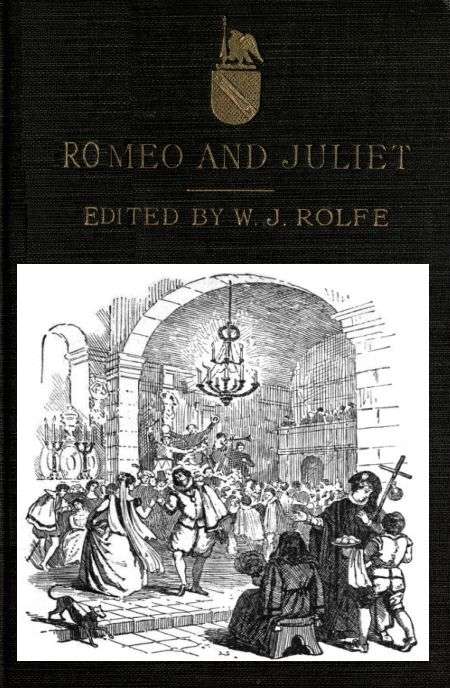
10. Like fire and powder. For the simile, cf. iii. 3. 132 and v. 1. 64 below.
12. His. Its; as often. Its was just coming into use when S. wrote. Cf. v. 3. 203 below.
13. Confounds. Destroys; as often. Cf. Macb. ii. 2. 12, iv. 1. 54, iv. 3. 99, etc. So confusion often = destruction, ruin; as in iv. 5. 61 below.
15. Too swift, etc. "The more haste, the worse speed."
17. Will ne'er wear out, etc. White thinks that the reading of the 1st quarto, "So light a foot ne'er hurts the trodden flower," is "a daintier and more graceful, and therefore, it would seem, a more appropriate figure." The quarto, it is true, gives the "daintier" figure, which has been used by the poets from Pope's description of Camilla flying "o'er the unbending corn" to Tennyson's Olivia in The Talking Oak:—
It would be appropriate in the Friar's mouth if he were in the fields, as in ii. 3, and Juliet had met him there. Very likely S. at first wrote it as in the quarto, but his poetic instinct led him to change it in revising the play. The speaker is now in his cell, with its stone floor worn by the tread of many heavy feet—such as one sees in old churches and monasteries in Europe—but Juliet's light step will not thus wear "the everlasting flint." The comparison is natural and apt.
18. Gossamer. Light filaments floating in the air, especially in autumn. Their origin was formerly not understood, but they are now known to be the webs of certain species of spiders. Cf. Lear, iv. 6. 49: "Hadst thou been aught but gossamer, feathers, air." S. uses the word only twice.
20. Vanity. "Here used for 'trivial pursuit,' 'vain delight.' The word was much used in this sense by divines in Shakespeare's time, and with much propriety is so put into the good old Friar's mouth" (Clarke).
21. Confessor. For the accent on the first syllable, cf. M. for M. iv. 3. 133: "One of our covent and his confessor;" and Hen. VIII. i. 2. 149: "His confessor, who fed him every minute," etc. See also iii. 3. 49 below.
25. And that. And if. This use of that (in place of a preceding conjunction) is common in S. Cf. L. L. L. v. 2. 813, T. and C. ii. 2. 179, etc.
26. Blazon it. Set it forth. Cf. Oth. ii. 1. 63: "One that excels the quirks of blazoning pens," etc.
29. Encounter. Meeting. It is often used, as here, of the meeting of lovers. Cf. Much Ado, iii. 3. 161, iv. 1. 94, M.W. iii. 5. 74, etc.
30. Conceit. Conception, imagination. Cf. Ham. iii. 4. 114: "Conceit in weakest bodies strongest works," etc. So conceited = imaginative in R. of L. 1371: "the conceited painter," etc.
32. They are but beggars, etc. Cf. A. and C. i. 1. 15: "There's beggary in the love that can be reckon'd." Worth = wealth.
36. Leaves. The plural is used because the reference is to more than one person; a common construction in S. Cf. Rich. II. iv. 1. 314: "your sights," etc.
ACT III
Scene I.—
2. The day is hot. "It is observed that in Italy almost all assassinations are committed during the heat of summer" (Johnson).
3. Scape. Not "'scape," as often printed. The word is used in prose; as in M. of V. ii. 2. 174, etc.
6. Me. See on ii. 4. 23 above. We have the same construction in him, two lines below, where some eds. have "it" (from 1st quarto).
8. Operation. Effect. Cf. 2 Hen. IV. iv. 3. 104: "A good sherris-sack hath a twofold operation in it," etc.
11. Am I, etc. "The quietness of this retort, with the slight but significant emphasis which we imagine thrown upon the I, admirably gives point to the humorous effect of Mercutio's lecturing Benvolio—the sedate and peace-making Benvolio, and lectured by Mercutio, of all people!—for the sin of quarrelsomeness" (Clarke).
12. Jack. See on ii. 4. 127 above.
14. Moody. Angry. Cf. 2 Hen. IV. iv. 4. 39: "But, being moody, give him line and scope," etc.
31. Tutor me from. Teach me to avoid.
39. Good den. See on i. 2. 57 above.
43. Apt enough to. Ready enough for. Cf. iii. 3. 157 below.
47. Consort'st with. Keepest company with. Cf. V. and A. 1041, M.N.D. iii. 2. 387, T. and C. v. 3. 9, etc.
48. Consort. The word (with accent on first syllable) sometimes meant a company of musicians. Cf. T.G. of V. iii. 2. 84:—
See also 2 Hen. VI. iii. 2. 327. In these passages the modern eds. generally read "concert." Milton has consort in the same sense in the Ode at a Solemn Musick, 27:—
Cf.Ode on Nativ. 132: "Make up full consort to the angelic symphony;" Il Pens. 145: "With such consort as they keep," etc. "The consorts of S.'s time were not only concerted music, but generally composed of such instruments as belonged to one family. If, for example, only viols were employed, the consort was called whole, but if virginal, lute, or flute came into the combination, it was a broken consort, or broken music" (Elson). Cf. A.Y.L. i. 2. 150, etc.
51. Zounds. Like 'swounds (see Ham. ii. 2. 604), an oath contracted from "God's wounds!" and generally omitted or changed in the folio in deference to the statute of James I. against the use of the name of God on the stage. Here the folio has "Come."
54. Reason coldly. Talk coolly or dispassionately. Cf. M. of V. ii. 8. 27: "I reason'd with a Frenchman yesterday;" and Much Ado, iii. 2. 132: "bear it coldly but till midnight," etc.
"Benvolio presents a triple alternative: either to withdraw to a private place, or to discuss the matter quietly where they were, or else to part company; and it is supremely in character that on such an occasion he should perceive and suggest all these methods of avoiding public scandal" (White).
55. Depart. Perhaps = part. Cf. 3 Hen. VI. ii. 6. 43: "A deadly groan, like life and death's departing," etc. So depart with = part with; as in K. John, ii. 1. 563:—
In the Marriage Ceremony "till death us do part" was originally "us depart." The word is used in the same sense in Wiclif's Bible, Matthew, xix. 6. On the other hand, part often = depart; as in T.N. v. 1. 394, Cor. v. 6. 73, T. of A. iv. 2. 21, etc.
57. I. The repetition of the pronoun at the end of the sentence is common in S. Cf. T.G. of V. v. 4. 132: "I care not for her, I;" Rich. III. iii. 2. 78: "I do not like these several councils, I;" T.A. v. 3. 113: "I am no vaunter, I;" Id. v. 3. 185: "I am no baby, I," etc. See also iii. 5. 12 below.
62. The hate I bear thee. The reading of 1st quarto. The other early eds. have "love"; but Tybalt is not given to irony.
64. Love. Delius says that this "is of course ironical," but the reiteration in the next speech shows that it is not. Romeo's love for Juliet embraces, in a way, all her kindred. His heart, as Talfourd expresses it in Ion,—
65. Appertaining rage, etc. That is, the rage appertaining to (belonging to, or becoming) such a greeting. Cf. Macb. iii. 6. 48:—
68. Boy. Often used contemptuously; as in Much Ado. v. 1. 83, 187, Cor. v. 6. 101, 104, 117, etc.
73. Tender. Regard, cherish. Cf. Ham. i. 3. 107: "Tender yourself more dearly," etc.
76. A la stoccata. Capell's emendation of the "Alla stucatho" or "Allastucatho" of the early eds. Stoccata is the Italian term for a thrust or stab with a rapier. It is the same as the "stoccado" of M.W. ii. 1. 234, the "stock" of Id. ii. 3. 26, and the "stuck" of T.N. iii. 4. 303 and Ham. iv. 7. 162. Carries it away = carries the day.
79. King of cats. See on ii. 4. 20 above. On nine lives, cf. Marston, Dutch Courtezan: "Why then thou hast nine lives like a cat," etc. A little black-letter book, Beware the Cat, 1584, says that it was permitted to a witch "to take on her a cattes body nine times." Trusler, in his Hogarth Moralized, remarks: "The conceit of a cat's having nine lives hath cost at least nine lives in ten of the whole race of them. Scarce a boy in the streets but has in this point outdone even Hercules himself, who was renowned for killing a monster that had but three lives."
81. Dry-beat. Beat soundly. Cf. L. L. L. v. 2. 263: "all dry-beaten with pure scoff." See also iv. 5. 120 below. S. uses the word only three times; but we have "dry basting" in C. of E. ii. 2. 64.
83. Pilcher. Scabbard; but no other example of the word in this sense has been found. Pilch or pilche meant a leathern coat, and the word or a derivative of it may have been applied to the leathern sheath of a rapier.
87. Passado. See on ii. 4. 27 above.
89. Outrage. A trisyllable here. Cf. entrance in i. 4. 8.
91. Bandying. Contending. Cf. 1 Hen. VI. iv. 1. 190: "This factious bandying of their favourites." For the literal sense, see on ii. 5. 14 above.
92. The 1st quarto has here the stage-direction, "Tibalt under Romeos arme thrusts Mercutio in and flyes;" which some modern eds. retain substantially.
93. Sped. Dispatched, "done for." Cf. M. of V. ii. 9. 72: "So begone; you are sped;" T. of S. v. 2. 185: "We three are married, but you two are sped," etc. See also Milton, Lycidas, 122: "What need they? They are sped" (that is, provided for).
100. Grave. Farmer cites Lydgate's Elegy on Chaucer: "My master Chaucer now is grave;" and Steevens remarks that we have the same quibble in The Revenger's Tragedy, 1608, where Vindice dresses up a lady's skull and says: "she has a somewhat grave look with her." Cf. John of Gaunt's play on his name when on his death-bed (Rich. II. ii. 1. 82).
104. Fights by the book of arithmetic. Cf. ii. 4. 22 above: "keeps time, distance," etc.
111. Your houses! "The broken exclamation of a dying man, who has not breath to repeat his former anathema, 'A plague o' both your houses!'" (Marshall).
113. My very friend. Cf. T.G. of V. iii. 2. 41: "his very friend;" M. of V. iii. 2. 226: "my very friends and countrymen," etc.
116. Cousin. Some editors adopt the "kinsman" of 1st quarto; but cousin was often = kinsman. See on i. 5. 32 above.
120. Aspir'd. Not elsewhere used transitively by S. Cf. Chapman, Iliad, ix.: "and aspir'd the gods' eternal seats;" Marlowe, Tamburlaine: "our souls aspire celestial thrones," etc.
121. Untimely. Often used adverbially (like many adjectives in -ly); as in Macb. v. 8. 16, Ham. iv. 1. 40, etc. See also v. 3. 258 below.
122. Depend. Impend (Schmidt). Cf. R. of L. 1615: "In me moe woes than words are now depending;" and Cymb. iv. 3. 23: "our jealousy Doth yet depend."
126. Respective. Considerate. Cf. M. of V. v. 1. 156: "You should have been respective," etc.
127. Conduct. Conductor, guide. Cf. Temp. v. 1. 244:—
Rich. III. i. 1. 45: "This conduct to convey me to the Tower," etc. See also v. 3. 116 below.
129. For Mercutio's soul, etc. The passage calls to mind one similar yet very different in Hen. V. iv. 6. 15 fol.:—
133. Consort. Accompany. Cf. C. of E. i. 2. 28: "And afterward consort you till bedtime;" J.C. v. 1. 83: "Who to Philippi here consorted us," etc. For the intransitive use of the word, see on 43 above.
137. Doom thee death. Cf. Rich. III. ii. 1. 102: "to doom my brother's death;" T.A. iv. 2. 114: "The emperor, in his rage, will doom her death." Amazed = bewildered, stupefied; as often.
139. Fortune's fool. Made a fool of by fortune, the sport of fortune. Cf. Lear, iv. 6. 195: "The natural fool of fortune." See also Ham. i. 4. 54: "we fools of nature;" and cf. M. for M. iii. 1. 11, Macb. ii. 1. 44, etc.
145. Discover. Uncover, reveal. See on ii. 2. 106 above.
146. Manage. "Bringing about" (Schmidt); or we may say that all the manage is simply = the whole course. The word means management, administration, in Temp. i. 2. 70: "the manage of my state;" M. of V. iii. 4. 25: "The husbandry and manage of my house," etc. It is especially used of horses; as in A.Y.L. i. 1. 13, etc.
156. Spoke him fair. Spoke gently to him. Cf. M.N.D. ii. 1. 199: "Do I entice you? do I speak you fair?" M. of V. iv. 1. 275: "Say how I lov'd you, speak me fair in death" (that is, speak well of me after I am dead), etc.
157. Nice. Petty, trivial. Cf. Rich. III. iii. 7. 175: "nice and trivial;" J.C. iv. 3. 8: "every nice offence," etc. See also v. 2. 18 below.
160. Take truce. Make peace. Cf. V. and A. 82: "Till he take truce with her contending tears;" K. John, iii. 1. 17: "With my vex'd spirits I cannot take a truce," etc. Spleen = heat, impetuosity. Cf. K. John, iv. 3. 97: "thy hasty spleen;" Rich. III. v. 3. 350: "Inspire us with the spleen of fiery dragons!" etc.
167. Retorts. Throws back; as in T. and C. iii. 3. 101:—
171. Envious. Malicious; as often.
173. By and by. Presently. See on ii. 2. 151 above, and cf. iii. 3. 76 and v. 3. 284 below.
180. Affection makes him false. "The charge, though produced at hazard, is very just. The author, who seems to intend the character of Benvolio as good, meant, perhaps, to show how the best minds, in a state of faction and discord, are detorted to criminal partiality" (Johnson).
188. Concludes. For the transitive use (= end), cf. 2 Hen. VI. iii. 1. 153: "Will not conclude their plotted tragedy."
190. Exile. Accented by S. on either syllable. So also with the noun in iii. 3. 20 and v. 3. 211 below.
193. Amerce. Used by S. only here.
196. Purchase out. Cf. buy out in C. of E. i. 2. 5, K. John, iii. 1. 164, Ham. iii. 3. 60, etc.
198. Hour. Metrically a dissyllable; as in ii. 5. 11 above. Cf. Temp. v. 1. 4. etc.
200. Mercy but murthers, etc. Malone quotes Hale, Memorials: "When I find myself swayed to mercy, let me remember likewise that there is a mercy due to the country."
Scene II.—
1. Gallop apace, etc. Malone remarks that S. probably remembered Marlowe's Edward II., which was performed before 1593:—
and Barnaby Rich's Farewell, 1583: "The day to his seeming passed away so slowely that he had thought the stately steedes had bin tired that drawe the chariot of the Sunne, and wished that Phaeton had beene there with a whippe." For the thought, cf. Temp. iv. 1. 30.
3. Phaethon. For other allusions to the ambitious youth, see T.G. of V. iii. 1. 153, Rich. II. iii. 3. 178, and 3 Hen. VI. i. 4. 33, ii. 6. 12.
6. That runaways' eyes may wink. This is the great crux of the play, and more has been written about it than would fill a volume like this. The condensed summary of the comments upon it fills twenty-eight octavo pages of fine print in Furness, to which I must refer the curious reader. The early eds. have "runnawayes," "run-awayes," "run-awaies," or "run-aways." Those who retain this as a possessive singular refer it variously to Phœbus, Phaethon, Cupid, Night, the sun, the moon, Romeo, and Juliet; those who make it a possessive plural generally understand it to mean persons running about the streets at night. No one of the former list of interpretations is at all satisfactory. Personally, I am quite well satisfied to read runaways', and to accept the explanation given by Hunter and adopted by Delius, Schmidt, Daniel, and others. It is the simplest possible solution, and is favoured by the untalk'd of that follows. White objects to it that "runaway seems to have been used only to mean one who ran away, and that runagate, which had the same meaning then that it has now, would have suited the verse quite as well as runaway;" but, as Furnivall and others have noted, Cotgrave apparently uses runaway and runagate as nearly equivalent terms. In a letter in the Academy for Nov. 30, 1878, Furnivall, after referring to his former citations in favour of runaways = "runagates, runabouts," and to the fact that Ingleby and Schmidt have since given the same interpretation, adds, "But I still desire to cite an instance in which Shakspere himself renders Holinshed's 'runagates' by his own 'runaways.' In the second edition of Holinshed's Chronicle, 1587, which Shakspere used for his Richard III., he found the passage (p. 756, col. 2): 'You see further, how a company of traitors, thieves, outlaws, and runagates, be aiders and partakers of this feate and enterprise,' etc. And he turned it thus into verse (1st folio, p. 203):—
Herford regards this interpretation as "a prosaic idea;" but it seems to me perfectly in keeping with the character and the situation. The marriage was a secret one, and Juliet would not have Romeo, if seen, supposed to be a paramour visiting her by night. She knows also the danger he incurs if detected by her kinsmen. Cf. ii. 2. 64 fol. above.
10. Civil. Grave, sober. Cf. M.W. ii. 2. 101: "a civil modest wife," etc.
12. Learn. Teach; as often. Cf. A.Y.L. i. 2. 5, Cymb. i. 5. 12, etc.
14. Hood my unmann'd blood, etc. The terms are taken from falconry. The hawk was hooded till ready to let fly at the game. Cf. Hen. V. iii. 7. 121: "'tis a hooded valour; and when it appears it will bate." An unmanned hawk was one not sufficiently trained to know the voice of her keeper (see on ii. 2. 159 above). To bate was to flutter or flap the wings, as the hawk did when unhooded and eager to fly. Cf. T. of S. iv. 1. 199:—
Dyce quotes Holmes, Acad. of Armory: "Bate, Bateing or Bateth, is when the Hawk fluttereth with her Wings either from Pearch or Fist, as it were striveing to get away; also it is taken from her striving with her Prey, and not forsaking it till it be overcome."
15. Strange. Reserved, retiring.
17. Come, Night, etc. Mrs. Jameson remarks: "The fond adjuration, 'Come, Night, come, Romeo, come thou day in night!' expresses that fulness of enthusiastic admiration for her lover which possesses her whole soul; but expresses it as only Juliet could or would have expressed it—in a bold and beautiful metaphor. Let it be remembered that, in this speech, Juliet is not supposed to be addressing an audience, nor even a confidante; and I confess I have been shocked at the utter want of taste and refinement in those who, with coarse derision, or in a spirit of prudery, yet more gross and perverse, have dared to comment on this beautiful 'Hymn to the Night,' breathed out by Juliet in the silence and solitude of her chamber. She is thinking aloud; it is the young heart 'triumphing to itself in words.' In the midst of all the vehemence with which she calls upon the night to bring Romeo to her arms, there is something so almost infantine in her perfect simplicity, so playful and fantastic in the imagery and language, that the charm of sentiment and innocence is thrown over the whole; and her impatience, to use her own expression, is truly that of 'a child before a festival, that hath new robes and may not wear them.' It is at the very moment too that her whole heart and fancy are abandoned to blissful anticipation that the Nurse enters with the news of Romeo's banishment; and the immediate transition from rapture to despair has a most powerful effect."
18. For thou, etc. "Indeed, the whole of this speech is imagination strained to the highest; and observe the blessed effect on the purity of the mind. What would Dryden have made of it?" (Coleridge).
20. Black-brow'd Night. Cf. King John, v. 6. 17: "Why, here walk I in the black brow of night."
25. The garish sun. Johnson remarks: "Milton had this speech in his thoughts when he wrote in Il Pens., 'Till civil-suited morn appear,' and 'Hide me from day's garish eye.'" S. uses garish only here and in Rich. III. iv. 4. 89: "a garish flag."
26, 27. I have bought, etc. There is a strange confusion of metaphors here. Juliet is first the buyer and then the thing bought. She seems to have in mind that what she says of herself is equally true of Romeo. In the next sentence she reverts to her own position.
30. That hath new robes, etc. Cf. Much Ado, iii. 2. 5: "Nay, that would be as great a soil in the new gloss of your marriage as to show a child his new coat and forbid him to wear it." See also Macb. i. 7. 34.
40. Envious. Malignant; as in i. 1. 148 and iii. 1. 171 above.
45. But ay. In the time of S. ay was commonly written and printed I, which explains the play upon the word here. Most editors print "but 'I'" here, but it does not seem necessary to the understanding of the quibble. Lines 45-51 evidently belong to the first draft of the play.
47. Death-darting eye, etc. The eye of the fabled cockatrice or basilisk was said to kill with a glance. Cf. T.N. iii. 4. 215: "they will kill one another by the look, like two cockatrices;" Rich. III. iv. 1. 55:—
49. Those eyes. That is, Romeo's.
51. Determine of. Decide. Cf. 2 Hen IV. iv. 1. 164:—
See also T.G. of V. ii. 4. 181, Rich. III. iii. 4. 2, etc.
53. God save the mark! An exclamation of uncertain origin, commonly = saving your reverence, but sometimes, as here = God have mercy! Cf. 1 Hen. IV. i. 3. 56. So God bless the mark! in M. of V. ii. 2. 25, Oth. i. 1. 33, etc.
56. Gore-blood. Clotted blood. Forby remarks that the combination is an East-Anglian provincialism. Halliwell-Phillipps cites Vicars, trans, of Virgil, 1632: "Whose hollow wound vented much black gore-bloud." Swounded is the reading of the 1st quarto; the other early eds. have "sounded," "swouned," and "swooned." In R. of. L. 1486 we have "swounds" rhyming with "wounds."
57. Bankrupt. The early eds. have "banckrout" or "bankrout," as often in other passages and other writers of the time.
64. Contrary. The adjective is accented by S. on the first or second syllable. Cf. Ham. iii. 2. 221, etc. For the verb, see on i. 5. 87 above.
73. O serpent heart, etc. Cf. Macb. i. 5. 66:—