
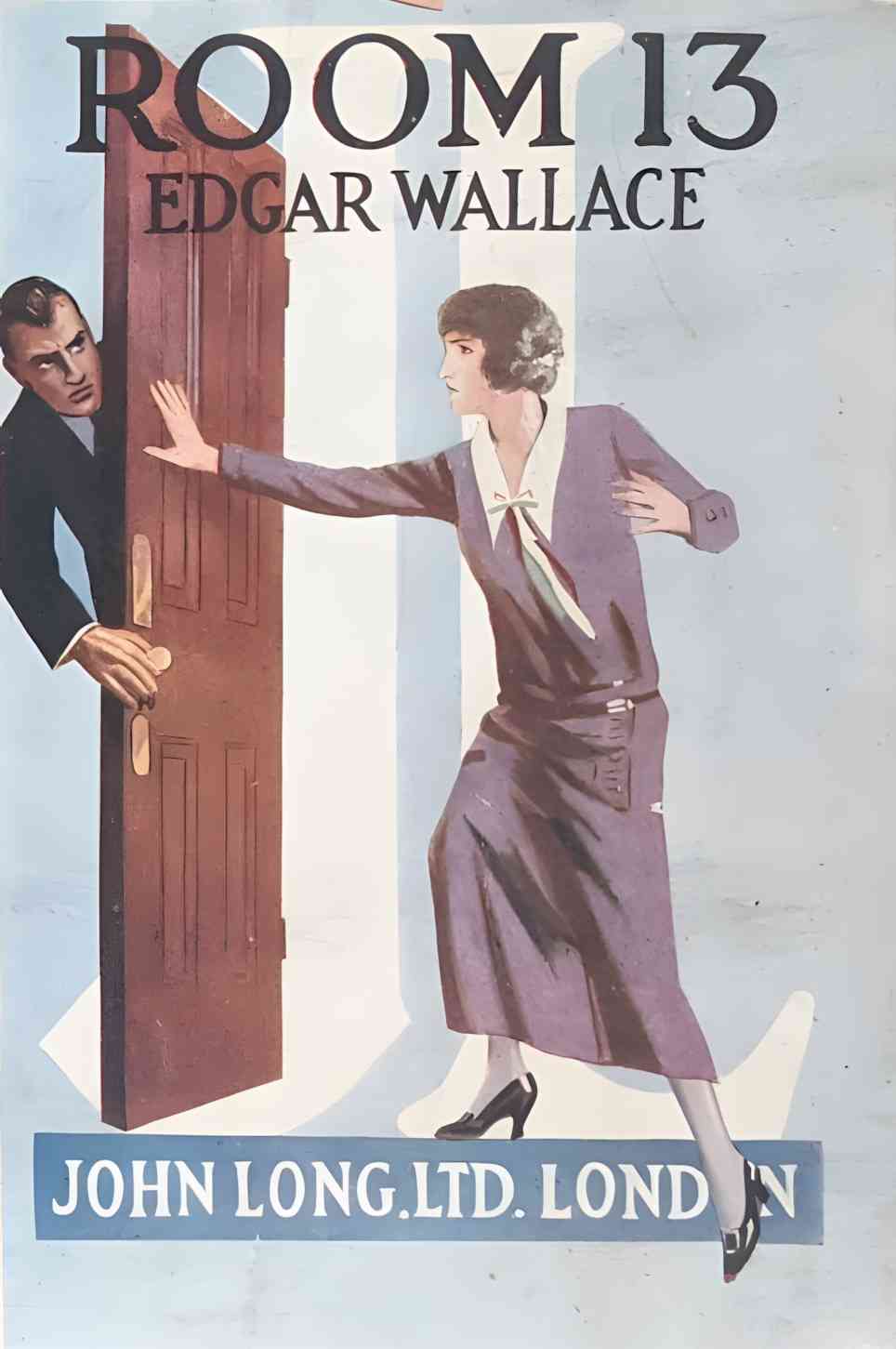
CHAPTER XII
Emanuel Legge was half-way home before he could sort out his impressions. He went back to the Bloomsbury Hotel where he was staying. There was no message for him, and there had been no callers. It was now seven o’clock. He wondered whether Jeff had restrained his impatience. Jeff must be told and warned. Johnny Gray, dead or maimed in a hospital, had ceased to be a factor. Peter Kane, for all his cunning and his vengefulness, might be dismissed as a source of danger. It was Mr. J.G. Reeder who filled his thoughts: the bored Civil Servant with a weak voice, who had such a surprising knowledge of things, and whose continuous pointed references to Jeffrey filled him with unquiet. Jeffrey must clear out of the country, and must go while the going was good. If he hadn’t been such a fool, he would have moved that night. Now, that was impossible.
Peter had not arrived at the Charlton, or the men whom Legge had set to watch would have reported. If it had not been for the disturbing interview he had had with Reeder, he would have been more worried about Peter Kane; for when Peter delayed action, he was dangerous.
At eight o’clock that night, a small boy brought him a note to the hotel. It was addressed “E. Legge,” and the envelope was grimy with much handling. Emanuel took the letter to his room and locked the door before he opened it. It was from a man who was very much on the inside of things, one of Jeff’s shrewd but illiterate assistants, first lieutenant of the Big Printer, and a man to be implicitly trusted.
There were six closely written pages, ill-spelt and blotted. Emanuel read the letter a dozen times, and when he finished, there was panic in his heart.
“Johnny Gray got out of the tunnel all right, and he’s going to squeak to Reeder,” was the dramatic beginning, and there was a great deal more.…
Emanuel knew a club in the West End of London, and his name was numbered amongst the members, even in the days when he had little opportunity of exercising his membership. It was a club rather unlike any other, and occupied the third and fourth floor of a building, the lower floors being in the possession of an Italian restaurateur. Normally, the proprietor of a fairly popular restaurant would not hire out his upper floors to so formidable a rival; but the proprietors of the club were also proprietors of the building, the restaurant keeper being merely a tenant.
It suited the membership of the Highlow Club to have their premises a little remote. It suited them better that no stairway led from the lower to the upper floors. Members of the club went down a narrow passage by the side of the restaurant entrance. From the end of the passage ran a small elevator, which carried them to the third floor. The County Council, in granting this concession, insisted upon a very complete fire escape system outside the building—a command which very well suited the members. Some there were who found it convenient to enter the premises by this latter method, and a window leading into the club was left unfastened day and night against such a contingency.
On the flat roof of the building was a small superstructure, which was never used by the club members; whilst another part of the building which also belonged exclusively to the Highlow, was the basement, to which the restaurant proprietor had no access—much to his annoyance, since it necessitated the building of a wine storage room in the limited space in the courtyard behind.
Stepping out of the elevator into a broad passage, well carpeted, its austere walls hung with etchings, Emanuel Legge was greeted respectfully by the liveried porter who sat behind a desk within sight of the lift. There was every reason why Emanuel should be respected at the Highlow, for he was, in truth, the proprietor of the club, and his son had exercised control of the place during many of the years his father had been in prison.
The porter, who was a big ex-prize fighter, expressly engaged for the purpose for which he was frequently required, hurried from his tiny perch to stand deferentially before his master.
“Anybody here?” asked Legge.
The man mentioned a few names.
“Let me see the engagement book,” said the other, and the man produced from beneath the ledge of his desk a small, red book, and Emanuel turned the pages. The old man’s hand ran down the list, and suddenly stopped.
“Oh, yes,” he said softly, closing the book and handing it back.
“Are you expecting anybody, Mr. Legge?” asked the porter.
“No, I’m not expecting anybody… only I wondered…”
“Mr. Jeffrey got married to-day, I hear, sir? I’m sure all the staff wish him joy.”
All the staff did not wish Mr. Jeffrey Legge joy, for neither he nor his father were greatly popular, even in the tolerant society of the Highlow, and moreover, strange as it may appear, very few people knew him by sight.
“That’s very good of you, very good indeed,” murmured Emanuel absently.
“Are you dining here, sir?”
“No, no, I’m not dining here. I just looked in, that is all.”
He stepped back into the elevator, and the porter watched it drop with pleasure. It was half-past eight; the glow was dying in the sky, and the lights were beginning to twinkle in the streets, as Emanuel walked steadily toward Shaftesbury Avenue.
Providentially, he was at the corner of a side street when he saw Peter Kane. He was near enough to note that under his thin overcoat Peter was in evening dress. Slipping into the doorway, he watched the man pass. Peter was absorbed in thought; his eyes were on the ground, and he had no interest for anything but the tremendous problem which occupied his mind.
Legge came back to the corner of the street and watched him furtively. Opposite the club, Peter stopped, looked up for a while, and passed on. The watcher laughed to himself. That club could have no pleasant memories for Peter Kane that night; it was in the Highlow that he had met the “young Canadian officer” and had “rescued” him, as he had thought, from his dangerous surroundings. There had Peter been trapped, for the introduction of Jeff Legge was most skilfully arranged. Going into the club one night, Peter saw, as he thought, a young, good-looking soldier boy in the hands of a gang of cardsharpers, and the “rescued officer” had been most grateful, and had called upon Peter at the earliest opportunity. So simple, so very simple, to catch Peter. It would be a more difficult matter, thought Emanuel, for Peter to catch him.
He waited until the figure had disappeared in the gloom of the evening, and then walked back to the Avenue. This comedy over, there remained the knowledge of stark tragedy, of danger to his boy, and the upsetting of all his plans, and, the most dreadful of all possibilities, the snaring of the Big Printer. This night would the battle be fought, this night of nights would victory or defeat be in his hands. Reeder—Johnny—Peter Kane—all opposed him, innocent of their co-operation, and in his hands a hostage beyond price—the body and soul of Marney Legge.
He had scarcely disappeared when another person known to him came quickly along the quiet street, turned into the club entrance, and, despite the expostulations of the elevator man, insisted upon being taken up. The porter had heard the warning bell and stood waiting to receive her when the door of the elevator opened.
“Where’s Emanuel?” she asked.
“Just gone,” said the porter.
“That’s a lie. I should have seen him if he’d just gone.”
She was obviously labouring under some emotion, and the porter, an expert on all stages of feminine emotionalism, shrewdly diagnosed the reason for her wildness of manner and speech.
“Been a wedding to-day, hasn’t there?” he asked with heavy jocularity. “Now, Lila, what’s the good of kicking up a fuss? You know you oughtn’t to come here. Mr. Legge gave orders you weren’t to be admitted whilst you were at Kane’s.”
“Where is Emanuel?” she asked.
“I tell you he’s just gone out,” said the porter in a tone of ponderous despair. “What a woman you are! You don’t believe anything!”
“Has he gone back to his hotel?”
“That’s just where he has gone. Now be wise, girl, and beat it. Anybody might be coming here—Johnny Gray was in last night, and he’s a pal of Peter’s.”
“Johnny knows all about me,” she said impatiently. “Besides, I’ve left Peter’s house.”
She stood undecidedly at the entrance of the open elevator, and then, when the porter was preparing some of his finest arguments for her rapid disappearance, she stepped into the lift and was taken down.
The Highlow was a curious club, for it had no common room. Fourteen private dining-rooms and a large and elegantly furnished card-room constituted the premises. Meals were served from the restaurant below, being brought up by service lift to a small pantry. The members of the club had not the club feeling in the best sense of the word. They included men and women, but the chief reason for the club’s existence was that it afforded a safe and not unpleasant meeting-place for members of the common class, and gave necessary seclusion for the slaughter of such innocents as came within the influence of its more dexterous members. How well its inner secrets were kept is best illustrated by the fact that Peter Kane had been a member for twenty years without knowing that his sometime companion in crime had any official connection with its control. Nor was it ever hinted to him that the man who was directing the club’s activities during Emanuel’s enforced absence, was his son.
Peter was a very infrequent visitor to the Highlow; and indeed, on the occasion of his first meeting with the spurious Major Floyd, he had been tricked into coming, though this he did not know.
The porter was busy until half-past nine. Little parties came, were checked off in the book, and then—he looked at his watch.
“Twenty-five to ten,” he said, and pushed a bell button.
A waiter appeared from the side passage.
“Put a bottle of wine in No. 13,” he said.
The waiter looked at him surprised.
“No. 13?” he said, as if he could not believe his ears.
“I said it,” confirmed the porter.
* * * * *
Jeffrey ate a solitary dinner. The humour of the situation did not appeal to him. On his honeymoon, he and his wife were dining, a locked door between them. But he could wait.
Again he tried the queer-shaped pliers upon the key of the second bedroom. The key turned readily. He put the tool into his pocket with a sense of power. The clatter of a table being cleared came to him from the other room, and presently he heard the outer door close and a click of the key turning. He lit his fourth cigar and stepped out on to the balcony, surveying the crowded street with a dispassionate interest. It was theatre time. Cars were rolling up to the Haymarket; the long queue that he had seen waiting at the doors of the cheaper parts of the house had disappeared; a restaurant immediately opposite was blazing with lights; and on a corner of the street a band of ex-soldiers were playing the overture of “Lohengrin.”
Glancing down into the street, he distinguished one of the “minders” his father had put there for his protection, and grinned. Peter could not know; he would have been here before. As to Johnny… ? Emanuel had been very confident that Johnny presented no danger, and it rather looked as though Emanuel’s view was right. But if Peter knew, why hadn’t he come?
He strolled back to the room, looked at the girl’s door and walked toward it.
“Marney!” he called softly.
There was no answer. He knocked on the panel.
“Marney, come along. I want to talk to you. You needn’t open the door. I just wanted to ask you something.”
Still there was no answer. He tried the door: it was locked.
“Are you there?” he called sharply, but she did not reply.
He pulled the pliers from his pocket, and, pushing the narrow nose into the keyhole, gripped the end of the key and turned it. Then, flinging open the door, he rushed in.
The room was empty, and the big bathroom that led out of the suite was empty also. He ran to the passage door: it was locked—locked from the outside. In a sweat of fear he flew through the saloon into the corridor, and the first person he saw was the floor waiter.
“Madam, sir? Yes, she went out a little time ago.”
“Went out, you fool? Where?” stormed Jeff.
“I don’t know, sir. She just went out. I saw her going along the corridor.”
Jeff seized his hat and went down the stairs three at a time. The reception clerk had not seen the girl, nor had any of the pages, or the porter on the door. Oblivious to any immediate danger, he dashed out into the street, and, looking up and down, saw the minder and called him.
“She hasn’t come out this entrance. There’s another in Pall Mall,” he explained. “Jimmy Low’s there.”
But the second man on the Pall Mall entrance had not seen her either. Jeff went back to interview the manager.
“There is no other way out, sir, unless she went down the service stairs.”
“It was that cursed maid, the Welsh woman,” snarled Jeffrey. “Who is she? Can I see her?”
“She went off duty this afternoon, sir,” said the manager. “Is there anything I can do? Perhaps the lady has gone out for a little walk? Does she know London?”
Jeff did not stop to reply: he fled up the stairs, back to the room, and made a quick search. The girl’s dressing-case, which he knew had been taken into the bedroom, was gone. Something on the floor attracted his attention. He picked it up, and read the few scribbled lines, torn from a notebook; and as he read, a light came into his eyes. Very carefully he folded the crumpled sheet and put it into his pocket. Then he went back to his sitting-room, and sat for a long time in the big arm-chair, his legs thrust out before him, his hands deep in his trousers pockets, and his thoughts were not wholly unpleasant.
The light was now nearly gone, and he got up.
“Room thirteen,” he said. “Room thirteen is going to hold a few surprises to-night!”
CHAPTER XIII
To Parker, the valet, as he laid out Johnny’s dress clothes, there was a misfortune and a tragedy deeper than any to which Johnny had been a spectator. Johnny, loafing into his bedroom, a long, black, ebonite cigarette-holder between his teeth, found his man profoundly agitated.
“The buckle of your white dress waistcoat has in some unaccountable way disappeared,” he said in a hushed voice. “I’m extremely sorry, sir, because this is the only white dress waistcoat you have.”
“Be cheerful,” said Johnny. “Take a happier view of life. You can tie the tapes behind. You could even sew me together, Parker. Are you an expert needle-worker, or do you crochet?”
“My needlework has been admired, sir,” said Parker complacently. “I think yours is an excellent suggestion. Otherwise, the waistcoat will not sit as it should. Especially in the case of a gentleman with your figure.”
“Parker,” said Johnny, as he began to dress leisurely, “have you ever killed a man?”
“No, sir, I have never killed a man,” said Parker gravely. “When I was a young man, I once ran over a cat—I was a great cyclist in my youth.”
“But you never killed a man? And, what is more, you’ve never even wanted to kill a man?”
“No, sir, I can’t say that I ever have,” said Parker after a few moments’ consideration, as though it were possible that some experience had been his which had been overlooked in the hurry of his answering.
“It is quite a nice feeling, Parker. Is there a hip pocket to these—yes, there is,” he said, patting his trousers.
“I’m sorry there is,” said Parker, “very sorry indeed. Gentlemen get into the habit of carrying their cigarette cases in the hip pocket, with the result that the coat tail is thrown out of shape. That is where the dinner jacket has its advantages—the Tuxedo, as an American gentleman once called it, though I’ve never understood why a dinner jacket should be named after a Scottish town.”
“Tuxedo is in Dixie,” said Johnny humorously, “and Dixie is America’s lost Atlantis. Don’t worry about the set of my tail coat. I am not carrying my cigarette case there.”
“Anything more bulky would of course be worse, sir,” said Parker, and Johnny did not carry the discussion any farther.
“Get me a cab,” he ordered.
When Parker returned, he found his master was fully dressed.
“You will want your cane, sir. Gentlemen are carrying them now in evening dress. There is one matter I would like to speak to you about before you go—it is something that has been rather worrying me for the past few days.”
Johnny was leaving the room, and turned.
“Anything serious?” he asked, for a moment deceived.
“I don’t like telling you, sir, but I have discussed the matter with very knowledgeable people, and they are agreed that French shapes are no longer worn in silk hats. You occasionally see them in theatrical circles——”
Johnny put up a solemn hand.
“Parker, do not let us discuss my general shabbiness. I didn’t even know I had a hat of French shape.” He took off his hat and looked at it critically. “It is a much better shape than the hat I was wearing a week ago, Parker, believe me!”
“Of course I believe you, sir,” agreed Parker, and turned to the door.
Johnny dismissed his cab in Shaftesbury Avenue and walked down toward the club. It was dark now; half-past nine had chimed as he came along Piccadilly.
It was a point of honour with all members of the Highlow that nobody drove up to the club, and its very existence was unknown to the taximen. That was a rule that had been made, and most faithfully adhered to; and the members of the Highlow observed their rules, for, if a breach did not involve a demand for their resignation, it occasionally brought about a broken head.
Just before he reached the club, he saw somebody cross the road. It was not difficult to recognise Jeff Legge. Just at that moment it would have been rather embarrassing for Johnny to have met the man. He turned and walked back the way he had come, to avoid the chance of their both going up in the elevator together.
Jeff Legge was in a hurry: the elevator did not move fast enough for him, and he stepped out on to the third floor and asked a question.
“No, sir, nobody has come. If they do, I’ll send them along to you. Where will you be? You haven’t a room engaged—your own room is taken. We don’t often let it, but we’re full to-night, and Mr. Legge raised no objection.”
“No, I don’t object,” said Jeff; “but don’t you worry about that. Let me see the book.”
Again the red-covered engagement book was opened. Jeff read and nodded.
“Fine,” he said. “Now tell me again who is here.”
“There is Mr. George Kurlu, with a party of friends in No. 3; there’s Mr. Bob Albutt and those two young ladies he goes about with—they’re in No. 4.” And so he recited until he came to No. 13.
“I know all about No. 13,” said Jeff Legge between his teeth. “You needn’t bother about me, however. That will do.”
He strode along the carpeted hallway, turned abruptly into the right-angled passage, and presently stopped before a door with a neat golden “13” painted on its polished panel. He opened the door and went in. On the red-covered table was a bottle of wine and two glasses.
It was a moderately large room, furnished with a sofa, four dining chairs and a deep easy chair, whilst against one wall was a small buffet. The room was brilliantly lighted. Six bracket lamps were blazing; the centre light above the table, with its frosted bulbs, was full on. He did not shut the door, leaving it slightly ajar. There was too much light for his purpose. He first switched out the bracket lamps, and then all but one of the frosted bulbs in the big shaded lamp over the table. Then he sat down, his back to the door, his eyes on the empty fire-grate.
Presently he heard a sound, the whining of the elevator, and smiled. Johnny stepped out to the porter’s desk with a friendly nod.
“Good evening, Captain,” said the porter with a broad grin. “Glad to see you back, sir. I wasn’t here last night when you came in. Hope you haven’t had too bad a time in the country?”
“Abroad, my dear fellow, abroad,” murmured the other reproachfully, and the porter chuckled. “Same old crowd, I suppose?”
“Yes, sir.”
“Same old bolt down the fire-escape when the ‘busies’ call—or have you got all the ‘busies’ straightened?”
“I don’t think there’s much trouble, sir,” said the porter. “We often have a couple of those gentlemen in here to dinner. The club’s very convenient sometimes. I shouldn’t think they’ll ever shut us up.”
“I shouldn’t think so, either,” said Johnny. “Which of the ‘busies’ do you get?”
“Well, sir, we get Mr. Craig, and—once we had that Reeder. He came here alone, booked a table and came alone! Can you beat it? Came and had his dinner, saw nobody and went away again. I don’t think he’s right up there”—he tapped his forehead significantly. “Anything less like a ‘busy’ I’ve never seen.”
“I don’t know whether he is a detective,” said Johnny carelessly. “From all I’ve heard, he has nothing whatever to do with the police.”
“Private, is he?” said the other in a tone of disappointment.
“Not exactly private. Anyway,” with a smile, “he’s not going to bother you or our honourable members. Anybody here?”
The porter looked to left and right, and lowered his voice.
“A certain person you know is here,” he said meaningly.
Johnny laughed.
“It would be a funny club if there wasn’t somebody I knew,” he said. “Don’t worry about me; I’ll find a little corner for myself.…”
Jeff looked at his watch; it was a quarter to ten, and he glanced up at the light; catching a glimpse of himself in the mirror of the buffet, was satisfied.
Room 13! And Marney was his wife! The blood surged up into his face, gorging the thick veins in his temples at the thought. She should pay! He had helped the old man, as he would help him in any graft, but he had never identified himself so completely with the plan as he did at that moment.
“Put her down to the earth,” had said Emanuel, and by God he would do it. As for Johnny Gray…
The door opened stealthily, and a hand came in, holding a Browning. He heard the creak of the door but did not look round, and then:
“Bang!”
Once the pistol fired. Jeff felt a sharp twitch of pain, exquisite, unbearable, and fell forward on his knees.
Twice he endeavoured to rise, then with a groan fell in a huddled heap, his head in the empty fire-place.
CHAPTER XIV
The doors and the walls of the private dining-rooms were almost sound-proof. No stir followed the shot. In the hall outside, the porter lifted his head and listened.
“What was that?” he asked the waiting elevator man.
“Didn’t hear anything,” said the other laconically. “Somebody slammed a door.”
“Maybe,” said the porter, and went back to his book. He was filling in the names of that night’s visitors, an indispensable record in such a club, and he was filling them in with pencil, an equally necessary act of caution, for sometimes the club members desired a quick expungement of this evidence.
In Room 13 silence reigned. A thin blue cloud floated to the ceiling; the door opened a little farther, and Johnny Gray came in, his right hand in his overcoat pocket.
Slowly he crossed the room to where the huddled figure lay, and, stooping, turned it upon its back. Then, after a brief scrutiny, his quick hands went through the man’s pockets. He found something, carried it to the light, read with a frown and pushed the paper into his own pocket. Going out, he closed the door carefully behind him and strolled back to the hall.
“Not staying, Captain?” asked the porter in surprise.
“No, nobody I know here. Queer how the membership changes.”
The man on duty was too well trained to ask inconvenient questions.
“Excuse me, Captain.” He went over to Johnny and bent down. “You’ve got some blood on your cuff.”
He took out his handkerchief and wiped the stain clean. Then his frowning eyes met the young man’s.
“Anything wrong, Captain?”
“Nothing that I can tell you about,” said Johnny. “Good night.”
“Good night, sir,” said the porter.
He stood by his desk, looking hard at the glass doors of the elevator, heard the rattle of the gate as it opened, and the whine of the lift as it rose again.
“Just stay here, and don’t answer any rings till I come back,” he said.
He hurried along the corridor into the side passage and, coming to No. 13, knocked. There was no answer. He turned the handle. One glance told him all he wanted to know. Gently he closed the door and hurried back to the telephone on his desk.
Before he raised the receiver he called the gaping lift-boy.
“Go to all the rooms, and say a murder has been committed. Get everybody out.”
He was still clasping the telephone with damp hands when the last frightened guest crowded into the elevator, then:
“Highlow Club speaking. Is that the Charing Cross Hospital? … I want an ambulance here… Yes, 38, Boburn Street… There’s been an accident.”
He rung off and called another number.
“Highlow Club. Is that the police station? … It’s the porter at the Highlow Club speaking, sir. One of our members has shot himself.”
He put down the instrument and turned his face to the scared elevator man who had returned to the high level. At the end of the passage stood a crowd of worried waiters.
“Benny,” he said, “Captain Gray hasn’t been here to-night. You understand? Captain—Gray—has—not—been—here—to-night.”
The guest-book was open on the desk. He took his pencil and wrote, on the line where Johnny Gray’s name should have been, “Mr. William Brown of Toronto.”
CHAPTER XV
The last of the guests had escaped, when the police came, and, simultaneously with the ambulance, Divisional-Inspector Craig, who had happened to be making a call in the neighbourhood. The doctor who came with the ambulance made a brief examination.
“He is not dead, though he may be before he reaches hospital,” he said.
“Is it a case of suicide?”
The doctor shook his head.
“Suicides do not, as a rule, shoot themselves under the right shoulder-blade. It would be a difficult operation: try it yourself. I should say he’d been shot from the open doorway.”
He applied a rough first dressing, and Jeffrey was carried into the elevator. In the bottom passage a stretcher was prepared, and upon this he was laid, and, covered with a blanket, carried through the crowd which had assembled at the entrance.
“Murder, or attempted murder, as the case may be,” said Craig. “Someone has tipped off the guests. You, I suppose, Stevens? Let me see your book.”
The inspector ran his finger down the list, and stopped at Room 13.
“Mr. William Brown of Toronto. Who is Mr. Brown of Toronto?”
“I don’t know, sir. He engaged a room by telephone. I didn’t see him go.”
“That old fire-escape of yours still working?” asked Craig sardonically. “Anybody else been here? Who is the wounded man? His face seemed familiar to me.”
“Major Floyd, sir.”
“Who?” asked Craig sharply. “Impossible! Major Floyd is——”
It was Floyd! He remembered now. Floyd, with whom he had sat that day—that happily-married man!
“What was he doing here?” he asked. “Now, spill it, Stevens, unless you want to get yourself into pretty bad trouble.”
“I’ve spilled all I know, sir,” said Stevens doggedly. “It was Major Floyd.”
And then an inspiration came to him.
“If you want to know who it was, it was Jeff Legge. Floyd’s his fancy name.”
“Who?”
Craig had had many shocks in his life, but this was the greatest he had had for years.
“Jeff Legge? Old Legge’s son?”
Stevens nodded.
“Nobody knows that but a couple of us,” he said. “Jeff doesn’t work in the light.”
The officer nodded slowly.
“I’ve never seen him,” he admitted. “I knew Legge had a son, but I didn’t know he was running crook. I thought he was a bit of a boy.”
“He’s some boy, let me tell you!” said Stevens.
Craig sat down, his chin in his hands.
“Mrs. Floyd will have to be told. Good God! Peter Kane’s daughter! Peter didn’t know that he’d married her to Legge’s son?”
“I don’t know whether he knew or not,” said Stevens, “but if I know old Peter, he’d as soon know that she’d gone to the devil as marry her to a son of Emanuel Legge’s. I’m squeaking in a way,” he said apologetically, “but you’ve got to know—Emanuel will tell you as soon as he gets the news.”
“Come here,” said Craig. He took the man’s arm and led him to the passage where the detectives were listening, opened the door of a private room, the table giving evidence of the hasty flight of the diners. “Now,” he said, closing the door, “what’s the strength of this story?”
“I don’t know it all, Mr. Craig, but I know they were putting a point on Peter Kane a long time ago. Then one night they brought Peter along and kidded him into thinking that Jeff was a sucker in the hands of the boys. Peter had never seen Jeff before—as a matter of fact, I didn’t know he was Jeff at the time; I’d heard a lot about him, but, like a lot of other people, I hadn’t seen him. Well, they fooled Peter all right. He took the lad away with him. Jeff was wearing a Canadian officer’s uniform, and, of course, Jeff told the tale. He wouldn’t be the son of his father if he didn’t. That’s how he got to know the Kanes, and was taken to their home. When I heard about the marriage, I thought Peter must have known. I never dreamt they were playing a trick on him.”
“Peter didn’t know,” said Craig slowly. “Where’s the girl?”
“I can’t tell you. She’s in London somewhere.”
“At the Charlton,” nodded the other. “Now, you’ve got to tell me, Stevens, who is Mr. Brown of Toronto? It’s written differently from your usual hand—written by a man who has had a bad scare. In other words, it was written after you’d found the body.”
Stevens said nothing.
“You saw him come out: who was he?”
“If I die this minute——” began Stevens.
“You might in a few months, as ‘accessory after,’ ” said the other ominously; “and that’s what you’ll do if you conceal a murderer. Who is Mr. Brown?”
Stevens was struggling with himself, and after a while it came out.
“Johnny was here to-night,” he said huskily. “Johnny Gray.”
Craig whistled.
There was a knock at the door. A police officer, wanting instructions.
“There’s a woman down below, pretty nigh mad. I think you know her, sir.”
“Not Lila?” blurted Stevens.
“That’s the girl. Shall I let her come up?”
“Yes,” said Craig. “Bring her in here.”
She came in a minute, distracted, incoherent, her hair dishevelled, her hands trembling.
“Is he dead?” she gasped. “For God’s sake tell me. I see it in your face—he’s dead. Oh, Jeff, Jeff!”
“Now you sit down,” said the kindly Craig. “He’s no more dead than you or I are. Ask Stevens. Jeff’s doing very well indeed. Just a slight wound, my dear—nothing to worry about. What was the trouble? Do you know anything about it?”
She could not answer him.
“He’s dead,” she moaned. “My God, I killed him! I saw him and followed him here!”
“Give her a glass of wine, Stevens.”
The porter poured out a glass of white wine from one of the many deserted bottles on the table, and put it to her chattering teeth.
“Now, Lila, let’s get some sense out of you. I tell you, Jeff’s not dead. What is he to you, anyway?”
“Everything,” she muttered. She was shivering from head to foot. “I married him three years ago. No, I didn’t,” she said in a sudden frenzy.
“Go on; tell us the truth,” said Craig. “We’re not going to pull him for bigamy, anyway.”
“I married him three years ago,” she said. “He wasn’t a bad fellow to me. It was the old man’s idea, his marrying this girl, and there was a thousand for me in it. He put me down in Horsham to look after her, and see that there were no letters going to Johnny. There wasn’t any need of that, because she never wrote. I didn’t like the marriage idea, but he swore to me that it was only to get Peter’s money, and I believed him. Then to-night he told me the truth, knowing I wouldn’t squeak. I wish to God I had now, I wish I had! He is dead, isn’t he? I know he’s dead!”
“He’s not dead, you poor fish,” said Craig impatiently. “I might be congratulating you if he was. No, he’s got a bit of a wound.”
“Who shot him?”
“That’s just what I want to know,” said Craig. “Was it you?”
“Me!” Her look of horror supplied a satisfactory answer to his question. “No, I didn’t. I didn’t know he was here, or coming here. I thought he was at the hotel, till I saw him. Yet I had a feeling that he was coming here to-night, and I’ve been waiting about all evening. I saw Peter and dodged him.”
“Peter? Has he been near the club?”
She shook her head.
“I don’t know. He was on his way. I thought he was going to the Highlow. There’s nowhere else he’d go in this street—I saw him twice.”
Craig turned his bright, suspicious eyes upon the porter.
“Peter been here? I didn’t see anything about Mr. Brown of Montreal?” he asked sarcastically.
“No, he hasn’t. I haven’t seen Peter since the Lord knows when,” said the porter emphatically. “That’s the truth. You can give the elevator boy permission to tell you all he knows, and if Peter was here to-night you can hang me.”
Craig considered for a long time.
“Does Peter know his way in by the easy route?” he asked.
“You mean the fire-escape? Yes, Peter knows that way, but members never come in by the back nowadays. They’ve got nothing to hide.”
Craig went out of the room and walked down the passage, stopping at No. 13. Immediately opposite the door was a window, and it was wide open. Beyond was the grille of the fire-escape landing. He stepped out through the window and peered down into the dark yard where the escape ended. By the light of a street lamp he saw a stout gate, in turn pierced by a door, and this led to the street. The door was open, a fact which might be accounted for by the presence in the yard of two uniformed policemen, the flash of whose lanterns he saw. He came back into the corridor and to Stevens.
“Somebody may have used the fire-escape to-night, and they may not,” he said. “What time did Gray come in? Who came in first?”
“Jeff came first, about five minutes before Gray.”
“Then what happened?”
“I had a chat with Captain Gray,” said the porter, after a second’s hesitation. “He went round into the side passage——”
“The same way that Jeff had gone?”
The porter nodded.
“About a minute later—in fact, it was shorter than a minute—I heard what I thought was a door slammed. I remarked upon the fact to the elevator man.”
“And then?”
“I suppose four or five minutes passed after that, and Captain Gray came out. Said he might look in later.”
“There was no sign of a struggle in Captain Gray’s clothes?”
“No, sir. I’m sure there was no struggle.”
“I should think not,” agreed Craig. “Jeff Legge never had a chance of showing fight.”
The girl was lying on the sofa, her head buried in her arms, her shoulders shaking, and the sound of her weeping drew the detective’s attention to her.
“Has she been here before to-night?”
“Yes, she came, and I had to throw her out—Emanuel told me she was not to be admitted.”
Craig made a few notes in his book, closed it with a snap and put it in his pocket.
“You understand, Stevens, that, if you’re not under arrest, you’re under open arrest. You’ll close the club for to-night and admit no more people. I shall leave a couple of men on the premises.”
“I’ll lock up the beer,” said Stevens facetiously.
“And you needn’t be funny,” was the sharp retort. “If we close this club you’ll lose your job—and if they don’t close it now they never will.”
He took aside his assistant.
“I’m afraid Johnny’s got to go through the hoop to-night,” he said. “Send a couple of men to pull him in. He lives at Albert Mansions. I’ll go along and break the news to the girl, and somebody’ll have to tell Peter—I hope there’s need for Peter to be told,” he added grimly.
CHAPTER XVI
A surprise awaited him when he came to the Charlton. Mrs. Floyd had gone—nobody knew whither. Her husband had followed her some time afterwards, and neither had returned. Somebody had called her on the telephone, but had left no name.
“I know all about her husband not returning,” said Craig. “But haven’t you the slightest idea where the lady is?”
The negative reply was uncompromising.
“Her father hasn’t been here?”
His informant hesitated.
“Yes, sir; he was on Mrs. Floyd’s floor when she was missing—in fact, when Major Floyd was down here making inquiries. The floor waiter recognised him, but did not see him come or go.”
Calling up the house at Horsham he learnt, what he already knew, that Peter was away from home. Barney, who answered him, had heard nothing of the girl; indeed, this was the first intimation he had had that all was not well. And a further disappointment lay in store for him. The detective he had sent to find Johnny returned with the news that the quarry had gone. According to the valet, his master had returned and changed in a hurry, and, taking a small suit-case, had gone off to an unknown destination.
An inquiry late that night elicited the fact that Jeff was still living, but unconscious. The bullet had been extracted, and a hopeful view was taken of the future. His father had arrived early in the evening, and was half mad with anxiety and rage.
“And if he isn’t quite mad by the morning, I shall be surprised,” said the surgeon. “I’m going to keep him here and give him a little bromide to ease him down.”
“Poison him,” suggested Craig.
When the old detective was on the point of going home, there arrived a telephone message from the Horsham police, whom he had enlisted to watch Peter’s house.
“Mr. Kane and his daughter arrived in separate motor-cars at a quarter past twelve,” was the report. “They came within a few minutes of one another.”
Craig was on the point of getting through to the house, but thought better of it. A fast police car got him to Horsham under the hour, the road being clear and the night a bright one. Lights were burning in Peter’s snuggery, and it was he himself who, at the sound of the motor wheels, came to the door.
“Who’s that?” he asked, as Craig came up the dark drive, and, at the sound of the detective’s voice, he came half-way down the drive to meet him. “What’s wrong, Craig? Anything special?”
“Jeff’s shot. I suppose you know who Jeff is?”
“I know, to my sorrow,” said Peter Kane promptly. “Shot? How? Where?”
“He was shot this evening between a quarter to ten and ten o’clock, at the Highlow Club.”
“Come in. You’d better not tell my girl—she’s had as much as she can bear to-night. Not that I’m worrying a damn about Jeff Legge. He’d better die, and die quick, for if I get him——”
He did not finish his sentence, and the detective drew the man’s arm through his.
“Now, listen, Peter, you’ve got to go very slow on this case, and not talk such a darned lot. You’re under suspicion too, old man. You were seen in the vicinity of the club.”
“Yes, I was seen in the vicinity of the club,” repeated Peter, nodding. “I was waiting there—well, I was waiting there for a purpose. I went to the Charlton, but my girl had gone—I suppose they told you—and then I went on to the Highlow, and saw that infernal Lila—by the way, she’s one of Jeff’s women, isn’t she?”
“To be exact,” said the other quietly, “she’s his wife.”
Peter Kane stopped dead.
“His wife?” he whispered. “Thank God for that! Thank God for that! I forgive her everything. Though she is a brute—how a woman could allow—but I can’t judge her. That graft has always been dirty to me. It is hateful and loathsome. But, thank God she’s his wife, Craig!” Then: “Who shot this fellow?”
“I don’t know. I’m going to pull Johnny for it.”
They were in the hall, and Peter Kane spun round, open-mouthed, terror in his eyes.
“You’re going to pull Johnny?” he said. “Do you know what you’re saying, Craig? You’re mad! Johnny didn’t do it. Johnny was nowhere near——”
“Johnny was there. And, what is more, Johnny was in the room, either at the moment of the shooting or immediately after. The elevator boy has spoken what’s in his mind, which isn’t much, but enough to convict Johnny if this fellow dies.”
“Johnny there!” Peter’s voice did not rise above a whisper.
“I tell you frankly, Peter, I thought it was you.”
Craig was facing him squarely, his keen eyes searching the man’s pallid face. “When I heard you were around, and that you had got to know that this fellow was a fake. Why were you waiting?”
“I can’t tell you that—not now,” said the other, after turning the matter over in his mind. “I should have seen Johnny if he was there. I saw this girl, Lila, and I was afraid she’d recognise me. I think she did, too. I went straight on into Shaftesbury Avenue, to a bar I know. I was feeling queer over this—this discovery of mine. I can prove I was there from a quarter to ten till ten, if you want any proof. Oh, Johnny, Johnny!”
All this went on in the hall. Then came a quick patter of footsteps, and Marney appeared in the doorway.
“Who is it—Johnny? Oh, it is you, Mr. Craig? Has anything happened?” She looked in alarm from face to face. “Nothing has happened to Johnny?”
“No, nothing has happened to Johnny,” said Craig soothingly. He glanced at Peter. “You ought to know this, Marney,” he said. “I can call you Marney—I’ve known you since you were five. Jeff Legge has been shot.”
He thought she was going to faint, and sprang to catch her, but with an effort of will she recovered.
“Jeff shot?” she asked shakily. “Who shot him?”
“I don’t know. That’s just what we are trying to discover. Perhaps you can help us. Why did you leave the hotel. Was Johnny with you?”
She shook her head.
“I haven’t seen Johnny,” she said, “but I owe him—everything. There was a woman in the hotel.” She glanced timidly at her father. “I think she was an hotel thief or something of the sort. She was there to—to steal. A big Welsh woman.”
“A Welshwoman?” said Craig quickly. “What is her name?”
“Mrs. Gwenda Jones. Johnny knew about her, and telephoned her to tell her to take care of me until he could get to me. She got me out of the hotel, and then we walked down the Duke of York steps into the Mall. And then a curious thing happened—I was just telling daddy when you came. Mrs. Jones—she’s such a big woman——”
“I know the lady,” said Craig.
“Well, she disappeared. She wasn’t exactly swallowed up by the earth,” she said with a faint smile, “and she didn’t go without warning. Suddenly she said to me: ‘I must leave you now, my dear. I don’t want that man to see me.’ I looked round to find who it was that she was so terribly afraid of, and there seemed to be the most harmless lot of people about. When I turned, Mrs. Jones was running up the steps. I didn’t wish to call her back, I felt so ridiculous. And then a man came up to me, a middle-aged man with the saddest face you could imagine. I told you that, daddy?”
He nodded.
“He took his hat off—his hair was almost white—and asked me if my name was Kane. I didn’t tell him the other name,” she said with a shiver. “ ‘May I take you to a place of safety, Miss Kane?’ he said. ‘I don’t think you ought to be seen with that raw-boned female.’ I didn’t know what to do, I was so frightened, and I was glad of the company and protection of any man, and, when he called a cab, I got in without the slightest hesitation. He was such a gentle soul, Mr. Craig. He talked of nothing but the weather and chickens! I think we talked about chickens all the way to Lewisham.”
“Are you sure it was Lewisham?”
“It was somewhere in that neighbourhood. What other places are there there?”
“New Cross, Brockley——” began Craig.
“That’s the place—Brockley. It was the Brockley Road. I saw it printed on the corner of the street. He took me into his house. There was a nice, motherly old woman whom he introduced to me as his housekeeper.”
“And what did he talk about?” asked the fascinated Craig.
“Chickens,” she said solemnly. “Do you know what chickens lay the best eggs? I’m sure you don’t. Do you know the best breed for England and the best for America? Do you know the most economical chickens to keep? I do! I wondered what he was going to do with me. I tried to ask him, but he invariably turned me back to the question of incubators and patent feeds, and the cubic space that a sitting hen requires as compared with an ordinary hen. It was the quaintest, most fantastic experience. It seems now almost like one of Alice’s dreams! Then, at ten o’clock, I found a motor-car had come for me. ‘I’m sending you home, young lady,’ he said.”
“Were you with him all the time, by the way?” asked Craig.
She shook her head.
“No, some part of the time I was with his housekeeper, who didn’t even talk about chickens, but knitted large and shapeless jumpers, and sniffed. That was when he was telephoning; I knew he was telephoning because I could hear the drone of his voice.”
“He didn’t bring you back?”
“No, he just put me into the car and told me that I should be perfectly safe. I arrived just a few minutes ahead of daddy.”
The detective scratched his chin, irritated and baffled.
“That’s certainly got me,” he said. “The raw-boned lady I know, but the chicken gentleman is mysterious. You didn’t hear his name, by any chance?”
She shook her head.
“Do you know the number of the house?”
“Yes,” she said frankly, “but he particularly asked me to forget it, and I’ve forgotten it.” Then, in a more serious tone: “Is my—my——”
“Your nothing,” interrupted Peter. “The blackguard was married—married to Lila. I think I must have gone daft, but I didn’t realise this woman was planted in my house for a purpose. That type of girl wouldn’t come at the wages if she had been genuine. Barney was always suspicious of her, by the way.”
“Have you seen Johnny?” the girl asked Craig.
“No, I haven’t seen him,” said Craig carefully. “I thought of calling on him pretty soon.”
Then it came to her in a flash, and she gasped.
“You don’t think Johnny shot this man? You can’t think that?”
“Of course he didn’t shoot him,” said Peter loudly. “It is a ridiculous idea. But you’ll understand that Mr. Craig has to make inquiries in all sorts of unlikely quarters. You haven’t been able to get hold of Johnny to-night?”
A glance passed between them, and Peter groaned.
“What a fool! What a fool!” he said. “Oh, my God, what a fool!”
“Father, Johnny hasn’t done this? It isn’t true, Mr. Craig. Johnny wouldn’t shoot a man. Did anybody see him? How was he shot?”
“He was shot in the back.”
“Then it wasn’t Johnny,” she said. “He couldn’t shoot a man in the back!”
“I think, young lady,” said Craig with a little smile, “that you’d better go to bed and dream about butterflies. You’ve had a perfect hell of a day, if you’ll excuse my language. Say the firm word to her, Peter. Who’s that?” He turned his head, listening.
“Barney,” said Peter. “He has a distressing habit of wearing slippers. You can hear him miles away. He’s opening the door to somebody—one of your people, perhaps. Or he’s taking your chauffeur a drink. Barney has an enormous admiration for chauffeurs. They represent mechanical genius to him.”
The girl was calmer now.
“I have too much to thank God for to-day, for this terrible thing to be true,” she said in a low voice. “Mr. Craig, there is a mistake, I’m sure. Johnny couldn’t have committed such a crime. It was somebody else—one of Jeffrey Legge’s associates, somebody who hated him. He told me once that lots of people hated him, and I thought he was joking; he seemed so nice, so considerate. Daddy, I was mad to go through that, even to make you happy.”
Peter Kane nodded.
“If you were mad, I was criminal, girlie,” he said. “There was only one man in the world for you——”
The door opened slowly, and Barney sidled in.
“Johnny to see you folks,” he said, and pulled the door wider.
John Gray was standing in the passage, and his eyes fell upon Craig with a look of quiet amusement.
CHAPTER XVII
In another second the girl was in his arms, clinging to him, weeping convulsively on his shoulder, her face against his, her clasped hands about his neck.
Craig could only look, wondering and fearing. Johnny would not have walked into the net unwarned. Barney would have told him that he was there. What amazed Craig, as the fact slowly dawned upon him, was that Johnny was still in evening dress. He took a step toward him, and gently Johnny disengaged the girl from his arms.
“I’d like to see the right cuff of your shirt, Johnny,” said Craig.
Without a word, Gray held up his arm, and the inspector scrutinised the spotless linen, for spotless it was. No sign of a stain was visible.
“Either somebody’s doing some tall lying, or you’re being extraordinarily clever, Johnny. I’ll see that other cuff if I may.”
The second scrutiny produced no tangible result.
“Didn’t you go home and change to-night?”
“No, I haven’t been near my flat,” he said.
Craig was staggered.
“But your man said that you came in, changed, took a suit-case and went away.”
“Then Parker has been drinking,” was the calm reply. “I have been enjoying the unusual experience of dining with the detective officer who was responsible for my holiday in Devonshire.”
Craig took a step back.
“With Inspector Flaherty?” he asked.
Johnny nodded.
“With the good Inspector Flaherty. We have been exchanging confidences about our mutual acquaintances.”
“But who was it went to your flat?” asked the bewildered Craig.
“My double. I’ve always contended that I have a double,” said Johnny serenely.
He stood in the centre of the astounded group. Into Marney’s heart had crept a wild hope.
“Johnny,” she said, “was it this man who committed the crime for which you were punished?”
To her disappointment he shook his head.
“No, I am the gentleman who was arrested and sent to Dartmoor—my double stops short of these unpleasant experiences, and I can’t say that I blame him.”
“But do you mean to say that he deceived your servant?”
“Apparently,” said Johnny, turning again to the detective who had asked the question.
“I take your word, of course, Johnny, as an individual.”
Johnny chuckled.
“I like the pretty distinction. As an official, you want corroboration. Very well, that is not hard to get. If you take me back to Flaherty, he will support all I have told you.”
Peter and the detective had the good taste to allow him to take leave of the girl without the embarrassment of their presence.
“It beats me—utterly beats me. Have you ever heard of this before, Peter?”
“That Johnny had a double? No, I can’t say that I have.”
“He may have invented the story for the sake of the girl. But there is the fact: he’s in evening dress, whilst his servant distinctly described him as wearing a grey tweed suit. There is no mark of blood on his cuff, and I’m perfectly certain that Stevens wouldn’t have tried to get Johnny in bad. He is very fond of the boy. Of course, he may be spinning this yarn for the sake of Marney, but it’ll be easy enough to corroborate. I’ll use your phone, Peter,” he said suddenly. “I’ve got Flaherty’s number in my book.”
The biggest surprise of the evening came when a sleepy voice, undeniably Flaherty’s, answered him.
“Craig’s speaking. Who have you been dining with to-night, Flaherty?”
“You don’t mean to tell me that you’ve called me up in the middle of the night,” began the annoyed Irishman, “to ask me who I’ve been dining with?”
“This is serious, Flaherty. I want to know.”
“Why, with Johnny, of course—Johnny Gray. I asked him to come to dinner.”
“What time did he leave you?”
“Nearer eleven than ten,” was the reply. “No, it was after eleven.”
“And he was with you all that time? He didn’t leave for a quarter of an hour?”
“Not for a quarter of a minute. We just talked and talked.…”
Craig hung up the receiver and turned away from the instrument, shaking his head.
“Any other alibi would have hanged you, Johnny. But Flaherty’s the straightest man in the C.I.D.”
In view of what followed when Johnny reached his flat in the early hours of the morning, this testimony to the integrity of Inspector Flaherty seemed a little misguided.
“Nobody else been here?”
“No, sir,” said Parker.
“What did you do with the shirt I took off?”
“I cut off the cuffs and burnt them, sir. I did it with a greater pleasure, because the rounded corner cuff is just a little démodé, if you do not mind my saying so, just a little—how shall I call it?—theatrical.”
“The rest of the shirt——?”
“The rest of the shirt, sir,” said Parker deferentially, “I am wearing. It is rather warm to wear two shirts, but I could think of no other way of disposing of it, sir. Shall I put your bath ready?”
Johnny nodded.
“If you will forgive the impertinence, did you succeed in persuading the gentleman you were going to see, to support your statement?”
“Flaherty? Oh, yes. Flaherty owes me a lot. Good night, Parker.”
“Good night, sir. I hope you sleep well. Er—may I take that pistol out of your pocket, sir? It is spoiling the set of your trousers. Thank you very much.”
He took the Browning gingerly between his finger and thumb and laid it on Johnny’s writing-table.
“You don’t mind my being up a little late, sir?” he said. “I think I would like to clean this weapon before I retire.”
CHAPTER XVIII
Jeff Legge reclined in a long cane chair on a lawn which stretched to the edge of a cliff. Before him were the blue waters of the Channel, and the more gorgeous blue of an unflecked sky. He reached out his hand and took a glass that stood on the table by his side, sipped it with a wry face and called a name pettishly.
It was Lila who came running to his side.
“Take this stuff away, and bring me a whisky-and-soda,” he said.
“The doctor said you weren’t to have anything but lime juice. Oh, Jeff, you must do as he tells you,” she pleaded.
“I’ll break your head for you when I get up,” he snarled. “Do as you’re told. Where’s the governor?”
“He’s gone into the village to post some letters.”
He ruminated on this, and then:
“If that busy comes, you can tell him I’m too ill to be seen.”
“Who—Craig?”
“Yes,” he growled, “the dirty, twisting thief! Johnny would have been in boob for this if he hadn’t straightened Craig. If he didn’t drop a thousand to keep off the moor, I’m a dead man!”
She pulled up a low chair to his side.
“I don’t think Johnny did it,” she said. “The old man thinks it was Peter. The window was found open after. He could have come in by the fire-escape—he knows the way.”
He grumbled something under his breath, and very discreetly she did not press home her view.
“Where’s Marney—back with her father?”
She nodded.
“Who told him I was married to you?”
“I don’t know, Jeff,” she said.
“You liar! You told him; nobody else could have known. If I get ‘bird’ for this marriage, I’ll kill you, Lila. That’s twice you’ve squeaked on me.”
“I didn’t know what I was saying. I was half mad with worry.”
“I wish you’d gone the whole journey,” he said bitterly. “It isn’t the woman—I don’t care a darn about that. It’s the old man’s quarrel, and he’s got to get through with it. It’s the other business being disorganised that’s worrying me. Unless it’s running like clockwork, you’ll get a jam; and when you’ve got a jam, you collect a bigger crowd than I want to see looking at my operations. You didn’t squeak about that, I suppose?”
“No, Jeff, I didn’t know.”
“And that’s the reason you didn’t squeak, eh?”
He regarded her unfavourably. And now she turned on him.
“Listen, Jeff Legge. I’m a patient woman, up to a point, and I’ll stand for all your bad temper whilst you’re ill. But you’re living in a new age, Jeff, and you’d better wake up to the fact. All that Bill Sikes and Nancy stuff never did impress me. I’m no clinger. If you got really rough with me, I’d bat you, and that’s a fact. It may not be womanly, but it’s wise. I never did believe in the equality of the sexes, but no girl is the weaker vessel if she gets first grip of the kitchen poker.”
Very wisely he changed the subject.
“I suppose they searched the club from top to bottom?” he said.
“They did.”
“Did they look in the loft?”
“I believe they did. Stevens told me that they turned everything inside out.”
He grunted.
“They’re clever,” he said. “It must be wonderful to be clever. Who’s this?” He scowled across the lawn at a strange figure that had appeared, apparently by way of the cliff gate.
She rose and walked to meet the stooping stranger, who stood, hat in hand, waiting for her and smiling awkwardly.
“I’m so sorry to intrude,” he said. “This is a beautiful place, is it not? If I remember rightly, this is the Dellsea Vicarage? I used to know the vicar—a very charming man. I suppose you have taken the house from him?”
She was half amused, half annoyed.
“This is Dellsea Vicarage,” she said curtly. “Do you want to see anybody?”
“I wanted to see Mr. Jeffrey”—he screwed up his eyes and stared at the sky, as though trying to withdraw from some obscure cell of memory a name that would not come without special effort—“Mr. Jeffrey Legge—that is the name—Mr. Jeffrey Legge.”
“He is very ill and can’t be seen.”
“I’m sorry to hear that,” said the stranger, his mild face expressing the intensest sympathy. “Very sorry indeed.”
He fixed his big, round glasses on the tip of his nose, for effect apparently, because he looked over them at her.
“I wonder if he would see me for just a few minutes. I’ve called to inquire about his health.”
“What is your name?” she asked.
“Reeder—J.G. Reeder.”
The girl felt her colour go, and turned quickly.
“I will ask him,” she said.
Jeff heard the name and pursed his lips.
“That’s the man the bank are running—or maybe it’s the Government—to trail me,” he said in a low tone. “Slip him along, Lila.”
Mr. Reeder was beckoned across the lawn, and came with quick, mincing steps.
“I’m so sorry to see that you’re in such a deplorable condition, Mr. Legge,” he said. “I hope your father is well?”
“Oh, you’ve met the old man, have you?” said Jeffrey in surprise.
Mr. Reeder nodded.
“Yes; I have met your father,” he said. “A very entertaining and a very ingenious man. Very!” The last word was spoken with emphasis.
Jeff was silent at this tribute to his parent’s amiability.
“There has been a lot of talk in town lately about a certain nefarious business that is being carried on—surreptitiously, of course,” said Mr. Reeder, choosing his words with care. “I, who live out of the world, and in the backwater of life, hear strange rumours about the distribution of illicit money—I think the cant term is ‘slush’ or ‘slosh’—probably it is ‘slush.’ ”
“It is ‘slush,’ ” agreed Jeff, not knowing whether to be amused or alarmed, and watching the man all the time.
“Now I feel sure that the persons who are engaged in this practice cannot be aware of the enormously serious nature of their offence,” said Mr. Reeder confidentially.