
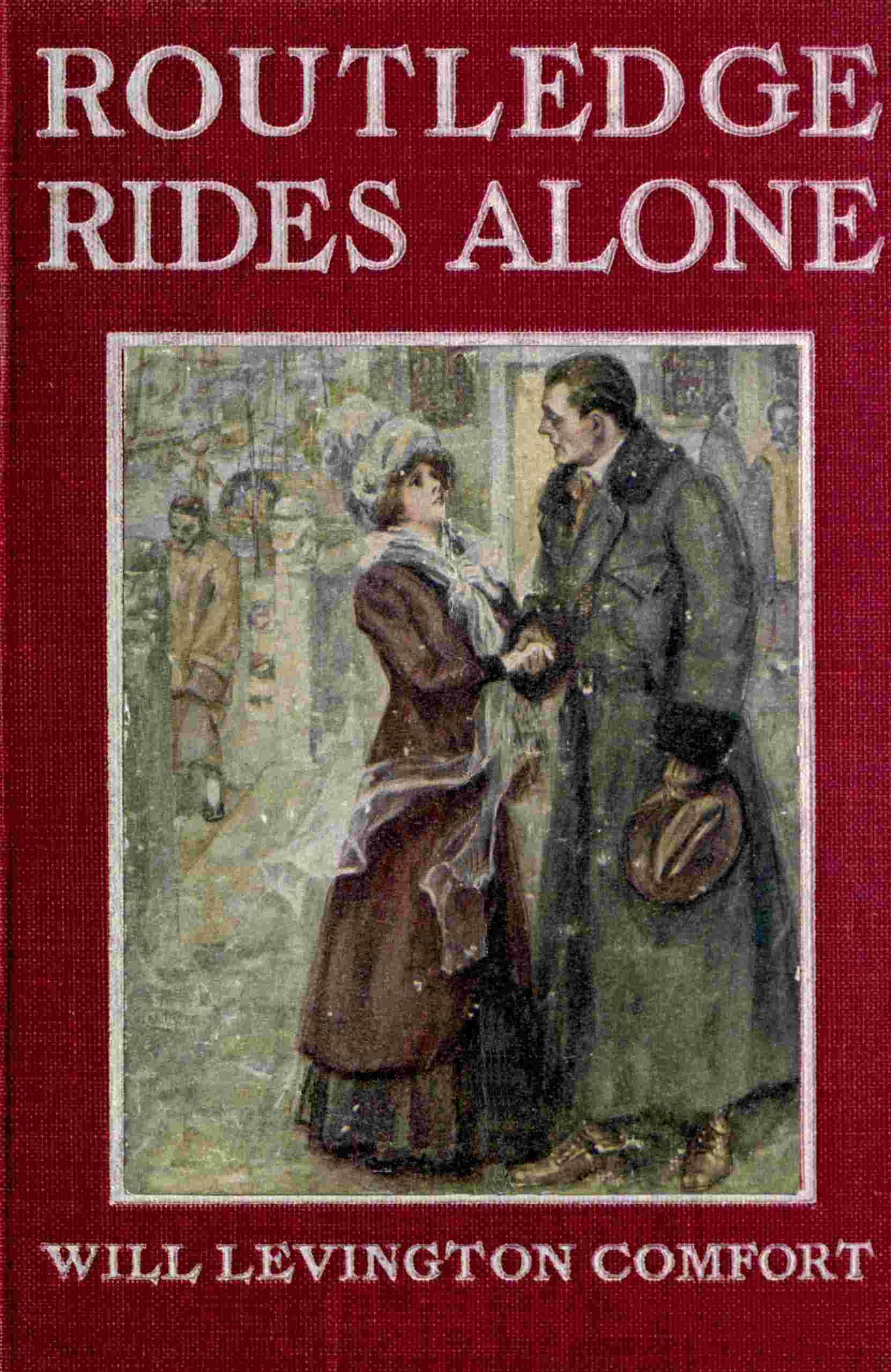
ELEVENTH CHAPTER
A HAND TOUCHES THE SLEEVE OF THE GREAT FRIEZE
COAT IN THE WINTRY TWILIGHT ON
THE BUND AT SHANGHAI
Routledge sat long in meditation after Rawder and his master had taken up their journey. Time passed unmeasured over his head until he was aroused by the guttering of a candle-wick. In quite an un-American fashion, he believed the prophetic utterances which the night had brought. The more a man knows, the more he will believe. The mark of a small man is ever his incapacity to accept that which he cannot hold in continual sight. Still, Routledge endured a reaction for the high moments of the recent hour. Sekar and Rawder and the power were gone from Rydamphur. He even felt abashed because of his outbursts to Rawder, so long had he been accustomed to the iron control of his emotions. It was not that he was sorry for what he had said, but torrential utterance leaves depletion. He did not feel the strength now to make men laugh at wars, nor to stay the tide of the world’s wars by painting the volcanic wrath of nations in all its futile and ferocious significance.
That he was to be hurt in the new war was in itself but a vague anxiety, dull of consideration except for its relation to the foretelling—that another was to come to help him!... He wondered if the wound would come from his enemies. Once before, a night in Madras, as he was entering a house of hiding a noose of leather dropped upon his shoulder. It was jerked tight with a sinister twang. Routledge had just escaped the garrote in the dark. He could not always escape; and yet he was not to die next time. Rawder said: ... “To fall wounded, apart from the battle-field, to lie helplessly regarding men and events from the fallen state, instead of face to face—this was but one of the tossing tragedies of cloud in his mind. Yet there was a radiant light in the midst of it all—only one woman in the world’s half-billion would come to him.”
Any suffering was cheap to prevent her coming—but he could not prevent! One cannot run from a vision or a prophecy. It is well to obey when one is ordered up into Nineveh. Even Sekar had cast him off, because he was a counter-attraction to the soul of Rawder. He could not forswear war—and so avoid the promised wound, which would enable her to find him—since he was not to meet the levelling stroke during a collision of troops, but somewhere apart. It was a chain of circumstances in which he was absolutely powerless—and she was coming to him!
First, it would mean that Jerry Cardinegh, the man he had preserved, was dead. If he were dead with his secret, Noreen would find him—Routledge—identify herself with the most loathed of outcasts, fleeing forever before the eyes and fingers of England. There was rebellion against this in every plane of the man’s consciousness. He could not suffer his love, nor hers, to be tested by such a tragedy. He would flee again from her.... But if old Jerry had remembered the truth at the last—if the fates had willed him to tell the monstrous truth—and the Hate of London were lifted from the name of Routledge, to become a heritage of Noreen Cardinegh—and then if she should come to him! He could not cover his eyes to the flash of radiance which this thought brought him.... He would have died to prevent such a thing from coming to pass. For more than a year, he had kept out of the ken of the world, to forestall any efforts on the part of the Cardineghs, to find him. He was worn to a shadow, hunted, harrowed, hated, lost to himself in disguises, ever apart from the gatherings of men and the decent offerings of life—all to prevent the very thing which, in thinking of now, lit every lamp of his being. Quite as readily would he have performed the treachery for which he suffered as return to the father of Noreen Cardinegh, saying: “I am tired, Jerry. Give me back my name.” But if, after all he had done to spare her from the truth, the fates ruled against him—then he would not flee from her!
Hours passed. Every little while, through the piling cumulus of disorder, would flash the reality, and for the interval he ceased to breathe.... To think of looking up from some half-delirium and discovering her face! To feel the touch of her hand—this woman—attuned to respond to every vibration of his voice and brain and heart.... Sometimes he fell into a heresy of manhood and demanded of himself what significance had England, the world, compared with the rest of his days with Noreen Cardinegh, in the glory of their union which formed a trinity—man and woman and happiness....
He laughed bitterly at the starry distances. “It would be a fitting end for a man who is supposed to have betrayed the country he served—to allow a woman to share such fortunes as mine, and take up the trail of an outcast.”
Routledge rose to go to the Rest House, but reflected that it must be nearer dawn than midnight. He was curiously disinclined to seek his room at this hour. With his face to the doorway, he sank down upon the matting and rested his chin in his palms.... The touch of Rawder’s hand awoke him, and he stared in wonder at the chela, his own eyes stinging from the East. The figure of a woman was prone before him.
“Routledge, my brother, here is work for you. I found her far out on the road. She was crawling into Rydamphur, carrying the child. I could not leave her. She is close to death. Sekar waits for me, and so again, good-by.”
Rawder had turned with a quick hand-clasp, and hurried away in the dawn-light to his master. It was all over quickly and strangely—as some psychic visitation. Routledge was already weary of the pitiless day. The blazing temple of dawn had shone full upon his eyelids as he slept, and there was an ache deep in his brain from the light.... The woman raised her head from the ground waveringly, like a crushed serpent, and plucked at his garments. There was a still, white-lipped babe at her breast. Her voice was like dried sticks rubbing together. He held the cup of water to her lips.
“I am the widow of Madan Das, who is dead since the drouth,” she told him. “The white holy man carried me here, leaving the other on the road. This is my son—the son of Madan Das. There were two others, both girls, but they are dead since the drouth. Also the brother of my husband, who was a leper. My husband worked, but there has been no work since the drouth. First we sold the cow——”
“My good mother, don’t try to talk,” Routledge said, as he lifted her into the hut, but she could not understand. As soon as he had placed her upon the matting, she took up the tale, thinking that she must tell it all. Her face was like dusty paper; her lips dried and stretched apart. Her hair had fallen away in patches, and her throat was like an aged wrist.
“First we sold the cow,” she mumbled, trying to find him with her eyes, “then we sold the household things. After that we sold the doors and door-posts. Even after that the food was all gone, and my husband, whose name is Madan Das, gave his clothing to his brother, who is a leper, to sell in the village for food. A neighbor lent my husband a cotton cloth to put about his loins. The chaukadari tax was due. Madan Das could not pay. We were starving, and one of the babes, a girl, was dead. The tahsildar” (a collector for the English) “came and took away from the second babe, who was in the doorway of our house, a little brass bowl for the tax. There was in the bowl some soup which my babe was eating—a little soup made of bark, flower-pods and wild berries.... Since then there has been no food. Madan Das is dead, and the two girls are dead, and the brother of Madan Das, who is a leper, died last night. The white holy man carried me here, leaving the other on the road. This is the son of Madan Das——”
Life was going out of her with the words, but she would not stop. Her heart was pounding like a frightened bird’s. The weight of them both was but that of a healthy child—an armful of dissolution.
“Listen, mother,” Routledge said. “Do not talk any more. I am going to the Rest House to get food for you and the son of Madan Das. Lie here and rest. I shall not be long.”
Even as he left her, she was repeating her story. He returned with a pitcher of hot tea, strong enough to color and make palatable the nourishment of half a can of condensed milk. He brought a servant with him, and a sheet to cover the woman. Routledge handed the child to the servant, and lifted the mother’s head to a cup. Afterward he cleansed her face and throat and arms with cool water, and bade her sleep.
“The little one is quite well, mother,” he told her softly. “All is well with you now. The English will be here to-day with much food, and you have only to rest. The child eats.”
“He is the son of Madan Das,” she mumbled, “and I am his mother.... Do not forget.”
She sank into a half-stupor. The servant had spooned a few drops into the babe’s mouth. Routledge took the child—a wee thing, light as a kitten, numbed from want, and too weak to cry. Its body had the feel of a glove, and the bones showed white under the dry brown skin, and protruded like the bones of a bat’s wing. The servant went to fetch a basin of water.
“Why must you, little seedling, learn the hunger-lesson so soon?” Routledge reflected whimsically. “You are lots too little to have done any wrong, and if your bit of a soul is stained with the sins of other lives, you are lots too little to know that you are being punished for them now.... I should have asked Sekar of what avail is the karmic imposition of hunger upon the body of a babe.”
He sponged and dried the little one, wrapped him in a cloth, and fed him again—just a few drops. The son of Madan Das choked and gurgled furthermore over a half-spoonful of water.
“Oh, you’re not nearly so far gone as your mother, my son. She was already starving before your inestimable fountains dried.... And so they took away your sister’s little brass bowl—and the soup made of bark and flower-pods and wild berries. The poor tahsildar must have been very tired and hot that day.... And so your worthy uncle who was a leper sold the clothing of Madan Das, who borrowed a loin-cloth from a neighbor, and did not need that very long.... Curl up and sleep on a man’s arm, my wee Rajput.”
Between the two, Routledge passed the forenoon. At last, miles away across the dusty sun-shot plain eastward, a bullock-cart appeared, and long afterward behind it, faint as its shadow, another—and others. Almost imperceptibly, they moved forward on the twisting, burning road, like crippled insects; and the poles of the native-drivers raised from time to time like tortured antennæ. There was a murmur now within the huts of stricken Rydamphur. Routledge had sent his baggage west to the railroad and settled his account at the Rest House. He would leave with the coming of the famine relief. The child was better, but the woman could not rally. The nourishment lay dead within her. The bullock-carts merely moved in the retina of his eye. He was thinking deep, unbridled things in the stillness of high noon.
The great law of cause and effect had brought the answer to his whimsical question of a few hours before. Why did karma inflict starvation upon the child before the tablets had formed within him on which the lesson might be graven for his life’s direction? The son of Madan Das was but an instrument of punishment for the mother.... What wrong she must have done, according to Hindu doctrine, to him in one of the dim other lives—when she was forced to bring him into the world, the famine-world of India, forced to love him, to watch him waste with hunger, and to crawl with him in the night. Incomparable maternal tragedy. The sins of how many lives had she not expiated up yonder in the withered fields!
The woman’s arm flung itself out from her body, and lay in a checkered patch of sunlight. It made Routledge think of a dried and shrunken earth-worm which the morning heat had overtaken upon a wide pavement. Her eyelids were stretched apart now.
Sierras of tragedy are pictured in the eyes of the starving. Processes of decay are intricate and marvellous—like the impulses of growth and replenishing. There is no dissolution which so masterfully paints itself in the human eye as Hunger. The ball is lit with the expiration of the body, filled with a smoky glow of destroying tissue. The unutterable mysteries of consummation are windowed there. The body dies, member by member; all flesh save the binding fibres wastes away, and the hideous hectic story of it all is told in the widening, ever widening eyes—even to the glow of the burning-ghats—all is there.
And the mother’s eyes! She was already old in the hunger-lesson. The husband, Madan Das; the leper, his brother; the two little girls; the little brass bowl—all were gone, when this child ceased to feed upon the mother’s flesh. And still she crawled with the last of her body to the town—all for this little son of Madan Das, who slept the sleep of healing within reach of her arm.
Routledge gazed upon the great passion of motherhood. In truth, the little hut in Rydamphur had been to him a place of unfolding revelations. He had seen much of death in wars, but this war was so poignant, so intimate.... Why did the woman sin? Routledge’s tired brain forged its own answer on the vast Hindu plan of triple evolution. Countless changes had carried this creature, as he himself had been carried, up from a worm to a human. It is a long journey begun in darkness, and only through error, and the pains of error, does the soul-fragment learn to distinguish between the vile and the beautiful. In the possession of refining senses, and the travail of their conquering, the soul whitens and expands. Often the wild horses of the senses burst out of control of the charioteer of the soul; and for each rushing violence, the price must be paid in pangs of the body—until there are no longer lessons of the flesh to be learned, and the soul puts on its misery no more.... Routledge came up to blow, like a leviathan, from the deeps of reflection, and wondered at the feverish energy of his brain. “I shall be analyzing presently the properties which go into the crucible for the making of a prophet,” he declared.
The servant had brought a doctor, but it was mere formality. Routledge bent over the dying woman. Her heart filled the hut with its pounding. It ran swift and loud, like a ship’s screw, when the clutching Pacific rollers fall away. In that devouring heat, the chill settled.
“Do not forget.... He is the son of Madan Das, and I am his mother——”
“I shall not forget, good mother,” Routledge whispered. “A worthy man shall take care of him. This, first of all, shall I attend.”
“Madan Das was a worthy man——”
The rest was as the rattle of ripe seeds in a windblown pod.... Routledge turned his face from the final wrench. There was a foot-fall in the sand, and a shadow upon the threshold, but Routledge raised his hand for silence. The moment of all life in the flesh when silence is dearest is the last.... The child stirred and opened its eyes—roused, who can tell, by its own needs of a metaphysical sympathy? And what does it matter? The man covered in the sheet the poor body which the soul had spurned, and turned to feed the child again. The American was at the door.
“And have you been specializing in famine at first hand, Mr. Jasper?” Routledge inquired.
“Yes, and I see, sir, that you have been doing more.”
“The task came to me this morning. A little touch of motherhood makes the whole world kin, you know.... This baby seal is the son of Madan Das. He is sleepy, having ridden all night bareback—and the bones of his mount were sharp.”
“Allow me to say, rather from necessity than any notion of being pleasant,” Mr. Jasper observed slowly, “that I think you are a wonderful man.... I have found myself weak and cowardly and full of strange sickness. I am going back to the railway filled with a great dislike for myself. The things which I find to do here, and want to do, prove a physical impossibility. I want to leave a hundred pounds in Rydamphur. It is but a makeshift of a coward. It occurred to me to ask you how it would be best to leave the money, and where.”
“Don’t be disturbed, Mr. Jasper,” Routledge said, struck by the realness of the other’s gloom. “I know the feeling—know it well. A white man is not drilled in these matters. God, I have been ill, too! I am ill now. See the soaps and water-basins which I have served with my ministrations—and I am old in India. It is the weakness from hunger which makes the people a prey to all the atrocities of filth and disease. First famine, then plague.... A hundred pounds—that is good of you. I know a missionary who will thank God directly for it—all night on his knees—and he will not buy a can of butter for himself. I will lead you to him if you wish.”
They passed through the village. The English were coming with the bullock-carts, and the people, all those who could crawl out of their huts, were gathered in the blazing sunlight on the public threshing-floor. Mr. Jasper quickened his step and averted his face.... Routledge had been several days in Rydamphur, and a guest in most of the huts, but there were many upon the threshing-floor now (the old in agony, borne there by the young; loathsome human remnants moving upon the sand) that he had not seen before. It profited not to look deeply into that harrowing dream of hell, in the light of the most high sun, lest the spectacle remain in the brain, an indissoluble haunt.
“Yes, I know, Mr. Jasper,” Routledge muttered. “It is shocking as the bottom of the sea—with the waters drained off. It is the carnal mystery of a famine.”
There was but one thing left in Rydamphur for Routledge to do. It concerned the servant of the Rest House, whom he had found good, and the little son of Madan Das.
“This is to be your child,” he said to the man. “The mother is dead, and the others of the family lie dead in the country. I am leaving Rydamphur now, but by chance I shall come back. You shall attend the mother’s body—and take the child for your own. It is the wish of the very holy man who tarried here a few days. It was his chela who carried the woman in from the country during the night. It is also my wish, and I leave you money. More money will be forthcoming in due time. First of all, I want you to buy a little brass bowl, which shall be the child’s own. Remember the name. He is the son of Madan Das. And now give me your name.”
It was done in order. An hour after, when all the village was attracted to the threshing-floor, and the bullock-carts were creaking in, and the sweating, harried Englishmen were pushing back the natives, lest they fall under the wheels, Mr. Jasper perceived the man who had so fascinated him set out, alone and without conveyance, along the sandy western road toward the railroad.
It was a night late in October when Routledge reached Calcutta, where he was forced to sink deeply into the native life to avoid recognition. With two months’ files of the Pioneer, he sat down to study the premonitive mutterings of the Russo-Japanese war. They were wide in aim, but deep with meaning for the man who had mastered the old game of war. The point which interested him most in regard to this inevitable fracture of the world’s peace was not brought out in the Pioneer. Just how much did the awful activity of one Tyrone patriot, Jerry Cardinegh, have to do with the ever bristling negotiations between Tokyo and St. Petersburg?... In the light of the present developments, the Anglo-Japanese alliance was one of the cleverest figments of diplomacy in the history of national craft. Japan was a fine tool, with a keen and tempered edge. It would take all the brute flesh that Russia could mass in Manchuria to blunt it. Decidedly, Russia would have none left to crumple the borders of British India. Meanwhile, England had nothing more serious to do than to collect her regular Indian tributes, attend her regular Indian famines, and to vent from time to time a world-wide whoop of encouragement for her little brown brothers, facing the Bear.
“That reminds me,” Routledge reflected with a start, “that all this is my work. I took it from Jerry Cardinegh.”
He breathed hard, and perused again the long, weary story of negotiations, the preliminary conflict. It appeared that Russia recognized Japan’s peculiar interest in Korea, and called it reasonable for her to take charge of the affairs of the Korean court.... “By the way,” Routledge mused ironically, “the Anglo-Japanese alliance was hung on the fact that Korea was to be preserved an automatic unit. However, the Anglo-Japanese alliance was hung in haste.”... The Czar observed that he had a peculiar brotherly regard for Manchuria, and that Japan must bear in mind that her Korean business must remain for all time south of the Yalu. “Don’t cross that river,” said Nicholas.... Ominous courtesy, rejections, modifications, felicitations, and the thunder of riveting war-ships in each navy-yard of the respective Powers involved. Brute boy, Japan, at a white heat from Hakodate to Nagasaki; Russia sweetly ignoring the conflagration and sticking for Great Peter’s dream for a port in the Pacific.
And so it stood when Routledge closed his last Pioneer in his Calcutta hiding-place, and embarked European steerage for Shanghai. Two days north of Hong Kong, the steamer ran into the first breath of winter, and Routledge drew out the great frieze coat to go ashore in the Paris of China. Far out on the Hankow road, he ensconced himself in a small German hostelry, and caught up with the negotiations through the successive editions of the North China News. Not a line anywhere regarding the life or death of Jerry Cardinegh.
Closer and closer, the Powers drew about to hear the final back-talk between Russia and Japan. The latter said that she would establish a neutral zone along the northern Korean frontier, if Russia would do likewise on the southern frontier of Manchuria. Some humorist in England observed that you cannot have a neutral zone without war; and the correspondents set out from England, via America, where they picked up the men from New York, Chicago, and Three Oaks—travelling west to the Far East. At this point, Routledge, with great secrecy, made possible through a solid friend in New York, secured credentials, under an assumed name, for free-lance work in the interests of the World-News. Thus passed the holidays. The first month of 1904 was remarkable for the unexampled tension created by Japan burning the cables for Russia’s last word.
Routledge thrilled in spite of himself. He felt that this was to be his last service and the biggest. What a farce were the negotiations, with Japan already a-tramp with soldiery and the great single-track railroad from St. Petersburg to Port Arthur groaning with troop-trains; with India locked tight in the strong white British hand for at least another decade; with England turned to watch her Asiatic agent spitted on the Czar’s rusty bayonets—what a farce, indeed, with Russia willing, and Japan determined, for war.
Late in January, and a snowy twilight. Routledge stood for a moment on the Bund in Shanghai. He was sailing that night for Chifu, and wondering as he stood in the falling dark, his face concealed in the high-collar, how fared Jerry Cardinegh in the crux of these great affairs. Was he dead—or dead in brain only? Of Noreen—thoughts of Noreen were always with him.
One of the launches of an Empress liner was leaving the Bund in a few minutes for the ship in the offing—her nose turned to Japan. Routledge was thinking that he would have to play the game alone now, if never before. He smiled at the thought of what the boys gathering at the Imperial Hotel in Tokyo would do if he should turn up among them.... Suddenly he felt a man’s eyes fixed upon him from the right. He turned his head carelessly, and discovered a figure marvelously like Finacune’s stepping overside into the launch. It disappeared into the small cabin. Routledge turned his back to the launch with that degraded, shrunken sensation which concealment always incited.
“They would murder me,” he muttered absently. “I must swing it more than ever alone—from the edges and alone.”
A woman’s hand touched the sleeve of the great frieze coat, and Routledge jerked about in a startled way. Men and wars were obliterated like dry leaves in a flame.... The launch whistled a last time.