
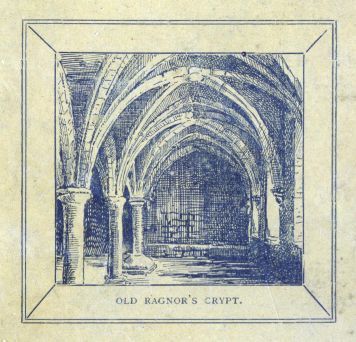
Eric Entombed.
Entombed alive! A struggling streak of light
Made visible the gloom,—
His living shroud.
He felt himself alive yet without room
To live or breathe. He groaned, then cried aloud,
"O God, while in this porch of hell, be Thou my light!"
Next morn—if morn, it were—no count of hours,
The dungeon-tenant kept,—
A silver ray
Woke hope afresh, as down a cord there crept
A basket full of meats, while 'neath them lay
A lamp and tools, with hints where he might try their powers.
Henceforth work's pulses guaged his night and day,
As sandstone rock he bored.
His ear supplied,
By sound of sea, how much his axe had gored,
As clearer came the welcome rush of tide.
Hope made his feeble lamp effulgent as sun's ray!
The Rift in Hell Gate.
The first hole pierced, his head grew sick and faint.
To pray he tried; no word
Escaped his lips.
Yet sure he felt his spirit's groanings heard,
As prone he lay and gasped the air by sips;
For that he'd breathed so long, was foul with dead men's taint.
His strength now grew with every stroke he plied.
At sound of sea and men,
Death's clammy sweat
Was changed for drops that told of health again,
While through his languid frame life's current swept,
It only made him feel how nearly he had died.
At last his living tomb of rock was rent;
Though but a narrow rift
He yet had made
Enough; it did a horrid monster lift,
That clutched him close and held aloft a blade;
He felt himself undone, when, lo! God had deliv'rance sent.
The Crucified One.
So wildly beat his heart and throbbed his veins,
As morn's first struggling gleam.
His rift net caught,
He e'en must follow its meandering beam,
Till something on the walls his footsteps brought
To rest. He shuddered as he saw the death-throe stains
Of some whose hands and ankles, staple-bound,
Had graved thereon the sign
Of crucified.
"My God!" he cried, "such fate may yet be mine!"
He turned and lo! close at his feet he spied
A note. A piercing wail then woke the echoes round.
"To-morrow, Eric, will decide your fate.
Confess and you are free;
Else will you die
A death of torture, marks of which you'll see
Upon the walls around. Fly, Eric, fly,
This night, this very night, or it will be too late!"
Eric Faithful Unto Death.
When Eric woke to thought, the light had flown,
With Hope upon its wing
And left Despair.
One thought alone could light and comfort bring—
His secret—This, not death should from him tear.
Rowena's safe retreat, he never would make known!
The rasp of grating chains and rush of air
Awoke the sleeping page
From frightful dreams.
A voice he heard. Alas! 'twas fierce with rage,
While on his sight there flashed the fitful gleams
Of warders' arms. In haste they clangour down the stair.
"Come forth, young man! Sir Guy awaits above.
We dare not tarry long;
He's mad this morn.
Keep up your heart, my son! Be firm, be strong!
A page, yet truer knight was never born!
Betray her not, brave youth, as you esteem her love!"
Eric to be Crucified.
"Have rats and goblins eaten up your pride
And will you tell me now
What well you know?
The holy father, here, can loose your vow.
Still silent!" roared Sir Guy, "O there! Below
With him, and if rack fail, let him be crucified."
"I fear not crucifixion, master mine,
As oath forsworn from fear
Of death. No pangs
Shall ever make me breathe to mortal ear
Her safe retreat. Transfix me with your fangs
With speed; my life for hers I freely will resign."
"Fear not, brave youth, Sir Guy doth go
This night to meet Prince John,
Who claims the crown.
But we do hear our king will come anon;
Then woe to all who have incurred his frown!
For sure he'll vengeance take on John and every foe."
To Die or Live?
At least he knew his fate—Condemned to die!
He bade farewell to all,
Then went below.
The darkness closed around him like a pall
The dead. Yet drain the bitter cup of woe
For her, e'en to the dregs, he would without a sigh.
Yet did he not despair. Athwart the gloom
A gleam of hope there stole.
As clothed in light,
He saw the form that could his fears control,
And which the darkness only made more bright—
It was her angel presence lit his rock-hewn tomb!
It beckoned him; he boldly followed till,
Beside the narrow cleft,
His axe had wrought,
It stood. He saw the fissure wider reft.
To challenge death then fly—ignoble thought!—
He knelt and prayed: "O God, but show me now Thy will!"
Eric Escapes.
He rose and turned a quick retreat to make,
When lo! that presence bright
Still barred his way,
And stood with hand stretched towards the rift's pale light—
A sign which Eric felt in words would say—
"What God, in mercy sends, dare you refuse to take?"
As Cherubim with flaming sword it kept
The gates of death. How could
He pass them now?
Enough, that she would know his will was good,
From, what he'd suffered for his loyal vow.
"Heaven's will be done!" he cried, and through the portal crept.
The sudden call to life from out the tomb;
Death's bands thus swiftly rent,
Life's tidal force
Undammed, had rushed with too impetuous vent,
Did not a tortuous cave arrest its course,
Ere he at length emerged beneath night's starless gloom.
The Smuggler's Den.
Along the shore he sped nor stopped his flight
Until a burly voice,
His fleet foot stayed.
That voice he knew full well. He had no choice
But one—to yield himself—nor felt afraid,
Within the smuggler's den to rest at least, the night.
So sweetly sound his sleep, without a dream
To shorten his repose;
The watcher's eye
Could scarce perceive he breathed save as arose
And fell his manly chest with deep-drawn sigh;
Which sign the smuggler caught beneath his lantern's gleam.
His story told, young Eric found a friend
And guide in one he feared;
Who bade him stay
Until he'd seen the coast of foes was cleared,
Then to St. Hilda's shrine he'd lead the way,
Those saintly walls to him would peace and succour lend.
Rowena's Fiery Furnace.
Now all this while Rowena struggled still,
Bound fast by fever's chain.
There seemed no hope!
No leech nor nurse could ease her tortured brain,
Or help her frail and sinking frame to cope
With all the fiery imps that sported there at will.
She sank at last in stupor so profound
They deemed her dead indeed,
And forthwith sent
A messenger to Ragnor's Tower with speed.
But as the heavens no light propitious lent,
The morn beheld the rider horseless on the ground.
Him bleeding sore, the smuggler found; his steed
Was grazing close at hand.
His master groaned,
And begged with tears, as one by fear unmanned
To die, for then his life will have atoned
For what may hap unless his note were sent with speed!
The Dungeon's Angel.
The smuggler promised, but when Eric read
The note, he knew Sir Guy
Was far away.
No need of guide, the horse did homewards fly
And at St. Hilda's gate alone made stay.
This was the night young Eric stood beside Rowena's bed.
Soon after midnight, life once more returned;
Her pulse beat full and fast.
The fever's power,
Some mystic spell had bound but not to last,
Save for one long more dead than living hour;
And now with force renewed, it once more raged and burned.
"Fly, Eric, fly," she cried, and pointed where
The morn's sweet dawning gleamed.
And as upright
She stood, the living counterpart she seemed
Of her whose presence made Hell's dungeons bright,
O God! his angel guide now raved in madness there!
Rediviva.
"Dear mistress mine," young Eric cried and rose;
Then took and kissed her hand,
As he had done,
That night he had received her last command—
To make her place of refuge known to none.
O blessed charm which brought her life and sweet repose!
When she awoke next morn she gazed on all
Around with look so calm
And smile so sweet,
As fell upon each soul like holy balm
Of healing. Yet their eyes could only greet
Her look of grateful love with tears unbidd'n to fall.
"That voice I heard last night," she weakly said,
"Whose tones familiar sent
A magic thrill
Through all my veins and fever's fetters rent,
Was Eric's, faithful youth, whom they would kill
In Ragnor's deadly vaults! O say he is not dead?"
Convalescent.
"He'll come anon," the holy mother said,
And kissed her death-white cheek.
"Now sleep! and while
We swiftly send your gallant page to seek,
Let holy thoughts and dreams the time beguile!"
She woke and lo! he stood 'mong those beside her bed.
She clasped his hand and whispered low. He bent
Once more to hear that voice
He must obey,
E'en though 'twixt life and death, no choice
It might him leave. She only bade him stay
Nor leave her more. The lady mother gave assent.
As flowers to sun respond with blushing hues
And grateful scents distil
Their voiceless praise;
So now as through her veins life's pulses thrill
Amid the breath of flowers and wood-choirs' lays,
She could, no more than they, her hymn of thanks refuse.
Rowena's Te Deum.
"O flowers," she sang, "sweet flowers,
Where beauty hath her throne,
Yea, smile away life's hours;
For you they'll soon be flown!
Then nursed awhile in womb of mother earth,
Ye'll rise, to taste with me, the joys of second birth!
O birds of happy wing!
With flowers' sweet incense blend
Your joyous notes and sing;
For soon your songs will end!
When summer's warmth again awakes your trills,
Ye too may know the joy which now my bosom fills!
The world seems one great heart,
Whose pulses move my soul.
I feel a feeble part
Of some mysterious whole!
Thy mighty heart, O God, 'tis thine alone,
That makes all things now breathe, responsive to mine own!"
The Lights of Home.
With sails full set to catch the western breeze,
The stout ship, Holy Cross,
The Channel ploughed;
Nor dreamt those noble hearts on board of loss;
Or that those silvered waves might prove their shroud;
As o'er her staunch bulwarks they pictured home and ease.
"What light is that which glimmers on yon height?"
The gallant captain cried,
"'Tis Ragnor's Tower,"
Sir Harold said, "where dwells my lady bride.
That light she vowed should never quit her bower.
Haste, captain, haste, I pray, and land me there this night."
"Steer straight for yonder light on Ragnor's crown!"
The captain made reply.
They set the helm;
And now with wings outstretched they swiftly fly,
Where demons will with mocking laugh o'erwhelm
And dance with fiendish glee to see them sink and drown.
The Lamp of Death.
Sir Guy had heard afar the tidings fell
Of Harold Wynn's return
From Holy Land.
The news more fiercely made his wrath to burn.
Hence hot with hate he sought Old Ragnor's strand,
Whose peaceful haunts became again a very hell.
By Eric fed, the beacon lamp once more
Shone o'er the treach'rous sea
Which hid Death's maw.
Rowena had a secret gate whose key,
Her page had used. Her light, Sir Guy first saw.
O madd'ning sight! "If saved, Rowena dies," he swore.
The light of life, he quenched, and straightway hung
A lamp to lure to death.
His eyes shot fire
As straight he saw her come. He held his breath,
At length he heard the crash. No Nero's lyre
Across his work of death such yells of triumph flung!
The Wreck of the "Holy Cross."
The noble ship had freight of nobler men,
Whose crosses bore the stain
Of deadly strife
With Turc and Saracen, on Acre's plain
And wounded sore had scarce escaped with life.
How beat their hearts with joy at sight of home again.
At home, alas! did foes more deadly wait
Than Saladin's fierce crew.
The lamp of love
Was changed for one of hate, which threw
Its false and fatal skein of light above.
A shuddering shock, a fearful crash, foretold the vessel's fate.
For many nights before, two lonely men
Stood ready, boat at hand.
God speed them now!
As swift they row and quick return to land,
Bearing a lifeless form with sword-cleft brow,
Whose arms fast clutch a maid. They bore them to their den.
Grief at Wynnwood Hall.
The news soon spread from coast to country round
That lost was every soul.
At Wynnwood Hall,
Sir Harold's home, their grief knew no control.
That he should be the first Wynn not to fall
In battle's heated fray; but should be basely drowned!
His helmet, cloak, and sword he'd cast aside,
To save the girl who clung
Around his neck.
These relics dear were found and silent hung
Beneath the rest. None sought grief's tears to check
To see the blood-stained cross for which he'd fought and died.
Alack! The ill-starred news had reach the shrine
Where sat mid birds and flowers,
His new-born bride.
To her the lead-winged moments seemed as hours;
And yet her bounding hope her baleful fears belied.
What tidings would morn bring. O could she but divine!
Saved.
The smuggler's patient skill soon fanned life's spark
Into a feeble flame.
Sir Harold first
The solemn quiet broke to breathe the name
Of Ruth, the Saracene who had him nurs'd
And hid with all a sister's love and care within her ark.
"She's saved? Thanks be to God," he said, and wept.
"And she, my lady bride!
O can you say
She too doth live? Or better yonder tide
Now held this hopeless wreck of life its prey!"
"She lives, brave knight," they said. He smiled his thanks
and slept.
A messenger of life, young Eric sped
And death's fell courier caught
At Hilda's gate.
The sisters' tears foretold the mischief wrought,
"She's swoon'd," they said. He curs'd his cruel fate.
They led him to her couch whereon she lay as dead.
Two Lives in One.
"Sir Harold saved!" Like drops of heavenly balm,
With healing quickening power,
The tidings thrilled
Her soul with joy intense as in that hour,
The rush of new-found life her pulses filled.
Her anxious fears allayed, she felt a holy calm.
Two lives in one, although they dwelt apart.
A sympathetic glow,
Each seemed to feel,
To pass from soul to soul; a constant flow
Of thought and feeling made their wounds to heal;
As though betwixt the two there beat one common heart.
Who nightly scared the darkness-loving owl
And made the hills resound
With watch-dogs' bark?
But he who faithful unto death was found;
Who'd buried been in Ragnor's dungeons dark,
While round him Death's grim shades pursued their midnight prowl.
The Lost Missive.
One night as Eric rode, a bolt whizzed by,
With well-nigh fatal aim.
He faster flew,
Until, alack! his faithful steed fell lame.
He leapt aground and o'er his arm he drew
The reins. What joy to find the smuggler's den was nigh!
For Eric's belt then held in close embrace,
As erst long months ago,
A precious note.
'Twas gone! and its contents would clearly show
His lurking place and hers—Alas! who wrote
To beg she soon might see her Harold face to face.
The smuggler begged young Eric show the road
He'd come. Then armed they go;
But without need;
For where Rowena's page alighted, lo!
The missive lay. They hasten back with speed;
And as they give God thanks, more eyes than one o'erflowed.
Another Dungeon Tenant.
"We e'en must quit, dear Mike, thy safe retreat;
'Tis clear, they're on our track.
Of this be sure,
That you henceforth in life shall nothing lack
That heart can wish or wealth of mine procure.
Swift send to Wynnwood Hall, a trusty man and fleet!"
"I'll go myself, Sir knight," old Michael said;
"For Eric here must stay
And hide awhile.
You'll see me back again by break of day;
With talk and sleep you can the hours beguile;
But one at least much [Transcriber's note: must?] watch,
for mischief broods o'erhead!"
When Mike returned, his den indeed was there
But tenants only one
Who bound him fast
And bade him take his leave of yonder sun,
For sure enough this look would be his last;
In Ragnor's gloomy vaults he'd find nor light nor air.
Nemesis.
Sir Guy's dire act of awful vengeance ta'en
A ravenous brood of prey,
To make their nest,
Seemed gnawing at his heart-strings night and day;
With croaks like drowning cries they filled his breast
And raised with fluttering wing the ghosts of those he'd slain.
No dove of peace on wings of morn returned.
He watched with eager eyes
Day's amber birth
And saw, or thought he saw, a form arise;
'Twas his—Sir Harold's—just as when on earth
He came to plead his suit and was with insult spurned.
"O God, have mercy! Grant it may be true
That he indeed doth live!
Oh! warders, fly,
Proclaim—a thousand livres I will give
To know the Knight of Wynnwood did not die
In that night's fearful wreck. If found, I'll make it two!"
The Demon Exorcised.
As beasts and lands welcome the rain they craved
And ope their parch-ed lips
To drink their fill;
So felt Sir Guy the demons loose their grips,
As warders, one by one, the news distil,
To quench their hell-lit fires—'that all on board were saved'!
Like savage beasts when bite and roar grow weak,
Seek out some lonely nook
Wherein to die;
So now Sir Guy, whose thunderous voice once shook
Old Ragnor's walls and made the bravest fly,
Would feebly cry: "My child!" then, death-like, swoon away.
Full ten days passed ere conscious life again
Illum'd those once stern eyes,
With rays serene,
Now mildly placid as the azure skies,
On which one grateful turns from sun's fierce sheen;
Refreshing, too, his milder tones as summer rain.
Father and Child.
"Rowena, Harold, Eric, friends, forgive!
And could I hear her say
'Dear father mine,
We all forgive'—I would no longer pray
For life; but to atone my all resign
To those I've wronged: for this alone I fain would live."
"They live, Sir Guy, and ere the sun has set
Will hither come!" they said.
He crossed his hands
While o'er his face a smile complacent spread
And docile as a child to their commands
To sleep he yields his eyes with gracious tear-drops wet.
Rowena's kiss, yet sweeter far the sound
She breathed of 'Father mine'
The knight awoke;
Another moment and their arms entwine.
She checked the word ere from his lips it broke
'Forgive'! Father and child long-lost, again were found.
Reconciliation.
His outstretched hands did next forgiveness seek
Of one who long had prayed
This hour to see.
With hands close clasp'd, no words the knight essayed;
In tears he quenched a life-long enmity.
Thus did the Saxon's love triumphant vengeance wreak!
Then last, though not the least who'd borne the cross
And bravely gone to die
In flower of youth,
Young Eric caught the knight's atoning sigh,
Who joined his hands with those of faithful Ruth
Thus triumphed faith and love o'er pain and death and loss.
And what of him whose kind and skilful care
Had saved the life of three?
Forget they him?
Not so! a gracious pardon, full and free,
With thankful joy they bear to dungeons grim;
And one more doomed to die from death's fierce grip they tear.
A Royal Visitor.
Unfurl the banner, let it court the breeze
Once more, on Ragnor's Towers.
A wedding peal
Now ring. Come virgins, strew with flowers
Their bridal path, whose woes this day will heal!
Look bright, ye frowning cliffs and laugh ye moaning seas!
What means that wild commotion an the strand?
A stately vessel nears
Old Ragnor's port!
"King Richard comes!" Sir Guy with terror hears.
"Haste, Harold, pay our sovereign royal court;
Crave pardon for me! Say, I lie at death's command!"
"Welcome, my liege!" "Sir Harold, welcome, too,
Is sight of thee, brave knight!
But where is he.
Sir Guy de Hastyngs,—flies he now my sight?"
"Nay, nay, my liege! his sponsor will I be;
His heart for thee, his king, doth bear allegiance true!"