
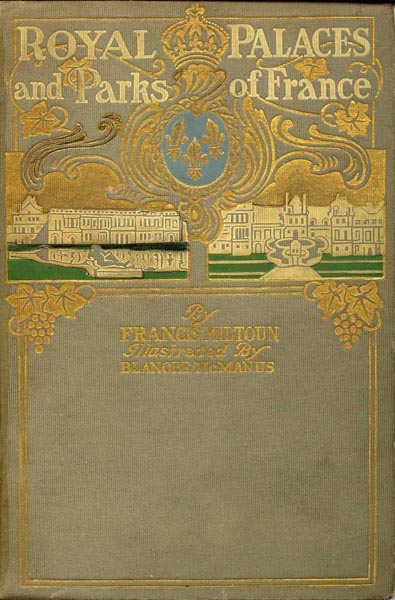
The Project Gutenberg eBook of Royal Palaces and Parks of France
Title: Royal Palaces and Parks of France
Author: M. F. Mansfield
Illustrator: Blanche McManus
Release date: June 19, 2008 [eBook #25842]
Language: English
Credits: E-text prepared by Juliet Sutherland, Janet Blenkinship, and the Project Gutenberg Online Distributed Proofreading Team
E-text prepared by Juliet Sutherland, Janet Blenkinship,
and the Project Gutenberg Online Distributed Proofreading Team
(http://www.pgdp.net)
Royal Palaces and Parks of France
By Francis Miltoun
Author of "Castles and Chateaux of Old Touraine," "Castles
and Chateaux of Old Burgundy," "Rambles in Normandy,"
"Italian Highways and Byways
from a Motor-Car," etc.
With Many Illustrations
Reproduced from paintings made on the spot
By Blanche McManus
BOSTON
L. C. PAGE & COMPANY
1910
Copyright, 1910.
By L. C. Page & Company.
(INCORPORATED)
All rights reserved
First Impression, November, 1910
Printed by
THE COLONIAL PRESS
C. H. Simonds & Co., Boston, U. S. A.
WORKS OF
FRANCIS MILTOUN
| Rambles on the Riviera | $2.50 |
| Rambles in Normandy | 2.50 |
| Rambles in Brittany | 2.50 |
| The Cathedrals and Churches of the Rhine | 2.50 |
| The Cathedrals of Northern France | 2.50 |
| The Cathedrals of Southern France | 2.50 |
| In the Land of Mosques and Minarets | 3.00 |
| Royal Palaces and Parks of France | 3.00 |
| Castles and Chateaux of Old Touraine and the Loire Country | 3.00 |
| Castles and Chateaux of Old Navarre and the Basque Provinces | 3.00 |
| Castles and Chateaux of Old Burgundy and the Border Provinces | 3.00 |
| Italian Highways and Byways from a Motor Car | 3.00 |
| The Automobilist Abroad | net 3.00 |
| (Postage Extra) |
L. C. Page and Company 53 Beacon Street, Boston, Mass.
Preface
"A thousand years ago, by the rim of a tiny spring, a monk who had avowed himself to the cult of Saint Saturnin, robed, cowled and sandalled, knelt down to say a prayer to his beloved patron saint. Again he came, this time followed by more of his kind, and a wooden cross was planted by the side of the "Fontaine Belle Eau," by this time become a place of pious pilgrimage. After the monk came a king, the latter to hunt in the neighbouring forest."
It was this old account of fact, or legend, that led the author and illustrator of this book to a full realization of the wealth of historic and romantic incidents connected with the French royal parks and palaces, incidents which the makers of guidebooks have passed over in favour of the, presumably, more important, well authenticated facts of history which are often the bare recitals of political rises and falls and dull chronologies of building up and tearing down.
Much of the history of France was made in the great national forests and the royal country-houses of the kingdom, but usually it has been only the events of the capital which have been passed in review. To a great extent this history was of the gallant, daring kind, often written in blood, the sword replacing the pen.
At times gayety reigned supreme, and at times it was sadness; but always the pageant was imposing.
The day of pageants has passed, the day when lords and ladies moved through stately halls, when royal equipages hunted deer or boar on royal preserves, when gay cavalcades of solemn cortèges thronged the great French highways to the uttermost frontiers and ofttimes beyond. Those days have passed; but, to one who knows the real France, a ready-made setting is ever at hand if he would depart a little from the beaten paths worn smooth by railway and automobile tourists who follow only the lines of conventional travel.
France, even to-day, the city and the country alike, is the paradise of European monarchs on a holiday. One may be met at Biarritz on the shores of the Gascon gulf; another may be taking the waters at Aix or Vichy, shooting pigeons under the shadow of the Tete de Chien, or hunting at Rambouillet. This is modern France, the most cosmopolitan meeting place and playground of royalty in the world.
French royal parks and palaces, those of the kings and queens of mediæval, as well as later, times, differ greatly from those of other lands. This is perhaps not so much in their degree of splendour and luxury as in the sentiment which attaches itself to them. In France there has ever been a spirit of gayety and spontaneity unknown elsewhere. It was this which inspired the construction and maintenance of such magnificent royal residences as the palaces of Saint Germain-en-Laye, Fontainebleau, Versailles, Compiègne, Rambouillet, etc., quite different from the motives which caused the erection of the Louvre, the Tuileries or the Palais Cardinal at Paris.
Nowhere else does there exist the equal of these inspired royal country-houses of France, and, when it comes to a consideration of their surrounding parks and gardens, or those royal hunting preserves in the vicinity of the Ile de France, or of those still further afield, at Rambouillet or in the Loire country, their superiority to similar domains beyond the frontiers is even more marked.
In plan this book is a series of itineraries, at least the chapters are arranged, to a great extent in a topographical sequence; and, if the scope is not as wide as all France, it is because of the prominence already given to the parks and palaces of Touraine and elsewhere in the old French provinces in other works in which the artist and author have collaborated. It is for this reason that so little consideration has been given to Chambord, Amboise or Chenonceaux, which were as truly royal as any of that magnificent group of suburban Paris palaces which begins with Conflans and ends with Marly and Versailles.
Going still further afield, there is in the Pyrenees that chateau, royal from all points of view, in which was born the gallant Henri of France and Navarre, but a consideration of that, too, has already been included in another volume.
The present survey includes the royal dwellings of the capital, those of the faubourgs and the outlying districts far enough from town to be recognized as in the country, and still others as remote as Rambouillet, Chantilly and Compiègne. All, however, were intimately connected with the life of the capital in the mediæval and Renaissance days, and together form a class distinct from any other monumental edifices which exist, or ever have existed, in France.
Mere historic fact has been subordinated as far as possible to a recital of such picturesque incidents of the life of contemporary times as the old writers have handed down to us, and a complete chronological review has in no manner been attempted.
| CHAPTER | PAGE | |
| I. | Introductory | 13 |
| II. | The Evolution of French Gardens | 14 |
| III. | The Royal Hunt in France | 43 |
| IV. | The Palais de la Cité and Tournelles | 61 |
| V. | The Old Louvre and Its History | 75 |
| VI. | The Louvre of Francis I and Its Successors | 85 |
| VII. | The Tuileries and Its Gardens | 106 |
| VIII. | The Palais Cardinal and the Palais Royal | 131 |
| IX. | The Luxembourg, the Elysée and the Palais Bourbon | 151 |
| X. | Vincennes and Conflans | 168 |
| XI. | Fontainebleau and Its Forest | 180 |
| XII. | By the Banks of the Seine | 203 |
| XIII. | Malmaison and Marly | 215 |
| XIV. | Saint Cloud and Its Park | 229 |
| XV. | Versailles: The Glory of France | 244 |
| XVI. | The Gardens of Versailles and the Trianons | 260 |
| XVII. | Saint Germain-en-Laye | 279 |
| XVIII. | Maintenon | 296 |
| XIX. | Rambouillet and Its Forest | 309 |
| XX. | Chantilly | 324 |
| XXI. | Compiègne and Its Forest | 342 |
| Index | 363 |
| Terrace of Henri IV, Saint Germain | Frontispiece |
| The Louvre, the Tuileries and the Palais Royal of To-day | 12 |
| "Jardin Français—Jardin Anglais" | 15 |
| Henri IV in an Old French Garden | 20 |
| Parterre de Diane, Chenonceaux | 27 |
| Plan of Sunken Garden (Jardin Creux) | 30 |
| A Parterre | 32 |
| Bassin de la Couronne, Vaux-le-Vicomte | 42 |
| A "Curée aux Flambeaux" | 46 |
| An Imperial Hunt at Fontainebleau | 52 |
| Rendezvous de Chasse, Rambouillet | 56 |
| Bird's Eye View of Old Paris (Map) | 74 |
| The XIV Century Louvre | 82 |
| The Louvre | 90 |
| Original Plan of the Tuileries (Diagram) | 106 |
| Salle des Marechaux, Tuileries | 116 |
| The Galleries of the Palais Royal | 146 |
| Bourbon-Orleans Descendants of Louis Philippe (Diagram) | 146 |
| Palais du Luxembourg | 154 |
| Door in Throne Room, Luxembourg | 156 |
| The Petit Luxembourg | 156 |
| The Luxembourg Gardens | 158 |
| The Throne of the Palais Bourbon | 161 |
| Vincennes Under Charles V | 168 |
| Chateau de Vincennes | 172 |
| A Hunt under the Walls of Vincennes | 174 |
| Conflans | 176 |
| Original Plan of Fontainebleau | 180 |
| From Paris to Fontainebleau (Map) | 180 |
| Palais de Fontainebleau | 186 |
| Salle du Throne, Fontainebleau | 190 |
| Fragments from Fontainebleau | 192 |
| Cheminée de la Reine, Fontainebleau | 194 |
| Monument to Rousseau and Millet at Barbison | 200 |
| Chateau de Bagatelle | 204 |
| Chateau de Malmaison | 218 |
| The Gardens of Saint Cloud | 236 |
| The Cascades at Saint Cloud | 240 |
| Cour de Marbre, Versailles | 264 |
| The Potager du Roy, Versailles | 270 |
| The Bassin de Latone, Versailles | 272 |
| The Fountain of Neptune, Versailles | 274 |
| Petit Trianon | 276 |
| Laiterie de la Reine, Petit Trianon | 277 |
| Saint Germain (Diagram) | 280 |
| The Valley of the Seine, from the Terrace at Saint Germain | 288 |
| Fauteuil of Mme. de Maintenon | 297 |
| Chateau de Maintenon | 300 |
| Aqueduct of Louis XIV at Maintenon | 306 |
| Chateau de Rambouillet (Diagram) | 309 |
| Laiterie de la Reine, Rambouillet | 312 |
| Chateau de Rambouillet | 316 |
| Chantilly (Diagram) | 325 |
| Statue of Le Notre, Chantilly | 326 |
| Chateau de Chantilly | 336 |
| Compiègne (Diagram) | 343 |
| Napoleon's Bedchamber, Compiègne | 352 |
| Cours de Compiègne | 356 |
Royal Palaces and Parks of France
CHAPTER I
INTRODUCTORY
The modern traveller sees something beyond mere facts. Historical material as identified with the life of some great architectural glory is something more than a mere repetition of chronologies; the sidelights and the co-related incidents, though indeed many of them may be but hearsay, are quite as interesting, quite as necessary, in fact, for the proper appreciation of a famous palace or chateau as long columns of dates, or an evolved genealogical tree which attempts to make plain that which could be better left unexplained. The glamour of history would be considerably dimmed if everything was explained, and a very seamy block of marble may be chiselled into a very acceptable statue if the workman but knows how to avoid the doubtful parts.
An itinerary that follows not only the ridges, but occasionally plunges down into the hollows and turns up or down such crossroads as may have chanced to look inviting, is perhaps more interesting than one laid out on conventional lines. A shadowy something, which for a better name may be called sentiment, if given full play encourages these side-steps, and since they are generally found fruitful, and often not too fatiguing, the procedure should be given every encouragement.
Not all the interesting royal palaces and chateaux of France are those with the best known names. Not all front on Paris streets and quays, no more than the best glimpses of ancient or modern France are to be had from the benches of a sight-seeing automobile.
Versailles, and even Fontainebleau, are too frequently considered as but the end of a half-day pilgrimage for the tripper. It were better that one should approach them more slowly, and by easy stages, and leave them less hurriedly. As for those architectural monuments of kings, which were tuned in a minor key, they, at all events, need to be hunted down on the spot, the enthusiast being forearmed with such scraps of historic fact as he can gather beforehand, otherwise he will see nothing at Conflans, Marly or Bourg-la-Reine which will suggest that royalty ever had the slightest concern therewith.
Dealing first with Paris it is evident it is there that the pilgrim to French shrines must make his most profound obeisance. This applies as well to palaces as to churches. In all cases one goes back into the past to make a start, and old Paris, what there is left of it, is still old Paris, though one has to leave the grand boulevards to find this out.
Colberts and Haussmanns do not live to-day, or if they do they have become so "practical" that a drainage canal or an overhead or underground railway is more of a civic improvement than the laying out of a public park, like the gardens of the Tuileries, or the building and embellishment of a public edifice—at least with due regard for the best traditions. When the monarchs of old called in men of taste and culture instead of "business men" they builded in the most agreeable fashion. We have not improved things with our "systems" and our committees of "hommes d'affaires."
It is the fashion to-day to decry the cavaliers and the wearers of "love-locks," but they had a pretty taste in art and an eye for artistic surroundings, those old fellows of the sword and cloak; a much more pretty taste than their descendants, the steam-heat and running-water partisans of to-day. Louis XV and Empire drawing and dining-rooms are everywhere advertised as the attractions of the great palace hotels, and some of them are very good copies of their predecessors, though one cannot help but feel that the clientele as a whole is more insistent on telephones in the bedrooms and auto-taxis always on tap than with regard to the sentiment of good taste and good cheer which is to be evoked by eating even a hurried meal in a room which reproduces some historically famous Salle des Gardes or the Chambre of the Œil de Bœuf of the Louvre, if, indeed, most of the hungry folk know what their surroundings are supposed to represent.
Any chronicle which attempts to set down a record of the comings and goings of French monarchs is saved from being a mere dull chronology of dates and résumé of facts by its obligatory references to the architects and builders who made possible the splendid settings amid which these picturesque rulers passed their lives.
The castle builders of France, the garden designers, the architects, decorators and craftsmen of all ranks produced not a medley, but a coherent, cohesive whole, which stands apart from, and far ahead of, most of the contemporary work of its kind in other lands. Castles and keeps were of one sort in England and Scotland, of still another along the Rhine, and if the Renaissance palaces and chateaux first came into being in Italy it is certain they never grew to the flowering luxuriance there that they did in France.
Thus does France establish itself as leader in new movements once again. It was so in the olden time with the arts of the architect, the landscape gardener and the painter; it is so to-day with respect to such mundane, less sentimental things as automobiles and aeroplanes.
Another chapter, in a story long since started, is a repetition, or review, of the outdoor life of the French monarchs and their followers. Not only did Frenchmen of Gothic and Renaissance times have a taste for travelling far afield, pursuing the arts of peace or war as their conscience or conditions dictated; but they loved, too, the open country and the open road at home; they loved also la chasse, as they did tournaments, fêtes-champêtres and outdoor spectacles of all kinds. Add these stage settings to the splendid costuming and the flamboyant architectural accessories of Renaissance times in France and we have what is assuredly not to be found in other lands, a spectacular and imposing pageant of mediæval and Renaissance life and manners which is superlative from all points of view.
This is perhaps hard, sometimes, to reconcile with the French attitude towards outdoor life to-day, when la chasse means the hunting of tame foxes (a sport which has been imported from across the channel), "sport" means a prize fight, and a garden party or a fête-champêtre a mere gossiping rendezvous over a cup of badly made tea. In the France of the olden time they did things differently—and better.
Not all French history was made, or written, within palace walls; much of it came into being in the open air, like the two famous meetings by the Bidassoa, Napoleon's first sight of Marie Louise on the highroad leading out from Senlis, or his making the Pope a prisoner at the Croix de Saint Héram, in the Forest of Fontainebleau.
It is this change of scene that makes French history so appealing to those who might otherwise let it remain in shut-up and dry-as-dust books on library shelves.
The French monarchs of old were indeed great travellers, and it is by virtue of the fact that affairs of state were often promulgated and consummated en voyage that a royal stamp came to be acquired by many a chateau or country-house which to-day would hardly otherwise be considered as of royal rank.
Throughout France, notably in the neighbourhood of Paris, are certain chateaux—palaces only by lack of name—of the nobility where royalties were often as much at home as under their own royal standards. One cannot attempt to confine the limits where these chateaux are to be found, for they actually covered the length and breadth of France.
Journeying afield in those romantic times was probably as comfortably accomplished, by monarchs at least, as it is to-day. What was lacking was speed, but they lodged at night under roofs as hospitable as those of the white and gold caravanserai (and some more humble) which perforce come to be temporary abiding places of royalties en tour to-day. The writer has seen the Dowager Queen of Italy lunching at a neighbouring table at a roadside trattoria in Piedmont which would have no class distinction whatever as compared with the average suburban road-house across the Atlantic. At Biarritz, too, the automobiling monarch, Alphonse XIII, has been known to take "tea" on the terrace of the great tourist-peopled hotel in company with mere be-goggled commoners. Le temps va! Were monarchs so democratic in the olden time, one wonders.
The court chronicles of all ages, and all ranks, have proved a gold mine for the makers of books of all sorts and conditions. Not only court chroniclers but pamphleteers, even troubadours and players, have contributed much to the records of the life of mediæval France. All history was not made by political intrigue or presumption; a good deal of it was born of the gentler passions, and a chap-book maker would put often into print many accounts which the recorder of mere history did not dare use. History is often enough sorry stuff when it comes to human interest, and it needs editing only too often.
Courtiers and the fashionable world of France, ever since the days of the poetry-making and ballad-singing Francis and Marguerite, and before, for that matter, made of literature—at least the written and spoken chronicle of some sort—a diversion and an accomplishment. Royal or official patronage given these mediæval story-tellers did not always produce the truest tales. Then, as now, writer folk were wont to exaggerate, but most of their work made interesting reading.
These courtiers of the itching pen did not often write for money. Royal favour, or that of some fair lady, or ladies, was their chief return in many more cases than those for which their accounts were settled by mere dross. It is in the work of such chroniclers as these that one finds a fund of unrepeated historic lore.
The dramatists came on the scene with their plots ready-made (and have been coming ever since, if one recalls the large number of French costume plays of recent years), and whether they introduced errors of fact, or not, there was usually so much truth about their work that the very historians more than once were obliged to have recourse to the productions of their colleagues. The dramatists' early days in France, as in England, were their golden days. The mere literary man, or chronicler, was often flayed alive, but the dramatist, even though he dished up the foibles of a king, and without any dressing at that, was fêted and made as much of as a record piano player of to-day.
One hears a lot about the deathbed scribblers in England in the sixteenth and seventeenth centuries, but there was not much of that sort of thing in France. No one here penned bitter jibes and lascivious verses merely to keep out of jail, as did Nash and Marlowe in England. In short, one must give due credit to the court chroniclers and ballad-singers of France as being something more than mere pilfering, blackmailing hacks.
All the French court and its followers in the sixteenth century shouted epigrams and affected being greater poets than they really were. It was a good sign, and it left its impress on French literature. Following in the footsteps of Francis I and the two Marguerites nobles vied with each other in their efforts to produce some epoch-making work of poesy or prose, and while they did not often publish for profit they were glad enough to see themselves in print. Then there were also the professional men of letters, as distinct from the courtiers with literary ambitions, the churchmen and courtly attachés of all ranks with the literary bee humming in their bonnets. They, too, left behind them an imposing record, which has been very useful to others coming after who were concerned with getting a local colour of a brand which should look natural.
It is with such guiding lights as are suggested by the foregoing résumé that one seeks his clues for the repicturing of the circumstances under which French royal palaces were erected, as well as for the truthful repetition of the ceremonies and functions of the times, for the court life of old, whether in city palace or country chateau, was a very different thing from that of the Republican régime of to-day.
Not only were the royal Paris dwellings, from the earliest times, of a profound luxuriance of design and execution, but the private hotels, the palaces, one may well say, of the nobility were of the same superlative order, and kings and queens alike did not disdain to lodge therein on such occasions as suited their convenience. The suggestive comparison is made because of the close liens with which royalty and the higher nobility were bound.
It is sufficient to recall, among others of this class, the celebrated Hotel de Beauvais which will illustrate the reference. Not only was this magnificent town house of palatial dimensions, but it was the envy of the monarchs themselves, because of its refined elegance of construction. This edifice exists to-day, in part, at No. 68 Rue François Miron, and the visitor may judge for himself as to its former elegance.
Loret, in his "Gazette" in verse, recounts a visit made to the Hotel de Beauvais in 1663 by Marie Thérèse, the Queen of Louis XIV.
Mercredi, notre auguste Reine,
Cette charmante souveraine,
Fut chez Madame de Beauvais
Pour de son amiable palais
Voir les merveilles étonnantes
Et les raretés surprenantes.
Times have changed, for the worse or for the better. The sedan-chair and the coach have given way to the automobile and the engine, and the wood fire to a stale calorifer, or perhaps a gas-log.
The comparisons are odious; there is no question as to this; but it is by contrast that the subject is made the more interesting.
From the old Palais des Thermes (now a part of the Musée de Cluny) of the Roman emperors down through the Palais de la Cité (where lodged the kings of the first and second races) to the modern installations of the Louvre is a matter of twelve centuries. The record is by no means a consecutive one, but a record exists which embraces a dozen, at least, of the Paris abodes of royalty, where indeed they lived according to many varying scales of comfort and luxury.
Not all the succeeding French monarchs had the abilities or the inclinations that enabled them to keep up to the traditions of the art-loving Francis I, but almost all of their number did something creditable in building or decoration, or commanded it to be done.
Louis XIV, though he delayed the adjustment of Europe for two centuries, was the first real beautifier of Paris since Philippe Auguste. Privately his taste in art and architecture was rather ridiculous, but publicly he and his architects achieved great things in the general scheme.
Napoleon I, in turn, caught up with things in a political sense, in truth he ran ahead of them, but he in no way neglected the embellishments of the capital, and added a new wing to the Louvre, and filled Musées with stolen loot, which remorse, or popular clamour, induced him, for the most part, to return at a later day.
In a decade Napoleon made much history, and he likewise did much for the royal palaces of France. After him a gap supervened until the advent of Napoleon III, who, weakling that he was, had the perspicacity to give the Baron Haussmann a chance to play his part in the making of modern Paris, and if the Tuileries and Saint Cloud had not disappeared as a result of his indiscretion the period of the Second Empire would not have been at all discreditable, as far as the impress it left on Paris was concerned.
CHAPTER II
THE EVOLUTION OF FRENCH GARDENS
The French garden was a creation of all epochs from the fifteenth to the seventeenth centuries, and, for the most part, those of to-day and of later decades of the nineteenth century, are adaptations and restorations of the classic accepted forms.
From the modest jardinet of the moyen-age to the ample gardens and parterres of the Renaissance was a wide range. In their highest expression these early French gardens, with their broderies and carreaux may well be compared as works of art with contemporary structures in stone or wood or stuffs in woven tapestries, which latter they greatly resembled.
Under Louis XIV and Louis XV the elaborateness of the French garden was even more an accentuated epitome of the tastes of the period. Near the end of the eighteenth century a marked deterioration was noticeable and a separation of the tastes which ordained the arrangement of contemporary dwellings and their gardens was very apparent. Under the Empire the antique style of furniture and decoration was used too, but there was no contemporary expression with regard to garden making.