
The Project Gutenberg eBook of Rugs: Oriental and Occidental, Antique & Modern
Title: Rugs: Oriental and Occidental, Antique & Modern
Author: Rosa Belle Holt
Release date: September 19, 2009 [eBook #30025]
Most recently updated: October 24, 2024
Language: English
Credits: Produced by Juliet Sutherland and the Online Distributed
Proofreading Team at https://www.pgdp.net
RUGS
ORIENTAL AND OCCIDENTAL ANTIQUE & MODERN
A Handbook for Ready Reference
BY
ROSA BELLE HOLT
New and Enlarged Edition, Entirely Reset
With 33 full-page Illustrations, 12 in full color, and other drawings
in the text, and a Map of the Orient
CHICAGO A. C. McCLURG & CO. 1908
Copyright
A. C. McClurg & Co.
1901-1908
This Enlarged Edition published October 10, 1908
The University Press, Cambridge, U.S.A.
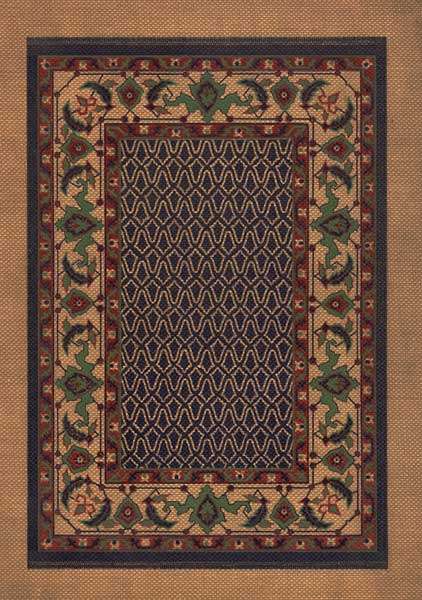
ANTIQUE TABRIZ SILK RUG
Size 8 × 6.3
This interesting and valuable rug is of antique Tabriz weave, of finely blended colors, and rare design. It represents the individual squares on the floor of a mosque, each one of which may be occupied by a worshipper kneeling in prayer. Rugs with a single design of this kind are usual, but a grouping of many such spaces in one rug is rare. Forms of the Tree of Life are represented in different panels, and the border is very rich and handsome. The fabric is fine, the texture soft and firm. The rich and splendid hues of the various panels are so soft in tone that, while there are several different colors in juxtaposition, these have been arranged so deftly and artistically that the effect is perfectly harmonious. It is impossible to describe in words the mellow richness and rare art displayed in this unique product of the loom.
PREFACE
TO NEW ENLARGED EDITION
When the first edition of this book was published in 1901, it stood almost alone as a reference work on Oriental Rugs. In the six years which have since elapsed, several volumes dealing with the subject have been published.
The extended knowledge of the public concerning the subject has materially altered the conditions of buying and selling. It has also served to increase curiosity and enthusiasm regarding these products of Oriental workmanship. I have been gratified to observe that a desire for additional information is sought. My mail has contained an increasing number of requests for an enlarged edition of my book, and my own enthusiasm for the subject makes me believe in the interest of my readers. I take pleasure in sharing with them the results of recent investigations made in the United States, in the art centres of Europe, and in the Orient.
New York City,
February 1, 1908.
PREFACE
While there is a singular lack of books in the English language treating directly of Rugs,—a theme which is so intensely interesting to buyers,—it is noteworthy that under the category of Oriental Carpets are to be found a few volumes of interest. These, however, are too rare and expensive for the general reader. For this reason I have undertaken to present in a concise form certain facts that may enable a novice to appreciate the beauty and interest attaching to rugs, and assist a prospective purchaser in judging of the merits of any particular rug he may desire to possess.
For much valuable information on the subject I am indebted to publications which are referred to in my Bibliography, to correspondence with Ministers to Oriental countries and Consuls residing therein, to interviews with rug-dealers in various cities, and to certain learned Americans, Armenians, Greeks, Syrians and Turks. It has also been my good fortune to be intrusted, for purposes of description and reproduction, with many beautiful and rare rugs, from owners who cherish them as treasures. These true rug-lovers have generously contributed to whatever there may be of interest in this book.
New York City,
August 1, 1901.
CONTENTS
| Page | |
| I. History and Details of Rug-weaving | |
|---|---|
| The History | 15 |
| The Loom and Its Work | 22 |
| The Weavers | 26 |
| The Materials | 30 |
| The Quality | 32 |
| The Knotting | 34 |
| Designs | 37 |
| The Dyes | 44 |
| Oriental Colors | 47 |
| II. Rug-Weaving in Egypt, Persia, and Turkey | |
| Rug-Weaving in Egypt | 51 |
| Persian Rugs | 53 |
| Characteristics of Certain Persian Rugs | 58 |
| Turkish Rugs | 71 |
| Characteristics of Certain Turkish Rugs | 74 |
| III. Rug-Weaving in India, Afghanistan, Beluchistan, | |
| Central Asia, and the Caucasus Region | |
| Indian Rugs | 87 |
| Characteristics of Certain Indian Rugs | 90 |
| Afghanistan Rugs | 95 |
| Beluchistan Rugs | 97 |
| Turkoman Rugs | 98 |
| Characteristics of Certain Turkoman Rugs | 100 |
| Caucasian Rugs | 105 |
| IV. Miscellaneous Oriental Rugs | |
| Rugs of the Holy Land | 111 |
| Chinese Rugs | 113 |
| Japanese Rugs | 116 |
| Khilim Rugs | 117 |
| Polish Rugs | 119 |
| Prayer Rugs | 120 |
| Silk Rugs | 123 |
| Felt Rugs | 126 |
| Hunting Rugs | 128 |
| V. Rug-Weaving in Europe and the United States | |
| Rug-Weaving in Europe and the United States | 131 |
| Greek Rugs | 132 |
| Moorish and Spanish Rugs | 134 |
| Bosnian, Servian, Roumanian, and Bulgarian | |
| Rugs | 136 |
| English Rugs | 138 |
| French Rugs | 141 |
| Rugs of the United States | 143 |
| VI. Miscellaneous Information | |
| Inscriptions on Rugs | 153 |
| Concerning Oriental Symbols | 156 |
| Chinese Symbols | 157 |
| Egyptian Symbols | 158 |
| Indian Symbols | 159 |
| Japanese Symbols | 160 |
| Persian Symbols | 160 |
| Turkish Symbols | 160 |
| Miscellaneous Symbols | 161 |
| Meanings of Some of the Place-Names Associated with Rugs | 162 |
| Geographical Data | 164 |
| Localities Arranged Geographically | 165 |
| Localities Arranged Alphabetically | 170 |
| List of Authorities | 175 |
| Index | 179 |
LIST OF PLATES
| Page | |
| Antique Tabriz Silk Rug | Frontispiece |
| Oriental Rugs Decorating a Balcony | 20 |
| Turkish Loom and Weavers | 24 |
| Vats for Washing and Dyeing Wool—Turkey | 28 |
| Soumak Rug | 30 |
| Indian Rug Designers | 32 |
| Sinna Rug | 34 |
| Rugs being Transported | 38 |
| Wool Drying after Dyeing | 44 |
| Antique Persian Rug | 54 |
| Khorassan Rug | 56 |
| Bijar (Sarakhs) Rug | 58 |
| Camel's Hair Rug from Hamadan | 60 |
| Feraghan Rug | 62 |
| Shiraz Rug | 68 |
| Arabian Rug | 70 |
| Old Ghiordes Prayer Rug | 74 |
| Indian Prayer Rug | 78 |
| Indian Loom and Weavers | 82 |
| Afghanistan Rug | 95 |
| Tekké-Turkoman or "Bokhara" Rug | 98 |
| Samarkand Rug | 102 |
| Daghestan Rug | 106 |
| Kazak Rug | 108 |
| Antique Chinese Wool Rug | 114 |
| Khilim Rug | 117 |
| Old Kirman Prayer Rug | 120 |
| Old Anatolian Prayer Rug | 122 |
| Persian Silk Rug | 124 |
| Derbent Rug | 126 |
| Early English Rug | 138 |
| Navajo Rug | 146 |
| Antique Persian Rug | 156 |
| Map of the Orient | 164 |
| Drawings in the Text | |
|---|---|
| A Loom | 25 |
| Persian or Sinna Knotting | 35 |
| Turkish or Ghiordes Knotting | 35 |
| Soumak Weave | 35 |
| Five Forms of the Palmette | 39, 40 |
| Herati Border | 40 |
| Central Design | 41 |
| Running Hook Design | 41 |
| Pomegranate | 41 |
| Palm Leaves | 41 |
| Cloud Bands | 41 |
| Lozenge | 41 |
| Wave-like Designs | 42 |
| Rosette | 42 |
| Reciprocal Trefoil | 42 |
| Central Design | 42 |
| Four Characteristic Caucasian Designs | 42 |
| Fylfot, or Swastika | 42 |
| Guli Hinnai | 43 |
| Lotus | 43 |
| Medallion | 43 |
RUGS
I
HISTORY AND DETAILS OF RUG-WEAVING
Fair warp and fitting woof
Weave a web that bideth proof.
Motto of the Canterbury Weavers.
RUGS
ORIENTAL AND OCCIDENTAL ANTIQUE AND MODERN
I
THE HISTORY AND DETAILS OF RUG-WEAVING
The History
Rugs, in the house beautiful, impart richness and represent refinement. Their manufacture was one of the earliest incentives for the blending of colors in such harmony as to please the eye and satisfy the mind; consequently, it is one of the most important of the industrial arts. Since the days when ancient peoples first lay down to sleep wrapped in the skins of animals, the human intelligence has quickened, and as the race has become more civilized, rugs have gradually taken the place of skins. Thus began the industry of rug-weaving, and it has grown to such an extent that it is now of world-wide importance.
The word Rug is used in this volume in the following sense: "A covering for the floor; a mat, usually oblong or square, and woven in one piece. Rugs, especially those of Oriental make, often show rich designs and elaborate workmanship, and are hence sometimes used for hangings," In several books rugs and carpets are referred to as identical. In fact most written information on rugs has been catalogued under the term carpets; and there seems to be good reason for assuming that the terms tapestries and carpets, as used in ancient times, were synonymous with the word rugs of the present day, for these were spread loosely on the floor without the aid of fastenings.
Historical references to spinning and to the weaving of tapestries date back to a very early period. An ancient Jewish legend states that Naamah, daughter of Lamech and sister of Tubal-Cain, was the inventor of the spinning of wool and of the weaving of thread into cloth.
On at least two of the wonderful rock-cut tombs at Beni-Hassan, in Egypt,—2800-2600 B.C.,—there are pictures of weavers at work. In one, women are filling a distaff with cotton, twisting it with a spindle into thread, and weaving this on an upright loom. Beside them is a man, evidently an overseer, watching the weavers and their work. The other wall-painting represents a man weaving a checkered rug on a horizontal loom. Other monuments of ancient Egypt and of Mesopotamia bear witness that the manufacture of rugs dates a considerable time prior to 2400 B.C.
At Thebes a fresco, dating 1700-1000 B.C., represents three men weaving at an upright loom. A small rug, discovered in that city some time between the years 666 and 358 B.C., and now in the possession of Mr. Hay in England, is described by Sir J. Gardner Wilkinson as follows: "This rug is eleven inches long by nine broad. It is made like many carpets of the present day, with woollen threads on linen string. In the centre is the figure of a boy in white, with a goose above it, the hieroglyphic of 'child' upon a green ground, around which is a border composed of red, white, and blue lines. The remainder is yellow, with four white figures above and below, and one at each side, with blue outlines and red ornaments; and the outer border is made up of red, white, and blue lines, with a fancy device projecting from it, with a triangular summit, which extends entirely round the edge of the rug. Its date is uncertain, but from the child, the combination of the colors, and ornamental border, I am inclined to think it really Egyptian, not of the Pharaonic, but of the Greek and Roman period." Dr. Samuel Birch, who edited the last edition of Wilkinson's work, affirms that this is so.
On the marbles of Nineveh is represented the pectoral worn by Sardanapalus. It is an exact miniature of a Kurdish rug of modern times. The Tree of Life, the motif of most of the Persian rug designs, is in the centre, and the border is ornamented with rosettes and bars.
Phœnician art is intermediate between Egyptian and Assyrian. The color most prized in the art of Phoenicia was the rare and beautiful purple (properly crimson) dye used exclusively for the garments of royalty. For centuries the process of making this dye was lost, and even at the time of its highest fame it was familiar only to the maritime Canaanites, who procured the color from an animal juice of the murex, a shellfish. The shellfish and the dye were known to the ancients as conchylium.
When Cleopatra, the famous Queen of Egypt, went to meet Cæsar for the first time, she knew that he would not allow her to enter his presence if recognized, and therefore she cleverly had herself carried into his palace wrapped in a rug of the finest texture. It may well be imagined that the unexpected disclosure of the charms of this subtle Egyptian shared largely in bringing the great Roman general into her toils.
Besides Biblical writers, Homer, Æschylus, Plautus, Metellus Scipio, Horace, Pliny, Lucan, Josephus, Arrian, and Athenæus all speak of rugs. To persons interested in rugs the search for these allusions is a most fascinating occupation.
The Egyptians bestowed the greatest care and patience upon the rugs they wove, as upon all else of their handiwork. They spread them before the images of their gods, and also on the ground for their sacred cattle to lie upon. They loved Nature intensely; like true lovers, they seemed to have reached her very heart, and they symbolized her works in their artistic designs. Even to this day many Oriental rugs have symbolic signs borrowed from the works of Nature.
In design and color the rugs woven to-day in the Orient are similar to the Assyrian and Babylonian textile fabrics of 1000-607 B.C. (Fall of Nineveh) and 538 (Fall of Babylon). At that early period these were used for awnings and floor-coverings in the palaces of the Assyrian kings Sargon, Sennacherib, Esarhaddon, and Sardanapalus. The designs on the stone slab from the palace of Koyunjik, Nineveh, and on the door-sill from the palace at Khorsabad, are probably copied from rugs.
From Egypt and Chaldea the manufacture of rugs was carried into Assyria, and then into Asia Minor. Ancient Egypto-Chaldean designs are occasionally seen in modern rugs, but usually in a modified form. For a long time the industry of rug-weaving was supreme in the countries mentioned, but about 480 B.C. it arrived at a high degree of perfection in Greece. Later, the art was corrupted by the Byzantine (Lower Roman) influence. In the seventh and eighth centuries the Saracens came into power in the Persian Empire after the fall of the Sassanian dynasty, and in the African and Syrian provinces. The Saracens believed that all labor tended to the glory of God; consequently, on their western campaigns they carried rug-manufacture into Sicily, Spain, France, and Italy; and thus it was introduced throughout Europe. It should be here noted that the name Saracen was given by the later Romans and Greeks to certain of the nomadic tribes on the Syrian borders of the Roman Empire. After the introduction of Mohammedanism the name was applied to the Arab followers of Mohammed.
From earliest times it has been the custom in the East to hang rugs over graves. About the vault of the mosque at Hebron where the patriarchs Abraham, Isaac, and Jacob are said to be buried, rugs are hung at the present day.
During times of grand fêtes in Europe, when house decoration is done with lavishness, people, to make their homes more attractive, drape with beautiful rugs the balconies, the loggias, and the front walls of buildings. The richness and color of these rugs blend harmoniously with flags and other emblems, producing an effect of great magnificence and splendor.
From a painting of the fifteenth century by Carpaccio Vittore, who was born in Istria, 1450, and died in Venice, 1522. The original painting is in the Correr Museum at Venice. On the balcony are several Oriental rugs in shades of rich red and rose color.
When we see the exquisite loom-work that has been wrought in the Orient, we sometimes wonder how the weavers have achieved such success, for they are destitute of what we call education, and they dwell amid the humblest surroundings. But Nature has been their instructor, and the rare shadings and varied designs of the rugs are excellent imitations of the forms and hues of the natural world. The weavers have intuitively grasped what is correct in color from the works of Nature surrounding them, and we reap the benefit in the rich specimens of their art which they export.
These patient toilers of the East delight in subdued colorings and artistic designs; and without a doubt many a story is woven in with the threads that go to form the fabric, many a song of joy, many a dirge of woe and despair. The number of Orientals engaged in the manufacture of rugs in the United States is increasing. It is now not an uncommon sight to see these weavers at work before the loom in the show windows of the rug-importing establishments of the larger cities.
The increasing use of polished hard wood and yellow pine floors and mosaic work, even in buildings of moderate cost, is displacing the use of cheap flooring, which could be covered satisfactorily only with carpets or matting. This has enormously increased the demand for rugs; and the selection of them affords a much wider range for the exercise of personal taste and discrimination in securing an article not only of greater artistic merit, but of greater durability.
The Loom and Its Work
The hand loom is Oriental, the power loom Occidental. The former adds much to the fame of the Orient. The exquisite fabrics it produces have made it world-renowned, and although it is simple in structure, its products show careful and finished labor. Hand looms in all Oriental countries are similar, and are to-day almost as imperfectly developed as when used by the ancient Egyptians. To weave their mats, the ancient Egyptians took the coarse fibre of the papyrus and, with the help of pegs, stretched it between two poles which were fastened in the ground. Two bars were placed in between these poles, the threads of the warp serving to keep them apart. The woof thread was passed through and pressed down tightly a number of times with a bent piece of wood.
The loom now generally used in the Orient is made by fastening two poles perpendicularly in the ground to a sufficient depth, leaving above ground as much of each pole as equals in length the desired rug. This framework supports two horizontal rollers, the warp threads being wound around the upper, while the ends are fastened to the lower; at this the weaving is begun, and on it the rug is rolled while in process of construction. To the warp threads of fine linen or cotton the weavers tie the tufts of worsted that form the pile. This worsted, which has been dyed previously, hangs over their heads in balls. When a row of knots is finished, it is pressed down to the underlying woof by a long and heavy comb with metal teeth. Then the tufts are clipped close with shears, to make the pile. In the finer rugs there are seldom more than two, or at the most three, threads between every two rows of knots, but in the coarser kinds there are more threads. In many districts every family possesses a loom, and it is generally small enough to be carried from place to place.
Sir George C. Birdwood has seen the web in the horizontal loom in Western India kept stretched by being wrapped, as worked, round the body of the weaver. In some instances the spinners make thread from the cotton wool by using the left hand as a distaff, and the right one as a spindle. In other cotton rugs which he has seen, the warp threads were placed horizontally, and the loom was without treadles and reed. The woof threads were thrown across by the weaver and brought together with a small hand comb. The same style of loom, arranged vertically, is that on which some of the richly figured cotton rugs from the Deccan are woven.
In some parts of Turkey there are European factories that have adopted some of the native methods; but as the majority of Turkish rugs are apt to be crooked, frames that weave them straight are now imported from Europe.
Mrs. Isabella Bird Bishop describes a tribe of people living at Biratori, on the Island of Yezo, Japan, and bearing the name of Ainos, whose women employ their time in weaving mats. Their loom is certainly a most primitive arrangement. A comb-like frame, through which the threads pass, rests on the ankles of the weaver. There is a heavy hook fastened in the ground or floor, and to this the threads at the far end of the web are sewed. A cord fastens the near end to the waist of the weaver, who by spinal rigidity supplies the necessary tension. As the work proceeds, she drags herself along nearer and nearer the hook. This is slow work, only about a foot being accomplished in a day; as in other countries, however, the women enjoy the neighborly chats that their work allows; and often two or more will bring to the house of a neighbor their simple apparatus, and, hanging the hooks to the roof or to a tree, will weave all day.
The power looms of modern civilization are chiefly to be found in the United States and Great Britain, Philadelphia being the principal American centre, and Kidderminster, Wilton, Worcester, Rochdale, Halifax, Dewsbury, and Durham, the English centres. Brussels and Scotland contain a number of such looms. In all Western countries schools of art furnish most of the designs, and have done much to improve taste. This can also be said of good colorists in their branch of this industry.
The Weavers
Rug-weaving in the Orient is an industry that, until recent years, has been carried on almost exclusively by women and girls. From childhood to womanhood, and on to old age, these weavers are at work. Girls of six years of age help their mothers, until they become experienced by long practice. Even ladies of rank and wealth weave rugs of fine quality for their own homes. In some districts, besides weaving for the market, girls weave one or two rugs for their dowry; this purpose furnishes them with enough excitement to keep them interested in their work and ambitious to excel. Now that there is a greater demand for rugs, and not enough women to supply the demand, men and boys have come into the business, but generally only in places where there are large factories, and especially in the cities. This is noticeably the case in India, where boys from nine to fifteen years of age do much of the weaving.
There are two classes of weavers, the sedentary and the nomadic. The former weave in their houses during the Winter, and in their courtyards during the Summer. The nomads spend the Winter in mud villages, and in the Summer go to the mountains with their flocks and live in tents made of goat's hair. The manner of life of the sedentary weaver works havoc with her constitution even in her youth; and consequently one is not surprised at her frail appearance. In Summer she is oppressed with heat as she sits before the frame, and in Winter she is almost frozen, for she has to work in the open air in order to have sufficient light. Hers is not an easy life. It would be pleasant to believe that in her toil, which she carries on with wondrous patience and in the humblest surroundings, the conscientious weaver finds the same inward satisfaction that comes to the true artist elsewhere.
The duties of the male portion of the family are to tend the flocks, shear the sheep, separate the various qualities of the wool into bundles, dye it, and make the framework for the rug. With the extension of the industry, a class of workers has arisen whose sole task is to manipulate and dye the wool for use. The reason why men do not usually weave is that the occupation, besides not being a paying one, requires an amount of patience not within the power of men accustomed to work out of doors. Nor is it a remunerative occupation. The reader, who is perhaps also a prospective rug-buyer, may be interested in the following calculation of the amount of labor bestowed upon a given piece of the best type, the cost of the materials, and its value when completed. A square foot of the best Persian rug is worth about ten dollars, and it takes a single weaver twenty-three days to complete this portion. This allows the weaver about forty-four cents per day for her wool and her labor; but as three-fourths of this amount goes to pay for the wool, only eleven cents per day is left for her labor. The wages of the producer of the inferior article are somewhat better. A square foot of an inferior rug is sold for about sixty cents, and the time required for weaving it is but two days, thus allowing the weaver thirty cents per day for her wool and labor. She uses inferior wool, washes but little of it, and pays only a nominal sum for a cheap dye. The framework of her loom costs comparatively little, as the rug it produces is from twenty to thirty times the size of the superior rug. Thus it appears that, in the long run, the inferior weaver is better paid than the one who fatigues her brain with her efforts to produce a rug of the best quality. On the other hand, the weaver of the superior fabric has advantages which the other has not. As a general rule, she weaves to order, and is paid for her work in advance. This prepayment is of great importance, considering the poverty of the weaver. The situation of the weaver of the inferior article differs in that she has to buy her wool, dye it, finish her rug, and then watch the market for buyers.