
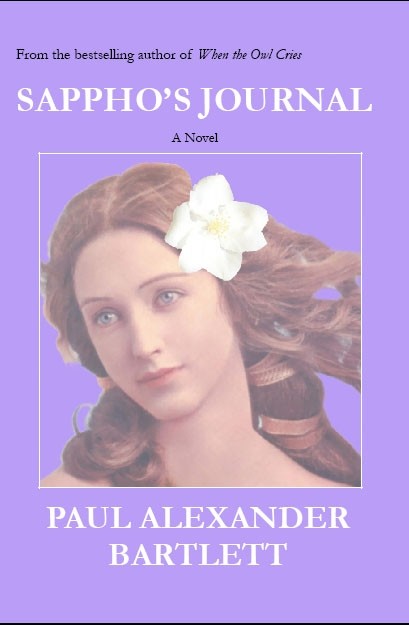
The Project Gutenberg eBook of Sappho's Journal
Title: Sappho's Journal
Author: Paul Alexander Bartlett
Editor: Steven J. Bartlett
Release date: April 17, 2012 [eBook #39467]
Most recently updated: January 25, 2021
Language: English
Credits: Produced by Al Haines
From the cover of Sappho’s Journal:
In Sappho’s Journal, the author brings the famous Greek poet Sappho back to life in a finely crafted novel that reveals her sense of beauty, her loves, her reflections, her inner world. Based on a careful study of ancient Greece and Sappho’s surviving fragments of poetry, Bartlett recreates Sappho in a lyrical account of the life, passion, fears, and faith of this remarkable woman whose intimate journal takes us back to 642 B.C. The book includes a Foreword by the well-known Sappho scholar and translator Willis Barnstone.
Bartlett’s writing has been praised by many leading authors, reviewers, and critics, among them:
James Michener, novelist: “I am much taken with Bartlett’s work and commend it highly.”
Charles Poore in The New York Times: “...believable characters who are stirred by intensely personal concerns.”
Grace Flandrau, author and historian: “...Characters and scenes are so right and living...it is so beautifully done, one finds oneself feeling it is not fiction but actually experienced fact.”
James Purdy, novelist: “An important writer... I find great pleasure in his work. Really beautiful and distinguished.”
Alice S. Morris in Harper’s Bazaar: “He tells a haunting and beautiful story and manages to telescope, in a brilliantly leisurely way, a lifetime, a full and eventful lifetime.”
Russell Kirk, novelist: “The scenes are drawn with power. Bartlett is an accomplished writer.”
Paul Engle in The Chicago Tribune: “...articulate, believable ... charms with an expert knowledge of place and people.”
Michael Fraenkel, novelist and poet: “His is the authenticity of the true and original creator. Bartlett is essentially a writer of mood.”
Willis Barnstone, Sappho scholar and translator: “A mature artist, Bartlett writes with ease and taste.”
J. Donald Adams in The New York Times: “...the freshest, most vital writing I have seen for some time.”
Pearl S. Buck, Nobel Laureate in Literature: “He is an excellent writer.”
Herbert Gorman, novelist and biographer: “He possesses a sensitivity in description and an acuteness in the delineation of character.”
Ford Madox Ford, English novelist, about Bartlett: “...a writer of very considerable merit.”
Lon Tinkle in the Dallas Morning News: “Vivid, impressive, highly pictorial.”
Joe Knoefler in the L.A. Times: “...an American writer gifted with...perception and sensitivity.”
Frank Tannenbaum, historian: “...written with great sensibility”
Worchester Telegram: “Between realism and poetry...brilliant, colorful.”
²
|
R |
eaders of this book who would like to acquire the bound illustrated volume can do this through any bookstore by giving the store the published book’s ISBN, which is
ISBN 978-0-6151-5646-0
or you can order the book online through
Barnes & Noble:
http://search.barnesandnoble.com/booksearch/results.asp?ATH=Paul+Alexander+Bartlett&z=y
Amazon.com:
If you would like to ask your local library to acquire a copy, it’s helpful to the library to give the book’s ISBN, mention that the book is distributed by Ingram and by Baker & Taylor, and give the book’s Library of Congress Catalog Card Number, which is 2006025662.
²
About Autograph Editions
Autograph Editions is committed to bringing readers some of the best of fine quality contemporary literature in unique, beautifully designed books, many of them illustrated with original art specially created for each book. Each of our books aspires to be a work of art in itself—in both its content and its design.
The press was established in 1975. Over the years Autograph Editions has published a variety of distinguished and widely commended books of fiction and poetry. Our most recent publication is the remarkable quintet, Voices from the Past, by bestselling author Paul Alexander Bartlett, whose novel, When the Owl Cries, has been widely acclaimed by many authors, reviewers, and critics, among them James Michener, Pearl S. Buck, Ford Madox Ford, Charles Poore, James Purdy, Russell Kirk, Michael Fraenkel, and many others.
eBook Notice
|
I |
n addition to this book’s availability in a printed edition, the copyright holder has chosen to issue this work as an eBook through Project Gutenberg as a free open access publication under the terms of the Creative Commons Attribution-NonCommercial-NoDerivs license, which allows anyone to distribute this work without changes to its content, provided that both the author and the original URL from which this work was obtained are mentioned, that the contents of this work are not used for commercial purposes or profit, and that this work will not be used without the copyright holder’s written permission in derivative works (i.e., you may not alter, transform, or build upon this work without such permission). The full legal statement of this license may be found at
http://creativecommons.org/licenses/by-nc-nd/3.0/legalcode
Sappho’s Journal
Books by
PAUL ALEXANDER BARTLETT
Novels
Voices from the Past:
Sappho’s Journal ` Christ’s Journal ` Leonardo da Vinci’s Journal
Shakespeare’s Journal ` Lincoln’s Journal
When the Owl Cries
Adiós Mi México
Forward, Children!
Poetry
Wherehill
Spokes for Memory
Nonfiction
The Haciendas of Mexico: An Artist’s Record
Sappho’s Journal
by
Paul Alexander Bartlett
and
Illustrated by the Author
Edited by
Steven James Bartlett
with a Foreword by
Willis Barnstone
“Violet-haired, pure
honey-smiling Sappho”
– Alcaeus
AUTOGRAPH EDITIONS
Salem, Oregon
AUTOGRAPH EDITIONS
P. O. Box 6141 Salem, Oregon 97304
Î Established 1975 Ó
This book is protected by copyright. No part
may be reproduced in any manner without
written permission from the publisher.
Copyright © 2007 by Steven James Bartlett
First Edition
ISBN 978-0-6151-5646-0
Library of Congress Catalog Card Number: 2006025662
Printed in the United States of America
Library of Congress Cataloguing-in-Publication Data
Bartlett, Paul Alexander.
Sappho's
journal / by Paul Alexander Bartlett and illustrated by the author ;
edited by Steven James Bartlett ; with a foreword by Willis Barnstone. -- 1st
ed.
p. cm.
Summary: "A historical novel that recounts the
life, thought, and times of the
Greek poet Sappho of Lesbos, based on a study of ancient Greece and
Sappho's surviving fragments of poetry"--Provided by publisher.
ISBN 978-0-6151-5646-0
1. Sappho--Fiction. I. Bartlett, Steven J. II. Title.
PS3602.A8396S27 2006
813'.6--dc22
2006025662
CONTENTS
Foreword by Willis Barnstone xi
Preface by Steven James Bartlett xiii
Sappho’s Journal 1
About the Author 151
Colophon 153
FOREWORD
Willis Barnstone
Distinguished Professor Emeritus of Comparative Literature
Indiana University
|
P |
aul Alexander Bartlett’s journal of Sappho is a masterful work. I had recently completed a translation of the extant lines of Sappho and am familiar with his problems. He was faced with the almost impossible task of reconstructing the personality of Sappho and her background in ancient Lesbos. To my happy surprise he did so, in a work which is at once poetic, dramatic and powerful. In Sappho’s Journal he does more than create a vague illusion of the past. He conveys the character of real people, their interior life and outer world. A mature artist, he writes with ease and taste.
PREFACE
Steven James Bartlett
Senior Research Professor of Philosophy, Oregon State University
and
Visiting Scholar in Psychology & Philosophy, Willamette University
|
S |
appho’s Journal is one of five independent works of fiction which together make up Voices from the Past, a quintet of novels that describe the inner lives of five extraordinary people. Progressing through time from the most distant to the most recent they are: Sappho of Lesbos, the famous Greek poet; Jesus; Leonardo da Vinci; Shakespeare; and Abraham Lincoln. For the most part, little is known about the inward realities of these people, about their personal thoughts, reflections, and the quality and nature of their feelings. For this reason they have become no more than voices from the past: The contributions they have left us remain, but little remains of each person, of his or her personality, of the loves, fears, pleasures, hatreds, beliefs, and thoughts each had.
Voices from the Past was written by Paul Alexander Bartlett over a period of several decades. After his death in an automobile accident in 1990, the manuscripts of the five novels were discovered among his as yet unpublished papers. He had been at work adding the finishing touches to the manuscripts. Now, more than a decade and a half after his death, the publication of Voices from the Past is overdue.
Bartlett is known for his fiction, including When the Owl Cries and Adiós Mi México, historical novels set during the Mexican Revolution of 1910 and descriptive of hacienda life, Forward, Children!, a powerful antiwar novel, and numerous short stories. He was also the author of books of poetry, including Spokes for Memory and Wherehill, the nonfiction work, The Haciendas of Mexico: An Artist’s Record, the first extensive artistic and photographic study of haciendas throughout Mexico, and numerous articles about the Mexican haciendas. Bartlett was also an artist whose paintings, illustrations, and drawings have been exhibited in more than 40 one-man shows in leading museums in the U.S. and Mexico. Archives of his work and literary correspondence have now been established at the American Heritage Center of the University of Wyoming, the Nettie Lee Benson Latin American Collection of the University of Texas, and the Rare Books Collection of the University of California, Los Angeles.
Paul Alexander Bartlett’s life was lived with a single value always central: a sustained dedication to beauty, which he believed was the most vital value of living and his reason for his life as a writer and an artist. Voices from the Past reflects this commitment, for he believed that these five voices, in their different ways, express a passion for life, for the creative spirit, and ultimately for beauty in a variety of its forms—poetic and natural (Sappho), spiritual (Jesus), scientific and artistic (da Vinci), literary (Shakespeare), and humanitarian (Lincoln). In this work, he has sought, as faithfully as possible, to relay across time a renewed lyrical meaning of these remarkable individuals, lending them his own voice, with a mood, simplicity, depth of feeling, and love of beauty that were his, and, he believed, also theirs.
The journal form has been used only rarely in works of fiction. Bartlett believed that as a form of literature the journal offers the most effective way to bring back to life the life-worlds of significant, unique, highly individual, and important creators. In each of the novels that make up Voices from the Past, his interest is to portray the inner experience of exceptional and special people, about whom there is scant knowledge on this level. During the many years of research he devoted to a study of the lives and thoughts of Sappho, Jesus, Leonardo, Shakespeare, and Lincoln, he sought to base the journals on what is known and what can be surmised about the person behind each voice, and he wove into each journal passages from their writings and the substance of the testimony of others. Yet the five novels are fiction: They re-express in an author’s creation lives now buried by the passage of centuries.
I am deeply grateful to my wife, Karen Bartlett, for her faithful, patient, and perceptive help with this long project.
✧
For my father,
Paul Alexander Bartlett,
whose kindness, love of beauty and of place
will always be greatly missed.
Sappho’s poetry, quoted throughout this novel, is included with the translator’s permission. The poems appeared in Sappho, Lyrics in the Original Greek, with translations by Willis Barnstone, Anchor Books, Doubleday, 1965.
For clarity, the calendar used by Sappho has been translated into our modern calendar.