
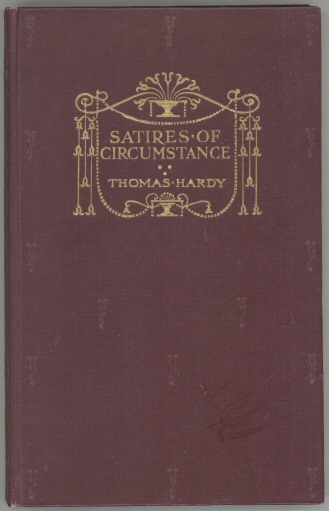
The Project Gutenberg eBook of Satires of Circumstance, Lyrics and Reveries, with Miscellaneous Pieces
Title: Satires of Circumstance, Lyrics and Reveries, with Miscellaneous Pieces
Author: Thomas Hardy
Release date: October 1, 2001 [eBook #2863]
Most recently updated: January 23, 2015
Language: English
Credits: Transcribed from the 1919 Macmillan and Co. edition by David Price
Transcribed from the 1919 Macmillan and Co. edition by David Price, email ccx074@pglaf.org
SATIRES
OF CIRCUMSTANCE
LYRICS AND REVERIES
WITH MISCELLANEOUS PIECES
BY
THOMAS HARDY
MACMILLAN AND CO., LIMITED
ST. MARTIN’S STREET, LONDON
1919
COPYRIGHT
First Edition 1914
Reprinted 1915, 1919
Pocket Edition 1919
CONTENTS
Lyrics and Reveries— |
PAGE |
||
|
In Front of the Landscape |
||
|
Channel Firing |
||
|
The Convergence of the Twain |
||
|
The Ghost of the Past |
||
|
After the Visit |
||
|
To Meet, or Otherwise |
||
|
The Difference |
||
|
The Sun on the Bookcase |
||
|
“When I set out for Lyonnesse” |
||
|
A Thunderstorm in Town |
||
|
The Torn Letter |
||
|
Beyond the Last Lamp |
||
|
The Face at the Casement |
||
|
Lost Love |
||
|
“My spirit will not haunt the mound” |
||
|
Wessex Heights |
||
|
In Death divided |
||
|
|||
|
Where the Picnic was |
||
|
The Schreckhorn |
||
|
A Singer asleep |
||
|
A Plaint to Man |
||
|
God’s Funeral |
||
|
Spectres that grieve |
||
|
“Ah, are you digging on my grave?” |
||
Satires of Circumstance— |
|||
|
I. |
At Tea |
|
|
II. |
In Church |
|
|
III. |
By her Aunt’s Grave |
|
|
IV. |
In the Room of the Bride-elect |
|
|
V. |
At the Watering-place |
|
|
VI. |
In the Cemetery |
|
|
VII. |
Outside the Window |
|
|
VIII. |
In the Study |
|
|
IX. |
At the Altar-rail |
|
|
X. |
In the Nuptial Chamber |
|
|
XI. |
In the Restaurant |
|
|
XII. |
At the Draper’s |
|
|
XIII. |
On the Death-bed |
|
|
XIV. |
Over the Coffin |
|
|
XV. |
In the Moonlight |
|
|
Self-unconscious |
||
|
The Discovery |
||
|
Tolerance |
||
|
Before and after Summer |
||
|
At Day-close in November |
||
|
The Year’s Awakening |
||
|
Under the Waterfall |
||
|
The Spell of the Rose |
||
|
St. Launce’s revisited |
||
Poems of 1912–13– |
|||
|
The Going |
||
|
Your Last Drive |
||
|
The Walk |
||
|
Rain on a Grace |
||
|
“I found her out there” |
||
|
Without Ceremony |
||
|
Lament |
||
|
The Haunter |
||
|
The Voice |
||
|
His Visitor |
||
|
A Circular |
||
|
A Dream or No |
||
|
After a Journey |
||
|
A Death-ray recalled |
||
|
|||
|
At Castle Boterel |
||
|
Places |
||
|
The Phantom Horsewoman |
||
Miscellaneous Pieces— |
|||
|
The Wistful Lady |
||
|
The Woman in the Rye |
||
|
The Cheval-Glass |
||
|
The Re-enactment |
||
|
Her Secret |
||
|
“She charged me” |
||
|
The Newcomer’s Wife |
||
|
A Conversation at Dawn |
||
|
A King’s Soliloquy |
||
|
The Coronation |
||
|
Aquae Sulis |
||
|
Seventy-four and Twenty |
||
|
The Elopement |
||
|
“I rose up as my custom is” |
||
|
A Week |
||
|
Had you wept |
||
|
Bereft, she thinks she dreams |
||
|
In the British Museum |
||
|
In the Servants’ Quarters |
||
|
The Obliterate Tomb |
||
|
|||
|
The Recalcitrants |
||
|
Starlings on the Roof |
||
|
The Moon looks in |
||
|
The Sweet Hussy |
||
|
The Telegram |
||
|
The Moth-signal |
||
|
Seen by the Waits |
||
|
The Two Soldiers |
||
|
The Death of Regret |
||
|
In the Days of Crinoline |
||
|
The Roman Gravemounds |
||
|
The Workbox |
||
|
The Sacrilege |
||
|
The Abbey Mason |
||
|
The Jubilee of a Magazine |
||
|
The Satin Shoes |
||
|
Exeunt Omnes |
||
|
A Poet |
||
Postscript— |
|||
|
“Men who march away” |
||
LYRICS AND REVERIES
IN FRONT OF THE LANDSCAPE
Plunging and
labouring on in a tide of visions,
Dolorous and dear,
Forward I pushed my way as amid waste waters
Stretching around,
Through whose eddies there glimmered the customed landscape
Yonder and near,
Blotted to feeble mist. And the coomb and
the upland
Foliage-crowned,
Ancient chalk-pit, milestone, rills in the grass-flat
Stroked by the light,
Seemed but a ghost-like gauze, and no substantial
Meadow or mound.
What were the infinite spectacles bulking
foremost
Under my sight,
Hindering me
to discern my paced advancement
Lengthening to miles;
What were the re-creations killing the daytime
As by the night?
O they were speechful faces, gazing
insistent,
Some as with smiles,
Some as with slow-born tears that brinily trundled
Over the wrecked
Cheeks that were fair in their flush-time, ash now with
anguish,
Harrowed by wiles.
Yes, I could see them, feel them, hear them,
address them—
Halo-bedecked—
And, alas, onwards, shaken by fierce unreason,
Rigid in hate,
Smitten by years-long wryness born of misprision,
Dreaded, suspect.
Then there would breast me shining sights,
sweet seasons
Further in date;
Instruments of strings with the tenderest passion
Vibrant, beside
Lamps long
extinguished, robes, cheeks, eyes with the earth’s crust
Now corporate.
Also there rose a headland of hoary aspect
Gnawed by the tide,
Frilled by the nimb of the morning as two friends stood there
Guilelessly glad—
Wherefore they knew not—touched by the fringe of an
ecstasy
Scantly descried.
Later images too did the day unfurl me,
Shadowed and sad,
Clay cadavers of those who had shared in the dramas,
Laid now at ease,
Passions all spent, chiefest the one of the broad brow
Sepulture-clad.
So did beset me scenes miscalled of the
bygone,
Over the leaze,
Past the clump, and down to where lay the beheld ones;
—Yea, as the rhyme
Sung by the sea-swell, so in their pleading dumbness
Captured me these.
For, their lost revisiting manifestations
In their own time
Much had I slighted, caring not for their purport,
Seeing behind
Things more coveted, reckoned the better worth calling
Sweet, sad, sublime.
Thus do they now show hourly before the
intenser
Stare of the mind
As they were ghosts avenging their slights by my bypast
Body-borne eyes,
Show, too, with fuller translation than rested upon them
As living kind.
Hence wag the tongues of the passing people,
saying
In their surmise,
“Ah—whose is this dull form that perambulates, seeing
nought
Round him that looms
Whithersoever his footsteps turn in his farings,
Save a few tombs?”
CHANNEL FIRING
That night your
great guns, unawares,
Shook all our coffins as we lay,
And broke the chancel window-squares,
We thought it was the Judgment-day
And sat upright. While drearisome
Arose the howl of wakened hounds:
The mouse let fall the altar-crumb,
The worms drew back into the mounds,
The glebe cow drooled. Till God called,
“No;
It’s gunnery practice out at sea
Just as before you went below;
The world is as it used to be:
“All nations striving strong to make
Red war yet redder. Mad as hatters
They do no more for Christés sake
Than you who are helpless in such matters.
“That this is not the judgment-hour
For some of them’s a blessed thing,
For if it were they’d have to scour
Hell’s floor for so much threatening . . .
“Ha, ha. It will be warmer when
I blow the trumpet (if indeed
I ever do; for you are men,
And rest eternal sorely need).”
So down we lay again. “I wonder,
Will the world ever saner be,”
Said one, “than when He sent us under
In our indifferent century!”
And many a skeleton shook his head.
“Instead of preaching forty year,”
My neighbour Parson Thirdly said,
“I wish I had stuck to pipes and beer.”
Again the guns disturbed the hour,
Roaring their readiness to avenge,
As far inland as Stourton Tower,
And Camelot, and starlit Stonehenge.
April 1914.
THE CONVERGENCE OF THE TWAIN
(Lines on the loss of the “Titanic”)
I
In
a solitude of the sea
Deep from human vanity,
And the Pride of Life that planned her, stilly couches she.
II
Steel chambers, late the
pyres
Of her salamandrine fires,
Cold currents thrid, and turn to rhythmic tidal lyres.
III
Over the mirrors meant
To glass the opulent
The sea-worm crawls—grotesque, slimed, dumb,
indifferent.
Jewels in joy designed
To ravish the sensuous mind
Lie lightless, all their sparkles bleared and black and
blind.
V
Dim moon-eyed fishes near
Gaze at the gilded gear
And query: “What does this vaingloriousness down
here?” . . .
VI
Well: while was fashioning
This creature of cleaving wing,
The Immanent Will that stirs and urges everything
VII
Prepared a sinister mate
For her—so gaily great—
A Shape of Ice, for the time far and dissociate.
VIII
And as the smart ship grew
In stature, grace, and hue,
In shadowy silent distance grew the Iceberg too.
Alien they seemed to be:
No mortal eye could see
The intimate welding of their later history,
X
Or sign that they were
bent
By paths coincident
On being anon twin halves of one august event,
XI
Till the Spinner of the
Years
Said “Now!” And each one hears,
And consummation comes, and jars two hemispheres.
THE GHOST OF THE PAST
We two kept house,
the Past and I,
The Past and I;
I tended while it hovered nigh,
Leaving me never alone.
It was a spectral housekeeping
Where fell no jarring tone,
As strange, as still a housekeeping
As ever has been known.
As daily I went up the stair
And down the stair,
I did not mind the Bygone there—
The Present once to me;
Its moving meek companionship
I wished might ever be,
There was in that companionship
Something of ecstasy.
It dwelt with me just as it was,
Just as it was
When first its prospects gave me pause
In wayward wanderings,
Before the
years had torn old troths
As they tear all sweet things,
Before gaunt griefs had torn old troths
And dulled old rapturings.
And then its form began to fade,
Began to fade,
Its gentle echoes faintlier played
At eves upon my ear
Than when the autumn’s look embrowned
The lonely chambers here,
The autumn’s settling shades embrowned
Nooks that it haunted near.
And so with time my vision less,
Yea, less and less
Makes of that Past my housemistress,
It dwindles in my eye;
It looms a far-off skeleton
And not a comrade nigh,
A fitful far-off skeleton
Dimming as days draw by.
AFTER
THE VISIT
(To F. E. D.)
Come again to the place
Where your presence was as a leaf that skims
Down a drouthy way whose ascent bedims
The bloom on the farer’s face.
Come again, with the feet
That were light on the green as a thistledown ball,
And those mute ministrations to one and to all
Beyond a man’s saying sweet.
Until then the faint scent
Of the bordering flowers swam unheeded away,
And I marked not the charm in the changes of day
As the cloud-colours came and went.
Through the dark corridors
Your walk was so soundless I did not know
Your form from a phantom’s of long ago
Said to pass on the ancient floors,
Till you drew from the shade,
And I saw the large luminous living eyes
Regard me in fixed inquiring-wise
As those of a soul that weighed,
Scarce consciously,
The eternal question of what Life was,
And why we were there, and by whose strange laws
That which mattered most could not be.
TO MEET, OR OTHERWISE
Whether to sally and
see thee, girl of my dreams,
Or whether to stay
And see thee not! How vast the difference seems
Of Yea from Nay
Just now. Yet this same sun will slant its beams
At no far day
On our two mounds, and then what will the difference weigh!
Yet I will see thee, maiden dear, and make
The most I can
Of what remains to us amid this brake Cimmerian
Through which we grope, and from whose thorns we ache,
While still we scan
Round our frail faltering progress for some path or plan.
By briefest meeting something sure is won;
It will have been:
Nor God nor Daemon can undo the done,
Unsight the seen,
Make muted music be as unbegun,
Though things terrene
Groan in their bondage till oblivion supervene.
So, to the one long-sweeping symphony
From times remote
Till now, of human tenderness, shall we
Supply one note,
Small and untraced, yet that will ever be
Somewhere afloat
Amid the spheres, as part of sick Life’s antidote.
THE DIFFERENCE
I
Sinking down by the
gate I discern the thin moon,
And a blackbird tries over old airs in the pine,
But the moon is a sorry one, sad the bird’s tune,
For this spot is unknown to that Heartmate of mine.
II
Did my Heartmate but haunt here at times such
as now,
The song would be joyous and cheerful the moon;
But she will see never this gate, path, or bough,
Nor I find a joy in the scene or the tune.
THE
SUN ON THE BOOKCASE
(Student’s Love-song)
Once more the
cauldron of the sun
Smears the bookcase with winy red,
And here my page is, and there my bed,
And the apple-tree shadows travel along.
Soon their intangible track will be run,
And dusk grow strong
And they be fled.
Yes: now the boiling ball is gone,
And I have wasted another day . . .
But wasted—wasted, do I say?
Is it a waste to have imaged one
Beyond the hills there, who, anon,
My great deeds done
Will be mine alway?
“WHEN I SET OUT FOR LYONNESSE”
When I set out for
Lyonnesse,
A hundred miles away,
The rime was on the spray,
And starlight lit my lonesomeness
When I set out for Lyonnesse
A hundred miles away.
What would bechance at Lyonnesse
While I should sojourn there
No prophet durst declare,
Nor did the wisest wizard guess
What would bechance at Lyonnesse
While I should sojourn there.
When I came back from Lyonnesse
With magic in my eyes,
None managed to surmise
What meant my godlike gloriousness,
When I came back from Lyonnesse
With magic in my eyes.
A
THUNDERSTORM IN TOWN
(A Reminiscence)
She wore a new
“terra-cotta” dress,
And we stayed, because of the pelting storm,
Within the hansom’s dry recess,
Though the horse had stopped; yea, motionless
We sat on, snug and warm.
Then the downpour ceased, to my sharp sad
pain,
And the glass that had screened our forms before
Flew up, and out she sprang to her door:
I should have kissed her if the rain
Had lasted a minute more.
THE TORN LETTER
I
I tore your letter into strips
No bigger than the airy feathers
That ducks preen out in changing weathers
Upon the shifting ripple-tips.
II
In darkness on my bed alone
I seemed to see you in a vision,
And hear you say: “Why this derision
Of one drawn to you, though unknown?”
III
Yes, eve’s quick mood had run its
course,
The night had cooled my hasty madness;
I suffered a regretful sadness
Which deepened into real remorse.
I thought what pensive patient days
A soul must know of grain so tender,
How much of good must grace the sender
Of such sweet words in such bright phrase.
V
Uprising then, as things unpriced
I sought each fragment, patched and mended;
The midnight whitened ere I had ended
And gathered words I had sacrificed.
VI
But some, alas, of those I threw
Were past my search, destroyed for ever:
They were your name and place; and never
Did I regain those clues to you.
VII
I learnt I had missed, by rash unheed,
My track; that, so the Will decided,
In life, death, we should be divided,
And at the sense I ached indeed.
That ache for you, born long ago,
Throbs on; I never could outgrow it.
What a revenge, did you but know it!
But that, thank God, you do not know.
BEYOND
THE LAST LAMP
(Near Tooting Common)
I
While rain, with eve
in partnership,
Descended darkly, drip, drip, drip,
Beyond the last lone lamp I passed
Walking slowly, whispering sadly,
Two linked loiterers, wan, downcast:
Some heavy thought constrained each face,
And blinded them to time and place.
II
The pair seemed lovers, yet absorbed
In mental scenes no longer orbed
By love’s young rays. Each countenance
As it slowly, as it sadly
Caught the lamplight’s yellow glance
Held in suspense a misery
At things which had been or might be.
When I retrod that watery way
Some hours beyond the droop of day,
Still I found pacing there the twain
Just as slowly, just as sadly,
Heedless of the night and rain.
One could but wonder who they were
And what wild woe detained them there.
IV
Though thirty years of blur and blot
Have slid since I beheld that spot,
And saw in curious converse there
Moving slowly, moving sadly
That mysterious tragic pair,
Its olden look may linger on—
All but the couple; they have gone.
V
Whither? Who knows, indeed . . . And
yet
To me, when nights are weird and wet,
Without those comrades there at tryst
Creeping slowly, creeping sadly,
That lone lane does not exist.
There they seem brooding on their pain,
And will, while such a lane remain.
THE FACE AT THE CASEMENT
If
ever joy leave
An abiding sting of sorrow,
So befell it on the morrow
Of that May eve . . .
The travelled sun dropped
To the north-west, low and lower,
The pony’s trot grew slower,
And then we stopped.
“This cosy house just
by
I must call at for a minute,
A sick man lies within it
Who soon will die.
“He wished to marry
me,
So I am bound, when I drive near him,
To inquire, if but to cheer him,
How he may be.”
A message was sent in,
And wordlessly we waited,
Till some one came and stated
The bulletin.
And that the sufferer
said,
For her call no words could thank her;
As his angel he must rank her
Till life’s spark fled.
Slowly we drove away,
When I turned my head, although not
Called; why so I turned I know not
Even to this day.
And lo, there in my view
Pressed against an upper lattice
Was a white face, gazing at us
As we withdrew.
And well did I divine
It to be the man’s there dying,
Who but lately had been sighing
For her pledged mine.
Then I deigned a deed of
hell;
It was done before I knew it;
What devil made me do it
I cannot tell!
Yes, while he gazed above,
I put my arm about her
That he might see, nor doubt her
My plighted Love.
The pale face vanished
quick,
As if blasted, from the casement,
And my shame and self-abasement
Began their prick.
And they prick on,
ceaselessly,
For that stab in Love’s fierce fashion
Which, unfired by lover’s passion,
Was foreign to me.
She smiled at my caress,
But why came the soft embowment
Of her shoulder at that moment
She did not guess.
Long long years has he
lain
In thy garth, O sad Saint Cleather:
What tears there, bared to weather,
Will cleanse that stain!
Love is long-suffering,
brave,
Sweet, prompt, precious as a jewel;
But O, too, Love is cruel,
Cruel as the grave.
LOST LOVE
I play my sweet old
airs—
The airs he knew
When our love was true—
But he does not balk
His determined walk,
And passes up the stairs.
I sing my songs once more,
And presently hear
His footstep near
As if it would stay;
But he goes his way,
And shuts a distant door.
So I wait for another morn
And another night
In this soul-sick blight;
And I wonder much
As I sit, why such
A woman as I was born!
“MY SPIRIT WILL NOT HAUNT THE MOUND”
My spirit will not
haunt the mound
Above my breast,
But travel, memory-possessed,
To where my tremulous being found
Life largest, best.
My phantom-footed shape will go
When nightfall grays
Hither and thither along the ways
I and another used to know
In backward days.
And there you’ll find me, if a jot
You still should care
For me, and for my curious air;
If otherwise, then I shall not,
For you, be there.
WESSEX HEIGHTS (1896)
There are some
heights in Wessex, shaped as if by a kindly hand
For thinking, dreaming, dying on, and at crises when I stand,
Say, on Ingpen Beacon eastward, or on Wylls-Neck westwardly,
I seem where I was before my birth, and after death may be.
In the lowlands I have no comrade, not even the
lone man’s friend—
Her who suffereth long and is kind; accepts what he is too weak
to mend:
Down there they are dubious and askance; there nobody thinks as
I,
But mind-chains do not clank where one’s next neighbour is
the sky.
In the towns I am tracked by phantoms having
weird detective ways—
Shadows of beings who fellowed with myself of earlier days:
They hang
about at places, and they say harsh heavy things—
Men with a frigid sneer, and women with tart disparagings.
Down there I seem to be false to myself, my
simple self that was,
And is not now, and I see him watching, wondering what crass
cause
Can have merged him into such a strange continuator as this,
Who yet has something in common with himself, my chrysalis.
I cannot go to the great grey Plain;
there’s a figure against the moon,
Nobody sees it but I, and it makes my breast beat out of tune;
I cannot go to the tall-spired town, being barred by the forms
now passed
For everybody but me, in whose long vision they stand there
fast.
There’s a ghost at Yell’ham Bottom
chiding loud at the fall of the night,
There’s a ghost in Froom-side Vale, thin lipped and vague,
in a shroud of white,
There is one in the railway-train whenever I do not want it
near,
I see its profile against the pane, saying what I would not
hear.
As for one rare fair woman, I am now but a thought of
hers,
I enter her mind and another thought succeeds me that she
prefers;
Yet my love for her in its fulness she herself even did not
know;
Well, time cures hearts of tenderness, and now I can let her
go.
So I am found on Ingpen Beacon, or on
Wylls-Neck to the west,
Or else on homely Bulbarrow, or little Pilsdon Crest,
Where men have never cared to haunt, nor women have walked with
me,
And ghosts then keep their distance; and I know some liberty.
IN DEATH DIVIDED
I
I shall rot here, with those whom in their
day
You never knew,
And alien ones who, ere they chilled to clay,
Met not my view,
Will in your distant grave-place ever neighbour you.
II
No shade of pinnacle or tree
or tower,
While earth endures,
Will fall on my mound and within the hour
Steal on to yours;
One robin never haunt our two green covertures.
III
Some organ may resound on
Sunday noons
By where you lie,
Some other thrill the panes with other tunes
Where moulder I;
No selfsame chords compose our common lullaby.
The simply-cut memorial at my
head
Perhaps may take
A Gothic form, and that above your bed
Be Greek in make;
No linking symbol show thereon for our tale’s sake.
V
And in the monotonous moils
of strained, hard-run
Humanity,
The eternal tie which binds us twain in one
No eye will see
Stretching across the miles that sever you from me.
THE PLACE ON THE MAP
I
I look upon the map that hangs by me—
Its shires and towns and rivers lined in varnished
artistry—
And I mark a jutting height
Coloured purple, with a margin of blue sea.
II
—’Twas a day of
latter summer, hot and dry;
Ay, even the waves seemed drying as we walked on, she and I,
By this spot where, calmly quite,
She informed me what would happen by and by.
III
This hanging map depicts the
coast and place,
And resuscitates therewith our unexpected troublous case
All distinctly to my sight,
And her tension, and the aspect of her face.
Weeks and weeks we had loved
beneath that blazing blue,
Which had lost the art of raining, as her eyes to-day had too,
While she told what, as by sleight,
Shot our firmament with rays of ruddy hue.
V
For the wonder and the
wormwood of the whole
Was that what in realms of reason would have joyed our double
soul
Wore a torrid tragic light
Under order-keeping’s rigorous control.
VI
So, the map revives her
words, the spot, the time,
And the thing we found we had to face before the next
year’s prime;
The charted coast stares bright,
And its episode comes back in pantomime.
WHERE THE PICNIC WAS
Where we made the
fire,
In the summer time,
Of branch and briar
On the hill to the sea
I slowly climb
Through winter mire,
And scan and trace
The forsaken place
Quite readily.
Now a cold wind blows,
And the grass is gray,
But the spot still shows
As a burnt circle—aye,
And stick-ends, charred,
Still strew the sward
Whereon I stand,
Last relic of the band
Who came that day!
Yes, I am here
Just as last year,
And the sea breathes brine
From its strange straight line
Up hither, the same
As when we four came.
—But two have wandered far
From this grassy rise
Into urban roar
Where no picnics are,
And one—has shut her eyes
For evermore.
THE
SCHRECKHORN
(With thoughts of Leslie Stephen)
(June 1897)
Aloof, as if a thing
of mood and whim;
Now that its spare and desolate figure gleams
Upon my nearing vision, less it seems
A looming Alp-height than a guise of him
Who scaled its horn with ventured life and limb,
Drawn on by vague imaginings, maybe,
Of semblance to his personality
In its quaint glooms, keen lights, and rugged trim.
At his last change, when Life’s dull
coils unwind,
Will he, in old love, hitherward escape,
And the eternal essence of his mind
Enter this silent adamantine shape,
And his low voicing haunt its slipping snows
When dawn that calls the climber dyes them rose?
A
SINGER ASLEEP
(Algernon Charles Swinburne, 1837–1909)
I
In this fair niche above the unslumbering
sea,
That sentrys up and down all night, all day,
From cove to promontory, from ness to bay,
The Fates have fitly bidden that he should be
Pillowed eternally.
II
—It was as though a garland of red
roses
Had fallen about the hood of some smug nun
When irresponsibly dropped as from the sun,
In fulth of numbers freaked with musical closes,
Upon Victoria’s formal middle time
His leaves of rhythm and rhyme.
III
O that far morning of a summer day
When, down a terraced street whose pavements lay
Glassing
the sunshine into my bent eyes,
I walked and read with a quick glad surprise
New words, in classic guise,—
IV
The passionate pages of his earlier years,
Fraught with hot sighs, sad laughters, kisses, tears;
Fresh-fluted notes, yet from a minstrel who
Blew them not naïvely, but as one who knew
Full well why thus he blew.
V
I still can hear the brabble and the roar
At those thy tunes, O still one, now passed through
That fitful fire of tongues then entered new!
Their power is spent like spindrift on this shore;
Thine swells yet more and more.
VI
—His singing-mistress verily was no
other
Than she the Lesbian, she the music-mother
Of all the tribe that feel in melodies;
Who leapt, love-anguished, from the Leucadian steep
Into the rambling world-encircling deep
Which hides her where none sees.
And one can hold in thought that nightly
here
His phantom may draw down to the water’s brim,
And hers come up to meet it, as a dim
Lone shine upon the heaving hydrosphere,
And mariners wonder as they traverse near,
Unknowing of her and him.
VIII
One dreams him sighing to her spectral form:
“O teacher, where lies hid thy burning line;
Where are those songs, O poetess divine
Whose very arts are love incarnadine?”
And her smile back: “Disciple true and warm,
Sufficient now are thine.” . . .
IX
So here, beneath the waking constellations,
Where the waves peal their everlasting strains,
And their dull subterrene reverberations
Shake him when storms make mountains of their plains—
Him once their peer in sad improvisations,
And deft as wind to cleave their frothy manes—
I leave him, while the daylight gleam declines
Upon the capes and chines.
Bonchurch, 1910.