
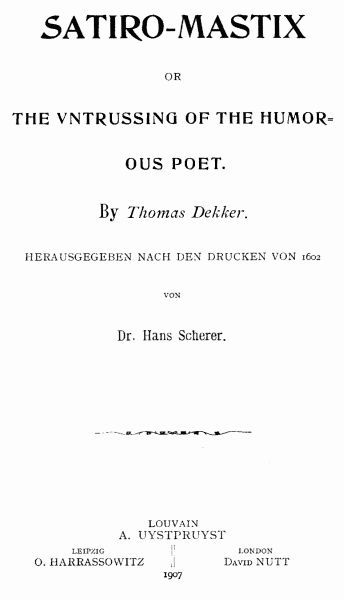
OR
The vntrussing of the Humorous Poet.
As it hath bin presented publikely,
by the Right Honorable, the Lord Chamberlaine
his Seruants; and priuately, by the
Children of Paules.
By Thomas Dekker.
Non recito cuiquam nisi Amicis idq; coactus.
LONDON,
Printed for Edward White, and are to bee
solde at his shop, neere the little North doore of Paules
Church, at the signe of the Gun. 1602.
Dramatis personæ.
- 1. William Rufus.
- 2. Sir Walter Terill.
- 3. Sir Rees ap Vaughan.
- 4. S. Quintilian Shorthose.
- 5. Sir Adam Prickshaft.
- 6. Blunt.
- 7. Crispinus.
- 8. Demetrius Fannius.
- 9. Tucca.
- 10. Horace.
- 11. Asinius Bubo.
- 12. Peter Flash.
- 13. Cælestine.
- 14. Mistris Miniuer.
- 15. Ladies.
Ad Detractorem.
Non potes in Nugas dicere plura meas,
Jpse ego quam dixi.—Qui se mirantur, in illos
Virus habe: Nos hæc nouimus esse nihil.
To the World.
World, I was once resolu’d to bee round with thee, because I know tis thy fashion to bee round with euery bodie: but the winde shifting his point, the Veine turn’d: yet because thou wilt sit as Judge of all matters (though for thy labour thou wear’st Midasses eares, and art Monstrum horrendum, informe: Ingens cui lumen ademptum; whose great Poliphemian eye is put out) I care not much if I make description (before thy Vniuersality) of that terrible Poetomachia, lately commenc’d betweene Horace the second, and a band of leane-witted Poetasters. They haue bin at high wordes, and so high, that the ground could not serue them, but (for want of Chopins) haue stalk’t vpon Stages.
Horace hal’d his Poetasters to the Barre, the Poetasters vntruss’d Horace: how worthily eyther, or how wrongfully, (World) leaue it to the Jurie: Horace (questionles) made himselfe beleeue, that his Burgonian wit might desperately challenge all commers, and that none durst take vp the foyles against him: It’s likely. if he had not so beleiu’d, he had not bin so deceiu’d, for hee was answer’d at his owne weapon: And if before Apollo himselfe (who is Coronator Poetarum) an Inquisition should be taken touching this lamentable merry murdering of Innocent Poetry: all mount Helicon to Bun-hill, it would be found on the Poetasters side Se defendendo. Notwithstanding the Doctors thinke otherwise. I meete one, and he runnes full Butt at me with his Satires hornes, for that in vntrussing Horace, I did onely whip his fortunes, and condition of life, where the more noble Reprehension had bin of his mindes Deformitie, whose greatnes if his Criticall Lynx had with as narrow eyes, obseru’d in himselfe, as it did little spots vpon others, without all disputation: Horace would not haue left Horace out of Euery man in’s Hvmour. His fortunes? why does not he taxe that onely in others? Read his Arraignement and see. A second Cat-a-mountaine mewes, and calles me Barren, because my braines could bring foorth no other Stigmaticke than Tucca, whome Horace had put to making, and begot to my hand: but I wonder what language Tucca would haue spoke, if honest Capten Hannam had bin borne without a tongue? Ist not as lawfull then for mee to imitate Horace, as Horace Hannam?
Besides, If I had made an opposition of any other new-minted fellow, (of what Test so euer) hee had bin out-fac’d, and out-weyed by a settled former approbation: neyther was it much improper to set the same dog vpon Horace, whom Horace had set to worrie others.
I could heere (eeuen with the feather of my pen) wipe off other ridiculous imputations: but my best way to answer them, is to laugh at them: onely thus much I protest (and sweare by the diuinest part of true Poesie) that (howsoeuer the limmes of my naked lines may bee and I know haue bin, tortur’d on the racke) they are free from conspiring the least disgrace to any man, but onely to our new Horace; neyther should this ghost of Tucca, haue walkt vp and downe Poules Church-yard, but that hee was raiz’d vp (in print) by newe Exorcismes. World, if thy Hugenes will beleiue this: doe, if not, I care not: for I dedicate my booke not to thy Greatnes, but to the Greatnes of thy scorne: Defying which, let that mad Dog Detraction bite till his teeth bee worne to the stumps: Enuy feede thy Snakes so fat with poyson till they burst: World, let all thy Adders shoote out their Hidra-headed-forked Stinges, Ha, Ha, Nauci; if none will take my part, (as I desire none) yet I thanke thee (thou true Venusian Horace) for these good wordes thou giu’st me: Populus me sibylat at mihi plaudo. World farewell.
Malim Conuiuis quam placuisse Cocis.
Ad Lectorem
In steed of the Trumpets sounding thrice, before the Play begin: it shall not be amisse (for him that will read) first to beholde this short Comedy of Errors, and where the greatest enter, to giue them in stead of a hisse, a gentle correction.
In letter C. Page. I. for, Whom I adorn’d as Subiects: Read, Whom I ador’d as, &c.
In Letter C Pa. 3. for, Ile starte thence poore: Read, Ile starue their poore, &c.
In Letter C Pa. 6. for, her white cheekes with her dregs and bottome: Read, her white cheekes with the dregs and, &c.
In the same Page, for, Strike off the head of Sin: Read, Strike off the swolne head, &c.
In the same Page, for, that of fiue hundred, foure hundred fiue Read, that of fiue hundred: foure.
In Letter G. pa. 1. for, this enterchanging of languages: Read, this enterchange of language.
In Letter L. pa. 5 for, And stinging insolence should: Read, And stinking insolence, &c.
The Vntrussing of the Humorous Poet.
Enter two Gentlewomen strewing of flowers.
1. Come bedfellow come, strew apace, strew, strew: in good troth tis pitty that these flowers must be trodden vnder feete as they are like to bee anon.
2. Pitty, alacke pretty heart, thou art sorry to see any good thing fall to the ground: pitty? no more pitty, then to see an Innocent Maydenhead deliuered vp to the ruffling of her new-wedded husband. Beauty is made for vse, and hee that will not vse a sweete soule well, when she is vnder his fingers, I pray Venus he may neuer kisse a faire and a delicate, soft, red, plump-lip.
1. Amen, and that’s torment enough.
2. Pitty? come foole, fling them about lustily; flowers neuer dye a sweeter death, than when they are smoother’d to death in a Louers bosome, or else paue the high wayes, ouer which these pretty, simpring, setting things, call’d brides, must trippe.
1. I pray thee tell mee, why doe they vse at weddings to furnish all places thus, with sweet hearbes and flowers?
2. One reason is, because tis——ô a most sweet thing to lye with a man.
1. I thinke tis a O more more more more sweet to lye with a woman.
2. I warrant all men are of thy minde: another reason is, because they sticke like the scutchions of madame chastity, on the sable ground, weeping in their stalkes, and wincking with theyr yellow-sunke eyes, as loath to beholde the lamentable fall of a Maydenhead: what senceles thing in all the house, that is not nowe as melancholy, as a new set-vp Schoolemaster?
2. Troth I thinke thou mournst, because th’ast mist thy turne, I doe by the quiuer of Cupid: you see the torches melt themselues away in teares: the instruments weare theyr heart stringes out for sorrow: and the Siluer Ewers weepe most pittifull Rosewater: fiue or sixe payre of the white innocent wedding gloues, did in my sight choose rather to be torne in peeces than to be drawne on; and looke this Rosemary, (a fatall hearbe) this dead-mans nose-gay, has crept in amongst these flowers to decke th’ inuisible coarse of the Brides Maydenhead, when (oh how much do we poore wenches suffer) about eleuen or twelue, or one a clock at midnight at furthest, it descends to purgatory, to giue notice that Cælestine (hey ho) will neuer come to lead Apes in hell.
1. I see by thy sighing thou wilt not.
2. If I had as many Mayden-heads, as I have hayres on my head, Ide venture them all rather then to come into so hot a place; prethy strew thou, for my little armes are weary.
1. I am sure thy little tongue is not.
2. No faith that’s like a woman bitten fleas, it neuer lyes stil: fye vpont, what a miserable thing tis to be a noble Bride, there’s such delayes in rising, in fitting gownes, in tyring, in pinning Rebatoes, in poaking, in dinner, in supper, in Reuels, & last of all in cursing the poore nodding fidlers, for keeping Mistris Bride so long vp from sweeter Reuels; that, oh I could neuer endure to put it vp without much bickering.
1. Come th’art an odde wench, hark, harke, musicke? nay then the Bride’s vp.
2. Is she vp? nay then I see she has been downe: Lord ha mercy on vs, we women fall and fall still, and when we haue husbands we play upon them like Virginall Jackes, they must ryse and fall to our humours, or else they’l neuer get any good straines of musicke out of vs; but come now, haue at it for a mayden-head.
strew.
As they strew, enter Sir Quintilian Shorthose with Peeter Flash and two or three seruingmen, with lights.
Sir quin. Come knaues, night begins to be like my selfe, an olde man; day playes the theefe and steales vpon vs; O well done wenches, well done, well done, you haue couered all the stony way to church with flowers, tis well, tis well, ther’s an Embleame too, to be made out of these flowers and stones, but you are honest wenches, in, in, in.
2. When we come to your yeares, we shal learne what honesty is, come pew-fellow.
Exeunt.
Sir quin. Is the musicke come yet? so much to do! Ist come?
Sir quin. Haue the merry knaues pul’d their fiddle cases ouer their instruments eares?
Flash. As soone as ere they entred our gates, the noyse went, before they came nere the great Hall, the faint hearted villiacoes sounded at least thrice.
Sir quin. Thou shouldst haue reuiu’d them with a Cup of burnt wine and sugar; sirra, you, horse-keeper, goe, bid them curry theyr strings: Is my daughter vp yet?
Exit.
Flash. Vp sir? she was seene vp an houre agoe.
Sir quin. Shee’s an early sturrer, ah sirra.
Flash. Shee’l be a late sturrer soone at night sir.
Sir Quint. Goe too Peeter Flash, you haue a good sodaine flash of braine, your wittes husky, and no maruaile, for tis like one of our Comedians beardes, still ith stubble: about your busines, and looke you be nymble to flye from the wine, or the nymble wine will catch you by the nose.
Flash. If your wine play with my nose Sir, Ile knocke’s coxcombe.
Sir quin. Doe Peeter, and weare it for thy labour; Is my Sonne in Law Sir Walter Terell ready yet?
Omnes. Ready sir.
Exit another.
Sir Quin. One of you attend him: Stay Flash, where’s the note of the guestes you haue inuited?
Flash. Here Sir, Ile pull all your guestes out of my bosome; the men that will come, I haue crost, but all the Gentlewomen haue at the tayle of the last letter a pricke, because you may read them the better.
Sir quint. My spectacles, lyght, lyght, knaues: Sir Adam Prickshaft, thou hast crost him, heele come.
Flash. I had much a doe sir, to draw Sir Adam Prickeshaft home, because I tolde him twas early, but heele come.
Sir quint. Justice Crop, what will he come?
Flash. He took phisicke yesterday sir.
Sir quint. Oh then Crop cannot come.
Flash. O Lord yes, sir yes, twas but to make more roome in his Crop for your good cheare, Crop will come.
Sir quint. Widdow Mineuer.
Flash. Shee’s prickt you see sir, and will come.
Sir quint. Sir Vaughan ap Rees, oh hee’s crost twise, so, so, so, then all these Ladyes, that fall downewardes heere, will come I see, and all these Gentlemen that stand right before them.
Flash. All wil come.
Sir quint. Well sayd, heere, wryte them out agen, and put the men from the women, and Peeter, when we are at Church bring wine and cakes, be light & nimble good Flash, for your burden will be but light.
Enter sir Adam a light before him.
Sir Adam Prickeshaft. God morrow, god morrow: goe, in, in, in, to the Bridegroome, taste a cup of burnt wine this morning, twill make you flye the better all the day after.
Sir Adam. You are an early styrrer Sir Quintilian Shorthose.
Sir qui. I am so, it behoues me at my daughters wedding, in, in, in; fellow put out thy torch, and put thy selfe into my buttery, the torch burnes ill in thy hand, the wine will burne better in thy belly, in, in.
Flash. Ware there, roome for Sir Adam Prickeshaft: your Worship—
Exit.
Enter Sir Vaughan and Mistris Mineuer.
Sir quin. Sir Vaughan and Widdow Mineuer, welcome, welcome, a thousand times: my lips Mistris Widdow shall bid you God morrow, in, in, one to the Bridegroome, the other to the Bride.
Sir Vaughan. Why then Sir quiontilian Shorthose, I will step into mistris Bride, and Widdow Mineuer, shall goe vpon M. Bridegroome.
Mineu. No pardon, for by my truely Sir Vaughan, Ile ha no dealings with any M. Bridegroomes.
Sir quin. In widdow in, in honest knight in.
Sir Vaug. I will vsher you mistris widdow.
Flash. Light there for Sir Vaughan; your good Worship—
Sir Vaug. Drinke that shilling Ma. Peeter Flash, in your guttes and belly.
Fla. Ile not drinke it downe sir, but Ile turne it into that which shall run downe, oh merrily!
Exit Sir Vaughan.
Enter Blunt, Crispinus, Demetrius, and others with Ladies, lights before them.
Sir quin. God morrow to these beauties, and Gentlemen, that haue Vshered this troope of Ladyes to my daughters wedding, welcome, welcome all; musick? nay then the bridegroome’s comming, where are these knaues heere?
Flash. All here sir.
Enter Terill, Sir Adam, Sir Vaughan, Celestine, Mineuer and other Ladies and attendants with lights.
Teri. God morrow Ladies and fayre troopes of gallants, that
haue depos’d the drowzy King of sleep, to Crowne our traine with
your rich presences, I salute you all;
Each one share thanks from thanks in generall.
Cris. God morrow M. Bride-groome, mistris Bride.
Omnes. God morrow M. Bride-groome.
Ter. Gallants I shal intreate you to prepare,
For Maskes and Reuels to defeate the night,
Our Soueraigne will in person grace our marriage.
Sir quin. What will the king be heer?
Ter. Father he will.
Sir quin. Where be these knaues? More Rose-mary and gloues, gloues, gloues: choose Gentlemen; Ladyes put on soft skins vpon the skin of softer hands; so, so: come mistris Bride take you your place, the olde men first, and then the Batchelors; Maydes with the Bride, Widdows and wiues together, the priest’s at Church, tis time that we march thether.
Ter. Deare Blunt at our returne from Church, take paines to step to Horace, for our nuptiall songs; now Father when you please.
Sir quin. Agreed, set on, come good Sir Vaughan, must we lead the way?
Sir Vau. Peeter you goe too fast for Mistris pride: so, gingerly, gingerly; I muse why Sir Adam Prickeshaft sticks so short behinde?
Sir quin. He follows close, not too fast, holde vp knaues,
Thus we lead youth to church, they vs to graues.
Exeunt.
Horrace sitting in a study behinde a Curtaine, a candle by him burning, bookes lying confusedly: to himselfe.
Hor. To thee whose fore-head swels with Roses,
Whose most haunted bower
Giues life & sent to euery flower,
Whose most adored name incloses,
Things abstruse, deep and diuine,
Whose yellow tresses shine,
Bright as Eoan fire.
O me thy Priest inspire.
For I to thee and thine immortall name,
In—in—in golden tunes,
For I to thee and thine immortall name—
In—sacred raptures flowing, flowing, swimming, swimming:
In sacred raptures swimming,
Immortal name, game, dame, tame, lame, lame, lame,
Pux, hath, shame, proclaime, oh—
In Sacred raptures flowing, will proclaime, not—
O me thy Priest inspyre!
For I to thee and thine immortall name,
In flowing numbers fild with spright and flame,
Good, good, in flowing numbers fild with spright & flame.
Enter Asinius Bubo.
Asini. Horace, Horace, my sweet ningle, is alwayes in labour when I come, the nine Muses be his midwiues I pray Jupiter: Ningle.
Ho. In flowing numbers fild with sprite and flame,
To thee.
Asini. To me? I pledge thee sweet Ningle, by Bacchus quaffing boule, I thought th’adst drunke to me.
Hor. It must haue been in the deuine lycour of Pernassus, then in which, I know you would scarce haue pledg’d me, but come sweet roague, sit, sit, sit.
Asini. Ouer head and eares yfaith? I haue a sacke-full of newes for thee, thou shalt plague some of them, if God send vs life and health together.
Hor. Its no matter, empty thy sacke anon, but come here first honest roague, come.
Asini. Ist good, Ist good, pure Helicon ha?
Hor. Dam me ift be not the best that euer came from me, if I haue any iudgement, looke sir, tis an Epithalamium for Sir Walter Terrels wedding, my braines haue giuen assault to it but this morning.
Asin. Then I hope to see them flye out like gun-powder ere night.
Hor. Nay good roague marke, for they are the best lynes that euer I drew.
Asin. Heer’s the best leafe in England, but on, on, Ile but tune this Pipe.
Hor. Marke, to thee whose fore-head swels with Roses.
Asin. O sweet, but will there be no exceptions taken, because fore-head and swelling comes together?
Hor. Push away, away, its proper, besides tis an elegancy to say the fore head swels.
Asin. Nay an’t be proper, let it stand for Gods loue.
Hor. Whose most haunted bower,
Giues life and sent to euery flower,
Whose most adored name incloses,
Things abstruse, deep and diuine.
Whose yellow tresses shine,
Bright as Eoan fire.
Asini. O pure, rich, ther’s heate in this, on, on.
Hor. Bright as Eoan fire,
O me thy Priest inspire!
For I to thee and thine immortall name —— marke this.
In flowing numbers fild with spryte and flame.
Asini. I mary, ther’s spryte and flame in this.
Hor. A pox, a this Tobacco.
Asin. Wod this case were my last, if I did not marke, nay all’s one, I haue alwayes a consort of Pypes about me, myne Ingle is all fire and water; I markt, by this Candle (which is none of Gods Angels) I remember, you started back at sprite and flame.
Hor. For I to thee and thine immortall name,
In flowing numbers fild with sprite and flame,
To thee Loues mightiest King,
Himen ô Himen, does our chaste Muse sing.
Asin. Ther’s musicke in this.
Hor. Marke now deare Asinius.
Let these virgins quickly see thee,
Leading out the Bride,
Though theyr blushing cheekes they hide,
Yet with kisses will they fee thee,
To vntye theyr Virgin zone,
They grieue to lye alone.
Asini. So doe I by Venus.
Hor. Yet with kisses wil they fee thee, my Muse has marcht (deare roague) no farder yet: but how ist? how ist? nay prethee good Asinius deale plainly, doe not flatter me, come, how?—
Asin. If I haue any iudgement:
Hor. Nay look you Sir, and then follow a troope of other rich and labour’d conceipts, oh the end shall be admirable! but how ist sweet Bubo, how, how?
Asini. If I have any Iudgement, tis the best stuffe that euer dropt from thee.
Hor. You ha seene my Acrosticks?
Asi. Ile put vp my pypes and then Ile see any thing.
Hor. Th’ast a Coppy of mine Odes to, hast not Bubo?
Asi. Your odes? O that which you spake by word a mouth at th’ ordinary, when Musco the gull cryed Mew at it.
Hor. A pox on him poore braineles Rooke: and you remember, I tolde him his wit lay at pawne with his new Sattin sute, and both would be lost, for not fetching home by a day.
Asi. At which he would faine ha blusht but that his painted cheekes would not let him.
Hor. Nay sirra the Palinode, which I meane to stitch to my Reuels, shall be the best and ingenious peece that euer I swet for; stay roague, Ile fat thy spleane and make it plumpe with laughter.
Asi. Shall I? fayth Ningle, shall I see thy secrets?
Hor. Puh my friends.
Asi. But what fardle’s that? what fardle’s that?
Hor. Fardle, away, tis my packet; heere lyes intoomb’d the loues of Knights and Earles, heere tis, heere tis, heere tis, Sir Walter Terils letter to me, and my answere to him: I no sooner opened his letter, but there appeared to me three glorious Angels, whome I ador’d as subiectes doe their Soueraignes: the honest knight Angles for my acquaintance, with such golden baites— but why doost laugh my good roague? how is my answere, prethee, how, how?
Asi. Answere, as God iudge me Ningle, for thy wit thou mayst answer any Iustice of peace in England I warrant; thou writ’st in a most goodly big hand too, I like that, & readst as leageably as some that haue bin sau’d by their neck-verse.
Hor. But how dost like the Knights inditing?
Asi. If I haue any iudgement; a pox ont, heer’s worshipfull lynes indeed, heer’s stuffe: but sirra Ningle, of what fashion is this knights wit, of what blocke?
Hor. Why you see; wel, wel, an ordinary Ingenuity, a good wit for a knight, you know how, before God I am haunted with some the most pittyfull dry gallants.
Asini. Troth so I think; good peeces of lantskip, shew best a far off.
Hor. I, I, I, excellent sumpter horses, carry good cloaths; but honest roague, come, what news, what newes abroad? I haue heard a the horses walking a’ th top of Paules.
Asi. Ha ye? why the Captain Tucca rayles vpon you most preposterously behinde your backe, did you not heare him?
Ho. A pox vpon him: by the white & soft hand of Minerua, Ile make him the most ridiculous: dam me if I bring not’s humor ath stage: &—scuruy lymping tongu’d captaine, poor greasie buffe Ierkin, hang him: tis out of his Element to traduce me: I am too well ranckt Asinius to bee stab’d with his dudgion wit: sirra, Ile compose an Epigram vpon him, shall goe thus—
Asi. Nay I ha more news, ther’s Crispinus & his Iorneyman Poet Demetrius Faninus too, they sweare they’ll bring your life & death vpon’th stage like a Bricklayer in a play.
Hor. Bubo they must presse more valiant wits than theyr own to do it: me ath stage? ha, ha. Ile starue their poore copper-lace workmasters, that dare play me: I can bring (& that they quake at) a prepar’d troope of gallants, who for my sake shal distaste euery vnsalted line, in their fly-blowne Comedies.
Asi. Nay that’s certaine, ile bring 100. gallants of my ranke.
Hor. That same Crispinus is the silliest Dor, and Faninus the
slightest cob-web-lawne peece of a Poet, oh God!
Why should I care what euery Dor doth buz
In credulous eares, it is a crowne to me,
That the best iudgements can report me wrong’d.
Asi. I am one of them that can report it.
Hor. I thinke but what they are, and am not moou’d.
The one a light voluptuous Reueler,
The other, a strange arrogating puffe,
Both impudent, and arrogant enough.
Asin. S’lid do not Criticus Reuel in these lynes, ha Ningle ha?
Hor. Yes, they’re mine owne.
Cris. Horrace.
Dem. Flaccus.
Cris. Horrace, not vp yet.
Hor. Peace, tread softly, hyde my Papers; who’s this so early? Some of my rookes, some of my guls?
Cris. Horrace, Flaccus.
Hor. Who’s there? stray, treade softly: Wat Terill on my life: who’s there? my gowne sweete roague, so, come vp, come in.
Enter Crispinus and Demetrius.
Cris. God morrow Horrace.
Hor. O, God saue you gallants.
Cris. Asinius Bubo well met.
Asin. Nay, I hope so Crispinus, yet I was sicke a quarter of a yeare a goe of a vehement great tooth-atch: a pox ont, it bit me vilye, as God sa me la I knew twas you by your knocking so soone as I saw you; Demetrius Fannius, wil you take a whiffe this morning? I haue tickling geare now, heer’s that will play with your nose, and a pype of mine owne scowring too.
Dem. I, and a Hodgshead too of your owne, but that will neuer be scowred cleane I feare.
Asin. I burnt my pype yesternight, and twas neuer vsde since, if you will tis at your seruice gallants, and Tobacco too, tis right pudding I can tell you; a Lady or two, tooke a pype full or two at my hands, and praizde it for the Heauens, shall I fill Flannius?
Dem. I thanke you good Asinius for your loue,
I sildome take that Phisicke, tis enough
Hauing so much foole to take him in snuffe.
Hor. Good Bubo read some booke, and giue vs leaue....
As. Leaue haue you deare Ningle, marry for reading any book Ile take my death vpont (as my Ningle sayes) tis out of my Elemēt: no faith, euer since I felt one hit me ith teeth that the greatest Clarkes are not the wisest men, could I abide to goe to Schoole, I was at As in presenti and left there: yet because Ile not be counted a worse foole then I am, Ile turne ouer a new leafe.
Asinius reads and takes Tabacco.
Hor. To see my fate, that when I dip my pen
In distilde Roses, and doe striue to dreine,
Out of myne Inke all gall; that when I wey
Each sillable I write or speake, because
Mine enemies with sharpe and searching eyes
Looke through & through me, caruing my poore labours
Like an Anotomy: Oh heauens to see,
That when my lines are measur’d out as straight
As euen Paralels, tis strange that still,
Still some imagine they are drawne awry.
The error is not mine, but in theyr eye,
That cannot take proportions.
Cris. Horrace, Horrace,
To stand within the shot of galling tongues,
Proues not your gilt, for could we write on paper,
Made of these turning leaues of heauen, the cloudes,
Or speake with Angels tongues: yet wise men know,
That some would shake the head, tho Saints should sing,
Some snakes must hisse, because they’re borne with stings.
Hor. Tis true.
Cris. Doe we not see fooles laugh at heauen? and mocke
The Makers workmanship; be not you grieu’d
If that which you molde faire, vpright and smooth,
Be skrwed awry, made crooked, lame and vile,
By racking coments, and calumnious tongues,
So to be bit it rankcles not: for innocence
May with a feather brush off the foulest wrongs.
But when your dastard wit will strike at men
In corners, and in riddles folde the vices
Of your best friends, you must not take to heart,
If they take off all gilding from their pilles,
And onely offer you the bitter Coare.
Cri. Say that you haue not sworne vnto your Paper,
To blot her white cheekes with the dregs and bottome
Of your friends priuate vices: say you sweare
Your loue and your aleageance to bright vertue
Makes you descend so low, as to put on
The Office of an Executioner,
Onely to strike off the swolne head of sinne,
Where ere you finde it standing,
Say you sweare;
And make damnation parcell of your oath,
That when your lashing iestes make all men bleed;
Yet you whip none. Court, Citty, country, friends,
Foes, all must smart alike; yet Court, nor Citty,
Nor foe, nor friend, dare winch at you; great pitty.
Dem. If you sweare, dam me Faninus, or Crispinus,
Or to the law (Our kingdomes golden chaine)
To Poets dam me, or to Players dam me,
If I brand you, or you, tax you, scourge you:
I wonder then, that of fiue hundred: foure
Should all point with their fingers in one instant
At one and the same man?
Hor. Deare Faninus.
Dem. Come, you cannot excuse it.
Hor. Heare me, I can—
Dem. You must daube on thicke collours then to hide it.
Cris. We come like your Phisitions, to purge
Your sicke and daungerous minde of her disease.
Dem. In troth we doe, out of our loues we come,
And not reuenge, but if you strike vs still,
We must defend our reputations:
Our pens shall like our swords be alwayes sheath’d,
Vnlesse too much prouockt, Horace if then
They draw bloud of you, blame vs not, we are men:
Come, let thy Muse beare vp a smoother sayle,
Tis the easiest and the basest Arte to raile.
Hor. Deliuer me your hands, I loue you both,
As deare as my owne soule, prooue me, and when
I shall traduce you, make me the scorne of men.
Both. Enough, we are friends.
Asi. By my troth heer’s an excellent comfortable booke, it’s most sweet reading in it.
Dem. Why, what does it smell of Bubo?
Asi. Mas it smels of Rose-leaues a little too.
Hor. Then it must needs be a sweet booke, he would faine perfume his ignorance.
Asi. I warrant he had wit in him that pen’d it.
Cris. Tis good yet a foole will confesse truth.
Asi. The whoorson made me meete with a hard stile in two or three places as I went ouer him.
Dem. I beleeue thee, for they had need to be very lowe & easie Stiles of wit that thy braines goe ouer.
Enter Blunt and Tucca.
Blun. Wher’s this gallant? Morrow Gentlemen: what’s this deuise done yet Horace?
Hor. Gods so, what meane you to let this fellow dog you into my Chamber?
Blun. Oh, our honest Captayne, come, prethee let vs see.
Tuc. Why you bastards of nine whoores, the Muses, why doe you walk heere in this gorgeous gailery of gallant inuentions, with that whooreson poore lyme & hayre-rascall? why—
Cris. O peace good Tucca, we are all sworne friends.
Tuc. Sworne, that Iudas yonder that walkes in Rug, will dub you Knights ath Poste, if you serue vnder his band of oaths, the copper-fact rascal wil for a good supper out sweare twelue dozen of graund Iuryes.
Blun. A pox ont, not done yet, and bin about it three dayes?
Horr. By Iesu within this houre, saue you Captayne Tucca.
Tuc. Dam thee, thou thin bearded Hermaphrodite, dam thee, Ile saue my selfe for one I warrant thee, is this thy Tub Diogines?
Hor. Yes Captaine this is my poore lodging.
Asin. Morrow Captaine Tucca, will you whiffe this morning?
Tuc. Art thou there goates pizzel; no godamercy Caine I am for no whiffs I, come hether sheep-skin-weauer, s’foote thou lookst as though th’adst beg’d out of a Iayle: drawe, I meane not thy face (for tis not worth drawing) but drawe neere: this way, martch, follow your commaunder you scoundrell: So, thou must run of an errand for mee Mephostophiles.
Hor. To doe you pleasure Captayne I will, but whether.
Tuc. To hell, thou knowst the way, to hell my fire and brimstone, to hell; dost stare my Sarsens-head at Newgate? dost gloate? Ile march through thy dunkirkes guts for shooting iestes at me.
Hor. Deare Captaine but one word.
Tuc. Out bench-whistler out, ile not take thy word for a dagger Pye: you browne-bread-mouth stinker, ile teach thee to turne me into Bankes his horse, and to tell gentlemen I am a Iugler, and can shew trickes.
Hor. Captaine Tucca, but halfe a word in your eare.
Tuc. No you staru’d rascal, thou’t bite off mine eares then, you must haue three or foure suites of names, when like a lowsie Pediculous vermin th’ast but one suite to thy backe: you must be call’d Asper, and Criticus, and Horace, thy tytle’s longer a reading then the Stile a the big Turkes: Asper, Criticus, Quintus, Horatius, Flaccus.
Hor. Captaine I know vpon what euen bases I stand, and therefore—
Tuc. Bases? wud the roague were but ready for me.
Blun. Nay prethee deare Tucca, come you shall shake—
Tuc. Not hands with great Hunkes there, not hands, but Ile shake the gull-groper out of his tan’d skinne.
Crisp. & Deme. For our sake Captaine, nay prethee holde.
Tuc. Thou wrongst heere a good honest rascall Crispinus, and a poore varlet Demetrius Fanninus (bretheren in thine owne trade of Poetry) thou sayst Crispinus Sattin dublet is Reauel’d out heere, and that this penurious sneaker is out at elboes, goe two my good full-mouth’d ban-dog, Ile ha thee friends with both.
Hor. With all my heart captaine Tucca, and with you too, Ile laye my handes vnder your feete, to keepe them from aking.
Omnes. Can you haue any more?
Tuc. Saist thou me so, olde Coale? come doo’t then; yet tis no matter neither, Ile haue thee in league first with these two rowly powlies: they shal be thy Damons and thou their Pithyasse; Crispinus shall giue thee an olde cast Sattin suite, and Demetrius shall write thee a Scene or two, in one of thy strong garlicke Comedies; and thou shalt take the guilt of conscience for’t, and sweare tis thine owne olde lad, tis thine owne: thou neuer yet fels’t into the hands of sattin, didst?
Hor. Neuer Captaine I thanke God.
Tuc. Goe too, thou shalt now King Gorboduck, thou shalt, because Ile ha thee damn’d, Ile ha thee all in Sattin: Asper, Criticus, Quintus, Horatius, Flaccus, Crispinus shal doo’t, thou shalt doo’t, heyre apparant of Helicon, thou shalt doo’t.
Asi. Mine Ingle weare an olde cast Sattin suite?
Tuc. I wafer-face your Ningle.
Asi. If he carry the minde of a Gentleman, he’ll scorne it at’s heeles.
Tuc. Mary muffe, my man a ginger-bread, wilt eate any small coale?
Asi. No Captaine, wod you should well know it, great coale shall not fill my bellie.
Tuc. Scorne it, dost scorne to be arrested at one of his olde Suites?
Hor. No Captaine, Ile weare any thing.
Tuc. I know thou wilt, I know th’art an honest low minded Pigmey, for I ha seene thy shoulders lapt in a Plaiers old cast Cloake, like a Slie knaue as thou art: and when thou ranst mad for the death of Horatio: thou borrowedst a gowne of Roscius the Stager, (that honest Nicodemus) and sentst it home lowsie, didst not? Responde, didst not?
Blun. So, so, no more of this, within this houre—
Hor. If I can sound retreate to my wits, with whome this leader is in skirmish, Ile end within this houre.
Tuc. What wut end? wut hang thy selfe now? has he not writ Finis yet Iacke? what will he bee fifteene weekes about this Cockatrices egge too? has hee not cackeld yet? not laide yet?
Blunt. Not yet, hee sweares hee will within this houre.
Tuc. His wittes are somewhat hard bound: the Puncke his Muse has sore labour ere the whoore bee deliuered: the poore saffron-cheeke Sun-burnt Gipsie wantes Phisicke; giue the hungrie-face pudding-pye-eater ten Pilles: ten shillings my faire Angelica, they’l make his Muse as yare as a tumbler.
Blu. He shall not want for money if heele write.
Tuc. Goe by Ieronimo, goe by; and heere, drop the ten shillings into this Bason; doe, drop, when Iacke? hee shall call me his Mæcenas: besides, Ile dam vp’s Ouen-mouth for rayling at’s: So, ist right Iacke? ist sterling? fall off now to the vanward of yonder foure Stinkers, and aske alowde if wee shall goe? the Knight shall defray Iacke, the Knight when it comes to Summa totalis, the Knyght, the Knight.—
Blu. Well Gentlemen, we’ll leaue you, shall we goe Captaine? good Horrace make some hast.
Hor. Ile put on wings.
Asin. I neuer sawe mine Ingle so dasht in my life before.
Cris. Yes once Asinius.
Asi. Mas you say true, hee was dasht worse once going (in a rainy day) with a speech to’th Tilt-yard, by Gods lyd has call’d him names, a dog would not put vp, that had any discreation.
Tuc. Holde, holde vp thy hand, I ha seene the day thou didst not scorne to holde vp thy golles: ther’s a Souldiers Spur-royall, twelue pence: Stay, because I know thou canst not write without quick-siluer; vp agen, this goll agen, I giue thee double presse-money: Stay, because I know thou hast a noble head, ile deuide my Crowne, ô royall Porrex, ther’s a teston more; goe, thou and thy Muse munch, doe, munch; come my deare Mandrake, if Skeldring fall not to decay, thou shalt florish: farewell my sweet Amadis de Gaule, farewell.
Hor. Deare Captaine.
Dem. Nay Captaine stay, we are of your band.
Tuc. March faire then.
Cri. Horace farewell, adue Asinius.
Exeunt.
Asi. Ningle lets goe to some Tauerne, and dine together, for my stomache rises at this scuruy leather Captaine.
Hor. No, they haue choakt me with mine owne disgrace, Which (fooles) ile spit againe euen in your face.
Exeunt.
Enter Sir Quintilian Shorthose, Sir Adam, Sir Vaughan, Mineuer with seruingmen.
Sir quinti. Knaues, Varlets, what Lungis, giue me a dozen of stooles there.
Sir Vau. Sesu plesse vs all in our fiue sences a peece, what meane yee sir Kintilian Sorthose to stand so much on a dozen stooles, heere be not preeches inuffe to hyde a dozen stooles, vnlesse you wisse some of vs preake his sinnes.
Sir quin. I say sir Vaughan no shinne shal be broken heer; what lungis, a chayre with a stronge backe, and a soft bellie, great with childe, with a cushion for this reuerend Lady.
Mineu. God neuer gaue me the grace to be a Lady, yet I ha beene worshipt in my conscience to my face a thousand times, I cannot denye sir Vaughan, but that I haue all implements, belonging to the vocation of a Lady.
Sir Vaughan. I trust mistris Mineuer you haue all a honest oman shud haue?
Min. Yes perdie, as my Coach, and my fan, and a man or two that serue my turne, and other things which Ide bee loath euery one should see, because they shal not be common, I am in manner of a Lady in one point.
Sir Vaug. I pray mistris Mineuers, let vs all see that point for our better vnderstanding.
Mi. For I ha some thinges that were fetcht (I am sure) as farre as some of the Low Countries, and I payde sweetly for them too, and they tolde me they were good for Ladies.
Sir qui. And much good do’t thy good heart faire widdow with them.
Min. I am fayre enough to bee a Widdow, Sir Quintilian.
Sir Vaug. In my soule and conscience, and well fauoured enough to be a Lady: heere is sir Kintilian Sorthose, and heere is sir Adam Prickshaft, a sentleman of a very good braine, and well headed: you see he shootes his bolt sildome, but when Adam lets goe, he hits: and heere is sir Vaughan ap Rees, and I beleeue if God sud take vs all from his mercy, as I hope hee will not yet; we all three loue you, at the bottome of our bellyes, and our hearts: and therefore mistris Mineuer, if you please, you shall be knighted by one of vs, whom you sall desire to put into your deuice and minde.
Min. One I must haue sir Vaughan.
Sir quin. And one of vs thou shalt haue widdow.
Min. One I must haue, for now euery one seekes to crow ouer me.
Sir Vaug. By Sesu and if I finde any crowing ouer you, & he were a cocke (come out as farre as in Turkeys country) tis possible to cut his combe off.
Min. I muse why sir Adam Prickshaft flyes so farre from vs.
Sir Adam. I am in a browne study, my deare, if loue should bee turned into a beast, what beast hee were fit to bee turned into.
Sir quinti. I thinke Sir Adam an Asse, because of his bearing.
Min. I thinke (sauing your reuerence) Sir Adam a puppy, for a dog is the most louing creature to a christian that is, vnles it be a childe.
Sir Ad. No, I thinke if loue should bee turn’d away, and goe to serue any beast, it must bee an Ape, and my reason——
Sir Vaugh. Sir Adam, an Ape? ther’s no more reason in an Ape, than in a very plaine Monkey; for an Ape has no tayle, but we all know, or tis our duty to know, loue has two tailes; In my sudsment, if loue be a beast, that beast is a bunce of Reddis; for a bunce of Reddis is wise meate without Mutton, and so is loue.
Mi. Ther’s the yawning Captaine (sauing your reuerence that has such a sore mouth) would one day needes perswade me, that loue was a Rebato; and his reason was (sauing your reuerence) that a Rebato was worne out with pinning too often; and so he said loue was.
Sir Vaugh. And Master Captaine Tucca sayd wisely too, loue is a Rebato indeede: a Rebato must be poaked; now many women weare Rebatoes, and many that weare Rebatoes——
Sir Adam. Must be poakt.
Sir Vau. Sir Adam Prickshaft has hit the cloute.
Musicke.
Sir qui. The Musicke speakes to vs, we’ll haue a daunce before dinner.
Enter Sir Walter Terrill, Cælestine, Blunt, Crispinus, and Demetrius, euery one with a Lady.
All. The King’s at hand.
Ter. Father the King’s at hand.
Musicke talke lowder, that thy siluer voice,
May reach my Soueraignes eares.
Sir Vaug. I pray doe so, Musitions bestir your fingers, that you may haue vs all by the eares.
Sir quin. His Grace comes, a Hall varlets, where be my men? blow, blow your colde Trumpets till they sweate; tickle them till they sound agen.
Blun. Best goe meete his Grace.
All. Agreed.
Sir Vaug. Pray all stand bare, as well men as women: Sir Adam is best you hide your head for feare your wise braines take key-colde: on afore Sir Kintilian; Sentlemen fall in before the Ladyes, in seemely order and fashion; so this is comelye.
Enter Trumpets sounding, they goe to the doore, and meete the King and his Traine, and whilst the Trumpets sound the King is welcom’d, kisses the Bride, and honors the Bridegroome in dumbe shew.
King. Nay if your pleasures shrinke at sight of vs,
We shall repent this labour, Mistris Bride
You that for speaking but one word to day,
Must loose your head at night; you that doe stand
Taking your last leaue of virginity;
You that being well begun, must not be Maide:
Winne you the Ladies, I the men will wooe,
Our selfe will leade my blushing Bride with you.
Sir Vaughan. God blesse your Maiesty, and send you to be a long King William Rufus ouer vs, when he sees his times & pleasures.
King. Wee thanke you good Sir Vaughan, wee will take your meaning not your words.
Sir quint. Lowde Musicke there.
Sir Vau. I am glad your Maiesty will take any thing at my hands; my words I trust in Sesu, are spoken betweene my soule and body together, and haue neither Felonies nor treasons about them, I hope.
King. Good words Sir Vaughan, I prethee giue vs leaue.
Vaug. Good words sir Vaughan? thats by interpretation in english, you’r best giue good words sir Vaughan: god and his Ansells blesse me, what ayles his maiestye to be so tedious and difficult in his right mindes now, I holde my life that file rascall-rymer Horace hath puzd and puzd aboue a hundred merie tales and lyce, into his great and princely eares: by god and he vse it, his being Phœbus priest cannot saue him, if hee were his Sapline too ide prease vpon his coxcomb: good lord blesse me out of his maiesties celler: King Williams, I hope tis none offences to make a supplication to god a mightie for your long life: for by shesu I haue no meaning in’t in all the world, vnles rascalls be here that will haue your grace take shalke for shees, and vnlesse Horace has sent lyce to your maiesty.
King. Horace, what’s he sir Vaughan?
Vaugh. As hard-fauourd a fellow as your maiestie has seene in a sommers day: he does pen, an’t please your grace, toyes that will not please your grace; tis a Poet, we call them Bardes in our Countrie, singes ballads and rymes, and I was mightie sealous, that his Inke which is blacke and full of gall, had brought my name to your maiestie, and so lifted vp your hye and princely coller.
King. I neither know that Horace, nor mine anger,
If as thou saist our high and princely choller
Be vp, wee’l tread it downe with daunces; Ladies
Loose not your men; faire measures must be tread,
When by so faire a dauncer you are lead.
Vaugh. Mistris Miniuer:
Min. Perdie sir Vaughan I cannot dance.
Vaugh. Perdie by this Miniuer cappe, and acording to his masesties leaue too, you sall be put in among theise Ladies, & daunce ere long I trest in god, the saking of the seetes.
They daunce a straine, and whilst the others keepe on, the King and Celestine stay.
Kin. That turne faire Bride shews you must turne at night,
In that sweet daunce which steales away delight.
Cæl. Then pleasure is a theife, a fit, a feauer.
Kin. True, he’s the thiefe, but women the receiuer.
Another change; they fall in, the rest goe on.
Kin. This change sweet Maide, saies you must change your life,
As Virgins doe.
Cæl. Virgins nere change their life,
She that is wiu’d a maide, is Maide and wife.
Kin. But she that dyes a Maide;—
Cæl. Thrice happy then.
Cæl. Better leade Apes then men.
At this third change they end, and she meetes the King.
Kin. Well met.
Cæl. Tis ouertaken.
Cæl. Women are ouertaken when they meete.
Kin. Your bloud speakes like a coward.
Cæl. It were good,
If euery Maiden blush, had such a bloud.
Kin. A coward bloud, why whom should maidens feare?
Cæ. Men, were Maides cowards, they’d not come so nere,
My Lord the Measure’s done, I pleade my duetie.
Kin. Onelie my heart takes measure of thy beautie.