
WeRead Powered by ReaderPub
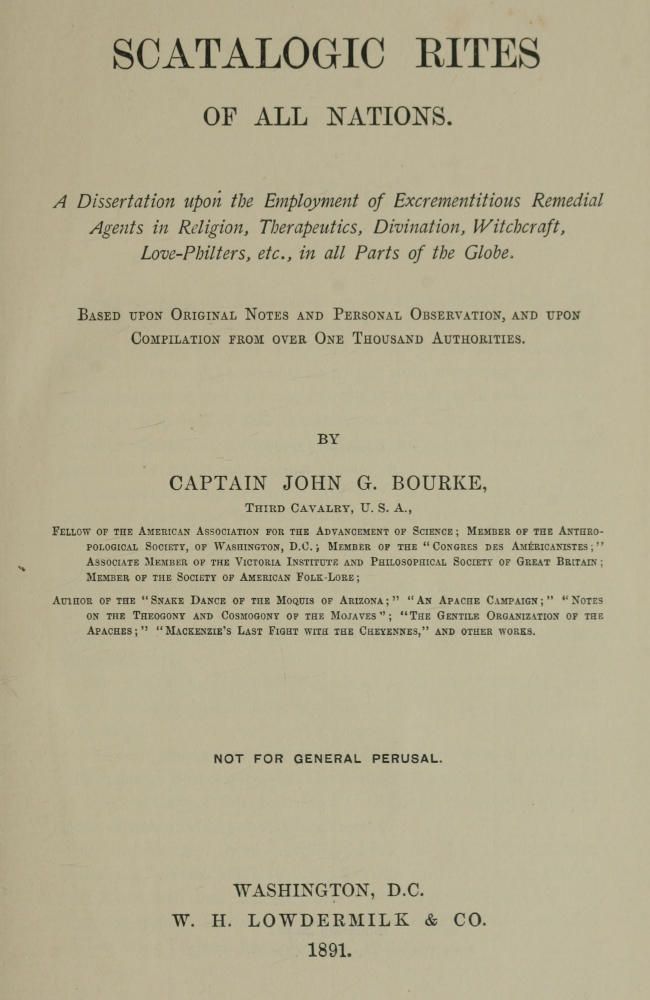
Scatalogic Rites of All Nations / A dissertation upon the employment of excrementitious remedial agents in religion, therapeutics, divination, witchcraft, love-philters, etc., in all parts of the globe cover

Scatalogic Rites of All Nations / A dissertation upon the employment of excrementitious remedial agents in religion, therapeutics, divination, witchcraft, love-philters, etc., in all parts of the globe

Chapter 154: ADDENDA.
Open in WeRead

About This Book

A global survey documents religious, medical, divinatory, and magical uses of human excrement and urine across cultures, drawing on the author's observations and a wide compilation of sources. It presents ethnographic case studies, such as ritual dances and festival practices, and compares phenomena like the European Feast of Fools and indigenous ceremonies to trace common origins. Chapters analyze therapeutic applications, food practices involving excrement, and associations with witchcraft, love-philters, and folk medicine, citing historical and contemporary authorities. The work aims to place these practices in religious and cultural context, juxtaposing evidence rather than imposing definitive interpretations.

ADDENDA.

Dr. Thomas G. Morton, of Philadelphia, imparts the information that not only is the use of human urine still general among ignorant women during pregnancy, but that it has been learned that female abortionists have been in the habit of vending a nostrum for defeating pregnancy, one of the components of which was the catamenial discharge.

Referring to previous remarks, on page 162, it may be noticed that a curious instance of survival by contrariety is to be detected in what Picart relates of the Hebrew ceremonial of the present day. He says of the behavior of the Hebrew while praying, that he should carefully avoid gaping, spitting, blowing his nose, or emitting any exhalations: “Il doit éviter autant qu’il se peut de bailler, de cracher, de se moucher, de laisser aller des vents.” (Picart, “Coutumes et Cérémonies,” &c., vol. i. p. 126). All this information seems to be taken from the work of the Rabbi Leon, of Modena.

In the above are seen the antipodes of the practices characteristic of the worship of Baal-Peor which the prophets had so much trouble in eradicating from the minds of the chosen people.