
WeRead Powered by ReaderPub
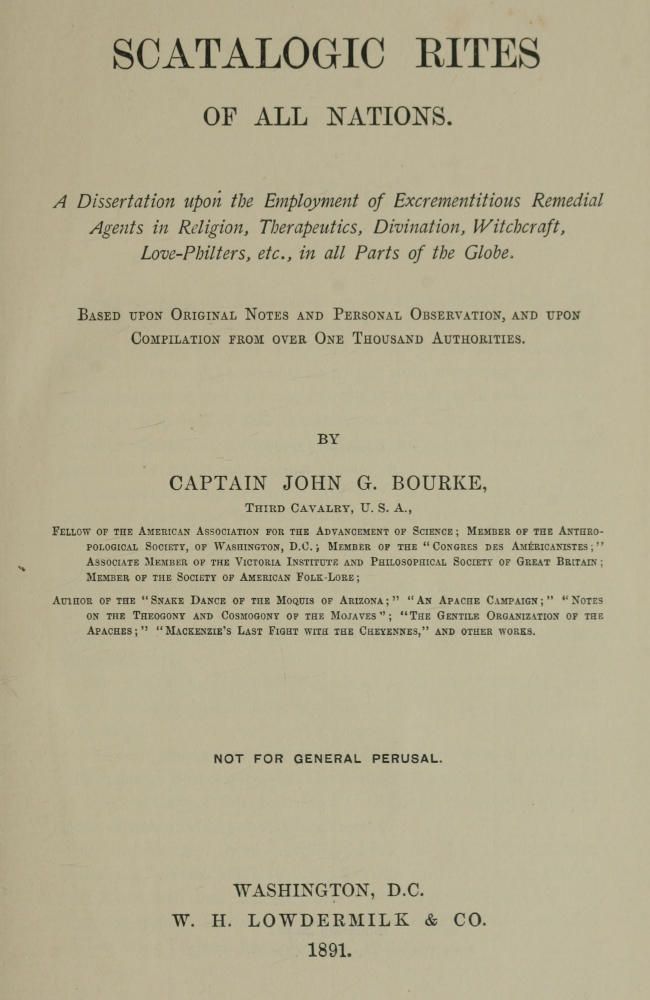
Scatalogic Rites of All Nations / A dissertation upon the employment of excrementitious remedial agents in religion, therapeutics, divination, witchcraft, love-philters, etc., in all parts of the globe cover

Scatalogic Rites of All Nations / A dissertation upon the employment of excrementitious remedial agents in religion, therapeutics, divination, witchcraft, love-philters, etc., in all parts of the globe

Chapter 56: XXV. URINE AND ORDURE AS SIGNS OF MOURNING.
Open in WeRead

About This Book

A global survey documents religious, medical, divinatory, and magical uses of human excrement and urine across cultures, drawing on the author's observations and a wide compilation of sources. It presents ethnographic case studies, such as ritual dances and festival practices, and compares phenomena like the European Feast of Fools and indigenous ceremonies to trace common origins. Chapters analyze therapeutic applications, food practices involving excrement, and associations with witchcraft, love-philters, and folk medicine, citing historical and contemporary authorities. The work aims to place these practices in religious and cultural context, juxtaposing evidence rather than imposing definitive interpretations.

XXV.
URINE AND ORDURE AS SIGNS OF MOURNING.

Care should be taken to distinguish between the religious use of ordure and urine, and that in which they figure as outward signs of mourning, induced by a frenzy of grief, or where they have been utilized in the arts.

Lord Kingsborough (Mexican Antiquities, vol. viii. p. 237) briefly outlines such ritualistic defilement in the Mortuary Ceremonies of Hebrews and Aztecs, giving as references for the latter Diego Duran, and for the former the prophet Zechariah, chap. iii.: “Now Joshua was clothed with filthy garments, and stood before the angel,” etc.

“The nearest relations cut their hair and blacken their faces, and the old women put human excrement on their heads,—the sign of the deepest mourning.”—(“The Native Tribes of South Australia,” Adelaide, 1879, pp. 200, received through the kindness of the Royal Society, New South Wales, T. B. Kyngdon, Secretary.)