WeRead Powered by ReaderPub
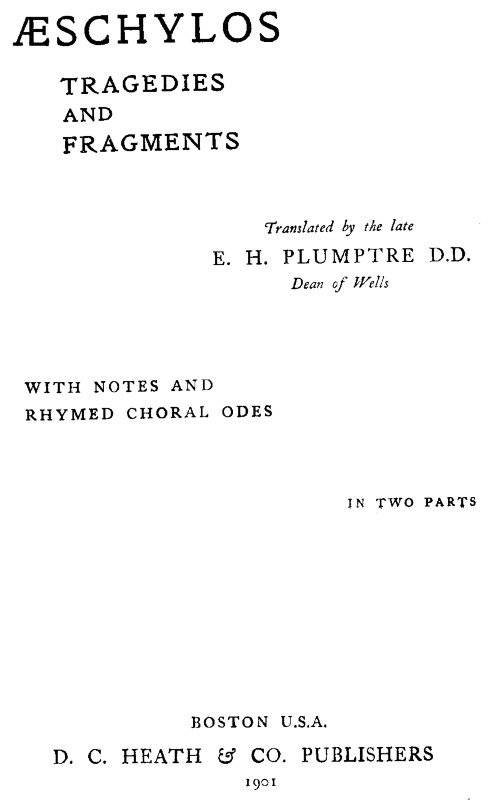
Æschylos Tragedies and Fragments cover

Æschylos Tragedies and Fragments

Chapter 16: THE LIBATION-POURERS
Open in WeRead

Explore more books like this:

About This Book

A curated edition gathers the seven surviving tragedies of an early Greek dramatist, accompanied by fragmentary remains, translator’s notes, and alternative choral renderings. The dramas range from a firsthand-style account of military catastrophe to mythic treatments of divine resistance, enforced exile, supplication, and the transition from private vengeance to public adjudication. Formal features include prominent choral odes, austere staging effects, and elevated poetic rhetoric, with the translator experimenting in metre and providing annotations. Recurring concerns are the tension between divine law and human agency, communal ritual, and the foundations of civic order.

THE LIBATION-POURERS

DRAMATIS PERSONÆ

Orestes
Clytæmnestra
Pylades
Electra
Ægisthos
Nurse
Servant
Chorus of Captive Women

ARGUMENT.—It came to pass, after Agamemnon had been slain, that Clytæmnestra and Ægisthos ruled in Argos, and all things seemed to go well with them. Orestes, who was heir to Agamemnon, they had sent away to the care of Strophios of Phokis, and there he abode. Electra, his sister, mourned in secret over her father's death, and prayed for vengeance, but no avenger came. And when Orestes grew up to man's estate, he went to ask counsel of the God at Delphi, and the Gods straitly charged him to take vengeance on his father's murderers; and so he started on his journey with his trusty friend Pylades, and arrived at Argos. And it chanced that a little while before he came, the Gods sent Clytæmnestra a fearful dream, that troubled her soul greatly; and in her terror she bade Electra go with her handmaids to pour libations on the tomb of Agamemnon, that so she might appease his soul, and propitiate the Powers that rule over the dark world of the dead.

THE LIBATION-POURERS
Scene.—Argos, in front of the palace of the Atreidæ. The tomb of
Agamemnon (a raised mound of earth) is seen in the background.

Enter Orestes and Pylades from the left; Orestes advances to the mound, and, as he speaks, lays on it a lock of his hair.

Orest. O Hermes of the darkness 'neath the earth,
Who hast the charge of all thy Father's[401] sway,
To me who pray deliverer, helper be;
For I to this land come, from exile come,
And on the raised mound of this monument
I bid my father hear and list. One tress,
Thank-offering for the gifts that fed my youth,
To Inachos I consecrate, and this
The second as the token of my grief;[402]
For mine it was not, father, being by,
Over thy death to groan, nor yet to stretch
My hand forth for the burial of thy corpse.
[As he speaks, Electra, followed by a train of
captive women in black garments, bearing libations,
wailing and tearing their clothes, comes
forth from the palace
What see I now? What company of women
Is this that comes in mourning garb attired?
What chance shall I conjecture as its cause?
10
Does a new sorrow fall upon this house?
Or am I right in guessing that they bring
Libations to my father, soothing gifts
To those beneath? It cannot but be so.
I think Electra, mine own sister, comes,
By wailing grief conspicuous. Thou, O Zeus,
Grant me full vengeance for my father's death,
And of thine own good will my helper be!
Come, Pylades, and let us stand aside,
That I may clearly learn what means this train
Of women offering prayers.
20
Strophe I
Chor. Sent from the house I come,
With quick, sharp beatings of the hands in grief,
To pour libations here;
*And see, my cheeks with bloody marks are tracked,[403]
The new-cut furrows which my nails have made,
And evermore my heart is fed with groans;
And folds of mantles tied
Across the breast are rent
To shreds and rags in grief,
*Marring the grace of linen vestments fair,
*Since we by woes that shut out smiles are smitten.
30
Antistrophe I
*Full clear a spectre came
That made each single hair to stand on end,
Dream-prophet of this house,
That e'en in sleep breathes out avenging wrath;
And from the secret chamber cried in fear
A cry that broke the silence of the night,
There, where the women dwell,
Falling with heaviest weight;
And those who judge such dreams
Told, calling God to witness, that the souls
Below were wroth and vexed with those that slew them.
40
Strophe II
On such a graceless deed of grace, as charm
To ward off ill, (O Earth! O mother kind!)
A godless woman now
Sends me with eager heart;
And yet I dread to utter that same prayer;
What ransom has been found
For blood on earth once poured?
Oh! hearth all miserable!
Oh! utter overthrow of house and home!
Yea, mists of darkness, sunless, loathed of men,
50
Cover both home and house
With its lords' bloody deaths.
Antistrophe II
Yea, all the majesty that awed of old,
Unchecked, unconquered, irresistible,
Thrilling the people's heart
As well as ears, is gone;
There are, may be, that fear;[404] but now Success
Is man's sole God and more;
Yet stroke of Vengeance swift
Smites some in life's clear day,
For some who tarry long their sorrows wait
In twilight dim, on darkness' borderland,
*And some an endless night
Of nothingness holds fast.
Strophe III
Because of blood that mother earth has drunk,
The guilt of slaughter that will vengeance work
Is fixed indelibly;
And Atè, working grief,
60
Permits awhile the guilty one to wait,
That so he may be full and overflow
*With all-devouring ill.
Antistrophe III
For him whose foul touch stains the marriage bed[405]
No remedy avails; and water-streams,
Though all as from one source
Should pour to cleanse the guilt
*Of murder that the sin-stained hand defiles,
*Would yet flow all in vain
*That guilt to purify.
Epode
But now to me, since the high Gods have sent
A doom of bondage round my city's walls,
(For from my father's home
They have brought on me fate of slavery,)
Deeds right and wrong alike
Have been as things 'twas meet I should accept,
70
Since this slave-life began,
Where deeds are done by violence and force,—
And I must needs suppress
*The bitter loathing of my inmost heart,
*And now beneath my cloak I weep and wail
*For all the frustrate fortunes of my lords,[406]
Chilled through with secret grief.
Elect. Ye handmaids, ye who deftly tend this house,
Since ye are here companions in my task
As suppliants, give me your advice in this,
What shall I say as these funereal gifts
I pour? How shall I speak acceptably?
80
How to my father pray? What? Shall I say
“I bring from loving wife to husband loved
Gifts”—from my mother? No, I am not bold
Enough for that, nor know I what to speak,
Pouring this chrism on my father's tomb,[407]
Or shall I say this prayer, as men are wont,
“Good recompense make thou to those who bring
These garlands,” yea, a gift full well deserved
By deeds of ill? Or dumb, with ignominy
Like that with which he perished, shall I pour
Libations on the earth, and like a man
That flings away the lustral filth, shall I
Throw down the urn and walk with eyes not turned?[408]
90
Be sharers in my counsels, O my friends;
A common hate we cherish in the house;
Hide nothing in your heart through fear of man.
Fate's doom firm-fixed awaits alike the free,
And those in bondage to another's hand.
Speak, if thou can'st a better counsel give.
100
Chor. [laying their hands on Agamemnon's tomb.] Thy father's tomb as altar honouring,
I, as thou bidd'st, will speak my heart-thoughts out!
Elect. Speak, then, as thou my father's tomb dost honour,
Chor. Say, as thou pour'st, good words for those that love,
Elect. Which of my friends shall I address as such!
Chor. First then thyself, and whoso hates Ægisthos.
Elect. Shall I for thee, as for myself, pray thus?
Chor. Now that thou'rt learning, judge of that thyself.
Elect. Whom shall I add then to this company?
Chor. Far though Orestes be, forget him not.
Elect. Right well is this: thou teachest admirably.
Chor. Then, for the blood-stained ones remembering say....
Elect. What then? Explain, and teach my ignorance.[409]
110
Chor. That there may come to them some God or man....
Elect. Shall I “as judge” or as “avenger” say?
Chor. Say it out plain! “to give them death for death.”...
Elect. May prayers like these consist with piety?
Chor. Why not,—a foe with evils to requite?
Elect. [moving to the tomb, and pouring libations as she speaks.] *O mightiest herald of the Gods on high
And those below, O Hermes of the dark,
Call thou the Powers beneath, and bid them hear
The prayers that look towards my father's house;
And Earth herself, who all things bringeth forth,
120
And rears them and again receives their fruit.
And I to human souls libations pouring,
Say, calling on my father, “Pity me;
How shall we bring our dear Orestes home?”
For now as sold to ill by her who bore us,
We poor ones wander. She as husband gained
Ægisthos, who was partner in thy death;
And I am as a slave, and from his wealth
Orestes now is banished, and they wax
Full haughty in the wealth thy toil had gained.
130
And that Orestes hither with good luck
May come, I pray. Hear thou that prayer, my father!
And to myself grant thou that I may be
Than that my mother wiser far of heart,
Holier in act. For us this prayer I pour;
And for our foes, my father, this I pray,
That Justice may as thine avenger come,
And that thy murderers perish. Thus I place
Midway in prayer for good that now I speak,
My prayer 'gainst them for evil. Be thou then
The escort[410] of these good things that I ask,
140
With help of Gods, and Earth, and conquering Justice.
With prayers like these my votive gifts I pour;
And as for you [turning to the Chorus] 'tis meet with cries to crown
The pæan ye utter, wailing for the dead.
Strophe
Chor. *Pour ye the pattering tear,
*Falling for fallen lord,
*Here by the tomb that shuts out good and ill,—
Here, where the full libations have been poured
That turn aside the curse men deprecate,
Hear me, O Thou my Dread,
150
Hear thou, O Sire, the words my dark mind speaks!
Antistrophe
Oh, woe is me, woe, woe!
Woe, woe, and woe is me!
*What warrior strong of spear
Shall come the house to free,
Or Ares with his Skythian bow[411] in hand,
Shaking its pliant strength in deeds of war,
*Or guiding in encounter closer yet
The weapons made with hilts?
[During the choral ode Electra, after going to the
mound, and pouring the libations on it, returns
holding in her hands the lock of hair which
Orestes had left there
Elect. The gifts the earth hath drunk, my father hath them:
Now this new wonder come and share with me.
Chor. Speak on, my heart goes pit-a-pat with fear.
Elect. There on the tomb I see this lock cut off.
160
Chor. What man or maid low-girdled can it claim?
Elect. Full easy this for any one to guess.
Chor. Old as I am, may I from younger learn?
Elect. None but myself could cut off lock like this.
Chor. Yea, foes are they that should with grief-locks mourn.
Elect. Yes, surely, 'tis indeed the self-same hair....
Chor. But as what tresses? This I seek to know.
Elect. And of a truth 'tis very like to ours....
Chor. Did then Orestes send this secret gift?[412]
Elect. It is most like those flowing locks of his.
170
Chor. Yet how had he adventured to come hither?
Elect. He to his father sent the lock as gift.
Chor. Not less regretful than before, thy words,
If on this soil his foot shall never tread.
Elect. Yea, on me too there rushed heart-surge of gall
And I was smitten as with dart that pierced;
And from mine eyes there fell the thirsty drops
That pour unchecked, of this full bitter flood,
As I this lock beheld. How can I think
That any other townsman owns this hair?
180
Nay, she who slew ... she did not cut it off,
My mother ... who towards her children shows
A godless mood that little suits the name;
And yet that I should this assert outright,
The precious gift is his whom most of men
I love, Orestes.... Nay, hope flatters me.
Alas! alas!
Would, herald-like, it had a kindly voice!
So should I not turn to and fro in doubt;
But either it had told me with all clearness
To loathe this tress, if cut from hated head;
190
Or, being of kin, had sought to share my grief,
To deck the tomb and do my father honour.
Chor. Well, on the Gods we call, on those who know
In what storms we, like sailors, now are tossed:
But if deliverance may indeed be ours,
From a small seed a mighty trunk may grow.[413]
Elect. Here too are foot-prints as a second proof,
Just like ... yea, close resembling those of mine.
For here are outlines of two separate feet,
His own and those of fellow-traveller,
200
And all the heels and impress of the feet,
When measured, fit well with my footsteps here....
Pangs come on me, and sore bewilderment.
[As she ceases speaking Orestes comes forward
from his concealment
Orest. Pray, uttering to the Gods no fruitless prayer,
For good success in what is yet to come.
Elect. What profits now to me the Gods' good will?
Orest. Thou see'st those here whom most thou did'st desire.
Elect. Whom called I on, that thou hast knowledge of?
Orest. Right well I know how thou dost prize Orestes.
Elect. In what then find I now my prayers fulfilled?
210
Orest. Behold me! Seek no dearer friend than I!
Elect. Nay, stranger, dost thou weave a snare for me?
Orest. Then do I plot my schemes against myself.
Elect. Thou seekest to make merry with my grief.
Orest. With mine then also, if at all with thine.
Elect. Art thou indeed Orestes that I speak to?
Orest. Though thou see'st him, thou'rt slow to learn 'tis I;
Yet when thou saw'st this lock of mourner's hair,
And did'st the foot-prints track my feet had made,
Agreeing with thine own, as brother's true,
Then did'st thou deem in hope thou looked'st on me.
220
Fit then this lock where it was cut, and see;
See too this woven robe, thine own hands' work,
The shuttle's stroke, and forms of beasts[414] of chase.
[Electra starts, as if about to cry aloud for joy
Restrain thyself, nor lose thy head for joy:
Our nearest kin, I know, are foes to us.
Elect. [embracing Orestes] Thou whom thy father's house most loves, most prays for,
Our one sole hope, bewept with many a tear,
Of issue that shall work deliverance!
Thine own might trusting, thou thy father's house
Shall soon win back. O pleasant fourfold name!
230
I needs must speak to thee as father dear;[415]
The love I owe my mother turns to thee,
(She with full right to me is hateful now,)
My sister's too, who ruthlessly was slain;
And thou wast ever faithful brother found,
And one whom I revered. May Might and Right,
And sovran Zeus as third, my helpers be!
Orest. Zeus! Zeus! be Thou a witness of our troubles,
See the lorn brood that calls an eagle sire,
Eagle that perished in the coils and folds
240
Of a fell viper. Now on them bereaved
Presses gaunt famine. Not as yet full-grown
Are they to bring their father's booty home.
Thus it is thine to see in me and her,
(I mean Electra) children fatherless,
Both suffering the same exile from our home.
Elect. And should'st Thou havoc make of brood of sire
Who at thine altar greatly honoured Thee,
Whence wilt Thou get a festive offering
From hand as free? Nor, should'st Thou bring to nought
The eagle's nestlings, would'st thou have at hand
250
A messenger to bear thy will to man
In signs persuasive; nor when withered up
This royal stock shall be, will it again
Wait on thine altars at high festivals:
Oh, bring it back, and then Thou too wilt raise
From low estate a lofty house, which now
Seems to have fallen, fallen utterly.
Chor. Ah, children! saviours of your father's house,
Hush, hush, lest some one hear you, children dear,
And for mere talking's sake report all this
To those that rule. Ah, would I might behold them
Lie dead 'midst oozing fir-pyre blazing high![416]
260
Orest. Nay, nay, I tell you, Loxias' oracle,
In strength excelling, will not fail us now,
That bade me on this enterprise to start,
And with clear voice spake often, warning me
Of chilling pain-throes at the fevered heart,
Unless my father's murderers I should chase,
Bidding me kill them in the self-same fashion,
Stirred by the wrongs that pauperise my life,
And said that I with many a mischief ill
Should pay for that fault with mine own dear life.
For making known to men the charms earth-born
270
*That soothe the wrathful powers,[417] he spake for us
Of ills as follows, leprous sores that creep
All o'er the flesh, and as with cruel jaws
Eat out its ancient nature, and white hairs[418]
On that foul ill to supervene: and still
He spake of other onsets of the Erinnyes,
As brought to issue from a father's blood;
For the dark weapon of the Gods below
Winged by our kindred that lie low in death,
And beg for vengeance, yea, and madness too,
And vague, dim fears at night disturb and haunt me,
*Seeing full clearly, though I move my brow[419]
280
In the thick darkness ... and that then my frame,
Thus tortured, should be driven from the city
With brass-knobbed scourge: and that for such as I
It was not given to share the wine-cup's taste,
Nor votive stream in pure libation poured;
And that my father's wrath invisible
Would drive me from all altars, and that none
Should take me in, or lodge with me; at last,
That, loathed of all and friendless, I should die,
A wretched mummy, all my strength consumed.
Must I not trust such oracles as these?
Yea, though I trust not, must the deed be done;
290
For many motives now in one converge,—
The God's command, great sorrow for my father;
My lack of fortune, this, too, urges me
Never to leave our noble citizens,
With noblest courage Troïa's conquerors,
To be the subjects to two women thus;
Yea, his soul is as woman's:[420] an' it be not,
He soon shall know the issue.
Chor. Grant ye from Zeus, O mighty Destinies!
That so our work may end
As Justice wills, who takes our side at last;
300
Now for the tongue of bitter hate let tongue
Of bitter hate be given. Loud and long
The voice of Vengeance claiming now her debt;
And for the murderous blow
Let him who slew with murderous blow repay.
“That the wrong-doer bear the wrong he did,”
Thrice-ancient saying of a far-off time,[421]
This speaketh as we speak.
Strophe I
Orest. O father, sire ill-starred,
What deed or word could I
Waft from afar to thee,
Where thy couch holds thee now,
310
*To be a light with dark commensurate?
Alike, in either case,
The wail that tells their praise is welcome gift
To those Atreidæ, guardians of our house.
Strophe II
Chor. My child, my child, the mighty jaws of fire[422]
Bind not the mood and spirit of the dead!
But e'en when that is past he shows his wrath.
When he that dies is wailed,
The murderer stands revealed:
320
The righteous cry for parents that begat,
To fullest utterance roused,
Searches the whole truth out.
Antistrophe I
Elect. Hear then, O father, now
Our tearful griefs in turn;
From us thy children twain
The funeral wail ascends;
And we, as suppliants and as exiles too,
Find shelter at thy tomb.
What of all this is good, what void of ills?
330
Is not this now a woe invincible?
Chor. Yet, even yet, from evils such as these,
God, if He will, may bring more pleasant strains:
And for the dirge we utter by the tomb,
A pæan in the royal house may raise
Welcome to new-found friend.
Strophe III
Orest. Had'st thou beneath the walls
Of Ilion, O my sire,
Been slain by Lykian foe,[423]
Pierced through and through with spear,
Leaving high fame at home,
340
And laying strong and sure
*Thy children's paths in life,
Then had'st thou had as thine
Far off across the sea
A mound of earth heaped high,
To all thy kith and kin endurable.
Antistrophe II
Chor. Yea, and as friend with friends
That nobly died, he then
Had dwelt in high estate
A sovereign ruler, held
Of all in reverence,
High in their train who rule
Supreme in that dark world;
350
For he, too, while he lived,
As monarch ruled o'er those
Whose hands the sceptre held
That mortal men obey.[424]
Antistrophe III
Elect. Not even 'neath the walls
Of Troïa, O my sire,
With those the spear hath slain,
Would I have had thee lie
By fair Scamandros' stream:
No, this my prayer shall be
That those who slew thee fall,
*By their own kin struck down,
360
That one might hear far off,
Untried by woes like this,
The fate that brings inevitable death.
Chor. Of blessings more than golden, O my child,
Greater than greatest fortune, or the bliss
Of those beyond the North[425] thou speakest now;
For this is in thy grasp;
But hold; e'en now this thud of double scourge[426]
Finds its way on to him;
Already these find helpers 'neath the earth,
But of those rulers whom we loathe and hate
Unholy are the hands:
370
And children gain the day.
Strophe IV
Elect. Ah! this, like arrow, pierces through the ear!
O Zeus! O Zeus! who sendest from below
A woe of tardy doom
Upon the bold and subtle hands of men....
Nay, though they parents be,
Yet all shall be fulfilled.
Strophe V
Chor. May it be mine to chant o'er funeral pyre
*Cry well accordant with the pine-fed blaze,[427]
When first the man is slain,
And his wife perisheth!
380
Why should I hide what flutters round my heart?
On my heart's prow a blast blows mightily,
Keen wrath and loathing fierce.
Antistrophe IV
Orest. And when shall Zeus, the orphan's guardian true,
Lay to his hand and smite the guilty heads?
So may our land learn faith!
Vengeance I claim from those who did the wrong.
390
Hear me, O Earth, and ye,
*Powers held in awe below!
Chor. Yea, the law saith that gory drops once shed
Upon the ground for yet more blood should crave;
*For lo! fell slaughter on Erinnys calls,
To come from those that perished long ago,
And on one sorrow other sorrow bring.
Strophe VI
Elect. *Ah, ah, O Earth, and Lords of those below!
Behold, ye mighty Curses of the slain,
Behold the remnant of the Atreidæ's house
Brought to extremest strait,
400
Bereaved of house and home!
Whither, O Zeus, can any turn for help?