WeRead Powered by ReaderPub
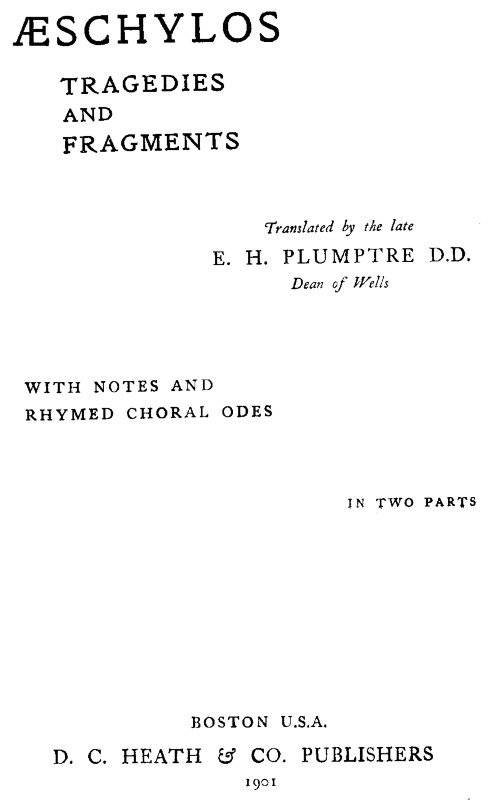
Æschylos Tragedies and Fragments cover

Æschylos Tragedies and Fragments

Chapter 7: DRAMATIS PERSONÆ
Open in WeRead

Explore more books like this:

About This Book

A curated edition gathers the seven surviving tragedies of an early Greek dramatist, accompanied by fragmentary remains, translator’s notes, and alternative choral renderings. The dramas range from a firsthand-style account of military catastrophe to mythic treatments of divine resistance, enforced exile, supplication, and the transition from private vengeance to public adjudication. Formal features include prominent choral odes, austere staging effects, and elevated poetic rhetoric, with the translator experimenting in metre and providing annotations. Recurring concerns are the tension between divine law and human agency, communal ritual, and the foundations of civic order.

THE PERSIANS[2]

DRAMATIS PERSONÆ

Atossa
Ghost of Dareios
Messenger
Xerxes
Chorus of Persian Elders

ARGUMENT.—When Xerxes came to the throne of Persia, remembering how his father Dareios had sought to subdue the land of the Hellenes, and seeking to avenge the defeat of Datis and Artaphernes on the field of Marathon, he gathered together a mighty host of all nations under his dominion, and led them against Hellas. And at first he prospered and prevailed, crossed the Hellespont, and defeated the Spartans at Thermopylæ, and took the city of Athens, from which the greater part of its citizens had fled. But at last he and his armament met with utter overthrow at Salamis. Meanwhile Atossa, the mother of Xerxes, with her handmaids and the elders of the Persians, waited anxiously at Susa, where was the palace of the great king, for tidings of her son.


2.  Note.—Within two years after the battle of Salamis, the feeling of natural exultation was met by Phrynichos in a tragedy bearing the title of The Phœnikians, and having for its subject the defeat of Xerxes. As he had come under the displeasure of the Athenian demos for having brought on the stage the sufferings of their Ionian kinsmen in his Capture of Miletos, he was apparently anxious to regain his popularity by a “sensation” drama of another kind; and his success seems to have prompted Æschylos to a like attempt five years later, B.C. 473. The Tetralogy to which the play belonged, and which gained the first prize on its representation, included the two tragedies (unconnected in subject) of Phineus and Glaucos, and the satyric drama of Prometheus the Fire-stealer.

The play has, therefore, the interest of being strictly a contemporary narrative of the battle of Salamis and its immediate consequences, by one who may himself have been present at it, and whose brother Ameinias (Herod, viii. 93) distinguished himself in it by a special act of heroism. As such, making all allowance for the influence of dramatic exigencies, and the tendency to colour history so as to meet the tastes of patriotic Athenians, it may claim, where it differs from the story told by Herodotos, to be a more trustworthy record. And it has, we must remember, the interest of being the only extant drama of its class, the only tragedy the subject of which is not taken from the cycle of heroic myths, but from the national history of the time. Far below the Oresteian Trilogy as it may seem to us as a work of art, having more the character of a spectacle than a poem, it was, we may well believe, unusually successful at the time, and it is said to have been chosen by Hiero for reproduction in Syracuse after Æschylos had settled there under his patronage.

THE PERSIANS
Scene.Susa, in front of the palace of Xerxes, the tomb
of Dareios occupying the position of the thymele
Enter Chorus of Persian Elders.
We the title bear of Faithful,[3]
Friends of Persians gone to Hellas,
Watchers left of treasure city,[4]
Gold-abounding, whom, as oldest,
Xerxes hath himself appointed,
He, the offspring of Dareios,
As the warders of his country.
And about our king's returning,
And our army's, gold-abounding,
Over-much, and boding evil,
10
Does my mind within me shudder
(For our whole force, Asia's offspring,
Now is gone), and for our young chief
Sorely frets: nor courier cometh,
Nor any horseman, bringing tidings
To the city of the Persians.
From Ecbatana departing,
Susa, or the Kissian fortress,[5]
Forth they sped upon their journey,
Some in ships, and some on horses,
Some on foot, still onward marching,
In their close array presenting
Squadrons duly armed for battle:
20
Then Armistres, Artaphernes,
Megabazes, and Astaspes,
Mighty leaders of the Persians,
Kings, and of the great King servants,[6]
March, the chiefs of mighty army.
Archers they and mounted horsemen.
Dread to look on, fierce in battle,
Artembares proud, on horseback,
And Masistres, and Imæos,
30
Archer famed, and Pharandakes,
And the charioteer Sosthanes.
Neilos mighty and prolific
Sent forth others, Susikanes,
Pegastagon, Egypt's offspring,
And the chief of sacred Memphis;
Great Arsames, Ariomardos,
Ruler of primeval Thebæ,
And the marsh-men,[7] and the rowers,
Dread, and in their number countless.
40
And there follow crowds of Lydians,
Very delicate and stately,[8]
Who the people of the mainland
Rule throughout—whom Mitragathes
And brave Arkteus, kingly chieftains,
Led, from Sardis, gold-abounding,
Riding on their many chariots,
Three or four a-breast their horses,
Sight to look upon all dreadful.
And the men of sacred Tmôlos[9]
Rush to place the yoke of bondage
On the neck of conquered Hellas.
50
Mardon, Tharabis, spear-anvils,[10]
And the Mysians, javelin-darting;[11]
Babylôn too, gold-abounding,
Sends a mingled cloud, swept onward,
Both the troops who man the vessels,
And the skilled and trustful bowmen;
And the race the sword that beareth,
Follows from each clime of Asia,
At the great King's dread commandment.
These, the bloom of Persia's greatness,
Now are gone forth to the battle;
60
And for these, their mother country,
Asia, mourns with mighty yearning;
Wives and mothers faint with trembling
Through the hours that slowly linger,
Counting each day as it passes.
Strophe I
The king's great host, destroying cities mighty,
Hath to the land beyond the sea passed over,
Crossing the straits of Athamantid Helle,[12]
70
On raft by ropes secured,
And thrown his path, compact of many a vessel,
As yoke upon the neck of mighty ocean.
Antistrophe I
Of populous Asia thus the mighty ruler
'Gainst all the land his God-sent host directeth
In two divisions, both by land and water,
Trusting the chieftains stern,
The men who drive the host to fight, relentless—
He, sprung from gold-born race, a hero godlike.[13]
80
Strophe II
Glancing with darkling look, and eyes as of ravening dragon,
With many a hand, and many a ship, and Syrian chariot driving,[14]
He upon spearmen renowned brings battle of conquering arrows.[15]
Antistrophe II
Yea, there is none so tried as, withstanding the flood of the mighty,
90
To keep within steadfast bounds that wave of ocean resistless;
Hard to fight is the host of the Persians, the people stout-hearted.
Mesode
Yet ah! what mortal can ward the craft of the God all-deceiving?
*Who, with a nimble foot, of one leap is easily sovereign?
For Atè, fawning and kind, at first a mortal betraying,
100
Then in snares and meshes decoys him,
Whence one who is but man in vain doth struggle to 'scape from.
Strophe III
For Fate of old, by the high Gods' decree,
Prevailed, and on the Persians laid this task,
Wars with the crash of towers,
And set the surge of horsemen in array,
And the fierce sack that lays a city low.
110
Antistrophe III
But now they learnt to look on ocean plains,[16]
The wide sea hoary with the violent blast,
Waxing o'er confident
In cables formed of many a slender strand,
And rare device of transport for the host.
Strophe IV
So now my soul is torn,
As clad in mourning, in its sore affright,
Ah me! ah me! for all the Persian host!
120
Lest soon our country learn
That Susa's mighty fort is void of men.
Antistrophe IV
And through the Kissians' town
Shall echo heavy thud of hands on breast.
Woe! woe! when all the crowd of women speak
This utterance of great grief,
And byssine robes are rent in agony.
Strophe V
For all the horses strong,
And host that march on foot,
Like swarm of bees, have gone with him who led
130
The vanguard of the host.
Crossing the sea-washed, bridge-built promontory
That joins the shores of either continent.[17]
Antistrophe V
And beds with tears are wet
In grief for husbands gone,
And Persian wives are delicate in grief,
Each yearning for her lord;
And each who sent her warrior-spouse to battle
140
Now mourns at home in dreary solitude.
But come, ye Persians now,
And sitting in this ancient hall of ours,
Let us take thought deep-counselling and wise,
(Sore need is there of that,)
How fareth now the great king Xerxes, he
Who calls Dareios sire,
Bearing the name our father bore of old?
Is it the archers' bow that wins the day?
Or does the strength prevail
150
Of iron point that heads the spear's strong shaft?
But lo! in glory like the face of gods,
The mother of my king, my queen, appears:
Let us do reverent homage at her feet;
Yea, it is meet that all
Should speak to her with words of greeting kind.
Enter Atossa in a chariot of state
Chor. O sovereign queen of Persian wives deep-zoned,
Mother of Xerxes, reverend in thine age,
Wife of Dareios! hail!
'Twas thine to join in wedlock with a spouse
Whom Persians owned as God,[18]
And of a God thou art the mother too,
Unless its ancient Fortune fails our host.
160
Atoss. Yes, thus I come, our gold-decked palace leaving,
The bridal bower Dareios with me slept in.
Care gnaws my heart, but now I tell you plainly
A tale, my friends, which may not leave me fearless,
Lest boastful wealth should stumble at the threshold,
And with his foot o'erturn the prosperous fortune
That great Dareios raised with Heaven's high blessing.
And twofold care untold my bosom haunteth:
We may not honour wealth that has no warriors,
Nor on the poor shines light to strength proportioned;
Wealth without stint we have, yet for our eye we tremble;
170
For as the eye of home I deem a master's presence.
Wherefore, ye Persians, aid me now in counsel;
Trusty and old, in you lies hope of wisdom.
Chor. Queen of our land! be sure thou need'st not utter
Or thing or word twice o'er, which power may point to;
Thou bid'st us counsel give who fain would serve thee.
Atoss. Ever with many visions of the night[19]
Am I encompassed, since my son went forth,
Leading a mighty host, with aim to sack
The land of the Ionians. But ne'er yet
180
Have I beheld a dream so manifest
As in the night just past. And this I'll tell thee:
There stood by me two women in fair robes;
And this in Persian garments was arrayed,
And that in Dorian came before mine eyes;
In stature both of tallest, comeliest size;
And both of faultless beauty, sisters twain
Of the same stock.[20] And they twain had their homes,
One in the Hellenic, one in alien land.
And these two, as I dreamt I saw, were set
190
At variance with each other. And my son
Learnt it, and checked and mollified their wrath,
And yokes them to his chariot, and his collar
He places on their necks. And one was proud
Of that equipment,[21] and in harness gave
Her mouth obedient; but the other kicked,
And tears the chariot's trappings with her hands,
And rushes off uncurbed, and breaks its yoke
Asunder. And my son falls low, and then
His father comes, Dareios, pitying him.
And lo! when Xerxes sees him, he his clothes
200
Rends round his limbs. These things I say I saw
In visions of the night; and when I rose,
And dipped my hands in fountain flowing clear,[22]
I at the altar stood with hand that bore
Sweet incense, wishing holy chrism to pour
To the averting Gods whom thus men worship.
And I beheld an eagle in full flight
To Phœbos' altar-hearth; and then, my friends,
210
I stood, struck dumb with fear; and next I saw
A kite pursuing, in her wingèd course,
And with his claws tearing the eagle's head,
Which did nought else but crouch and yield itself.
Such terrors it has been my lot to see,
And yours to hear: For be ye sure, my son,
If he succeed, will wonder-worthy prove;
But if he fail, still irresponsible
He to the people, and in either case,
He, should he but return, is sovereign still.[23]
Chor. We neither wish, O Lady, thee to frighten
O'ermuch with what we say, nor yet encourage:
But thou, the Gods adoring with entreaties,
If thou hast seen aught ill, bid them avert it,
And that all good things may receive fulfilment
For thee, thy children, and thy friends and country.
220
And next 'tis meet libations due to offer
To Earth and to the dead. And ask thy husband,
Dareios, whom thou say'st by night thou sawest,
With kindly mood from 'neath the Earth to send thee
Good things to light for thee and for thine offspring,
While adverse things shall fade away in darkness.
Such things do I, a self-taught seer, advise thee
In kindly mood, and any way we reckon
That good will come to thee from out these omens.
Atoss. Well, with kind heart, hast thou, as first expounder,
Out of my dreams brought out a welcome meaning
For me, and for my sons; and thy good wishes,
May they receive fulfilment! And this also,
As thou dost bid, we to the Gods will offer
230
And to our friends below, when we go homeward.
But first, my friends, I wish to hear of Athens,
Where in the world do men report it standeth?[24]
Chor. Far to the West, where sets our king the Sun-God.
Atoss. Was it this city my son wished to capture?
Chor. Aye, then would Hellas to our king be subject.
Atoss. And have they any multitude of soldiers?
Chor. A mighty host, that wrought the Medes much mischief.
Atoss. And what besides? Have they too wealth sufficing?
Chor. A fount of silver have they, their land's treasure.[25]
240
Atoss. Have they a host in archers' skill excelling?
Chor. Not so, they wield the spear and shield and bucklers.[26]
Atoss. What shepherd rules and lords it o'er their people?
Chor. Of no man are they called the slaves or subjects.
Atoss. How then can they sustain a foe invading?
Chor. So that they spoiled Dareios' goodly army.
Atoss. Dread news is thine for sires of those who're marching.
Chor. Nay, but I think thou soon wilt know the whole truth;
This running one may know is that of Persian:[27]
For good or evil some clear news he bringeth.
250
Enter Messenger
Mess. O cities of the whole wide land of Asia!
O soil of Persia, haven of great wealth!
How at one stroke is brought to nothingness
Our great prosperity, and all the flower
Of Persia's strength is fallen! Woe is me!
'Tis ill to be the first to bring ill news;
Yet needs must I the whole woe tell, ye Persians:
All our barbaric mighty host is lost.[28]
Strophe I
Chor. O piteous, piteous woe!
260
O strange and dread event!
Weep, O ye Persians, hearing this great grief!
Mess. Yea, all things there are ruined utterly;
And I myself beyond all hopes behold
The light of day at home.
Antistrophe I
Chor. O'er-long doth life appear
To me, bowed down with years,
On hearing this unlooked-for misery.
Mess. And I, indeed, being present and not hearing
The tales of others, can report, ye Persians,
What ills were brought to pass.
Strophe II
Chor. Alas, alas! in vain
The many-weaponed and commingled host
270
Went from the land of Asia to invade
The soil divine of Hellas.
Mess. Full of the dead, slain foully, are the coasts
Of Salamis, and all the neighbouring shore.
Antistrophe II
Chor. Alas, alas! sea-tossed
The bodies of our friends, and much disstained:
Thou say'st that they are drifted to and fro
*In far out-floating garments.[29]
Mess. E'en so; our bows availed not, but the host
Has perished, conquered by the clash of ships.
Strophe III
Chor. Wail, raise a bitter cry
280
And full of woe, for those who died in fight.
How every way the Gods have wrought out ill,
Ah me! ah me, our army all destroyed.
Mess. O name of Salamis that most I loathe!
Ah, how I groan, remembering Athens too!
Antistrophe III
Chor. Yea, to her enemies
Athens may well be hateful, and our minds
Remember how full many a Persian wife
290
She, for no cause, made widows and bereaved.
Atoss. Long time I have been silent in my woe,
Crushed down with grief; for this calamity
Exceeds all power to tell the woe, or ask.
Yet still we mortals needs must bear the griefs
The Gods send on us. Clearly tell thy tale,
Unfolding the whole mischief, even though
Thou groan'st at evils, who there is not dead,
And which of our chief captains we must mourn,
And who, being set in office o'er the host,
Left by their death their office desolate.
300
Mess. Xerxes still lives and sees the light of day.
Atoss. To my house, then, great light thy words have brought,
Bright dawn of morning after murky night.
Mess. Artembares, the lord of myriad horse,
On the hard flinty coasts of the Sileni
Is now being dashed; and valiant Dadakes,
Captain of thousands, smitten with the spear,
Leapt wildly from his ship. And Tenagon,
Best of the true old Bactrians, haunts the soil
Of Aias' isle; Lilaios, Arsames,
310
And with them too Argestes, there defeated,
Hard by the island where the doves abound,[30]
Beat here and there upon the rocky shore.
[And from the springs of Neilos, Ægypt's stream,
Arkteus, Adeues, Pheresseues too,
These with Pharnuchos in one ship were lost;]
Matallos, Chrysa-born, the captain bold
Of myriads, leader he of swarthy horse
Some thrice ten thousand strong, has fallen low,
His red beard, hanging all its shaggy length,
Deep dyed with blood, and purpled all his skin.
Arabian Magos, Bactrian Artames,
320
They perished, settlers in a land full rough.
[Amistris and Amphistreus, guiding well
The spear of many a conflict, and the noble
Ariomardos, leaving bitter grief
For Sardis; and the Mysian Seisames.]
With twelve score ships and ten came Tharybis;
Lyrnæan he in birth, once fair in form,
He lies, poor wretch, a death inglorious dying:
And, first in valour proved, Syennesis,
Kilikian satrap, who, for one man, gave
Most trouble to his foes, and nobly died.
330
Of leaders such as these I mention make,
And out of many evils tell but few.
Atoss. Woe, woe! I hear the very worst of ills,
Shame to the Persians, cause of bitter wail;
But tell me, going o'er the ground again,
How great the number of the Hellenes' navy,
That they presumed with Persia's armament
To wage their warfare in the clash of ships.
Mess. As far as numbers went, be sure the ships
Of Persia had the better, for the Hellenes
340
Had, as their total, ships but fifteen score,
And other ten selected as reserve.[31]
And Xerxes (well I know it) had a thousand
Which he commanded—those that most excelled[32]
In speed were twice five score and seven in number;
So stands the account. Deem'st thou our forces less
In that encounter? Nay, some Power above
Destroyed our host, and pressed the balance down
With most unequal fortune, and the Gods
Preserve the city of the Goddess Pallas.
Atoss. Is the Athenians' city then unsacked?
350
Mess. Their men are left, and that is bulwark strong.[33]
Atoss. Next tell me how the fight of ships began.
Who led the attack? Were those Hellenes the first,
Or was't my son, exulting in his strength?
Mess. The author of the mischief, O my mistress,
Was some foul fiend or Power on evil bent;
For lo! a Hellene from the Athenian host[34]
Came to thy son, to Xerxes, and spake thus,
That should the shadow of the dark night come,
The Hellenes would not wait him, but would leap
360
Into their rowers' benches, here and there,
And save their lives in secret, hasty flight.
And he forthwith, this hearing, knowing not
The Hellene's guile, nor yet the Gods' great wrath,
Gives this command to all his admirals,
Soon as the sun should cease to burn the earth
With his bright rays, and darkness thick invade
The firmament of heaven, to set their ships
In threefold lines, to hinder all escape,
And guard the billowy straits, and others place
370
In circuit round about the isle of Aias:
For if the Hellenes 'scaped an evil doom,
And found a way of secret, hasty flight,
It was ordained that all should lose their heads.[35]
Such things he spake from soul o'erwrought with pride,
For he knew not what fate the Gods would send;
And they, not mutinous, but prompt to serve,
Then made their supper ready, and each sailor
Fastened his oar around true-fitting thole;
And when the sunlight vanished, and the night
Had come, then each man, master of an oar,
380
Went to his ship, and all men bearing arms,
And through the long ships rank cheered loud to rank;
And so they sail, as 'twas appointed each,
And all night long the captains of the fleet
Kept their men working, rowing to and fro;
Night then came on, and the Hellenic host
In no wise sought to take to secret flight.
And when day, bright to look on with white steeds,
O'erspread the earth, then rose from the Hellenes
390
Loud chant of cry of battle, and forthwith
Echo gave answer from each island rock;
And terror then on all the Persians fell,
Of fond hopes disappointed. Not in flight
The Hellenes then their solemn pæans sang:
But with brave spirit hasting on to battle.
With martial sound the trumpet fired those ranks;
And straight with sweep of oars that flew through foam,
They smote the loud waves at the boatswain's call;
And swiftly all were manifest to sight.
400
Then first their right wing moved in order meet;[36]
Next the whole line its forward course began,
And all at once we heard a mighty shout,—
“O sons of Hellenes, forward, free your country;
Free too your wives, your children, and the shrines
Built to your fathers' Gods, and holy tombs
Your ancestors now rest in. Now the fight
Is for our all.” And on our side indeed
Arose in answer din of Persian speech,
And time to wait was over; ship on ship
410
Dashed its bronze-pointed beak, and first a barque
Of Hellas did the encounter fierce begin,[37]
And from Phœnikian vessel crashes off
Her carved prow. And each against his neighbour
Steers his own ship: and first the mighty flood
Of Persian host held out. But when the ships
Were crowded in the straits,[38] nor could they give
Help to each other, they with mutual shocks,
With beaks of bronze went crushing each the other,
Shivering their rowers' benches. And the ships
Of Hellas, with manœuvring not unskilful,
Charged circling round them. And the hulls of ships
420
Floated capsized, nor could the sea be seen,
Strown, as it was, with wrecks and carcases;
And all the shores and rocks were full of corpses.
And every ship was wildly rowed in fight,
All that composed the Persian armament.
And they, as men spear tunnies,[39] or a haul
Of other fishes, with the shafts of oars,
Or spars of wrecks went smiting, cleaving down;
And bitter groans and wailings overspread
The wide sea-waves, till eye of swarthy night
430
Bade it all cease: and for the mass of ills,
Not, though my tale should run for ten full days,
Could I in full recount them. Be assured
That never yet so great a multitude
Died in a single day as died in this.
Atoss. Ah, me! Great then the sea of ills that breaks
On Persia and the whole barbaric host.
Mess. Be sure our evil fate is but half o'er:
On this has supervened such bulk of woe,
As more than twice to outweigh what I've told.
440
Atoss. And yet what fortune could be worse than this?
Say, what is this disaster which thou tell'st,
That turns the scale to greater evils still?
Mess. Those Persians that were in the bloom of life,
Bravest in heart and noblest in their blood,
And by the king himself deemed worthiest trust,
Basely and by most shameful death have died.
Atoss. Ah! woe is me, my friends, for our ill fate!
What was the death by which thou say'st they perished?
Mess. There is an isle that lies off Salamis,[40]
Small, with bad anchorage for ships, where Pan,
450
Pan the dance-loving, haunts the sea-washed coast.
There Xerxes sends these men, that when their foes,
Being wrecked, should to the islands safely swim,
They might with ease destroy th' Hellenic host,
And save their friends from out the deep sea's paths;
But ill the future guessing: for when God
Gave the Hellenes the glory of the battle,
In that same hour, with arms well wrought in bronze
Shielding their bodies, from their ships they leapt,
And the whole isle encircled, so that we
460
Were sore distressed,[41] and knew not where to turn;
For here men's hands hurled many a stone at them;
And there the arrows from the archer's bow
Smote and destroyed them; and with one great rush,
At last advancing, they upon them dash
And smite, and hew the limbs of these poor wretches,
Till they each foe had utterly destroyed.
[And Xerxes when he saw how deep the ill,[42]
Groaned out aloud, for he had ta'en his seat,
With clear, wide view of all the army round,
On a high cliff hard by the open sea;
And tearing then his robes with bitter cry,
470
And giving orders to his troops on shore,
He sends them off in foul retreat. This grief
'Tis thine to mourn besides the former ills.]
Atoss. O hateful Power, how thou of all their hopes
Hast robbed the Persians! Bitter doom my son
Devised for glorious Athens, nor did they,
The invading host who fell at Marathon,
Suffice; but my son, counting it his task
To exact requital for it, brought on him
So great a crowd of sorrows. But I pray,
As to those ships that have this fate escaped,
480
Where did'st thou leave them? Can'st thou clearly tell?
Mess. The captains of the vessels that were left,
With a fair wind, but not in meet array,
Took flight: and all the remnant of the army
Fell in Bœotia—some for stress of thirst
About the fountain clear, and some of us,
Panting for breath, cross to the Phokians' land,
The soil of Doris, and the Melian gulf,
Where fair Spercheios waters all the plains
With kindly flood, and then the Achæan fields
490
And city of the Thessali received us,
Famished for lack of food;[43] and many died
Of thirst and hunger, for both ills we bore;
And then to the Magnetian land we came,
And that of Macedonians, to the stream
Of Axios, and Bolbe's reed-grown marsh,
And Mount Pangaios and the Edonian land.
And on that night God sent a mighty frost,
Unwonted at that season, sealing up
The whole course of the Strymon's pure, clear flood;[44]
And they who erst had deemed the Gods as nought,
500
Then prayed with hot entreaties, worshipping
Both earth and heaven. And after that the host
Ceased from its instant calling on the Gods,
It crosses o'er the glassy, frozen stream;
And whosoe'er set forth before the rays
Of the bright God were shed abroad, was saved;
For soon the glorious sun with burning blaze
Reached the mid-stream and warmed it with its flame,
And they, confused, each on the other fell.
Blest then was he whose soul most speedily
Breathed out its life. And those who yet survived
And gained deliverance, crossing with great toil
510
And many a pang through Thrakè, now are come,
Escaped from perils, no great number they,
To this our sacred land, and so it groans,
This city of the Persians, missing much
Our country's dear-loved youth. Too true my tale,
And many things I from my speech omit,
Ills which the Persians suffer at God's hand.
Chor. O Power resistless, with what weight of woe
On all the Persian race have thy feet leapt!
Atoss. Ah! woe is me for that our army lost!
O vision of the night that cam'st in dreams,
520
Too clearly did'st thou show me of these ills!
But ye (to Chorus) did judge them far too carelessly;
Yet since your counsel pointed to that course,
I to the Gods will first my prayer address.
And then with gifts to Earth and to the Dead,
Bringing the chrism from my store, I'll come.
For our past ills, I know, 'tis all too late,
But for the future, I may hope, will dawn
A better fortune! But 'tis now your part
In these our present ills, in counsel faithful
To commune with the Faithful; and my son,
530
Should he come here before me, comfort him,
And home escort him, lest he add fresh ill
To all these evils that we suffer now. [Exit
Chor. Zeus our king, who now to nothing
Bring'st the army of the Persians,
Multitudinous, much boasting;
And with gloomy woe hast shrouded
Both Ecbatana and Susa;
Many maidens now are tearing
With their tender hands their mantles,
540
And with tear-floods wet their bosoms,
In the common grief partaking;
And the brides of Persian warriors,
Dainty even in their wailing,
Longing for their new-wed husbands,
Reft of bridal couch luxurious,
With its coverlet so dainty,
Losing joy of wanton youth-time,
Mourn in never-sated wailings.
And I too in fullest measure
Raise again meet cry of sorrow,
Weeping for the loved and lost ones.