
WeRead Powered by ReaderPub
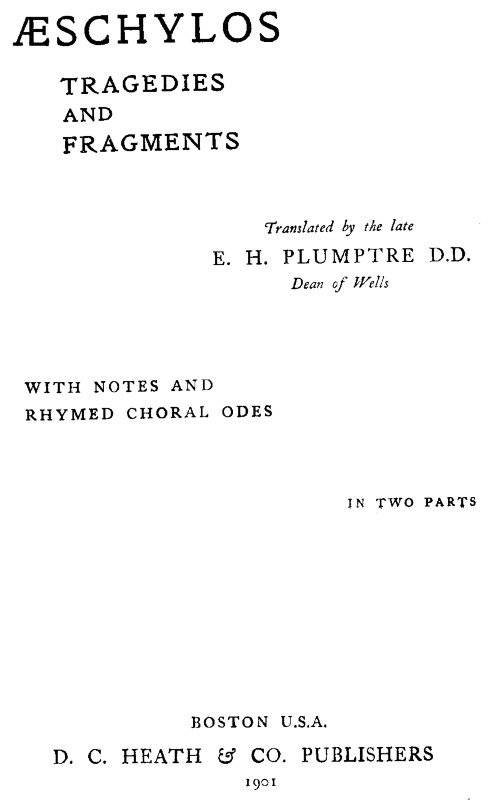
Æschylos Tragedies and Fragments cover

Æschylos Tragedies and Fragments

Chapter 9: DRAMATIS PERSONÆ
Open in WeRead

Explore more books like this:

About This Book

A curated edition gathers the seven surviving tragedies of an early Greek dramatist, accompanied by fragmentary remains, translator’s notes, and alternative choral renderings. The dramas range from a firsthand-style account of military catastrophe to mythic treatments of divine resistance, enforced exile, supplication, and the transition from private vengeance to public adjudication. Formal features include prominent choral odes, austere staging effects, and elevated poetic rhetoric, with the translator experimenting in metre and providing annotations. Recurring concerns are the tension between divine law and human agency, communal ritual, and the foundations of civic order.

THE SEVEN WHO FOUGHT AGAINST THEBES

DRAMATIS PERSONÆ

Eteocles
Scout
Herald
Ismene
Antigone
Chorus of Theban Maidens

ARGUMENT.—When Œdipus king of Thebes discovered that he had unknowingly been the murderer of his father, and had lived in incest with his mother, he blinded himself. And his two sons, Eteocles and Polyneikes, wishing to banish the remembrance of these horrors from the eyes of men, at first kept him in confinement. And he, being wroth with them, prayed that they might divide their inheritance with the sword. And they, in fear lest the prayer should be accomplished, agreed to reign in turn, each for a year, and Eteocles, as the elder of the two, took the first turn. But when at the end of the year Polyneikes came to ask for the kingdom, Eteocles refused to give way, and sent him away empty. So Polyneikes went to Argos and married the daughter of Adrastos the king of that country, and gathered together a great army under six great captains, himself going as the seventh, and led it against Thebes. And so they compassed it about, and at each of the seven gates of the city was stationed one of the divisions of the army.

Note.The Seven against Thebes appears to have been produced B.C. 472, the year after The Persians.

THE SEVEN AGAINST THEBES

Scene.Thebes in front of the Acropolis

Enter Eteocles, and crowd of Theban Citizens.
Eteoc. Ye citizens of Cadmos, it behoves
That one who standeth at the stern of State
Guiding the helm, with eyes unclosed in sleep,
Should speak the things that meet occasion's need.
For should we prosper, God gets all the praise:
But if (which God forbid!) disaster falls,
Eteocles, much blame on one head falling,
Would find his name the by-word of the State,[73]
Sung in the slanderous ballads of the town;
Yes, and with groanings, which may Zeus the Averter,
True to his name, from us Cadmeians turn!
But now 'tis meet for all, both him who fails
10
Of full-grown age, and him advanced in years,
Yet boasting still a stalwart strength of frame,
And each in life's full prime, as it is fit,
The State to succour and the altars here
Of these our country's Gods, that never more
Their votive honours cease,—to help our sons,
And Earth, our dearest mother and kind nurse;
For she, when young ye crept her kindly plain,
Bearing the whole charge of your nourishment,
Reared you as denizens that bear the shield,
That ye should trusty prove in this her need.
20
And now thus far God turns the scale for us;
For unto us, beleaguered these long days,
War doth in most things with God's help speed well,
But now, as saith the seer, the augur skilled,[74]
Watching with ear and mind, apart from fire,
The birds oracular with mind unerring,
He, lord and master of these prophet-arts,
Says that the great attack of the Achæans
This very night is talked of, and their plots
Devised against the town. But ye, haste all
Unto the walls and gateways of the forts;
30
Rush ye full-armed, and fill the outer space,
And stand upon the platforms of the towers,
And at the entrance of the gates abiding
Be of good cheer, nor fear ye overmuch
The host of aliens. Well will God work all.
And I have sent my scouts and watchers forth,
And trust their errand is no fruitless one.
I shall not, hearing them, be caught with guile.
[Exeunt Citizens.
Enter one of the Scouts.
Mess. King of Cadmeians, great Eteocles,
I from the army come with tidings clear,
40
And am myself eye-witness of its acts;
For seven brave warriors, leading armèd bands,
Cutting a bull's throat o'er a black-rimmed shield,
And dipping in the bull's blood with their hands,
Swore before Ares, Enyo,[75] murderous Fear,
That they would bring destruction on our town,
And trample under foot the tower of Cadmos,
Or dying, with their own blood stain our soil;
And they memorials for their sires at home
Placed with their hands upon Adrastos' car,[76]
50
Weeping, but no wail uttering with their lips,
For courage iron-hearted breathed out fire
In manliness unconquered, as when lions
Flash battle from their eyeballs. And report
Of these things does not linger on the way.
I left them casting lots, that each might take,
As the lot fell, his station at the gate.
Wherefore do thou our city's chosen ones
Array with speed at entrance of the gates;
For near already is the Argive host,
Marching through clouds of dust, and whitening foam
60
Spots all the plain with drops from horses' mouths.
And thou, as prudent helmsman of the ship,
Guard thou our fortress ere the blasts of Ares
Swoop on it wildly; for there comes the roar
Of the land-wave of armies. And do thou
Seize for these things the swiftest tide and time;
And I, in all that comes, will keep my eye
As faithful sentry; so through speech full clear,
Thou, knowing all things yonder, shalt be safe.
[Exit.
Eteoc. O Zeus and Earth, and all ye guardian Gods!
Thou Curse and strong Erinnys of my sire!
70
Destroy ye not my city root and branch,
With sore destruction smitten, one whose voice
Is that of Hellas, nor our hearths and homes;[77]
Grant that they never hold in yoke of bondage
Our country free, and town of Cadmos named;
But be ye our defence. I deem I speak
Of what concerns us both; for still 'tis true,
A prosperous city honours well the Gods. [Exit.
Enter Chorus of Theban Maidens in solemn procession
as suppliants
Chor. I in wild terror utter cries of woe;
An army leaves its camp and is let loose:
Hither the vanguard of the horsemen flows,
80
And the thick cloud of dust,
That suddenly is seen,
Dumb herald, yet full clear,
Constrains me to believe;
And smitten with the horses' hoofs, the plain
Of this my country rings with noise of war;
It floats and echoes round,
Like voice of mountain torrent dashing down
Resistless in its might.
Ah Gods! Ah Goddesses!
Ward off the coming woe.
With battle-shout that rises o'er the walls,
The host whose shields are white[78]
90
Marches in full array against our city.
Who then, of all the Gods
Or Goddesses, will come to help and save?
Say, shall I fall before the shrines of Gods?
O blessed Ones firm fixed!
'Tis time to clasp your sacred images.
Why linger we in wailing overmuch?
Hear ye, or hear ye not, the din of shields?
When, if not now, shall we
Engage in prayer with peplos and with boughs?[79]
I hear a mighty sound; it is the din
100
Not of a single spear.
O Ares! ancient guardian of our land!
What wilt thou do? Wilt thou betray thy land?
O God of golden casque,
Look on our city, yea, with favour look,
The city thou did'st love.
And ye, ye Gods who o'er the city rule,
Come all of you, come all.
Behold the band of maidens suppliant,
In fear of bondage foul;
For now around the town
The wave of warriors bearing slopèd crests,
With blasts of Ares rushing, hoarsely sounds:
110
But thou, O Zeus! true father of us all,
Ward off, ward off our capture by the foe.
Strophe I
For Argives now surround the town of Cadmos,
And dread of Ares' weapons falls on us;
And, bound to horses' mouths,
The bits and curbs ring music as of death;
And seven chief rulers of the mighty host,
With warriors' arms, at each of seven tall gates,
Spear-armed and harnessed all,
Stand, having cast their lots.
       ·       ·       ·       ·       ·
Mesode
And thou, O Zeus-born power in war delighting,
120
O Pallas! be our city's saviour now;
And Thou who curb'st the steed,
Great King of Ocean's waves,
Poseidon, with thy trident fish-spear armed,[80]
Give respite from our troubles, respite give!
And Thou, O Ares, guard the town that takes
Its name from Cadmos old,[81]
Watch o'er it visibly.
Antistrophe I
And thou, O Kypris, of our race the mother,
Ward off these ills, for we are thine by blood:
To thee in many a prayer,
130
With voice that calls upon the Gods we cry,
And unto thee draw near as suppliants:
And Thou, Lykeian king, Lykeian be,[82]
Foe of our hated foes,
For this our wailing cry;
And Thou, O child of Leto, Artemis,
Make ready now thy bow.
Strophe II
Ah! ah! I hear a din of chariot wheels
Around the city walls;
O Hera great and dread!
The heavy axles of the chariots groan,
140
O Artemis beloved!
And the air maddens with the clash of spears;
What must our city bear?
What now shall come on us?
When will God give the end?
Antistrophe II
Ah! ah! a voice of stones is falling fast
On battlements attacked;[83]
O Lord, Apollo loved,
A din of bronze-bound shields is in the gates;
And oh! that Zeus may give
150
A faultless issue of this war we wage!
And Thou, O blessed queen,
As Guardian Onca known,[84]
Save thy seven-gated seat.
Strophe III
And ye, all-working Gods,
Of either sex divine,
Protectors of our towers,
Give not our city, captured by the spear,
To host of alien speech.[85]
Hear ye our maidens; hear,
160
As is most meet, our prayers with outstretched hands.
Antistrophe III
O all ye loving Powers,
Compass our State to save;
Show how that State ye love;
Think on our public votive offerings,
And as ye think, oh, help:
Be mindful ye, I pray,
Of all our city's rites of sacrifice.
Re-enter Eteocles
Eteoc. (to the Chorus) I ask you, O ye brood intolerable,
Is this course best and safest for our city?
170
Will it give heart to our beleaguered host,
That ye before the forms of guardian Gods
Should wail and howl, ye loathèd of the wise;[86]
Ne'er be it mine, in ill estate or good,
To dwell together with the race of women;
For when they rule, their daring bars approach,
And when they fear, alike to house and State
Comes greater ill; and now with these your rushings
Hither and thither, ye have troubled sore
Our subjects with a coward want of heart;
And do your best for those our foes without;
180
And we are harassed by ourselves within.
This comes to one who dwells with womankind.
And if there be that will not own my sway,
Or man or woman in their prime, or those
Who can be classed with neither, they shall take
Their trial for their life, nor shall they 'scape
The fate of stoning. Things outdoors are still
The man's to look to: let not woman counsel.
Stay thou within, and do no mischief more.
Hear'st thou, or no? or speak I to the deaf?
Strophe I
Chor. Dear son of Œdipus,
190
I shuddered as I heard the din, the din
Of many a chariot's noise,
When on the axles creaked the whirling wheels,
*And when I heard the sound
*Of fire-wrought curbs within the horses' mouths.
Eteoc. What then? Did ever yet the sailor flee
From stern to stem, and find deliverance so,
While his ship laboured in the ocean's wave?[87]
Antistrophe I
Chor. Nay, to the ancient forms
Of mighty Powers I rushed, as trusting Gods;
And when behind the gates
Was heard the crash of fierce and pelting storm,
200
Then was it, in my fear,
I prayed the Blessed Ones to guard our city.
Eteoc. Pray that our towns hold out 'gainst spear of foes.[88]
Chor. Do not the Gods grant these things?
Eteoc. Nay the Gods,
So say they, leave the captured city's walls.[89]
Strophe II
Chor. Ah! never in my life
May all this goodly company of Gods
Depart; nor may I see
This city scene of rushings to and fro,
210
*And hostile army burning it with fire!
Eteoc. Nay, call not on the Gods with counsel base;
Obedience is the mother of success,
Child strong to save. 'Tis thus the saying runs.
Antistrophe II
Chor. True is it; but the Gods
Have yet a mightier power, and oftentimes,
In pressure of sore ill,
It raises one perplexed from direst woe,
When dark clouds gather thickly o'er his eyes.
Eteoc. 'Tis work of men to offer sacrifice
And victims to the Gods, when foes press hard;
220
Thine to be dumb and keep within the house.
Strophe III
Chor. 'Tis through the Gods we live
In city unsubdued, and that our towers
Ward off the multitude of jealous foes.
What Power will grudge us this?
Eteoc. I grudge not your devotion to the Gods;
But lest you make my citizens faint-hearted
Be tranquil, nor to fear's excess give way.
Antistrophe III
Chor. Hearing but now a din
Strange, wildly mingled, I with shrinking fear
Here to our city's high Acropolis,
Time-hallowed spot, have come.
230
Eteoc. Nay, if ye hear of wounded men or dying,
Bear them not swiftly off with wailing loud;
*For blood of men is Ares' chosen food.[90]
Chor. Hark! now I hear the panting of the steeds.
Eteoc. Clear though thou hear, yet hear not overmuch.
Chor. Lo! from its depths the fortress groans, beleaguered.
Eteoc. It is enough that I provide for this.
Chor. I fear: the din increases at the gates.
Eteoc. Be still, say nought of these things in the city.
Chor. O holy Band![91] desert ye not our towers.
240
Eteoc. A curse fall on thee! wilt thou not be still?
Chor. Gods of my city, from the slave's lot save me!
Eteoc. 'Tis thou enslav'st thyself and all thy city.
Chor. Oh, turn thy darts, great Zeus, against our foes!
Eteoc. Oh, Zeus, what race of women thou hast given us!
Chor. A sorry race, like men whose city falls.
Eteoc. What? Cling to these statues, yet speak words of ill?
Chor. Fear hurries on my tongue in want of courage.
Eteoc. Could'st thou but grant one small boon at my prayer!
250
Chor. Speak it out quickly, and I soon shall know.
Eteoc. Be still, poor fool, and frighten not thy friends.
Chor. Still am I, and with others bear our fate.
Eteoc. These words of thine I much prefer to those:
And further, though no longer at the shrines,
Pray thou for victory, that the Gods fight with us.
And when my prayers thou hearest, then do thou
Raise a loud, welcome, holy pæan-shout,
The Hellenes' wonted cry at sacrifice;
So cheer thy friends, and check their fear of foes;
And I unto our country's guardian Gods,
260
Who hold the plain or watch the agora,
The springs of Dirkè, and Ismenos' stream;—
If things go well, and this our city's saved,—
I vow that staining with the blood of sheep
The altar-hearths of Gods, or slaying bulls,
We'll fix our trophies, and our foemen's robes
On the spear's point on consecrated walls,
Before the shrines I'll hang.[92] Pray thou this prayer,
Not weakly wailing, nor with vain wild sobs,
For no whit more thou'lt 'scape thy destined lot:
270
And I six warriors, with myself as seventh,
Against our foes in full state like their own,
Will station at the seven gates' entrances,
Ere hurrying heralds and swift-rushing words
Come and inflame them in the stress of need. [Exit
Strophe I
Chor. My heart is full of care and knows not sleep,
By panic fear o'ercome;
And troubles throng my soul,
And set a-glow my dread
Of the great host encamped around our walls,
As when a trembling dove
Fears, for her callow brood,
280
The snakes that come, ill mates for her soft nest;
For some upon our towers
March in full strength of mingled multitude;
And what will me befall?
And others on our men on either hand
Hurl rugged blocks of stone.
In every way, ye Zeus-born Gods, defend
290
The city and the host
That Cadmos claim as sire.
Antistrophe I
What better land will ye receive for this,
If ye to foes resign
This rich and fertile clime,
And that Dirkæan stream,
Goodliest of founts by great Poseidon sent,
Who circleth earth, or those
Who Tethys parent call?[93]
300
And therefore, O ye Gods that guard our city,
Sending on those without
Our towers a woe that robs men of their life,
And makes them lose their shield,
Gain glory for these countrymen of mine;
And take your standing-ground,
As saviours of the city, firm and true,
In answer to our cry
Of wailing and of prayer.
Strophe II
For sad it were to hurl to Hades dark
A city of old fame,
310
The spoil and prey of war,
With foulest shame in dust and ashes laid,
By an Achæan foe at God's decree;
And that our women, old and young alike,
Be dragged away, ah me!
Like horses, by their hair
Their robes torn off from them.
And lo, the city wails, made desolate,
While with confusèd cry
320
The wretched prisoners meet doom worse than death.
Ah, at this grievous fate
I shudder ere it comes.
Antistrophe II
And piteous 'tis for those whose youth is fresh
Before the rites that cull
Their fair and first-ripe fruit,
To take a hateful journey from their homes.
Nay, but I say the dead far better fare
Than these, for when a city is subdued
It bears full many an ill.
This man takes prisoner that,
330
Or slays, or burns with fire;
And all the city is defiled with smoke,
And Ares fans the flame
In wildest rage, and laying many low,
Tramples with foot unclean
On all men sacred hold.
Strophe III
And hollow din is heard throughout the town,
Hemmed in by net of towers;
And man by man is slaughtered with the spear,
And cries of bleeding babes,
Of children at the breast,
340
Are heard in piteous wail,
And rapine, sister of the plunderer's rush,
Spoiler with spoiler meets,
And empty-handed empty-handed calls,
Wishing for share of gain,
Both eager for a portion no whit less,
For more than equal lot
With what they deem the others' hands have found.
Antistrophe III
And all earth's fruits cast wildly on the ground,
350
Meeting the cheerless eye
Of frugal housewives, give them pain of heart;
And many a gift of earth
In formless heaps is whirled
In waves of nothingness;
And the young maidens know a sorrow new;
For now the foe prevails,
And gains rich prize of wretched captive's bed;
360
And now their only hope
Is that the night of death will come at last,
Their truest, best ally,
To rescue them from sorrow fraught with tears.
Enter Eteocles, followed by his Chief Captains,
and by the Scout
Semi-Chor. A. The army scout, so deem I, brings to us,
Dear friends, some tidings new, with quickest speed
Plying the nimble axles of his feet.
Semi-Chor. B. Yea, the king's self, the son of Œdipus,
Is nigh to hear the scout's exact report;
And haste denies him too an even step.
Mess. I knowing well, will our foes' state report,
370
How each his lot hath stationed at the gates.
At those of Prœtos, Tydeus thunders loud,
And him the prophet suffers not to cross
Ismenos' fords, the victims boding ill.[94]
And Tydeus, raging eager for the fight,
Shouts like a serpent in its noontide scream,
And on the prophet, Œcleus' son, heaps shame,
That he, in coward fear, doth crouch and fawn
Before the doom and peril of the fight.
And with such speech he shakes his triple crest,
O'ershadowing all his helm, and 'neath his shield
380
Bells wrought in bronze ring out their chimes of fear;
And on his shield he bears this proud device,—
A firmament enchased, all bright with stars;[95]
And in the midst the full moon's glittering orb,
Sovran of stars and eye of Night, shines forth.
And thus exulting in o'er boastful arms,
By the stream's bank he shouts in lust of war,
[E'en as a war-horse panting in his strength
Against the curb that galls him, who at sound
Of trumpet's clang chafes hotly.] Whom wilt thou
Set against him? Who is there strong enough
When the bolts yield, to guard the Prœtan gates?
390
Eteoc. No fear have I of any man's array;
Devices have no power to pierce or wound,
And crest and bells bite not without a spear;
And for this picture of the heavens at night,
Of which thou tellest, glittering on his shield,
*Perchance his madness may a prophet prove;
For if night fall upon his dying eyes,
Then for the man who bears that boastful sign
It may right well be all too truly named,
400
And his own pride shall prophet be of ill.
And against Tydeus, to defend the gates,
I'll set this valiant son of Astacos;
Noble is he, and honouring well the throne
Of Reverence, and hating vaunting speech,
Slow to all baseness, unattuned to ill:
And of the dragon-race that Ares spared[96]
He as a scion grows, a native true,
E'en Melanippos; Ares soon will test
His valour in the hazard of the die:
And kindred Justice sends him forth to war,
For her that bore him foeman's spear to check.
410
Strophe I
Chor. May the Gods grant my champion good success!
For justly he goes forth
For this our State to fight;
But yet I quake with fear
To see the deaths of those who die for friends.
Mess. Yea, may the Gods give good success to him!
The Electran gates have fallen to Capaneus,
A second giant, taller far than he
Just named, with boast above a mortal's bounds;
And dread his threats against our towers (O Fortune,
420
Turn them aside!)—for whether God doth will,
Or willeth not, he says that he will sack[97]
The city, nor shall e'en the wrath of Zeus,
On the plain swooping, turn him from his will;
And the dread lightnings and hot thunderbolts
He likens to the heat of noon-day sun.
And his device, the naked form of one
Who bears a torch; and bright the blaze shines forth
And in gold characters he speaks the words,
The city I will burn.” Against this man
Send forth ... but who will meet him in the fight?
430
Who, without fear, await this warrior proud?
Eteoc. Herein, too, profit upon profit comes;
And 'gainst the vain and boastful thoughts of men,
Their tongue itself is found accuser true.
Threatening, equipped for work is Capaneus,
Scorning the Gods: and giving speech full play,
And in wild joy, though mortal, vents at Zeus,
High in the heavens, loud-spoken foaming words.
And well I trust on him shall rightly come
Fire-bearing thunder, nothing likened then
To heat of noon-day sun. And so 'gainst him,
440
Though very bold of speech, a man is set
Of fiery temper, Polyphontes strong,
A trusty bulwark, by the loving grace
Of guardian Artemis[98] and other Gods.
Describe another, placed at other gates.
Antistrophe I
Chor. A curse on him who 'gainst our city boasts!
May thunder smite him down
450
Before he force his way
Into my home, and drive
Me from my maiden bower with haughty spear?
Mess. And now I'll tell of him who by the gates
Stands next; for to Eteocles, as third,
To march his cohort to Neïstian gates,
Leaped the third lot from upturned brazen helm:
And he his mares, in head-gear snorting, whirls,
Full eager at the gates to fall and die;
Their whistling nozzles of barbaric mode,
Are filled with loud blast of the panting nostrils.[99]
In no poor fashion is his shield devised;
460
A full-armed warrior climbs a ladder's rungs,
And mounts his foeman's towers as bent to sack;
And he too cries, in words of written speech,
That “Not e'en Ares from the towers shall drive him.”
Send thou against him some defender true,
To ward the yoke of bondage from our State.
Eteoc. Such would I send now; by good luck indeed
He has been sent, his vaunting in his deeds,
Megareus, Creon's son, who claims descent
From those as Sparti known, and not by noise
Of neighings loud of warlike steeds dismayed,
470
Will he the gates abandon, but in death
Will pay our land his nurture's debt in full,[100]
Or taking two men, and a town to boot,
(That on the shield,) will deck his father's house
With those his trophies. Of another tell
The bragging tale, nor grudge thy words to me.