
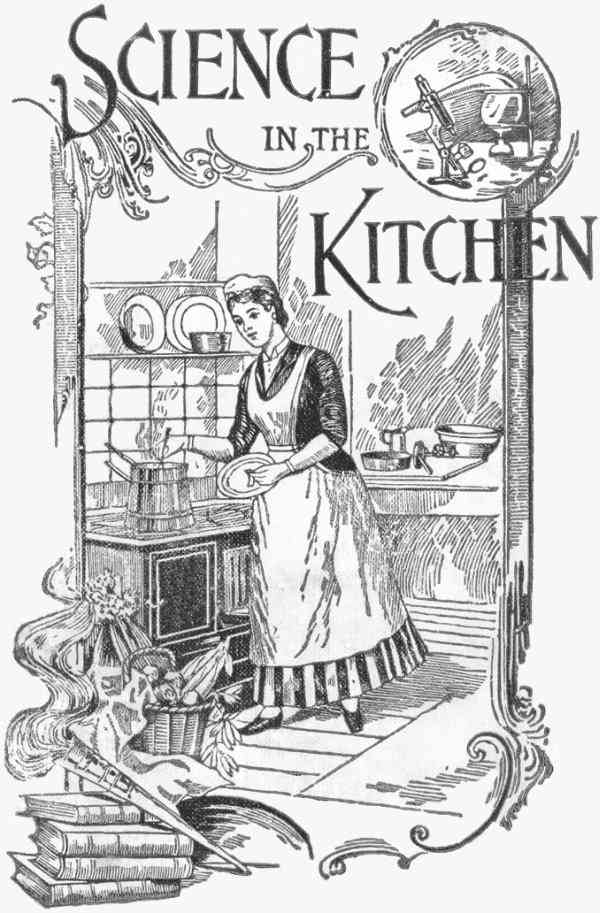
The Project Gutenberg eBook of Science in the Kitchen
Title: Science in the Kitchen
Author: E. E. Kellogg
Release date: May 1, 2004 [eBook #12238]
Most recently updated: October 28, 2024
Language: English
Credits: E-text prepared by Charles Franks, Stephen Schulze, and the Project Gutenberg Distributed Proofreading Team from digital images provided by Michigan State University Libraries
The Project Gutenberg eBook, Science in the Kitchen., by Mrs. E. E. Kellogg
and the Project Gutenberg Distributed Proofreading Team
from digital images provided by
Michigan State University Libraries
| Note: |
Images of the original pages are available through the
Michigan State University Libraries. See http://digital.lib.msu.edu/projects/cookbooks/books/sciencekitchen/scie.pdf |
SCIENCE IN THE KITCHEN.
A SCIENTIFIC TREATISE ON FOOD SUBSTANCES AND THEIR DIETETIC PROPERTIES, TOGETHER WITH
A PRACTICAL EXPLANATION OF THE PRINCIPLES OF HEALTHFUL COOKERY,
AND A LARGE NUMBER OF ORIGINAL, PALATABLE, AND WHOLESOME RECIPES.
BY
MRS. E.E. KELLOGG, A.M.
Superintendent of the Sanitarium School of Cookery and of the Bay View Assembly School of Cookery, and Chairman of the World's Fair Committee on Food Supplies, for Michigan
1893
PREFACE.
The interest in scientific cookery, particularly in cookery as related to health, has manifestly increased in this country within the last decade as is evidenced by the success which has attended every intelligent effort for the establishment of schools for instruction in cookery in various parts of the United States. While those in charge of these schools have presented to their pupils excellent opportunities for the acquirement of dexterity in the preparation of toothsome and tempting viands, but little attention has been paid to the science of dietetics, or what might be termed the hygiene of cookery.
A little less than ten years ago the Sanitarium at Battle Creek Mich., established an experimental kitchen and a school of cookery under the supervision of Mrs. Dr. Kellogg, since which time, researches in the various lines of cookery and dietetics have been in constant progress in the experimental kitchen, and regular sessions of the school of cookery have been held. The school has gradually gained in popularity, and the demand for instruction has become so great that classes are in session during almost the entire year.
During this time, Mrs. Kellogg has had constant oversight of the cuisine of both the Sanitarium and the Sanitarium Hospital, preparing bills of fare for the general and diet tables, and supplying constantly new methods and original recipes to meet the changing and growing demands of an institution numbering always from 500 to 700 inmates.
These large opportunities for observation, research, and experience, have gradually developed a system of cookery, the leading features of which are so entirely novel and so much in advance of the methods heretofore in use, that it may be justly styled, A New System of Cookery. It is a singular and lamentable fact, the evil consequences of which are wide-spread, that the preparation of food, although involving both chemical and physical processes, has been less advanced by the results of modern researches and discoveries in chemistry and physics, than any other department of human industry. Iron mining, glass-making, even the homely art of brick-making, and many of the operations of the farm and the dairy, have been advantageously modified by the results of the fruitful labors of modern scientific investigators. But the art of cookery is at least a century behind in the march of scientific progress. The mistress of the kitchen is still groping her way amid the uncertainties of mediæval methods, and daily bemoaning the sad results of the "rule of thumb." The chemistry of cookery is as little known to the average housewife as were the results of modern chemistry to the old alchemists; and the attempt to make wholesome, palatable, and nourishing food by the methods commonly employed, is rarely more successful than that of those misguided alchemists in transmuting lead and copper into silver and gold.
The new cookery brings order from out the confusion of mixtures and messes, often incongruence and incompatible, which surrounds the average cook, by the elucidation of the principles which govern the operations of the kitchen, with the same certainty with which the law of gravity rules the planets.
Those who have made themselves familiar with Mrs. Kellogg's system of cookery, invariably express themselves as trebly astonished: first, at the simplicity of the methods employed; secondly, at the marvelous results both as regards palatableness, wholesomeness, and attractiveness; thirdly, that it had never occurred to them "to do this way before."
This system does not consist simply of a rehash of what is found in every cook book, but of new methods, which are the result of the application of the scientific principles of chemistry and physics to the preparation of food in such a manner as to make it the most nourishing, the most digestible, and the most inviting to the eye and to the palate.
Those who have tested the results of Mrs. Kellogg's system of cookery at the Sanitarium tables, or in their own homes through the instruction of her pupils, have been most enthusiastic in their expressions of satisfaction and commendation. Hundreds of original recipes which have appeared in her department in Good Health, "Science in the Household", have been copied into other journals, and are also quite largely represented in the pages of several cook books which have appeared within the last few years.
The great success which attended the cooking school in connection with the Bay View Assembly (the Michigan Chautauqua), as well as the uniform success which has met the efforts of many of the graduates of the Sanitarium school of cookery who have undertaken to introduce the new system through the means of cooking classes in various parts of the United States, has created a demand for a fuller knowledge of the system.
This volume is the outgrowth of the practical and experimental work, and the popular demand above referred to. Its preparation has occupied the entire leisure time of the author during the last five or six years. No pains or expense has been spared to render the work authoritative on all questions upon which it treats, and in presenting it to the public, the publishers feel the utmost confidence that the work will meet the highest expectations of those who have waited impatiently for its appearance during the months which have elapsed since its preparation was first announced. PUBLISHERS.