
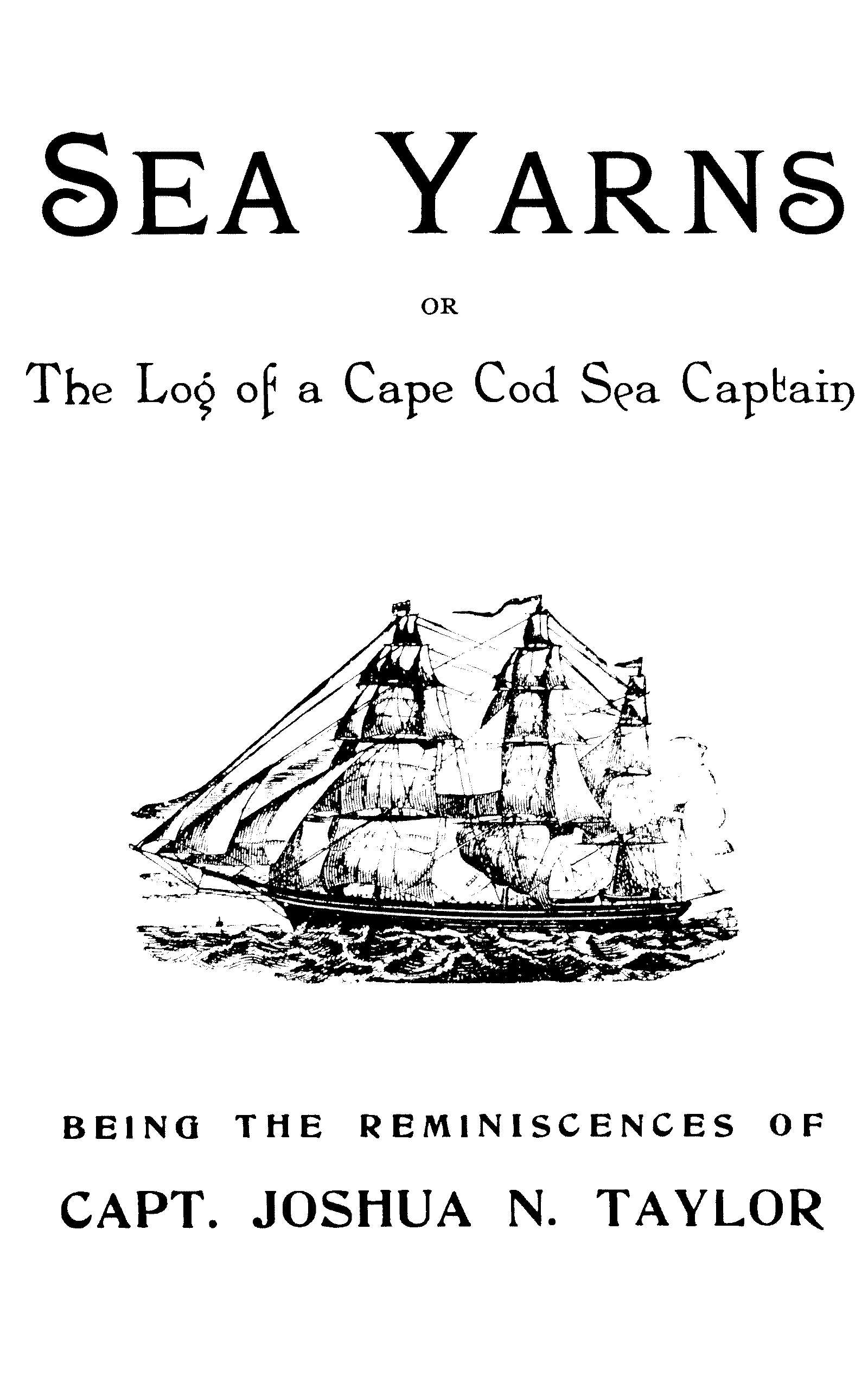
The Bowen was built at Quincy, Mass., by Deacon Thomas, and was owned by a syndicate, Captain J. Amesbury being the principal owner. He had been her only and original commander up to the time he was murdered at sea by his colored crew. The story of the murder is fresh in my mind, as I took charge of the Bowen a few days after the captain met his death.
The Bowen was some 300 miles east of New York, bound for Gibraltar and Cadiz. The first officer (a mere boy), nephew of the captain, was ordered to take the anchors in on the top-gallant forecastle and secure them for the voyage. The first officer was inexperienced and, wanting to show his authority, had used abusive and insulting language to the crew. A dispute followed, the crew shouting and crowding about the mate, threatening to do him bodily harm. The captain, who was in his cabin at the time, on hearing the shouts and rush of feet, ran forward to the assistance of his mate, and picked up a hand spike as he ran along. The crew, who claimed they thought they were in danger of their lives, struck the captain with an iron belaying pin, which fractured his skull and caused instant death. This, it seemed, ended the mutiny, but the brig drifted helplessly around for several days, as the mate knew nothing of navigation. They finally hoisted signals of distress, and the German ship Helvetia, bound to New York from Europe, sent an officer and men aboard the brig and took her back to New York. She was anchored in the lower bay, libelled, a keeper put on board, and the crew arrested and brought to New York for trial. I was telegraphed for to take charge of the ship, and was present at the trial, which seemed to me the greatest farce that I ever witnessed. The negro crew were treated, not like sinners, but as if they had been sinned against. They were acquitted, probably to renew their mutinous acts on some other poor ship officer. The owners of the Bowen gave bonds, and afterwards the case was settled by giving the libellants $8000 as salvage.
With new officers and crew I sailed from New York to complete the voyage that had begun so disastrously. In just 18 days from New York we were at anchor at Gibraltar, after a pleasant and uneventful trip. Some of the sailors, who knew the history of the brig, kept voicing the opinion that we were bound to have bad luck, but their superstitious fears were doomed to be disappointed this time.
We now discharged that portion of the cargo which was bound for this place, and proceeded for the final port of discharge, which was Cadiz. It took us but twenty-four hours to run around to this port, as we had strong and favorable winds. There I found instructions from the owners to purchase a cargo of salt and proceed without delay to Boston. As soon as the salt agents found that I was in the market for salt I was deluged with offers, and at much lower prices than my owners had limited me. The American barque Two Brothers was in port at this time loading salt for New York, with Mate Pease on board, who was an old Boston boy and was known to me. He introduced me to his commander, who told me to take my time, as I could name my own price, as the salt market was in a demoralized condition. He then introduced me to his agents, Solomon & Sons, Jews, but very honorable men. Through them I bought a full cargo of salt for seven cents a bushel, which gave the brig a good charter, resulting in a prosperous trip for the owners, especially for the widow of the late Captain Amesbury. He had built the brig to sail on half shares, he to victual and man the brig, pay half the port charges and other bills, and was to receive 5% on gross stock, which, for the round voyage, netted her something like $2500. We had a quick run across and discharged cargo at East Boston at the Eastern Salt Company’s wharf. I now purchased from Mrs. Amesbury all of her interest in the brig, and it turned out a most profitable deal for me.
On this voyage a lady came to me in East Boston, a Mrs. Gurney, and said her son James had the sea-fever very badly, and wanted me to ship him as cabin boy and, if possible, cure him of his illusions of sea life. I told her that I would do my best, and young James was duly installed as cabin boy of the Bowen. We found plenty to keep him busy, assisting on deck, keeping the lamps trimmed and making himself generally useful. Oftentimes, as he was not used to this kind of work, our red-and-green side lights would go out at midnight (and often the deck officer would put them out), and then poor “Jim” would be turned out of his warm bunk to trim and replace the ones that had refused to burn. He would rub his eyes, mutter, and cuss the captain, and say that if he ever got foot on shore he would never step on a ship again. He left us at Liverpool and returned home, but his first trip did not break him of his love for sea life. He made many foreign trips, and afterwards commanded the American barque Bruce Hawkins, in which ship he became dismantled in mid-ocean and narrowly escaped with his life.
We then went to Charleston, S. C., and up the Ashly River, loaded with phosphate-rock, and sailed to Liverpool with cotton as the balance of cargo. We left Charleston about the middle of December, and strong gales and fair winds drove us along nicely, so that in twenty-one days we were at anchorage in the Mersey River, Liverpool. The barque Keystone, Captain Bonny, left Charleston five days ahead of us and arrived three days later. Captain Bonny was a very sad and surprised man when he learned the Bowen was already in.
Discharging our cargo at Liverpool, we were chartered to load asphaltum for Port Cette, in the Mediterranean, about thirty miles west of Marseilles. The rate of charter seemed to me to be extra good, yet had I known the character of the cargo I would not have touched it at any price. The stuff was of a light, pitchy nature, and we packed her full from keelson to deck, and yet our draft was that of a light cargo. Our between-deck hatches were left off and we proceeded to sea, beating about the Irish Channel for a week before clearing Land’s End, and then fine weather to Bay of Biscay. Now the brig commenced to roll heavily, and it was almost impossible to stand on deck. One fine morning I ordered the main deck hatch to be taken off, and to my great surprise the pitch had melted and settled; not over eighteen inches remained on upper between-decks. That was like a frozen lake, smooth and glassy, and the lower hold was the same, a perfect skating rink. It was a sorry looking sight; most of the cargo had settled to the lower hold, and that was the cause of her rolling so. And as nothing could be done to remedy the matter, we made the best of it for the rest of the trip until we arrived at Cette.
I reported condition of cargo to the consignee. He ordered me to allow no one in the hold until contract had been made with stevedore to discharge, and also ordered me to require deposit of 1000 francs from the stevedore to bind the contract. This was done, and the hatches lifted off. My, but what a howl went up when they saw the stuff they had contracted to discharge. They offered to give half of forfeit money and give up the job, but the French law was such that we had them, and they were obliged to go ahead. For the next thirty days, early and late, the only sound heard was from the pick-axe force in the hold, toiling to get the stuff out. Men and women worked together, and the pieces were passed out weighing anywhere from ten to fifty pounds. To add to the misery, no fires or lights were allowed on board the ship; all cooking had to be done ashore in a general cook-house, and a dirty, filthy place it was. Then the food was transferred to the ship in a boat, and by the time it was on the table it was cool and unpalatable. I shall never forget Cette, yet it had one redeeming feature: champagne was only three francs a quart, and I must acknowledge I had my share.
The cargo discharged, we were ordered to proceed to Leghorn, Italy, where we went to load with marble and rags for Baltimore. The day we passed out by the breakwater at Cette was one of the happiest in my life. The ship was covered with a fine dust from the asphaltum, and we did nothing but clean for the next thirty days to get the ship clean again.
While the ship was loading at Leghorn a trip was made to Pasa, Rome and Florence. The party consisted of three captains and their wives and two single men, one being myself. There were Captain Downs and wife, of the British ship British Empire; Captain Hall and wife, of the barque Valita; Captain Watts and wife, of a ship from Thomaston, Maine, the name of which I have forgotten. Captain Gardner of the barque Winged Arrow and your humble servant of the brig Bowen completed the party. We had a beautiful trip, and Captain Downs and his wife, who were well educated, told us about all the historic places and incidents connected with them. The condition of the Italian people at that time (in the early 70’s) was pitiable. Scarcely fifteen per cent of the people were able to read or to write, but conditions have somewhat improved since then.
Bidding good-bye to Leghorn, we sailed for Baltimore with several Italian passengers. Fishing was very good, and we caught many barracuda, a beautiful fish, and when properly cooked were fine eating. When off the Balearic Islands, in the Mediterranean, we had several days of calms and light and baffling winds. One morning we discovered a large “Bum-boat” pulling off from the coast. They came alongside loaded with fruits, curios, and wine in kegs and demijohns. With what broken Spanish I had, I gave them to understand that I had nothing but American paper money, and that it would be of no use to them. But they all commenced to shout, “Americana papeleto mucho bueno, change heem at Americana Consuelo,” which meant American paper money much good, and they would change it at the American consul’s office. So we took about $90 worth of fruit, wine and other things, and they went off very happy, and off they went toward other outward bound vessels to finish trading. But a guilty conscience bothered me, for I had indeed paid them with “Americano papelita”; I had paid them in Confederate money, which was worth about two cents for a hundred dollars. Well, the next morning about eight bells a guilty man, with glass in hand, I saw a large boat pulled by a crowd of fierce-looking men and aided by large sails coming our way. Every moment they gained on us, and I could hear them shouting, “Americano papelita no good,” and then they would curse and swear, and their leader, who stood up in the bow, kept drawing a huge and hideous-looking knife across his throat. I then realized that we were in serious difficulty, and that we all might be murdered by these men because of my too slick “Yankee” dealings; but a heavy breeze came up (such as is frequently met with in those seas), and we shot ahead of them in spite of their sails and hard rowing. Our long passage home (some forty days) I always attributed to my passing those Southern “shin-plasters” on those poor devils, but consoled myself as best I could with the idea that they had probably stolen their fruit and wine, for they were notorious thieves.
On our arrival at Baltimore, we were chartered to carry coal from Locust Point to Aspinwall for the Pacific Mail S. S. Company, and thence to load cargo of hard pine from Pensacola, Florida, to Philadelphia, one of the best round charters ever made, the profits averaging $100 a day for the round trip. We loaded the coal at $8.50 per ton, gold, and were only sixteen days out to Aspinwall, a very quick trip. On arrival, we reported to the agent, and he was glad indeed to get the hard coal. In the harbor there were a number of ships loaded with soft coal, and many had been waiting for weeks to discharge, but at the present time the barque Sagadahawk, Captain Geer, was discharging as fast as he could get empty cars from Panama. The head stevedore was a powerful Jamaica negro, a Mr. Williams by name, and a perfect type of gentleman. He at once placed at my disposal a majority of the cars, as our hard coal was in demand. Now, Captain Geer was a most profane man, and you may be sure that when he saw our cargo being unloaded before his was he called the stevedore by every foul name he could lay his tongue to. Yellow fever was raging at this time, and all wanted to get away as soon as possible from this infected port. Three of my crew were taken sick and died in a few days, and were buried ashore. On my bills of lading I had endorsed in red ink that ten tons of coal were to be retained for the ship’s use. The brig was built very broad, both forward and aft, so that fifty or eighty tons of coal made but little showing in the hold. The morning that we finished unloading I called Mr. Williams to the hatch-way and asked him if he thought he had left me my ten tons, and he said he was satisfied and stopped unloading. We then pulled off in the stream and took on ballast for our trip across to Pensacola. We shipped new men in place of those who had died with the yellow fever, and was warned by the port physician that we might have more sickness before we finished our trip, and sure enough we did, as four more died and were buried at sea, leaving us barely men enough to work her.
Our passage was a stormy one; head winds and adverse currents so delayed us that we were double the time we should have been on the trip. On arrival at Pensacola, we anchored near the place where we were to load hard pine for Philadelphia. As I went up to the customs house I was asked if we had any coal on board that I wanted to sell. The Southern coal mines had shut down, and ten dollars a ton was offered me. The owner of the wharf where we docked bought the coal, and in addition to the price agreed upon gave us free wharfage while loading. I now learned how profitable it was to always show courtesy to a black man. Back in Aspinwall I had given Mr. Williams, the colored stevedore, the full run of the ship, several cases of champagne, a case of gin, and had treated him as I would any white man. Now when we came to get out the coal, we took out one hundred tons, and for which I was paid one thousand dollars. So my kindness had been repaid ten-fold, and I thought of the old Scripture passage in regard to casting your bread upon the waters.
We made a fine run around to Philadelphia, and had some trouble with Mr. Whitten, the agent, in regard to my money received from the coal. He claimed half of the money, but as I showed him that it was my grub and liquor that had made it possible, he was entitled legally to only freight on the coal. So we settled it up this way. But the money I received for the coal went very quickly. A churchman in my town borrowed the money, and, tempted by an investment which promised a large rate of interest, he lost it all, and again I thought: in retribution, “Americano papelita no bueno.”
We were now chartered for Russia to carry a cargo of oil, and half commission on the charter was given me.
Capt Joshua N Taylor 1861