
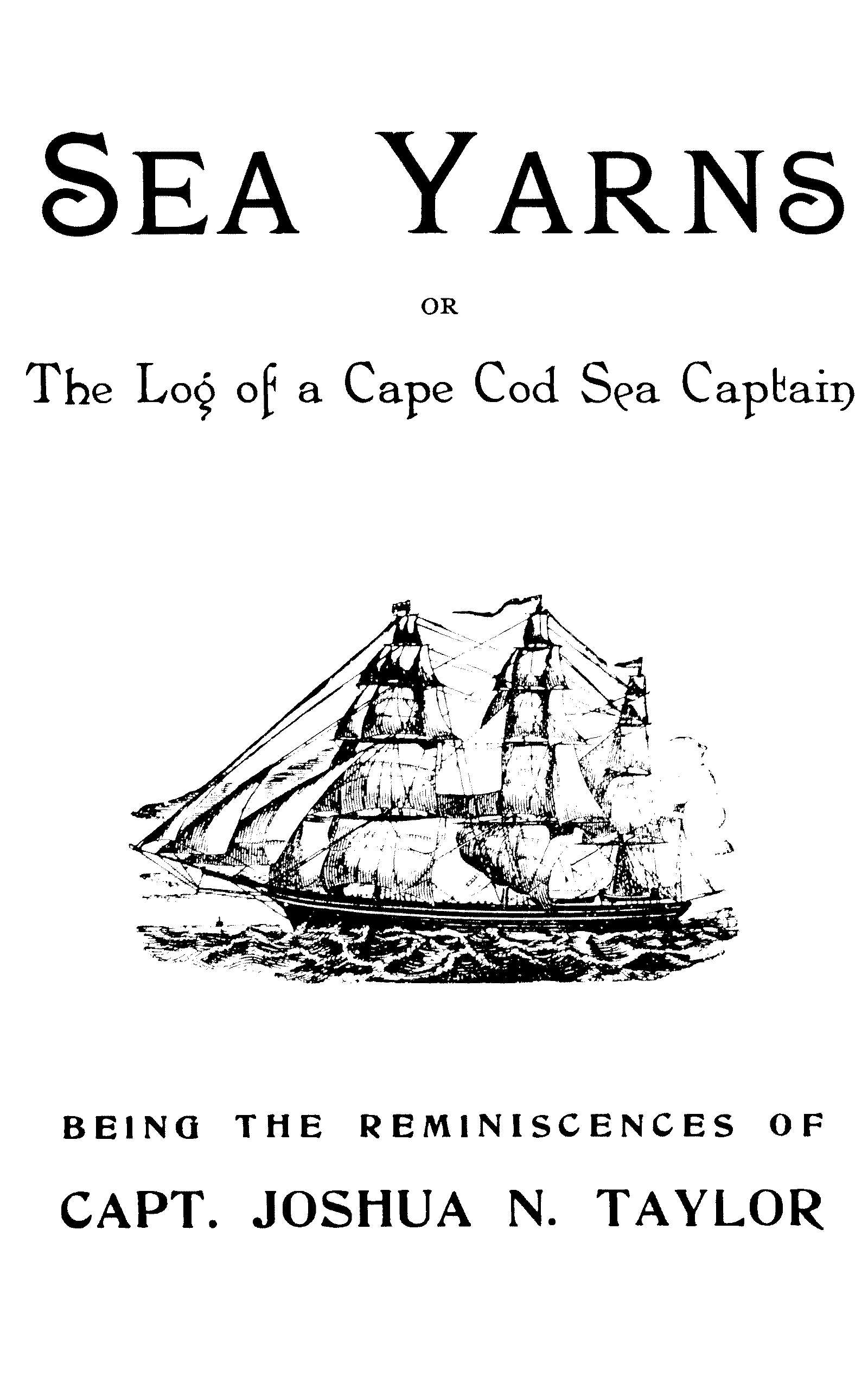
I made this trip while in my “teens,” and the voyage was out to Cape Town from Boston and return. Our crew consisted of six men and four boys before the mast. The chief officer was a brother of the Captain, Prince Harding Taylor by name, and a man by name of Harding as second mate, all officers hailing from Chatham, Mass.
The Captain had his wife and two children with him, one a boy about seven years of age and the other a babe of eighteen months. The Captain was a big, powerful man, very nervous and always finding fault with someone, or something, and his special trouble was the weather. When it was fine we were going to have a storm, and when it was a fair wind it would not last long, and so on, day in and day out, always in a stir.
Now the Captain happened to be a cousin of mine, and was always pleasant with me, and would often come and chat with me while I had a trick at the wheel. But should any officer or man suddenly make his appearance he would damn me and order me to mind my course and not be star-gazing around, and I would always answer, “Aye, aye, sir.”
This always gave the men the idea that I was very harshly treated by him, and they were very ready with sympathies. Although the barque was a small one, not over 450 tons, one would have thought at times that she was a four-deck ship by some of the maneuvers we went through. Every week we had to holystone the decks, wash and wipe off the paint-work, and swab up the decks at 7 bells in the morning, when we were supposed to be through cleaning. We would then trim sails fore and aft and the watch would be relieved and go below for breakfast, and we would be off duty until 7 bells, or 11.30 a.m.
Those who were asleep would be called to dinner so as to relieve the other watch at 8 bells, or noon-time. Every other night the starboard watch had from 8 to 12, midnight, and from 4 a.m. to 8 a.m., when we had breakfast. In this way we changed the time and evened things up. At two bells, or five o’clock in the morning, we always commenced to wash down decks and clean things up for the day, except in stormy times, when we were kept at work below or in the deck house.
When nearing the equator, on our outward bound trip, I was at the wheel one morning from eight to ten, and as sailors are always scanning the horizon, I saw a sail coming up from astern and, as is the custom, sang out, “Sail ho!”
The captain said, “Where away?” and I answered, “Dead astern, sir.” He then told me to attend to my steering and never mind what was going on astern. In a short time we made her out to be a large, full-rigged ship, coming down on us with all sail set, and with her port studding-sails rigged out. She soon came up to us, going very fast and sailing at least two feet to our one. Instead of passing us under our lea, as is the custom, she hove down her wheel and shot across our port quarter, taking the wind out of our sails, which almost be-calmed us. Our skipper was now boiling mad. She was a beautiful sight, carrying an immense spread of canvas, and her decks crowded with passengers.
He then hailed us, but our captain was so mad that he could only swear and rave at him for an unwashed son of a sea dog. To cap the climax, the big ship’s band struck up “The Girl I Left Behind Me.”
She proved to be the old American ship “Red Jacket” (sister ship to the famous “Blue Jacket”.) She was bound for Melbourne, Australia, and was out of sight in a short time. Our captain continued to rave and swear about the “damned lime-juicer” as long as she was in sight.
Some of our night watches while passing through the tropics were lovely, and one would feel like having something to eat, if he could only have access to the cabin stores.
We soon learned the location of the cook’s pantry, and would often explore it when the officer of the deck was not near us, and “appropriate for the good of the watch” whatever tidbits we might run across. The pantry door opened off the main deck from the starboard side, and one man would always watch to see that the officer of the deck remained on the quarter deck, and if he changed his location the signal would be given, and whoever was in the pantry would slide out on the main deck again.
For several nights I did the foraging and my chum kept watch. From the several cupboards in the pantry I would select pie, cake and chicken, and carry them forward to the fo’c’sle, where they would be stowed away and eaten at our leisure. One morning, when I was at the wheel, the first table in the cabin were at breakfast, I heard loud talking between the captain and his brother, the mate. Just before this row, I had heard the captain’s wife say, “Steward, bring out some of that cold chicken that was left over from yesterday.” The colored steward replied, “Dar is none, dey done eat him all last night.” This led the captain to say to his brother, “Eat all you want at the table, but don’t be lunching at all hours aboard this ship,” and “There is no need of you eating in the night watch, anyway.” The conversation became heated, and as the wheel was near the cabin door, I could hear the mate say, “I don’t eat in the night-time, and you need not accuse me of being a thief.” After a while they cooled down, and when the second mate came to breakfast the captain said to him, “Mr. Harding, eat all you want at the table, but quit cleaning out the pantry at night.” This led to another denial from Mr. Harding, and I heard the captain say, “By God, I’ll find out the thief.”
It was extremely funny, and I could hardly keep from laughing out loud. Later on in the morning, the captain came to me and said, “Have you seen any of the sailors going in the cabin at night time?” Now, I was not a sailor, but had shipped as an ordinary boy, so I replied, “No, sir. I have seen cake crumbs and pieces of pie about, but supposed it was something the steward had given the men, and had I seen any one in the pantry stealing, I would have felt it my duty to have reported it to you.” “Well, by God,” he said, “I will find out who has been stealing aboard this ship.”
Then he called the steward aft and said in my hearing, “Steward, make up a batch of cake and some dried apple pies, and dose them heavy with jalap, which I will get you from the medicine chest.” Now, jalap is a very active purgative, and in a strong dose causes free movements, with some pain and griping, so I concluded to say nothing and await results. That night, when all hands were in the fo’c’sle, except the man at the wheel and the lookout, the crew said to me, “Now, Taylor, get us some pie and cake.” I replied, “Not on your life; you will give me away.” They all swore strict allegiance, so at midnight I “yaffeled” three pies and a loaf of cake from out the steward’s pantry, and brought them into the fo’c’sle. It was customary for both watches at midnight to smoke and talk for about half an hour, so all hands set to and cleaned up the stolen grub, which was, as I knew, well dosed with the jalap. I did not eat any, as I told them I had eaten all I wanted, but I made up my mind that there would be a windstorm by daylight.
Sure enough, they commenced to feel the effects of the medicine and were soon grumbling and rubbing their stomachs. I said to them, “Well, it looks like Asiatic cholera, as we are in the tropics, and liable to get these sort of things.” At two o’clock the starboard watch were so sick they could not go on duty, and at daylight reported to the captain, who sent for them to come aft.
The captain said, “What hurts you?” They answered, “Pains in the stomach and bowels, sir.” “What have you been eating?” was his next question. “Nothing, sir, outside our regular grub,” they replied. “You act as if you had taken poison; go forrard, you thieves, now I know who has been stealing my cabin grub.” He then called me aft and questioned me sharply, but I was innocence abroad. This ended the “cake walk,” and there was nothing missing after that.
The remainder of the outward voyage was very quiet, and we soon came to anchor in the open roadstead at Cape Town, in one of the finest of harbors on the African coast. After discharging cargo, we took on board a cargo of dry and salted hides, sheep-skins, and wool. This kept us in Cape Town about four weeks, and we had ample time to see the place to our hearts’ content. The harbor was filled with ships from all parts of the world, and many English warships were there at that time, so there was plenty going on to make things interesting for the sailors.
On our return trip we had pleasant S. E. trade winds, which carried us along to the island of St. Helena, where we stopped for fresh provisions and water, and were given a run ashore to visit the final resting-place of the great Napoleon.
One little incident occurred on the return trip. The captain’s little son had a small cart, and as he was up early every morning, would run back and forth on the deck, making plenty of noise and keeping the watch below, who had turned in, from getting their sleep. We had protested to the captain, but of no avail, so we drew lots to see which one of us should dispose of the cart, and it fell to me to do the deed. I afterwards learned that my name had been slyly written on all the slips, so they played it on me anyway, possibly as retribution for my silence in regard to the jalap being put in the pies, which they in some way seemed to attribute to me, although nothing had been said about it.
One very dark night I crept forward to the top-gallant fo’c’sle with the cart, and overboard she went. Next morning there was a big row. Little Johnny couldn’t find his cart, and all hands were called aft and questioned, but nobody knew where the cart was. The captain seemed very suspicious of me (probably my guilty conscience) and said, “Now, look here, do you know where that cart is?” Now, the cart by this time was many miles astern of us, so I said, “I couldn’t tell the place that cart was in if you gave me a hundred dollars.”
The captain was very angry, and ordered the steward to cut out the “duff” and potatoes, and to give us the “duff” twice a week instead of twice a day, as he had been doing. (This “duff” is like dumplings, and filled with raisins, dried apples or currants, is one of the sailors’ favorite dishes).
We protested, but it was no use; the captain ordered the store room opened, and overboard went eight barrels of potatoes. The captain was very angry, the crew did not dare to say any more, but I said I would report to the owners when we got to Boston. By good luck we made a rapid run to Boston, and I was detained as ship-keeper.
One day the captain said to me, “Now, Joshua, tell me who hove over that cart?” I said, “Will you hold me harmless and protect me if I tell you who did it?” He said, “Yes, I will, but I would like to know, and you can tell me now that it is all over.” So I told him that I did it. He grabbed me by the neck and slatted me around until I thought a stone crusher had run over me, he was so angry, and told me to pack up my bag and get ashore. You may be sure I did, and made for the office of the owner, who was my cousin, and told them the whole story. They all roared with laughter, for the captain was well known for his quick temper. They gave me a note to carry back to the captain, which ordered him to keep me until further orders.