
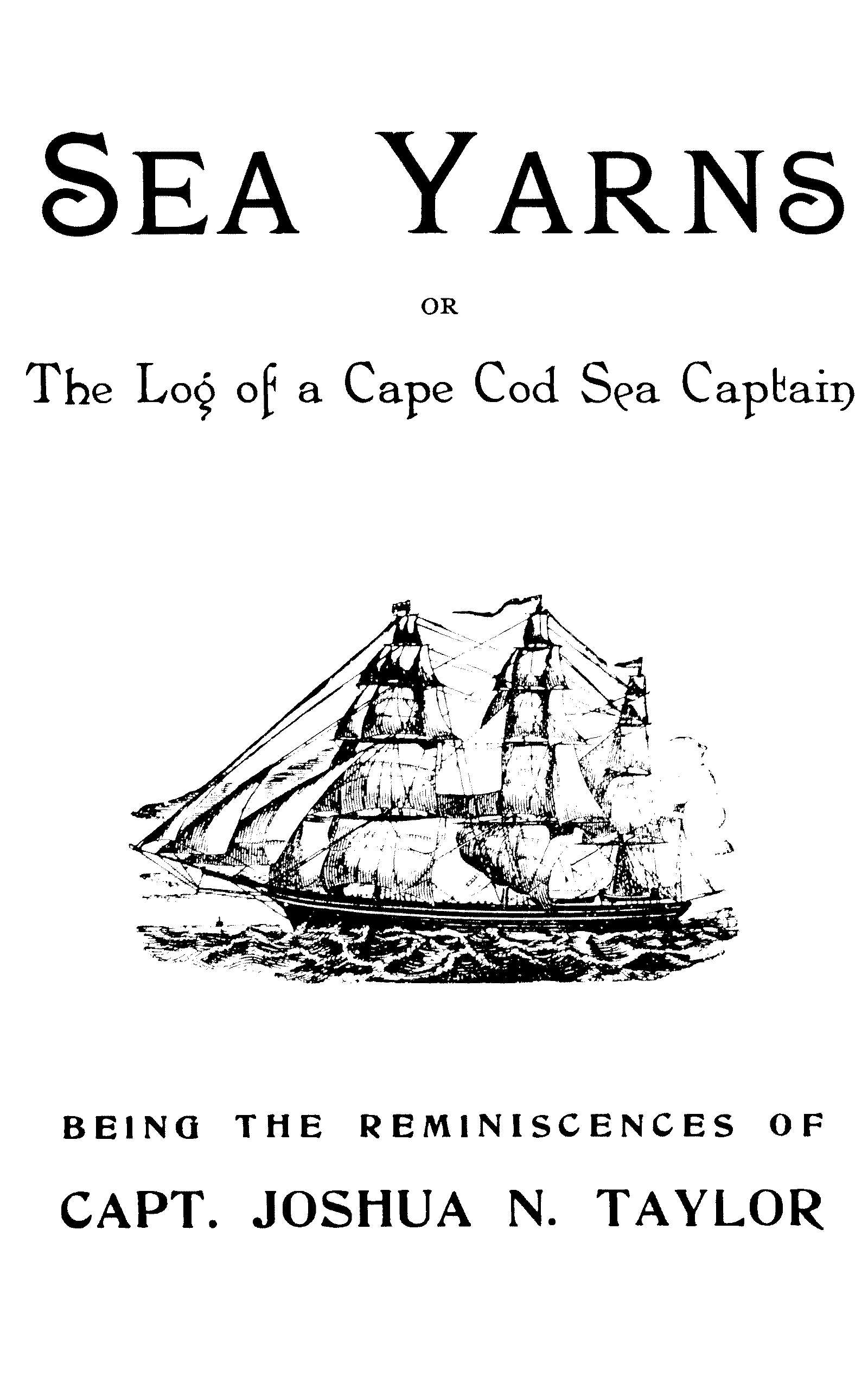
I took this yacht from Sag Harbor, New York, around to Boston and there fitted her out for the passage to New Zealand, and although this yacht was but 64 tons, we made the record time of 82 days from Boston out to Littleton, New Zealand. After we reached New Zealand the yacht was put under the British flag and her name changed to the “Canterbury” on account of the Civil War, which was then raging in the States. The Confederate privateers had destroyed so much of our shipping that it was necessary to do this if one wished to save his ship from destruction in case he should be overhauled by one of these “licensed pirates.”
My crew consisted of three men before the mast, a negro cook and two mates. Second Mate Kenrick and his brother Benjamin, who was before the mast, were both natives of my town. They both left me in 1864 at New Zealand, and remained out there; the mate died in 1906 and the other, I believe, is still living now at Christ Church, New Zealand. As this was my first command and as I was but a boy, I did indeed feel proud, but most anxious. The yacht was built of white oak, copper fastened, drew 13 foot aft and 7 foot forward, and could sail like a bird. It was a bitter cold day in December, in the early sixties, when we cast off our lines from Commercial Wharf, Boston, and started on this long journey of 16,000 miles, across several oceans where beautiful trade-winds blow and where the home reach is a long stretch of 7000 miles in the Southern Sea, where in latitude 50 south, one runs his eastern longtitude down. (By “reach” we mean the nautical term which means to sail directly on one’s course with the wind forward of the beam, usually with the sheets eased off).
In these regions strong gales prevail for ten months in the year from N. West to S. West, and as ships are seldom seen in these Southern latitudes, it makes the passage seem long and dreary. The wonderful bird called the “albatross” makes these regions its home and is ever on the wing, a monarch of the air. We also saw thousands of “penguins,” sometimes called the great auk, and one time, when we were obliged to “heave to” on account of the heavy south-east gale, thousands of them rose up from the ocean and covered the water as far as the eye could reach. Our nearest land was then 2000 miles away, so they must have had a long swim, as they can fly but a short distance, having but short, flipper-like wings which are used almost wholly for swimming. The king penguin has a yellow, heart-shaped breast, and while the feathers are short and thick, they are very beautiful. Humboldt, the great naturalist, in his early travels, states that he has seen these birds 3000 miles from their breeding place.
We crossed the equator in 18 days out from Boston, were in the same longtitude of the Cape of Good Hope in 40 days, and dropped anchor in New Zealand in 82 days. This was a remarkable trip for a small craft to cover 16,000 miles in that time.
My brother, Captain James P. Taylor, sailed from Boston 60 days before we did, and was 145 days in making the passage, and 135 days was considered a good passage from European ports. The cause of my brother’s lengthy trip was due to the fact that he got so far to “leeward,” as sailors say, in crossing the equator that he was obliged to beat about Cape St. Roque for nearly 80 days before he got by this point, being detained by a strong N. West current which runs from four to five miles an hour. Such conditions are one of the chief causes of profanity in seafaring men.
I had discharged my outward cargo, which consisted mostly of Yankee notions, brooms, buckets, wheel-barrows, wash-tubs, etc., and Mr. Curtis, the agent, had arranged to send me to Hobart Town for a load of potatoes. A failure of the potato crop had sent the price up to six and eight pence a pound, and there was a good chance for a large profit. Hobart Town was about 1400 miles across from Littleton, and we made the trip without any trouble.
This place was first settled by the English, and after they abandoned Botany Bay as a penal station they moved the prisoners over to Hobart Town. Here they employed the convicts in opening up the country and building roads. Many of these men had been exiled from England for what seemed to me to be trivial offences, such as petty larceny, begging and drunkenness.
One of the convicts I met had received ten years for stealing a penny loaf of bread, and after serving most of his time had been shot in the right leg by the guard in attempting to escape. After suffering for a long time, he was obliged to have it amputated, and after a long time he became one of the leading “ticket-of-leave men” in the place, and went by the name of “One Leg George.” He built one of the finest hotels in Hobart, especially for the seafaring men, and kept the place and surrounding gardens in beautiful condition. All of his help were ex-convicts who had been sent out for minor offences, many of them being mere boys, but under the care of “One Leg George” had become good citizens again, and were now making clean records for themselves and a new colony for “Old England.” The executive ability of this man was remarkable; he had a most pleasing personality, and was well liked by all the captains who made his place their headquarters. I shall never forget “One Leg George” and his experiences as a proof that, though man may fall, he will rise again.
With our little craft loaded with potatoes in sacks, we left the wharf late one evening, dropped down the bay, and out into the ocean. The ensuing four days and nights will never be forgotten by me or by those who were with me at that time. It blew a terrific gale, all the sail we could carry was the bonnet out of the small square-sail we carried. We put two reefs in this, and when the yard was hoisted up it served to steady her and keep the sea from flooding us from behind. Our decks were constantly filled with water and, heavily laden as she was, it seemed as if she would founder. Not one wink of sleep did I get for over 70 hours, the storm was so fierce, and we reached Littleton Heads in six days, beating the steamer by two days.
In beating up the harbor I passed a ship which I at once recognized as my brother’s, so we dropped anchor near-by, furled sails, and went alongside of him in my small boat. The deck officer gruffly hailed us and demanded to know our business, and when I explained to him that I was the captain’s brother, he said they had just arrived a few hours ago, and the captain was below and asleep.
I stepped in the cabin and woke him up, and there was great rejoicing. “Have you just arrived from Boston? I never thought your yacht would stand the trip, and had made up my mind you had gone to the bottom of old ocean.” When I told him that we had made the trip out from Boston in 82 days, and had already been to Tasmania and return, he laughed and said, “That is a pretty good yarn for Robinson Crusoe to tell.” But I finally persuaded him that the so-called “yarn” was true, and you may be sure he was pleased. He was some twelve years older than myself, and was as capable a commander as ever trod a ship’s quarter deck, being an expert navigator and handler of ships.
The next day the Littleton Times had quite an article in it about the little yacht and its remarkable trip out from the States, and the meeting of the brothers.
After leaving the sea, my brother went to Chicago, became a broker “On Change,” associated with the famous “Old Hutchinson,” and for years was a familiar figure in the stock exchange, and was called by all “Captain Jim.” On his 83rd birthday he dropped anchor forever, and one more of the old-time American sea-dogs passed on.
While in Littleton the news reached us of the destruction of the “Alabama.” I immediately ran up the American flag, and kept it up all that day. I really had no right to do this, as my yacht was under the British flag, but no one offered to molest it. This news created great excitement in New Zealand, as it practically was a forerunner of the downfall of the so-called “Southern Confederacy,” and the re-establishment of the Union.