
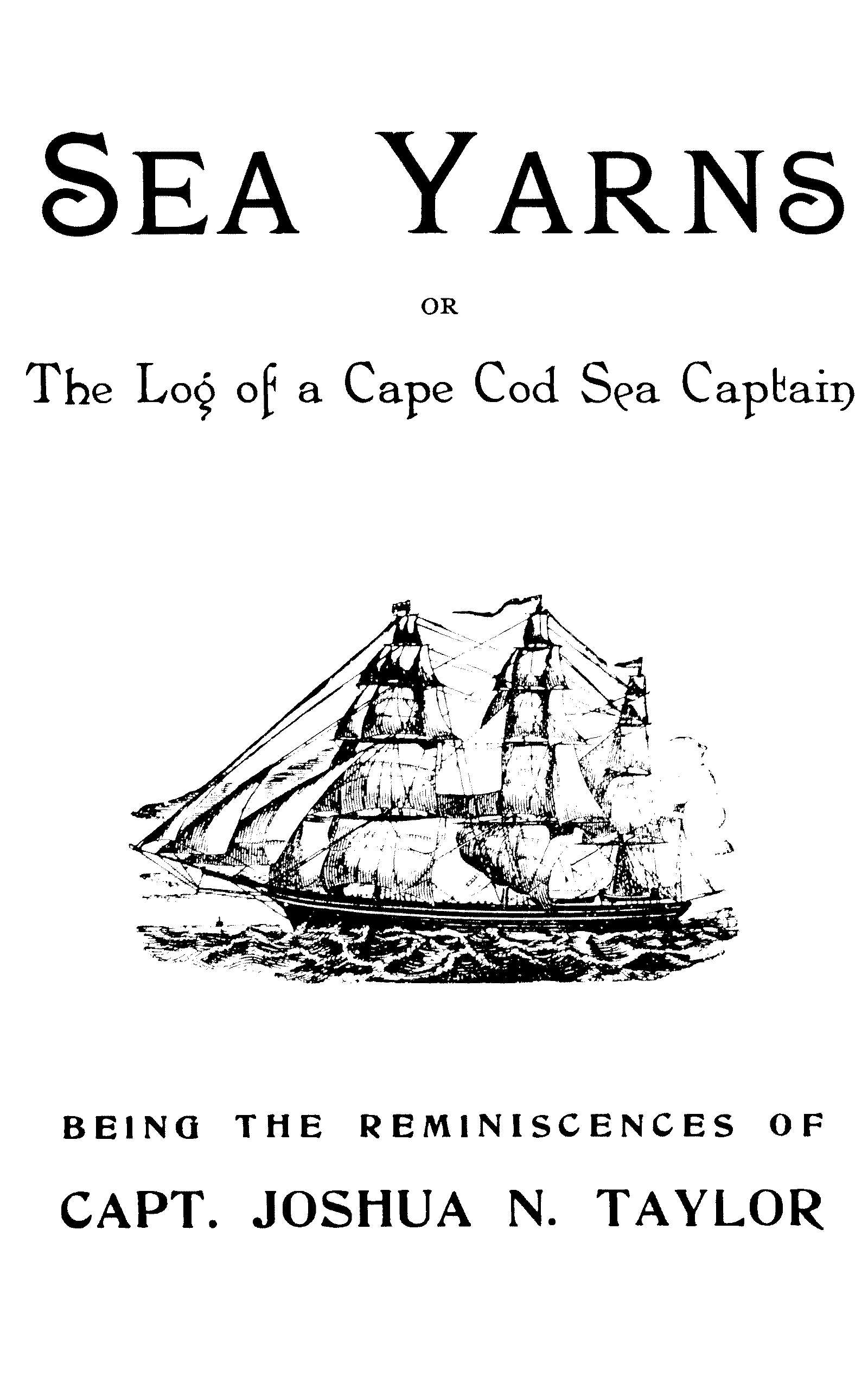
Now that the Canterbury was gone, I decided to go to the gold mines of Otago and try my luck as a gold miner. But fate had decided otherwise for me. Captain White of the clipper ship Blue Jacket called for me at the hotel one morning and offered me the berth of sailing master on the Blue Jacket at twenty-five pounds a month. They were short of officers, and as the ship was about loaded and ready to sail for London, I took his offer.
We were about ten days getting things in shape, and early one morning we hove up anchor and shaped our course for the long run to Cape Horn. A heavy southwest gale followed us for several days, and running our eastern down, we averaged 20 knots an hour at times, with all sail set. At times our patent log even showed 23 knots an hour. This may seem almost incredible, but the American ship James Baines at one time made an equal record.
After leaving New Zealand we had strong S. West gales, which carried us well east until we rounded Cape Horn and hauled up to Norrard. We had, up to this time, averaged 384 miles a day, beating all records ever made by a sailing ship up to that time.
The Blue Jacket was an American built ship, formerly owned by Isaac Taylor, of Boston, and built by Robert E. Jackson, of East Boston. On her maiden voyage across to Liverpool she made the trip in eleven days, out of which they were hove to for 36 hours to avoid ice on the Grand Banks.
She was sold to an English firm, and her owners made a handsome profit. Now they put her on the Australian Packet Service, carrying mail and passengers, and she seldom varied five days on either outward or inward trips from the 65 days, which was a record passage.
My commanding officer was James White, born in Ireland, a man of great ability, who had run away to sea when a boy, and had been rapidly promoted.
He was a large man, weighing over 200 pounds and standing over six feet in height, and when he gave orders everyone jumped. He is said to have been paid the highest wages of any sea captain sailing out of a European port.
We crossed the equator on our 42nd day out from New Zealand, and docked in the East India Docks at London in 63 days, a “lightning” passage. Captain White was a great man to carry all sail, and one incident occurred on this trip which will show some of his characteristics.
One night at sundown a stiff gale was blowing and he ordered me to take in the main top-gallant skysail and royals, and these had no apparent effect in reducing her speed. He told me that he had never taken a top-sail off of her while at sea.
My watch on deck was from 8 bells in the afternoon to 8 bells at night, and again at 8 bells the next morning for four hours more, being relieved by the third officer at meal time. During that night I heard the captain tell the chief mate, a Scotchman, by name of Craig, not to take any sail off the ship unless he called him on deck.
The ship was equipped with a powerful steering gear with double wheels, and under ordinary conditions one man and a boy could handle her. But this night we had four men, two at each wheel, as a heavy sea was running and the wind was quartering, and even then she would often get away from them and broach to. It required all their strength to get the wheels over so she would pay off on her course.
At 4 a.m. I came on deck and relieved the officer, who said, “My God, if the captain don’t take off some of this sail he’ll have the masts out of her.” A little after one bell we had a frightful squall strike us. The night was as black as ink, and at times the sharp lightning would blind one. I ran below and saw that the barometer had fallen, and calling for Captain White to come on deck, ran up the after companion-way on to the deck.
No sooner had I reached the deck than a fearful squall struck us and the rain fell in torrents and the ship fell rapidly off her course. I yelled out to let go the top-gallant halyards, fore and aft, and then she payed off on her course again. By this time the captain had reached the deck, and oh! how he jawed me for lowering those top-gallant sails. I immediately ordered them hoisted again, and inside of ten minutes she had the best of the helmsmen and came to several points before she answered her wheel. An old comber of a sea now struck her on the quarter, and tons of water flooded the decks, burst through the after companion-way doors, and the water rushed into our main saloon, filling it two feet deep. Then the passengers commenced to yell, “We are sinking.” They were soon pacified, however, and returned to their berths. In the meantime Captain White had ordered the top-gallant sails down and the ship was riding easier. I had felt pretty badly over the blowing up the captain had given me, but he now stretched out his hand to me and said, “Accept my apology, Mr. Taylor; you were all right, and the drinks are on me.”
Well, Captain White made his last voyage in the old Blue Jacket in the early seventies from Melbourne, Australia, with a valuable cargo and many passengers and a large shipment of gold. Neither the captain nor the ship has ever been heard of since. Some think the crew mutinied, scuttling the ship, killing the passengers and escaping with the gold, who knows? But I never forgot his mania for carrying all sail, no matter how windy, and believe that she was wrecked in mid-ocean after she had become dismantled in some heavy gale, and then went down with all hands. A fitting end for an old sea-dog, but hard for the passengers and crew.
I now had a good opportunity to roam about the great city of London and visit the places of interest. The Crystal Palace was at that time one of the chief centers of attraction, and thousands were visiting the place.
London is and always has been one of the world’s greatest centers, and for commerce, crimes, customs and culture has no equal. Other cities that I have visited have had many attractions, but great, dark, gloomy London, with its ever-flowing tide of humanity, always interested me more than any.
I now took passage for America on a small Allan Line steamer for Montreal and came to Boston by rail, putting up at the old Bromfield House, at that time a great place for sea-faring men. Presenting myself at 15 Kilby Street the next morning, where my owners had their offices, I was paid off and ordered home to await further orders.
As I had been out to New Zealand for several years, you may be sure that I was glad enough to be able to get back to the old homestead once again.
Thus ended my little experience on one of the greatest American built sailing ships that was ever launched, and whose sailing records have never been beaten.