
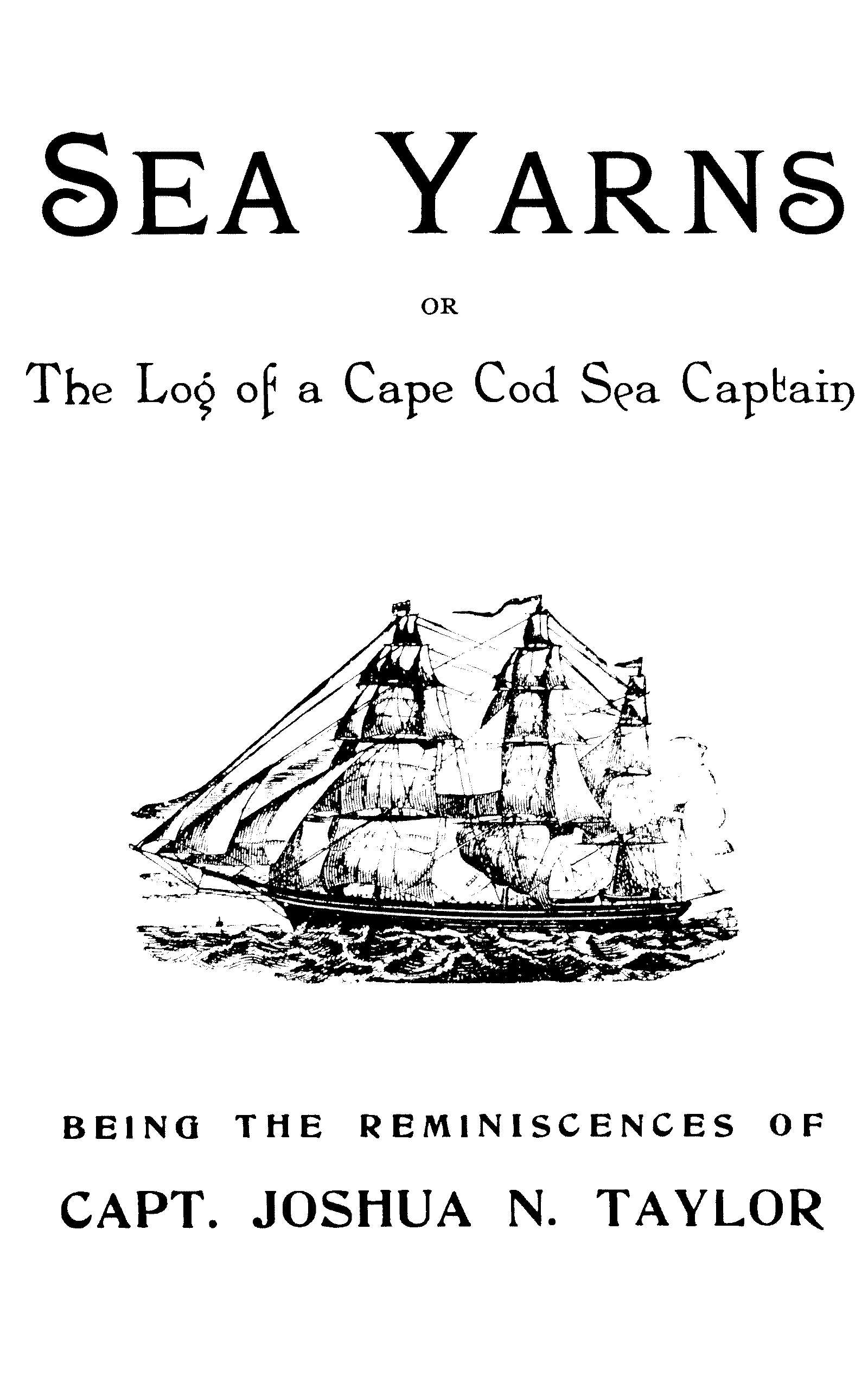
The barque Otago was one of the finest crafts that ever rested a keel on the water. She was of clipper build, had a carrying capacity of about 1500 tons, was an able sea boat, and with a breeze of wind that was suitable to her taste would reel off 15 knots easy.
On my first voyage as captain of this barque we sailed from Boston bound for the East Coast of Africa, via Cape Town, Port Elizabeth, Port Natal and other small ports. We had a general cargo with ploughs, hoes, shovels, rakes and other articles too numerous to mention, which were intended for the Dutch farmers or native Boers.
Our voyage out was a pleasant one, making about 58 days to Cape Town and 27 days to the equator. At no time was there more than a wholesail breeze, and nothing special of note took place, with this exception: we never took in a royal until we hove to and came to our anchorage in the beautiful bay or roadstead. On this voyage, two degrees south of the equator, we sighted what appeared to be a steamer with fore and aft sails set, and bound south.
At 11 a.m. we ran close up under his lee and spoke to him. He said he was from Cardiff, Wales, and was bound for the Heathcote River, on the middle of New Zealand. He had been 100 days out and had a large lee-board out to prevent his vessel from making so much lee drift. He asked me if I would not come aboard, but as we were going ten miles to his one, I tacked ship and headed about north, eased off head-sheets and hove main-topsail aback. We hove over our Yankee dory, which I always carried, and was soon aboard of him. He was much pleased to see me, and although he had drifted along for 100 days seemed reconciled to his fate and fully expected the trip to take him at least 250 days. As I was familiar with the New Zealand group and he had never been there before, I gave him all the information required, and tracked off on his chart for him the course he should pursue, and he was more than grateful. He had his wife and child with him, a gay little girl about ten years old. We had dinner and a glorious old talk; he put out his best, plenty of wine and beer, and at 1.30 p.m. he hoisted signals to our barque to come on. All this time from 11 to 1.30 she had made about seven miles. Her main topsails were braced up and sheets taken in, and about she came like a race horse—a thing of life. She did look so handsome coming down, and seemed to say, “I will show you my heels in a short time.” About 2.15 p.m., according to record, the chief officer, Mr. Harding, brought her to and I went on board, having greatly enjoyed the pleasant change of a visit at sea.
We filled away and passed under the Comet’s lee, saluting him by a rousing good cheer, such as can only be given by a sailor, and bidding him a pleasant bon voyage, and in one hour she was out of sight.
When I left the Comet the captain had given me a large English market basket full of good things: a Yorkshire ham, English cheese, port, brandy and beer, and that night I could not help thinking of that captain and his family wallowing slowly along behind us. At this time foul grass, in some places a foot long, had grown on the vessel’s bottom, and in what a condition she must have been when, in 259 days out from Cardiff, she finally reached New Zealand.
Ten months later I had a letter from the captain saying had it not been for my advice he would never have arrived out, as it had been his intention to make his Eastern or longtitude no further south than 35°; instead he went direct to 45°, as I had suggested, and ran his Eastern down in high latitude.
Here in this Southern belt the winds blow eleven months of the year, from West N. W. to West S. W., and in this long stretch of over 7500 miles one seldom ever sees a sail unless overtaking some ship or being overtaken by some ship bound to Australia, or Van Dieman’s Land, or perhaps to New Zealand.
The never-absent companion of the sailor is the albatross, a large bird which often follows a vessel for long distances, and which “Jack” calls the “spirit of a departed sailor.”
The barque Otago reached Cape Town, and after entering at the Custom House and reporting to the consignees, we commenced to discharge that portion of the cargo which was to be landed, some of which had to be transported by bullock trams 300 to 500 miles inland.
To these monstrous trek wagons are attached often some thirty or thirty-six Cape oxen. They are immense fellows and their entire harness is made of trecto, or raw hide. The campers or drivers are often 30 or 40 days on the way, and in the dry season, especially in the Southern summer months, December, January and February, the cattle suffer much for want of water, and travel in the night time and out span in day, so they can feed and water their cattle if they are fortunate enough to find it.
The Zaro, or headman, who has charge of the freight, is a native Kaffir; under him are two drivers, one a young Kaffir, who is a leader and who, when they in-span, directs the head yoke. Imagine a picture of 15 yoke of oxen, or thirty in all, strung up to a Crow wagon 30 feet long, a Kaffir boy at the head with the leaders, and the driver with a long bamboo whip in his hand. This whip is a rod 20 feet long, with a whip lash over 80 feet long made of dry hide, attached to the end, and is used in such a way that it will reach, at any time, any of the bullocks.
The Kaffirs are men of great vitality and can endure great hardships, but are at all times most faithful and trustworthy. They can go days without food, and then have a big feast, and it is said that ten men could devour the carcass of a good-sized bullock, and never leave the table until it was all gone. Underneath their wagons they slung their hammocks, made from native jute buts, and their cooking utensils. Their pay, in the early sixties, was a pound sterling a month, and find themselves, with no set hours for duty, and it often happened that they were on the road for forty-eight hours at a time.
Today, rails and the steam engine do in an hour what in the old days took ten.
Before we weigh anchor I will mention my visit to Table Mountain, 8000 feet above the level of the sea. This mountain is usually covered by a thick mist or fog-bank, called by the natives and seamen “Table-cloth,” but when it is perfectly clear one can depend on fine weather.
A party of sixteen men and women, led by Guide Wilson, started on our journey up the mountain, by way of the bridal path, at three a.m. We went round the Lion’s Rump, then round and round, reaching the top at 8 a.m. Such a wonderful sight I never before witnessed! The ship in the bay looked like a toy vessel, and the town itself was full of tiny houses. The top of the mountain was very flat—called Table-land from the flatness of the surrounding Table Mountain—here is situated a lake, said to be in some places more than 200 fathoms deep, and filled with small thorny fish. We breakfasted and rested here until 11 a.m., and then gradually made our descent, reaching the town at 4.30 p.m., well compensated although weary from our journey.
I went to the end of the Long Pier and, signalling for my boat, was soon on my barque enjoying my evening meal.
We started to get under way; I gave orders to the chief officer to heave short loose top-sails and top-gallant sails, and it was done with a merry good will, as sailors are always glad to reach port and to leave it. While heaving up the anchor, Captain Smith and his crew came on board to assist us in getting under way, a courtesy usually extended in foreign ports by all ships.
The heavens were beaming with stars, a bright moon was shining, and a light wind blowing from the southwest helped to make a lovely night and a still one. Judson, our “Shanty-man,” started the crew up to sing the old “Shanty songs,” such as “Bonney was a Warrior,” “I am going away to leave you,” “Santa Anna was a one-legged man,” and numerous other songs. The singing was fine, causing large crowds to gather on the pier-heads, and the verandahs of the houses were filled with people.
The first officer shouted, “All away, sir,” meaning the anchor was off the bottom, we hoisted jibs and filled away, heading out to the westward, bidding good-bye to Captain Smith, whose boats-crew gave three rousing loud cheers for the old “Otago,” who picked up her skirts and started around the Cape for Algoa Bay, about 600 miles away.
At 10 p.m., or four bells by ship time, we tacked ship and ran in to clear the Cape. At this time the wind had changed to north-west, about an eight-knot breeze, which was a fair wind to lead us around the Cape. We made the run to Cape Receme in 78 hours, hauled around to the northward for about ten miles and cast anchors, mooring the ship from east north-east to south-east with “open-horse,” as the sailors say. As the east wind comes into this bay and causes a very heavy swell, we adopted this position to make the ship ride easy and take off the strain on chain and windlass. After a gale is over, great care and watchfulness on the part of the officers is necessary so that the slack chain may be hove in or paid out when the wind increases so as to avoid fouling the anchors. The wind often changes several times in twenty-four hours, and if the ship swings around there is much hard work and time lost in clearing the foul chain.
Some of the ships used a long shackle, which saves trouble, but was not considered as safe to ride to, as it did not give an equal strain on each anchor. We now proceeded to enter at the Customs and go through the regular formalities, reporting to Taylor Bros., consignees, who were agents of Isaac Taylor, the ship’s owner. While in port I made my stay with them and was royally entertained. Saddle-horses and carriages were placed at my disposal, and we saw much of the country.
Unfavorable weather delayed landing of the cargo, as it was necessary to discharge into large flat-bottomed lighters which could be used only in a fairly smooth sea. A large anchor is placed about 300 feet off shore, to which a hawser is attached and then made fast to one end of the lighter; on the shore end is another anchor fastened to forward end of lighter, and by manipulating these hawsers the lighters are run back and forth and the cargo discharged. Once on shore, the goods are put on the heads and shoulders of the Hottentots, who worked clothed only in a breech-cloth. They work all day long and receive very good pay; at that time they got a half-crown a day, about 62 cents in American money. The Kaffir gang of carriers were kept apart from the Hottentots, as they never mixed. Many of the Hottentots in this neighborhood had attained great wealth as cattle dealers, and came out gaily decked on Sunday afternoons. Having discharged our cargo at Port Elizabeth, we proceeded with fine west wind to Port Natal, E. N. East from our departure. A sand-bar prevented our entering this harbor until part of the cargo was taken off by lighters. Having reduced our cargo till we drew but 12 feet of water, we were now able to get over the sand-bar and proceed up the river. This port is the center for all East African goods, and raw-hide and sheep skins are the principal exports. The Boer farmers bring in their goods in the bullock-wagons, sometimes being thirty days on the road before getting into Port Natal. Here they rest up for a week and enjoy themselves drinking Dutch brandy. Then they load up with household goods and provisions enough to last them until next sheep-shearing season.
Many of the farmers were very wealthy, owning 75,000 head of sheep and cattle, visiting Europe every year, and keeping well posted on market conditions. Game was very abundant, and the farmers were all expert with the rifle. In later years this prowess was well shown in their dealings with the English army. We made the acquaintance of a Mr. Hoffenhimer, who had lost the previous night some twenty head of cattle by a tiger. He had prepared a large cage, baited it with a lamb, and the next morning was rewarded by catching an immense big tiger alive. European zoological gardens paid a big price for these fellows, and the skins were also valuable.
We now put ballast in our barque and returned to Port Elizabeth to load with wool, hides and skins for Boston, Mass. At Natal we had taken on board a Mr. Thompson and wife, who were bound out West to settle, and we now embarked twelve more passengers who were a mixture of Dutch, Irish and Africanders, or native-born whites. These had “made their pile” and were returning to civilization to settle down.
With a good easterly breeze and threatening weather, we got under way, close-hauled by the wind and a heavy swell on. We stood south, hoping to clear Cape Receif, which we did without tacking ship. In fact, it would have been difficult to tack, as we were too near the shore to wear ship. I ordered the lead to be hove, and fully expected to strike bottom every moment. By good luck the wind hauled around and we headed up two points to eastward, and at dark, with the roar of the surf breaking under our lee, we cleared the rock.
Outwardly I showed no nervousness, but I assure you my heart was in my mouth, and it was a happy moment when I shouted, “Hard up your wheel, brace in main and fore yard, and keep her west by south.” It was now blowing a living gale, east-north-east, nearly astern, but hauling up the clews of our mainsail, we set the main top-gallant sail and sent up a silent prayer for safe deliverance.
An easterly gale prevailed through the night, and our good ship bowled off 15 knots an hour until 8 a.m. next morning. However, under fore-sail, fore-topsail, main-topsail and main top-gallant sail, she made splendid weather, although there was a very heavy swell from the East.
During the evening the chief officer had very foolishly told the passengers what a narrow escape they had had in rounding Cape Receif, and it had caused considerable uneasiness among them as to their safety, for the wind was blowing fiercely. After I had assured them that there was not the least danger, I got Mrs. Thompson to play a few good old Methodist hymns on the organ, and we all sang until confidence was restored, and all retired saying, “God bless Captain Taylor.”
The next morning at eight bells, 8 o’clock a.m., the wind moderated and hauled round to the S. S. East, and all sails were set and we passed the next twenty-four hours in comparative comfort.
The next day we made land about fifty miles to the westward of Cape of Good Hope. Here we passed several Cape fishing boats, fishing for the famous Cape snook. We passed so near that many of the men, thinking we were going to run them down, shouted out to us in their Hottentot language.
At sundown that evening we made Cape Light, distant about eight miles under our starboard lee-bow. With a good south breeze we shaped our course at 8 p.m. for the island of St. Helena, lying directly in the path for all homeward-bound American vessels. A beautiful breeze followed us until we struck the S. E. Trades, in latitude 28° S., and from there we had fine weather until we hauled to close under the land and cast anchor at this island, made famous by the exile of Napoleon. We had been twenty-three days on the voyage from the Capes to the Island, most of the time the sea being like a mill pond it was so smooth. Casting anchor at early daybreak, and so close that our jib-boom touched the rocks, found twenty fathoms of water, and, after breakfast, launched the boats and gave the passengers a day’s liberty to visit the island.
The older part of the town was in ruins, caused, strange to say, by the fact that the St. Helena ants had worked their way into the mortar and undermined the foundations. The township is located in the center of the island, and is surrounded by high hills on both sides. On the top of the hill on the northwest side are the English barracks, where several companies of troops are stationed, ready for call to any part of the Cape or British India. The island is also used as the recruiting ground of the invalid soldiers.
We spent most of the day on the southeast side visiting the home of Napoleon, while he was exiled on the island, and the place on the hillside where he was buried, before his body was removed to France.
We returned to the town, and I made purchases of fresh ship stores, green groceries, fowl, and a few sheep, for fresh meat to be used as needed on the voyage home.
At 6 p.m., pretty tired but delighted with our visit to St. Helena, we boarded the ship, and after supper, with sails all aback, we drifted off a piece and squared away on our homeward journey.
We crossed the equator in sight of Cape St. Rourke, and taking the N. E. Trades we made straight course, with yards eased in a little, to 30 degrees north latitude, when the wind headed us off a little to the westward, and passing Cape Hatteras, about thirty degrees off shore. The wind favored us until South Shoal Lightship was made at 10 a.m. We had been fifty-seven days out from Algoa Bay, South Africa, and thirty-four days from St. Helena. After leaving Nantucket Lightship, we shaped our course to clear the shoal ground, and hauled in under the Cape. Fifteen miles off the Cape, the wind hauled to the eastward and it commenced to snow. The barometer commenced to fall, and there was every indication of a nasty night. First it would blow, then a snow squall, then clear a bit. We finally got sight of Race Point Light, and got good cross bearing and at nine o’clock shaped our course for Boston Light. Noting that our patent log was set, I ordered one of our best helmsmen to take the wheel, and the chief officer to have the anchors off the bow ready to let go at any moment. The wind had commenced to blow N. E. to E. with terrific force, and at times one could not see a ship’s length ahead, but with light sails furled, only running under two topsails and jib, the ship bounded along.
I have often thought how imprudent I was to run for port on such a night, yet I had confidence that my course was right, and all hands were on the lookout both port and starboard.
For one instant I at last caught a glimmer of Boston Light on our starboard, and all hands forward shouted, “Light ho, right ahead!” We hove wheel hard down, let sail run, and dropped both anchors, just forty-eight hours from Nantucket Shoals Lightship. Next morning everything was covered with snow, but we took a tug at nine o’clock, and docked at Lewis Wharf at ten o’clock. Later in the day I reported at the office, and the first words that greeted me were, “Foor goodness’ sake, Captain, where did you come from and how did you get here?”