
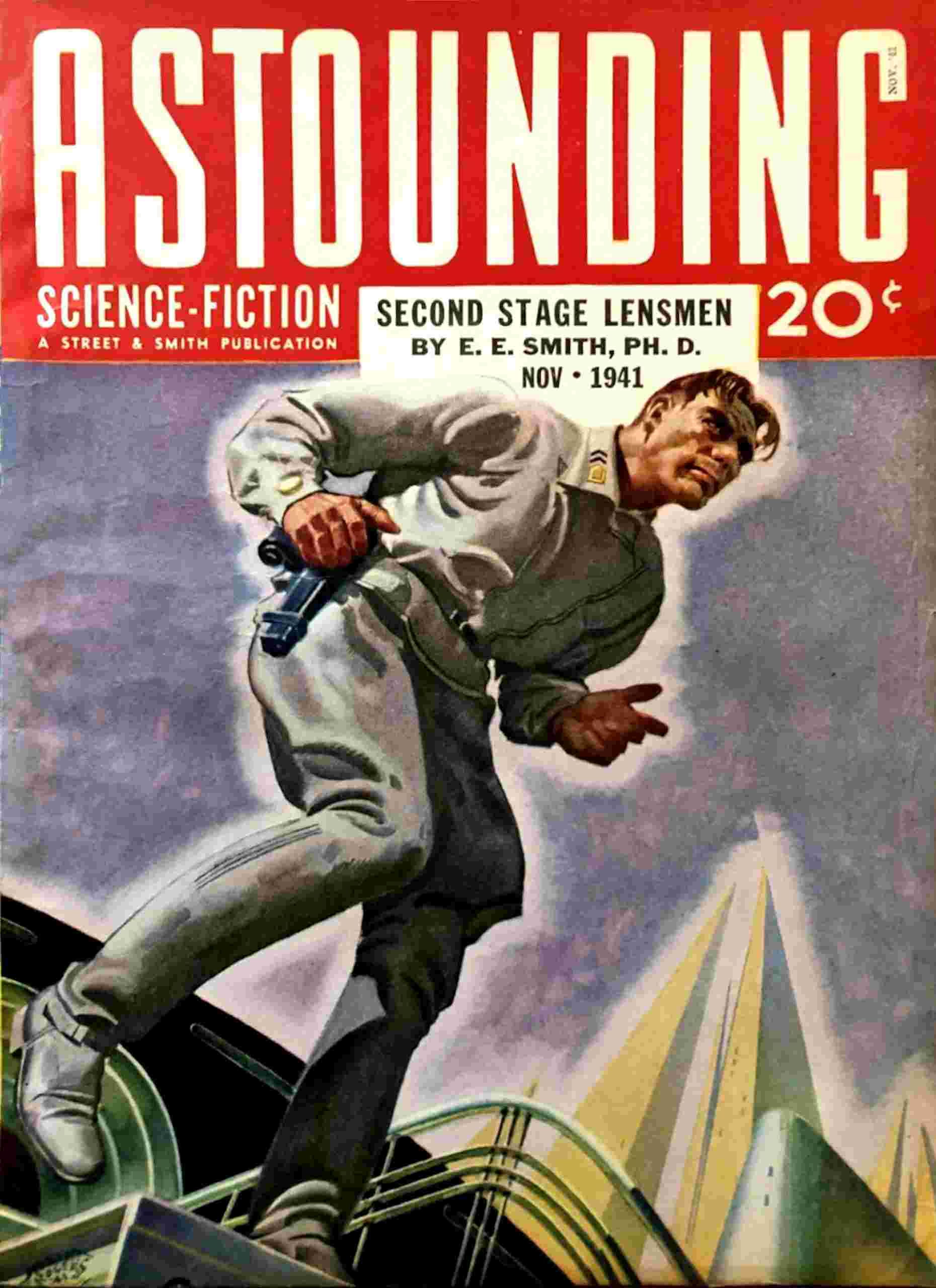
The Project Gutenberg eBook of Second stage Lensmen
Title: Second stage Lensmen
Author: E. E. Smith
Illustrator: Hubert Rogers
Release date: April 7, 2023 [eBook #70494]
Language: English
Original publication: United States: Street & Smith Publications, Incorporated, 1941
Credits: Greg Weeks, Mary Meehan and the Online Distributed Proofreading Team at http://www.pgdp.net
SECOND STAGE LENSMEN
By E. E. Smith, Ph.D.
[Transcriber's Note: This etext was produced from
Astounding Science Fiction November, December 1941,
January, February 1942.
Extensive research did not uncover any evidence that
the U.S. copyright on this publication was renewed.]
HISTORICAL
Law enforcement lagged behind crime because the police were limited in their spheres of action, while criminals were not. Therefore, when Bergenholm invented the inertialess drive and commerce throughout the Galaxy became commonplace, crime became so rampant as to threaten the very existence of Civilization.
Thus came into being the Galactic Patrol, an organization whose highest members are called "Lensmen." Each is identified by wearing the Lens, a pseudoliving telepathic jewel matched to the ego of its wearer by those master philosophers, the Arisians. The Lens cannot be either imitated or counterfeited, since it glows with color when worn by its owner, and since it kills any other who attempts to wear it.
Of each million selected candidates for the Lens all except about a hundred fail to pass the grueling tests employed to weed out the unfit. Kimball Kinnison graduated No. 1 in his class and was put in command of the spaceship Brittania—a war vessel of a new type, using explosives, even though such weapons had been obsolete for centuries. The "pirates"—the Boskonian Conflict was just beginning, so that no one yet suspected that the Patrol faced anything worse than highly organized piracy—were gaining the upper hand because of a new and apparently almost unlimited source of power. Kinnison was instructed to capture one of the new-type pirate ships, in order to learn the secret of that power.
He found and defeated a Boskonian warship. Peter VanBuskirk led the storming party of Valerians—men of human type, but of extraordinary size, strength and agility because of the enormous gravitational force of their home planet—in wiping out those of the pirate crew not killed in the battle between the two ships.
The scientists of the expedition secured the information desired. It could not be transmitted to Prime Base, however, because the pirates blanketed all channels of communication. Boskonian warships were gathering, and the crippled Brittania could neither run nor fight. Therefore each man was given a spool of tape bearing the data and all the Patrolmen took to the lifeboats.
Kinnison and VanBuskirk, in one of the boats, were forced to land upon the planet Delgon, where they joined forces with Worsel—later to become Lensman Worsel—a winged, reptilian native of a neighboring planet, Velantia. The three destroyed a number of the Overlords of Delgon, a sadistic race of monsters who preyed upon the other races of their solar system by sheer power of mind. Worsel accompanied the Patrolmen to Velantia, where all the resources of the planet were devoted to preparing defenses against the expected Boskonian attack. Several others of the Brittania's lifeboats reached Velantia, called by Worsel's prodigious mind working through Kinnison's ego and Lens.
Kinnison finally succeeded in tapping a communicator beam, thus getting one line upon Helmuth, who "spoke for Boskone"—it was supposed then that Helmuth actually was Boskone instead of a comparatively unimportant Director of Operations—and upon his Grand Base.
The Boskonians attacked Velantia and six of their vessels were captured. In these ships, manned by Velantian crews, the Tellurians set out for Earth and the Prime Base of the Galactic Patrol. Kinnison's Bergenholm, the generator of the force which makes inertialess—"free," in space parlance—flight possible, broke down, wherefore he had to land upon the planet Trenco for repairs.
Trenco, the tempestuous, billiard ball-smooth planet where it rains forty-seven feet and five inches every night and where the wind blows eight hundred miles an hour. Trenco, the world upon which is produced thionite, the deadliest and most potent of all habit-forming drugs. Trenco, the Mecca of all the "zwilniks"—members of the Boskonian drug ring; sometimes loosely applied to any Boskonian—of the Galaxy. Trenco, whose weirdly charged ether and atmosphere so distort beams and vision that it can be policed only by such beings as the Rigellians, who possess the sense of perception instead of sight and hearing!
Lensman Tregonsee, of Rigel IV, then in command of the Patrol's wandering base upon Trenco, furnished Kinnison a new Bergenholm and he again set out for Tellus.
Meanwhile Helmuth, the Boskonian commander, had deduced that some one particular Lensman was back of all his setbacks; and that the Lens, a complete enigma to the Boskonians, was in some way connected with Arisia. That planet had always been dreaded and shunned by all spacemen. No one would ever say why, but no being who had ever approached that planet uninvited could be compelled, even by threat of death, to go near it again.
Helmuth, thinking himself secure by virtue of his thought-screens, the secret of which he had stolen from Velantia, went alone to Arisia, to learn how the Lens gave its wearer such power. He was stopped at the barrier. His thought-screens were useless—the Arisians had given them to Velantia, hence knew how to break them down. He was punished to the verge of insanity, but was finally permitted to return to his Grand Base, alive and sane: "Not for your own good, but for the good of that struggling young civilization which you oppose."
Kinnison finally reached Prime Base with the all-important data. By building superpowerful battleships, called "maulers," the Patrol gained a temporary advantage over Boskonia, but a stalemate soon ensued. Kinnison developed a plan of action whereby he hoped to locate Helmuth's Grand Base; and asked Port Admiral Haynes, Chief of Staff of the entire Patrol, for permission to follow it. In lieu of that, however, Haynes informed him that he had been given his Release; that he was an Unattached Lensman—a "Gray" Lensman, popularly so called, from the color of the plain leather uniforms they wear. Thus he earned the highest honor which the Galactic Patrol can bestow, for the Gray Lensman works under no direction whatever. He is as absolutely a free agent as it is possible to be. He is responsible to no one; to nothing save his own conscience. He is no longer of Tellus, nor of the Solarian System, but of the Universe as a whole. He is no longer a cog in the immense machine of the Patrol: wherever he may go, throughout the unbounded reaches of space, he is the Patrol!
In quest of a second line upon Grand Base, Kinnison scouted a pirate stronghold upon Aldebaran I. Its personnel, however, were not even near-human, but were Wheelmen, possessed of the sense of perception; hence Kinnison was discovered before he could accomplish anything and was very seriously wounded. He managed to get back to his speedster and to send a thought to Port Admiral Haynes, who immediately rushed ships to his aid. In Base Hospital, Surgeon General Lacy put him together, and, during a long and quarrelsome convalescence, Nurse Clarrissa MacDougall held him together. Lacy and Haynes connived to promote a romance between nurse and Lensman.
As soon as he could leave the hospital he went to Arisia in the hope that he might be permitted to take advanced training; an unheard-of idea. Much to his surprise, he learned that he had been expected to return, for exactly such training. Getting it almost killed him, but he emerged infinitely stronger of mind than any man had ever been before. He also now had the sense of perception; a sense somewhat analogous to that of sight, but of vastly greater penetration, power and scope and not dependent upon light; a sense only vaguely forecast by ancient work upon clairvoyance.
By the use of his new mental equipment he succeeded in entering a Boskonian base upon Boyssia II. There he took over the mind of the communications officer and waited. A pirate ship working out of that base captured a hospital ship of the Patrol and brought it in. Clarrissa, now chief nurse of the captured vessel, working under Kinnison's instructions, stirred up trouble. Helmuth, from Grand Base, interfered, thus enabling the Lensman to get his second, all-important line.
The intersection of the two lines, Boskonia's Grand Base, lay in a star cluster well outside the Galaxy. Pausing only long enough to destroy the Wheelmen of Aldebaran I, the project in which his first attempt had failed so dismally, he investigated Helmuth's headquarters. He found fortifications impregnable to any massed attack of the Patrol, manned by beings wearing thought-screens. His sense of perception was suddenly cut off—the enemy had thrown a thought-screen around the whole planet.
He returned to Prime Base, deciding en route that boring from within was the only possible way in which that base could be reduced. In consultation with Haynes the zero hour was set, at which the Grand Fleet of the Patrol would start raying Helmuth's base with every available projector.
Pursuant to his plan, Kinnison again visited Trenco, where Tregonsee and his Rigellians extracted for him fifty kilograms of thionite, the noxious drug which, in microgram inhalations, makes the addict experience all the physical and mental sensations of doing whatever it is that he wishes most ardently to do. The larger the dose the more intense the sensations—but the slightest overdose means a sudden and super-ecstatic death.
Thence to Helmuth's planet; where, by controlling the muscles of a dog whose brain was unscreened, he let himself into the central dome. Here, just before zero time, he released his thionite into the primary air stream, thus wiping out all the pirate personnel except Helmuth; who, in his inner dome, could not be affected. The Patrol attacked on schedule. Kinnison killed Helmuth in hand-to-hand combat. Grand Base was blasted out of existence, largely by the explosion of bombs of duodecaplyl atomate placed by the pirates themselves. These bombs were detonated by an enigmatic, sparkling force-ball which Kinnison had studied with care. He knew that it was operated by thought, and he suspected—correctly—that it was in reality an intergalactic communicator.
Kinnison's search for the real Boskone lead to Lundmark's Nebula, thenceforth called the Second Galaxy. His ship, the superpowerful Dauntless, met and defeated a squadron of Boskonian warships. The Tellurians landed upon the planet Medon, whose people were fighting a losing war against the forces of Boskone. The Medonians, electrical wizards who had been able to install inertia-neutralizers and a space drive upon their planet, moved their world over to our First Galaxy.
With the cessation of military activity, however, the illicit traffic in habit-forming drugs amongst all races of warm-blooded oxygen breathers had increased tremendously; and Kinnison, deducing that Boskone was back of the Drug Syndicate, decided that the best way to find the real leader of the enemy was to work upward through the drug ring.
Disguised as a dock walloper, he frequented the saloon of a drug baron, and helped to raid it; but, although he secured much information, his disguise was penetrated.
He called a Conference of Scientists, to devise means of building a gigantic bomb of negative matter. Then, impersonating a Tellurian secret-service agent who lent himself to the deception, he tried to investigate the stronghold of Prellin of Bronseca, one of Boskone's Regional Directors. This disguise also failed and he barely escaped.
Ordinary disguises having proved useless against Boskone's clever agents, Kinnison himself became Wild Bill Williams; once a gentleman of Aldebaran II, now a space rat meteor miner. Instead of pretending to drink he really drank; making of himself a practically bottomless drinker of the most vicious beverages known to space. He became a drug fiend—a bentlam eater—discovering that his Arisian-developed mind could function at full efficiency even while his physical body was stupefied. He became widely known as the fastest, deadliest performer with twin ray guns that had ever struck the asteroid belts. Thus, through solar system after solar system, he built up an unimpeachable identity as a hard-drinking, wildly carousing, bentlam-eating, fast-shooting space hellion; a lucky or a very skillful meteor miner; a derelict who had been an Aldebaranian gentleman once and who would be again if he should ever strike it rich and if he could conquer his weaknesses.
Physically helpless in a bentlam stupor, he listened in on a zwilnik conference and learned that Edmund Crowninshield, of Tressilia III, was also a Regional Director of the enemy.
Boskone formed an alliance with the Overlords of Delgon, and through a hyperspatial tube or vortex the combined forces again attacked humanity. Not simple slaughter this time, for the Overlords tortured their captives and consumed their life forces in sadistic orgies. The Conference of Scientists solved the mystery of the tube and the Dauntless attacked through it; returning victorious.
Wild Bill Williams struck it rich at last. Forthwith he abandoned the low dives in which he had been wont to carouse, and made an obvious effort to become again an Aldebaranian gentleman. He secured an invitation to visit Crowninshield's resort. The Boskonian, believing that Williams was basically a drink and drug-soaked bum, took him in, to get his quarter-million credits. Relapsing into a characteristically wild debauch, Kinnison-Williams did squander a large part of his new fortune; but he learned from Crowninshield's mind that one Jalte, a Kalonian by birth, was Boskone's Galactic Director and that Jalte had his headquarters in a star cluster just outside the First Galaxy. Pretending bitter humiliation and declaring that he would change his name and disappear, the Gray Lensman left the planet—to investigate Jalte's base.
He learned that Boskone was not a single entity, but was a council. He also learned that, while the Kalonian did not know who or where Boskone was, Eichmil, Jalte's superior, who lived upon the planet Jarnevon in the Second Galaxy, would probably know all about it.
Kinnison and Worsel, therefore, set out to investigate Jarnevon. Kinnison was captured and tortured—there was at least one Delgonian upon Jarnevon—but Worsel rescued him before his mind was damaged and brought him back to the Patrol's Grand Fleet with his knowledge intact. Jarnevon was populated by the Eich, a race of monsters as bad as the Overlords of Delgon; the Council of Nine which ruled the noisome planet was, in fact, the long-sought, the utterly detested Boskone!
The greatest surgeons of the age—Phillips of Posenia and Wise of the newly acquired planet Medon—demonstrated that they could grow new nervous tissue; even new limbs and organs if necessary.
Again Clarrissa MacDougall nursed Kinnison back to health, and this time the love between them would not be denied.
The Grand Fleet of the Patrol was assembled, and with Kinnison in charge of Operations, swept outward from the First Galaxy. Jalte's planet was destroyed by means of the negasphere—the negative-matter bomb. Then on to the Second Galaxy.
There the Patrol forces destroyed Jarnevon, the planet of the Eich, by smashing it between two barren planets which had been driven there in the "free"—inertialess—condition. These planets, having opposite intrinsic velocities, were placed one upon each side of Jarnevon. Then their Bergenholms were cut, restoring inertia and intrinsic velocity; and when that frightful collision was over a minor star had come into being.
Grand Fleet returned to our Galaxy. Galactic Civilization rejoiced. Earth in particular made merry, and Prime Base was the center of celebration. And in Prime Base Kinnison, supposing that the war was over and that his problem was solved, threw off his Gray Lensman's burden and forgot all about the Boskonian menace. Marrying his Chris, he declared, was the most important thing in the Universe.
But how wrong he was! For, even as Lensman and Sector Chief Nurse were walking down a hallway of Base Hospital after a conference with Lacy and Haynes regarding that marriage—
I.
"Stop, youth!" The voice of that nameless, incredibly ancient Arisian who was Kinnison's instructor and whom he had thought of and spoken of simply as "Mentor" thundered silently, deep within the Lensman's brain.
He stopped convulsively, almost in midstride, and at the rigid, absent awareness in his eyes Nurse MacDougall's face went white.
"This is not merely the loose and muddy thinking of which you have all too frequently been guilty in the past," the deeply resonant, soundless voice went on, "it is simply not thinking at all. At times, Kinnison of Tellus, we almost despair of you. Think, youth, think! For know, Lensman, that upon the clarity of your thought and upon the trueness of your perception depends the whole future of your Patrol and of your Civilization; more so now by far than at any time in the past."
"Wha'dy'mean, 'think'?" Kinnison snapped back, thoughtlessly. His mind was a seething turmoil, his emotions an indescribable blend of surprise, puzzlement and incredulity.
For moments, as Mentor did not reply, the Gray Lensman's mind raced. Incredulity—becoming tinged with apprehension—turning rapidly into rebellion.
"Oh, Kim!" Clarrissa choked. A queer-enough tableau they made, these two, had any been there to see; the two uniformed figures standing there so strainedly, the nurse's two hands gripping those of the Lensman. She, completely en rapport with him, had understood his every fleeting thought. "Oh, Kim! They can't do that to us—"
"I'll say they can't!" Kinnison flared. "By Klono's tungsten teeth, I won't do it! We have a right to happiness, you and I, and we'll—"
"We'll what?" she asked, quietly. She knew what they had to face; and, strong-souled woman that she was, she was quicker to face it squarely than was he. "You were just blasting off, Kim, and so was I."
"I suppose so," glumly. "Why in all the nine hells of Valeria did I have to be a Lensman? Why couldn't I have stayed a—"
"Because you are you," the girl interrupted, gently. "Kimball Kinnison, the man I love. You couldn't do anything else." Chin up, she was fighting gamely. "And if I rate Lensman's Mate I can't be a sissy, either. It won't last forever, dear. Just a little longer to wait, that's all."
Eyes, steel-gray now, stared down into eyes of tawny, gold-flecked bronze. "QX, Chris? Really QX?" What a world of meaning there was in that cryptic question!
"Really, Kim." She met his stare unfalteringly. If not entirely unafraid, at least with whole-hearted determination. "On the beam and on the green, Gray Lensman, all the way. Every long, last millimeter. There, wherever it is—to the very end of whatever road it has to be—and back again. Until it's over. I'll be here. Or somewhere, Kim. Waiting."
The man shook himself and breathed deep. Hands dropped apart—both knew consciously as well as subconsciously that the less of physical demonstration the better for two such natures as theirs—and Kimball Kinnison, Unattached Lensman, came to grips with his problem.
He began really to think; to think with the full power of his prodigious mind; and as he did so he began to see what the Arisian could have—what he must have—meant. He, Kinnison, had gummed up the works. He had made a colossal blunder in the Boskonian campaign. He knew that the Brain, although silent, was still en rapport with him; and as he coldly, grimly, thought the thing through to its logical conclusion he knew, with a dull, sick certainty, what was coming next. It came:
"Ah, you perceive at last some portion of the truth. You see that your confused, superficial thinking has brought about almost irreparable harm. I grant that, in specimens so young of such a youthful race, emotion has its place and its function; but I tell you now in all solemnity that for you the time of emotional relaxation has not yet come. Think, youth—THINK!" and the ancient sage of Arisia snapped the telepathic line.
As one, without a word, nurse and Lensman retraced their way to the room they had left so shortly before. Port Admiral Haynes and Surgeon General Lacy still sat upon the nurse's davenport, scheming roseate schemes having to do with the wedding they had so subtly engineered.
"Back so soon? Forget something, MacDougall?" Lacy asked, amiably. Then, as both men noticed the couple's utterly untranslatable expression:
"What happened? Break it out, Kim!" Haynes commanded.
"Plenty, chief," Kinnison answered, quietly. "Mentor—my Arisian, you know—stopped us before we got to the elevator. Told me that I'd put my foot in it clear up to the hip joint on that Boskonian thing. That instead of being all buttoned up, my fool blundering has put us further back than we were when we started."
"Mentor!"
"Your Arisian!"
"Told you!"
"Put us back!"
It was an entirely unpremeditated, unconscious duet. The two old officers were completely dumfounded. Arisians never had come out of their shells, they never would. Infinitely less disturbing would have been the authentic tidings that a brick house had fallen upstairs. They had nursed this romance along so carefully, had timed it so exactly, and now it had gone p-f-f-f-t—it had been taken out of their hands entirely. That thought flashed through their minds first. Then, as catastrophe follows lightning's flash, the real knowledge exploded within their consciousnesses that, in some unguessable fashion or other, the whole Boskonian campaign had gone p-f-f-f-t, too.
Port Admiral Hayes, master tactician, reviewed in his keen strategist's mind every phase of the recent struggle, without being able to find a flaw in it.
"There wasn't a loophole anywhere," he said aloud. "Where did they figure we slipped up?"
"We didn't slip—I slipped," Kinnison stated, flatly. "When we took Bominger—the fat Chief Zwilnik of Radelix, you know—I took a bop on the head to learn that Boskone had more than one string per bow. Observers, independent, for every station at all important. I learned that fact thoroughly then, I thought. At least, we figured on Boskone's having lines of communication past, not through, his Regional Directors, such as Prellin of Bronseca. Since I changed my line of attack at that point, I did not need to consider whether or not Crowninshield of Tressilia III was by-passed in the same way; and when I had worked my way up through Jalte in his star cluster to Boskone itself, on Jarnevon, I had forgotten the concept completely. Its possibility did not even occur to me. That is where I fell down."
"I still don't see it!" Haynes protested. "Boskone was the top!"
"Yeah?" Kinnison asked, pointedly. "That's what I thought—but prove it."
"Oh." The Port Admiral hesitated. "We had no reason to think otherwise—looked at it in that light, this intervention would seem to be conclusive—but before that there were no—"
"There were so," Kinnison contradicted, "but I didn't see them then. That's where my brain went sour; I should have seen them. Little things, mostly, but significant. Not so much positive as negative indices. Above all, there was nothing whatever to indicate that Boskone actually was the top. That idea was the product of my own wishful and very low-grade thinking, with no basis or foundation in fact or in theory. And now," he concluded bitterly, "because my skull is so thick that it takes an idea a hundred years to filter through it—because a sheer, bare fact has to be driven into my brain with a Valerian maul before I can grasp it—we're sunk without a trace."
"Wait a minute, Kim, we aren't sunk yet," the girl advised, shrewdly. "The fact that, for the first time in history, an Arisian has taken the initiative in communicating with a human being, means something big—really big. Mentor does not indulge in what he calls 'loose and muddy' thinking. Every part of every thought he sent carries meaning—plenty of meaning."
"What do you mean?" As one, the three men asked substantially the same question; the Lensman, by virtue of his faster reactions, being perhaps half a syllable in the lead.
"I don't know, exactly," Clarrissa admitted. "I've got only an ordinary mind, and it's firing on half its jets or less right now. But I do know that his thought was 'almost' irreparable, and that he meant precisely that—nothing else. If it had been wholly irreparable he not only would have expressed his thought that way, but he would have stopped you before you destroyed Jarnevon. I know that. Apparently it would have become wholly irreparable if we had got—" she faltered, blushing, then went on, "—if we had kept on about our own personal affairs. That's why he stopped us. We can win out, he meant, if you keep on working. It's your oyster, Kim—it's up to you to open it. You can do it, too—I just know that you can."
"But why didn't he stop you before you fellows smashed Boskone?" Lacy demanded, exasperated.
"I hope you're right, Chris—it sounds reasonable," Kinnison said, thoughtfully. Then, to Lacy:
"That's an easy one to answer, doctor. Because knowledge that comes the hard way is knowledge that really sticks with you. If he had drawn me a diagram before, it wouldn't have helped, the next time I get into a jam. This way it will. I've got to learn how to think, if it cracks my skull.
"Really think," he went on, more to himself than to the other three. "To think so that it counts."
"Well, what are we going to do about it?" Haynes was—he had to be, to get where he was and to stay where he was—quick on the uptake. "Or, more specifically, what are you going to do and what am I going to do?"
"What I am going to do will take a bit of mulling over," Kinnison replied, slowly. "Find some more leads and trace them up, is the best that occurs to me right now. Your job and procedure are rather clearer. You remarked out in space that Boskone knew that Tellus was very strongly held. That statement, of course, is no longer true."
"Huh?" Haynes half pulled himself up from the davenport, then sank back. "Why?" he demanded.
"Because we used the negasphere—a negative-matter bomb of planetary antimass—to wipe out Jalte's planet, and because we smashed Jarnevon between two colliding planets," the Lensman explained, concisely. "Can the present defenses of Tellus cope with either one of those offensives?"
"I'm afraid not—no," the port admiral admitted. "But—"
"We can admit no 'buts,' admiral," Kinnison declared, with grim finality. "Having used those weapons, we must assume that the Boskonian scientists—we'll have to keep on calling them 'Boskonians,' I suppose, until we find a truer name—had recorders on them and have now duplicated them. Tellus must be made safe against anything that we have ever used; against, as well, everything that, by the wildest stretch of the imagination, we can conceive of the enemy using."
"You're right—I can see that," Haynes nodded.
"We have been underestimating them right along," Kinnison went on. "At first we thought that they were merely organized outlaws and pirates. Then, when it was forced upon us that they could match us—overmatch us in some things—we still would not admit that they must be as large and as widespread as we are—galactic in scope. We know now that they were wider-spread than we are. Intergalactic. They penetrated into our Galaxy, riddled it, before we knew even that theirs was inhabited or inhabitable. Right?"
"To a hair, although I never thought of it in exactly that way before."
"None of us have—mental cowardice. And they have the advantage," Kinnison continued, inexorably, "in knowing that our Prime Base is upon Tellus; whereas, if Jarnevon was not in fact theirs, we have no idea whatever where it is. And another point. Does that fleet of theirs, as you look back on it, strike you as having been a planetary outfit?"
"Well, Jarnevon was a big planet, and the Eich were a mighty warlike race."
"Quibbling a bit, aren't you, chief?"
"Uh-huh," Haynes admitted, somewhat sheepishly. "The probability is very great that no one planet either built or maintained that fleet."
"And that leads us to expect what?"
"Counterattack. In force. Everything they can shove this way. However, they've got to rebuild their fleet, besides designing and building the new stuff. We'll have time enough, probably, if we get started right now."
"But, after all, Jarnevon may have been their vital spot," Lacy submitted.
"Even if that were true, which it probably isn't," the now thoroughly convinced port admiral sided in with Kinnison, "it doesn't mean a thing, Sawbones. If they should blow Tellus out of space, it wouldn't kill the Galactic Patrol. It would hurt it, of course, but it wouldn't cripple would, go ahead with it."
"My thought exactly," from Kinnison. "I check you to the proverbial nineteen decimals."
"Well, there's a lot to do and I'd better be getting at it," and Haynes and Lacy got up to go. Gone now was all thought of demerits or of infractions of rules—each knew what a wrenching the young couple had undergone. "See you in my office when convenient?"
"I'll be there directly, chief—as soon as I tell Chris, here, good-by."
At about the same time that Haynes and Lacy went to Nurse MacDougall's room, Worsel the Velantian arrowed downward through the atmosphere toward a certain flat roof. Leather wings shot out with a snap and in a blast of wind—Velantians can stand eleven Tellurian gravities—he came in to his customary appalling landing and dived unconcernedly down a nearby shaft. Into a corridor, along which he wriggled blithely to the office of his old friend, Master Technician LaVerne Thorndyke.
"Verne, I have been thinking," he announced, as he coiled all but about six feet of his sinuous length into a tight spiral upon the rug and thrust out half a dozen weirdly stalked eyes.
"That's nothing new," Thorndyke countered. No human mind can sympathize with or even remotely understand the Velantian passion for solid weeks of intense, uninterrupted concentration upon a single thought. "What about this time? The which-ness of the why?"
"That is the trouble with you Tellurians," Worsel grumbled. "Not only do you not know how to think, but you—"
"Hold on!" Thorndyke interrupted, unimpressed. "If you've got anything to say, old snake, why not say it? Why circumnavigate all the stars in space before you get to the point?"
"I have been thinking about thought—"
"So what?" The technician derided. "That's even worse. That's a dizzy spiral if there ever was one."
"Thought—and Kinnison," Worsel declared, with finality.
"Kinnison? Oh—that's different. I'm interested—very much so. Go ahead."
"And his weapons. His DeLameters, you know."
"No, I don't know, and you know that I don't know. What about them?"
"They are so ... so ... so obvious." The Velantian finally found the exact thought he wanted. "So big, and so clumsy, and so obtrusive. So inefficient, so wasteful of power. No subtlety—no finesse."
"But that's far and away the best hand weapon that has ever been developed!" Thorndyke protested.
"True. Nevertheless, a millionth of that power, properly applied, could be at least a million times as deadly."
"How?" The Tellurian, although shocked, was dubious.
"I have reasoned it out that thought, in any organic being, is and must be connected with one definite organic compound—this one," the Velantian explained didactically, the while there appeared within the technician's mind the space formula of an incredibly complex molecule; a formula which seemed to fill not only his mind, but the entire room as well. "You will note that it is a large molecule, and one of high molecular weight. Thus it is comparatively unstable. A vibration at the resonant frequency of any one of its component groups would break it down, and thought would therefore cease."
It took perhaps a minute for the full import of the ghastly thing to sink into Thorndyke's mind. Then, every fiber of him flinching from the idea, he began to protest.
"But he doesn't need it, Worsel. He's got a mind already that can—"
"It takes much mental force to kill," Worsel broke in, equably. "By that method one can slay only a few at a time, and it is exhausting work. My proposed method would require only a minute fraction of a watt of power and scarcely any mental force at all."
"And it would kill—it would have to. That reaction could not be made reversible."
"Certainly," Worsel concurred. "I never could understand why you soft-headed, soft-hearted, soft-bodied human beings are so reluctant to kill your enemies. What good does it do merely to stun them?"
"QX—skip it." Thorndyke knew that it was hopeless to attempt to convince the utterly unhuman Worsel of the fundamental rightness of human ethics. "But nothing has ever been designed small enough to project such a wave."
"I realize that. Its design and construction will challenge your inventive ability. Its smallness is its great advantage. He could wear it in a ring, in the bracelet of his Lens; or, since it will be actuated, controlled, and directed by thought, even imbedded surgically beneath his skin."
"How about backfires?" Thorndyke actually shuddered. "Projection—shielding—"
"Details—mere details," Worsel assured him, with an airy flip of his scimitared tail.
"That's nothing to be running around loose," the man argued. "Nobody could tell what killed them, could they?"
"Probably not." Worsel pondered briefly. "No. Certainly not. The substance must decompose in the instant of death, from any cause. And it would not be 'loose,' as you think; it should not become known, even. You would make only the one, of course."
"Oh. You don't want one, then?"
"Certainly not. What do I need of such a thing? Kinnison only—and only for his protection."
"Kim can handle it—but he's the only being this side of Arisia that I'd trust with one. QX, give me the dope on the frequency, wave form, and so on, and I'll see what I can do."
II.
Port Admiral Haynes, newly chosen President of the Galactic Council and by virtue of his double office probably the most powerful being in the First Galaxy, set instantly into motion the vast machinery which would make Tellus safe against any possible attack. He first called together his Board of Strategy; the same keen-minded tacticians who had helped him plan the invasion of the Second Galaxy and the eminently successful attack upon Jarnevon. Should Grand Fleet, many of whose component fleets had not yet reached their home planets, be recalled? Not yet—lots of time for that. Let them go home for a while first. The enemy would have to rebuild before they could attack, and there were many more pressing matters.
Scouting was most important. The planets near the galactic rim could take care of that. In fact, they should concentrate upon it, to the exclusion of everything else of warfare's activities. Every approach to the Galaxy—yes, the space between the two galaxies and as far into the Second Galaxy as it was safe to penetrate—should be covered as with a blanket. That way, they could not be surprised.
Kinnison, when he heard that, became vaguely uneasy. He did not really have a thought; it was as though he should have had one, but didn't. Deep down, far off, just barely above the threshold of perception an indefinite, formless something obtruded itself upon his consciousness. Tug and haul at it as he would, he could not get the drift. There was something he ought to be thinking of, but what in all the iridescent hells from Vandemar to Alsakan was it? So, instead of flitting about upon his declared business, he stuck around; helping the General Staff—and thinking.
And Defense Plan GBT went from the idea men to the draftsmen, then to the engineers. This was to be, primarily, a war of planets. Ships could battle ships, fleets fleets; but, postulating good tactics upon the other side, no fleet, however armed and powered, could stop a planet. That had been proved. A planet had a mass of the order of magnitude of one times ten to the twenty-fifth kilogram, and an intrinsic velocity of somewhere around forty kilometers per second. A hundred probably, relative to Tellus, if the planet came from the Second Galaxy. Kinetic energy, roughly, about five times ten to the forty-first ergs. No, that was nothing for any possible fleet to cope with.
Also, the attacking planets would of course be inertialess until the last strategic instant. Very well, they must be made inert prematurely, when the Patrol wanted them that way, not the enemy. How? The Bergenholms upon those planets would be guarded with everything the Boskonians had.
The answer to that question, as worked out by the engineers, was something they called a "super-mauler." It was gigantic, cumbersome and slow; but little faster, indeed, than a free planet. It was like Helmuth's fortresses of space, only larger. It was like the special defense cruisers of the Patrol, except that its screens were vastly heavier. It was like a regular mauler, except that it had only one weapon. All of its incomprehensible mass was devoted to one thing—power! It could defend itself; and, if it could get close enough to its objective, it could do plenty of damage—its dreadful primary was the first weapon ever developed capable of cutting a Q-type helix squarely in two.
And in various solar systems, uninhabitable and worthless planets were converted into projectiles. Dozens of them, possessing widely varying masses and intrinsic velocities. One by one they flitted away from their parent suns and took up positions—not too far away from our Solar System, but not too near.
And finally Kinnison, worrying at his tantalizing thought as a dog worries a bone, crystallized it. Prosaically enough, it was an extremely short and flamboyantly waggling pink shirt which catalyzed the reaction; which acted as the seed of the crystallization. Pink—a Chickladorian—Xylpic the Navigator—Overlords of Delgon. Thus flashed the train of thought, culminating in:
"Oh, so that's it!" he exclaimed, aloud. "That's IT, as sure as hell's a man trap!" He whistled raucously at a taxi, took the wheel himself, and broke—or at least bent—most of the city's traffic ordinances in getting to Haynes' office.
The port admiral was always busy, but he was never too busy to see Gray Lensman Kinnison; especially when the latter demanded the right of way in such terms as he used then.
"The whole defense set-up is screwy," Kinnison stated, baldly and at once. "I thought from the first that I was overlooking a bet, but I couldn't locate it. Why should they fight their way through intergalactic space and through sixty thousand parsecs of planet-infested galaxy when they don't have to?" he demanded. "Think of the length of the supply line, with our bases placed to cut it in a hundred places, no matter how they route it. It doesn't make sense. They'd have to outweigh us in an almost impossibly high ratio, unless they have an improbably superior armament."
"Check." The old warrior was entirely unperturbed. "Surprised that you didn't see that long ago. We did. We do not believe that they are going to attack at all."
"But you're going ahead with all this just as though—"
"Certainly. Something may happen, and we can't be caught off guard. Besides, it's good training for the boys. Helps morale, no end." Haynes' nonchalant air disappeared and he studied the younger man keenly for moments. "But Mentor's warning certainly meant something, and you said 'when they don't have to.' But even if they go clear around the Galaxy to the other side—an impossibly long haul—we're covered. Tellus is near enough to the center of this galaxy so that they can't possibly take us by surprise. So—spill it!"
"How about a hyperspatial tube? They know exactly where we are, you know."
"Hm-m-m!" Haynes was taken aback. "Never thought of it—possible, distinctly a possibility. A duodec bomb, say, just far enough underground—"
"Nobody else thought of it, either, until just now," Kinnison broke in. "However, I'm not afraid of duodec—don't see how they could control it accurately enough at this three-dimensional distance. Too deep, it wouldn't explode at all. What I don't like to think of, though, is a negasphere. Or a planet, perhaps."
"Ideas? Suggestions?" the admiral snapped.
"No—I don't know anything about the stuff. How about putting our Lenses on Cardynge?"
"That's a thought!" and in seconds they were in communication with Sir Austin Cardynge, Earth's mightiest mathematical brain.
"Kinnison, how many times must I tell you that I am not to be interrupted?" the aged scientist's thought was a crackle of fury. "How can I concentrate upon vital problems if every young whippersnapper in the System is to perpetrate such abominable, such outrageous intrusions—"
"Hold it, Sir Austin—hold everything!" Kinnison soothed. "I'm sorry. I wouldn't have intruded if it hadn't been a matter of life or death. But it would be a worse intrusion, wouldn't it, if the Boskonians sent a planet about the size of Jupiter—or a negasphere—through one of their extradimensional vortices into your study? That's exactly what they're figuring on doing."
"What ... what ... what?" Cardynge snapped, like a string of firecrackers. He quieted down, then, and thought. And Sir Austin Cardynge could think, upon occasion and when he felt so inclined; could think in the abstruse symbology of pure mathematics with a cogency equaled by few minds in the Universe. Both Lensmen perceived those thoughts, but neither could understand or follow them. No mind not a member of the Conference of Scientists could have done so.
"They can't!" of a sudden the mathematician cackled, gleefully disdainful. "Impossible—quite definitely impossible. There are laws governing such things, Kinnison, my impetuous and ignorant young friend. The terminus of the necessary hypertube could not be established within such proximity to the mass of the Sun. This is shown by—"
"Never mind the proof—the fact is enough," Kinnison interposed, hastily. "How close to the Sun could it be established?"
"I couldn't say, offhand," came the cautiously scientific reply. "More than two astronomical units, certainly, but the computation of the exact distance would require some little time. It would, however, be an interesting, if minor, problem. I will solve it for you, if you like, and advise you of the exact minimum distance."
"Please do so—thanks a million," and the Lensmen disconnected.
"The conceited old goat!" Haynes snorted. "I'd like to smack him down!"
"I've felt like it more than once, but it wouldn't do any good. You've got to handle him with gloves—besides, you can afford to make concessions to a man with a brain like that."
"I suppose so. But how about that infernal tube? Knowing that it cannot be set up within or very near Tellus helps some, but not enough. We've got to know where it is—if it is. Can you detect it?"
"Yes. That is, I can't, but the specialists can, I think. Wise of Medon would know more about that than anyone else. Why wouldn't it be a thought to call him over here?"
"It would that;" and it was done.
Wise of Medon and his staff came, conferred and departed.
Sir Austin Cardynge solved his minor problem, reporting that the minimum distance from the Sun's center to the postulated center of the terminus of the vortex—actually, the geometrical origin of the three-dimensional figure which was the hyperplane of intersection—was three point two six four seven, approximately, astronomical units; the last figure being tentative and somewhat uncertain because of the rapidly moving masses of Jupiter—
"Cover everything beyond three units out in every direction," Haynes directed, when he got that far along the tape. He had no time to listen to an hour of mathematical dissertation. What he wanted was facts.
Shortly thereafter, five-man speedsters, plentifully equipped with new instruments, flashed at full drive along courses carefully calculated to give the greatest possible coverage in the shortest possible time.
Unobtrusively the loose planets closed in upon the Solar System. Not close enough to affect appreciably the orbits of Sol's own children, but close enough so that at least three or four of them could reach any designated point in one minute or less. And the outlying units of Grand Fleet, too, were pulled in. That fleet was not actually mobilized—yet—but every vessel in it was kept in readiness for instant action.
"No trace," came the report from the Medonian surveyors, and Haynes looked at Kinnison, quizzically.
"QX, chief—glad of it," the Gray Lensman answered the unspoken query. "If it was up, that would mean that they were on the way. Hope they don't get a trace for two months yet. But I'm next to positive that that's the way they're coming and the longer they put it off the better—there's a possible new projector that will take a bit of doping out. I've got to do a flit—can I have the Dauntless?"
"Sure—anything you want. She's yours, anyway."
Kinnison went. And, wonder of wonders, he took Sir Austin Cardynge with him. From solar system to solar system, from planet to planet, the mighty Dauntless hurtled at the incomprehensible velocity of her full maximum blast; and every planet so visited was the home world of one of the most co-operative—or, more accurately, one of the least non-co-operative—members of the Conference of Scientists. For days brilliant but more or less unstable minds struggled with new and obdurate problems; struggled heatedly and with friction, as was their wont. Few, if any, of those mighty intellects would have really enjoyed a quietly studious session, even had such a thing been possible.
Then Kinnison returned his guests to their respective homes and shot his flying warship-laboratory back to Prime Base. And, even before the Dauntless landed, the first few hundreds of a fleet which was soon to be numbered in the millions of meteor miners' boats began working like beavers to build a new and exactly designed system of asteroid belts of iron meteors.
And soon, as such things go, new structures began to appear here and there in the void. Comparatively small, these things were; tiny, in fact, compared to the Patrol's maulers. Unarmed, too; carrying nothing except defensive screen. Each was, apparently, simply a powerhouse; stuffed skin full of atomic motors, exciters, intakes and generators of highly peculiar design and pattern. Unnoticed except by gauntly haggard Thorndyke and his experts, who kept dashing from one of the strange craft to another, each took its place in a succession of precisely determined relationships to the Sun.
Between the orbits of Mars and of Jupiter, the new, sharply defined rings of asteroids moved smoothly. Grand Fleet formed an enormous hollow globe, six astronomical units in diameter. Outside that globe the surveying speedsters and flitters rushed madly hither and yon. Uselessly, apparently, for not one needle of the vortex detectors stirred from its zero pin.
And as nearly as possible at the center of that globe, circling the Sun well inside the orbit of Venus, there floated the flagship. Technically the Z9M9Z, socially the Directrix, ordinarily simply GFHQ, that ship had been built specifically to control the operations of a million separate flotillas. At her million-plug board stood—they had no need, ever, to sit—two hundred blocky, tentacle-armed Rigellians. They were waiting, stolidly motionless.
Intergalactic space remained empty. Interstellar ditto, ditto. The flitters flitted, fruitlessly.
But if everything out there in the threatened volume of space seemed quiet and serene, things in the Z9M9Z were distinctly otherwise. Haynes and Kinnison, upon whom the heaviest responsibilities rested, were tensely ill at ease.
The admiral had his formation made, but he did not like it at all. It was too big, too loose, too cumbersome. The Boskonian fleet might appear anywhere outside that thin globe of Patrol ships, and it would take him far, far too long to get any kind of a fighting formation made, anywhere. So he worried. Minutes dragged—he wished that the pirates would hurry up and start something!
Kinnison was even less easy in his mind. He was not afraid of negaspheres, even if Boskonia should have them; but he was afraid of fortified, mobile planets. The supermaulers were big and powerful, of course, but they very definitely were not planets; and the big, new idea was mighty hard to jell. He did not like to bother Thorndyke by calling him—the master technician had troubles of his own—but the reports that were coming in were none too cheery. The excitation was wrong or the grid action was too unstable or the screen potentials were too high or too low or something. Sometimes they got a concentration, but it was just as apt as not to be a spread flood instead of a tight beam. To Kinnison, therefore, the minutes fled like seconds—but every minute that space remained clear was one more precious minute gained.
Then, suddenly, it happened. A needle leaped into significant figures. Relays clicked, a bright red light flared into being, a gong clanged out its raucous warning. A fractional instant later ten thousand other gongs in ten thousand other ships came brazenly to life as the discovering speedster automatically sent out its number and position; and those other ships—surveyors all—flashed toward that position and dashed frantically about. Theirs the task to determine, in the least number of seconds possible, the approximate location of the center of emergence.
For Port Admiral Haynes, canny old tactician that he was, had planned his campaign long since. It was standing plain in his tactical tank—to inglobe the entire space of emergence of the foe and to blast them out of existence before they could maneuver. If he could get into formation before the Boskonians appeared, it would be a simple slaughter—if not, it might be otherwise. Hence seconds counted; and hence he had had high-speed computers working steadily for weeks at the computation of courses for every possible center of emergence.
"Get me that center—fast!" Haynes barked at the surveyors, already blasting at maximum.
It came in. The chief computer yelped a string of numbers. Selected loose-leaf binders were pulled down, yanked apart, and distributed on the double, leaf by leaf. And:
"Get it over there! Especially the shock globe!" the port admiral yelled.