
The Project Gutenberg eBook of Selected Poems
Title: Selected Poems
Author: Robert Frost
Release date: June 27, 2019 [eBook #59824]
Language: English
Credits: Produced by Laura Natal Rodrigues at Free Literature (Images
generously made available by Hathi Trust.)
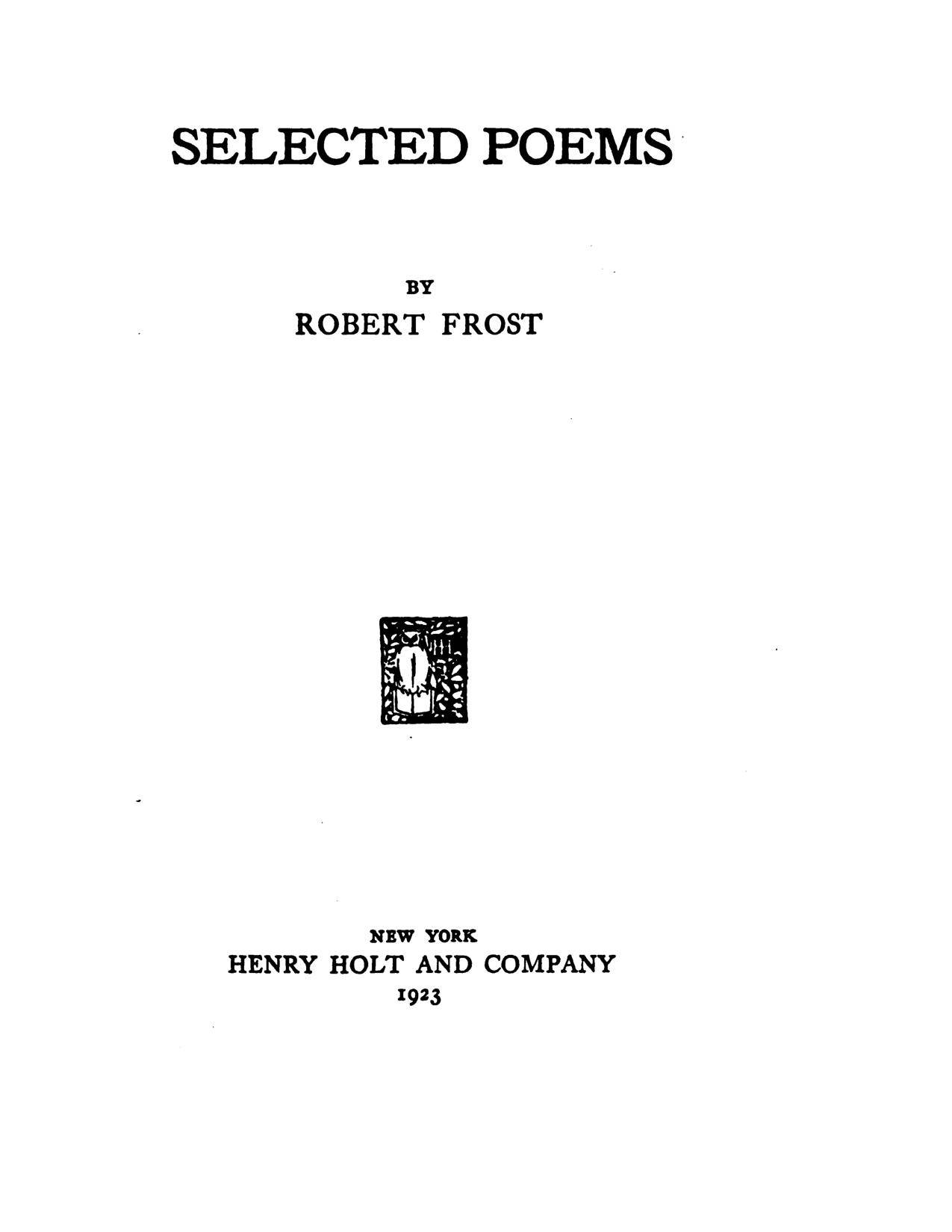
SELECTED POEMS
BY
ROBERT FROST
NEW YORK
HENRY HOLT AND COMPANY
1923
TO
HELEN THOMAS
IN MEMORY OF
EDWARD THOMAS
PUBLISHERS' NOTE
The poems included in this volume are reprinted from "Mountain Interval" "North of Boston" and "A Boy's Will."
I
THE PASTURE
THE COW IN APPLE-TIME
THE RUNAWAY
II
AN OLD MAN'S WINTER NIGHT
HOME BURIAL
THE DEATH OF THE HIRED MAN
A SERVANT TO SERVANTS
THE SELF-SEEKER
THE HILL WIFE
"OUT, OUT...."
III
PUTTING IN THE SEED
GOING FOR WATER
MOWING
IV
AFTER APPLE-PICKING
BIRCHES
THE GUM-GATHERER
THE MOUNTAIN
THE TUFT OF FLOWERS
MENDING WALL
AN ENCOUNTER
THE WOOD-PILE
V
SNOW
IN THE HOME STRETCH
VI
THE ROAD NOT TAKEN
THE OVEN BIRD
A VANTAGE POINT
THE SOUND OF TREES
HYLA BROOK
MY NOVEMBER GUEST
RANGE-FINDING
OCTOBER
TO THE THAWING WIND
VII
A TIME TO TALK
THE CODE
A HUNDRED COLLARS
BLUEBERRIES
BROWN'S DESCENT OR, THE WILLY-NILLY SLIDE
VIII
REVELATION
STORM-FEAR
BOND AND FREE
FLOWER-GATHERING
RELUCTANCE
INTO MY OWN
I
THE PASTURE
I'm going out to clean the pasture spring;
I'll only stop to rake the leaves away
(And wait to watch the water clear, I may):
I shan't be gone long.—You come too.
I'm going out to fetch the little calf
That's standing by the mother. It's so young,
It totters when she licks it with her tongue.
I shan't be gone long.—You come too.
THE COW IN APPLE-TIME
Something inspires the only cow of late
To make no more of a wall than an open gate,
And think no more of wall-builders than fools.
Her face is flecked with pomace and she drools
A cider syrup. Having tasted fruit,
She scorns a pasture withering to the root.
She runs from tree to tree where lie and sweeten
The windfalls spiked with stubble and worm-eaten.
She leaves them bitten when she has to fly.
She bellows on a knoll against the sky.
Her udder shrivels and the milk goes dry.
THE RUNAWAY
Once when the snow of the year was beginning to
fall,
We stopped by a mountain pasture to say "Whose
colt?"
A little Morgan had one forefoot on the wall,
The other curled at his breast. He dipped his head
And snorted at us. And then he had to bolt.
We heard the miniature thunder where he fled,
And we saw him, or thought we saw him, dim and
grey,
Like a shadow against the curtain of falling flakes.
"I think the little fellow's afraid of the snow.
He isn't winter-broken. It isn't play
With the little fellow at all. He's running away.
I doubt if even his mother could tell him, 'Sakes,
It's only weather.' He'd think she didn't know!
Where is his mother? He can't be out alone."
And now he comes again with a clatter of stone
And mounts the wall again with whited eyes
And all his tail that isn't hair up straight.
He shudders his coat as if to throw off flies.
"Whoever it is that leaves him out so late,
When other creatures have gone to stall and bin,
Ought to be told to come and take him in."
II
AN OLD MAN'S WINTER NIGHT
All out of doors looked darkly in at him
Through the thin frost, almost in separate stars,
That gathers on the pane in empty rooms.
What kept his eyes from giving back the gaze
Was the lamp tilted near them in his hand.
What kept him from remembering what it was
That brought him to that creaking room was age.
He stood with barrels round him—at a loss.
And having scared the cellar under him
In clomping there, he scared it once again
In clomping off;—and scared the outer night,
Which has its sounds, familiar, like the roar
Of trees and crack of branches, common things,
But nothing so like beating on a box.
A light he was to no one but himself
Where now he sat, concerned with he knew what,
A quiet light, and then not even that.
He consigned to the moon, such as she was,
So late-arising, to the broken moon
As better than the sun in any case
For such a charge, his snow upon the roof,
His icicles along the wall to keep;
And slept. The log that shifted with a jolt
Once in the stove, disturbed him and he shifted,
And eased his heavy breathing, but still slept.
One aged man—one man—can't keep a house,
A farm, a countryside, or if he can,
It's thus he does it of a winter night.
HOME BURIAL
He saw her from the bottom of the stairs
Before she saw him. She was starting down,
Looking back over her shoulder at some fear.
She took a doubtful step and then undid it
To raise herself and look again. He spoke
Advancing toward her: "What is it you see
From up there always—for I want to know."
She turned and sank upon her skirts at that,
And her face changed from terrified to dull.
He said to gain time: "What is it you see?"
Mounting until she cowered under him.
"I will find out now—you must tell me, dear."
She, in her place, refused him any help
With the least stiffening of her neck and silence.
She let him look, sure that he wouldn't see,
Blind creature; and a while he didn't see.
But at last he murmured, "Oh," and again, "Oh."
"What is it—what?" she said.
"Just that I see."
"You don't," she challenged. "Tell me what it is."
"The wonder is I didn't see at once.
I never noticed it from here before.
I must be wonted to it—that's the reason.
The little graveyard where my people are!
So small the window frames the whole of it.
Not so much larger than a bedroom, is it?
There are three stones of slate and one of marble,
Broad-shouldered little slabs there in the sunlight
On the sidehill. We haven't to mind those.
But I understand: it is not the stones,
But the child's mound——"
"Don't, don't, don't, don't," she cried.
She withdrew shrinking from beneath his arm
That rested on the banister, and slid downstairs;
And turned on him with such a daunting look,
He said twice over before he knew himself:
"Can't a man speak of his own child he's lost?"
"Not you! Oh, where's my hat? Oh, I don't
need it!
I must get out of here. I must get air.
I don't know rightly whether any man can."
"Amy! Don't go to someone else this time.
Listen to me. I won't come down the stairs."
He sat and fixed his chin between his fists.
"There's something I should like to ask you, dear."
"You don't know how to ask it."
"Help me, then."
Her fingers moved the latch for all reply.
"My words are nearly always an offence.
I don't know how to speak of anything
So as to please you. But I might be taught
I should suppose. I can't say I see how.
A man must partly give up being a man
With women-folk. We could have some
arrangement
By which I'd bind myself to keep hands off
Anything special you're a-mind to name.
Though I don't like such things 'twixt those that
love.
Two that don't love can't live together without
them.
But two that do can't live together with them."
She moved the latch a little. "Don't—don't go.
Don't carry it to someone else this time.
Tell me about it if it's something human.
Let me into your grief. I'm not so much
Unlike other folks as your standing there
Apart would make me out. Give me my chance.
I do think, though, you overdo it a little.
What was it brought you up to think it the thing
To take your mother-loss of a first child
So inconsolably—in the face of love.
You'd think his memory might be satisfied——"
"There you go sneering now!"
"I'm not, I'm not!
You make me angry. I'll come down to you.
God, what a woman! And it's come to this,
A man can't speak of his own child that's dead."
"You can't because you don't know how.
If you had any feelings, you that dug
With your own hand—how could you?—his little
grave;
I saw you from that very window there,
Making the gravel leap and leap in air,
Leap up, like that, like that, and land so lightly
And roll back down the mound beside the hole.
I thought, Who is that man? I didn't know you.
And I crept down the stairs and up the stairs
To look again, and still your spade kept lifting.
Then you came in. I heard your rumbling voice
Out in the kitchen, and I don't know why,
But I went near to see with my own eyes.
You could sit there with the stains on your shoes
Of the fresh earth from your own baby's grave
And talk about your everyday concerns.
You had stood the spade up against the wall
Outside there in the entry, for I saw it."
"I shall laugh the worst laugh I ever laughed.
I'm cursed. God, if I don't believe I'm cursed."
"I can repeat the very words you were saying.
'Three foggy mornings and one rainy day
Will rot the best birch fence a man can build.'
Think of it, talk like that at such a time!
What had how long it takes a birch to rot
To do with what was in the darkened parlour?
You couldn't care! The nearest friends can go
With anyone to death, comes so far short
They might as well not try to go at all.
No, from the time when one is sick to death,
One is alone, and he dies more alone.
Friends make pretence of following to the grave,
But before one is in it, their minds are turned
And making the best of their way back to life
And living people, and things they understand.
But the world's evil. I won't have grief so
If I can change it. Oh, I won't, I won't!"
"There, you have said it all and you feel better.
You won't go now. You're crying. Close the door.
The heart's gone out of it: why keep it up?
Amy! There's someone coming down the road!"
"You—oh, you think the talk is all. I must go—
Somewhere out of this house. How can I make
you——"
"If—you—do!" She was opening the door wider.
"Where do you mean to go? First tell me that.
I'll follow and bring you back by force. I will!——"
THE DEATH OF THE HIRED MAN
Mary sat musing on the lamp-flame at the table
Waiting for Warren. When she heard his step,
She ran on tip-toe down the darkened passage
To meet him in the doorway with the news
And put him on his guard. "Silas is back."
She pushed him outward with her through the door
And shut it after her. "Be kind," she said.
She took the market things from Warren's arms
And set them on the porch, then drew him down
To sit beside her on the wooden steps.
"When was I ever anything but kind to him?
But I'll not have the fellow back," he said.
"I told him so last haying, didn't I?
'If he left then,' I said, 'that ended it.'
What good is he? Who else will harbour him
At his age for the little he can do?
What help he is there's no depending on.
Off he goes always when I need him most.
'He thinks he ought to earn a little pay,
Enough at least to buy tobacco with,
So he won't have to beg and be beholden.'
'All right,' I say, 'I can't afford to pay
Any fixed wages, though I wish I could.'
'Someone else can.' 'Then someone else will have
to.'
I shouldn't mind his bettering himself
If that was what it was. You can be certain,
When he begins like that, there's someone at him
Trying to coax him off with pocket-money,—
In haying time, when any help is scarce.
In winter he comes back to us. I'm done."
"Sh! not so loud: he'll hear you," Mary said.
"I want him to: he'll have to soon or late."
"He's worn out. He's asleep beside the stove.
When I came up from Rowe's I found him here,
Huddled against the barn-door fast asleep,
A miserable sight, and frightening, too—
You needn't smile—I didn't recognise him—
I wasn't looking for him—and he's changed.
Wait till you see."
"Where did you say he'd been?"
"He didn't say. I dragged him to the house,
And gave him tea and tried to make him smoke.
I tried to make him talk about his travels.
Nothing would do: he just kept nodding off."
"What did he say? Did he say anything?"
"But little."
"Anything? Mary, confess
He said he'd come to ditch the meadow for me."
"Warren!"
"But did he? I just want to know."
"Of course he did. What would you have him say?
Surely you wouldn't grudge the poor old man
Some humble way to save his self-respect.
He added, if you really care to know,
He meant to clear the upper pasture, too.
That sounds like something you have heard before?
Warren, I wish you could have heard the way
He jumbled everything. I stopped to look
Two or three times—he made me feel so queer—
To see if he was talking in his sleep.
He ran on Harold Wilson—you remember—
The boy you had in haying four years since.
He's finished school, and teaching in his college.
Silas declares you'll have to get him back.
He says they two will make a team for work:
Between them they will lay this farm as smooth!
The way he mixed that in with other things.
He thinks young Wilson a likely lad, though daft
On education—you know how they fought
All through July under the blazing sun,
Silas up on the cart to build the load,
Harold along beside to pitch it on."
"Yes, I took care to keep well out of earshot."
"Well, those days trouble Silas like a dream.
You wouldn't think they would. How some things
linger!
Harold's young college boy's assurance piqued him.
After so many years he still keeps finding
Good arguments he sees he might have used.
I sympathise. I know just how it feels
To think of the right thing to say too late.
Harold's associated in his mind with Latin.
He asked me what I thought of Harold's saying
He studied Latin like the violin
Because he liked it—that an argument!
He said he couldn't make the boy believe
He could find water with a hazel prong—
Which showed how much good school had ever done
him.
He wanted to go over that. But most of all
He thinks if he could have another chance
To teach him how to build a load of hay——"
"I know, that's Silas' one accomplishment.
He bundles every forkful in its place,
And tags and numbers it for future reference,
So he can find and easily dislodge it
In the unloading. Silas does that well.
He takes it out in bunches like big birds' nests.
You never see him standing on the hay
He's trying to lift, straining to lift himself."
"He thinks if he could teach him that, he'd be
Some good perhaps to someone in the world.
He hates to see a boy the fool of books.
Poor Silas, so concerned for other folk,
And nothing to look backward to with pride,
And nothing to look forward to with hope,
So now and never any different."
Part of a moon was falling down the west,
Dragging the whole sky with it to the hills.
Its light poured softly in her lap. She saw
And spread her apron to it. She put out her hand
Among the harp-like morning-glory strings,
Taut with the dew from garden bed to eaves,
As if she played unheard the tenderness
That wrought on him beside her in the night.
"Warren," she said, "he has come home to die:
You needn't be afraid he'll leave you this time."
"Home," he mocked gently.
"Yes, what else but home?
It all depends on what you mean by home.
Of course he's nothing to us, any more
Than was the hound that came a stranger to us
Out of the woods, worn out upon the trail."
"Home is the place where, when you have to go
there,
They have to take you in."
"I should have called it
Something you somehow haven't to deserve."
Warren leaned out and took a step or two,
Picked up a little stick, and brought it back
And broke it in his hand and tossed it by.
"Silas has better claim on us, you think,
Than on his brother? Thirteen little miles
As the road winds would bring him to his door.
Silas has walked that far no doubt to-day.
Why didn't he go there? His brother's rich,
A somebody—director in the bank."
"He never told us that."
"We know it though."
"I think his brother ought to help, of course.
I'll see to that if there is need. He ought of right
To take him in, and might be willing to—
He may be better than appearances.
But have some pity on Silas. Do you think
If he'd had any pride in claiming kin
Or anything he looked for from his brother,
He'd keep so still about him all this time?"
"I wonder what's between them."
"I can tell you.
Silas is what he is—we wouldn't mind him—
But just the kind that kinsfolk can't abide.
He never did a thing so very bad.
He don't know why he isn't quite as good
As anyone. He won't be made ashamed
To please his brother, worthless though he is."
"I can't think Si ever hurt anyone."
"No, but he hurt my heart the way he lay
And rolled his old head on that sharp-edged
chair-back.
He wouldn't let me put him on the lounge.
You must go in and see what you can do.
I made the bed up for him there to-night.
You'll be surprised at him—how much he's broken.
His working days are done; I'm sure of it."
"I'd not be in a hurry to say that."
"I haven't been. Go, look, see for yourself.
But, Warren, please remember how it is:
He's come to help you ditch the meadow.
He has a plan. You mustn't laugh at him.
He may not speak of it, and then he may.
I'll sit and see if that small sailing cloud
Will hit or miss the moon."
It hit the moon.
Then there were three there, making a dim row,
The moon, the little silver cloud, and she.
Warren returned—too soon, it seemed to her,
Slipped to her side, caught up her hand and waited.
"Warren," she questioned.
"Dead," was all he answered.
A SERVANT TO SERVANTS
I didn't make you know how glad I was
To have you come and camp here on our land.
I promised myself to get down some day
And see the way you lived, but I don't know!
With a houseful of hungry men to feed
I guess you'd find.... It seems to me
I can't express my feelings any more
Than I can raise my voice or want to lift
My hand (oh, I can lift it when I have to).
Did ever you feel so? I hope you never.
It's got so I don't even know for sure
Whether I am glad, sorry, or anything.
There's nothing but a voice-like left inside
That seems to tell me how I ought to feel,
And would feel if I wasn't all gone wrong.
You take the lake. I look and look at it.
I see it's a fair, pretty sheet of water.
I stand and make myself repeat out loud
The advantages it has, so long and narrow,
Like a deep piece of some old running river
Cut short off at both ends. It lies five miles
Straight away through the mountain notch
From the sink window where I wash the plates,
And all our storms come up toward the house,
Drawing the slow waves whiter and whiter and
whiter.
It took my mind off doughnuts and soda biscuit
To step outdoors and take the water dazzle
A sunny morning, or take the rising wind
About my face and body and through my wrapper,
When a storm threatened from the Dragon's Den,
And a cold chill shivered across the lake.
I see it's a fair, pretty sheet of water,
Our Willoughby! How did you hear of it?
I expect, though, everyone's heard of it.
In a book about ferns? Listen to that!
You let things more like feathers regulate
Your going and coming. And you like it here?
I can see how you might. But I don't know!
It would be different if more people came,
For then there would be business. As it is,
The cottages Len built, sometimes we rent them,
Sometimes we don't. We've a good piece of shore
That ought to be worth something, and may yet.
But I don't count on it as much as Len.
He looks on the bright side of everything,
Including me. He thinks I'll be all right
With doctoring. But it's not medicine—
Lowe is the only doctor's dared to say so—
It's rest I want—there, I have said it out—
From cooking meals for hungry hired men
And washing dishes after them—from doing
Things over and over that just won't stay done.
By good rights I ought not to have so much
Put on me, but there seems no other way.
Len says one steady pull more ought to do it.
He says the best way out is always through.
And I agree to that, or in so far
As that I can see no way out but through—
Leastways for me—and then they'll be convinced.
It's not that Len don't want the best for me.
It was his plan our moving over in
Beside the lake from where that day I showed you
We used to live—ten miles from anywhere
We didn't change without some sacrifice,
But Len went at it to make up the loss.
His work's a man's, of course, from sun to sun,
But he works when he works as hard as I do—
Though there's small profit in comparisons.
(Women and men will make them all the same.)
But work ain't all. Len undertakes too much.
He's into everything in town. This year
It's highways, and he's got too many men
Around him to look after that make waste.
They take advantage of him shamefully,
And proud, too, of themselves for doing so.
We have four here to board, great good-for-nothings,
Sprawling about the kitchen with their talk
While I fry their bacon. Much they care!
No more put out in what they do or say
Than if I wasn't in the room at all.
Coming and going all the time, they are:
I don't learn what their names are, let alone
Their characters, or whether they are safe
To have inside the house with doors unlocked.
I'm not afraid of them, though, if they're not
Afraid of me. There's two can play at that.
I have my fancies: it runs in the family.
My father's brother wasn't right. They kept him
Locked up for years back there at the old farm.
I've been away once—yes, I've been away.
The State Asylum. I was prejudiced;
I wouldn't have sent anyone of mine there;
You know the old idea—the only asylum
Was the poorhouse, and those who could afford,
Rather than send their folks to such a place,
Kept them at home; and it does seem more human.
But it's not so: the place is the asylum.
There they have every means proper to do with,
And you aren't darkening other people's lives—
Worse than no good to them, and they no good
To you in your condition; you can't know
Affection or the want of it in that state.
I've heard too much of the old-fashioned way.
My father's brother, he went mad quite young.
Some thought he had been bitten by a dog,
Because his violence took on the form
Of carrying his pillow in his teeth;
But it's more likely he was crossed in love,
Or so the story goes. It was some girl.
Anyway, all he talked about was love.
They soon saw he would do someone a mischief
If he wa'n't kept strict watch of, and it ended
In father's building him a sort of cage,
Or room within a room, of hickory poles,
Like stanchions in the barn, from floor to ceiling,—
A narrow passage all the way around.
Anything they put in for furniture
He'd tear to pieces, even a bed to lie on.
So they made the place comfortable with straw,
Like a beast's stall, to ease their consciences.
Of course they had to feed him without dishes.
They tried to keep him clothed, but he paraded
With his clothes on his arm—all of his clothes.
Cruel—it sounds. I s'pose they did the best
They knew. And just when he was at the height,
Father and mother married, and mother came,
A bride, to help take care of such a creature,
And accommodate her young life to his.
That was what marrying father meant to her.
She had to lie and hear love things made dreadful
By his shouts in the night. He'd shout and shout
Until the strength was shouted out of him,
And his voice died down slowly from exhaustion.
He'd pull his bars apart like bow and bow-string,
And let them go and make them twang until
His hands had worn them smooth as any ox-bow.
And then he'd crow as if he thought that child's
play—
The only fun he had. I've heard them say, though,
They found a way to put a stop to it.
He was before my time—I never saw him;
But the pen stayed exactly as it was
There in the upper chamber in the ell,
A sort of catch-all full of attic clutter.
I often think of the smooth hickory bars.
It got so I would say—you know, half fooling—
"It's time I took my turn upstairs in jail"—
Just as you will till it becomes a habit.
No wonder I was glad to get away.
Mind you, I waited till Len said the word.
I didn't want the blame if things went wrong.
I was glad though, no end, when we moved out,
And I looked to be happy, and I was,
As I said, for a while—but I don't know!
Somehow the change wore out like a prescription.
And there's more to it than just window-views
And living by a lake. I'm past such help—
Unless Len took the notion, which he won't,
And I won't ask him—it's not sure enough.
I 'spose I've got to go the road I'm going:
Other folks have to, and why shouldn't I?
I almost think if I could do like you,
Drop everything and live out on the ground—
But it might be, come night, I shouldn't like it,
Or a long rain. I should soon get enough,
And be glad of a good roof overhead.
I've lain awake thinking of you, I'll warrant,
More than you have yourself, some of these nights.
The wonder was the tents weren't snatched away
From over you as you lay in your beds.
I haven't courage for a risk like that.
Bless you, of course, you're keeping me from work,
But the thing of it is, I need to be kept.
There's work enough to do—there's always that;
But behind's behind. The worst that you can do
Is set me back a little more behind.
I shan't catch up in this world, anyway.
I'd rather you'd not go unless you must.
THE SELF-SEEKER
"Willis, I didn't want you here to-day:
The lawyer's coming for the company.
I'm going to sell my soul, or, rather, feet.
Five hundred dollars for the pair, you know."
"With you the feet have nearly been the soul;
And if you're going to sell them to the devil,
I want to see you do it. When's he coming?"
"I half suspect you knew, and came on purpose
To try to help me drive a better bargain."
"Well, if it's true! Yours are no common feet.
The lawyer don't know what it is he's buying:
So many miles you might have walked you won't
walk.
You haven't run your forty orchids down.
What does he think?—How are the blessed feet?
The doctor's sure you're going to walk again?"
"He thinks I'll hobble. It's both legs and feet."
"They must be terrible—I mean to look at."
"I haven't dared to look at them uncovered.
Through the bed blankets I remind myself
Of a starfish laid out with rigid points."
"The wonder is it hadn't been your head."
"It's hard to tell you how I managed it.
When I saw the shaft had me by the coat,
I didn't try too long to pull away,
Or fumble for my knife to cut away,
I just embraced the shaft and rode it out—
Till Weiss shut off the water in the wheel-pit.
That's how I think I didn't lose my head,
But my legs got their knocks against the ceiling."
"Awful. Why didn't they throw off the belt
Instead of going clear down in the wheel-pit?"
"They say sometime was wasted on the belt—
Old streak of leather—doesn't love me much
Because I made him spit fire at my knuckles,
The way Ben Franklin used to make the kite-string.
That must be it. Some days he won't stay on.
That day a woman couldn't coax him off.
He's on his rounds now with his tail in his mouth
Snatched right and left across the silver pulleys.
Everything goes the same without me there.
You can hear the small buzz saws whine, the big saw
Caterwaul to the hills around the village
As they both bite the wood. It's all our music.
One ought as a good villager to like it.
No doubt it has a sort of prosperous sound,
And it's our life."
"Yes, when it's not our death."
"You make that sound as if it wasn't so
With everything. What we live by we die by.
I wonder where my lawyer is. His train's in.
I want this over with; I'm hot and tired."
"You're getting ready to do something foolish."
"Watch for him, will you, Will? You let him in.
I'd rather Mrs. Corbin didn't know;
I've boarded here so long, she thinks she owns me.
You're bad enough to manage without her."
"And I'm going to be worse instead of better.
You've got to tell me how far this is gone:
Have you agreed to any price?"
"Five hundred.
Five hundred—five—five! One, two, three, four,
five.
You needn't look at me."
"I don't believe you."
"I told you, Willis, when you first came in.
Don't you be hard on me. I have to take
What I can get. You see they have the feet,
Which gives them the advantage in the trade.
I can't get back the feet in any case."
"But your flowers, man, you're selling out your
flowers."
"Yes, that's one way to put it—all the flowers
Of every kind everywhere in this region
For the next forty summers—call it forty.
But I'm not selling those, I'm giving them,
They never earned me so much as one cent:
Money can't pay me for the loss of them.
No, the five hundred was the sum they named
To pay the doctor's bill and tide me over.
It's that or fight, and I don't want to fight—
I just want to get settled in my life,
Such as it's going to be, and know the worst,
Or best—it may not be so bad. The firm
Promise me all the shooks I want to nail."
"But what about your flora of the valley?"
"You have me there. But that—you didn't think
That was worth money to me? Still, I own
It goes against me not to finish it
For the friends it might bring me. By the way,
I had a letter from Burroughs—did I tell you?—
About my Cyprepedium reginœ;
He says it's not reported so far north.
There! there's the bell. He's rung. But you go
down
And bring him up, and don't let Mrs. Corbin.—
Oh, well, we'll soon be through with it. I'm tired."
Willis brought up besides the Boston lawyer
A little barefoot girl who in the noise
Of heavy footsteps in the old frame house,
And baritone importance of the lawyer,
Stood for a while unnoticed with her hands
Shyly behind her.
"Well, and how is Mister—"
The lawyer was already in his satchel
As if for papers that might bear the name
He hadn't at command. "You must excuse me,
I dropped in at the mill and was detained."
"Looking round, I suppose," said Willis.
"Yes,
Well, yes."
"Hear anything that might prove useful?"
The Broken One saw Anne. "Why, here is Anne
What do you want, dear? Come, stand by the bed;
Tell me what is it?" Anne just wagged her dress
With both hands held behind her. "Guess," she
said.
"Oh, guess which hand? My, my! Once on a
time
I knew a lovely way to tell for certain
By looking in the ears. But I forget it.
Er, let me see. I think I'll take the right.
That's sure to be right even if it's wrong.
Come, hold it out. Don't change.—A Ram's Horn
orchid!
A Ram's Horn! What would I have got, I wonder,
If I had chosen left. Hold out the left.
Another Ram's Horn! Where did you find those,
Under what beech tree, on what woodchuck's knoll?"
Anne looked at the large lawyer at her side,
And thought she wouldn't venture on so much.
"Were there no others?"
"There were four or five.
I knew you wouldn't let me pick them all."
"I wouldn't—so I wouldn't. You're the girl!
You see Anne has her lesson learned by heart."
"I wanted there should be some there next year."
"Of course you did. You left the rest for seed,
And for the backwoods woodchuck. You're the girl!
A Ram's Horn orchid seedpod for a woodchuck
Sounds something like. Better than farmer's beans
To a discriminating appetite,
Though the Ram's Horn is seldom to be had
In bushel lots—doesn't come on the market.
But, Anne, I'm troubled; have you told me all?
You're hiding something. That's as bad as lying.
You ask this lawyer man. And it's not safe
With a lawyer at hand to find you out.
Nothing is hidden from some people, Anne.
You don't tell me that where you found a Ram's
Horn
You didn't find a Yellow Lady's Slipper.
What did I tell you? What? I'd blush, I would.
Don't you defend yourself. If it was there,
Where is it now, the Yellow Lady's Slipper?"
"Well, wait—it's common—it's too common."
"Common?
The Purple Lady's Slipper's commoner."
"I didn't bring a Purple Lady's Slipper
To You—to you I mean—they're both too
common."
The lawyer gave a laugh among his papers
As if with some idea that she had scored.
"I've broken Anne of gathering bouquets.
It's not fair to the child. It can't be helped
though:
Pressed into service means pressed out of shape.
Somehow I'll make it right with her—she'll see.
She's going to do my scouting in the field,
Over stone walls and all along a wood
And by a river bank for water flowers,
The floating Heart, with small leaf like a heart,
And at the sinus under water a fist
Of little fingers all kept down but one,
And that thrust up to blossom in the sun
As if to say 'You! You're the Heart's desire.'
Anne has a way with flowers to take the place
Of that she's lost: she goes down on one knee
And lifts their faces by the chin to hers
And says their names, and leaves them where they
are."
The lawyer wore a watch the case of which
Was cunningly devised to make a noise
Like a small pistol when he snapped it shut
At such a time as this. He snapped it now.
"Well, Anne, go, dearie. Our affair will wait.
The lawyer man is thinking of his train.
He wants to give me lots and lots of money
Before he goes, because I hurt myself,
And it may take him I don't know how long.
But put our flowers in water first. Will, help her:
The pitcher's too full for her. There's no cup?
Just hook them on the inside of the pitcher.
Now run.—Get out your documents! You see
I have to keep on the good side of Anne.
I'm a great boy to think of number one.
And you can't blame me in the place I'm in.
Who will take care of my necessities
Unless I do?"
"A pretty interlude,"
The lawyer said: "I'm sorry, but my train——
Luckily terms are all agreed upon.
You only have to sign your name. Right—there."
"You, Will, stop making faces. Come round here
Where you can't make them. What is it you want?
I'll put you out with Anne. Be good or go."
"You don't mean you will sign that thing unread?"
"Make yourself useful then, and read it for me.
Isn't it something I have seen before?"
"You'll find it is. Let your friend look at it."
"Yes, but all that takes time, and I'm as much
In haste to get it over with as you.
But read it, read it. That's right, draw the curtain:
Half the time I don't know what's troubling me.—
What do you say, Will? Don't you be a fool.
You! crumpling folkses' legal documents.
Out with it if you've any real objection."
"Five hundred dollars!"
"What would you think right?"
"A thousand wouldn't be a cent too much;
You know it, Mr. Lawyer. The sin is
Accepting anything before he knows
Whether he's ever going to walk again.
It smells to me like a dishonest trick."
"I think—I think—from what I heard to-day—
And saw myself—he would be ill-advised——"
"What did you hear, for instance?" Willis said.
"Now the place where the accident occurred——"
The Broken One was twisted in his bed.
"This is between you two apparently.
Where I come in is what I want to know.
You stand up to it like a pair of cocks.
Go outdoors if you want to fight. Spare me.
When you come back, I'll have the papers signed.
Will pencil do? Then, please, your fountain pen.
One of you hold my head up from the pillow."
Willis flung off the bed. "I wash my hands—
I'm no match—no, and don't pretend to be——"
The lawyer gravely capped his fountain pen.
"You're doing the wise thing: you won't regret it.
We're very sorry for you."
Willis sneered:
"Who's we?—some stockholders in Boston?
I'll go outdoors, by gad! and won't come back."
"Willis, bring Anne back with you when you come.
Yes. Thanks for caring. Don't mind Will: he's
savage.
He thinks you ought to pay me for my flowers.
You don't know what I mean about the flowers.
Don't stop to try now. You'll miss your train.
Good-bye." He flung his arms around his face.
THE HILL WIFE
LONELINESS
(Her Word)
One ought not to have to care
So much as you and I
Care when the birds come round the house
To seem to say good-bye;
Or care so much when they come back
With whatever it is they sing;
The truth being we are as much
Too glad for the one thing
As we are too sad for the other here—
With birds that fill their breasts
But with each other and themselves
And their built or driven nests.
HOUSE FEAR
Always—I tell you this they learned—
Always at night when they returned
To the lonely house from far away
To lamps unlighted and fire gone gray,
They learned to rattle the lock and key
To give whatever might chance to be
Warning and time to be off in flight:
And preferring the out- to the in-door night,
They learned to leave the house-door wide
Until they had lit the lamp inside.
THE SMILE
(Her Word)
I didn't like the way he went away.
That smile! It never came of being gay.
Still, he smiled—did you see him?—I was sure!
Perhaps because we gave him only bread
And the wretch knew from that that we were poor.
Perhaps because he let us give instead
Of seizing from us as he might have seized.
Perhaps he mocked at us for being wed,
Or being very young (and he was pleased
To have a vision of us old and dead).
I wonder how far down the road he's got.
He's watching from the woods as like as not.
THE OFT-REPEATED DREAM
She had no saying dark enough
For the dark pine that kept
Forever trying the window-latch
Of the room where they slept.
The tireless but ineffectual hands
That with every futile pass
Made the great tree seem as a little bird
Before the mystery of glass!
It never had been inside the room,
And only one of the two
Was afraid in an oft-repeated dream
Of what the tree might do.
THE IMPULSE
It was too lonely for her there,
And too wild,
And since there were but two of them,
And no child,
And work was little in the house,
She was free,
And followed where he furrowed field,
Or felled tree.
She rested on a log and tossed
The fresh chips,
With a song only to herself
On her lips.
And once she went to break a bough
Of black alder.
She strayed so far she scarcely heard
When he called her—
And didn't answer—didn't speak—
Or return.
She stood, and then she ran and hid
In the fern.
He never found her, though he looked
Everywhere,
And he asked at her mother's house
Was she there.
Sudden and swift and light as that
The ties gave,
And he learned of finalities
Besides the grave.
OUT, OUT....
The buzz-saw snarled and rattled in the yard
And made dust and dropped stove-length sticks of
wood,
Sweet-scented stuff when the breeze drew across it.
And from there those that lifted eyes could count
Five mountain ranges one behind the other
Under the sunset far into Vermont.
And the saw snarled and rattled, snarled and rattled,
As it ran light, or had to bear a load.
And nothing happened: day was all but done.
Call it a day, I wish they might have said
To please the boy by giving him the half hour
That a boy counts so much when saved from work.
His sister stood beside them in her apron
To tell them "Supper." At the word, the saw,
As if to prove saws knew what supper meant,
Leaped out at the boy's hand, or seemed to leap—
He must have given the hand. However it was,
Neither refused the meeting. But the hand!
The boy's first outcry was a rueful laugh.
As he swung toward them holding up the hand
Half in appeal, but half as if to keep
The life from spilling. Then the boy saw all—
Since he was old enough to know, big boy
Doing a man's work, though a child at heart—
He saw all spoiled. "Don't let him cut my hand of—
The doctor, when he comes. Don't let him, sister!"
So. But the hand was gone already.
The doctor put him in the dark of ether.
He lay and puffed his lips out with his breath.
And then—the watcher at his pulse took fright.
No one believed. They listened at his heart.
Little—less—nothing!—and that ended it.
No more to build on there. And they, since they
Were not the one dead, turned to their affairs.
III
PUTTING IN THE SEED
You come to fetch me from my work to-night
When supper's on the table, and we'll see
If I can leave off burying the white
Soft petals fallen from the apple tree
(Soft petals, yes, but not so barren quite,
Mingled with these, smooth bean and wrinkled
pea);
And go along with you ere you lose sight
Of what you came for and become like me,
Slave to a springtime passion for the earth.
How Love bums through the Putting in the Seed
On through the watching for that early birth
When, just as the soil tarnishes with weed,
The sturdy seedling with arched body comes
Shouldering its way and shedding the earth crumbs.
GOING FOR WATER
The well was dry beside the door,
And so we went with pail and can
Across the fields behind the house
To seek the brook if still it ran;
Not loth to have excuse to go,
Because the autumn eve was fair
(Though chill), because the fields were ours,
And by the brook our woods were there.
We ran as if to meet the moon
That slowly dawned behind the trees,
The barren boughs without the leaves,
Without the birds, without the breeze.
But once within the wood, we paused
Like gnomes that hid us from the moon,
Ready to run to hiding new
With laughter when she found us soon.
Each laid on other a staying hand
To listen ere we dared to look,
And in the hush we joined to make
We heard, we knew we heard the brook.
A note as from a single place,
A slender tinkling fall that made
Now drops that floated on the pool
Like pearls, and now a silver blade.
MOWING
There was never a sound beside the wood but one,
And that was my long scythe whispering to the
ground.
What was it it whispered? I knew not well myself;
Perhaps it was something about the heat of the sun,
Something, perhaps, about the lack of sound—
And that was why it whispered and did not speak.
It was no dream of the gift of idle hours,
Or easy gold at the hand of fay or elf:
Anything more than the truth would have seemed
too weak
To the earnest love that laid the swale in rows,
Not without feeble-pointed spikes of flowers
(Pale orchises), and scared a bright green snake.
The fact is the sweetest dream that labour knows.
My long scythe whispered and left the hay to make.
IV
AFTER APPLE-PICKING
My long two-pointed ladder's sticking through a tree
Toward heaven still,
And there's a barrel that I didn't fill
Beside it, and there may be two or three
Apples I didn't pick upon some bough.
But I am done with apple-picking now.
Essence of winter sleep is on the night,
The scent of apples: I am drowsing off.
I cannot rub the strangeness from my sight
I got from looking through a pane of glass
I skimmed this morning from the drinking trough
And held against the world of hoary grass.
It melted, and I let it fall and break.
But I was well
Upon my way to sleep before it fell,
And I could tell
What form my dreaming was about to take.
Magnified apples appear and disappear,
Stem end and blossom end,
And every fleck of russet showing clear.
My instep arch not only keeps the ache,
It keeps the pressure of a ladder-round.
I feel the ladder sway as the boughs bend.
And I keep hearing from the cellar bin
The rumbling sound
Of load on load of apples coming in.
For I have had too much
Of apple-picking: I am overtired
Of the great harvest I myself desired.
There were ten thousand thousand fruit to touch,
Cherish in hand, lift down, and not let fall.
For all
That struck the earth,
No matter if not bruised or spiked with stubble,
Went surely to the cider-apple heap
As of no worth.
One can see what will trouble
This sleep of mine, whatever sleep it is.
Were he not gone,
The woodchuck could say whether it's like his
Long sleep, as I describe its coming on,
Or just some human sleep.
BIRCHES
When I see birches bend to left and right
Across the lines of straighter darker trees,
I like to think some boy's been swinging them.
But swinging doesn't bend them down to stay.
Ice-storms do that. Often you must have seen them
Loaded with ice a sunny winter morning
After a rain. They click upon themselves
As the breeze rises, and turn many-coloured
As the stir cracks and crazes their enamel.
Soon the sun's warmth makes them shed crystal
shells
Shattering and avalanching on the snow-crust—
Such heaps of broken glass to sweep away
You'd think the inner dome of heaven had fallen.
They are dragged to the withered bracken by the
load,
And they seem not to break; though once they are
bowed
So low for long, they never right themselves:
You may see their trunks arching in the woods
Years afterwards, trailing their leaves on the ground,
Like girls on hands and knees that throw their hair
Before them over their heads to dry in the sun.
But I was going to say when Truth broke in
With all her matter-of-fact about the ice-storm,
I should prefer to have some boy bend them
As he went out and in to fetch the cows—
Some boy too far from town to learn baseball,
Whose only play was what he found himself,
Summer or winter, and could play alone.
One by one he subdued his father's trees
By riding them down over and over again
Until he took the stiffness out of them,
And not one but hung limp, not one was left
For him to conquer. He learned all there was
To learn about not launching out too soon
And so not carrying the tree away
Clear to the ground. He always kept his poise
To the top branches, climbing carefully
With the same pains you use to fill a cup
Up to the brim, and even above the brim.
Then he flung outward, feet first, with a swish,
Kicking his way down through the air to the ground.
So was I once myself a swinger of birches.
And so I dream of going back to be.
It's when I'm weary of considerations,
And life is too much like a pathless wood
Where your face burns and tickles with the cobwebs
Broken across it, and one eye is weeping
From a twig's having lashed across it open.
I'd like to get away from earth awhile
And then come back to it and begin over.
May no fate wilfully misunderstand me
And half grant what I wish and snatch me away
Not to return. Earth's the right place for love:
I don't know where it's likely to go better.
I'd like to go by climbing a birch tree,
And climb black branches up a snow-white trunk
Toward heaven, till the tree could bear no more,
But dipped its top and set me down again.
That would be good both going and coming back.
One could do worse than be a swinger of birches.
THE GUM-GATHERER
There overtook me and drew me in
To his down-hill, early-morning stride,
And set me five miles on my road
Better than if he had had me ride,
A man with a swinging bag for load
And half the bag wound round his hand.
We talked like barking above the din
Of water we walked along beside.
And for my telling him where I'd been
And where I lived in mountain land
To be coming home the way I was,
He told me a little about himself.
He came from higher up in the pass
Where the grist of the new-beginning brooks
Is blocks split off the mountain mass—
And hopeless grist enough it looks
Ever to grind to soil for grass.
(The way it is will do for moss.)
There he had built his stolen shack.
It had to be a stolen shack
Because of the fears of fire and loss
That trouble the sleep of lumber folk:
Visions of half the world burned black
And the sun shrunken yellow in smoke.
We know who when they come to town
Bring berries under the wagon seat,
Or a basket of eggs between their feet;
What this man brought in a cotton sack
Was gum, the gum of the mountain spruce.
He showed me lumps of the scented stuff
Like uncut jewels, dull and rough.
It comes to market golden brown;
But turns to pink between the teeth.
I told him this is a pleasant life
To set your breast to the bark of trees
That all your days are dim beneath,
And reaching up with a little knife,
To loose the resin and take it down
And bring it to market when you please.
THE MOUNTAIN
The mountain held the town as in a shadow.
I saw so much before I slept there once:
I noticed that I missed stars in the west,
Where its black body cut into the sky.
Near me it seemed: I felt it like a wall
Behind which I was sheltered from a wind.
And yet between the town and it I found,
When I walked forth at dawn to see new things,
Were fields, a river, and beyond, more fields.
The river at the time was fallen away,
And made a widespread brawl on cobble-stones;
But the signs showed what it had done in spring;
Good grass-land gullied out, and in the grass
Ridges of sand, and driftwood stripped of bark.
I crossed the river and swung round the mountain.
And there I met a man who moved so slow
With white-faced oxen in a heavy cart,
It seemed no harm to stop him altogether.
"What town is this?" I asked.
"This? Lunenburg."
Then I was wrong: the town of my sojourn,
Beyond the bridge, was not that of the mountain,
But only felt at night its shadowy presence.
"Where is your village? Very far from here?"
"There is no village—only scattered farms.
We were but sixty voters last election.
We can't in nature grow to many more:
That thing takes all the room!" He moved his goad.
The mountain stood there to be pointed at.
Pasture ran up the side a little way,
And then there was a wall of trees with trunks:
After that only tops of trees, and cliffs
Imperfectly concealed among the leaves.
A dry ravine emerged from under boughs
Into the pasture.
"That looks like a path.
Is that the way to reach the top from here?—
Not for this morning, but some other time:
I must be getting back to breakfast now."
"I don't advise your trying from this side.
There is no proper path, but those that have
Been up, I understand, have climbed from Ladd's.
That's five miles back. You can't mistake the place:
They logged it there last winter some way up.
I'd take you, but I'm bound the other way."
"You've never climbed it?"
"I've been on the sides
Deer-hunting and trout-fishing. There's a brook
That starts up on it somewhere—I've heard say
Right on the top, tip-top—a curious thing.
But what would interest you about the brook,
It's always cold in summer, warm in winter.
One of the great sights going is to see
It steam in winter like an ox's breath.
Until the bushes all along its banks
Are inch-deep with the frosty spines and bristles—
You know the kind. Then let the sun shine on it!"
"There ought to be a view around the world
From such a mountain—if it isn't wooded
Clear to the top." I saw through leafy screens
Great granite terraces in sun and shadow,
Shelves one could rest a knee on getting up—
With depths behind him sheer a hundred feet;
Or turn and sit on and look out and down,
With little ferns in crevices at his elbow.v
"As to that I can't say. But there's the spring,
Right on the summit, almost like a fountain.
That ought to be worth seeing."
"If it's there.
You never saw it?"
"I guess there's no doubt
About its being there. I never saw it.
It may not be right on the very top:
It wouldn't have to be a long way down
To have some head of water from above,
And a good distance down might not be noticed
By anyone who'd come a long way up.
One time I asked a fellow climbing it
To look and tell me later how it was."
"What did he say?"
"He said there was a lake
Somewhere in Ireland on a mountain top."
"But a lake's different. What about the spring?"
"He never got up high enough to see.
That's why I don't advise your trying this side.
He tried this side. I've always meant to go
And look myself, but you know how it is:
It doesn't seem so much to climb a mountain
You've worked around the foot of all your life.
What would I do? Go in my overalls,
With a big stick, the same as when the cows
Haven't come down to the bars at milking time?
Or with a shotgun for a stray black bear?
'Twouldn't seem real to climb for climbing it."
"I shouldn't climb it if I didn't want to—
Not for the sake of climbing. What's its name?"
"We call it Hor: I don't know if that's right."
"Can one walk round it? Would it be too far?"
"You can drive round and keep in Lunenburg,
But it's as much as ever you can do,
The boundary lines keep in so close to it.
Hor is the township, and the township's Hor—
And a few houses sprinkled round the foot,
Like boulders broken off the upper cliff,
Rolled out a little farther than the rest."
"Warm in December, cold in June, you say?"
"I don't suppose the waters changed at all.
You and I know enough to know it's warm
Compared with cold, and cold compared with warm.
But all the fun's in how you say a thing."
"You've lived here all your life?"
"Ever since Hor
Was no bigger than a——" What, I did not hear.
He drew the oxen toward him with light touches
Of his slim goad on nose and offside flank,
Gave them their marching orders, and was moving.
THE TUFT OF FLOWERS
I went to turn the grass once after one
Who mowed it in the dew before the sun.
The dew was gone that made his blade so keen
Before I came to view the levelled scene.
I looked for him behind an isle of trees;
I listened for his whetstone on the breeze.
But he had gone his way, the grass all mown,
And I must be, as he had been—alone,
"As all must be," I said within my heart,
"Whether they work together or apart."
But as I said it, swift there passed me by
On noiseless wing a bewildered butterfly,
Seeking with memories grown dim o'er night
Some resting flower of yesterday's delight.
And once I marked his flight go round and round,
As where some flower lay withering on the ground.
And then he flew as far as eye could see,
And then on tremulous wing came back to me.
I thought of questions that have no reply,
And would have turned to toss the grass to dry;
But he turned first, and led my eye to look
At a tall tuft of flowers beside a brook,
A leaping tongue of bloom the scythe had spared
Beside a reedy brook the scythe had bared.
I left my place to know them by their name,
Finding them butterfly weed when I came.
The mower in the dew had loved them thus,
By leaving them to flourish, not for us,
Nor yet to draw one thought of ours to him.
But from sheer morning gladness at the brim.
The butterfly and I had lit upon,
Nevertheless, a message from the dawn.
That made me hear the wakening birds around,
And hear his long scythe whispering to the ground,
And feel a spirit kindred to my own;
So that henceforth I worked no more alone;
But glad with him, I worked as with his aid,
And weary, sought at noon with him the shade;
And dreaming, as it were, held brotherly speech
With one whose thought I had not hoped to reach.
"Men work together," I told him from the heart,
"Whether they work together or apart."
MENDING WALL
Something there is that doesn't love a wall,
That sends the frozen-ground-swell under it,
And spills the upper boulders in the sun;
And makes gaps even two can pass abreast.
The work of hunters is another thing:
I have come after them and made repair
Where they have left not one stone on a stone,
But they would have the rabbit out of hiding,
To please the yelping dogs. The gaps I mean,
No one has seen them made or heard them made,
But at spring mending-time we find them there.
I let my neighbour know beyond the hill;
And on a day we meet to walk the line
And set the wall between us once again.
We keep the wall between us as we go.
To each the boulders that have fallen to each.
And some are loaves and some so nearly balls
We have to use a spell to make them balance:
"Stay where you are until our backs are turned!"
We wear our fingers rough with handling them.
Oh, just another kind of out-door game,
One on a side. It comes to little more:
There where it is we do not need the wall:
He is all pine and I am apple orchard.
My apple trees will never get across
And eat the cones under his pines, I tell him.
He only says, "Good fences make good neighbours."
Spring is the mischief in me, and I wonder
If I could put a notion in his head:
"Why do they make good neighbours? Isn't it
Where there are cows? But here there are no cows.
Before I built a wall I'd ask to know
What I was walling in or walling out,
And to whom I was like to give offence.
Something there is that doesn't love a wall,
That wants it down." I could say "Elves" to him,
But it's not elves exactly, and I'd rather
He said it for himself. I see him there
Bringing a stone grasped firmly by the top
In each hand, like an old-stone savage armed.
He moves in darkness as it seems to me,
Not of woods only and the shade of trees.
He will not go behind his father's saying,
And he likes having thought of it so well
He says again, "Good fences make good
neighbours."
AN ENCOUNTER
Once on the kind of day called "weather breeder,"
When the heat slowly hazes and the sun
By its own power seems to be undone,
I was half boring through, half climbing through,
A swamp of cedar. Choked with oil of cedar
And scurf of plants, and weary and over-heated,
And sorry I ever left the road I knew,
I paused and rested on a sort of hook
That had me by the coat as good as seated,
And since there was no other way to look,
Looked up toward heaven, and there against the
blue
Stood over me a resurrected tree,
A tree that had been down and raised again—
A barkless spectre. He had halted too,
As if for fear of treading upon me.
I saw the strange position of his hands—
Up at his shoulders, dragging yellow strands
Of wire with something in it from men to men.
"You here?" I said. "Where aren't you nowadays?
And what's the news you carry—if you know?
And tell me where you're off for—Montreal?
Me? I'm not off for anywhere at all.
Sometimes I wander out of beaten ways
Half looking for the orchid Calypso."
THE WOOD-PILE
Out walking in the frozen swamp one gray day
I paused and said, "I will turn back from here.
No, I will go on farther—and we shall see."
The hard snow held me, save where now and then
One foot went through. The view was all in lines
Straight up and down of tall slim trees
Too much alike to mark or name a place by
So as to say for certain I was here
Or somewhere else: I was just far from home.
A small bird flew before me. He was careful
To put a tree between us when he lighted,
And say no word to tell me who he was
Who was so foolish as to think what he thought.
He thought that I was after him for a feather—
The white one in his tail; like one who takes
Everything said as personal to himself.
One flight out sideways would have undeceived him.
And then there was a pile of wood for which
I forgot him and let his little fear
Carry him off the way I might have gone,
Without so much as wishing him good-night.
He went behind it to make his last stand.
It was a cord of maple, cut and split
And piled—and measured, four by four by eight.
And not another like it could I see.
No runner tracks in this year's snow looped near it.
And it was older sure than this year's cutting,
Or even last year's or the year's before.
The wood was gray and the bark warping off it
And the pile somewhat sunken. Clematis
Had wound strings round and round it like a bundle.
What held it though on one side was a tree
Still growing, and on one a stake and prop,
These latter about to fall. I thought that only
Someone who lived in turning to fresh tasks
Could so forget his handiwork on which
He spent himself, the labour of his axe,
And leave it there far from a useful fireplace
To warm the frozen swamp as best it could
With the slow smokeless burning of decay.