
CHAPTER XI.
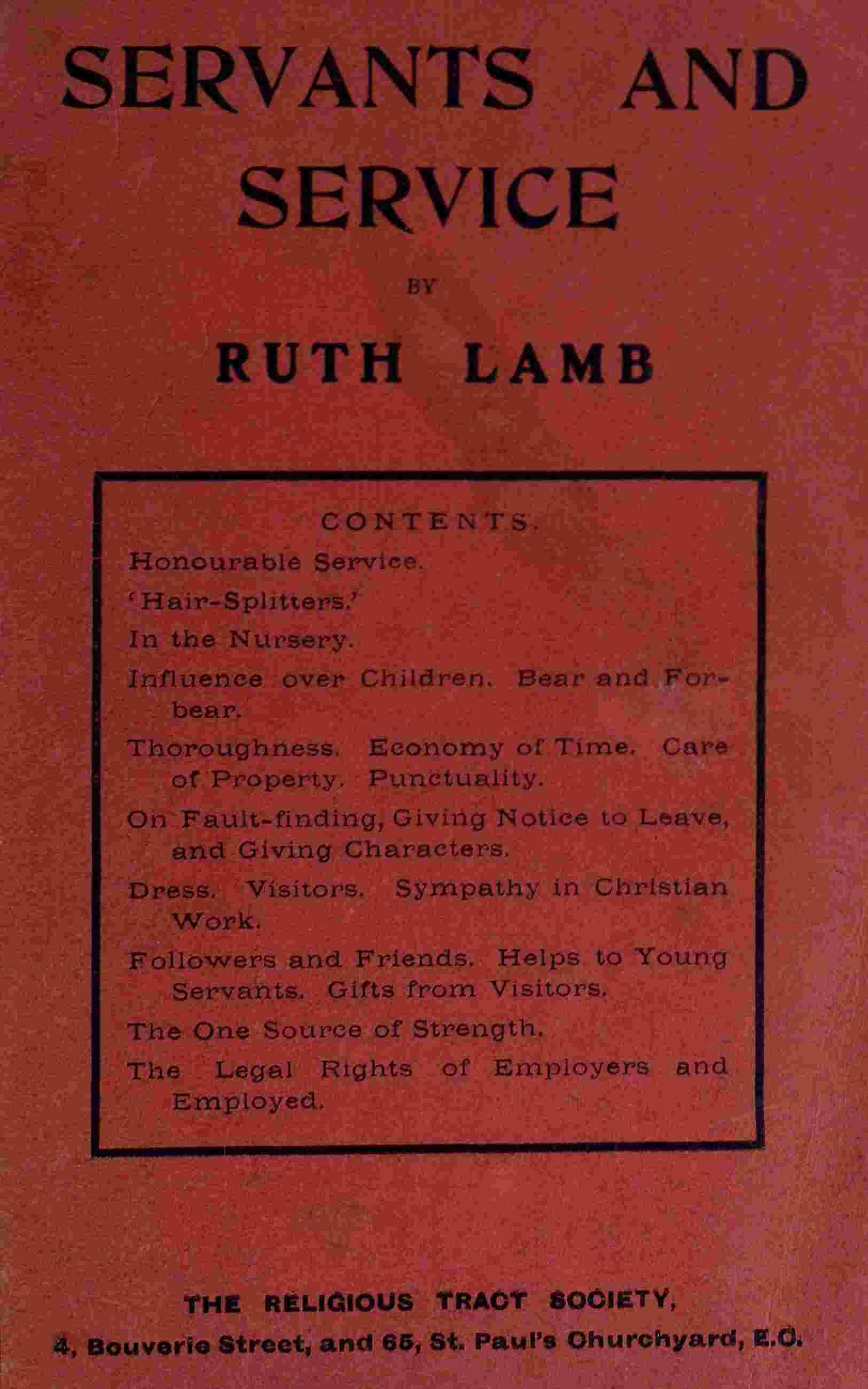
THE LEGAL RIGHTS OF EMPLOYERS AND
EMPLOYED.
According to a learned writer the relationship of master and servant is one founded on convenience, whereby a person is directed to call in the assistance of others where his own skill and labour will not be sufficient to answer the cares incumbent on him. It is a relationship which has existed from time immemorial, though in olden times the respective positions of a master and his servant were much more akin to each other than they are in the present day. Of old the servant was more in the position of a slave, whose life and body were entirely at the disposal of his master, but as the age became more enlightened his position improved. All traces of slavery in England vanished by the end of the sixteenth century, and thenceforth the relation of master and servant became one of pure contract.
In the present day a servant may, therefore, be defined as ‘a person who voluntarily agrees, either for wages or not, to subject himself at all times during the period of service to the lawful orders and directions of another in respect of certain work to be done.’ It follows from this that a master is a person who is entitled to give such orders and to have them obeyed.
From the foregoing definition it will be seen that the term ‘servant’ has a very extensive meaning, and includes every person who is under the orders of another, no matter what his duties may be; but the following lines have reference to domestic or household servants only. Domestic servants are sometimes called menial servants, but there is a distinction in the meaning of the two words. The word ‘menial’ has a wider signification than the word ‘domestic,’ and includes it. Every servant who at all times during the service is under the immediate control, discipline, and management of his or her master or mistress, and is liable also to attend their persons, is a menial servant; whereas those only who form part of the family household are domestic servants. There is no hard-and-fast rule as to who are domestic or menial servants, but each case depends on its own circumstances. All indoor servants whose duty it is to attend on their masters and perform household acts are clearly menial and domestic servants, and this will include a coachman or gardener living in a lodge or other separate cottage, but it will not include a farm bailiff, though living in the house. Neither is a governess a menial servant, from the position she holds in the family of her employer and in society generally.
The contract for the hire of a servant by a married woman as mistress of her husband’s house is a good and binding one, and her husband will in most cases be bound by it to pay the servant’s wages; for, although it is the wife who actually engages the servant, and who will during the service probably be the person to whom the servant will look for her orders, still the wife only acts as her husband’s agent and by his authority. This authority may be given expressly or may be implied by circumstances. A servant, suitable to their degree in life, engaged and hired by the wife can recover wages from the husband. Where a husband and wife do not live together, it depends on the circumstances of the case whether or not the husband is liable. For instance, if when living apart the husband allows the wife sufficient means to enable her to maintain herself in her proper position, he cannot be made liable for the wages, nor can he where he has expressly forbidden his wife to hire a servant, if the latter is aware of the fact.
[As this chapter appears in a book devoted to matters of feminine interest, the word ‘mistress’ will be used throughout the rest of it instead of master, though the latter must be understood to be included and for the same reason the servant will be referred to by words indicative of the female sex, although the law laid down is equally applicable to males.]
With regard to the duration of the period of service, the contract of hiring between a mistress and servant is deemed to be a general one, and to last for the period of a year; and where there is no express mention made of the time for which the hiring is to continue, or of the time for giving notice, it is understood that the hiring is for a year, but may be determined at any moment by either party giving to the other a month’s notice, or warning, or a month’s wages in lieu of notice. Where, however, the duration of the engagement is expressly mentioned, the presumption that it is for a year is rebutted; and where there is nothing to show that it is not intended to be a yearly hiring, the payment of wages at short intervals, such as a fortnight or a month, will not make it less a hiring to last for a year, nor even the payment of wages by the week, where the engagement was to be determined by a month’s notice. As before stated, it is a well-known rule—founded solely on custom, however—that a contract of service may be determined by either the mistress or servant giving to the other a month’s notice, and at the expiration of this month, on the servant’s leaving, she must be paid her full wages up to that time.
The service may also be determined at a moment’s notice on payment by the party giving the notice to the other of a sum equivalent to a month’s wages. (These remarks do not apply to the case of a mistress summarily dismissing a servant for misconduct, which subject will be mentioned later on.) If a servant gives notice and leaves there and then, she is entitled to be paid a proportionate part of the wages accrued since the last day of payment up to the time of leaving, but in return she must pay her mistress a month’s wages as compensation for not serving the month out. If, however, a servant packs up her boxes and goes away without saying anything about it, she utterly forfeits all claim to any wages which have accrued since the last day of payment, and cannot, after wilfully violating the contract according to which she was hired, claim the sum to which her wages would have amounted had she kept her contract, merely deducting therefrom one month’s wages.
Some persons may perhaps think this somewhat harsh, but it is nevertheless the law, and, moreover, it is more consistent with honesty and common-sense than to allow a servant to break a contract, and at the same time claim a benefit under it, when upon simply giving notice to the mistress and paying, or agreeing to allow the mistress to deduct from the amount due to her, a month’s wages, she can leave at any time. The distinction between leaving at a moment’s notice and leaving without notice at all may seem to some perhaps rather fine, but the practical effect of adhering to the strict letter of the law is merely to compel a servant to give her mistress notice when she wants to leave, which can be but little trouble to the servant, and will, in most cases, save the mistress a good deal of unnecessary trouble and inconvenience, and perhaps loss. So that if a servant is paid on the first of each month, and on the fifteenth of the month she gives notice to leave, she may go there and then, and the mistress must pay her the amount of wages earned in those fifteen days; but the servant must pay the mistress a full month’s wages as compensation for not staying the month out. But if, instead of giving notice, the servant simply goes away without saying a word, in that case the wages which had accrued between the first and the fifteenth would be absolutely forfeited.
The service is also put an end to by the death of the employer, and, of course, by the death of the servant. If, therefore, a servant be discharged on the death of the employer, she can claim and must be paid wages from the time of the last payment up to the death. If, however, the servant is kept on by the representatives of the deceased to look after things, she will then be their servant, and they must pay her. If a servant dies during the service, all wages due to her up to the time of her death must be paid to her representatives, who may sue for the same if withheld.
One of the cases in which erroneous impressions frequently exist is as to what will justify a mistress in summarily dismissing a servant. The following are the principal grounds which will justify the discharge of a servant at a moment’s notice:—1, Wilful disobedience to any lawful order; 2, gross moral misconduct; 3, habitual negligence; 4, incompetence or permanent incapacity from illness.
As to wilful disobedience, if a servant will not obey a lawful order she must suffer for her obstinacy. If a servant will persist in going out, or standing at the street door, and such like, after having been forbidden to do so, such conduct will justify instant dismissal. In one case a female servant persisted in going out against her mistress’s orders, though it was to visit a dying mother, and she was thereupon dismissed. It was subsequently decided by the judges that such summary dismissal was justifiable. This case is not quoted as an example to others to do likewise, but simply to show under what circumstances summary dismissal is justifiable. The mistress’s orders must be confined to those services for which the servant was hired, and a mere obstinate refusal to do some particular act will not justify dismissal, the refusal must be persistent.
Again, theft, immorality, drunkenness, and such like, all constitute good grounds for discharging a servant. If a servant is grossly rude and insolent, she may be at once dismissed; and if she is violent, and uses abusive language to her mistress or one of the family, the latter may send for a policeman and give her into custody.
If a servant will not do her work, or is habitually negligent in it, she may be sent away at once; but mere occasional neglect, which does not cause injury, does not justify instant dismissal without compensation. And, again, if a servant is hired for a particular purpose, and proves utterly incompetent to perform it, this is a good ground for discharge. For instance, if you engage a cook who represents herself to be thoroughly proficient and highly trained in the culinary art, and you pay her high wages, you will be quite justified in dismissing her if she altogether fails to redeem her profession in any essential particular. As a rule, however, it is not safe to dismiss ordinary domestics without notice or payment of wages for incompetence, for it is common knowledge that a great number of servants offer themselves, and are hired to perform, services which they are utterly incapable of rendering. Want of experience, clumsiness, absence of skill and finish about their work must be expected when untrained servants at low wages are hired, and must be taken as part of the bargain, and it would be safe to dismiss only in the higher branches of domestic service, when special knowledge and skill are necessary, but are not forthcoming in the servant who professed them, as in the case of the cook just mentioned. Of course, when a servant is dismissed for any of the above offences, she forfeits all claim to any wages which have accrued since the last day of payment, in the same manner as if she left without notice.
A temporary illness, with incapacity for work, is not a good ground for discharging a servant unless the contract has been rescinded; but permanent illness is a good ground for dismissal. The wages that have been earned by the servant up to the time of the illness must be paid, because it is no fault of hers that she cannot continue the service; and unless the contract is put an end to, there is no suspension of the right to wages because of her illness and incapacity to work. It may as well be stated here that a servant cannot legally compel a master or mistress to find her medicine when she is sick, or surgical attendance when she has met with an accident, unless the illness or accident is the direct result of fulfilling a lawful command. However, very slight evidence will fix the master or mistress with liability, and it is probable that if a servant were ill and sent for a medical man with the master’s knowledge, the latter would have to pay for the attendance. Indeed, in one case a servant was suddenly taken ill and sent for a doctor, and on the matter subsequently coming to the master’s knowledge he sent his own doctor. It was held that he was liable to pay the surgeon called in by the servant, simply because his wife knew that he had been called in, and did not express any disapprobation.
Now as to character. No mistress is legally bound to give her domestic or menial servant a character. It is, however, the duty of a mistress to state fairly and honestly what she knows of a servant when applied to by any one who may be about to take the servant into their employ; and those who are about to employ them have a corresponding interest in knowing the truth concerning them, so that they may be rightly informed as to those who are coming to form part of their domestic household. Masters and mistresses should be freely, unreservedly, and truthfully out-spoken as to their opinion of those servants who have left their service, not keeping back that which is unfavourable, nor speaking ill of them, nor recklessly exaggerating their faults and shortcomings. For while the law in the interests of society holds the communication of the character of servants privileged, yet a deliberately stated falsehood would be evidence of malice, and would tend to deprive the communication of its privilege, and render the person making it liable to an action at the suit of the servant. The mistress is in duty bound to state not only what she knows of the servant at the time of her discharge, but if she knows of any circumstance subsequently happening of which the inquirer is entitled to be informed, also to tell further what she conscientiously believes to be the case; therefore, if a good character is at first given, and the mistress subsequently finds out things unfavourable to the servant, it is her duty to communicate the discovery to the person to whom the character has been given.
Any communication made by a mistress as to the character of a servant—no matter how damaging such a character may be—if fairly and honestly made, is a privileged communication; that is to say, that such communication will not render the mistress liable to any action by the servant for slander. This privilege arises from the duty which, as before stated lies upon all mistresses to state fully and fairly the truth about a servant, whether in her favour or against her; and a mistress, so long as she does not go out of her way to injure, need not be afraid of telling the truth about the real character of any servant. Any person knowingly giving a false character to another person about to hire the servant, if the latter subsequently robs or injures his or her master or mistress, is guilty of a criminal offence which renders him liable to a penalty of £20, or three months’ imprisonment with hard labour. But a false character bonâ fide believed to be true will not render the giver so liable.
When a servant enters into the service of a mistress, it is her duty to fulfil the engagement to the best of her ability; to be honest, respectful, and diligent, to take due and proper care of her mistress’s property, and to obey all lawful orders. These orders must be lawful and within the scope of the employment for which the servant was hired; and no servant is obliged to obey an order attended with risk; for instance, a lady’s-maid would not be obliged to clean the scullery, and such like.
It is the duty of a master to supply a servant with proper food and shelter, and to pay the wages agreed on between them.
A master may not under any circumstances chastise a servant, no matter how incorrigible. If they cannot agree, the servant must be discharged. A master is not liable to a servant for any injuries inflicted by fellow-servants in the ordinary discharge of their duty; for a servant, when he or she engages to serve, impliedly undertakes as between himself or herself and the employer to run all the risks of the service. This branch of the law is, however, somewhat complicated, and in case of an accident happening, the liability or non-liability of the master or mistress would depend so much on the actual circumstances of the particular case, that it is impossible, in a chapter of this nature, to lay down any general rules bearing on the subject; and the only safe course under such circumstances would be to lay the case before a solicitor, and be guided by his advice.
Lastly, as to the liability of a master or mistress for the acts of the servant.
The principle on which a master or mistress is liable for the actions of their servant is that of agency. The mere relation of master and servant does not invest the latter with a right to pledge the master’s credit; and if the servant purchase goods on credit without the leave of the master, no liability attaches to the latter. But if a master holds out a servant as his authorized and accredited representative, it is only right and just that he should accept responsibility for his acts. For instance, where the master is in the habit of sending the servant to buy goods upon credit, and is not in the habit of paying for such goods at the time of buying, but on a particular occasion does furnish the servant with money to pay for such goods, and the servant either loses or steals the money, but orders the goods, the master is liable, because the tradesman has been in the habit of supplying goods on credit. But when the master is in the habit of supplying his servant with money to pay cash down for the goods he orders, and the servant steals or loses the money, but orders the goods, the master will not be liable, because he has always been in the habit of sending the servant with the money, and nothing but the master’s express authority to the tradesman to supply the goods on credit will render him liable.
In conclusion, it may be stated generally that a master is liable for all the acts of a servant which come within the scope of the latter’s employment, however wrongful and negligent such acts may be, but is not responsible for the wrongful act of a servant unless that act be done in the execution of the authority given by him in the course of the employment, for beyond the scope of his employment he or she is as much a stranger to the master as to any third person, and his or her act cannot, therefore, be regarded as the act of the master.
THE END.
Butler & Tanner, The Selwood Printing Works, Frome, and London.