
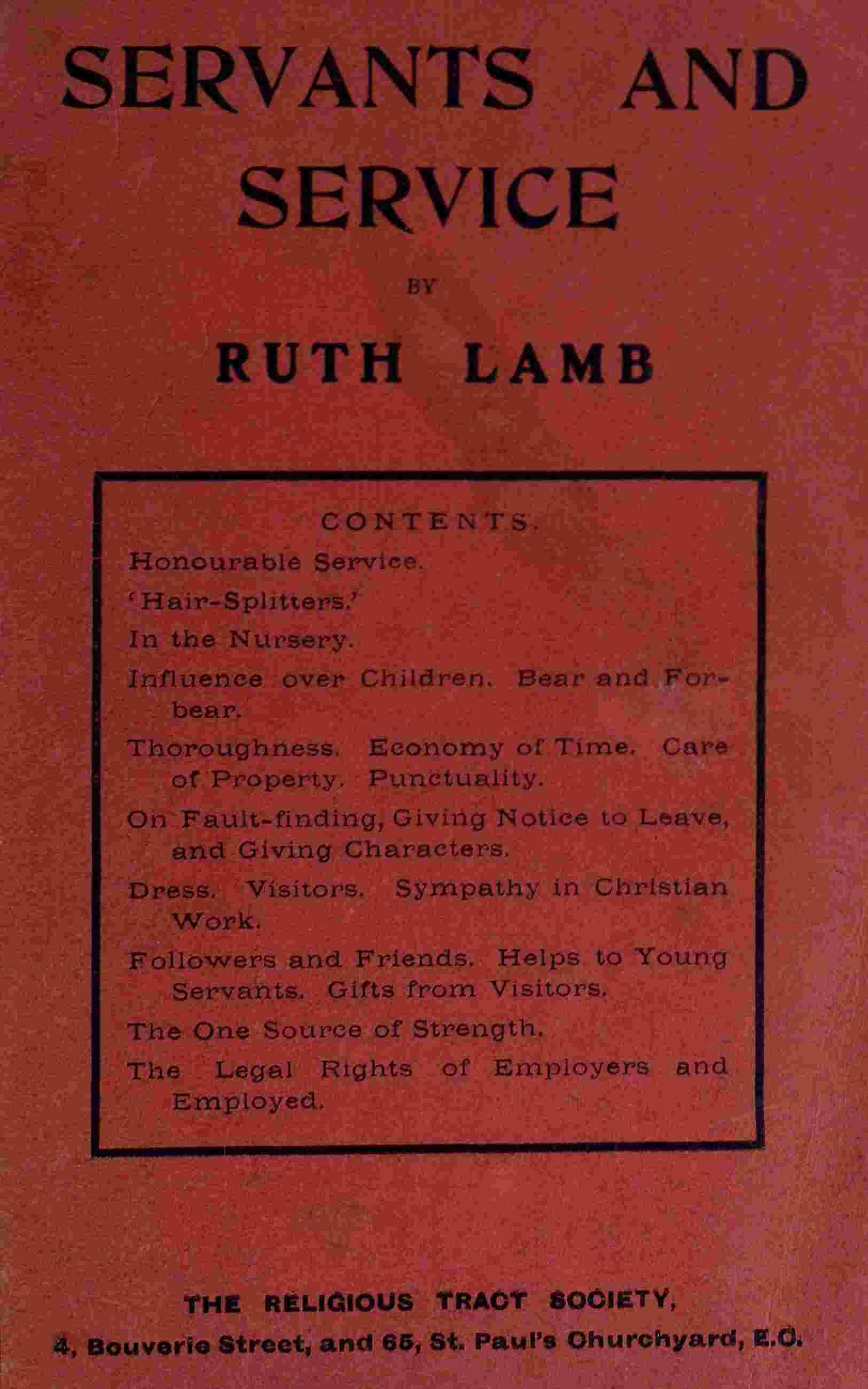
CHAPTER VII.
ON FAULT-FINDING—GIVING NOTICE TO LEAVE—AND
GIVING CHARACTERS.
There are two practices not altogether unknown amongst servants against which it is hardly possible to protest too strongly. I allude to those of listening, in order to find out things never intended for their ears, and of prying into odd papers or letters, accidentally or trustfully left within reach. No right-minded girl, no person deserving the name of Christian, would be guilty of either practice.
If employers leave their letters and papers lying about, this certainly implies trust in their servants, and that they believe them to be too upright and honourable to be guilty of prying into their contents. If they speak of private matters in such a place and tone that their servants could hear if they were mean enough to listen, it is a proof that they do not think them capable of such an underhand proceeding. Deserve their good opinion, dear girls, and preserve your self-respect by scorning to do, when unseen, what you would be ashamed of if detected in the act.
Servants sometimes complain that mistresses are unreasonably suspicious, and act as though they expected to be cheated at every turn—that, like Dickens’s Miss Sally Brass, they would padlock everything, down to the very salt-box, until ‘there was nothing that a chameleon could lunch upon’—and manifest to those whom they employ a prying spirit which they would be the first to complain of in their servants. This spirit is, however, often the harvest reaped by an upright girl from the seeds sown by a deceitful and dishonest one. When a mistress has trusted and been deceived, she is apt to become suspicious where there is no occasion to be so. The only remedy is for the new-comer so to act as to show that the more her conduct is looked into, the better she will be satisfied, as well as her mistress.
If, however, after a fair trial, the habit of locking up every little thing and incessant mistrustfulness should continue, a girl would be right to try for another place, where truth and honesty were better understood and appreciated. Were I a servant, I could not endure the harass of being constantly suspected and misjudged, any more than as a mistress I would, after a fair trial, keep a servant whom I could not both trust and respect.
People tell us that now-a-days there are no old servants—that where a seven years’ character used to be a common thing, one for twelve months or two years should be reckoned very good indeed. I do not agree with these sweeping statements, and my own home experience contradicts them. But I am well aware that, in many households, there is a perpetual game of Marjory-move-all going on. I believe this is for want of a little more reasonableness on both sides.
Small difficulties, which might be got over by a little patience, twist themselves into a knot which is summarily cut by the usual month’s warning. If I could only persuade you never to give warning on the day that something has occurred to irritate you, I should save many of you from throwing away a good place. But if, yielding to a momentary irritation, you have done this, and are sorry for it, do not be too proud to own that you were wrong, and ask forgiveness and permission to withdraw the notice. Your mistress will respect you and value your services all the more after such a display of right feeling and good sense.
To young mistresses I venture a word of advice. If you have something to complain about, always call your servants into your own sitting-room, after the day’s work is over, and point out the fault kindly and reasonably. Say what is wrong and how it is to be amended, and be firm in exacting attention and future obedience to your orders.
Never squabble with or rate your servants. By doing so you lose your own dignity and their respect. Never reprove them in the presence of visitors. Few things are more calculated to irritate, or to provoke a disrespectful reply; besides which, it renders the guests extremely uncomfortable.
I once saw a lady who had a very correct eye, and who was very particular about her table arrangements, seize upon a young servant, whisk her round as she was about to leave the room, and angrily direct her attention to a dish which was the least bit awry. The girl, a new-comer, young, inexperienced, and fresh from the country, blushed, trembled, and seemed ready to sink through the floor, had it been possible. Frightened at the angry looks of her mistress, and confused at being made a centre of observation to all those strange eyes, she was, moreover, unable to comprehend what was amiss. By the time the lady had, by shakes and jerks, aroused her to a sense of the mistake she had committed, the poor girl was hopelessly unnerved and in tears.
One blunder followed another. She handed dishes at the wrong side, spilled the liquids when attempting to pour them into glasses, was glared at by the mistress, secretly pitied by the guests, and occupied herself between times in furtively using her handkerchief to wipe away the tears which, once set flowing, were not easily stopped.
Yet an unnoticed touch from the deft hand of the lady would have straightened the dish. A few kind words and a little lesson in private, instead of the course pursued, would have revealed a disposition willing to be taught and led in the servant, and have shown the capability of the mistress to model her into a first-class parlour-maid. As it was, the girl left as soon as possible, and the mistress had to seek another maid—a difficult matter, for she had got the character of being perpetually changing her domestics. This is a real picture, and one which, with trifling variation in actual detail, I have seen enacted again and again.
‘Masters, give unto your servants that which is just and equal, knowing that ye also have a Master in heaven.’
This advice or command, given by the hand of an inspired apostle, applies to all who bear rule over servants, whether in the place of business or the home—to mistresses as well as masters. And surely in giving that which is just and equal, we have to think of more than a mere question of wages. We should be just in our acts, reasonable in our requirements, and even in our tempers, to those who serve us.
I know one lady who, when the smallest portion of the household machinery went wrong, would fly into a violent passion and say all sorts of unjust and harsh things to the author of the mishap. Being, like most hasty people, very generous, she would next lavish gifts on those to whom conscience told her she had been too severe. Her maids calculated on this result, and one was heard to say that she enjoyed a ‘flare-up’ with the mistress. Her temper was soon up, but as soon over. It was worth while to put up with it quietly, ‘it paid so well in the end.’
‘Be just and equal.’ A short sentence, but how much it says! Give praise heartily where it is fairly earned. Be equally just in pointing out what is wrong, and firm in enforcing obedience, but do it in a reasonable way—not in the heat of passion or in the presence of others, but so as to convince your servants that you know both your own place and their duty.
Young wives, who in their early married life are often much alone, sometimes make the mistake of first being over-confidential and familiar, and then of going into the opposite extreme. They have fault-finding fits, and the damsel who has been treated as a friend and confidante on one day cannot understand why her girl-mistress should on the next be sharp in speech and distant in manner. If we mistresses wish to be respected, we must, as I have said, be equal in temper, reasonable in our requirements, and just in our judgments.
I have alluded to the giving of hasty notices by servants, and suggested how these should act if they feel they are likely to throw away a good place, and are sorry for it. As a mistress, I would not advise another to ask a girl to withdraw a notice given in a fit of temper. However valuable her services might be, she had better be allowed to go unless she herself asks to stay, and owns that she has been wrong.
Were the mistress to ask the servant, the latter would probably get it into her head that she was too valuable to be spared, and the notice would be repeated whenever she was found fault with, until a separation became inevitable. Reasonable Christian girls have too much common sense and right feeling to act in this foolish manner.
On the other hand, if the mistress has been the one to give a hasty warning, and conscience tells her that she has acted on impulse and without a fair consideration of the grievance, I do not think she would lessen herself, or lose the respect of her servant, by frankly saying so, and asking the latter to remain. A good servant would show no foolish triumph, and would give herself no airs. On the contrary, she would manifest her sense of her mistress’s fairness by extra gentleness of speech and manners.
It is good alike for mistress and maid, for the mother of the family, and the young people, down to the little one who is only able to lisp out his request, to practise always and under the home-roof the same politeness that we take with us into the outer world.
There is an old saying, that ‘No man is a hero to his valet.’ The meaning is plain. The outside world too often gets the best side of us all. At home, we give way to little tempers, use hasty words, and act towards those whom we profess to love best as we would not do in the presence of strangers. Sometimes the mistress who is admired and sought after, the girls who are called charming in society, even the little children who have two sets of manners, one for home and the other for company use, have different verdicts passed upon them by those who serve in the house.
‘She’s no lady, or she wouldn’t speak to a servant worse than to a dog,’ is not an uncommon expression with regard to a mistress. Or, ‘If some of these fine young gentlemen could see our pretty young miss in one of her tempers, she wouldn’t be so run after,’ etc., etc.
Dear young mistresses, dear girls who look forward to being such, let me give you a hint or two. Be loving, kind, considerate, courteous, sympathetic, thoughtful for others, careful not to wound the feelings of those who dwell under the same roof with you. Practise true politeness there, every day and to every one with whom you have to do. Teach it to the little children, both by precept and example, and you will be doing them an inestimable service and yourselves also. That which is learned in childhood abides. That which is in hourly use is not likely to be forgotten. Those who are loved for their own sakes in the home, and whose manners are admired there, are certain to win love and to be charming when outside that hallowed circle and under other roofs.
It is next to impossible for a servant to treat a mistress rudely if the latter carries her own politeness and good manners with her wherever she goes. And the real daughters of the family will lose no dignity, but gain much love, if they, too, thoughtfully strive to lighten the work of servants by giving no needless trouble—if, thankfully remembering the goodness of God in giving them many advantages of education and surroundings not possessed by their toiling sisters of the household, they try to make the lot of these brighter and happier. They may do this by kindly consideration, feminine sympathy, pleasant words and looks, by imparting useful information, by lending suitable books; by acting in accordance with the spirit and teaching of our Divine Lord and Master; in short, by obeying His command, ‘Love one another.’ ‘Whatsoever ye would that men should do to you, do ye even so to them.’
We must show that we do not wish to exact all, and give nothing. We must manifest an interest in our servants, and in those near and dear to them. We must give a tender, womanly thought to the little, lonely lassie who, having come to her first place, is frightened at the sight of so many strangers, and yearns for the familiar faces she has left behind.
Our responsibilities extend beyond the threshold. If a mistress is a mother also, surely the thought of her own daughters will make her anxious to preserve every girl from what is impure or morally injurious. The young mistresses, in their turn, will feel anxious for the well-being of their domestics, and will strive to guard them from all evil influences, as they themselves have been guarded in their girlhoods’ homes.
We mistresses, each and all, should assure ourselves that our girls pass their Sundays as God’s children should spend His day. We should give them opportunities of enjoying the fresh air, which is as needful for their health as for our own. But if the girls are at a distance from their own homes and friends, we should ascertain what associates they have, and where and how a holiday is likely to be spent. We shall feel that it is our bounden duty to guard from contaminating influences these girls—the daughters of other mothers, who have been intrusted to our care, as well as to work for us and under our rule.
We shall encourage them to consult us in seasons of doubt, difficulty, or temptation. We shall help them to decide on taking the right course, and cheer and strengthen them in their efforts to resist evil.
We, too, shall have our reward; though we work not with any thought of benefit to ourselves, but with a single-hearted desire to do good to others. There are certain tasks and duties the performance of which can be bargained for, certain work that can be paid for in current coin of the realm. But there are numberless services, labours of love, which we cannot demand and money cannot buy. In such as these we shall reap an abundant harvest.
There is another matter in which we should be just and equal; namely, in the giving of characters. Alike for the sake of the servant herself and the future mistress, we should be equally frank and impartial. Few mistresses willingly give the worst side of a servant’s character. There is always the feeling that a girl’s bread depends on her obtaining a situation, and that ill-success may drive her to evil courses. So, whilst no untruth is told, the whole truth certainly is not. All that can be said for the departing servant is said, the damaging circumstances are glossed over or wholly suppressed, and perhaps the lady comforts herself with the thought that she has done a kind act.
Some much-pressed house-mother takes the girl. She has probably been unsuccessful in obtaining one, and the domestic emergency is great. Too soon she finds out how one-sided was the character given—out of kindness, or from fear of consequences it may be—and she feels that she has been cruelly deceived.
Ah, these half-truths! What mischief they do! I have always felt the importance of being just and equal in this respect, and that I owed a duty to the mistress in search of a servant, as much as to the girl in want of a place. ‘The truth, the whole truth, and nothing but the truth,’ should be our motto in character-giving.
That one and only bad servant I ever had would never have crossed our threshold but for the written character sent by her then mistress. When, after a few weeks of bitter experience, I came to analyse it, I wondered that I could have been deceived by such evasive answers to my queries, such self-evident half-truths.
That very servant, finding that no one would engage her, after an interview with me, wrote one of the most remarkable letters it was ever my lot to receive. Without for a moment professing regret for her wrong-doing, or a desire and determination to amend, she asked me to tell a falsehood in order to hide her untruthfulness and dishonesty, and obtain for her another place in which to resume her career of wickedness. What I did was to visit the different register offices at which she had entered her name, and warn those who kept them not to send to me for a character, as I would only tell the truth, and this would prevent any lady from engaging her.
Occasionally one finds that an employer will give a tolerably favourable character, but accompany her words with looks and manner which seem to say, ‘I could tell more if I chose, but I will not;’ or will merely state that the servant herself gave notice, and left by her own wish. This is neither fair to employer nor servant. A girl may have many excellent qualities, yet not prove equal to the duties she has undertaken. In such a case, I should, were I her mistress, look round for a vacant niche which she was likely to fill, and help her to obtain it. I have done so more than once with most satisfactory results. But I would never allow an inquiring mistress to be deceived, or to take into her house the seeds of trouble in the shape of an untruthful or impure-minded girl, for lack, on my part, of courage to speak of such a one as she is.
Let us, by all means, help the fallen to rise again, and stretch out the hand of love and pity to the penitent. But let us, mistresses, young and old, be true to others and to ourselves, and not show our compassion by concealing the truth, or help the wrong-doer to obtain a place by sacrificing the peace of our neighbour’s household.