
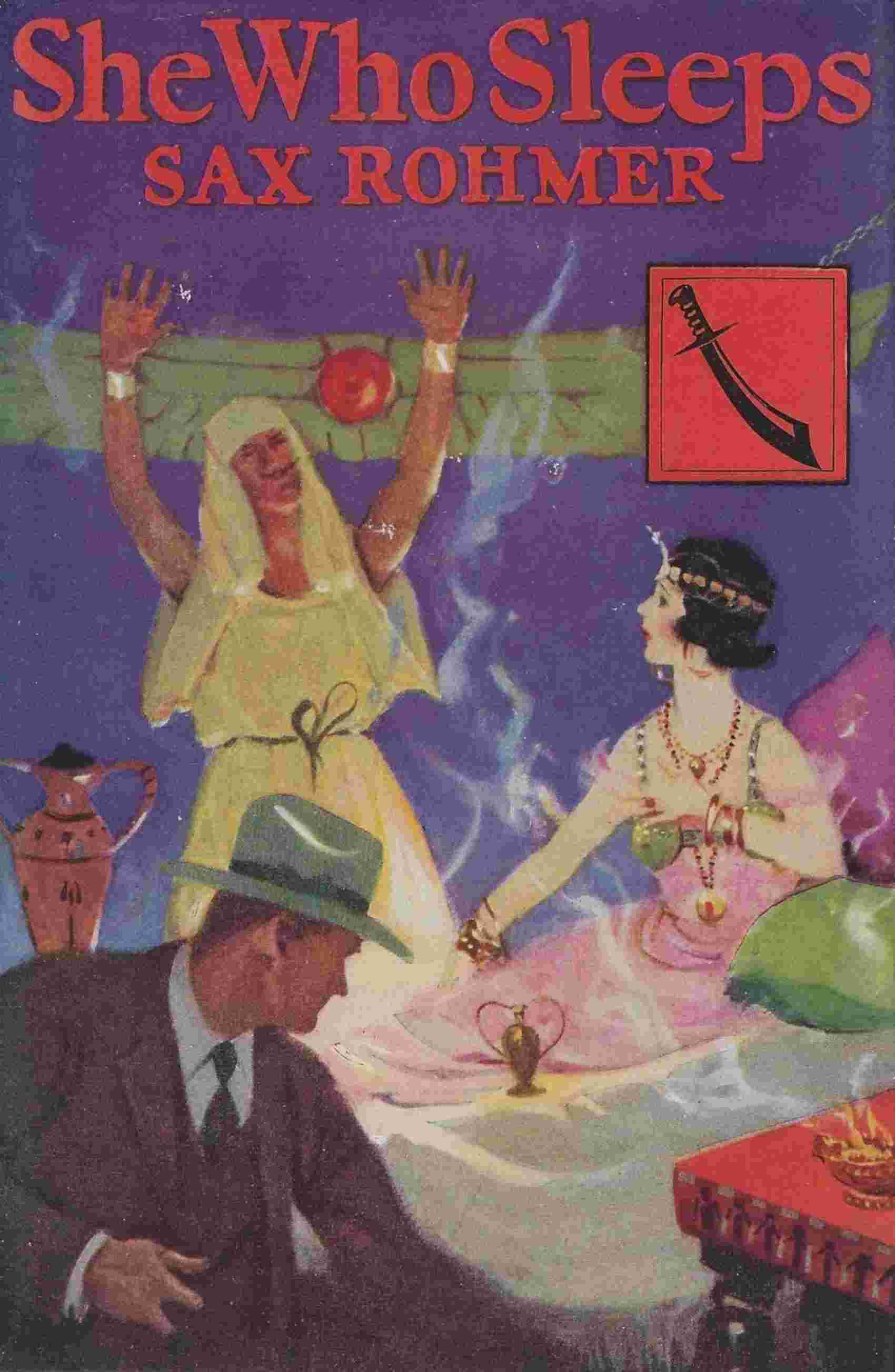
Marguerite Devina glanced up at him, and her eyes were very bright.
“He is the greatest-hearted soul in the world,” she answered in a queer tone of challenge. “My mother brought him nothing but sorrow. Yet he spent all he had to try to make her happy—at the end. And he took the place of my father—afterward.”
“And is he, also, an operatic artist?”
She gave a little choking laugh.
“No,” she replied. “He is, or used to be, a vaudeville artist! He retired years ago. He was known throughout Europe as ‘The Great Ahmes.’ He was an illusionist. Not so famous as Houdini, but equally clever in his own way.”
Watching her closely and trying to steady his voice:
“Ahmes is surely an Egyptian name?” said Barry.
“Yes,” she replied composedly. “He used to work as an Egyptian. There is Arab blood on his father’s side. He was always billed as ‘The Wizard of the Sphinx.’ ”
With a curious eagerness she poured out these confidences. Obviously she wanted to do so. She watched Barry with those long, lovely eyes, as if inviting further and closer cross-examination; as if challenging him to put her upon trial.
“Is—your guardian—in Paris?”
“I expect him to-day.”
“Did you expect me?”
The abruptness of the thrust startled her, Barry determined. But if it were so her defence remained impregnable.
“No,” she replied, laughing; “how could I?”
And even as she lowered her dark lashes and looked in her bag for a cigarette, sanity whispered: “How could she? This girl, whose every movement, every expression, every feature, and every mannerism are familiar, yet is not, cannot be, Zalithea!”
Memory plays odd tricks at times, and as Barry struck a match to light their cigarettes, a hitherto forgotten remark of Professor Blackwell’s flashed, intact, through his mind. It had been made on the evening that the Professor had examined Zalithea. “There is a small scar under the hair, just above the right ear, which suggests that the theory—now generally accepted, I believe—that surgery was practised by the ancients is not without foundation.”
“Have you a small scar under your hair above the right ear?” he asked suddenly.
At this Marguerite Devina unmistakably grew pale.
“Yes,” she answered, and looked at him with half-veiled alarm. “How strange you should know that!”
“Professor Blackwell told me.”
“Is he a clairvoyant?”
“No,” said Barry, and laughed without mirth. He met the glance of the dark eyes. “I once thought I was, though. Now—I don’t know what to think. But there’s something I must tell you. Perhaps I should have told you right away. You are the living image, a miraculous double, of someone——”
“Someone?”
“Someone I love very dearly. There! I’ve told you! I came here, to Paris, to find her. And when I saw you——”
His voice failed him. He turned his head aside miserably.
The girl was silent for a time; then, very gently:
“Do you mean,” she asked, “that you have come from America to—look for her?”
Barry nodded.
“What made you think you would find her in Paris?”
“I don’t know. We were—very happy in Paris. But I’m on my way to Egypt.”
“To Egypt!”
“Yes. That was where—we met.”
“And you really expect to meet her again, in Egypt?”
“I don’t dare to expect. But if I left off hoping——”
He did not complete the sentence. Marguerite Devina had abruptly stood up. Her head was averted.
“Please forgive me,” said Barry. “I didn’t mean to hurt you.”
Even as the words left his lips, he remembered where he had last uttered them—and to whom. She turned to him impulsively, and the memory was complete. Her lashes were wet with tears.
“You haven’t!” she said. “But I must go.”
Barry reached out a detaining hand.
“Please,” he pleaded, “let me see you again!”
She averted her head once more, and:
“If I can,” she murmured. “I’m sorry—but I must hurry away now.”
And, stumbling in her haste, she walked around the little table and ran across the lobby.…
Back to his room Barry went in a state of mind which he found himself incapable of analyzing. Was it possible, in the natural order of things, for two human beings to be so absolutely alike? As well ask himself if it were possible for a girl to live three thousand years! One being possible, why not the other?
He was curiously reluctant to leave the hotel. Therefore Jim dined with him in the grill room whose chef has been preserved for posterity by Orpen’s brush. Of Marguerite Devina they saw nothing. At the end of dinner:
“If I don’t stop thinking about this muddle,” Jim declared, “I shall become completely cuckoo. It’s the Folies Bergères or a lunatic asylum for mine. Make your selection.”
The selection was made. And it was at a late hour (Paris time) that Barry returned to the Chatham. The night porter handed him a letter.
In his room he tore open the envelope. He began to read. Then, rushing to the telephone, he banged the lever up and down in a frenzy of impatience. At last:
“Hullo! Hullo!” he called, in a high, unnatural voice. “Ring Miss Marguerite Devina!”
“Miss Devina left this evening, m’sieur.”
And when dawn came it found Barry haggard, wild-eyed, pacing the room, ever and anon taking up a crumpled letter and reading and rereading it.
CHAPTER XXXII.
THE GREAT AHMES
“Barry Dear:
“I don’t ask you to forgive me. I never meant to see you again. But when Jim spoke to me to-day I realized, somehow, that you were here. And I knew you would come. And I knew I would have to see you. I didn’t know how hard it would be—because I never believed you cared, like that.
“I don’t know how to tell you what I see now, I must tell. It all began, really many years ago, when I was a baby, and when Paul Ahmes was giving up everything to make my mother’s last days bearable. She had never loved him, but they had one thing in common. It was their passion for Egypt. She made her great success in an Egyptian opera and he as an Egyptian performer. He used to buy Egyptian antiques with all he could save. He knew more about these things than any dealer in Europe. Most of his stage properties were real. They inspired him.
“One day my mother read that a ring which had been the property of the real Thaïs was being auctioned at Sotheby’s in London. This ring had once belonged to her. She never sang Thaïs without wearing it. But poverty had forced her to sell it. Paul Ahmes, knowing what happiness the recovery of this ring would give her, went to London to buy it. This was like him. He did not bid, himself, as all the auctioneers knew him. He sent someone.
“Barry—your father was at that auction—and he has the ring to-day! When Ahmes heard that John Cumberland had secured it, he wrote to him, and without mentioning my mother’s name told him all the circumstances. Your father did not believe him.
“My mother died the night after Ahmes returned.
“Soon after that, before I can remember, we left Paris and went to live in America. I grew up to look upon Ahmes as my father. I was always surrounded by things belonging to Egypt, for my guardian had left the stage and become a professional dealer in antiques. He was sometimes away for months together, in Egypt, where he had agents now that his business had grown so big. He had changed his name. John Cumberland was one of his clients.
“But, Barry, very few of the wonderful and beautiful things he received from Egypt ever left Ahmes’s possession. They went into his own collection—which is priceless; for this was his ruling passion now that my mother was dead. He sold copies, or restored originals mostly, to his wealthy customers. Some of the most famous museums in the world contain his work! His love of everything belonging to Egypt simply wouldn’t allow him to sell a genuine piece. His genius for making duplicates (for he is, truly, a genius) made it easy for him to keep them.
“And all the money he earned in this way was spent acquiring more and more rarities for his private museum.
“Then—this was years ago—he stumbled upon the tomb of Zalithea. He reached it through a long narrow passage cut at some time by Arab robbers. He found there the great stone sarcophagus, and he raised and wedged the lid. The sarcophagus was empty.
“Thinking that one day this discovery might profit him, he reclosed and concealed the opening. This opening, I must tell you, came out in another valley, behind the tomb, and it led, through a hole in the roof, into the shaft between the first and second portcullis. You remember where the roof had fallen? This second portcullis the thieves had broken, and also the door of the chamber where the sarcophagus was.
“I unknowingly inspired him to what followed—I and his wish to score over John Cumberland, whom he had taught me to detest. He said I had the true Egyptian profile. The showman in him came to life—this part of his strange nature was only sleeping; and he thought of the wildest plot that surely any man ever attempted to carry out.
“He said to me, ‘I will sell you to John Cumberland! And if you play your cards properly you will marry a millionaire!’ I was completely under his influence, Barry. I had never known any other kind of life but this commercial use of Ahmes’s genius as an illusionist. I don’t want to excuse myself. I prepared for the thing with enthusiasm!
“This was when we came secretly to New Jersey. Mr. Brown, who took the house, was formerly Ahmes’s stage manager. His wife acted as cook. There were other members of my guardian’s old company there as well. For no one who had ever worked for Ahmes wanted to leave him.
“Here for a long time I lived like a nun. No one outside our small household ever saw me. When I went anywhere I was always heavily veiled. Ahmes taught me to speak Coptic. This was the mysterious language of Zalithea! Arabic I knew, because I had had an Arab nurse from childhood—an old member of Ahmes’s company—Safîyeh!
“A year before the papyrus was brought to your father, Ahmes went to Egypt. He erected the screen, as you know, his agent, Hassan es-Sugra, having traced the real, or front, entrance to the tomb. He broke through as far as the first portcullis, which he knew was intact. Then he reclosed and hid the entrance as you found it. The hieroglyphic of ‘She Who Sleeps’ he himself carved in the rock.
“By the other tunnel, the one he first discovered, he took in lifting gear and swung up the stone sarcophagus lid. The painted sarcophagus, which he had made in New Jersey and shipped out, he put inside. Then he lowered the stone lid again. The tables, lamps, couch, and other things he set in place. Some of these were genuine. Some he had made. He also added the cartouche of ‘She Who Sleeps’ to the ancient inscriptions painted on the wall.
“He cemented the door and, from the tunnel above, blocked the secret entrance. Then he came back to America. The stage was set for his last and greatest illusion.
“The ‘Zalithea Papyrus’ and the ‘Formula’ Ahmes had been at work upon for two years. They were the biggest achievements of his career! The materials had cost him no end of research. But no other man in Europe or America could have written them—to pass Horace Pain and Dr. Rittenburg!
“Yes, Barry! I’m proud of him! Until you came, it never occurred to me to question his way of life. Besides, he had taught me to hate the name of Cumberland. It was a mania with him. I believe for a long time he held John Cumberland responsible for my mother’s death.
“The Zalithea dress, the strange ingredients mentioned in the Formula, and all the other things, he got from many sources, working patiently for months and months. He put his whole soul into the affair.
“Then, just as we were ready, you had an accident right outside the house!
“We were in an awful panic. But Ahmes was always at his best in an emergency. You know how we managed to keep out of the matter. The household was dispersed. Only Mrs. Brown stayed to clear things up. I was hidden in my guardian’s apartment in New York. And I nearly ruined everything one evening by going out to our old garden in New Jersey to get some flowers. Yes! I was there that day when you came!
“As soon as the date of departure was fixed, Safîyeh and another Arab, called Omar, were sent to Egypt. Soon afterward I went, also. I sailed on the same ship, to Cherbourg, as Professor Blackwell! But it didn’t matter, because we had arranged that I should stay in my stateroom all the way.
“I remained hidden with Safîyeh in Luxor until the night before the tomb was opened. That night I was smuggled across—and you heard my voice as I stumbled in the little valley where Omar was waiting for me! Omar you saw once. He is tall and thin, and you thought he was a ghost!
“In a ruined tomb in that little valley I was dressed for the part of Zalithea. Safîyeh was there with me. But she went back to Luxor in the early morning.
“You understand, now, that when you first discovered the painted sarcophagus I was not in it? He carried me up to the tomb during the second watch on the night before the lid was raised! I was placed inside. Then the lid was fastened down! I was frightened, although the gold mask allowed me to breathe freely and there were lots of air holes in the sarcophagus.
“I had to lie there for nearly three hours! But I had been training to do this for months before.
“Never shall I forget my relief when you came at last to unwrap me! Of course I had been prepared in all sorts of ways for the ordeal. And you will remember, Barry, that none of you had a chance to touch me or even see me properly up to the time that I opened my eyes.
“Yes! You were in the hands of a master illusionist!
“As for the rest—I was prepared to hate you! But on the night you came to my tent and said, ‘Forgive me. I didn’t mean to hurt you,’ I couldn’t hate you, somehow.
“Ahmes, too, had changed his mind about John Cumberland. He had learned to respect him; in fact, to love him. But he had to go on then! So did I!
“Sometimes it was good fun. Sometimes, when your father talked to me, not knowing I understood, I couldn’t bear it. But we didn’t know how to end it!
“You ended it! The night when you found me with that pig Edwards I knew it must finish. While you were asleep I went to Ahmes and told him.
“He was sorry—for me; but glad that we were through. Safîyeh went to Montreal and sailed, under her own name, for England, three days later. I was here, in Paris, before you allowed the news of my disappearance to be published. Ahmes wrote the hieroglyphic letter to relieve your mind. It was delivered by the same messenger who brought another letter. He is here, now, with the others. That is why you failed to trace him.
“That’s all, Barry dear. We have a house in Paris. It had been closed, though, and so I stayed at the Chatham for a short time. But Ahmes arrived to-day, and I am going to join him. He knows I have told you.
“Do what you like. But I shall be punished enough.
“You see—I love you.
“Marguerite.”
CHAPTER XXXIII.
A FLASH OF LIGHTNING
“Jim,” said Barry miserably, “what else can I do?”
“Well,” Jim replied, thoughtfully rapping on the café table to attract the waiter’s attention, “you can order another half bottle of this very good wine, and then perhaps ideas may come.”
The order given:
“It’s Kismet,” Barry went on. “If she had confessed to murder I should still have wanted her! In fact, mad as it may seem, I love her better, now, knowing her to be what she is, than I did before.”
“Not mad in the least,” Jim commented. “Taking into consideration the way she was brought up, I, myself, harsh though my judgments of frail humanity notoriously are, should feel the same. I could both love and respect the Marguerite who wrote that brave letter. I don’t think I could ever have worked up any real enthusiasm for a living mummy.”
“I know,” said Barry emphatically, “that one day I shall find her again. When I do, I’m going to marry her if she’ll have me!”
“Strong, sound sentiments,” Jim replied. “It is men such as you are who make men such as I am love men such as you are! But the old problem arises; your father.”
“I have made up my mind on that point,” Barry declared. “He must not know—yet. It’s hateful, but I mustn’t shatter his illusion. I shall write and tell him I have met the girl of the balcony, and that she is the double of Zalithea—and the daughter of Devina. Those who knew Zalithea will soon forget the resemblance when they hear Marguerite speak. Then, one day, he shall know the truth. Nobody else must ever know.”
“We shall have to lie like the Brothers Ananias,” said Jim sadly, “for a time. This prospect appalls my proudly virtuous spirit. But it’s up to you. What you say, goes. Meanwhile, a full week has elapsed and our patient inquiries have merely yielded, No, sir. Shall you go on advertising in the Paris papers?”
“Yes,” was the answer. “My advertisement means nothing to anyone else. It might as well stand. Who knows?”
“Nobody knows,” Jim murmured. “It is ignorance and not knowledge which makes us lose faith in Santa Claus. And this afternoon? Shall I scour the district in and about Batignolles as you so kindly suggest?”
“Jim, you’re a brick! This ‘scouring’ is no sort of way to enjoy a holiday in Paris. Just say you’re tired, and I’ll do that part myself to-morrow.”
“No, no, Horatio. Batignolles appeals to me because I can’t pronounce it. And have I not said many times that I long for the life of a detective? ‘All forms of shadowing undertaken. Your pay roll guarded by machine-gun experts (in uniform). Missing relatives traced by our special staff of lady searchers. Our watchword——’ ”
“Jim! I love you, but——”
“Guilty! Dismiss the jury. We reassemble at the Chatham at six for cocktails.”
And so the quest went on. Barry had in mind a neighbourhood he had noted during a drive on the outskirts near the old fortifications. Here were discreet villas sheltering behind little gardens which, like the yashmak of a Turkish beauty, merely provoked without concealing. He felt sure that the house he sought would have a garden.
Barry had considered the idea of engaging a detective agency to trace Zalithea, so strangely found only to be lost again. But, in the circumstances, he had decided that to do so would be unwise.
Marguerite’s letter he almost knew by heart. At first, the shock of it had stunned him. The readjustment of perspectives which it entailed appalled his brain. But out of all the chaos one fact emerged—a fact brooking no denial. He loved her. He could not imagine life without her.
His eagerness was eternally conjuring up mirages. A group at a café table would suddenly come into view—and she was there. As he drew nearer, all resemblance would disappear. He hated those unconscious mimics, some of whom were astoundingly unlike Marguerite at close quarters. Perfumery stores he unfailingly explored. And a hundred times he had run like a madman to overtake some girl seen in the distance—only to alarm a stranger.
More than one gendarme had eyed him with suspicion. A tall, distinguished-looking old gentleman, wearing the ribbon of the Legion and escorting a very pretty girl whose figure and carriage certainly resembled those of Marguerite, demanded the name of his hotel and promised to send his seconds to Barry in the morning.
And now he was on the outskirts of the woods. Just ahead lay the group of villas which had attracted his attention on the previous day. He proposed to pursue a plan adopted on other occasions: viz.—to call at a likely-looking house and ask if Miss Devina and her father were at home. Being assured that he had come to the wrong address, he could inquire if two Americans resided anywhere in the vicinity.
Following an unseasonably hot morning, clouds had begun to gather shortly after noon. Now, it was growing very dark. The woods on his right were haunted by ghostly shadows. From somewhere beyond the western outskirts of Paris echoed ominous rumblings, to remind good Parisians of that black day when Von Kluck’s Prussians came hammering at their gates.
Then, suddenly, the downpour started. In sight of a charming little villa whose green shutters and green balconies were visible above a guardian row of dwarf acacias, Barry darted to cover. His back against the trunk of a tree the dense foliage of which promised shelter, he stood, looking up.
A black thunder pall hung directly above. Except for the sound of falling rain, a profound stillness had come. Then, blindingly, lightning flicked its venomous fang from the heart of the cloud. The house opposite was illuminated ice blue, eerily. Every leaf upon the trees was lent a momentary hard, individual existence. Every nail in the woodwork of the villa gate, every piece of gravel on the garden paths, summoned attention vividly, alone, aloof from the rest.…
And a window directly facing the tree beneath which Barry stood was thrown open.
Marguerite came out onto the green balcony!
Her lips were parted in a half-frightened smile. Exultant, like a roll of Titanic war drums, thunder crashed and boomed and beat out its fury in dying echoes.
Across the feathery crests of the acacias their glances met.…
Barry uttered an involuntary cry. The storm was forgotten. The world was forgotten. Out into the drenching downpour he ran, across to the gate and on, up the gravelled path, to the discreet, glazed door. She had fled at sight of him. The balcony above was empty; but the window remained open.
He rang, but without result. He rang again—and again—and again. He rang continuously.
The door was opened.
And he found himself looking into a wrinkled Arab face.
“Safîyeh!” he exclaimed.
She smiled, unsurprisedly, and stood aside to allow him to enter.
He discovered himself in a little lobby furnished throughout in Egyptian fashion. There were antique tables and figures of the gods of the Nile. There was a fresco of subjects from Der-el-Bahari. A perforated silver lamp hung from the ceiling. And the air was laden with a faint perfume, the indescribable smell of Egypt.
Safîyeh raised a tapestry curtain and again stood aside. Barry went into the room beyond.
This apartment was littered with every imaginable kind of relic, from exquisite enamel necklaces to mummied cats. At sight of the treasures contained there, Barry was transported in spirit to a similar room high above the turmoil of New York, where once he had sat in conference with Horace Pain, Dr. Rittenburg, and others.
Leaning upon a mantelpiece composed of carved red granite fragments adapted to the purpose was a tall man, the collar of whose white shirt fell open at the neck, while the sleeves were rolled up on muscular arms. One elbow rested on the ledge; the clenched fist supported a handsome, leonine head. A scarab ring glittered on his finger, as, raising the other hand to remove a cigar which he was smoking, he bowed in courteous greeting.
“Danbazzar!” cried Barry.
A roll of distant thunder from the moving storm echoed and reëchoed over Paris.
“Paul Ahmes, at your service, sir!” Danbazzar corrected him. “But the former, if you prefer it. One’s as much mine as the other! Sit down and let’s talk this thing over.”
Fascinated against his will, as he had always been fascinated by this man’s extraordinary personality, Barry dropped onto a divan, silenced—stupefied—by the entire self-possession of the speaker. Here was no recognition of wrongdoing; this was not a detected impostor; this was the masterful man to whom obstacles were merely stepping stones, who was fearless as he was unscrupulous. This was Danbazzar.
“Margot told me what she had said in her letter,” he went on. “I agreed. Get that clear. She did nothing behind my back. What she wants goes with me, and she wanted you to know the truth. You’d never have known if you hadn’t followed her to Paris. But I’m not sorry, anyway. I have retired from business. Zalithea was my last deal. I regretted it long before the end came, because I found out that John Cumberland was white clean through. So, listen. Tell him if you like. I’ll hand you a complete list of all the stuff he’s got that isn’t right, and he can sell it back to me for just what he paid. I’m not playing tin angels: I’ve got a market for it at big profit!”
Barry was unable to restrain a smile.
“If you ask me,” Danbazzar added, “he’d be happier left alone. But do as you damn’ please. There’s no committee of experts in the world would say any piece from my workshop was faked—and you can lay your last dollar I’m not going to say it! As for the job at the tomb—we’re all in the dock together. Pirates can’t afford to quarrel! And now I’m going to talk to you about Margot. I’m going to talk straight, and I expect you to talk straight.…”
He talked, and talked straight, for the better part of an hour. He displayed a side of his complex, twisted character, that Barry had never suspected to exist. And, at one point, when he spoke of Marguerite’s remorse for the part she had played, the words of Hassan es-Sugra recurred to Barry: “Be not angry with her.” Finally:
“Now we’ve got it all set,” said Danbazzar. “I’ve quit the United States for keeps. You know where I stand. We’re agreed about the bunch in New York. And I know where you stand. Settle the rest with the kid.”
He walked out of the room, stately, unperturbed; the Great Ahmes, master of the situation. Barry stood up. Suddenly, he had grown appallingly nervous. He paced up and down once or twice, among those priceless relics of an age whose loves and hates were forgotten before Paris arose from the forests. On one long, low wall, Pharaohs, gods, and goddesses made mysterious signs to one another, signalling: It was so in our day; it is so in this.
The rustle of the tapestry portière told him to turn.
He faced Marguerite.…
She stood on the threshold watching him. Her long dark eyes held the same expression as on that night when, unseen by Barry, she had stolen to the library door to take her last look at him.
Yet something else was there, and slowly she came forward to where he stood. When she was close to him:
“My darling!” he whispered.
His arms went around her very tightly but very gently—not as in that first fierce embrace. And when he kissed her it was a lingering tender kiss.
THE END
TRANSCRIBER’S NOTES
Minor spelling inconsistencies (e.g. El Kasr/El-Kasr, Kûrna/Kurna, etc.) have been preserved.
Alterations to the text:
Abandon the use of drop-caps.
Punctuation: fix some quotation mark pairings/nestings and missing periods.
[Chapter I]
Change “with never a word of farwell, urged by a sudden irrational” to farewell.
“Same classic analogy cropped up in his mind” to Some.
[Chapter XI]
“and ponds and gardens of flourishng trees” to flourishing.
[Chapter XII]
“Hassan es-Sufa extended his palms and softly intruded” to Sugra.
[Chapter XIII]
“He seemed scarely to have closed his eyes before” to scarcely.
[Chapter XIV]
(“By jove!” John Cumberland exclaimed.) to Jove.
[Chapter XV]
“His foosteps might be heard receding along the wâdi” to footsteps.
[Chapter XVI]
“It we had known, sir, with a little more time and trouble we” to If.
[Chapter XX]
(This was Kyphi, mentioned in the “Papyrus Embers,” and) to Ebers.
[Chapter XXIV]
“set upon Barry with an expresison of childish eagerness” to expression.
[Chapter XXVI]
“Priness Zalithea has very little English, so excuse her” to Princess.
[Chapter XXVII]
“he saw the long repressed tears gathering under the dark fringe” to long-repressed.
“Do they drown one of twins in those parts?” add the after of.
[Chapter XXXI]
“who drove you to the hospital and took care of you car” to your.
“suggests that the theory—now generally acepted, I believe” to accepted.
[End of text]