
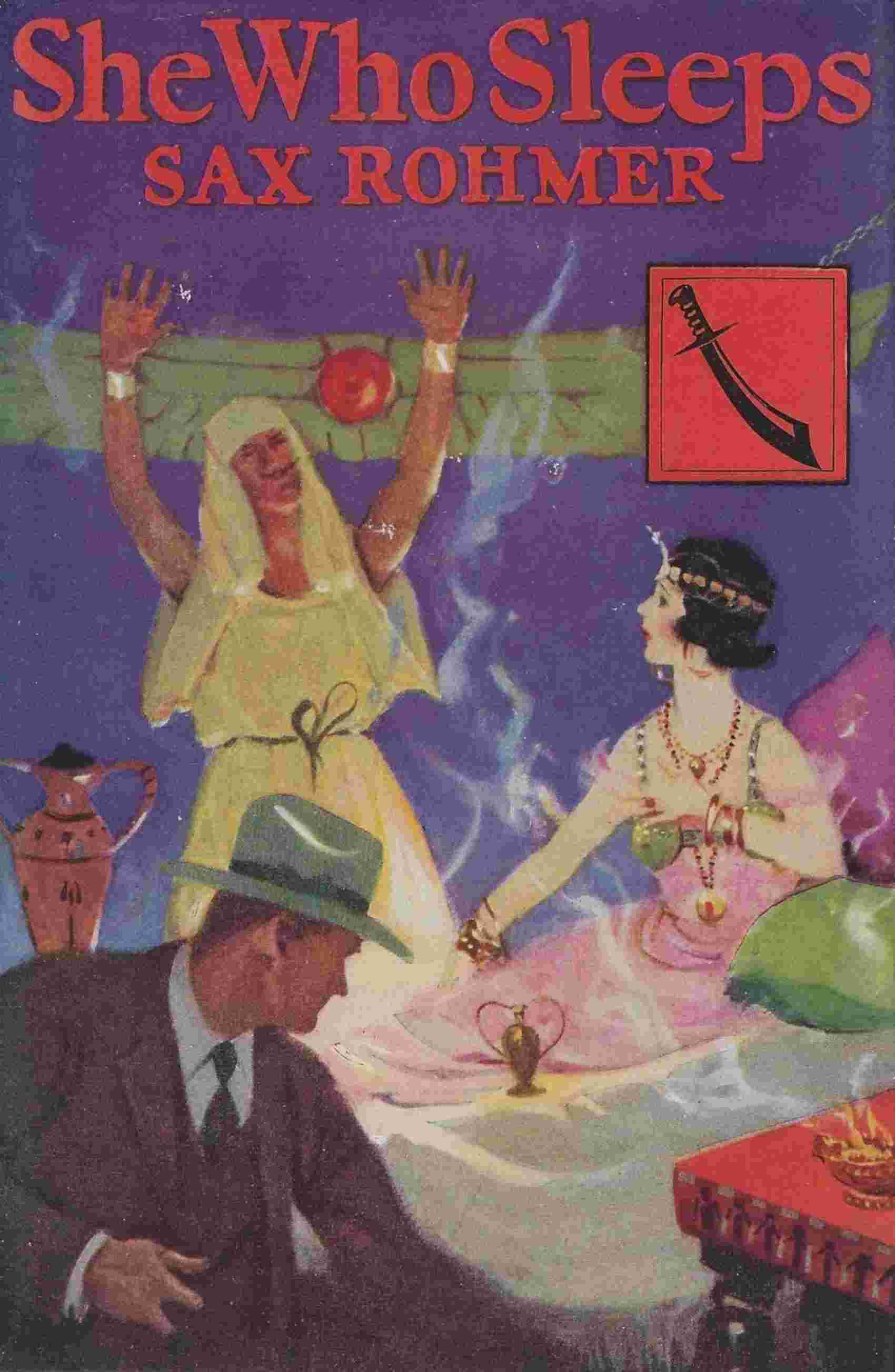
The Project Gutenberg eBook of She who sleeps
Title: She who sleeps
A romance of New York and the Nile
Author: Sax Rohmer
Release date: October 20, 2025 [eBook #77092]
Language: English
Original publication: Garden City: Doubleday, Doran & Company, Inc, 1928
Credits: an anonymous Project Gutenberg volunteer
SHE WHO SLEEPS
A ROMANCE OF NEW YORK
AND THE NILE
BY
SAX ROHMER
1928
DOUBLEDAY, DORAN & COMPANY, INC.
GARDEN CITY, NEW YORK
[COPYRIGHT]
COPYRIGHT, 1928, BY DOUBLEDAY, DORAN &
COMPANY, INC. COPYRIGHT, 1928, BY LIBERTY
WEEKLY, INC. ALL RIGHTS RESERVED.
FIRST EDITION
CONTENTS
XVII. MR. TAWWAB COMES TO TERMS
XXII. A SUMMONS FROM THE PRINCESS
SHE WHO SLEEPS
CHAPTER I.
A FLASH OF LIGHTNING
Barry Cumberland pushed on through a growing darkness. There seemed to be an unfamiliar quality in this darkness which he first noticed when, quite mechanically, he stooped to switch on his headlights, and in doing so saw the time by the clock in the car. He slowed down for a moment, on a crossways, and stared into the west.
A great cloud, black as the pall of Avalon, was draped before the sinking sun.
As he watched, it crept farther and farther up the dome of blue, like a velvet curtain drawn by giant hands. Through a gap in the trees which had closely beset the path for some distance now, Barry looked down into the valley along which his route lay to the highroad and New York.
Three hundred feet below, perched apparently on the edge of a ravine, he saw a house. Some rent in the curtain of the storm had allowed a ray like a searchlight to break through and to shine upon a sort of turret which crowned the building. Shrinking behind guardian walls and overhanging yet lower depths, the effect was that of a drawing by Sidney Sime. Beyond, the road zigzagged, disappeared into shadow, later to reappear in the form of a bridge, until it finally became lost to sight before the plain was reached.
The moving curtain blotted out the light. Where a fairy castle had been, eerily illuminated, came blackness. He looked ahead sharply, accelerated, and knowing the violence of these sudden storms in the mountains, prayed that his Rolls would deliver him from treacherous byways before the blinding rain began.
He had only himself to blame if he should be stormbound. For no reason that he could have defined he had left a cheery crowd at the club, with never a word of farewell, urged by a sudden irrational impulse to reach home in time for supper. Such abrupt changes of plan were characteristic of Barry, annoying to his friends, but in no way destructive of his popularity.
A young man endowed with good looks, charm of manner, and John Cumberland for a father is not dropped socially merely because nature has designed him for a poet in a material age.
Through this ever-growing darkness he drove on; and although the route was one which normally carried little traffic, it seemed that this evening not a soul rode or walked upon the length of it. But loneliness dovetailed with his mood. He welcomed it. And so, when a sharp bend leading to a long descent set the storm behind him, he thought of it as a pursuer. He took the slope in breakneck fashion. It was a race against the pursuing darkness.
Presently came a dangerous turning which he remembered. But he had possessed the Rolls—a birthday present from his father—long enough for it to have become a part of him, responsive almost to a thought, nearly to a mood.
He checked where a ragged fence appeared suddenly ahead like a barrier and negotiated a tortured figure S which brought him out above a sheer drop. Beneath lay meadows where late corn showed speckled gold in the crawling shadows. Down, the road led, and still down. A gallant ray from the stifled sun alighted momentarily upon white walls of a building far ahead. He was aware of a flowered porch, a window, a low roof.
Vaguely he recalled this little home. Something had drawn his attention to it upon the outward journey from New York. Then it was blotted out like a house of dreams; but he was losing nothing on the storm. The race grew more and more real.
Some classic analogy cropped up in his mind; a fragment of half forgotten studies which he could not identify. He became a mortal defying the gods. But from this flight of imagination he came sharply back to earth. The house by the roadside passed—and even now he was bearing down upon it—what lay beyond?
Jim Sakers, his pilot on the outward run, now was many miles behind, probably dancing; happily unconscious of the fact that his friend, bareheaded, in dinner kit, was racing for New York, a victim of moods, pursued by the storm.
There was a bridge, Barry remembered. They had passed a Studebaker on it; very nice navigation, for the bridge was narrow. Yes! Here was the bridge. The Rolls went booming across it at fifty-five. And now Barry sighted his first pedestrian: an old man with a clean-shaven upper lip and a tufty white beard. He wore blue overalls, a huge plaid cap which would have suited Harry Lauder, and smoked a very short pipe. Pausing, he stepped hurriedly aside as the bareheaded madman swept by in a cloud of dust. His cap went up like a Scotch balloon.
Barry clenched his teeth. The shadow was gaining upon him. Oh! for a long, straight turnpike where he could open up. But memory warned him that there were many tortuous miles in which no such race track offered. Now came a long sweeping curve which he recalled clearly, tree bordered on the one side, and, on the other, outlining an upcrop of primitive sandstone, where sparse vegetation and scattered rocks formed an isthmus around which his route lay.
Here for a moment he could glance aside. The black curtain was still gaining. The storm promised to win.
Into a cutting he plunged, high-banked, tree-topped, through the blackness of which his headlights carved like a gleaming scimitar. Some little animal shot across the blade of silver. He resigned himself to his mood, wondering in what way he differed from his friends, what barrier it was that would intrude at times between him and those enjoyments for which others never lost zest.
In the games and amusements to which they devoted much of their lives he took part; and most of the things that Barry Cumberland attempted he did well. His sports record was good, but not excellent. He was happy in athletic pursuits, but could never screw up any enthusiasm for pot hunting. Cards frankly bored him. He danced well, except when abruptly, unaccountably, his dancing mood left him and he experienced a sudden longing for the silence of imaginary forests.
The girls about whom other men raved stirred him but slightly. They were all too true to pattern. The thought of home life with any one of them was definitely objectionable.
He took a sharp bend at dangerous speed, wondering if, during a long-projected but never accomplished tour of Europe, he should meet a girl having power to arouse that curious state of unrest which he had sometimes noted in his friends and vaguely wished he could experience. No doubt he was a visionary. He had often been told so. Perhaps the influence of his own home might be to blame.
It was only reasonable to suppose that an establishment which is less a residence than a museum of Ancient Egyptian antiquities, should contribute something to the character of one born and reared in it. Those almond-eyed, slender priestesses, so alluring, so aloof, had possibly played a part in disabusing his mind of any romance in connection with the girls of that very modern set to which he belonged. Since childhood they had looked down upon him, from wall paintings, vases, bas-reliefs, those cloudily robed, sinuous Egyptians, whose long eyes were wells of feminine secrets; who had never smoked or tasted cocktails, but who lived in a mysterious world which for some reason he identified with the deep notes of an organ.
Yes, it was their mystery that appealed to him. Mystery was what he sought, but never found, among the women of his acquaintance.
The road became a high ledge, a thread encircling a bowl of shadow. The gradient grew dangerously steep, and Barry checked speed almost unconsciously.
His musing had carried him many miles. Startled, he became aware of the fact that he could recall no point of the route from the spot where he had passed that solitary pedestrian. But the black cloud had won; for a darkness like night had fallen all around him. He must think what lay at the bottom of this winding road, and how they had approached it. He seemed to remember that there was a fork; that they had come out upon the valley side by one of three ways. But by which of them?
He slowed down more and more as he reached the bottom of the slope, which now turned sharply eastward out of the valley. He had been right. Three roads opened before him. His decision was promptly made. He swung into the middle route, confidently giving the Rolls her head again. On he raced, along a smooth avenue, overshadowed, and so dark that midnight might have come.
During that momentary check he had heard the booming of thunder, away behind him in the west. The avenue began to curve south. It seemed to be unfamiliarly narrow. More and more southerly it inclined, until at last came a crossroad. He pulled up, hesitated, and knew definitely that he had made a wrong choice. It was the north fork he should have taken. Therefore he turned left into the crossing, presuming that it must bring him out upon his proper route.
Going was very bad. The Rolls bumped and shook from stem to stern. But he pursued his way and swore under his breath when he found that this road also inclined to the south. But now, through an opening in the trees, he saw yet another crossway. Left again he swung, pursued by louder rumbling of thunder. Rain was beginning to fall.
Suddenly, his head lamps flooded a high wall. He wondered, but drove on; when—blinding, awesome—the lightning came… and he saw Her!
There was a stone-faced house not twenty yards ahead, and on a balcony high up before an open window she stood. She wore some kind of cloudy robe—a jewelled girdle—the dress of a Theban priestess! One hand upraised rested against the sash of the window, the other upon the curve of her hip.
She had long dark eyes which seemed to be watching him, and her lips were parted in a slight smile.…
“I am dreaming,” he said aloud. “An Egyptian princess!”
Save that it seemed to live, the beautiful figure was one of those out of a dim past which had watched over him from childhood!
And now the wheel was wrenched from Barry’s grasp—he was aware of a cry—a loud, splintering crash—a sickening blow on the skull—of no more.…
CHAPTER II.
THE DIVIDING LINE
Very slowly Barry Cumberland opened his eyes—took one look straight before him—and then shut them again quickly.
Something was wrong. He could swear he had been sitting but a moment before with his back against the giant pillar of an Ancient Egyptian building, staring at a window high up in a temple wall. In the moonlight he had seen a beautiful priestess standing at this window; and he had been waiting patiently—patiently—for a black cloud to pass, a cloud that had suddenly obscured the moon and hidden the slender figure.
Yes, those were the facts, he felt fairly confident. He opened his eyes again. He saw a small, very clean white room; and he was lying in a very clean white bed. He seemed to be propped up in some way, and he experienced great difficulty in moving his head, together with great disinclination to do so because of a dull pain above his eyes.
There were some medicine bottles and cups upon a glass-topped table, and there was a tall white screen of some very glossy material. The only spot of colour in the room was a bowl filled with red roses, which also stood upon the table. He wondered idly what was behind the screen, and then closed his eyes once more.
There was some mistake. No doubt the explanation was simple enough, but his brain seemed to be tired, physically tired. He found himself incapable of grappling with the problem. In one respect, of course, he must have been wrong: In regard to the Egyptian temple. He had never been in Egypt. In his idea that he lay in this unfamiliar white room, no doubt he was wrong, also; although the red roses were suspiciously like the handiwork of his Aunt Micky.
Without Barry becoming aware of any movement, a cool hand was presently laid upon his forehead.
For the third time he raised weary lids—and found himself looking into a pair of kindly eyes, their kindliness magnified by the glasses which their owner wore. A white-capped nurse was bending over him! She was entirely dressed in white, too. Everything in the place seemed to be white, except the roses, which were red, and the nurse’s eyes, which were blue.
“Ah!” she said, speaking in a low, soothing voice which yet had a note of gaiety in it, “so you have decided to wake up.”
Barry Cumberland tried to say Yes, but only achieved a whisper. Great heavens! He had never felt so cheap in his life! What was it all about?
“Don’t bother to talk,” the soothing voice went on. “When you have had another little sleep you will feel ever so much better. I have brought you a drink.”
She held a glass to his lips. He drank, looking into the kindly, smiling eyes; and fell asleep again.
The next time he awoke, the nurse was sitting in a chair beside him, reading. Presumably it was night, for a silk-shaded lamp was lighted upon the table at her elbow.
Barry stirred slightly and turned in her direction. She looked up at once.
“Good-evening,” she said; “is there anything you want?”
“No, thank you.” His voice was very low, but at least he could make himself understand. “Except—where am I?”
“In the first place, you are quite all right,” she replied in her gentle way. “You were thrown out of your car, you know, and really had—a most lucky escape. In the second place, you are in the Elizabeth Foundation Hospital.”
“Thrown out of my car?” Barry muttered. “Elizabeth? How did I get to Elizabeth?”
The nurse looked at him doubtfully, stood up, and:
“I am not at all sure that you should be allowed to talk yet,” she said in a tone of authority. “At any rate, it is time for your medicine.”
She measured out a dose from a graduated bottle on the table, and held it to his lips. He drank, watching her, and vainly trying to grab at any one of a thousand ideas that were dancing wildly through his brain. Yes, of course!—there had been a crash! He remembered, now. He had been driving the Rolls—when was it? Some time earlier in the evening, no doubt. And there was something about Egypt. Had someone been talking to him about Egypt? He could not capture this idea at all.
As the empty glass was set down:
“Please tell me,” he asked, and found that he had already more control of his voice, “did I crash near here?”
“Some little distance away,” the nurse answered, resuming her seat and smoothing a white apron with sensitive fingers.
Barry considered this reply for a long time. His brain was working with unfamiliar and amazing slowness. Then:
“Was I alone?” he inquired.
“You were alone in the car—yes.”
“You are sure there was no lady with me?”
“Quite sure.”
“Then how do I come to be here?”
“You were brought here by someone who found you.”
“Do you mean a friend?” Barry asked.
And as he spoke an explanation came to him of that extraordinary pressure about his skull for which he had hitherto been unable to account. His head was tightly bandaged!
“I am afraid you are talking too much,” the nurse said with gentle sternness. “It is contrary to Dr. Barton’s orders for me to allow you to talk. But I will answer your question. The man who brought you was a stranger, and his finding you a pure accident. And now please close your eyes and stop thinking about it.”
Barry smiled, and, in regard to closing his eyes, obeyed. But he did not stop thinking about it. He lay there endeavouring to capture those maddeningly elusive ideas which scampered about his mind like so many rabbits. Yes—he had crashed in the Rolls. He had been bound for New York. He remembered so much, clearly. He could not remember why he was bound for New York, nor from where; but New York had been his objective. He opened his eyes.
“How was I dressed when I was brought in?” he inquired.
“You were wearing your dinner clothes,” the nurse replied distinctly, raising her eyes from the book which she had resumed reading. “Please ask no more questions, because I shall be unable to answer them. In ten minutes I am going to turn the light out and leave you. So try to get to sleep.”
“Thank you,” said Barry, and continued his reflections.
He had been wearing his dinner clothes. Where on earth could he have been coming from? He opened his eyes, another point having occurred to him which might help to throw light upon the problem. But, slowly turning his head aside and noting the firm little chin of the girl as she bent over her book, he hesitated and did not ask the question. Nevertheless, he determined to remain awake until he had the facts in order. With which idea firmly in mind, he immediately fell asleep again.
When next he awakened, morning sunlight flooded the room, and he saw, standing beside the white-capped nurse, a cheery-looking, gray-haired man, having a very ruddy complexion.
“Good-morning, Mr. Cumberland,” said the cheery man in a cheery voice.
“Good-morning,” Barry replied—and, in the act of speaking, knew that he was himself again and that he had not been himself during those earlier conversations with the nurse.
He raised his hand to his bandaged skull. It was singing and throbbing, but that curious dull pain had gone.
“My name is Dr. Barton,” the other went on. “Feel better?”
“Rather!” said Barry. “What the deuce happened to me? Did I try to take a high jump or something?”
“Not exactly,” Dr. Barton replied, sitting on a rail at the end of the bed and addressing Barry over his shoulder. “You seem to have tried to climb a tree.”
Barry grinned feebly.
“How’s the Rolls looking?” he inquired.
“That I can’t tell you,” was the reply. “I understand it has been towed to a garage some miles from here.”
But, even as he listened to Dr. Barton’s answer, Barry’s mind had been actively at work. A phantom that had been haunting him took human shape. He recalled every circumstance that had led up to the accident. His smashed car ceased to interest him. His own condition became a very trivial matter. One thing, and one thing only, he wanted to know, and:
“I remember it all clearly,” he said. “I had lost my way. One point I must clear up.”
“Well, get busy with it,” the genial doctor directed, “because we are going to have you out of bed, presently, and see how you feel on your feet.”
“Splendid,” Barry replied. “What I want you to tell me is this: the exact spot at which the crash took place.”
Dr. Barton shook his head.
“I haven’t the faintest idea!”
“What!” Barry exclaimed. “But whoever brought me here must have known where he found me!”
“No doubt,” Dr. Barton admitted, “but he didn’t think it necessary to mention the fact.”
“Perhaps you don’t understand,” Barry went on patiently, “that it’s rather important. Could you possibly ring up this Good Samaritan and arrange for me to see him?”
“We could—if we knew his number.”
“Didn’t he leave it?”
“He left nothing!” was the astonishing answer. “He drove you here in a Studebaker—it was a Studebaker, wasn’t it, Nurse?” The nurse confirmed his statement with a nod; and: “In a Studebaker,” Dr. Barton continued, “at somewhere around ten o’clock. Dr. Perry was in charge and admitted you. You looked like a serious case, you understand. You’re not, but you looked like it. Who you were we found out from your cards, license, and what not. Then this dark horse in the Studebaker faded out.”
“Faded out?” Barry echoed.
“Precisely!” Dr. Barton inclined his head in solemn fashion. “Faded out. He didn’t leave so much as his best wishes.”
“Do you mean you have no means of tracing him?”
“None whatever,” the nurse assured him. “Dr. Perry told me he was a rough-looking man. I was on duty that night. And no one was more surprised than Dr. Perry when we learned that he had driven off.”
“You see, it looked suspicious,” Dr. Barton explained; “and we have been manhandled by the police about it. I mean, there was nothing to show that you had not been assaulted and robbed.”
Barry stared at the speaker unseeingly. He was thinking again.
“Whoever towed my car to the garage,” he mused aloud, “will tell me where I was found—or where the car was found.”
“I am sorry,” Barton declared, “but he won’t! The garage telephoned here the same night to say they had the car. We had a police officer on the premises at the time.”
“Well?” said Barry eagerly.
“A man driving a Studebaker towed the car in,” Barton went on; “said it was the property of Mr. Barry Cumberland and that Mr. Cumberland would settle with them for repairing it. Then he faded out.”
“Leaving no name?”
“Leaving no name.”
“Was this last night?”
Dr. Barton glanced at the nurse, smiled, and then:
“It was on Wednesday night,” he returned. “You were semiconscious for forty-eight hours! And now, stop talking. I’ve got my work to do. Stand by, Nurse.”
“One moment!” Barry pleaded. “My father?”
“Your father has been in constant touch. We advised him at once. He is downstairs now, waiting to see you.”
CHAPTER III.
A WEEK LATER
“She might have stepped down from that painting!” said Barry, pointing to a reproduction of part of a wall of the great temple at Medinet Habu, above the carven mantelpiece of the library.
His father nodded and smiled, but not unkindly. He was strangely like his son, except that John Cumberland’s curly hair was gray and Barry’s curly hair was brown.
At the present moment Barry did not look his best, owing to the fact that a patch of the said curly hair was very neatly shaved and the corresponding portion of his skull decorated with unattractive surgical dressing.
They both possessed fresh, healthy colouring and steadfast gray eyes. Both were virile, real, and would have been unusually handsome except that both had “the Cumberland nose,” which was quite frankly tip-tilted. But, in spite of it, there were many girls in New York who invariably referred to Barry Cumberland as good-looking. And indeed he was, as his father still remained.
No two men could have seemed more strangely out of place in this setting. John Cumberland might have passed for an old-fashioned English squire; Barry was as typical a young man of to-day—sane, fit, keen—as one could find anywhere in the English-speaking world. Yet this library more closely resembled one of the Egyptian rooms at the British Museum than the favourite haunt of a prosperous man of affairs.
Egypt—unaccountable though it appeared to his friends—was John Cumberland’s hobby; a hobby in which he had sunk a not inconsiderable fortune; in which he had sought, and ultimately found, it would seem, consolation for the loss of Barry’s mother, who had died when Barry was seven years old.
To-day the Cumberland Collection ranked as the second finest of its kind in the United States. It was representative of Egyptian civilization in all its phases—save that it contained no mummies. It was not confined to the library, but overflowed into practically every room in the house. Yet nowhere were there any mummies. This was a concession to Aunt Micky, John Cumberland’s sister, who acted as the widower’s housekeeper and hostess.
Whereas the loss of his wife had occasioned a wound to John Cumberland’s heart that only time had healed, the loss by his sister of the dissolute Count Colonna had left her a grateful if somewhat embittered woman. The later years of her married life had been years of hidden misery, during which she had realized to the full that, if she had married a title, Colonna had married a dowry. Time, however, had sweetened her even as it had healed her brother. She tasted the strange fruits of our modern orchard with astonishment but without dyspepsia, nevertheless firmly declining to remain under the same roof with a mummy.
“This girl on the balcony seems to have made a tremendous impression upon you,” said John Cumberland, keenly watching his son across the library table.
“I can never forget her,” Barry declared; for between these two was that rare comradeship which makes secrets unnecessary. “I don’t mean that I have fallen in love at first sight, or anything ridiculous like that! But I have an intense curiosity to know who she is.”
“You are quite sure,” his father went on, carefully selecting a cigar, “that the order of events was: the girl and the crash?—not the crash and the girl? You see what I mean, Barry? You have always had an interest in these things—” he waved his cigar vaguely in the direction of the library walls—“which I suppose I have encouraged. You had it in mind to get back here to supper, and so it is just possible——”
“I quite see what you mean,” Barry interrupted: “that the girl on the balcony was the beginning of delirium after I had banged my head? Well, of course, it’s impossible to explain how I know it, but you are wrong. I certainly saw her. And what adds to my certainty is the curious behaviour of the people who took care of me afterward.”
“You mean the man who brought you to the hospital and the one who towed your car to the garage?”
“Why, certainly!” Barry replied. “As not a thing was stolen, either from me personally or out of the Rolls, why should these people have deliberately kept in the background?”
“I see your point,” said his father slowly; “but I rather think there was only one man concerned.”
“I believe you are right,” Barry agreed; “and I believe that this man was acting for the girl I saw at the window!”
John Cumberland looked up, fumbling for his lighter.
“Now,” he confessed, “I don’t entirely follow you.”
“I mean, Dad,” Barry explained excitedly, “that she must have seen me. She was looking at me. If I saw her, she certainly saw me!”
John Cumberland lighted his cigar.
“Now I begin to follow,” he nodded. “You mean that she didn’t want you to trace her?”
“Exactly!”
“You are sure she saw you? A flash of lightning such as you describe would have a very blinding effect.”
“It did,” Barry admitted ruefully, “in my case! But the crash took place less than twenty yards from the spot where she was standing.”
“Yes,” his father mused; “probably you are right. You think that she sent this mysterious man with the Studebaker to your assistance, had you taken to the hospital in Elizabeth, and then had the Rolls towed to a distant garage, with the idea that you would be unable to find the spot later? Rather a hazard. How was she to know that you were unfamiliar with the neighbourhood?”
“She might have thought it worth a chance, at any rate.”
“But the object?” John Cumberland exclaimed. “What could be the object? Was she very inadequately dressed? I mean was she likely to feel ashamed of having been seen in such a condition?”
“Why, no,” said Barry reflectively. “She was very strangely dressed, and, as far as that goes, scantily. But in these days that wouldn’t upset her. There’s some mystery about it—of this I am certain. To-morrow I am going exploring. I wish you could come.”
“Unfortunately I can’t,” was the reply. “I have two important conferences. But if you go, let Hemingway drive you. You have had a devil of a knock on the head, my boy, and you shouldn’t overtax yourself.”
Barry, however, had planned to go with Jim Sakers, who claimed to know the country like the palm of his hand. And on the following morning the two made an early start, beneath a cloudless sky which lent the towering buildings of New York an unfamiliar ethereal quality.
Jim Sakers, in appearance and in temperament, was as different from Barry Cumberland as a Gruyère cheese is different from an ivory Buddha. He was dark and of a lovable ugliness; practical to a degree that his friend sometimes found irritating; invariably good-humoured; and frankly ignorant of everything that could not be dealt with on Wall Street. An enthusiastic sportsman to whom the Arts were an awful mystery, he, withal, regarded the moody Barry more tenderly than Horatio looked upon Hamlet.
Once extricated from the crossword puzzle of New York’s traffic and clear of Hoboken’s shores, they began to make speed, Jim commenting continuously upon sights by the way, as was his manner, Barry answering only in monosyllables and being entirely wrapped up in his own thoughts. Presently:
“When we get to the house,” he said, “I propose to call.”
“Cheers!” cried Jim. “I hope the Egyptian princess keeps a good cellar. But what for?”
“To thank her for looking after me. I shall take it for granted that she did.”
“Wait until we find the house,” Jim warned; “and then, wait until we get in!”
Barry smiled lightly.
“Of course we shall find the house,” he asserted. “You know the way, don’t you?”
“Absolutely,” Jim assured him, “as far as the forks. I simply couldn’t go wrong. But from there onward, I am entirely in your hands. You say you took the middle road?”
“Yes,” Barry nodded. “The middle one.”
He became lost in thought again, paying so little attention to his companion’s cheery remarks that presently these ceased, as mile after mile was left behind and New York seemed to become very remote, in the peace of the countryside that they were traversing.
And now, undaunted, Jim began to sing, loudly.
“ ‘Dear one, the moon is waiting for the sunshine——’ ”
“Shut up!” Barry implored. “Don’t sing. Or, if you must sing, sing the right words. It isn’t ‘the moon’—it’s ‘the world.’ ”
“Oh!” Jim stared. “I don’t believe it. But, anyway, I like ‘the moon’ better.”
“The tune is all wrong as well.”
“You’re too blamed particular!” said Jim.
Engaged in this argument they came sweeping down a long, straight road, turned sharply to the right, and Jim pulled up.
“Behold!” he cried, and pointed.
Barry could not conceal his excitement.
“Gad!” he muttered. “It looks all different, now. But, yes, that’s the road.”
“Middle one, boss?”
“Yes.”
“Very good, boss.”
Jim grinned cheerfully and swung around into the thoroughfare indicated.
“Tell me when to stop, boss!” he shouted. “ ‘Dear one, the moon …’ ”
He sang lustily, and inaccurately, for half a mile or more; until:
“Here we are! Left!” Barry shouted.
Jim obediently turned into the narrow way indicated by his companion, raced along it, and then:
“What’s this?” he exclaimed, and pulled up sharply. A barrier confronted them. “We’ve got into a private road! And it’s closed for repairs. Look!” He pointed to the board which clearly stated this fact. “It’s been closed for a long time, too, from the look of it. You’ve muddled the contract, you poor nut!”
Barry sat staring blankly ahead. At last:
“Try back,” he suggested. “I can’t make this out.”
Jim grunted, backed out to a gap, turned, and retraced the path to the high road. Slowing up:
“Now, boss,” he demanded, “what next? Where’s the princess?”
Barry, who had been sitting with knitted brows, looked up sharply.
“Jim,” he declared, “that was the right road—and it was open on the night I drove along it!”
“We might park the bus and walk,” Jim suggested helpfully.
“No,” Barry replied; “I don’t feel fit enough. Besides——”
“Well?” Jim prompted.
“Why was the road closed? There’s a mystery here, Jim, and I shall never solve it by blundering in like a bull at a fence.”
“Then what do we do now, boss?” Jim demanded.
“Go home!” was the reply.
“Right!” said Jim, and headed east for New York. “Once upon a time,” he recited, in a loud singsong, “there was a princess …”
CHAPTER IV.
SHADED WINDOWS
In the days that followed, Barry Cumberland resigned himself to waiting. He was soon practically fit again, however, and he made up his mind to employ his first morning of freedom in a methodical search for the scene of his accident.
Working from the nearest base where he could garage the convalescent Rolls, he set out on foot; and in something less than half an hour had reached the barricaded road. He had come alone. Jim Sakers’s open scepticism upon the subject to which he usually alluded as “Barry’s princess” had begun to jar upon the victim’s sensitiveness.
He made a slight detour through close-set trees and came out upon the private road twenty yards beyond. There was nothing to show that anything in the nature of repairs was taking place, and he proceeded confidently, looking about him in quest of some landmark. He found none. But presently an opening appeared on the left. Barry turned into it, pulled up, and suppressed a cry of triumph.
Hitherto completely hidden by embracing woods, a house lay forty yards back from the road. Its grounds were surrounded by a high wall, and its construction was memorable because of a turret which crowned the easterly wing of the building.
Barry stood watching it for a time, and groping for another memory which the sight of the house provoked, but which nevertheless eluded him. He realized from its situation that upon the southeast it must look sheerly down into a valley. When, and where, before, had he seen such a house? Try how he might he could not remember. Had he seen it in a dream? Surely he had looked down upon it from a great height! But when? Had the vision been prophetic—an omen? If so, an omen of what?
He advanced slowly. He bent, studying the road and the unkempt shrubbery on his left. The track was altogether too deeply rutted to have retained any imprint by which the passage of his own tires could be identified.
But now, in the very shadow of the building, he pulled up sharply, staring. There was a tree stump some four feet out from the wall, its bark newly gashed in a rather peculiar manner. The undergrowth about here, too, had an odd appearance. It was dying in patches.
Stepping back to the middle of the road, he looked up across the wall. He found that he was staring directly at a window of the house beyond—a window before which a small balcony projected!
He had made no mistake! Here it was—at this very spot—that he had crashed! Dr. Barton had been nearer to the truth than he knew when he had declared, “You seem to have tried to climb a tree.”
Exhilaration came. This provoking mystery was about to be solved.
Passing along the entire length of the wall without coming to any gate, Barry reached the corner and looked across a sloping lawn beyond which stone steps led down to a sunken garden. Far below lay the bowl of the valley through which ran the high road to New York. A semicircular path swept around before the long, low porch of the house, which, as he immediately noted, appeared to be deserted. All visible windows were shaded. There was no evidence of life whatever about the premises. His hopes fell to zero.
Stepping onto the porch, which looked very dusty and unswept, he pressed the bell and waited, lighting a cigarette.
There was no response; not even the barking of a dog. A second and a third time he rang with equally negative results. The thing was growing more and more extraordinary.
Since this road, now closed, clearly led to nowhere but the house, if he had imagined that figure of a girl at the window, by whom had he been taken to the hospital?
Baffled, but not beaten, he walked down the steps again. He had noted a path which clearly led to a garden at the back—a garden concealed behind that high wall against which he had crashed. He turned into it, passed under the very window in which the girl had stood, and came out at the rear of this house of mystery.
He paused in sight of the garden. Beside him was a door. It was partly open—and from beyond came an unmistakable sound of clattering pots and pans!
Barry raised his hand and rapped sharply. The sounds ceased. A minute passed in silence. Barry rapped again, more loudly.
The door was suddenly opened—so suddenly, he realized, that the woman who now stood before him must have crept forward to peep at the intruder. He found himself confronted by a truly formidable female, built for cargo rather than for speed. Her arms appeared to be wet to the elbows, and were, in the words of Jim Sakers, to whom Barry later gave an account of the interview, “as per specification. See ‘Village Blacksmith,’ page 1.” Her muscular hands rested upon her hips. She was iron-jawed, and her regard was a challenge.
“Good-morning,” he began. “My name is Barry Cumberland.”
The woman did not reply.
“I could get no answer to the bell,” he went on, “and came around in the hope of finding someone at home.”
“There’s no one home but me.”
“Can you tell me when they will be back?”
“Who?”
“Well—particularly the lady. The lady whom I really came to thank for her service——”
“Say it again.”
“The lady who witnessed an accident which took place outside this house two weeks ago.”
The Amazon stared in silence, until:
“Forgive me,” said Barry patiently, “but did you hear what I said?”
“I heard.”
“Then why don’t you answer?”
“I don’t know what you’re talking about.”
“But a lady does live here.”
“Does she?”
Barry was torn between laughter and indignation, but he feared an assault might follow any manifestation of either; therefore:
“I think I told you that my name was Barry Cumberland?” he said in his most amiable manner.
“You surely did.”
“You may have heard the name?”
“You said it twice.”
“Hang it all! At least you must know I mean no harm. I want to thank the owner of the house for taking care of me when otherwise I might have died on the roadside.”
“There’s no one home.”
“So you have told me! But surely I can communicate with him somewhere? What is his name?”
“Brown.”
“But there are so many Browns! What is his first name?”
“John.”
Barry, stifling his rising anger, drew out a pocket case and pencil. Solemnly he noted the name “John Brown”; then:
“And at what address can I write to Mr. Brown?” he asked.
“I don’t know.”
“I mean, is it anywhere in America, or has Mr. Brown gone to Europe?”
“I don’t know.”
Apparently by accident, a ten-dollar bill dropped from the case, and Barry held it out insinuatingly. Thereupon, with suddenly dilated nostrils, the formidable guardian of the empty mansion slammed the door in his face! He distinctly heard a bolt being shot.
“Well, I’ll be damned!” said he.
There are some situations from which retirement in good order is the only possible course; and Barry Cumberland recognized the fact that this was one of them. Returning his wallet to his pocket, he began to retrace his steps.
“What the devil does it mean?” he muttered.
Of the woman’s antagonism there could be no doubt, nor of her loyalty to her employer. “John Brown!” Of course, it was a fabrication. She was lying, deliberately. Her instructions plainly were to give no information—and she had followed them to the letter.
The object of it all defied his imagination, but he was more than ever certain that the girl at the window overlooking the garden had been real and no figment of delirium.
As he walked slowly out to the road again, his mind was busy with possible theories. He had learned much but little. Suspicion created by the barred road was strengthened by what he had found at the house. For some unfathomable reason, the girl at the window and those associated with her were peculiarly anxious to avoid meeting him.
But the longer he considered the problem, the more hopeless it became. He determined to consult the local real estate people, to endeavour to trace the ownership of the place, and to identify this “John Brown” who was so pointedly anxious to avoid him.
CHAPTER V.
BARRY IS HAUNTED
“In short,” said Jim, “the princess may be described as still at large?”
“Shut up about ‘the princess,’ ” Barry retorted. “At least I have found out that the woman didn’t lie. The house actually belongs to someone called John Brown.”
“Then, in private life, the—the lady—must be a Miss or a Mrs. Brown. Not a romantic name. But what did the realty sportsman tell you about this mysterious citizen Brown?”
“Very little. Said he had never seen him. And, for your enlightenment, there is no Mrs. Brown and no Miss Brown.”
“Odder and odder. Have you thought that she may have been the daily help bound for a fancy-dress orgy?”
“I have not.”
“Well, think about it. Sherlock Holmes would have thought about it at once. Another theory. Mr. Brown may be a bootlegger! A third theory——”
“I don’t want to hear it!”
Jim Sakers looked at Barry reproachfully.
“You are not tackling this thing in the light of pure reason,” he protested. “The proper method is to think of every possible solution, jot ’em all down, and then pick out the right one.”
“Go to blazes!” said Barry.
He had begun to cultivate a sort of New Jersey complex, and was forever driving out into the hills which had been the scene of his strange and unfortunate experience.
One afternoon he drove as far as the club from which he had been returning when the accident had occurred. He had no particular purpose in view, beyond that of travelling over the now familiar route. The golf course was thickly dotted with players, but none of his intimate set seemed to be in the clubhouse or on the tennis courts. He smoked a reflective pipe on the veranda, watching long drives and short drives from the first tee, and then set out for home again.
Rain threatened; indeed, was only checked by a high wind. And at a point in the descending road which seemed to be peculiarly familiar for some reason, he pulled up and sat staring as one who has seen an apparition.
A long-dormant memory awoke.
Through a rift in the driving clouds sunlight poured suddenly upon a building halfway down the slope beneath, surrounded by high walls and having a curious turretlike structure at one corner!
Good heavens! It was the house—her house; and he had first seen it under very similar conditions on the evening of his crash! The clouds swept on, and shadow came where there had been light—just as had happened before.
He had not dreamed it, after all. But, nevertheless, his first glimpse of the building had been in the nature of an omen. Considering the fact that it lay a mile or more back from the main road, his subsequently coming to disaster under its very walls was at least an amazing coincidence.
Automatically he took out his case and lighted a cigarette, all the time watching the mystery house nestling there far below in its enclosing gardens. Once he glanced away. It was to see what prospect offered of sunlight again flooding that part of the landscape. Even as he looked back, the desired effect came about. Some quality in the atmosphere seemed to bring out details very sharply; and the result was that effected by a reducing glass. He saw the house as through the lens of a camera.
Smoke from his newly lighted cigarette rose before his eyes. Abruptly he tossed the cigarette away, and watched—watched; eagerly, fixedly.
A tiny but clear-cut figure in the distance, a girl moved in the walled garden!
She appeared to be gathering flowers.… The shadow of a cloud crept across and across; until once more the picture was blotted out.
Barry’s heart gave a great leap. At crazy speed he swept down the valley road, taking one keen bend on two tires. Of his going he afterward remembered nothing. When, for the second time, he stepped upon the porch of “John Brown’s” house, he recalled the remark of a girl he had once overheard: “Barry Cumberland is picturesquely mad,” she had said.
“She was right,” he reflected and pressed the bell.
The place looked as it had looked before. All the windows were shaded. There was dust on the porch. No one answered his repeated ringing.
In a state bordering upon stupefaction, he went to that side path which led to the garden. He found only a barred gate, at which he stared in unbelieving wonder. Beyond, he could see the door where he had held his interview with the unrelenting caretaker. But all around was silence. To-day there was no rattling of pots and pans.
Could it be, as his father had hinted, that imagination was playing tricks with him? Had the vision at the window indeed been the outcome of an injury, and was this phantom of the garden an aftermath of it—a second illusion—a mirage? Back along the ill-kept road he walked to the barrier, where, heedless of possible loss, he had left the Rolls.
What ailed him? Was he going mad? Was his interest in this house and its occupants due to frustrated curiosity? If so, did this fully explain his waking and sleeping dreams of a dark-eyed girl in a cloudy robe, watching him from a high balcony?
Barry was taking Aunt Micky to dine that evening at a restaurant on Forty-seventh Street, which legitimately enjoyed the reputation of owning a good cellar. Jim Sakers was joining them, and bringing Jack Lorrimer. Jack was Barry’s cousin. She was very pretty, having missed the Cumberland nose. Following dinner, they were going to see the most improper play on Broadway. The event was in honour of Aunt Micky, who occasionally indulged in what she termed “a night of pure sin.”
Having dressed, Barry was sitting smoking in the library when she came down. He had been studying the figure of a slender priestess from the temple at Dendera.
“Well, young Cumberland,” came a deep female voice, “dreaming again?”
Barry turned—he was seated on the edge of the library table—and smiled at the speaker. Countess Colonna was a woman of medium height, sturdily built, and deep-chested, as were all the Cumberlands. Her crisp gray hair was closely bobbed; her unflinching steel-gray eyes looked out from under thick, dark eyebrows to tell the world that a dissolute husband had not crushed her spirit. She had been handsome in her youth. The Cumberland nose in a woman was not unattractive.
Her dress was somewhat masculine, consisting of a smart dinner jacket with white silk waistcoat—the latter cut moderately low—a short black skirt, black silk stockings, and chic black shoes. That she had hitherto refrained from wearing trousers Barry regarded as a concession, for which he was duly grateful.
“Hello, Micky,” he said—“all set?”
“Surely,” his aunt replied, lighting a very large cigarette and replacing the lighter in the pocket of her jacket. “I have always avoided your speak-easy, young Cumberland, because I don’t want to be mixed up in a raid. But, as I don’t care for whisky with dinner, I have fallen.”
“Splendid,” replied Barry, laughing. “We shall make you a complete sinner yet.”
“I aim to be,” said Aunt Micky, “on my ‘night.’ The night over, there isn’t a better citizen in the United States than Michael Colonna.”
“There isn’t a better sport in the world,” added Barry affectionately. “Pity you never married again, Micky.”
“Don’t be a damn’ fool!” was the reply.
As they came down the steps to the street:
“Hello!” said Barry, “why have we got the big car?”
“John has taken the other,” his aunt replied.
She wore a French cape, red-lined, with which in the high wind she was struggling valiantly.
“Where has he gone?” Barry asked, as Hemingway held open the door of the car.
“He is dining with the man Danbazzar,” Aunt Micky answered, getting in.
“That means he’s spending money,” Barry mused as he dropped down upon the seat beside her. “What is it this time? A scarab or half the side of a temple?”
“Can’t say.” His aunt shrugged her shoulders. “Don’t like Danbazzar. Fascinating man, but don’t like him.”
“Oddly enough, I have never met him,” Barry said. “But I know he has done business with Dad for years.”
Presently the car pulled up before an ordinary-looking chop house, and Barry jumped out, helping Aunt Micky to alight. She stared in through the open windows, beyond which rows of tables might be seen, some already occupied; she glanced up at the signboard and looked into the narrow doorway.
“Hardly Ritzy,” she commented.
“Not to look at,” Barry admitted. “But the wine is bon; so are the liqueurs.”
“Ah, well,” his aunt mused, “sin leads our footsteps into strange bypaths.”
They went in. Barry had reserved a table to which a very gentlemanly Irishman conducted them.
“Haven’t my friends arrived, Pat?” Barry inquired.
“No, Mr. Cumberland. But you are a shade early.”
Barry glanced at his watch and then at the clock.
“You are right,” he agreed. “What about two special cocktails?”
“Precisely,” his aunt inquired, ignoring all offers of assistance and throwing her cavalry cloak across the back of a chair—“precisely what is a ‘special cocktail’?”
“It is clearly indicated to-night,” Barry assured her.
“Then let it be brought,” said Aunt Micky.
The cocktails had just been served and Barry was studying the menu when Jim appeared in the open doorway, staring from table to table in quest of his party. Beside him stood a pretty girl wearing a very modern dance frock, a fragment of silvery gauze. Barry stood up, waving, and Aunt Micky shaded her eyes with her hand, a mannerism indicating disapproval. She drew a deep breath as the new arrivals approached, Jack Lorrimer observed of many observers.
“H’m,” she murmured—“silver currency coming in again. Young Lorrimer has a dollar in front, a dollar behind and no change. Barry, the girl’s nude!”
“Shut up, Micky!” said her embarrassed nephew. “Hello, Jack! Hello, Jim! They are bringing your cocktails.”
When everyone was seated, Aunt Micky shaded her eyes again, surveying Jack from shingled nut-brown hair downward to the table edge.
“Are you liking my frock,” the girl asked, “or hating it?”
“Neither,” was the reply. “I am looking for it.”
Jim applauded softly, and Jack turned to Barry for sympathy, leaning forward so that two curly heads were very close together.
“Do you see anything wrong with me?” she pleaded.
Jim watched in tragic disapproval, then rested his hand upon Aunt Micky’s shoulder.
“Look at them!” he said—“admired, self-satisfied—pink and white. Micky, we brunettes must hang together!”
The dinner turned out a great success.
Aunt Micky followed a routine on these occasions: drinking red wine because of its pleasing resemblance to blood, eating a prodigious quantity of celery, taking the blue-plate item in the menu regardless of its constitution, and winding up with rum omelette in flames, because it was “so hellish.”
The notorious play bored her.
“I am going home to read in bed,” she declared, as they waited outside the theatre for the car. “I shall read The Sorrows of Satan, by Marie Corelli.”
They dropped her at the Cumberland town house, an old-fashioned mansion in one of those sections of the big city where a few historic families still linger. A tired-looking person was smoking a slightly used cigar and supporting the iron post which decorated a neighbouring corner. As the door closed and Barry came down to reënter the car, the weary man saluted him.
“Bloated capitalist,” Jim murmured; “living in constant terror of the honest but starving burglar. Your wretched treasures guarded night and day by detectives——”
“Yes,” said Barry, laughing, and directing Hemingway through the tube. “It seems funny to me. Because I can’t imagine the most hard-working burglar staggering away with a couple of hundred-weights of granite sphinx on his back.”
“I much prefer the detective’s life,” Jim continued irrepressibly. “The detective’s life is the life for me. ‘All forms of shadowing undertaken. Divorce and blackmail our specialties. Order your armed guards by telephone. One to five thousand—in uniform—at a moment’s notice. Our watchword: Shoot to Kill. Telegraphic address: Confidence, New York’——”
“For the love of Mike,” Jack implored, “be quiet for five minutes!”
The car threaded its way through Fifth Avenue, and, at the very moment of its turning into that thoroughfare sacred to prohibitive prices, a traffic signal checked them. A French limousine shot past ahead, its occupants clearly visible. They were two; and as the man was seated on the off-side, Barry had never a glimpse of his features. But the girl wore a curious black veil, of a fashion neither Oriental nor Spanish.
She had apparently just raised it, but dropped it again swiftly on seeing another car so near. Yet she failed to veil quickly enough to prevent Barry obtaining a glimpse of her face. He uttered a loud cry. To the astonishment of his friends—even Jim was silenced—he wrenched open the door and leaped out into the street!
He ran three or four paces and stood there like a madman, right in the traffic fairway, glaring after the retreating car! Its number was indistinguishable. He turned, staring back at Hemingway, who was regarding him with deep concern.
“Am I really going mad?” he muttered.
The girl in the car was the girl of the balcony!