
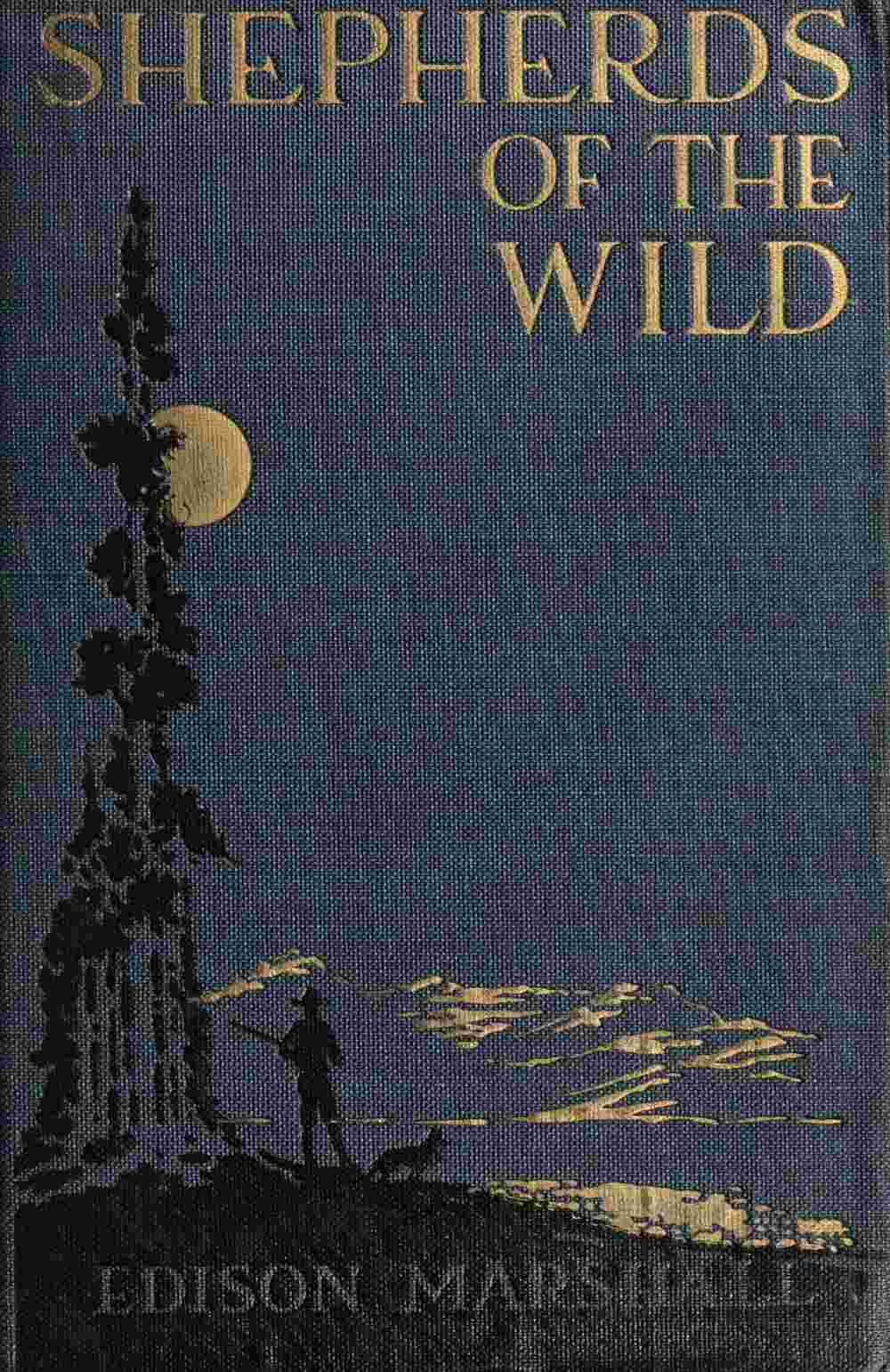
The Project Gutenberg eBook of Shepherds of the Wild
Title: Shepherds of the Wild
Author: Edison Marshall
Illustrator: W. Herbert Dunton
Release date: April 3, 2022 [eBook #67764]
Most recently updated: October 18, 2024
Language: English
Original publication: United States: A.L. Burt Company, 1922
Credits: Mardi Desjardins & the online Distributed Proofreaders Canada team at https://www.pgdpcanada.net from page images generously made available by the Internet Archive
“We’ll pay you two dollars a day—and furnish you with supplies,” she assured him soberly.—Frontispiece. See page 122.
SHEPHERDS OF
THE WILD
By EDISON MARSHALL
Author of
“The Snowshoe Trail,” “The Voice of the Pack,”
“The Strength of the Pines,” etc.
A. L. BURT COMPANY
Publishers New York
Published by arrangement with Little, Brown and Company
Printed in U. S. A.
Copyright, 1922,
By Little, Brown, and Company.
——
Published February, 1922
Printed in the United States of America
Shepherds of the Wild
CHAPTER I
The mouth of the canyon was darkened with shadows when the bull elk came stealing down the brown trail through the dusky thicket. In all this mountain realm, a land where the wild things of the forest still held sway, there was no creature of more majestic bearing or noble beauty. He was full-grown; his great antlers swept back over his powerful shoulders; and it was evident from his carriage that he had no fear of such enemies as might be lurking in the gloomy canyon. For it was known far through the forest that even the great puma or the terrible grizzly, unless they had the advantage of ambush, treated Spread Horn with considerable respect.
Signs of July were everywhere: signs that were large print and clear to the eyes of the wild creatures, but which would have been mostly unintelligible to men. The huckleberries were just beginning to ripen in the thickets as always, in the seventh month. The fledglings, the little weasel noticed as he climbed here and there through the branches, were just the July size,—still soft with the fat of squabhood but yet big enough to make a pleasing lump in the stomach. The pines are a wonderful calendar in themselves; and only to the eyes of human beings, badly in need of spectacles, do they seem never to change. They go from a deep, rich green to a strange dusky blue, and now they were just about halfway between. This fact, as well as the size and developments of their cones, indicated as clearly as a printed calendar that the month was July. Besides, old Spread Horn had a sure index to the month in his own antlers.
Time was, and not many months back at that, when he had no more sign of antlers than his own cows. The time would come, just before they fell off completely, when they would be suitably hard and sharp for the edification of any rival stags that should attempt to disrupt his family life. Just at present they were full-grown but still in the “velvet,”—covered with a sort of tawny fuzz that was soft to the touch. It indicated July without the least chance for doubt.
He came slipping easily down the canyon; and there was no reason whatever for expecting him. He walked into the wind: his scent was blown behind. Otherwise certain coyotes and lynx and such hunters, too ineffective ever to get farther than hungry thoughts and speculations, would have been somewhat excited by his approach. Spread Horn made it his business to walk into the face of the wind just as much as possible, and in that way he was aware of all living creatures in the foreground before they were aware of him. To walk down the wind, all creatures know, is to announce one’s self as clearly as to wear a bell around the neck.
Neither did the great elk make any sounds in particular. If indeed a twig cracked from time to time beneath his foot it was not enough to arouse any interest. He was not especially hungry, but now and then he lowered his head to crop a tender shoot from the shrubbery. At such times he kept watch, out of the corner of his eyes, for any enemies that might be waiting in ambush beside the trail. He would stake his horns and hoofs against any wild creature that inhabited Smoky Land, in a fair fight; but the puma—and sometimes even the grizzly—didn’t always play fair. They knew how to leap like the blast of doom from a heavy thicket.
A coyote—most despised of hunters—saw Spread Horn’s tall form in the shrubbery and glided away. There was a legend in the coyote’s family of how once a particularly bold forefather had seized a cow elk by the leg, and of the subsequent tragedy that had befallen. The only result, it had seemed, was a careful and patient dissection of the gray body beneath the front hoofs of the bull—arriving just the wrong moment—and Gray Thief had no desire to start a new legend on his own account.
Spread Horn showed no surprise at his appearance. His only neighbors were the wild folk,—the only people that he knew. For the wild creatures were still, as far as facts went, the real owners and habitants of Smoky Land. It is true that in various heavy and dusty books in legal offices it could be learned that this particular part of Idaho was public domain, but as yet few frontiersmen had come to clear away the forest and till the meadows. The place was really startlingly large—distances are always rather generous in the West—but few were the maps that named it. Those that had gone to fish in its waters and hunt its mountains thought of it always as beyond,—beyond the last outposts of civilization, beyond the end of the trails, and clear where the little rivers rose in great springs. The cattlemen had named it, and at the end of the dry summer, when forest fires ranged here and there through the high ridges on each side, the name was particularly appropriate. Because of the structure of the passes the winds were likely to fill the region with pale, blue smoke.
In reality Smoky Land lay on the great shoulders of the Rockies,—a high plateau, studded here and there by grim and lofty snow peaks. It was not a land for gentlefolk. It was a hard, grim place, a forbidding land where the sun was a curse in summer and the winds a stinging lash in winter, where great glaciers gleamed in the morning light and snow fields lay unchanging above the line where the timber became stunted and died. There were rugged crags and impassable cliffs, deep gorges and dark, still canyons; miles of gray sliderock and glossy grass slope; and through it all, dwelling like a spirit, there was a beauty that could not be denied. It manifested itself to every sweep of the eyes.
Game trails wound and crisscrossed through the thickets, and the dung was not dried to dust and the tracks half obliterated and stale as in many of the game trails of the West. One only had to wait, to lie still as a shadow in the coverts to see such sights as the forest gods usually reserved for the chosen few. Sometimes it was a doe, stealing with mincing steps and incredible grace from thicket to thicket; sometimes a puma, glaring of eye and hushed of foot and curiously interested in all the doings of the deer; sometimes an old black bear grunted and mumbled and soliloquized as he blundered along; and there is a tale, one that only the swans that come to the high lakes lived long enough to remember, that years ago, in a particularly cold winter, Old Argali, the great mountain ram, led his flock down from the high peaks to feed on the green banks of the streams.
Spread Horn knew them all. They were his neighbors. Also he knew the people that lived in the cataract at the bottom of the gorge. Sometimes, when he paused to drink, the salmon rushed past him in their mysterious journeyings,—their fourth-year migration to the waters in which they were born. They come to spawn in the waters where they were themselves spawned before they go down to the sea, and after they spawn they die. To the naturalist there are strange significances in this repatriation of the salmon. There is a sense of curious relationships,—for strong men, too, always try to return to their homeland for their last days. After four years, almost to the day, the salmon come fighting their way back through the riffles, into dreadful gorges, up cataracts, and high is the waterfall that holds them back.
The salmon were not the only water people that Spread Horn knew. He had seen the trout, too (of course the salmon himself is just an overgrown trout that has taken up a seafaring life) and some of them, like the salmon themselves, took an occasional thousand-mile jaunt to the ocean. These were the great steelheads and such seagoing people, and sportsmen say that a five-pounder at the end of a silk line will permit, for ten tearing, fighting, breathless moments, a glimpse into the Promised Land. But you can imagine the mighty salmon, who have spent four years in the sea and who have swum about the reefs of Kamchatka, regarding them with some patronage. Then there were the little trout: quivering, timid, sparkling creatures that, although great stay-at-homes and never going to sea, still look very beautiful in a creel.
It seems to be one of Nature’s aims to make life interesting and exciting for all her creatures, so she had provided certain other river-folk to entertain these finned people. Their method of entertainment was to take a sudden leap into a riffle or trout pool with glittering, gleaming razor-edged teeth all set and ready. One little instant’s delay in darting to safety, one little clasping of those wicked teeth into the beautiful silver shoulder,—and the trout leaped no more for flies in the cool of the evening. These were the otter and mink and such fur-bearing people, and they existed in plentiful numbers because in this region the trapper had not yet made himself particularly manifest. Then there were plenty of mergansers and other feathered fishermen to take care of the fingerlings.
The cattle herds fed through the region, and sometimes sportsmen penetrated its fastnesses, but mostly Smoky Land was simply the wilderness, primeval and unchanged. The venerable grizzly still dug for marmots on the high ranges,—the great killer that shared the mountain monarchy with the bull elk. The Rocky Mountain goat, white-whiskered as a patriarch, had a range just adjoining that of the bighorn. The wolf pack sang of death and hunger when the ridges were swept with snow.
The late afternoon sunlight, shot and dappled by the shadows of the leaves, fell over the bull elk’s body; and the animal sensed the approach of night. It was the drinking hour. A spring flowed at the foot of the glen, Spread Horn knew, and he turned toward it, stealing softly. And all at once he seemed to freeze in his tracks.
The wind had brought him a message, unmistakably as wireless telephones bring messages of approaching foes across a battle field. His nervous reaction was instantaneous: danger, go slow! Yet it was not a familiar smell, and scientists would have a hard time explaining why the stag had at once recognized its menace. For the creature from whom it came was almost a stranger to these mountains, and it was wholly possible that Spread Horn had never perceived the breed before.
He stood still, gazing, and he looked a long time through the shrubbery branches down to a little green glade beside the spring. He raised one foot and lifted his long muzzle. Then he gave the warning cry,—the sound with which, in the fall, he would warn his herd of danger.
There was no more distinctive cry in the whole wilderness world than this,—a strange, whistling snort, beginning high on the scale and descending to a deep bawl. It traveled far through the stillness. He waited a breathless instant while the echo came back to him. Then he sprang and darted at full speed away into the heavier thickets.
Far below, at the spring, an unfamiliar figure in these wilds leaped to his feet with a guttural cry. It was also a distinctive sound: and no wonder the little chipmunk paused in his scurried occupations to listen to it. Even to the addled brain of the squirrel it suggested annoyance and anger,—a quality possessed by the snarl of the puma when it had missed its stroke. No wonder Spread Horn had fled. The figure was none other than that tall harbinger of death and peril, man.
“It was an elk,” the man cried. “You’ve missed your chance.”
Some one stretched on the grass at his feet answered with a half-snarl. “To hell with the elk,” he replied. “You’ve tipped over the last quart.”
CHAPTER II
It is a far cry from the fastnesses of Idaho back to the lounging room of the Greenwood Club in a great and fashionable city on the Atlantic seaboard; but that distance must be traveled in order to explain at all, to the satisfaction of the old camp-robber bird that perched and squawked upon a limb beside his camp, the presence of Hugh Gaylord in Smoky Land. It all went back to a June evening, immediately preceding the dinner hour, in which he had a short and somewhat important talk with that gray, wise, venerable head of the board of governors whom all men knew fondly as the “Old Colonel.”
It was always very easy to learn to love the Old Colonel. On the particular late June night in question the Colonel looked his usual best in correctly tailored dinner clothes, possessing only one note of individuality, the black bow, obviously factory-tied, set at his collar at a rather startling angle.
“Gaylord,” he said suddenly. “I’d like a few words with you. Bring your glass over to my chair.”
The young man thus addressed had been one of a gay group across the lounging room, and they all looked up with interest. It was a remembered fact that when the Colonel spoke in that tone of voice it was well to listen closely. Gaylord himself smiled and came at once toward him. The group went on with their talk.
The club lights showed the young man plainly, yet he did not in the least stand out. In fact, at first glance there was very little to distinguish him from most of the other men of his age that frequented the club rooms. It was not until two weeks later, when his great adventure had actually begun, and when the camp-robber studied him from the tree limb, that his real personality stood forth. Of course it was by light of contrast. In these luxurious rooms he was among his own kind: in those far mountains he was a stranger and an alien.
He was a familiar type: rather boyish, kind-hearted as are most men who have lived sheltered lives, a fair athlete and a good sportsman at the poker table. It was enough; most of his young friends were wholly satisfied with him, and except perhaps for a vague, troubled hour—usually late at night—Hugh Gaylord was wholly satisfied with himself. And perhaps the reason why the blood mounted higher in his cheeks as the Colonel summoned him was his realization that the old man had had sterner training, and that he possessed X-ray eyes that could read straight into a man. In the first place the Colonel had amassed a fortune by his own resistless effort. In the second, he had known the great school of the forest. He was a sportsman whose metal had been tried and proven on the game trails of two continents.
His eyes leaped over Hugh’s face, and he wondered if he had undertaken a vain task. He knew that a steel-worker cannot make tempered blades out of inferior metal. He wondered if he could hope for any real response from the treatment he was about to suggest. Hugh looked soft, and soft men are not usually made hard by a few weeks in the mountains. To follow the high trails, to seek the hidden people, to scale the cliffs and wade the marsh require a certain hardihood of spirit to start with,—and Hugh Gaylord seemed lacking in that trait. It was not that he had a weakling’s body. Because it was the thing to do in his own circle he had kept himself fit on the gym-floor of his athletic club. His hands were hard and brown, his figure lithe, his face and neck were tanned in tennis court and golf links.
Yet that hard-eyed old woodsman looked at him straight and knew the truth. Hugh would not be able at once to enter into the spirit of the land where the Colonel was about to advise him to go. The lean foresters, natives of the land, would not accept him either; nor would they stay to eat at his camp. They wouldn’t linger to tell him secrets of the wild. If they talked to him at all, it would be to narrate long and impossible adventures that are usually, on the frontier, the “feed” for tenderfeet. He could not enter into the communion of the camp fire; and yet no one—except possibly the Colonel himself—could tell him why.
Perhaps he lacked the basic stuff. The Old Colonel was a little despairing: he had begun to fear that in this lay the true explanation. But perhaps—and this was the old man’s hope—the matter got down to a simple phrase of ancient usage: that Hugh had merely not yet learned to be a “man of his hands.” The meaning goes deeper than mere manual toil. It implies achievement, discipline, self-reliance. It is not a thing to mistake. It promotes the kind of equality that the Old Colonel himself knew,—that which abides at a Western cow ranch or in the battle trench. Hugh’s face was not unlined; but dissipation rather than stress had made the furrows. The lips did not set quite firm, the young eyes were slightly dimmed and bloodshot. There was, however, the Colonel saw with relief, no trace of viciousness in his youthful face. He was an Anglo-Saxon: after the manner of most Northern men he was an honest young debaucher, taking his orgies rather seriously and overdoing them in a way that would be shocking in a Latin. Possibly the same Northern blood gave him a background of strength: this was the old man’s hope.
“You’re looking a bit seedy, Hugh,” the Old Colonel began in his usual straightforward way. “I’m afraid you’re getting to be sort of a poor stick.”
His tone was that with which he was wont to begin an interesting story: perfectly matter-of-fact, just as if he were pronouncing a judgment on the weather. Hugh flushed to the roots of his hair but he didn’t take offense. No one ever could take offense when the Colonel told them truths.
“Complimentary mood to-day, eh, Colonel,” Hugh commented lightly. In reality he didn’t feel in a festive mood at all. But he sat still, dreading what might come next.
“No, not particularly,” the Colonel answered soberly. “You know, Hugh, the interest I’ve always taken in you. And you know why.”
Yes, Hugh knew why. It went back to one of his own mother’s girlhood romances,—a rather beautiful story such as men tell their wives and sweethearts but from masculine reserve do not talk over among themselves.
“I know,” Hugh agreed.
“I can’t see,” the old man went on thoughtfully, “that in spite of the—er—damnable joy of having you around, you’re any good to yourself or any one else. Why don’t you lay off of it a while?”
“You mean—this?” Hugh tilted his glass up on one edge.
“I didn’t happen to mean that, but perhaps I’d better include it. I saw you last night, Hugh, and I’m not one to think hard of a boy for an occasional exhilaration. But the trouble was—it was the night before too, and the night before that, and nobody knows how many more such nights. You’re looking a little soft around the mouth, and just a little—too old for your years. Won’t do, Hughey boy. I mean why don’t you lay off this sort of life you’ve been leading: too much ease, too much loaf, too much booze, too much chorus, not enough work. Oh, damn their skins! I wish they’d sent you to France.”
“And I guess you know how I felt about that,” Hugh replied in his own defense. Yes, the Colonel knew: Hugh had really and earnestly wanted to go to France. He had been commissioned, however, rather sooner than was best for him, and he had been kept in an office in Washington.
“And the worst of it is you never even had to go through the grind of being a real buck private, with nothing particularly in sight. You’ve had everything too easy. You ought to sweat once, and feel a few breaks in your skin and a few sore muscles. Soft, Hugh, soft as soap. Lazy as sin. Why don’t you get out and rough it for a while?”
Hugh stood up. “I don’t know——” he began stiffly.
“But I do. Sit down.”
The eyes of the two men met, and those of the old man smiled under his bushy brows. Hugh sat down again. He knew, only too well, how true these words were. He had always been soft, and trial had never hardened him. “I suppose the same old chant—to go to work.”
“Not this time. I’m going to prescribe another treatment—a more pleasant one. I know there’s no use of asking you to go to work. I don’t see what work you could do. Sitting around an office, considering the safe and sane nature of your investments, wouldn’t help you much. But, Hugh, I have some English friends—good enough beggars most of ’em—and once or twice they’ve confessed—that the only thing that kept them from utter damnation was devoting their lives to sport.”
Hugh knew about these “good enough beggars” that were friends to the Colonel—many of them men of great names and titles whom lesser Americans would boast of knowing. The Old Colonel shook his head somewhat sadly, and for a moment his eyes gazed out over the twilight grounds.
“When I say ‘sport,’ ” he explained, “I mean he-man sport. Into Africa after lions. Shooting a tiger from the ground. Up to Tibet after snow leopards. Down to New Zealand after trout. Going—going—going—never getting soft. Blizzards and jungle and thirst and cold. I know there’s no chance for me to get you to do real work. But damn me—I can’t help but think there’s a little of the old stuff in you somewhere, and I’ve been thinking that a hard course with rifle and fly rod might—might get you going along the right lines. If you’d once learn to love the outdoors, and learn to love to fight, who knows what might not happen.”
“And you suggest—that I take a trip after lions?”
“Lions are hard game, not for children,” was the reply. “ ‘I hunted the lion,’ was one of the few things an old and tough Egyptian Pharaoh saw fit to record imperishably on his monument—but you’re not a Pharaoh yet. I’ve got something here.”
He fished through many waistcoat pockets and drew out a clipping, spreading it out on the broad arm of his chair. “I thought of you when I read it—and cut it out—and I thought what I would have done if it wasn’t for the old game leg. I thought maybe it would stir up your dormant imagination and set you off. Read it.”
Hugh read, noting first that the clipping was a reprint from an Idaho paper:
The stockmen of the Smoky Land section, up Silver Creek way, say that unless government hunters come to their aid, the stock business in that district will be seriously impaired. Wolves and coyotes seem extra plentiful this year, and besides a giant cougar, to whom the sparse settlers have given the name of Broken Fang, has been ranging there for some months, doing thousands of dollars’ worth of damage to cattle and sheep. From the size of his track and the occasional glimpses of him, the residents of that section think that he is the largest of the great cats that has ranged in Idaho for many years.
The Old Colonel studied Hugh’s face as he read. “Not very interesting, eh?” he commented at last. “My boy—he would be a trophy. I know something about that hairy old breed of mountaineers in the Upper Salmon country. They don’t take the trouble to give a puma a name unless he’s a moose. I know quite a little about pumas, too—or cougars, they call ’em. Usually they are about as dangerous as white rabbits. But once in a while one of them gets overgrown and thinks he bosses the range. If wounded—and sometimes by a long chance even if he isn’t wounded—they put up a wicked fight. This big boy would be a trophy worth having; besides, you might pick up a grizzly or a smaller puma. There are always trout, and this is trout-time in the West. Why don’t you go after him?”
The Old Colonel always put his propositions in just that straight-out way; and it made them hard to refuse.
“You mean—go out there three thousand miles on a long chance of killing this cattle-slayer?”
“Why not? You’re not paralyzed or anything. You ought to see Idaho. Every man should. As I said, there are worlds of smaller game. Every man ought to have an objective in his trip; so I say go to Smoky Land. These two weeks might teach you to love the woods so you’d go again and again. And a few trips to the high ranges, once you really got to love ’em and play ’em right, might make—might do wonders for you. Please give me the pleasure of telling the boys that Hughey Gaylord has gone big-game hunting.”
Hugh felt the wave of red spreading in his cheeks again. He knew perfectly what the old man had been about to say—“to make a man of him.”
“Remember,” the Old Colonel urged further, “you’re an Anglo-Saxon—a white man of straight descent. It’s a heritage, Hugh. And it implies an obligation.”
“I’d hate it,” Hugh protested.
“Try it and see. Perhaps—there might be a miracle.”
Hugh drained his glass; then stood up. “Very well, I’ll start next week,” he said at last simply.
Thus this son of cities gave his promise to go forth into a man’s land: a land of trial and travail, of many perils and strong delights, a jagged mountain land where the powers of the wilderness still ruled supreme—and yet a place where miracles might come to pass.
CHAPTER III
The camp-robber, perched on a limb, was in considerable of a mental turmoil. His mentality was never of an extra high grade, and to-day his intellectual grasp had almost failed him. And the reason was that he had made an astonishing discovery; and these remote Idaho forests had suddenly revealed to him a form of life that he hadn’t had any idea existed.
Of course his true name wasn’t “camp-robber.” In reality he belonged to that noisy, thievish jay-magpie assemblage that is to be found in almost all of the great Western forests, and he had a long and jaw-breaking scientific designation besides. But on the lower East Side it isn’t necessary to hunt up the name in full of Tony the Dip, because the title describes him better than the name his mother gave him. It was much the same with the camp-robber. He got the title from his habits and it fitted him to perfection.
He was rather a gay old bird with considerable blue and gray in his feathers, and in his several months of life he had concluded that he knew these Idaho woods from one end to another. He thought it would be a long, cold summer day before he would meet a situation that he could not immediately handle. He knew just how to look twice into a cluster of leaves and twigs before he lighted among them—lest a certain little brown-furred cutthroat that was rather unpleasantly known to his family should be waiting in ambush. He knew how to select a nest-site out of the reach of a prowling raccoon, and he was as impertinent and saucy from all this knowledge as words can tell. Yet out of a perfectly clear ground, so to speak (it wouldn’t be correct to say out of a clear sky when referring to one who habitually lives in the sky) two utterly unknown and enormous living creatures had revealed themselves.
The camp-robber had been winging back and forth through the forest and had flitted down to the spring for a bath. One of the two figures was standing erect, shaking his fist at the speeding form of Spread Horn,—a creature from the back of which the camp-robber had almost, if not quite, gathered vermin. The other was lying down, gazing moodily at an interesting-looking object that had oozed what had seemed to be dark blood on the pine needles. In form they resembled bears; yet he didn’t for an instant think that they were. They were not deer or cougar or even overgrown raccoons. He perched upon the limb to think it over.
Yet the camp-robber never spends a great deal of time in such a profitless occupation as thought. At once his instincts began to get busy inside of him. He was a born kleptomaniac, and he was simply fascinated by the number of bright and interesting things lying about the ashes of the dead fire. He began to have all manner of pleasing conjectures in regard to them. Like many gentlemen-of-fortune in the Parisian underworld he had a long ancestry of famous criminals; and now he remembered certain advice his mother had given him when he was a fledgling in the nest.
“If ever you find a camp of men,” one can imagine the old mother-bird chirping, as she flicked her tail here and there, “fly right down into it. You will have more fun than you ever had in your life before.”
These were men: no other supposition remained. The camp-robber squawked once, in enthusiasm, and sailed down to the ground beside the prone figure.
The result was rather astonishing. For the second at least Hugh Gaylord forgot the late tragedy to his last bottle of bourbon. A smile that was singularly winning and boyish played around his lips.
It was not quite Gaylord’s way to smile at such little things as this. It usually required a very keen jest from a clever comedian in a musical comedy to draw a smile from him. Strangest of all, he hadn’t been in the least in the humor for gaiety since the first day he had come to these stern, lonely mountains.
He watched the bird with growing astonishment. His surprise was really no less than that of the camp-robber on first beholding the two men. The bird hopped here and there among the camp supplies, scratched in the pine needles for crumbs, and then, with astounding cheek, began to peck holes in the soap. He had tasted many things in his months of foraging, but here was something the like of which he had never tasted before. The truth was that more than one camp, here and there through the forest, could not yield up such a treat as this. Many of the sparse visitors to the Upper Salmon mountains regarded the use of soap as they did Christmas,—something to celebrate once a year.
Hugh had not discerned the fleeting form of the elk in the thickets, and except for his guide, this bird was the first living thing he had seen since he had come to Smoky Land. It was not that the forest did not literally teem with life. The trouble lay in Hugh’s eyes. The living things of the great forest are always furtive and hidden, and they only yield their most priceless secrets to those who seek them.
A man never sees clearly when his brain is misted and blurred from the fumes of strong drink; besides, Hugh had not yet gone a half-mile from camp. He was a tenderfoot in the raw, and the forest creatures had been able to discern his heavy tread in plenty of time to get out of sight. He had been disgusted and annoyed by the discomforts of camp life, and he was eager to return to his own kind; his stock of liquor had been running low and without it he did not believe he could exist; he spoke loudly and his spirit was dead within him: and thus the forest had remained a closed book. His choice of a companion had not been particularly fortunate either. Pete had good blood in him, the blood of as brave and hardy a race as ever lived, but degeneracy was upon him and his people. He had been employed as Hugh’s guide, but he had found it much more convenient to stay in camp and drink Hugh’s whisky.
The Indian guide would have been a familiar type to any one of the hardy, farseeing frontiersmen that occasionally ranged through the forest, but Hugh himself would have wakened some wonder. He was still obviously a man of cities. He wore the outdoor clothes of a gentleman, which is but rarely the outdoor garb of the frontier. They were stained with dirt and their careful crease was destroyed; yet they marked him as a tenderfoot.
The truth was that the Colonel’s experiment had seemingly failed: the few days that Hugh had already spent in the far Rockies had wrought no change in him. He had not found Broken Fang—the great cougar that had already won a name through a thousand square miles of Idaho forest—and he was ready to admit to himself, at least, that he had made no real effort to find him. He had fished once, succeeding in breaking a number of expensive gut leaders and high-grade flies in the brush along the stream. The remainder of the time he had lain in camp, wishing he hadn’t come. Fortunately the two weeks were nearly over.
The guide brought his wandering mind back to the disaster of his liquor. “I know where you can buy quart—take place that one I spilled,” the Indian said.
Hugh’s face brightened. “Lead me to it.”
“Just over ridge. Sheep camp there—only one this part of mountains. Herder’ll have extra quart or two.”
Hugh looked at his watch. “We can get over and back by dark?”
“Maybe soon after. Going to be pretty dusky right away.”
The man spoke true. The twilight was falling over Smoky Land. The sun was set, the tall pines seemed to darken above them, the dusk grew and deepened between the distant trunks. The immeasurable silence of the mountain night, broken by such little sounds as only accentuate the hush, was deepening about them.
Hugh had no answer at first. For once no words were at his lips, and it was a good and portentous sign. He stood listening. Perhaps because the visit of the camp-robber had been an impulse to his imagination, perhaps only because the effect of his last drink was dying within him, some little portion at least of the age-old magic of the wilderness twilight was going home to him. Now that his guide’s voice died away, he was a little startled by the vastness of the silence.
Far and wide through the forest the wild creatures were starting forth on their night’s business. But they moved with stealth. Hugh had an instant’s dim realization that thickets moved and rustled in the ultimate reaches of hearing; that dim shadows wavered so far distant that he could not be sure of them. The wilderness forces were coming to life.
He lifted his face. As usual in the twilight hour, the faintest breath of wind came slipping, light as a deer-tread itself, from the further mountains. He saw the two long ridges that enclosed his particular part of the plateau, and the last light of day gleamed on their tall, white, snow-laden peaks. These were the high Rockies; sentinel mountains grand and austere.
These mountains looked just at hand in the daylight, but now in the gathering gloom they seemed to be receding into the infinite distance. The attention of Hugh Gaylord was not usually held by mere scenic beauty, but to-night, for a lone, long instant, he felt vaguely stirred.
Then a faint, sharp sound reached him through the growing silence. It came from an amazing distance, and but for the fact that all his senses had been unusually alert he would not have discerned it at all. All that was left of it was a faint prick in the eardrums,—a noise that a beetle might make in the leaves.
“Did you hear something?” he asked his guide doubtfully.
“Yes,” the Indian replied. “Little noise. Know who made it?”
“A shot?”
“Yes. Maybe ’nother hunter, but they don’t often come here. Over toward sheep camp. But gotto hurry heap—get whisky—come back while plenty light to see.”
Hugh nodded, and they headed up the ridge.
CHAPTER IV
It was written, by those special jungle gods that plan entertainment for tenderfeet, that Hugh Gaylord should get some slight taste of the real mountains on his walk to the sheep camp. It was only a mile, but the trail was nothing whatever like the golf course that Hugh had been wont to walk around on Friday afternoons. It was narrow and brown, and hard-packed by the feet of the wild folk that had been passing up and down that way since the mountains were new. They hadn’t been careful to keep the grade under six per cent. There was also an occasional rock and a rather frequent dead log that had to be leaped. Moreover the berry vines scratched the face and caught at his clothes when the trail twined between the heavier thickets.
Hugh had been proud of his physical condition. He had been under the tutelage of a high-paid physical director, and he could swing the Indian clubs a startling number of times without fatigue. Before that walk was done, however, the fine edge of his self-assurance had been somewhat dulled. In the first place, the pace was rather fast. Pete the guide was inordinately lazy and a wretched guide, but like most wilderness men who get their exercise in walking game trails rather than in swinging Indian clubs, he knew how to make the long miles slide under his feet. It is not an accomplishment of a day—that bent-kneed, shuffling walk, shoulders sagging and feet falling lightly—and it is far from graceful. But it clicks out four miles in every hour through the long mountain day without fatigue. It carries a man up mountains and into glens, and he feels fresh at the end. To-night Pete was in a particular hurry. The devils that dwell just under the dark skins of all his race were crying for strong drink. Besides, darkness would be upon them very soon.
The pace took Gaylord’s wind. It brought queer pains low in his chest and an odd heaviness in his legs. But for all that, a physician could have prescribed no better medicine for him. The sweat leaped from his white skin and felt prickly at his neck and forehead, and the fumes of alcohol departed from his brain. The truth was that in this deepening twilight Gaylord saw more clearly than any time since his arrival at Smoky Land.
His senses became more alert, his eyes began to penetrate deeper into the thickets. He began to notice dainty mountain flowers, and he took a singular delight in the tracks of the wild things that had been left in the trail. Here a coyote had skulked, here a wolf had raced along in some chase of death, and here a cougar had crept by in some dreadful business of a few nights before. His hearing was sharper, and once the rustle of leaves above his head called his attention to a family of gray squirrels, disporting on the limbs. He found himself watching, with unexplainable interest, his guide.
For the first time he marked clearly the silent tread, the peculiar alertness of his carriage, and most of all the dark surface-lights in his eyes. As they headed deeper into the thickets a strange change seemed to come over the man. Perhaps the liquor was dying in him, too, or possibly Gaylord’s imagination was playing tricks upon him. He received an odd impression that hitherto his guide had been asleep and had just now wakened. They were near the sheep camp now; they could hear the faint bleat of the bedding animals, and the Indian seemed to forget the other’s presence. All at once he began to stalk in earnest. He slackened his pace: Gaylord behind him slackened his. The moccasined feet had fallen softly before; now they seemingly made no sound at all. The dark eyes brightened, the muscles rippled under the dusky skin, a new vitality seemed to come over him. The truth was that this son of a savage race had not undergone so great degeneration but that he still responded to the age-old intoxication of the falling night. It was the hunting hour, and Hugh could imagine the tawny cougar, Broken Fang, whom he had come to slay, responding in the same way.
Abruptly the Indian paused and held up his hand. Hugh crept near.
“—— Big animal—close,” the guide whispered. “Maybe you get a shot.”
Hugh stood still, listening. Far distant he heard the usual, faint mysterious sounds that the early night hours always bring to the wilderness world; but if anything, the primordial silence was more heavy and portentous than ever. The snow peaks still gleamed faintly, and he sensed their majesty and grandeur as never before. It was not alone an impression of beauty. Beauty is an external thing alone: in this moment of farseeing, he understood something of their mighty symbolism, their eternal watch over the waste places. He saw them as they were: grand, silent, unutterably aloof.
“How do you know?” he asked, in reply to his guide. “I don’t hear anything.”
The truth was that Pete would have found considerable difficulty in telling just how he knew. Rather it was a sixth sense, an essence in the air that blunter senses could not have perceived. “We’re near flock—maybe lot of varmints hanging close. Always is—around sheep. Don’t know what animal came near just now—cougar, I think.”
“Maybe old Broken Fang himself?”
“I don’t know. Heap maybe not. Country’s big.”
Pete was given to telling lies, on occasion, but he had told the truth for once. Hugh’s eyes leaped from peak to peak, and he began to realize something of the vast, tremendous distances of the region. They pushed on, over the ridge and through the last of a heavy wall of brush.
They came out on the edge of a small meadow,—one of those grassy, treeless stretches that are so often encountered in the high ranges. Silver Creek ran through it: a stream that was a “creek” only in the Western sense. In reality it carried more water than many a famous river. It was narrow, however, lined with thickets, and evidently deep and swift. Five hundred yards beyond the great forest encroached again, and the meadow was even more narrow, parallel to the creek. And at the first glance Hugh might have thought that the meadow was covered with deep snow.
It was the sheep. They were bedding down for the night,—a flock that could not contain less than three thousand ewes and lambs. They had crowded so close together that they occupied, in all, a space hardly more than a hundred yards square, and the only break in the white drift was an occasional spot of inky black. These, in a moment’s inspection, revealed themselves as black sheep,—animals that occur in every western flock and are generally used by the herdsmen as markers.
Their numbers staggered Hugh. He wondered how any one herder could care for them. And he was suddenly amazed at the strange thoughts that flooded him.
The truth was that Hugh was an exceedingly sensitive man, finely tuned to all manner of external impressions. Something about that snowy band touched a side of his nature of which he had never been aware before. He couldn’t quite identify the thoughts that stirred him. They dwelt in an unknown realm of his being; he grasped for them but always they flitted away. He held hard on himself and tried to understand. The sheep bleated, the shadows grew over the distant mountains. He began to think that the plaintive bleat of the sheep was playing tricks upon his imagination. It sounded to him almost as a direct appeal for help and protection. He realized at once the truth of a fact he had heard long ago,—that sheep, above all other domestic animals, are dependent upon men for their very lives. A horse may run freely in the waste places, fighting off with slashing fore feet and terrible teeth such wild enemies as molest it. The cattle can range far in comparative safety: for even the great grizzly has been known to avoid the horned steer. Even the hogs, half-wild in the underbrush, have some means of self-protection. These sheep had none.
But the thoughts he had went deeper than that. He was dimly aware of a vague symbolism, a realization that in this mountain scene could be read some of the great, essential truths of life. He had a curious impression of being face to face, for the first time in his life, with realities,—in spite of the paradoxical fact that a vagueness, seemingly a bewilderment, was upon him.
All his life Hugh Gaylord had dwelt in cities. He had traveled far: sometimes in motors, usually in luxurious sleeping cars, occasionally in steamships. Yet he had never really been outside of cities. He knew the hurrying throngs, the great buildings, the busy streets. The shops, the theaters, the gaiety had been acquaintances as long as he could remember. He had never dreamed of a world without these things. Yet, in an instant, all of them seemed infinitely distant. Strangest of all, they suddenly didn’t seem to matter.
It was an impression that all his life there had been a cloud before his vision, and all at once he could see clear. Here, not in those swarming cities, was reality. The cities had been built in a day; the other factors that had been so necessary in his life—his clubs, his motor cars, his amusements, even much of the great world of business—were merely mushroom growths of a little handful of centuries that men called the age of civilization. Strangely, they no longer seemed to him the basic things of existence. Rather now, for the first time in his days, he was face to face with life,—life in its simplest phases, with all its unrealities and superficialities swept away. This was no vista of the present: this scene of the white sheep bedding down for the night in the dim light of the herder’s fire. Rather it was an image of the uncounted ages. All the basic elements of life were here: the flocks, the herder’s little shelter, the fire glowing in the falling darkness, the watchful shepherd dog guarding the lambs, the beasts of prey lurking in the growing shadows.
There was nothing here to perish or change. It had been the same for uncounted centuries,—since the first dim days when the nomads drove their flocks over the plains of Asia. Cities are born, grow great, are cursed with wickedness, and perish. The flocks still wander on the hills. Men catch new fancies, follow new teachings, build new orders, and pursue new ways. The firelight of the herder still glows in the twilight. Civilization rises and falls like the tide. The beasts of prey still lurk in the thickets to slay the sheep. Fashions, hobbies, pleasures, habits and modes of life, faiths and doctrines, even kingdoms and palaces start up, flourish, change and die,—and still the shepherd dog keeps his watch.
He was suddenly called from his reverie by the voice of the guide beside him. “Fire’s about out,” the man said. “Time herder put on more fuel.”
It was a commonplace remark, yet it compelled Hugh’s attention. His startled eyes turned to the Indian’s impassive face. “It’s not cold to-night,” he replied. “What’s the need of the fire?”
The Indian made no immediate reply. He did, however, hold up his hand. Hugh listened. Somewhere back of them in the thicket a twig broke with miniature explosion. Then two leaves rustled together.
“That’s why,” the Indian said. “Keep off varmints.”
At that instant the dog discerned them and came barking toward them. He was a beautiful shepherd—from his unusual size evidently a crossed breed—and the light was still good enough for them to see his lustrous coat, his powerful form, his intelligent head, his fine brush that he carried high. The dog slowed to a walk, and Hugh spoke to him. A moment more the animal was at his knees.
Hugh had always been a dog-lover—giving his regard to an ill-mannered, savage German police dog that lived a parasitical life at his city house—and he knelt quickly to caress the shepherd’s head. And for the second time that night he had a series of impressions that he could not trace or name.
They arose from the behavior of the dog. The animal seemed oddly nervous and shaken, and the great, brown, lustrous eyes were full of singular appeal. He ran from them a little way, barking, then returned as if he desired them to follow him. “What’s the matter, old boy?” Gaylord asked. “What’s up?”
The dog barked again, coming to his arms for more petting. Then the Indian dropped to his knees with a curious little cry.
Pete the guide had an exceedingly good command of English for a half-breed. But in that moment of astonishment the use of the language fell away from him, and his only utterance was an exclamation in his own almost-forgotten tongue. He rubbed his hand over the animal’s shoulder.
“What is it, Pete?” Hugh asked quietly.
“He’s creased. Dog’s been shot—bullet took away a little skin.”
“The shot we heard?”
“No. That rifle shot. The dog shot with pistol.”
“And how in the world did you find that out?”
“Not know sure—looks heap like a scratch by small-caliber bullet. Couldn’t hear pistol shot so far.”
“I’ve heard,” Hugh said thoughtfully, “that it isn’t good form—for a herder to shoot at his own dog.”
“Maybe not that,” the Indian went on. His tone was so strange and flat that Hugh whirled to stare at him. “Fire’s burning out too—sheep getting restless. Maybe better see where herder is.”
“Don’t you suppose he’s in his shelter tent?”
“We’ll look and see.”
They started out into the clearing, the dog running in front of them. The sheep, after the manner of their kind, paid no attention to them. They walked swiftly toward the little tent beside the stream.
The dog stopped, sniffing at something that lay in a little clump of thicket. When still a few paces distant, Hugh thought it was one of the black sheep, separated from the flock. The Indian, however, made no such mistake. And he hardly turned to glance at it.
“The herder’s other dog,” he explained. “Knew there ought to be two. Better shooting this time.”
Hugh felt a little stir of excitement. The black dog had been slain by a small-calibered bullet, and his body was still warm. The Indian increased his pace.
A second more, and they were at the door of the tent. It was hard for them to see clearly at first. The shadows were quite deep inside. And at first they were only aware of a heavy, strange silence that seemed to grow and deepen as they stood looking.
The herder was not standing up to greet them. Neither was he busy at any of his late-evening tasks. They made out his figure dimly, sprawled on his blankets in one corner of the tent.
“By Jove!” Hugh exclaimed. “I believe the beggar’s asleep.”
But he didn’t speak quite the truth. In reality, he believed something far different. It is the way of a certain type of man to avoid at all costs any appearance or semblance of hysterics or sensationalism. Hugh was of that type, and he unconsciously shrank from the utterance of his true beliefs.
“Not asleep,” the Indian replied bluntly. He stopped, walked into the tent, and turned the man’s body in his hands. No wonder the camp fire was dying. Its tender—the sheep herder—had been shot and killed a few moments before.