
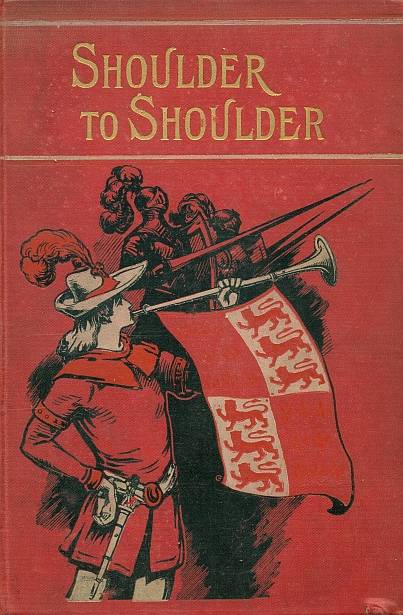
The Project Gutenberg eBook of Shoulder to shoulder
Title: Shoulder to shoulder
A story of the stirring times of old
Author: Gordon Stables
Release date: May 8, 2025 [eBook #76046]
Language: English
Original publication: London: John F. Shaw and Co, 1896
Credits: Al Haines
"Hurrah, my lads; remember Egypt!" shouted Sir John Moore. p. 310
Shoulder
to Shoulder:
A
STORY OF THE STIRRING TIMES OF OLD.
BY
GORDON STABLES, M.D., C.M.
(Surgeon Royal Navy),
AUTHOR OF "ON TO THE RESCUE"; "HEARTS OF OAK";
"EXILES OF FORTUNE";
ETC. ETC.
"Be Britain still to Britain true,
Amang oursels united;
For never but by British hands
Maun British wrangs be righted."—BURNS.
NEW EDITION.
LONDON:
JOHN F. SHAW AND CO.,
48, PATERNOSTER ROW, E.C.
COPYRIGHT BOOKS UNIFORM WITH THIS VOLUME.
CLEARED FOR ACTION W. B. ALLEN.
EXILES OF FORTUNE DR. GORDON STABLES.
A REAL HERO G. STEBBING.
A TANGLED WEB E. S. HOLT.
BEATING THE RECORD G. STEBBING.
THRO' UNKNOWN WAYS L. E. GUERNSEY.
IN SHIPS OF STEEL DR. GORDON STABLES.
IN CLOISTER AND COURT E. EVERETT-GREEN.
THE UGLY DUCKLING HANS ANDERSEN.
ODEYNE'S MARRIAGE E. EVERETT-GREEN.
ENGLAND'S HERO PRINCE DR. GORDON STABLES.
ANDERSEN'S FAIRY TALES H. C. ANDERSEN.
FACING FEARFUL ODDS DR. GORDON STABLES.
SHOULDER TO SHOULDER DR. GORDON STABLES.
EDGAR NELTHORPE ANDREW REED.
WINNING AN EMPIRE G. STEBBING.
HONOUR NOT HONOURS DR. GORDON STABLES.
IDA VANE ANDREW REED.
GRAHAM'S VICTORY G. STEBBING.
THE END CROWNS ALL EMMA MARSHALL.
HER HUSBAND'S HOME E. EVERETT-GREEN.
FOSTER SISTERS L. E. GUERNSEY.
DOROTHY'S STORY L. T. MEADE.
A TRUE GENTLEWOMAN EMMA MARSHALL.
BEL MARJORY L. T. MEADE.
WINNING GOLDEN SPURS H. M. MILLER.
ON TO THE RESCUE DR. GORDON STABLES.
DASHING DAYS OF OLD DR. GORDON STABLES.
TWO SAILOR LADS DR. GORDON STABLES.
IN SEARCH OF FORTUNE DR. GORDON STABLES.
ENGLAND, HOME, AND BEAUTY DR. GORDON STABLES.
HEARTS OF OAK DR. GORDON STABLES.
OLD ENGLAND ON THE SEA DR. GORDON STABLES.
LONDON: JOHN F. SHAW & CO.,
48, PATERNOSTER ROW, E.C.
CONTENTS.
Book I
IN THE HIGHLANDS A HUNDRED YEARS AGO.
CHAPTER
I. AULD-DA
II. MY HERO—BONNIE PRINCE CHARLIE
III. THE FIRST ACT IN A TRAGEDY—A WILD AND LAWLESS MAN—MUIRACHIE THE DWARF
VI. A HIGHLAND SCHOOL A HUNDRED YEARS AGO
X. THE KING'S SHILLING—IN CORNEY'S CAVE—"SURRENDER IN THE KING'S NAME!"—CAPTURE AND ESCAPE
Book II.
OFF TO JOIN HIS REGIMENT.
II. THE VOYAGE OF THE "VENGEFUL"—TERRIBLE SUFFERINGS AT SEA
IV. WHAT A BATTLE SEEMS LIKE TO THE SOLDIER—TERRIBLE TIMES IN PARIS—CIVIL WAR AND MURDER
Book III.
FROM WAR TO GENTLE PEACE.
II. AWFUL CONDITION OF GIB—GRANDFATHER STABBED—A VENDETTA—THE DUKE WAS THE BEST-HATED MAN ON THE ROCK
III. MYSTERY—A GRUESOME BOX—A MEETING OF CONSPIRATORS—TERRIBLE THREATS—THE MUTINY
V. NAPOLEON'S SCHEME FOR INVADING BRITAIN—A BRIGHT PROMISE—GRANDFATHER MEETS HIS FATE
IX. FIGHTING AGAINST FEARFUL ODDS—DEATH OF MOORE—THE EMBARKATION—A WIFE AND A NEW SET OF BAGPIPES
XI. ACROSS THE WIDE ATLANTIC—A STRANGE PARADE—THE BAREFOOT SQUAD—SHIPWRECK—A FEARFUL FIGHT
XII. RED-EYE, THE INDIAN CHIEF—A TERRIBLE ADVENTURE WITH A BEAR—BAD NEWS!—STOLEN OR KILLED BY INDIANS
XIII. "WHERE IS RED-EYE? I WILL KILL HIM!"—A SOLEMN SCENE—THE MOONLIT FOREST
XIV. THE FIGHT WITH SAVAGES—A LONE GRAVE IN THE FOREST—RETURN OF SPRING—NAPOLEON AT ST. HELENA
To
DR. JOHN ROBERTSON
THIS BOOK IS INSCRIBED,
WITH MANY A KINDLY WISH,
BY HIS COUSIN,
THE AUTHOR
Book I.
In the Highlands a Hundred Years Ago.
SHOULDER TO SHOULDER.
Book I.
IN THE HIGHLANDS A HUNDRED YEARS AGO.
CHAPTER I.
AULD-DA.
Never for a moment—as we sat together in the twilight—could the dear old man have imagined that, just thirty years after his death, his grandson would be here, in a wigwam, writing the story of his romantic life.
That story, let me tell you, is also the story of the old days, when
"Wild war's deadly blast was blowing";
the story of the times when Napoleon was still the world's hero, his glory putting in the shade even that of Wellington himself, and many another great and notable general.
Ah, me! how long ago it seems now since I used to lift the "sneck" of Auld-da's door, and slip quietly in, just as the shades of evening were deepening into night.
"Is that you, Williamie?" he would say, without turning his head.
"Yes, Auld-da"; and, next moment, I would be sitting on the "creepie"* by his feet, with my arm leaning on his knee, waiting for a story.
* Creepie: a low stool.
A little, little boy, they tell me I was then, with pale face and dark-blue wondering eyes. Not over strong, you may guess, because I lived in the realms of romance, and because fairy tales—stories of water-kelpies, that lurk in the darkest pools of forest-shaded rivers, and eat men's flesh at midnight; stories of brownies and spunkies, that bob their lights before belated travellers to lure them far across the moor to the bog, in which they sink and perish—and all the legends of my native Scottish land were, to me, as dear as the very air I breathed.
But, pale-faced though I was, and not likely, then, to grow up an athlete, I was my grandfather's favourite.
In Scotland, far north, although in the sweet summer-time one can see to read nearly all night long, yet in winter,
".... When the rain rains cauld,
And frost and snow on every hill,"
the days are very short indeed, and gloaming comes on at four in the afternoon, or even earlier. But, then, there is all the long, delightful forenights to spend by the cheerful low fires of peat and wood; so, with games and music, one never does feel weary, and bed-time comes far, far too soon.
* * * * *
A very humble cottage was Auld-da's—only a but and a ben, with attics—but it was sufficient for all his needs; and his little garden, where, in the soft, sweet summer time, old-fashioned flowers grew in banks, where the honeysuckle twined over the hedge, and the roses trailed above the porch, was pleasant indeed.
A better or a bigger house than this might have been his, had he cared for it, but he dearly loved the children, as he called my brothers and sisters, and liked to be near us all.
Very old he was, as I remember him. Probably bordering upon eighty. But he bore his years well, though winter's snows had whitened his hair and furrowed his war-bronzed face.
When not working in his garden, he was ever, ever reading, and, strange to say, with the exception of the weekly paper, his books were only two. One was the Bible, which, every year of his life, he read from beginning to end, always, he used to tell us, discovering some new truth or truths in it; the other, a very large, well-thumbed volume, called Looking unto Jesus.
But at eventide, when
"The day was done, and the darkness
Fell from the wings of night,
As a feather is wafted downwards
From an eagle in its flight,"
then my aunt, who kept house for her father, took the books away, and left him for a while to sit in his easy-chair and look at the fire.
And this was my hour—"the children's hour," as Longfellow so prettily calls it.
It is pleasant to sit and look at a fire on a low hearth, just between the dark and the daylight, and, child though I was, I knew, as if by instinct, that scenes in his past life were rising up before him in the peat fire's fitful glow.
"Tell me a story."
"Tell you a story, Williamie, laddie? Was that it?"
He bends down to move a log, and a merrier light bursts up through the curling smoke, and throws the room behind us into darker gloom.
"Yes, auld-da, and mind it must be all true."
"Tell me," I would say if he paused to consider. "Did you ever kill a man?"
This was a blood-thirsty query to put, but I think it comes natural to all little boys to revel in thoughts of gore.
My question, however, was one that my grandfather could seldom be prevailed upon to answer directly.
"O, Williamie!" he might begin. "War is a terrible, terrible thing——"
But that was the very reason I wanted to hear about it.
The old man would often recite to me whole plays, from beginning to end; for he was possessed of a marvellous memory. But ever my thoughts would revert to fighting and slaughter by land and by sea; so, nolens volens, he had to return to war.
It was thus, during these delightful twilight hours by the low hearth in winter, or out in the woods when summer days were fine, that I learned, bit by bit, the whole story of my grandfather's life, and that, too, of many and many of his messmates.
"For a boy's will is the wind's will,
And the thoughts of youth are long, long thoughts."
* * * * *
Whatever my lot in life, I never could forget that kind Auld-da, who, next to my parents themselves, was the dearest and best friend I ever knew. But were I inclined to forget those old days I could not, just for one reason which may seem strange to many. There grows, then, in my orchard an old apple-tree—long may it flourish—which every year is laden with fruit. The apples are a species of codlin, somewhat pear-shaped but raised in ridges, very white on one side, very rosy on the other, and the scent is like that of no other in all my place. Well, I never pass that tree when autumn winds are bringing down the nearly-ripe fruit, without my thoughts reverting to the days o' auld lang syne.
That was the apple, laden with which, Auld-da used to return from the city of Aberdeen, every quarter day.
These were red-letter days to my sister Leonora and me, for the old Highland soldier, my grandfather, would be up betimes, and after an early breakfast, would start alone for the distant city of Aberdeen, to draw his half-pay, or retiring allowance. There were coaches running on the road, grand old-fashioned four-in-hands, that could take one into town very quickly. But these the sturdy veteran despised. Many a weary march he had made in his soldier days; he was not going to fail now.
So, wet day or dry day, in sunshine, sleet or snow, away he would trudge. A stick he carried, but it was but to twirl in his hand, and I never saw it touch the ground.
How eagerly Sissie and I used to watch for his home-returning—not, mind you, reader, for the sake of the apples and nuts, not for the sake of the prospective and certain half-crown each, that he always gave us, but for sake of the dear old man himself. Sometimes we would see him, in the winter-time, when a whole mile off, a little black dot, which by-and-by became a man walking sturdily towards us, between the great white banks left by the snow-plough. Then how madly we would rush to meet him and lead him home and into my mother's house, where dinner was waiting, and where he would spend the evening up to nearly the midnight hour.
Auld-da preached me many a sermon in the long forenights. I think I have never quite forgotten them. They were spoken so earnestly and with such an air of truth and experience. And the burden of almost every such discourse was love and trust and hope in the goodness of a Heavenly Father, and in Him who died.
I must not give you the impression, however, that Auld-da was a solemn man—by no means, only in his thinking, philosophising moods. Out of doors he was always as merry as merry could be. He would often visit the servants working in the fields, especially in the harvest, and the droll old stories he told them kept all hands laughing continuously.
In the hey-day of his manhood he had been—like all true soldiers of those good old times—a splendid swordsman. His claymore and pike were as sharp as razors. With that claymore he could have cut a horse's head off with one blow, or broken the bayonet from the musket of a charging enemy, and slain him where he stood.
One piece of clever swordsmanship in my grandfather's younger days, unknown now, I believe, was as follows: The performer, who had to be extra expert, stood facing the edge of an open door, and bringing his face or nose within two inches—the sword's breadth—of the door-edge, cause the claymore to describe circles without touching either door or nose. The sword's edge being very keen, this was a trick that required a steady hand, a steady head, courage, and a supple wrist. If anyone who reads this would like to try the trick, I advise him to practise with a paper-cutter in the first off-go.
We have heard of people being born with silver spoons in their mouths: my grandfather was not, but Highlanders seemed in those days to be born with swords between their lips. Their performances with the claymore would have eclipsed those of the Arabs, and they are perhaps the finest swordsmen in the world.
When out in the harvest-field, it used to give my grand-da great pleasure to be allowed to put an edge on the men's scythes. The servants declared that after this they cut like razors, and the labour was lightened by one half.
But such was my grandfather in his green old age. No Pharisaical Christian he, but a believer in the truest sense of the word, happy and contented, ever looking forward with faith and joy to a brighter world beyond the tomb.
* * * * *
He wore away at last in his 89th year, and I think the last words he spoke were to me.
I stood by his bedside trying in vain to repress the tears.
I laid my hand gently on his, as it lay cold and white on the coverlet.
"Do you know me, Auld-da?" I said.
"O, yes," came the answer, faint but clear. "Don't I know my own laddie! Mercy! Mercy!"
Shortly after this he expired, and my parents led me heart-broken from the room. Beside the Bass o' Ury—a strange green knoll in the grave-yard, said by some to have been the burying-place of chiefs of old—my dear Auld-da lies sleeping, and the river sings his lullaby.
Near him, alas! lie my father and mother too. Is it any wonder that the place should be sacred to me, or that, slightly altering the words of Thorn, the Inverurie poet, I should say:
"Move noiseless, gentle Ury, around his lonely bed,
And I'll love the gentle Ury, where'er my footsteps tread
For sooner shall thy fairy wave return from yonder sea,
Than I forget yon lowly grave and a' it hides from me."
CHAPTER II.
MY HERO—BONNIE PRINCE CHARLIE.
There was one subject, and one only, upon which, boy though I was, I dared to differ from my grandfather. And that related to Bonnie Prince Charlie and the so-called "rebellion" of 1745.
If it was rebellion for Prince Charles to attempt in fair and honest fight to win back the throne that belonged of right to the ancient Stuart line, then was I, at the age of seven, one of the rankest little rebels that ever waved a wooden sword and cut off the heads of tansies, imagining every one of them to be a fallen foe.
Nor could you have wondered at it, had you but heard the sweet and plaintive songs my mother sang,
"As she rocked me in my cradle,
Or crooned* me on her knee—
And I would not sleep, she sang so sweet,
Those dear old songs to me."
* Crooned: sang low lullabies.
It has been said, dear boy and girl readers, that I, the author of this book, have Jacobite tendencies. This is not the truth. I love the Queen as only Scotsmen can love her; I have served her loyally, and would to-morrow, or to-night, spill my last drop of blood fighting for her and my native land. I love her all the better because she has some of the old Stuart blood in her veins. But—listen—had I been a man, or even a lad, in the —45, I would have done as my ancestors, the Gordons, did, side by side with those of Lord George Gordon Byron—I would have fought till the bitter end for Bonnie Prince Charlie.
Yes, and I love the Queen as much as I hate and despise the atrocious memory of ——, but stay! I will not even write his name in the same sentence as that of her kind Majesty.
The memory, I was going to say, of the "bloody Duke of Cumberland," who stained our Highland heather with the blood of old, white-haired men and helpless babies.
It is told of this fiend, that, while walking across the fatal field of Culloden after the battle, and accompanied by one of his officers, a poor Highland soldier sat in the agonies of death against a bank, looking towards them.
"Shoot me that grinning Scot!" cried the Duke.
The reply of the officer was that of a brave Englishman and a true soldier.
"Your Grace," he said, "I am your humble servant, but not your executioner."
The inhuman coward—all cruel men are cowards—then seized a musket from one of his attendants and, rushing forward, shot the man himself.
* * * * *
One hundred and fifty years have passed and gone since the battle in which the once bright sun of the Royal Stuarts set behind the red clouds of battle on Culloden Moor, but the memory of the terrible atrocities committed by the Duke and his minions dwells in the hearts of the Highlanders, as if they had been committed but yester e'en.
Tourists to the land of green heath and shaggy wood see or know little, if anything, of this. The Scots are far too proud to speak of what their forefathers suffered after the "rebellion," to strangers or foreigners. But in many a humble cottage home, by mountain, stream, or sea, those sweet old Jacobite songs are still sung, and their pathetic music, and no less pathetic words, never fail to bring the "saut,* saut tear" to the eye of the listener.
* Salt.
And the songs never fail to lead to a story of the terrible times, told by the low fire of logs and peats that burns upon the hearth; told, in all probability, by the head of the house to the big-eyed, eager-faced bairnies that gather round his knee, and drink in every word. But the ending of the true tale is invariably somewhat as follows:
"And now, children, let us thank our Heavenly Father that we live in times of peace, under the reign of a pious Queen, and shall never see the babe torn from the young mother's arms to be tossed on bayonets, while she is dragged to death and worse. Come, bring the Book, and then for bed."
The Scots are of the poetic temperament. This, among those who dwell amidst the wild mountains, is somewhat imbued with superstition, but all are musical to the core and from the core. There is just this difference between the Celt and the Saxon, or purely English—the latter have no natural love for music until it is taught to them; even then, seldom indeed it is a sacred fire burning on the heart as its altar, but your Celt, be he Scotch or Irish, sings without book-teaching, sings as naturally as does the mavis in the bonnie woods, or the lintie on the golden furze.
Ah! me, but those old, old songs are plaintive and sorrowful even to a degree, yet tender and sweet beyond compare. They seem to have been written with the very heart's blood of the heroes who died for their native land.
But the fate of Prince Charlie, instead of crushing the patriotism of his countrymen, only intensified it, and around his memory are woven many of the sweetest, saddest ballads we possess. Some South Britons pretend to despise these—Germans or Italians do not—but bide a wee till war comes, and this country has to bleed and to suffer, and then even John Bull will know the power that song has, either to cheer the soldier in his camp, or lead him on to death or victory.
On hearing the soldiers singing in their camp on the night before the battle of Inkermann, someone feelingly wrote:
"'T was strange in that dark hovel drear,
With war's impending horrors near,
Those homely, doric tones to hear;
Or list the vocal flow
Of sad, but sacred, home-love, blent
With chivalrous and hold intent,
And thoughts on deadly conflict bent,
And battle's wildest throe.
"No recreant will that soldier prove
Within whose valiant breast
The gentle thoughts of woman's love,
With warlike ardour rest."
Well, I am not ashamed to confess that it was the songs sung by mother, or "crooned," rather than sung, that made a little rebel of me at seven years of age. But the stories of the awful tragedies and sufferings of the clans, with many of which I count kinship, had much to do with it. The story of our Prince and his deeds of valour took strong hold of an imaginative child.
That sweet old song, "He's owre the hills that I lo'e weel," how well do I recollect it of my father, as he sang it. Let me give but a verse or so, it is so expressive of the feeling of those by-gone warlike days.
HE'S OWRE THE HILLS THAT I LO'E WEEL.
HE'S OWRE THE HILLS THAT I LO'E WEEL.
DUET.
1st VOICE. With animation.
He s owre the hills that I lo'e weel. He s owre the hills we
2nd VOICE.
daur na name; He's owre the hills a - yont Dumblane, Wha soon will
get his welcome hame. My Fa-ther's gane to fight for Him, My
brith-ers win - na bide at hame, My mith-er greets* and
prays for them, And 'deed she thinks they're no to blame.
He's owre the hills. &c
The whigs may scoff, and the whigs may jeer,
But ah! that love maun be sincere,
Which still keeps true whate'er betide,
And for his sake leaves a' beside.
* Greets—Weeps.
There is something so thoroughly expressive of true patriotism in those last two lines:
"My mither greets and prays for them,
And 'deed she thinks they're no' to blame."
That Scottish mother is like a Spartan of old. The Spartan handed her son his large shield before he went to battle. "Go, my son," she would say, "to battle against the foe. You fight for the ashes of your fathers, for the temples of your gods. Here is your shield. Come back with it or on it."
And the Highland mother says, "Here is your sword, my own boy. Never heed my foolish tears. Go fight for your Prince, and lawful King, and I will stay at home to pray."
And even the young soldier's sister must speak with a dash of naiveté and pluck:
"What lads ere did, our laddies will do,
Were I a laddie, I'd follow him too."
* * * * *
But the martial fire and spirit in that true soldier-song:
"Cam' ye by Athol, lad wi' the philabeg,*
Down by the Tummel and banks o' the Garry,
Saw ye the lads, wi' their bonnets and white cockades,
Leaving their mountains to follow Prince Charlie?"
so fired my young blood, as my father sang it, that it took a whole hour in the field of tansies with my wooden sword to allay my excitement.
* Kilt.
I followed all the story of our Prince, and the humour of Johnnie Cope's defeat used to make me chuckle with glee. In my imagination I could see the wild and impetuous rush of the Highlanders, dashing on like a mountain torrent that nothing could withstand. Wedge-shaped was their first formation, firing their pistols but once, then dashing them at the heads of the foe, as they drew their claymores and dirks, and charged, while slogan after slogan rent the morning air. I could see the foe as they backward reeled, dazed and astonished; I could see the Prince, with his bonnie yellow hair floating on the breeze, as he led on his fiery soldiers. Then the flight and the race.
Ah! it was in the race that Johnnie Cope, the general, showed his skill. He won that, though he couldn't win the fight. He not only outstripped his pursuers, but took the cake from his own followers. They literally were his followers now. And the song makes Cope say of the Highlanders:
"If I'd stayed any longer,
They'd have broken my legs,
So I bade them good-day
In the morning."
But then, my hero's story took the wrong turning. The clansmen quarrelled among themselves, and many forsook his cause. Thus—disaster.
A disaster that culminated at Culloden.* In his beautiful song—wedded to music so charming—the Anglo-Scottish bard, Lord Byron, speaks of the Gordons, his ancestors, thus:
"Shades of the dead, have I not heard your voices
Rise on the night-rolling breath of the gale?
Surely the soul of some hero rejoices,
And rides on the wind o'er his own Highland vale.
Round Loch-na-garr, while the stormy mist gathers,
Winter presides in his cold, icy car;
Clouds there encircle the forms of my fathers!
They dwell 'mid the tempests of dark Loch-na-garr.
"Ill-starred, though brave, did no vision foreboding
Tell you that fate had forsaken your cause?
Ah! were ye then destined to die at Culloden,
Tho' victory crowned not your fall with applause?
Still were ye happy, in death's earthy slumbers;
You rest with your clan in the caves of Brae-mar,
The pibroch resounds to the piper's loud numbers,
Your deeds to the echoes of dark Loch-na-garr."
* To English readers: The "o" is long, as it is in Balmoral and Oban.
But the sorrows of my hero Prince made him all the dearer to me.
I used to cry when my mother sang that touching ballad, "O, wae 's me!* for Prince Charlie."
* Woe is me!
I could in fancy see the little bird coming to the hall-door, and singing my Prince's sorrow, and the old man, whose son was slain, weeping as he listens to that "lilt o' dool and sorrow."
"O! when I heard the wee bird sing,
The tears came dripping rarely,
I took the bonnet aff my head,
For weel I lo'ed Prince Charlie."
And the birdie sings on:
"Dark night came on, the tempest howled
Got o'er the woods and valleys,
And where was't that our Prince lay doon,
Whose home should've been a palace?
"He rolled him in his Highland plaid
That covered him but sparely,
And slept beneath a bush o' broom,
O! wae 's me for Prince Charlie!"
But my mother consoled me when she told me of his wanderings through the Highland wilds, and that although
"O'er hills that were by right his own,
He roamed a weary stranger;
On every side pressed hard by want,
On every side by danger,"
still he ever found a kindly welcome in the houses, or rather huts, of the peasantry, who shielded him and bielded him, though thirty thousand pounds was offered for his head. Then came his romantic escape and "Flora Macdonald's Lament."
But one winter's evening—I mind it well—while I sat at Auld-da's fireside, I broached the subject of Prince Charlie for the first time—-and for the last.
He kicked a burning log till the sparks flew up the chimney, and I could see a red spot burning on his cheek.
But he soon cooled down.
"Ah! dear boy," he said, "never speak of the Pretender to me. Your father's kin were rebels to a man, but your mother's forbears, the Robertsons of the Braes of R——, were royalists all.
"It was for this very reason that, when compelled to become a soldier, I joined the 1st Regiment or Royal Scots.
"So old is this regiment, Williamie, that it was called for fun, 'Pontius Pilate's Guards.'
"That regiment was at Culloden, on the right and royal side, and in it fought your ancestors, boy, and mine. Robertsons even from Struan itself.
"The Duke of Kent was my colonel. The Duke of Kent was our dear Queen's father, a daughter of the regiment we well might call her."
* * * * *
I remembered then that once when the Queen was ailing, I had seen the old man shed tears, and it occurred to me now to put the following silly question:
"Auld-da, do you love the Queen—much?"
At this moment I think I can see the mild blue eyes he turned upon me.
"Love her, boy? Love my Queen? Don't I pray for her every night? And I had the high honour of once talking to her when she was little more than a baby. She a baby—I a simple soldier. Yes, boy—I—love—the Queen.
"Her father was the means of saving my life," he said, after a pause.
"Tell me that story."
"Not to-night. Some other time.
"But as for your Prince Charlie," he added, giving that log of wood another kick, "why, that much for him and his cause, which ended even as that log will end, in smoke and sparks——"
"And in blood," I ventured to put in.
He paid no heed to that remark.
"There's a verse of an old Scotch song," he said, "that goes thus:
"'O, but you've been long o' coming,
Long, long, long o' coming;
O, but you've been long o' coming,
But you're welcome, Royal Charlie.'
"Well, we soldiers of the gallant 1st used to sing that, but we put the 'royal' in the right place:
"'O, but you've been long in coming,
But you're royal-welcome, Charlie.'"
I was silent for a time, now. I was watching the sparks and the rolling smoke.
But I was just as much a rebel as ever.
"So," I said at last, "my father's clan, the Gordons, fought at Culloden, and my mother's, the Robertsons, also."
"True, boy, true, and both under a different banner."
"How funny!"
"Ah! laddie, war is a terrible thing, and there was little fun at Culloden, and less after it.
"And our family on the Braes of R—— would have been killed, and their houses laid in ashes by the Pretender's flying and vanquished troops, had not a special Providence seemed to intervene.
"And thereby hangs a tale, dear child."
"A story, Auld-da? A story with fighting in it? O, tell us, tell us."
"To-morrow, then, boy, to-morrow, if we are both spared."
So I said good-night, and left him dreaming over the fire, thinking over the earthly past, and the future that, for him, was all beyond the grave.
CHAPTER III.
THE FIRST ACT IN A TRAGEDY—A WILD AND LAWLESS
MAN—MUIRACHIE THE DWARF.
Next day seemed a long one to me. And school, with its tasks, its books and its slates and its drawing, was very irksome. As soon, however, as I got clear out and away, I started to run. For a whole mile I went on at a jog-trot, and finally plunged into a wood. The rest of the boys who came my way I had by this time left far behind. I did not care much for them anyhow; I much preferred to be alone, because the birds and the beasts, and all kinds of creatures, seemed to speak to me, and even the wild flowers nodded as I passed; while the feathery larch-trees and the pines whispered many a secret into my listening ear.
Besides, these lads were but lowland farmers' sons, and their chief conversation was about horses and cattle and crops. I rather glorified in the fact that I hated and despised all such menial ties, and that I could trace my descent through a long line of men who had fought in many a blood-stained field, both in their own country and far abroad.
These boys had not grandfathers who could tell them stories to make their flesh creep, and their hair stir as if the wind were blowing through it. Their grandfathers were old, feeble men, who hadn't a soul among them above a turnip or a leek; who had never been ten miles, in all their lives, beyond the fields that grew the corn for their porridge; men who were not only old, but looked old, bent and grizzled, and who, when you talked to them, put one hand behind an ear and yelled, "Eh—h? what d' ye say? Canna hear a single wird," and then stumped off looking uglier and sourer than ever. But my Auld-da was a hero and a warrior to boot.
As I trotted home that afternoon, with the stout saugh (willow) wand I carried, I smote off the head of many a tansy, but I spared the thistles.
I spared them because their pink or crimson blooms looked so bonnie against the green of the ferns; because they scented the evening air with their sweet perfume; because they made beds for the bumble-bees, but most of all, I spared them because they were the emblems of my native land—the land I had already learned to love.
I am sure Auld-da liked his "laddie," as he fondly called me, to come in of an evening and listen to his stories, or even his soliloquies. It is better even to speak to a boy than talk to a burning peat.
"Finished your dinner already, laddie?"
"Yes, Auld-da. It was only porridge and milk; that soon goes down, you know.
"Weren't you going to tell me a story, Auld-da?" I said, after a pause.
"A story! Well, boy, I have nothing but the truth to relate."
Though a Celt of Celts, Auld-da had no superstition. That had been born in him, no doubt, but contact with a rough world had worn it away long, long ago. But he had a genuine love for history and for poetry, and could repeat many of the longest poems of Burns and of Scott, ay, and even lengthy extracts from Ossian, but this, best in the Gaelic language.
"Well, Williamie, you know," he began to-night, "when the Pretender landed——"
"No, no," I cried, "you must begin your story quite like a story, you know."
"Shall I begin," he said, as he stirred up the fire till our shadows danced on the opposite wall, "shall I begin with the words, 'Once upon a time'?"
"O, no, Auld-da! that is only fit for children. I'm nearly a man, you know. I'm quite seven. But tell me, in the first place, where our people lived in those old days."
Auld-da looked at me and said:
"I seem to be there now, laddie, high up among the wild hills; far above are the dark woods, but far above these the mighty mass of bold Ben Wyvis, that sternly stands with his snow-clad shoulder to the west. Sailing round and round in the blue silence of the sky, is an eagle—Jove's own bird, they say—and not a sound save his wild scream pierces the stillness of the scene."
"A bit of poetry now, Auld-da? I beg."
"Well, well," he says, smiling.
"What lonely magnificence stretches around,
Each sight how sublime, how awful each sound,
All hushed and serene as a region of dreams,
The mountains repose 'midst the roar of the streams."
I am not sure that I can give my grandfather's exact words, but I can follow the thread of his narrative as if told to me only the day before yesterday.
"But," he continued, "that which I have tried to describe to you was the wildest portion of the scenery, and lay far back and above the bonnie Braes of R——. And what I am about to tell you of happened many, many years before I was born. My people had not come from Struan a very long time. The house they occupied then was rather a pretentious sort of a building, and stood well up on a brae-land, and not far from a lovely and well-wooded dingle, where in spring and summer it was a treat to listen to the song of merle and thrush. At the bottom of this dingle was a fishing-stream, that, as a rule, ran singing over its pebbly bed to mingle its waters with the river that should bear it onwards to the sea.
"This river is and was the Beauly,* and not far from the bonnie banks, all among its woods and wilds, stood the castle of the Frasers of Lovat—Belladrum.
* Beauly: pronounce Bewley.
"Simon Fraser, the Lord of Lovat, was a cousin of my father's father, and it was on his account, I believe, that our people had come from Struan to settle in his lovely district, on a farm under the rebel lord.
"The town of Beauly, now so charming and pretty, was then but a hamlet, and the road leading along the south bank of the bonnie bay was little more than a bridle-path.
"My father's father, boy, was then a young and stalwart man. He lived, I may tell you, to the patriarchal age of 101, and was found, one day, sitting in the forest, his back against a pine-tree, his snuff-box in his hand—dead."
"Dead, Auld-da?"
"Ay, dead, dear boy. God had taken him. Every forenoon, in summer, he used to go for a walk into the cool, green depths of the wood, but that day he was missing, and that is how they found him.
"But, as I say, some years before the war broke out, and the fiery cross was sent through the glens to call the clans to arms, he was living a very peaceful life indeed. My father and sisters were but little tow-headed mites, my grandmother—Heaven rest her soul—was not very old. But a younger sister lived with them, and it is around her that this true story centres. Fiona* was her name. Fiona Stuart, just turned eighteen, with dark-brown eyes and tresses like the raven. They said she looked like some beautiful Italian girl, and the blue-eyed maidens of the braes and glens called her Gipsy. They were jealous of her beauty, as well they might be, for there was not a lad, far away or near, who did feel happy for all the week, if he got but a word or a smile from Fiona at the little church on Sunday.
* Pronounce Feeona
"At this time there was living at the castle a wild young Highlander, called Raoul McIvor, but usually known as Raoul Dhu, or Black Ronald. He was a great musician, both on pipes and violin, and this is, perhaps, the reason that he was so much and so often with Lord Lovat. Those were the high-drinking days, which I trust will never come again, and Raoul Dhu was nothing if not a bacchanalian and a reveller. In this respect he was eminently suitable as a companion for my grandfather's cousin, the arch-rebel Lovat.
"Raoul was a tall and handsome Highlander, who spent most of his time on the hills or lakes, shooting or fishing.
"One day he crossed our people's farm, and entered to beg for a glass of water. By his side was a splendid deerhound, which Fiona bent down to caress, her beautiful hair flowing over the dog's shoulders as she did so.
"'If you would care for that dog,' said Raoul, with an affectation of gallantry, 'you shall have him.'
"The dignity of this Highland maiden was offended. With cheeks on fire, she stood erect and angry. She looked at him just once, thanked him with a word, then court'sied and withdrew.
"Just then her brother-in-law entered.
"'What!' he said, 'is it water you are drinking in the house of a Robertson? Sit down, sir. You're a friend of my kinsman, Lord Lovat, but were you an enemy, no one leaves my house without bite and sup.'
"Raoul gladly took a seat, and so agreeable did he prove himself to be, that when at last Robertson bade him good-bye, it was with an invitation to return.
"So, laddie, Raoul Dhu came and came again; and, as he also took to visiting the little church on Sunday, some said he was about to become a Protestant.
"'Pooh!' said an old man, who was reputed to be gifted with the second sight; 'Raoul Dhu worships but one saint, and that is St. Fiona. Yet the sweet bit lassie will never wed a rake like Raoul Dhu.'
"If she would not, it was no fault of his. But Fiona gave him little encouragement, indeed.
"Raoul learned the meaning of her indifference one afternoon. The girl was walking near the edge of the great forest, that stretched away and away for many a mile towards the wild mountains. She was alone, if one can be called alone who has a book and a faithful collie dog.
"Perhaps Fiona did not know, so absorbed was she in her book, how far she had come. But she was startled at last by the report of a gun close by her.
"Next moment, a poor, bleeding hare rushed almost into her arms. The creature was crying in a most human way, as wounded hares do. Fiona bent over it, but its eyes were already glazing, and the beautiful creature died in her arms.
"She was still bending over it, and, I believe, shedding tears—her honest collie doing his best to comfort her—when she heard footsteps behind her.
"'Fiona!' said a voice she well knew.
"'Raoul Dhu,' she answered, 'was it you who killed this gentle creature?'
"'Sport, Fiona! Sport, my fair one!'
"There was something in his voice that offended her.
"She stooped once more, just to touch the hare, as if in pity for its fate, then bowing, was about to go.
"'One moment, Fiona. I would speak with you. I—I—I am a blunt, outspoken man, Fiona, and, when dealing with men, more fond of giving blows, I fear, than of making fine speeches. Fiona, I love you, and there's an end to it. You must marry me.'
"'Ronald McIvor,' she answered, with dignity, 'maidens of my clan are not accustomed to be dictated to, even by their kinsmen. As to marrying you, that I would never think of, even if I were free; but I am not. My heart is not my own to give. It is far, far away with my soldier boy, with ma ghaol ma chree, my Ian* Robertson. He is now fighting for his King and country in a foreign countrie.'
* Ian, pronounced Eean.
"Her heart was far away, as she said, and her eyes, also, at that moment had a far-away look in them. She was gazing southwards and eastwards, over the mountains, over the sea. But it was not the landscape she was gazing on. She saw not that, she saw but her soldier—an officer he was in the bold and gallant 1st. Saw him, too, as he stood before her on that last sad day when she bade him adieu.
"Raoul thought she never, looked more beautiful than she did then. But the love of wild and lawless men like this is like that of the wild beasts of the jungle, hardly, at times, to be distinguished from anger and hate.
"'He is a traitor,' he cried; 'a traitor to his lawful King—not your hateful, cow-lipped George, but a royal Stuart who will soon be here to claim his own. I hate your Ian, and, if we meet, I will sheath my dirk in his bosom.'
"'You dare not!'
"She was like a beautiful lioness at bay now.
"'I dare not! What is that, Raoul Dhu dare not?'
"He seized her arm in his passion and fury, so cruelly, too, that she screamed aloud.
"But help was at hand.
"Neither Fiona nor Raoul Dhu had noticed some creature that had leapt the green turf forest fence, and was creeping nearer and nearer through the long strong heather.
"It was a boy, or young man—you scarcely could have told which. A face wild and uncouth, though not unpleasant, a head all unkempt, a broad chest and long, long arms, as wiry as the sapling oak.
"He was close behind Raoul when Fiona screamed.
"Next moment he had sprung like a tiger on the strong man's back, and those sinewy arms of his tightened round his neck and held it as in a vice. Raoul's face grew almost black. He writhed and strained, and finally fell to the ground.
"The dwarf, for in height he was but little more, held a little longer, then slowly relaxed his grip and rose from the ground.
"'O, Muirachie,' cried Fiona, 'you have killed him!'
"'She'll no pe deaded whatefer, Miss Fiona. No, no. When ta dew falls ta rascal Raoul Dhu no pe deaded. O, no. Come, come!'
"I fear that poor Muirachie's English was not of the purest, but he did his best, and none can do more.
"A quarter of an hour after this Fiona was safe at home.
"She did not tell the adventure quite as it happened. Well she knew, that if she had done so, her stalwart brother-in-law would have followed Raoul and dirked him, even in the drawing-room of his kinsman, Simon Fraser, of Lovat.
"And now," said Auld-da, "the curtain drops, dear boy, on the first act of this Highland tragedy. An interval of four-and-twenty hours, Williamie, must elapse between the first and last acts."
Auld-da was a good disciplinarian, and I knew his word was law, and so I said, "Good-night!" and went home to bed—to think and dream.
CHAPTER IV.
THE DUKE AT FONTENOY—CULLODEN MOOR—THE CAVE—A
BRAVE HIGHLAND LASSIE—A RACE FOR LIFE—"TO
HORSE! TO HORSE!"
"The wild and lawless times came soon after this, my laddie," said Auld-da, next evening, when I was once more seated by his knee.
"Plenty of fighting I hope, Auld-da?"
"Alas! yes, fighting and trouble too. But let me tell you. Your Prince Charlie landed, and the fiery cross was sent through the glens to assemble the clans near Braemar. How quickly the clans answered the summons is historical. Would it had only been in a better cause, but, dear boy, I can see the finger of God in it now; ay, and in all the trouble that followed."
I sat uneasy on my stool for a moment as Auld-da said this, for I could not help thinking of all the Bloody Duke's atrocities after the terrible fight of Culloden, but I did not dare to interrupt the dear old man.
"With the rebellion itself, boy, I have nothing to do at present, except in so far as it affected your mother's ancestors and mine.
"Just a word or two, however," he continued, after a thoughtful pause, "about this Duke of Cumberland. I do not want to defend his terrible conduct after the victory of Culloden. No Englishman that I ever yet met has done that, but the Duke has been called a coward because of his cruelty. He was a brave, dashing man and an able leader nevertheless, and he was probably the only Saxon who could have quelled the rebellion.
"Have you heard of the battle of Fontenoy, laddie?"
"Only at school, Auld-da; and at school everything is so dry, you know."
"True, true, and to have the cane and the 'tawse'* over a poor boy's head is not the best way to develop his mental powers, or brighten his memory.
* A leather strap with which the boys were flogged on the hands.
"George II., then, was reigning in 1745, and the Duke of Cumberland was his son. In the spring of this year Louis XV. collected a great army of 76,000 in Flanders, under the command of Marshal Saxe, a man of undoubted military genius. In the early part of May, Saxe laid siege to Tournay. Now the British were then in alliance with the Dutch and with the Austrians. But neither came up to the scratch at the time their men were wanted most. Britain sent nearly 30,000 men to Europe—fellows who could fight—and among these were the Royal Scots. The Dutch had promised 50,000 men, and sent 23,000; while the Austrians only mustered eight or nine squadrons of cavalry, under the command of Marshal Konigsagg, who wanted everything his own way, and looked upon our Duke of Cumberland as little more than a boy.
"Prince Waldeck commanded the Dutch, and at his earnest supplication, Cumberland marched to relieve Tournay.
"The Allies, having made up their minds to do so, ought to have struck at once, but instead of that they shilly-shallied and dilly-dallied till Marshal Saxe was prepared and ready for battle. For this clever general left 5,000 men to continue the blockade of Tournay, and with 60,000 soldiers marched to near Fontenoy, where he quietly chose his own battle-field, and as quietly entrenched it, on the braes that slope upwards from the right banks of the Scheldt. It was a splendid position. Fontenoy and a valley lay in their front. Both Fontenoy and the village of Antoine were strongly garrisoned and fortified, and there were redoubts between the two.
"On the 10th of May, nothing daunted at the terrible obstacles to be overcome, Cumberland advanced and drove in the French outposts. Then night fell, and his army lay on their arms till four next morning, when the battle began in earnest.
"The Duke, in person, led the Hanoverians and British, advancing against the French left. But now blundering began; for Ingoldsby was sent to clear a wood, and, mistaking some sharp-shooters who occupied it for a whole division, retreated.
"Meanwhile the Dutch, under Prince Waldeck, had been sent to attack the French right, also Fontenoy itself, supported by one of our Highland regiments. Those Dutch fight well at times. They did not that day. They proved arrant cowards. The Highlanders positively prodded them on to fight, but at last they fairly gave way, leaving this single Scottish regiment to face a hail of shot from the batteries and 5,000 French foot.
"This regiment had to retreat, or rather they were called upon to support the Duke, who had dashed on with his brave troops.
"The fighting now, in battery and in redoubt as well as in the open, was close and awful. The British and Hanoverians lay in heaps, and the French suffered too.
"But victory seemed in the hands of the Duke, and even Marshal Saxe thought he had lost the day; till suddenly an officer rode up to him just as he was about to seek safety in flight.
"'Sir, sir,' he cried, 'the Dutch are not coming up; they are leaving those brave English and Hanoverians to their fate.'
"'Good! send, then, all the troops from Fontenoy and Antoine to our assistance, and sad shall the fate of the brave English be.'
"Saxe therefore endeavoured now, with all his troops—notable among whom was an Irish regiment—who, as Walter Scott says,
"'Move to death with military glee.'
"Yes, to death, but would it not be to victory also? Ay, boy, for the British and Hanoverians now got massed, and, in this condition, were attacked by artillery and by foot, in front and on both flanks—truly a terrible tulzie. How well we fought is a matter of history, for when obliged to retire at last, the Duke left behind him 4000 British dead and wounded, and 2000 Hanoverians.
"But no prisoners save the wounded fell into the hands of the French, and never a standard.
"The Duke, in this fearful battle, had been the first to advance, and he was the last to retreat.
"So you see, boy, the Duke was no coward."
"But what cowards the Dutch were, Auld-da," I replied evasively.
"True, boy, true; and so terribly enraged at them were the British, that had there not been an enemy coming up behind, they would have fallen upon them in force, and the strangest battle in history would have been fought.
"But now, lad, let us return to the Braes of R——, when the fiery cross was carried through Strathglass and the glens around. Several families made no response. Among these were our own Robertsons, despite the fact that Lord Lovat was a cousin.
"Even before this, Raoul Dhu had shown his enmity to our family in many ways. He had taunted my father's father.
"'Charlie our Prince,' he said one day, 'will soon be landed. Of course, Robertson, you will be the first to join his standard?'
"'Indeed and indeed, Raoul,' was the bold reply. 'I'll be after doing nothing of the sort.'
"'What, not follow the fiery cross!'
"'I'll follow no cross save that which our Saviour carried, Raoul. If the Prince does land, it will only be to bring ruin and bloodshed on our poor country; to give the eyes of our young men to the ravens, our women and children to rapine and massacre. No, Raoul, I will not follow that cross. And I'd tell Lord Lovat that to his face, and the Chief Lochiel as well. Verily theirs is a losing cause——'
"'Is that why you will not fight, Robertson?'
"'No, Raoul Dhu, the Robertsons never were cowards, but would spend the last drop of their blood in a cause that was just. If you dare say the reverse——'
"Robertson drew himself up and fingered his dirk.
"'If I dared?' said Raoul, 'What then?'
"'I'd stretch you dead among the heather.'
"'Ah! my friend, Raoul Dhu takes a lot of frightening, but I speak for your own sake when I tell you that, if you join not our standard when it flutters on the Braes of Mar, Heaven help your wife, your children, and the beautiful Fiona as well. Good-day.'
"One evening, about a month after this, Muirachie the dwarf came rushing in panting and breathless.
"'O,' he cried in Gaelic, 'I have heard——I——'