
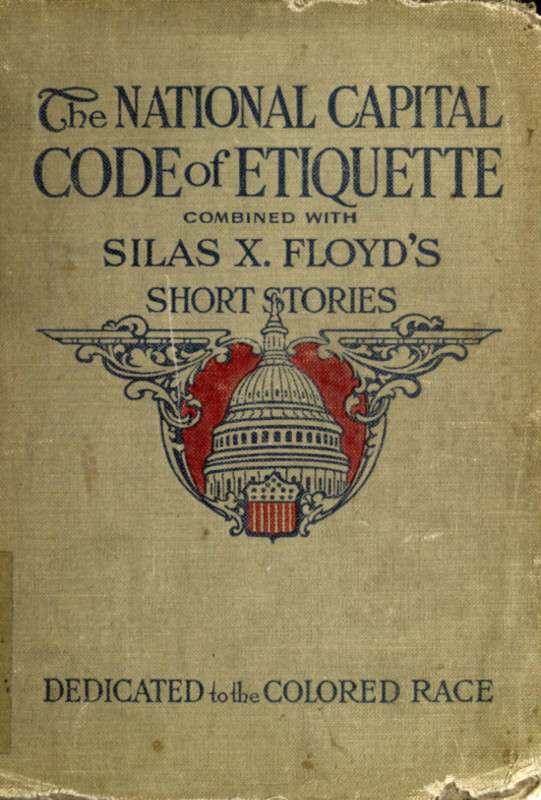
The Project Gutenberg eBook of Silas X. Floyd's Short Stories for Colored People Both Old and Young
Title: Silas X. Floyd's Short Stories for Colored People Both Old and Young
Author: Silas Xavier Floyd
Release date: November 25, 2019 [eBook #60780]
Most recently updated: October 17, 2024
Language: English
Credits: Produced by hekula03, Harry Lamé and the Online Distributed
Proofreading Team at http://www.pgdp.net (This book was
produced from images made available by the HathiTrust
Digital Library.)
Please see the Transcriber’s Notes at the end of this document.
Silas X. Floyd, Augusta, Ga.
Corresponding Secretary National Association of Teachers in Colored Schools.
SILAS X. FLOYD’S
SHORT STORIES
for
COLORED PEOPLE
BOTH OLD AND YOUNG
Entertaining Uplifting Interesting
PROF. SILAS X. FLOYD, A. M., D. D.,
Author of “The Gospel of Serv’ce and other Sermons,” “Life of
Charles T. Walker, D. D.,” “National Perils,” etc.
ILLUSTRATED
Published by
AUSTIN JENKINS CO.,
BOOK AND BIBLE PUBLISHERS
WASHINGTON, D. C.
AGENTS WANTED
Copyrighted 1905
BY
HERTEL JENKINS & CO.
Copyrighted 1920
BY
A. N. JENKINS
CAUTION
The entire contents of this book are protected by the stringent new copyright law, and all persons are warned not to attempt to reproduce the text, in whole or in part, or any of the specially posed illustrations.
PREFACE.
Truly the boys and girls of to-day ought to be thankful that they are alive. There never was such a golden age for childhood and youth as the present. To say nothing of the rich opportunities for mental and spiritual development, what a multitude of things have been provided for the innocent pleasure, the wholesome recreation of the young people of to-day, inventions that remind one of the magic of the “Arabian Nights”; tools of sport so perfect that one cannot imagine how they could be bettered; fascinating games, all unknown in the days gone by; books and papers upon which science, art and literary skill have lavished modern resources—all these and many other wonderful things have fallen to the lot of the favored boys and girls of to-day.
And now enterprising publishers of our grand country are going to put the boys and girls of America—and especially the colored boys and girls of America—under obligation to them, because they have decided to add to the list of good books for children and youths already on the market. I use the word “good” advisedly; for from the day that I was engaged to write this book I have had in mind constantly the thought of making it such a book as would tell for good. It is an old saying that “evil communications corrupt good manners,” but evil reading does more than this: for evil reading corrupts good morals.
I have endeavored to put into this book of stories for children only such things as might be freely admitted into the best homes of the land, and I have written with the hope that many young minds may be elevated by means of these stories and many hearts filled with high and holy aspirations. Our nation has a right to expect that our boys and girls shall turn out to be good men and good women, and this book is meant to help in this process.
SILAS X. FLOYD.
PUBLISHER’S NOTE.
The publishers of this book have spared neither pains nor expense in trying to make it as nearly perfect as a book of this kind can be. The typographical appearance and the illustrations will speak for themselves.
We consider ourselves fortunate in having been able to secure the services of the Rev. Dr. Silas X. Floyd as the author of this volume. Mr. Floyd’s life work, aside from his literary training, has made him the ideal man to speak to the colored boys and girls of the South. Soon after graduating from Atlanta University in 1891, Mr. Floyd became Principal of a Public School at Augusta, Ga., and remained in that city for five years consecutively as a teacher. In June, 1896, he was called from the school-room into the Sunday-school work, having been appointed by the International Sunday School Convention as one of its Field Workers throughout the South. He continued in this work for three years, retiring from it to become Pastor of Tabernacle Baptist Church, Augusta, Ga., one of the largest churches in the South. After a year and a half in the pastorate, he returned to the Sunday-school work, becoming Sunday-school Missionary for Georgia and Alabama under appointment of the American Baptist Publication Society.
Mr. Floyd’s work, as the record shows, has been conspicuously for and in behalf of the children, and he is known far and wide as a competent writer and speaker on topics concerning young people. He has contributed to the Sunday School Times, the International Evangel, the New York Independent, The World’s Work, Lippincott’s Magazine, and many other journals and periodicals. He is the author of a volume of sermons published by the American Baptist Publication Society, and listed in their catalogue as among their standard works, and is also the author of the Life of the leading colored Baptist preacher in America, published by the National Baptist Publishing Board. From the beginning of the Voice of the Negro, Mr. Floyd has had charge of the Wayside Department as Editor, and his work as a humorist and writer of negro dialect is known to many through that medium.
In 1894, Atlanta University, his alma mater, conferred upon Mr. Floyd the degree of Master of Arts, and in 1902, Morris Brown College conferred upon him the degree of Doctor of Divinity.
CONTENTS
| Page | |
|---|---|
| The Cowardly Hero | 17 |
| A Spelling Lesson | 22 |
| The Truth About Luck | 31 |
| An Evening at Home | 35 |
| The Making of a Man | 38 |
| False Pride | 42 |
| Thanksgiving at Piney Grove | 46 |
| The Loud Girl | 55 |
| The Rowdy Boy | 60 |
| Honesty | 62 |
| Uncle Ned and the Insurance Solicitor | 65 |
| The Strenuous Life | 70 |
| A Humbug | 73 |
| How to be Handsome | 76 |
| Patience | 78 |
| Going With the Crowd | 81 |
| Mary and Her Dolls | 85 |
| Jaky Tolbert’s Playmates | 88 |
| A Valentine Party | 92 |
| No Money Down | 95 |
| Tommy’s Baby Brother | 99 |
| Keeping School | 102 |
| The School of the Street | 105 |
| The Fox Hunt | 109 |
| A Bold Venture | 114 |
| The Road to Success | 117 |
| Keeping Ones Engagements | 120 |
| A Midnight Mishap | 122 |
| Frederick Douglass | 124 |
| Our Dumb Animals | 127 |
| A Plucky Boy | 129 |
| A Heart to Heart Talk | 132 |
| A Ghost Story | 135 |
| Good Cheer | 141 |
| Life a Battle | 144 |
| Hunting an Easy Place | 149 |
| The Big Black Burglar | 153 |
| Pin Money Made With the Needle | 156 |
| Self-Help | 160 |
| Aiming at Something | 165 |
| The Black Sheep of the Reynolds Family | 167 |
| The Holy Bible | 175 |
| Andrew Carnegie’s Advice to Young Men | 178 |
| Directions for Little Gentlemen | 179 |
| The Right to Play | 181 |
| A Christmas Present | 183 |
| The Nickel that Burned in Frank’s Pocket | 185 |
| Monument to a Black Man | 188 |
| The Bad Boy—Who He Is | 190 |
| The Bad Boy—How to Help Him | 193 |
| Thomas Greene Bethune (“Blind Tom”) | 197 |
| Not Fit to Know | 200 |
| The Right Way | 202 |
| Keeping Friendship in Repair | 205 |
| Little Annie’s Christmas | 208 |
| The Velocipede Race | 211 |
| Fault-Finding | 213 |
| Random Remarks | 216 |
| Benjamin Banneker, the Negro Astronomer | 220 |
| “A Little Child Shall Lead Them” | 224 |
| Directions for Little Ladies | 230 |
| Three Words to Young People | 232 |
| “A Lamp Unto My Feet” | 238 |
| The Three Brigades | 241 |
| “Home, Sweet Home” | 243 |
| Each One of Us of Importance | 247 |
| The Poetry of Life | 248 |
| On Being in Earnest | 250 |
| Young People and Life Insurance | 252 |
| The Little Sailor Cat | 255 |
| Advice to Little Christians | 257 |
| A Word to Parents | 259 |
| The Unseen Charmer | 262 |
| Our Country | 265 |
| The “Don’t-Care” Girl | 267 |
| Frederick Douglass to Young People | 270 |
| A Good Fellow | 274 |
| The Future of the Negro | 275 |
| The Training of Children | 277 |
STATE, WAR AND NAVY BUILDING, WASHINGTON
Most remarkable Office Building in the world. Right next door to the White House. Built of solid American Granite with over 500 rooms and over two miles of marble halls.
LIBRARY OF CONGRESS, WASHINGTON
Most wonderful Library building in the world. Erected at a cost of $7,000,000, upon a ten acre site. $20,000 worth of pure gold used in covering the Dome. Has room for 4,000,000 books.
The “President’s Sheep” are a Picturesque Sight on the South Lawn of the White House. The President “Taking the Sun” on the South Porch Frequently enjoys Watching the Gambols of the Flock.
“Great Heavens, the Brute is Mad,” Gasped Evans.
THE COWARDLY HERO.
George Washington Jones was his name. Where he got it nobody knew,—least of all himself. For two years he had sold newspapers one block from the big St. Charles Hotel in New Orleans. Very slender, with great big hungry eyes, this little colored waif presented a pitiful sight to the crowds that hurried by. He was scorned by the other newsboys, who yelled and jeered at him, causing him to shrink up even smaller and to glance fearfully at his tormentors, for George was what the other boys called a coward. He would not fight,—when attacked and imposed upon by his more sturdy associates he would throw up his hands and cower down against the ground like a whipped dog. All boys know what this means,—for months he was the mark for all of the coarse jokes and abuse of the rather rough lot of boys who were also engaged in the newspaper selling business thereabouts. He had lived ever since he remembered with an old colored man in a wretched attic over on the South Side,—the old man was a rag peddler and permitted him to share his miserable quarters for the payment of fifty cents every Saturday night. Poor food and poorer sleeping quarters had their effect, and George soon developed a hacking cough that made people turn their heads to see who it was and then hurry on faster than ever. One cold morning in December, while George stood shivering on his corner, scarcely able to shout loud enough to attract the attention of the passers by, a lady about to enter an automobile glanced at him, noted pityingly his emaciated and half-starved appearance, and the cough that wracked his slight frame,—she stepped up and asked him his name and address, which he gave, gazing in spell-bound admiration at this beautiful, fairy-like creature from a different world.
It so happened that this young lady’s father was a very influential man, and so in course of time the lady who had in the meantime called several times at George’s wretched quarters, with eggs and milk and other dainties, prevailed upon him to arrange for George to spend the spring and summer in the country.
So one bright day in April, George arrived at a big Louisiana plantation where he was to have good food and clothes, and when able, to do odd jobs and chores about the place to pay for his board. The Grahams were a couple who had been married seven or eight years and who had a little daughter of six who was a dainty and pretty little miss, somewhat spoiled, but naturally kind and good-hearted. To George she was the most beautiful thing he had ever seen, an angel, not to be thought of at the same time with earthly things. He soon became her devoted slave, following her about and trying to think of something he could do that would make her happy.
Now George did not change in the first few weeks of his stay with the Grahams. He was afraid of the cows, of the horses, even of the geese that ran around the yard. Little Louise, who had been raised in the country, could not understand this feeling and did not hesitate to let George know that she had nothing but contempt for his running wildly away from an inoffensive cow who happened to turn her head in his direction.
“But, dearest,” her mother said, “he has never even seen a cow before. To him that cow is only an awfully dangerous thing with horns, a long tail and big mouth.”
“Oh, but mamma, he is such an awful fraid cat,—whoever heard of getting scared at a lot of silly geese?”
“Yes, I fear he is a hopeless coward,” said Mrs. Graham, “but he certainly does work well.”
But the one thing that George feared above all other things was the dog that lived on the Evans place next door. There was considerable excuse for this fear, as the dog was a surly and somewhat dangerous brute, an immense Great Dane, who had no love nor respect for any living thing except his master. He seemed to take a savage delight in dashing to the fence and making strenuous efforts to jump over and attack poor George whenever he had to pass by. On such occasions, George would shriek and dash wildly up the road, screaming in terror,—he feared the Great Dane more than anything else on earth.
The days and weeks slipped by until the month of August. There had been a long dry spell; everything was hot, parched and burning up, and it seemed as if the earth was crying out for rain. Every one was cross and irritable and although not meaning to be unreasonable, Mr. and Mrs. Graham took considerable of their irritation out on our little colored friend George,—he was ordered about and shouted at to move faster and scolded and generally made the target for the ill humor of the entire household.
For some days the Great Dane had been acting strangely,—no one dared to approach him, and on one occasion he even snapped at his master.
“Guess I’ll chain him up until the rain sets in,” said Mr. Evans. However, the dog refused to be tied, avoiding his master and snapping whenever he approached. Suddenly he gave a roar and sprang right at Mr. Evans’ throat,—the man tripped and fell, which was the best thing he could possibly have done under the circumstances, as the dog ignored him, and, snapping right and left, dashed out of the gate and down the road towards the Graham place.
“Great Heavens! The brute is mad!” gasped Evans.
If any one has seen a dog go mad, he will testify that it is not a pretty sight. The maddened animal raced at top speed along the road, snapping wildly at sticks and stones along the way, with froth and foam flying from his mouth, his mammoth jaws closing and unclosing like the teeth of an enormous trap.
Straight down the road and straight through the gate that opened into the Graham yard dashed the enormous Great Dane—he was a hideous sight to the bravest; what he looked like to George no one will ever know. Graham, sitting on the porch, realized in an instant what had happened, and sprang to the dining-room to get his rifle,—right in the path was little Louise, with her dolls, sitting around a little table, in the midst of a party—she rose to her feet, the great frenzied brute but a few yards distant, her face paling, her lips unable to utter a sound. Graham was quick, but not quick enough,—the dog would be upon the child before he could possibly get ready to shoot, but quicker than Graham, quicker than the dog, was George,—what he felt, what he suffered in those few seconds, the Lord alone can tell—with a wild scream, he threw himself right in the path of the maddened Great Dane, right at his throat, shrieking and striking wildly with both clenched fists at the huge head and body of the dog. With a snarl, the dog turned and caught the negro boy,—but it was here that Providence took a hand, for he grabbed not George himself, but his coat, worn and shabby from much use, and the coat came off in his jaws,—before the dog could turn and renew the attack, Mr. Graham shot twice rapidly from the porch and the dog fell, writhing terribly in his death agonies.
White as a sheet, Graham ran quickly down the path and snatched Louise up in his arms,—but Mrs. Graham, who had been an agonized eyewitness of the near-tragedy, was almost as quick to reach George—throwing her arms around him, she sobbed, “God bless you, George; that was the bravest thing I ever saw.”
And in this way, George, the despised and ignored newsboy, who had always been called a coward, came into his own. Such is true courage. Poor boy, he was afraid, fearfully, awfully afraid! But he did not hesitate to risk everything to save the golden-haired little daughter of his employer.
George still remains on the Graham plantation, but you would scarcely know him—he coughs no longer; he stands erect and is becoming strong and sturdy; he has found himself, and no one will ever again have cause to say to him, “You coward!”
THE GREAT SPELLING MATCH.
There was no doubt about it,—of all the little colored boys and girls who went to the Peabody school, Margaret was the dullest. Her teacher said so, her friends said so, her parents were of the same opinion, and if asked herself, Margaret would undoubtedly have frankly acknowledged that her undisputed and proper place was at the foot of the class. Her brother Charles, who was one year younger than she, had proudly graduated from the fifth grade and was making rapid progress in the sixth. He did not spend one-half the time studying that Margaret did, and yet when it came time for recitations, he would stand up and recite in a manner that warmed his teacher’s heart and made him the envy of most all of his schoolmates.
An Exciting Moment.
If Margaret was backward in her studies, little Mable Green certainly was not. Arithmetic, geography, writing, reading, she excelled in all of them. She was a very bright little colored girl and a very good looking one, too. Mable knew this just as well as all of the boys and girls did,—she was not exactly foolish and vain, but she had been so praised and petted by her school friends and teachers that she was inclined to be a little conceited, what we all would call “stuck up.” Once a month a prize was given for the scholar who stood highest in certain studies, and Mable had twice been the successful pupil,—she had two highly prized silver medals to show for her skill.
Now one of the members of the school board was a farmer about forty years of age, kind-hearted, but a little old-fashioned. He believed in boys and girls knowing how to read and write and spell correctly, but he did not care for what he called the “new-fangled” ideas of some of the other members of the board. He was very much opposed to a course in music and elocution that was being considered by the school board, and did not hesitate to let every one know how he felt about it. Now he knew Mable and liked her—he was very much interested in the way in which she stood at the head of her classes and wanted to do something to encourage her in sticking to the old-fashioned forms of education. He thought over this for a long time, and finally decided to hold a spelling match. Now you all probably know what a spelling match is. Two sides are chosen who stand up on opposite sides of the room, and the teacher give out words, commencing at the head of the row,—any one who misses a word has to sit down, and the last one to stand up wins the prize for his side, also is pronounced the best speller and gets the personal prize.
The board all thought this a fine scheme, and so it was decided to hold the spelling match on Thanksgiving evening at the schoolhouse. The teacher was to pronounce the words, while the members of the board were to give her lists of words from which to choose.
“What are you going to give for a prize, Mr. Edwards?” asked the teacher.
“Well, I thought I would give twenty dollars,” replied the man. “Yes, I rather plan to give a bright twenty-dollar gold piece.”
The news spread like wild fire. Never had there been such excitement. This was a small fortune, and Mable’s mother pinned a bright red bow in her hair, and put on her prettiest frock,—Mable had already considered the prize as won,—in fact, she had planned just how she would spend it,—she was a good speller and felt confident that she could win.
The night arrived, bright and crisp November weather, with a bright moon overhead,—the little schoolhouse was packed. It was decided that all children in the fifth, sixth and seventh grades would be allowed to compete. Now, Margaret had been in a highly excited state ever since hearing of the contest—strange to say, she was a good speller. It has often been said, and quite correctly, too, that spelling is a gift,—that some people spell correctly quite naturally, while no amount of study or practice can make a good speller out of any one who was born with a head that ached and throbbed at the mere thought of spelling. She had never had fifty cents of her own in her whole life—twenty dollars in gold—it did not seem possible that there could be that much money in the whole world.
Sides were chosen and Margaret was almost hidden by fat Reggie Andrews, who stood next to her. Mable was right across the room from her, and smiled in a somewhat scornful manner at the girl she thought was a “dummy.”
The teacher began to pronounce the words and you could have almost heard a pin drop; the first few times around but few scholars dropped out, Reggie going down the third time on “mucilage.” Margaret gave a sigh of relief—Reggie had made her very nervous.
Nothing happened that amounted to much until the teacher began to give out words containing “ie” and “ei.” Now these words are very difficult unless a speller knows the rule—“ie” is almost always used except after the letter “c,”—following this letter “c,” it is always “ei.” Margaret had learned this rule in the second grade, and these words had no terror for her—she was gaining confidence now and the audience began to sit up and take notice. Soon but five were left standing,—three on Margaret’s side and only Mable and one little colored boy on the other. It seemed for a time that these five would have to divide the prize,—word after word was spelled and no one missed—the audience was hanging spellbound on every syllable, and the dignified members of the board were trying to act naturally, although in reality, greatly wrought up.
“Exhaustible,” suddenly said the teacher.
There was a moment’s hesitation, and then Ann Houston, on Margaret’s side glibly said:
“E-x-a-u-s-t-i-b-l-e.”
“Wrong; be seated,” and with much sniffling and rubbing her eyes, Ann walked sorrowfully to her seat.
The boy on Mable’s side shuffled his feet, looked up, down and around the room, and finally blurted out:
“E-x-h-a-u-s-t-a-b-l-e.”
“Wrong!” and Bobbie joined Ann in sorrowful silence.
Rose Holcomb, the one remaining girl on Margaret’s side, had become rattled—she rolled her eyes wildly up and down and then guessed,—she made a very bad guess.
“E-c-h-o-s-t-i-b-l-e!” and Rose was also counted out and took her seat, tossing her head and looking indifferently around.
It was now Mable’s turn, and she had sufficient intelligence to have profited by the experience of Ann and Bobbie—had the word been pronounced to her first, she would probably have misspelled it, but now she spelled it out firmly and confidently, letter for letter, without a hitch.
Now Mable faced Margaret for the final test—both were greatly excited, but their nervousness had passed—it was now that Margaret’s natural ability came to her aid. Word after word she spelled, and the crowd watched her in amazement. Here was the supposedly dull and backward pupil, the recognized “foot of the class,” standing up gallantly to the last against Mable, the favorite, to whom everybody had conceded the prize as already won.
The largest cities in America, in South America and Europe, proper names, animals,—the words became more and more difficult. Finally, the names of flowers were given—Mable had studied botany and was familiar with flowers—Margaret was now relying on her natural ability and nerve—all things come to an end, and at last the teacher pronounced the name of the flower—
“F-U-C-H-S-I-A.”
Now it is a fact that there is probably no more tricky word in the English language than this—it all depends upon where to place the letter “s.” Mable knew what fuchsias were,—knew all about the different parts, the petals, the stem,—she had spelled the word correctly many times, but, alas, she was a trifle hasty and exclaimed:
“F-U-S-C-H-I-A.”
“Wrong!”—Mable burst into tears,—and with loud sobs ran to her seat and threw herself down, her face buried in her arms.
All eyes were now on Margaret. She was strongly tempted to spell this commencing “ph”—it seemed correct, but something told her that Mable had been almost right. Almost, but not quite! Mable’s dramatic finish had given her time to think for a moment, and when the word was once more pronounced she was ready—without hesitation she spelled slowly and distinctly:
“F-U-C-H-S-I-A.”
“Correct,—Margaret, you have won the prize.”
Margaret’s knees almost gave way under her—surely she must be dreaming—it could not possibly be herself to whom the committeeman was advancing with a light blue plush case—every one was clapping their hands, and the boys had so forgotten themselves as to whistle through their fingers and noisily stamp their feet.
“Margaret, You Have Won the Prize.”
“It gives me great pleasure,” said Mr. Edwards, “to give this twenty-dollar gold piece to Margaret Hawkins, and to pronounce her the best speller in the school.”
Poor Mable cried herself to sleep that night, but it was a good lesson for her—it taught her to be more considerate of others, and that there were something at which she could be beaten.
Every one treated Margaret with increased respect, and her success was also good for her—she began to improve in her other studies, and as she gained in confidence, gradually became, if not one of the best, at least a very good scholar.
Mr. Edwards says his next prize will be given for the best all-around pupil at the close of the term—and Mable is once more looking forward with hope.
THE TRUTH ABOUT LUCK.
How often we hear some one say:
“My, but he’s lucky!” or “It’s better to be born lucky than rich.”
Boys and girls are too often in the habit of thinking that one of their schoolmates are “lucky” because they always stand well in their classes and frequently have spending money in their pockets.
It is not likely that “luck” had anything to do with it. They probably stood well and were at the head of the class in school because they studied and tried harder than the other scholars, and had money to spend because they spent their time out of school hours in working to earn it instead of at play.
Some years ago I happened to find myself near the terminal of the great East River Bridge in New York City. Two little boys were standing near one of the large iron posts crying their afternoon papers. I tarried near them because I was waiting for a particular car. One little fellow said to the other,—
“How many papers have you sold today, Tommie?”
“Nearly one hundred an’ fifty,” was Tommie’s quick reply.
“Honor bright?”
“Yes; honor bright.”
“Whoopee! but ain’t you in big luck, Tommie?”
“Luck!” exclaimed Tommie, wiping the perspiration from his brow. “There ain’t no luck about it; I’ve just been everlastingly at it since four o’clock this morning—that’s all!”
And that is the all of real success. Those who achieve success are “everlastingly at” what they are trying to do. Tommie was right in declining to have his hard and honest work cheapened by calling the result of it luck.
“You are the luckiest chap I ever saw,” I once heard a little boy about sixteen years say to another boy of about the same age.