
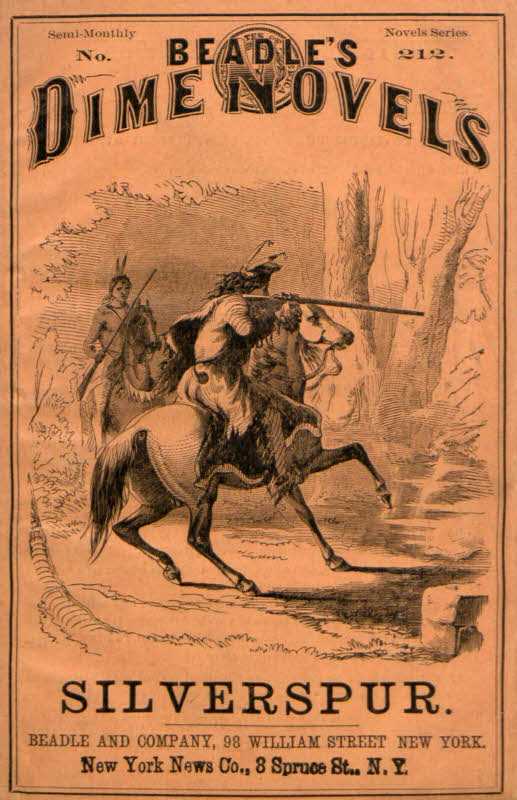
CHAPTER XI.
NOT UNWHIPT OF JUSTICE.
Silas Wormley was as much astonished at his release as Old Blaze had been at receiving a similar favor. He had fully expected that the Indians would mete out to him the same fate that would have awaited Dove-eye if he had succeeded in exposing her imposture, and he saw no way to extricate himself from the dilemma.
When he was informed that he was released by the order of the Big Medicine, he had his guess at the truth of the matter, as the hunter had had his. He perceived that Dove-eye had outwitted him, and he felt a strong desire to “get even” with her. This desire was intensified when he was further informed that the Arapahoes, in accordance with the direction of the Big Medicine, had determined not to pay what they were owing him, considering his false accusations, a receipt in full for all indebtedness. This was touching him in the pocket; it was ruining him in business, and he resolved that the matter should not rest as Dove-eye had left it.
Making inquiries in the village, he learned all the particulars of the visit to the lodge of the Big Medicine. He wondered at the shrewdness of Dove-eye, no less than at the credulity of the Indians. He had received a practical, matter-of-fact education, and had been brought up with a contempt for witchcraft, ghost-seers, prophecies, and all that savored of the supernatural. It would have been as impossible to make him believe that the Big Medicine had been to the spirit-land and returned, as to convince him that the Arapahoes had cut his head off. He knew that Dove-eye had been deceiving the people, and he felt that both principal and interest (of the debts the Arapahoes owed him) required him to expose the imposture. He knew, also, that it would never do for him to make a second failure, as death would surely be the penalty for another unsuccessful attempt. Nevertheless, he was willing to run some risk. Although he would not wet his feet to save the life of a fellow-man, he would dive to recover his pocket-book.
Had the old medicine-man been alive and concealed all this time, and had the girl been acting only as his instrument in the deception, or had she some other confederate, who had personated the Big Medicine? It could not be that the old man was alive, for he had seen him lying in his grave. The trader had no doubt of this, although the body had been so cunningly spirited away, he had never seen the old man in life; but Bull-tail could not have wished to deceive him. The hair, the features and the dress of the body corresponded exactly with the descriptions of the Big Medicine, and he had noticed a medal lying on his breast, which he had frequently heard mentioned and described. Besides, if the body had not been that of the Big Medicine, Dove-eye would not have taken the trouble to remove it and put another in its place. She had another confederate, and who was he?
Silas Wormley was shrewd enough; but his heart and brain were so contracted, that his shrewdness was exercised only on a small scale, he suspected that Dove-eye’s confederate was a white man, and there were two circumstances that confirmed him in that suspicion. The Big Medicine, he was told, had spoken quite imperfectly the dialect used by the Arapahoes, and the lame excuse which he had given, although it had easily satisfied the credulous Indians, had another effect upon Silas Wormley. Again—why had he directed the Arapahoes to release Old Blaze, about whom he seemed to know so much? What was the hunter doing when he was captured near the village? For what purpose had he come there? The trader knew that white men on the plains, like snakes, are generally found in couples. When one is seen, there is another not far from him.
Putting this and that together, his natural shrewdness stimulated by his desire for money and for Dove-eye, the trader concluded that there must be a white man at the bottom of the mystery, and that the white man was concealed at the lodge of the Big Medicine, he determined to reconnoiter that position, and to make such discoveries as he could, with as little danger to himself as possible.
He set out, accordingly, at a late hour in the evening, and went direct to the lodge at the foot of the cliff. Finding no entrance except through the hut, he crept as near to it as he dared, for the purpose of peeping and listening.
His enterprise was rewarded. He heard two voices, one of which he recognized as Dove-eye’s, and the other was that of a man. Yes, it was a white man’s voice; there was no mistaking the tone and the accent. He could not hear what they were saying; but they laughed merrily every now and then, and he had no doubt that they were discussing the events of the morning.
He was about to creep up closer; but he heard Dove-eye, as she moved toward the entrance, say that she must return to the village, and he was obliged to hasten away and conceal himself.
He watched the girl until she was out of sight, and then decided that he would make a closer examination of the lodge, in order to satisfy himself who and what the white man was.
There was an obstacle in his way. As he emerged from his hiding place, he was confronted by a dark and stalwart form.
It was the negro, Jose. In one hand he held a stout stick, and in the other he carried a leather thong.
“I saw you coming,” he said, “and I watched you. You whipped Jose, and now it is Jose’s turn to whip you.”
The trader hastily drew a pistol from his belt; but Jose’s stick knocked it from his hand before he could cock it. The next instant he was struggling in vain to release himself from the brawny arms of the negro.
“You had better be quiet,” said Jose. “If you make any noise, I will kill you. Go on!”
Having securely tied the hands of his victim, Jose flourished his stick over his head, and led him, holding the end of the leather thong, down into a thickly wooded ravine, where he fastened him to a tree. He then cut some tough switches, and addressed himself to his work.
Wormley begged piteously that his back might be spared, and then tried bribes and threats; but all without effect upon the obdurate negro, whose reply was always the same.
“You whipped Jose, and Jose means to whip you.”
And he did whip him. He plied his switches so effectually, that the trader squirmed and writhed, and cried and screamed, and called vainly for help. It was not until the negro had exhausted his switches, and had gone to procure a fresh supply that the victim had any respite. He anxiously looked around, hoping that somebody might have heard his appeals for help, and was delighted to see a man coming down the ravine toward him.
As it was dusk, he could not distinguish the features of the stranger until he came nearer, when he perceived that it was the white captive who had asked his aid in the village. At the same moment the negro returned with more switches.
Seeing the white man, Jose hesitated for a moment; but, as Old Blaze calmly seated himself on a log, and showed no disposition to interfere, he proceeded to administer another dose of the oil of hickory.
“Won’t you take this nigger off of me, mister?” entreated Wormley. “He has been torturing me more than half an hour and you see that he means to begin again.”
“Are ye right shore that it’s more’n half an hour?” replied the hunter. “Do ye kerry a watch, stranger?”
“The exact time is a matter of no consequence. You see what he has done. Don’t you mean to stop him?”
“I’m mighty sorry to see ye in that fix, stranger, and would like to help ye; but it’s a difficult thing to do.”
“It is very easy, if you wish to do it.”
“Thar ain’t no tellin’ how much I want to help you. War ye a-doin of any harm to the niggur?”
“None at all.”
“I’ve heern tell that that niggur has got a grudge ag’in ye, ’cause ye gin him a powerful whalin’ and chokin’ a while ago. That niggur is mad, and it mought be dangerous fur me to interfere with him.”
Jose stopped the colloquy by applying a few more stripes, and then the trader again besought the aid of Old Blaze.
“I tell ye that I’m mons’ous sorry to see ye in this fix,” replied the hunter. “What more kin ye ax? I shouldn’t wonder ef that niggur is five or six pound heavier than I am, and ye wouldn’t want me to resk my life by buttin’ ag’in him.”
“If you have the heart of a man, you will not allow him to torment me any longer.”
“I’ve got abundance of heart, stranger. In fact, my heart is bigger than a skinned hoss; but I’m kinder afeard. That thar niggur mought be owin’ me suthin sometime, and p’raps, ef I should interfere with him now, he wouldn’t be willin’ to pay me.”
“Jose has whipped you for himself,” said the negro. “He must now whip you for Dove-eye.”
He proved his zeal in the cause of his mistress by administering a dozen more blows, well laid on, and then he turned his victim loose.
“I’m glad that ye’re well orter that scrape, stranger,” said Old Blaze, rising to his feet. “Now I want ye to answer me one question. ’Pears like I’ve seen ye somewhar, sometime. Did ye ever go by the name of Bob Riley?”
The trader turned a frightened, suspicious glance upon his questioner, and then with a cry of alarm, ran at full speed down the ravine. Old Blaze quickly raised his rifle to his shoulder, but lowered it after a moment’s thought.
“It would bring the Injuns down on us,” he muttered, “and that mought upset some of Silverspur’s plans. But I do believe it is the same chap.”
He walked up to Dove-eye’s lodge, followed by Jose, who was supremely gratified at having been allowed to work out his revenge without hindrance.
Silas Wormley, however, was by no means gratified or satisfied. When he believed himself beyond the pursuit of Old Blaze, he slackened his speed, but did not stop until he was safe in the village and in his own lodge. His back smarted to such an extent that he could not sleep, and he passed a restless night, thinking of his degrading and painful punishment, and revolving plans of vengeance.
He was determined to be revenged, cost what it might, upon the negro, as well as upon Dove-eye and the white man whom he believed to be her confederate. There was but one way of accomplishing this—to expose completely the deception that had been practiced. He was afraid to prosecute his search while Old Blaze was in the neighborhood; but the hunter was to go away at an early hour in the morning, and then the coast would be clear.
He did not stir from his lodge until Old Blaze had left the village, and then he waited until evening before he ventured up into the mountains. He went armed, to defend himself against Jose, intending that the negro should not again take him at a disadvantage.
He carefully reconnoitered the lodge of Dove-eye before he ventured to approach it, but saw nothing to indicate that it was inhabited. He went nearer, and the same quiet and absence of incident prevailed. At length he went to the hut, and looked in at the door, when he saw that the tenement was deserted. He entered it, and the sight that met his eyes convinced him that his suspicions had been well founded.
Among other evidences of a hasty departure, he saw a quantity of long white hair on the stone floor of the cavern in the rear, and a robe of deerskin, covered with strange devices. A closer search revealed a spur lying in one corner—a large and handsome spur, of solid silver, with a steel rowel. This had been, without doubt, the property of Dove-eye’s white confederate.
Leaving things as he had found them, Wormley hastened back to the village, and told the head chief what he had discovered. Black Horse listened to him with the greatest incredulity, and it was not until he had repeated his story, with the strongest possible asservations of its truth, that the chief could be induced to call together the old men.
The trader argued his cause before them with great earnestness, feeling that his money and his revenge, if not his life, were now depending on his success, and at last they reluctantly consented to pay a visit to the lodge of the Big Medicine.
When they reached the lodge, however, and saw the proofs that Wormley had to show them, they were not as easily convinced as he had expected them to be. The cherished belief of many years was not to be demolished at one blow. Even the spur of silver, which he triumphantly exhibited to them, did not shake their confidence in Dove-eye.
“I know the white man who wore this,” said Black Horse as he held up the spur. “He is named Silverspur. He is a great warrior, and is a friend of the Crows. He may have been here. He may have captured Dove-eye and carried her away. If he has been here, that does not prove that the Big Medicine is dead, or that Dove-eye has deceived the people.”
“If the Big Medicine is alive,” replied the trader, “where is he? He was so weak that he could not move, and no one was to be allowed to touch him for six suns; but he is not here.”
“He may have gone out to walk,” suggested the chief, “or the white men may have captured both him and Dove-eye. Dove-eye is very beautiful, and the Big Medicine is very wise. The white people would be very glad to have both of them.”
Wormley was disgusted at this view of the subject, which seemed to him to be the hight of unreason. He began to despair of carrying his point, and it is probable that the investigation would have been abandoned, but for an unforeseen occurrence.
Two warriors, who had been sent to search for trails in the vicinity, returned and reported that they had came upon a grave that had been recently made. Surprised to find a grave in that locality, they had examined it, and had discovered the body of the Big Medicine.
At this announcement the old men hurried off in undignified haste to visit the grave, and found that the report of the warriors was true. Their demeanor changed instantly. They loaded Wormley with praises and promises, and could not find language severe enough for their denunciation of Dove-eye and her confederates. The warriors were sent out to hunt for the trail of the fugitives, and they soon discovered, at a little distance from the lodge, a place where horses had been kept, and from which the start had evidently been made. They followed the trail a little way, and reported that six horses had gone toward the north.
Black Horse returned to the village in hot haste, to organize a war party for the pursuit of the runaways; but it was night when he was ready, and the trail could not be taken up until morning.