
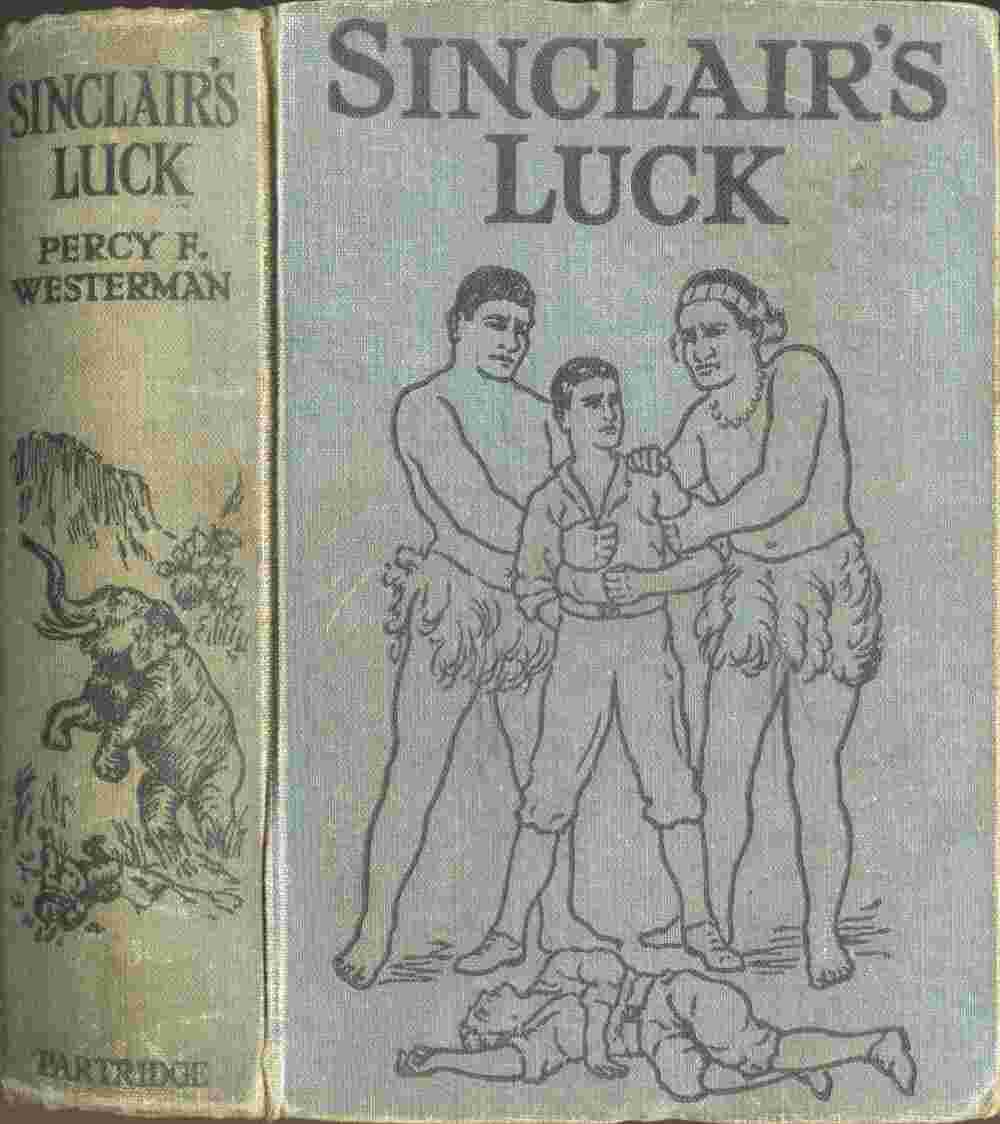
The Project Gutenberg eBook of Sinclair's luck
Title: Sinclair's luck
A story of adventure in East Africa
Author: Percy F. Westerman
Release date: January 10, 2024 [eBook #72673]
Most recently updated: October 10, 2024
Language: English
Original publication: United Kingdom: S.W. Partridge & Co, 1923
Credits: Produced by R.G.P.M. van Giesen, thank you Ru!
SINCLAIR'S LUCK
TITLES UNIFORM WITH THIS VOLUME
Rowland Walker
"School! School!"
Sydney Horler
Shandy of Ringmere School
Rowland Walker
The Fifth Form Detective
Rowland Walker
"Pickles" of the Lower Fifth
Rowland Walker
Trapped in Tripoli!
Tom Bevan
Sinclair's Luck!
Percy F. Westerman
Jack Rollock's Adventures
Hugh St. Leger
Cap'n Nat's Treasure
Robert Leighton
The Secret Men
Tom Bevan
The Adventures of Don Lavington
George Manville Fenn
The Terror of the Tin Mine
George Manville Fenn
S. W. PARTRIDGE & Co.
4, 5 & 6 Soho Square, London, W.1
SINCLAIR'S LUCK
A STORY OF ADVENTURE IN
EAST AFRICA
BY
PERCY F. WESTERMAN
AUTHOR OF
"BILLY BARCROFT, OF THE R.N.A.S."
"THE DREADNOUGHT OF THE AIR,"
"THE RIVAL SUBMARINES," ETC., ETC.
S. W. PARTRIDGE & CO.
4, 5 & 6, SOHO SQUARE, LONDON, W.1
Readers of the adventures in East Africa of the two heroes, Colin Sinclair and Tiny Desmond, as narrated in the pages of this book, will be greatly interested in their school life, before leaving for the Dark Continent, which is splendidly told in the story entitled "The Mystery of Stockmere School."
MADE IN GREAT BRITAIN
First published 1923
Frequently reprinted
Contents
| CHAPTER | PAGE | |
| I. | THE TWO CHUMS | 9 |
| II. | "MEETING THE CASE" | 18 |
| III. | FAREWELL | 25 |
| IV. | "REGARDLESS OF THE RISK" | 30 |
| V. | IN THE DITCH—AND OUT | 41 |
| VI. | VAN DER WYCK'S GIFT | 49 |
| VII. | DETAINED AT CAPE TOWN | 54 |
| VIII. | HELD UP | 59 |
| IX. | ROBBERY UNDER ARMS | 66 |
| X. | THE MOUNTAIN TRACK | 71 |
| XI. | AT THE EDGE OF THE CHASM | 80 |
| XII. | BESET BY LIONS | 86 |
| XIII. | THE MORNING AFTER | 94 |
| XIV. | BY VIRTUE OF THE TALISMAN | 99 |
| XV. | AT KILEMBONGA | 106 |
| XVI. | SIBENGA'S ENVOYS | 112 |
| XVII. | THE PLAGUE OF LOCUSTS | 121 |
| XVIII. | THE AMBUSH | 130 |
| XIX. | HOTLY PURSUED | 138 |
| XX. | NIPPED IN THE BUD | 144[ |
| XXI. | THE OTHER VAN DER WYCK | 153 |
| XXII. | PALAVER | 160 |
| XXIII. | THE BULL ELEPHANT | 167 |
| XXIV. | A LUCKY SHOT | 175 |
| XXV. | MISSING | 182 |
| XXVI. | A DOUBTFUL CLUE | 188 |
| XXVII. | THE RAVING OF THE WITCH-DOCTOR | 195 |
| XXVIII. | KIDNAPPED | 206 |
| XXIX. | IN THE HANDS OF THE MAKOH'LENGA | 212 |
| XXX. | TO WHAT END | 221 |
| XXXI. | THE GOLDEN IMAGE | 229 |
| XXXII. | AT THE FATAL MOMENT | 238 |
| XXXIII. | WHERE THE GOLD WENT | 244 |
| XXXIV. | EXPLANATIONS AND SURPRISES | 248 |
| Illustrations | |
|---|---|
| Facing page | |
| "SUDDENLY DESMOND FELL WITH A LOUD THUD" | Frontispiece |
| "HE FIRED TWO SHOTS IN QUICK SUCCESSION" | 42 |
| "HIS FOOT CAUGHT IN THE TRAILING TENDRIL AND HE CRASHED HEAVILY" | 174 |
| "WE'VE DONE IT, BY JOVE!'" | 230 |
SINCLAIR'S LUCK
CHAPTER I
THE TWO CHUMS
"My last term, Tiny, old son," announced Sinclair dismally.
"What? Never!" replied "Tiny" Desmond, who, at the age of sixteen years and three months, had attained the height of six feet one inch. "Your last term at Stockmere? You're trying to pull my leg."
"Wish I were," rejoined Colin. "But it's a fact. My governor wrote to Dr. Narfield a week ago."
"Why?" inquired Desmond, linking arms with his sturdy, athletically-built chum. "Tell me all about it. Chuck it off your chest."
It was the first day of the summer term. Stockmere was in a state of commotion that is usually associated with the commencement of a new session. There were boys promoted to higher forms, boys remaining in a state of "as you were," new boys wandering about aimlessly like strangers in a strange land, fearful the while lest by word or deed they should transgress the moral and social side of their new school-fellows. There were boys seeking old chums; boys casting about for fresh ones. Housemasters and formmasters were discussing boys; the Head and the Matron were doing likewise. In short, the topic was "Boys."
"Let's get out of this crush," continued Tiny. "Lorrimer and Perkins are cackling away in our study. You know what they are. I vote we push off up on the moors. I'll ask Collier."
The housemaster, recently placed in charge of the Upper Sixth, gave the required permission.
"Very good, Desmond," he replied in answer to Tiny's request. "Back at four, mind. How's that cough of yours, by the bye? Lost it yet?"
"Nearly, sir," replied Tiny, flushing.
"H'm, about time," rejoined Mr. Collier. "All right, carry on."
The two sixth-formers touched their caps and walked away.
"Wish he wouldn't harp on that cough," murmured Desmond. "It's really nothing much; a bit of a bother first thing in the morning. Now, Colin, what's this stunt?"
Sinclair told his story simply and without hesitation. There were no secrets between the two chums. They shared their pleasures, their, for the most part trivial, troubles, their perplexities, and their worldly goods (as far as their school belongings went) whole-heartedly.
"Fact is," said Colin, "my governor has been losing a lot of money since the War, and he can't afford to keep me at Stockmere after this term. I found out quite accidentally that the pater had been pretty badly hit for some time. I ought to have left a year ago, only he kept it dark and managed to let me stay on. He was hoping for things to improve financially only they didn't. So that's that."
"Hard lines!" ejaculated Desmond sympathetically.
"That's why the governor didn't come up to the sports," resumed Sinclair. "He simply couldn't run to it. And he's sold his car and cut down a lot of things, but he's losing ground, so to speak. His pension was quite all right once upon a time, but now it goes nowhere."
"And what are you going to do?" asked Tiny.
"I hardly know," replied his chum. "Of course, my idea of going to an engineering college is off. After all's said and done, it means earning nothing until a fellow's well over twenty-one, and then he's lucky if he makes as much as a miner or a bricklayer. At any rate, I've got to do something—to earn something. In fact, I don't think I ought to have come back this term."
"Well, what are you going to do?" asked Desmond.
Colin shook his head.
"I hardly know," he replied. "Anything to help things along. I've got thirteen weeks to think over it. By that time—but, I say, Tiny, you won't say a word to any of the other fellows?" he added anxiously.
"'Course not," declared Desmond.
"Right-o!" rejoined Sinclair, then, as if he had put the matter out of his mind, he drew himself up, stretched his arms, and sniffed appreciatively at the keen, bracing mountain air.
"My word," he exclaimed, "isn't it tophole? I'll race you to the crest of Shutter Pike."
It was a distance of about four hundred yards to the summit of the hill known as Shutter Pike—a gentle gradient for two-thirds of the way, ending up with a fairly stiff ascent.
For the first fifty yards Tiny led, but gradually Colin recovered the initial advantage his companion had gained, and before the last fifty yards he had drawn up level. Then, putting his whole energy into the race, Sinclair dashed ahead and flung himself upon the grassy knoll at the summit. To his surprise, Tiny had stopped and was holding his hands against his ribs and coughing violently.
"Buck up, man!" Sinclair shouted. "I'm a bit out of training .... Why, what's the matter? Anything wrong?"
Desmond shook his head, but made no attempt to move. His companion jumped to his feet and ran down the slope.
"Did you fall?" he asked anxiously, for the bluish-grey pallor on his chum's face rather took him aback.
"No," spluttered Tiny. "Stitch, or something ... nothing much."
He sat down abruptly, endeavouring to stifle the fit of coughing. At length he succeeded.
"You're not up to the mark, that's evident," said Colin. "What have you been doing these hols? You're right out of condition. You'll have to train, my festive."
"I will," replied Desmond. "I've been slacking a bit, but I'll soon get into form. I say, it's close on four. Let's get a move on."
Hardly a word was exchanged as the pair made their way schoolwards.
"Don't say anything to Collier," said Tiny, as they passed the lodge gates. "About this little cough of mine, I mean."
"'Course not," declared Colin. "Why should I?"
Tea over, Desmond and Sinclair went to the rooms they shared with Lorrimer and "Polly" Perkins. Here everything was in a state of disorder. The furniture had only just been removed from their last term's den; their boxes and trunks, half unpacked, were piled upon the table and chairs, while an assortment of bats, tennis rackets, fishing rods, nets, and other articles inseparable with schoolboys filled every available corner of the room.
"You're a nice pair!" exclaimed Lorrimer. "Mooching off and leaving Polly and me to square things up."
"And a fine square up you've made of it," replied Tiny. "Hullo, what's this? My razor! Polly, you are the absolute limit."
Perkins received the intelligence with as good grace as possible when discovered in the act of using another fellow's razor for the purpose of cutting rope.
"Sorry, old man," he replied apologetically. "But what do you do with your razor, by the bye? Half a mo', Tiny, before you start scrapping. The Head's been looking out for you."
"Honest?" inquired Desmond.
"Honest," assented Polly.
At Stockmere that word was sufficient. No fellow ever doubted the genuineness of an assertion thus expressed. Desmond picked up his cap and made his way to Dr. Narfield's study.
The summons did not surprise him. Coupled with the fact that he was one of the head boys, and that this was the first day of a new term, it was not unusual for a youth in Desmond's position to be called to the Head's study.
Dr. Narfield was standing with his back to the empty fireplace in a characteristic attitude, his mortar-board on the back of his head and his hands clasped under the tails of his gown:
"You sent for me, sir?"
"Yes, Desmond," replied the Head, looking at the lad over the top of his spectacles. "I thought, Desmond, that you, a head boy, would be above a senseless practical joke."
He paused. Tiny regarded the doctor dumfoundedly. And then that irritating cough made itself known again.
Dr. Narfield waited until the fit was over.
"Perhaps, Desmond," he resumed, "you will kindly explain why this was found in your handbag?"
He pointed to a large dish on a side table. On it, writhing gently, was an eel, about ten inches in length.
"That—er—pet," continued the Head, "nearly frightened the housekeeper into hysterics when she opened your bag. You are, of course, aware that pets are permitted at Stockmere, but there are limits in the choice of a selection. Now, Desmond, please explain."
Desmond hesitated. The affair wanted some explanation, but he wasn't at all sure that his elucidation was a correct one.
"I can't exactly explain, sir," he replied. "I didn't put it into my bag, and I certainly didn't intend to frighten Mrs. Symonds or anybody."
"Then how did it get into your bag?" asked the Head patiently. Previous experiences had taught him the advisability of a patient hearing and not to judge by circumstantial evidence. He knew perfectly well the best way to detect a guilty culprit was to let him tell his story without comment until he had made the fatal error of condemning himself.
"It was like this, sir," explained Desmond. "The train was crowded, and I rode in the guard's van. In the van, amongst other things, was a large box labelled 'Eels—Perishable.' It had a small crack in it, and very soon I saw an eel's tail appear. Then somehow other tails found their way through and the box began to open."
Dr. Narfield nodded. He knew from personal experience that eels have frequently been known to force open heavy boxes in which they are packed for transit.
"Go on, Desmond," he said gravely. Tiny, finding that the Head did not ridicule his tale, plunged into his narrative without further hesitation.
"I told the guard," he continued, "but he was busy writing in a book, and told me it wasn't his business. It wasn't mine, so I just watched. And before we got to Little Porton the eels had forced open the box and were wriggling all over the place—hundreds of them, sir. The guard got the wind up then—I mean, sir, he was in a bit of a funk. I didn't exactly care for it myself, although it was a topping rag to watch. So we both sat on some luggage and kept our feet up, although at every station the guard had to get out. And a crowd of eels got out, too. There were dozens of them left on every platform, and by the time we got to Colbury Monkton the van was almost empty. I must have left my bag unfastened—in fact, I remember closing it when I got out—so I suppose one of them wriggled in."
The Head smiled.
"That explanation is quite satisfactory, Desmond," he remarked. "You may go."
CHAPTER II
"MEETING THE CASE"
At dinner that evening, a rather informal meal, at which the Head and the housemasters discuss the wholly absorbing topic of boys, Dr. Narfield related his interview with Desmond.
"By the way," he continued, addressing Mr. Collier, who sat next to him, "have you noticed anything peculiar about Desmond?"
"He hasn't seemed quite up to the mark for some time," replied Mr. Collier. "A rather troublesome cough——"
"Precisely," interrupted the Head. "That was the fact to which I was going to refer. He's a big fellow obviously outgrowing his strength. I don't like that cough. It's strange his people didn't notice it. Some parents never do. However, Collier, without frightening the lad, send him over to the sanatorium to-morrow morning and get Dr. Anderson to run over him. I believe I mentioned that Sinclair was leaving this term?"
"Yes, indeed," replied the sixth form housemaster. "And I'm very sorry to hear it. We'll miss him in the next inter-school sports."
Dr. Narfield sighed. Even years of experience of this sort of thing—of promising pupils leaving just as they were doing sterling work for the good and honour of the school—had not made him indifferent to the continual changes that are inevitable.
"And just as he was showing promise of gaining his Matric," he added gloomily. "Case of financial difficulties, I am informed. It's a strange England nowadays, Collier. All ups and downs, and goodness only knows what things are coming to. Yes, I'm sorry for Sinclair."
"Now hold your breath ... count ten ... say, 'Ah.'"
Dr. Anderson tapped Desmond with his stethoscope.
"Again .... Cough."
Tiny Desmond tried to cough, but without success. That irritating cough of his had a nasty habit of asserting itself at very inconvenient times, but now, when the doctor wanted him to cough, he simply couldn't.
"All right, Desmond. Get your clothes on. I'll make you up a little medicine. For the present I must keep you here."
"In the sanny, doctor!" exclaimed the astonished Tiny. "Why, sir, is there anything very much wrong with me?"
The doctor smiled.
"You want to go into dock for a slight overhaul and refit, Desmond," he replied. "Nothing much, but if neglected, your cough will develop into something serious. You've been maintaining a full head of steam in a boiler with defective tubes. Those tubes haven't blown out yet, but they might. You understand what I mean? Very well, then. It's merely a matter of going slow, taking reasonable precautions, and undergoing a sort of treatment, and we'll soon have you fit again."
Tiny Desmond nodded gravely. He was not deceived by the kindly doctor's words. What he imagined was wrong with him for some time past—he had tried over and over again to treat it lightly—was no illusion. It was lung trouble.
"I ran over young Desmond this morning, Dr. Narfield," reported Dr. Anderson. "It's no use mincing matters, although I tried, ineffectually, I fear, to bluff the lad. One lung is badly affected; the other shows signs of pulmonary weakness. The best thing to be done is to send that youngster abroad—to a warm, dry climate. It will mean you losing a promising pupil, but that's an assured thing in any case. If he does go abroad there's a thundering good chance that he will make a complete recovery. If he doesn't—well——"
Dr. Anderson turned his thumbs down. There was no mistaking the significance of the act.
"I'll write to his parents at once," declared the Head. "I don't suppose for one moment they have noticed Desmond's condition. Parents rarely do; they trust implicitly to the school physician. Fortunately, Anderson, we've found out in time, I trust. By the bye, it might be a dispensation of Providence; how would East Africa suit him?"
"Quite all right in the uplands of the interior," replied Dr. Anderson. "The coast and the forest regions—no. Why do you ask?"
"Because not half an hour ago I received a letter from my brother Herbert," explained the Head. "You know he left there to take up an official appointment in Ceylon. His papers were cancelled for some reason, and instead he was given a post as mining engineer at Kilembonga, which is, I believe, about a hundred miles north-west of Tabora. He asks if I know of a couple of Stockmere boys about to leave school who would be willing to act as his assistants. Curiously enough, he mentioned Desmond and Sinclair."
"The very thing!" ejaculated Dr. Anderson. "You were telling me about young Sinclair—a hard case. I feel sorry for that lad."
The outcome of the conversation resulted in Colin Sinclair and Tiny Desmond being called to the Head's study. Briefly Dr. Narfield outlined his brother's request.
"It is a healthy life," he continued, "and there are excellent prospects of qualifying for a well-paid profession. If you two fellows would like to go, I will write to your respective parents, and if they are agreeable there's no reason why you shouldn't be in what was recently German East Africa in less than a couple of months. But I suppose you want time to consider matters?"
Tiny looked at Colin, and Colin looked at Tiny. It was a case of spontaneous mutual telepathy.
"No need for that, sir," declared Tiny, "we're on it—I mean, sir, we are only too delighted."
"Rather, sir!" agreed Sinclair heartily. Then, suddenly remembering, he added: "But I'm afraid, sir, the cost would be ... I don't mind mentioning it before Desmond, because he knows. I've told him about things at home. I'm afraid my people couldn't afford the expense of a journey to Africa."
"That is a detail that can be gone into later," observed Dr. Narfield mildly. "The question is, are you anxious to go?"
"Yes, sir," replied Colin simply.
"Very well," rejoined the Head. "That's all for the present. You may go."
And with these somewhat ambiguous words ringing in their ears, the two chums hurried out to discuss between themselves the portentous event that loomed large on their mental horizon.
For his part, Dr. Narfield was as enthusiastic as the two lads over the proposal. He had no doubt but that Desmond's people would willingly give the required permission, especially in view of the fact that the climate was in every way suited to effect Desmond's complete recovery.
Sinclair's case was different. Although the Head was not aware by the tone of Colin's father's letter of the extreme financial straits in which Mr. Sinclair found himself, he was able to form a fairly accurate opinion of the situation.
Had Mr. Desmond and Mr. Sinclair had the opportunity of comparing notes, they would have seen an important difference in the text of the Head's letter. In that to Colin's father Dr. Narfield concluded with the bold announcement that "Your son's passage will be paid." Nicholas Narfield believed in doing good turns by stealth.
And so, three days later, Tiny Desmond and Colin Sinclair were informed that they were to hold themselves in readiness to sail on S.S. Huldebras for Cape Town, en route to the wilds of East Africa.
CHAPTER III
FAREWELL
Next morning Colin Sinclair bade farewell to Stockmere School. It cannot be said that he did so reluctantly. His mind was so full of the tremendous adventure which confronted him that he hardly realised he was passing another landmark in his career.
He had parted with his school-fellows amid unanimous good wishes and envious regrets. Mr. Collier, his housemaster, gave him some sound advice, which, seemingly falling upon deaf ears, served a useful purpose before many months had passed. He also handed the lad a small box wrapped up in brown paper—a gift that Colin afterwards found to be a tabloid medicine chest.
The Head was moved to the verge of tears during his farewell interview, at which Colin wondered. There seemed a vast difference between the austere pedagogue and the frail, sympathetic man—yet they were one and the same.
"And, Colin," he concluded, "I want you to accept and use this little gift. You will find it more of a protection than a rifle."
Sinclair took the proffered parcel with undisguised curiosity. By the feel of it it was like a large revolver, which, he thought, was a strange choice on the part of the learned Dr. Narfield. But when the wrappings were removed a plated article that looked like a motor-pump and carburetter was displayed.
"It's a filter," explained the Head. "Impure water is, as you know, one of the greatest sources of disease in tropical countries. So always filter your drinking water, Colin, and if it is possible, boil it as well. One cannot be too careful in that respect. I remember as a young man—eheu, fugaces—when I was engaged in a scientific expedition in South America how a lack of pure water hampered our work and endangered the health of the whole party. Well, good-bye, Colin, and God-speed."
Ten minutes later Colin was bowling along towards Colbury Monkton in a taxi. Then, and only then, did the thought strike him that he was leaving Stockmere for good. He might see the school again—he hoped he would as an Old Boy—but there was a chance that he might not.
For the next six weeks—days that moved with leaden feet—Colin's parents, brothers and sisters, cousins and aunts, busied themselves with the preparations for the lad's departure. In spite of Dr. Narfield's generosity in secretly providing the passage money, the already seriously strained financial resources of the family were severely taxed.
An outfit—a heavy expense even in pre-war days—had to be procured. This, cut down as efficiency would permit, made quite a hole in fifty pounds. Nothing superfluous was ordered since Mr. Sinclair "knew the ropes" and strenuously resisted the blandishments of the outfitter to purchase "necessaries" which more than likely would never be required.
At length the day prior to the sailing of the S.S. Huldebras arrived. Colin, accompanied by his father, went up to London, where at an hotel Tiny Desmond joined them.
Tiny had brought all the family with him—apparently because he had no option in the matter. His outfit, too, was mountainous. Each of his three trunks was larger than Colin's modest two metal-bound boxes. His worldly goods were greatly superior to his chum's, but Colin had something that Desmond, with all the wealth of his family to back him, did not possess—good health.
"Simply had to bring all this stuff along, Colin," he explained apologetically. "We'll share and share alike on this stunt. I've a couple of fine .303 sporting rifles given me. Wish I could have shown you, but they're packed. One's yours. Wonder who'll bag the first lion? There are hundreds of them around Kilembonga, I'm told."
Desmond was excited, but even a casual observer could see that the lad was far from well. His treatment under Dr. Anderson—he did not leave Stockmere for a month after Colin's departure—had merely arrested the progress of the malady. As the doctor had said, nothing less than a prolonged stay in a warm, dry climate would effect a cure.
At nine o'clock on the following morning the two chums went on board. It was a bewildering sort of morning. They were shown their respective berths by the busy steward, and, of course, Colin's father and Tiny's swarm of relatives had to see their cabins. Since there were hundreds of passengers and their friends all doing the same sort of thing, there was little privacy and no opportunity for a quiet farewell.
An hour later a bell rang and an order was given for all visitors to leave the ship.
"Good-bye, my boy, and the best of luck," exclaimed Mr. Sinclair, gripping his son's hand. The last farewells were exchanged, the gangways clattered on the quay-side, and, bullied and cajoled by a pair of fussy tugs, the Huldebras glided into the broad estuary of the Thames.
Fainter and fainter dwindled the shouts from the wharf, until the dense crowd of people vanished in the light mist that overhung the river.
Then, under the impulse of her powerful engines, the good ship gathered way and was fairly on her voyage.
"It seems too good to be true," exclaimed Tiny. "I hope I shan't wake up and find it's all a dream."