
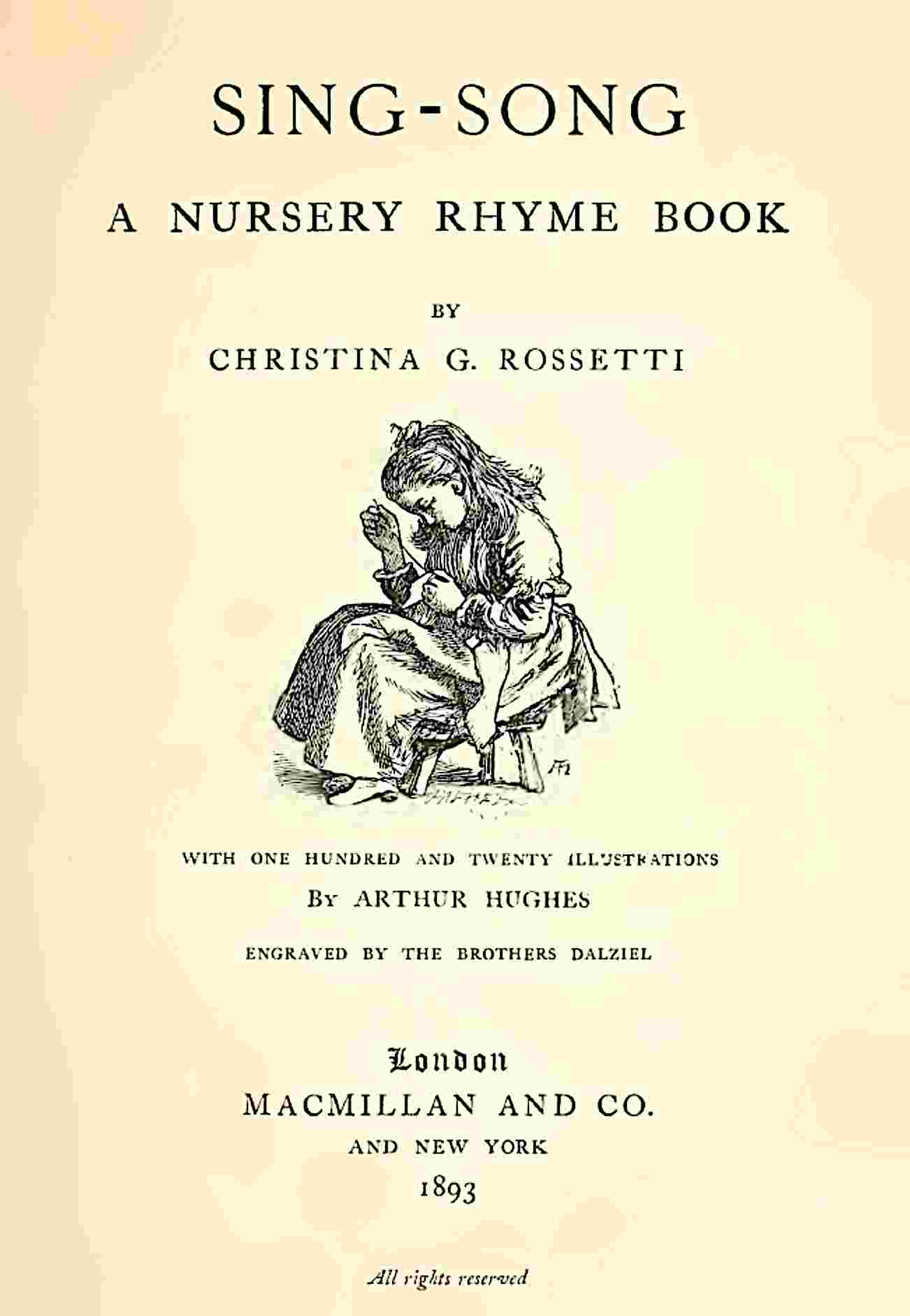
The Project Gutenberg eBook of Sing-song
Title: Sing-song
A nursery rhyme book
Author: Christina Georgina Rossetti
Illustrator: Arthur Hughes
Release date: August 19, 2025 [eBook #76703]
Language: English
Original publication: London: MacMillan & Co, 1893
Credits: George A. Rawlyk Library, Crandall University, produced from scans generously made available by the Internet Archive.
SING-SONG
A NURSERY RHYME BOOK
BY CHRISTINA G. ROSSETTI
WITH ONE HUNDRED AND TWENTY ILLUSTRATIONS
BY ARTHUR HUGHES
ENGRAVED BY THE BROTHERS DALZIEL
LONDON
MACMILLAN AND CO.
AND NEW YORK
1893
CONTENTS
A baby's cradle with no baby in it
An emerald is as green as grass
A pin has a head, but has no hair
A rose has thorns as well as honey
A toadstool comes up in a night
Brownie, Brownie, let down your milk
Crimson curtains round my mother’s bed
Crying, my little one, footsore and weary?
Dead in the cold, a song-singing thrush
Fly away, fly away over the sea
“Goodbye in fear, goodbye in sorrow”
Hear what the mournful linnets say
Hope is like a harebell trembling from its birth
Hop-o’-my-thumb and little Jack Horner
Hopping frog, hop here and be seen
I dreamt I caught a little owl
I dug and dug amongst the snow
If all were rain and never sun
If stars dropped out of heaven
I have but one rose in the world
In the meadow—what in the meadow?
Is the moon tired? she looks so pale
Motherless baby and babyless mother
My baby has a father and a mother
O Lady Moon, your horns point toward the east
Stroke a flint, and there is nothing to admire
The city mouse lives in a house
The dear old woman in the lane
The peach tree on the southern wall
The peacock has a score of eyes
There is but one May in the year
There is one that has a head without an eye
The rose that blushes rosy red
The rose with such a bonny blush
The wind has such a rainy sound
Twist me a crown of wind-flowers
What are heavy? sea-sand and sorrow
What does the donkey bray about?
What will you give me for my pound?
When the cows come home the milk is coming
Where innocent bright-eyes daisies are
Angels at the foot,
And Angels at the head,
And like a curly little lamb
My pretty babe in bed.
Love me,—I love you,
Love me, my baby;
Sing it high, sing it low,
Sing it as may be.
Mother’s arms under you,
Her eyes above you;
Sing it high, sing it low,
Love me,—I love you.
My baby has a father and a mother,
Rich little baby!
Fatherless, motherless, I know another
Forlorn as may be:
Poor little baby!
Our little baby fell asleep,
And may not wake again
For days and days, and weeks and weeks
But then he’ll wake again,
And come with his own pretty look,
And kiss Mamma again.
“Kookoorookoo! kookoorookoo!”
Crows the cock before the morn
“Kikirikee! kikirikee!”
Roses in the east are born.
“Kookoorookoo! kookoorookoo!”
Early birds begin their singing;
“Kikirikee! kikirikee!”
The day, the day, the day is springing.
Baby cry—
Oh fie!—
At the physic in the cup:
Gulp it twice
And gulp it thrice,
Baby gulp it up.
Eight o’clock;
The postman’s knock!
Five letters for Papa;
One for Lou,
And none for you,
And three for dear Mamma.
Bread and milk for breakfast,
And woollen frocks to wear,
And a crumb for robin redbreast
On the cold days of the year.
There’s snow on the fields,
And cold in the cottage,
While I sit in the chimney nook
Supping hot pottage.
My clothes are soft and warm,
Fold upon fold,
But I’m so sorry for the poor
Out in the cold.
Dead in the cold, a song-singing thrush,
Dead at the foot of a snowberry bush,—
Weave him a coffin of rush,
Dig him a grave where the soft mosses grow,
Raise him a tombstone of snow.
I dug and dug amongst the snow,
And thought the flowers would never grow;
I dug and dug amongst the sand,
And still no green thing came to hand.
Melt, O snow! the warm winds blow
To thaw the flowers and melt the snow
But all the winds from every land
Will rear no blossom from the sand.
A city plum is not a plum;
A dumb-bell is no bell, though dumb
A party rat is not a rat;
A sailor’s cat is not a cat;
A soldier’s frog is not a frog;
A captain’s log is not a log.
Your brother has a falcon,
Your sister has a flower;
But what is left for mannikin,
Born within an hour?
I’ll nurse you on my knee, my knee,
My own little son;
I’ll rock you, rock you, in my arms,
My least little one.
Hear what the mournful linnets say:
“We built our nest compact and warm.
But cruel boys came round our way
And took our summerhouse by storm.
“They crushed the eggs so neatly laid;
So now we sit with drooping wing,
And watch the ruin they have made,
Too late to build, too sad to sing.”
A baby’s cradle with no baby in it,
A baby’s grave where autumn leaves drop sere;
The sweet soul gathered home to Paradise,
The body waiting here.
Hop-o’-my-thumb and little Jack Horner,
What do you mean by tearing and fighting?
Sturdy dog Trot close round the corner,
I never caught him growling and biting.
Hope is like a harebell trembling from its birth.
Love is like a rose the joy of all the earth;
Faith is like a lily lifted high and white,
Love is like a lovely rose the world’s delight;
Harebells and sweet lilies show a thornless growth,
But the rose with all its thorns excels them both.
O wind, why do you never rest,
Wandering, whistling to and fro,
Bringing rain out of the west,
From the dim north bringing snow?
Crying, my little one, footsore and weary?
Fall asleep, pretty one, warm on my shoulder:
I must tramp on through the winter night dreary,
While the snow falls on me colder and colder.
You are my one, and I have not another;
Sleep soft, my darling, my trouble and treasure;
Sleep warm and soft in the arms of your mother,
Dreaming of pretty things, dreaming of pleasure.
Growing in the vale
By the uplands hilly,
Growing straight and frail,
Lady Daffadowndilly.
In a golden crown,
And a scant green gown
While the spring blows chilly,
Lady Daffadown,
Sweet Daffadowndilly.
A linnet in a gilded cage,—
A linnet on a bough,—
In frosty winter one might doubt
Which bird is luckier now.
But let the trees burst out in leaf,
And nests be on the bough,
Which linnet is the luckier bird,
Oh who could doubt it now?
Wrens and robins in the hedge,
Wrens and robins here and there;
Building, perching, pecking, fluttering,
Everywhere!
My baby has a mottled fist,
My baby has a neck in creases;
My baby kisses and is kissed,
For he’s the very thing for kisses.
Why did baby die,
Making Father sigh,
Mother cry?
Flowers, that bloom to die,
Make no reply
Of “why?”
But bow and die.
If all were rain and never sun,
No bow could span the hill;
If all were sun and never rain,
There’d be no rainbow still.
O wind, where have you been,
That you blow so sweet?
Among the violets
Which blossom at your feet.
The honeysuckle waits
For Summer and for heat.
But violets in the chilly Spring
Make the turf so sweet.
Brownie, Brownie, let down your milk
White as swansdown and smooth as silk,
Fresh as dew and pure as snow:
For I know where the cowslips blow,
And you shall have a cowslip wreath
No sweeter scented than your breath.
On the grassy banks
Lambkins at their pranks;
Woolly sisters, woolly brothers
Jumping off their feet
While their woolly mothers
Watch by them and bleat.
Rushes in a watery place,
And reeds in a hollow;
A soaring skylark in the sky,
A darting swallow;
And where pale blossom used to hang
Ripe fruit to follow.
Minnie and Mattie
And fat little May,
Out in the country,
Spending a day.
Such a bright day,
With the sun glowing,
And the trees half in leaf,
And the grass growing.
Pinky white pigling
Squeals through his snout,
Woolly white lambkin
Frisks all about.
Cluck! cluck! the nursing hen
Summons her folk,—
Ducklings all downy soft
Yellow as yolk.
Cluck! cluck! the mother hen
Summons her chickens
To peck the dainty bits
Found in her pickings.
Minnie and Mattie
And May carry posies,
Half of sweet violets,
Half of primroses.
Give the sun time enough,
Glowing and glowing,
He’ll rouse the roses
And bring them blowing.
Don’t wait for roses
Losing to-day,
O Minnie, Mattie,
And wise little May.
Violets and primroses
Blossom to-day
For Minnie and Mattie
And fat little May.
Heartsease in my garden bed,
With sweetwilliam white and red,
Honeysuckle on my wall:—
Heartsease blossoms in my heart
When sweet William comes to call,
But it withers when we part,
And the honey-trumpets fall.
If I were a Queen,
What would I do?
I’d make you King,
And I’d wait on you.
If I were a King,
What would I do?
I’d make you Queen,
For I’d marry you.
What are heavy? sea-sand and sorrow:
What are brief? to-day and to-morrow:
What are frail? Spring blossoms and youth
What are deep? the ocean and truth.
Stroke a flint, and there is nothing to admire:
Strike a flint, and forthwith flash out sparks of
fire.
There is but one May in the year,
And sometimes May is wet and cold;
There is but one May in the year
Before the year grows old.
Yet though it be the chilliest May,
With least of sun and most of showers,
Its wind and dew, its night and day,
Bring up the flowers.
The summer nights are short
Where northern days are long:
For hours and hours lark after lark
Trills out his song.
The summer days are short
Where southern nights are long:
Yet short the night when nightingales
Trill out their song.
The days are clear,
Day after day,
When April’s here,
That leads to May,
And June
Must follow soon:
Stay, June, stay!—
If only we could stop the moon
And June!
Twist me a crown of wind-flowers;
That I may fly away
To hear the singers at their song,
And players at their play.
Put on your crown of wind-flowers
But whither would you go?
Beyond the surging of the sea
And the storms that blow.
Alas! your crown of wind-flowers
Can never make you fly:
I twist them in a crown to-day,
And to-night they die.
Brown and furry
Caterpillar in a hurry,
Take your walk
To the shady leaf, or stalk,
Or what not,
Which may be the chosen spot.
No toad spy you,
Hovering bird of prey pass by you
Spin and die,
To live again a butterfly.
A toadstool comes up in a night,—
Learn the lesson, little folk:—
An oak grows on a hundred years,
But then it is an oak.
A pocket handkerchief to hem—
On dear, oh dear, oh dear!
How many stitches it will take
Before it’s done, I fear.
Yet set a stitch and then a stitch,
And stitch and stitch away,
Till stitch by stitch the hem is done—
And after work is play!
If a pig wore a wig,
What could we say?
Treat him as a gentleman,
And say “Good day.”
If his tail chanced to fail,
What could we do?—
Send him to the tailoress
To get one new.
Seldom “can’t,”
Seldom “don’t”
Never “shan’t,”
Never “won’t.”
1 and 1 are 2
That’s for me and you.
2 and 2 are 4—
That’s a couple more.
3 and 3 are 6
Barley-sugar sticks.
4 and 4 are 8
Tumblers at the gate.
5 and 5 are 10
Bluff seafaring men.
6 and 6 are 12
Garden lads who delve.
7 and 7 are 14
Young men bent on sporting.
8 and 8 are 16
Pills the doctor’s mixing.
9 and 9 are 18
Passengers kept waiting.
10 and 10 are 20
Roses—pleasant plenty!
11 and 11 are 22
Sums for brother George to do.
12 and 12 are 24
Pretty pictures, and no more.
How many seconds in a minute?
Sixty, and no more in it.
How many minutes in an hour?
Sixty for sun and shower.
How many hours in a day?
Twenty-four for work and play.
How many days in a week?
Seven both to hear and speak.
How many weeks in a month?
Four, as the swift moon runn’th.
How many months in a year?
Twelve the almanack makes clear.
How many years in an age?
One hundred says the sage.
How many ages in time?
No one knows the rhyme.
What will you give me for my pound?
Full twenty shillings round.
What will you give me for my shilling?
Twelve pence to give I’m willing.
What will you give me for my penny?
Four farthings, just so many.
January cold desolate;
February all dripping wet;
March wind ranges;
April changes;
Birds sing in tune
To flowers of May,
And sunny June
Brings longest day;
In scorched July
The storm-clouds fly
Lightning-torn;
August bears corn,
September fruit;
In rough October
Earth must disrobe her;
Stars fall and shoot
In keen November;
And night is long
And cold is strong
In bleak December.
What is pink? a rose is pink
By the fountain’s brink.
What is red? a poppy’s red
In its barlev bed.
What is blue? the sky is blue
Where the clouds float thro’.
What is white? a swan is white
Sailing in the light.
What is yellow: pears are yellow,
Rich and ripe and mellow.
What is green? the grass is green.
With small flowers between.
What is violet? clouds are violet
In the summer twilight.
What is orange? why, an orange,
Just an orange!
Mother shake the cherry-tree,
Susan catch a cherry;
Oh how funny that will be,
Let’s be merry!
One for brother, one for sister,
Two for mother more,
Six for father, hot and tired,
Knocking at the door.
A pin has a head, but has no hair;
A clock has a face, but no mouth there
Needles have eyes, but they cannot see;
A fly has a trunk without lock or key;
A timepiece may lose, but cannot win;
A corn-field dimples without a chin;
A hill has no leg, but has a foot;
A wine-glass a stem, but not a root;
A watch has hands, but no thumb or finger
A boot has a tongue, but is no singer;
Rivers run, though they have no feet;
A saw has teeth, but it does not eat;
Ash-trees have keys, yet never a lock;
And baby crows, without being a cock.
Hopping frog, hop here and be seen,
I’ll not pelt you with stick or stone:
Your cap is laced and your coat is green;
Good bye, we’ll let each other alone.
Plodding toad, plod here and be looked at,
You the finger of scorn is crooked at:
But though you’re lumpish, you’re harmless too;
You won’t hurt me, and I won’t hurt you.
Where innocent bright-eyed daisies are,
With blades of grass between,
Each daisy stands up like a star
Out of a sky of green.
The city mouse lives in a house;—
The garden mouse lives in a bower,
He’s friendly with the frogs and toads,
And sees the pretty plants in flower.
The city mouse eats bread and cheese;—
The garden mouse eats what he can;
We will not grudge him seeds and stalks,
Poor little timid furry man.
What does the donkey bray about?
What does the pig grunt through his snout?
What does the goose mean by a hiss?
Oh, Nurse, if you can tell me this,
I’ll give you such a kiss.
The cockatoo calls “cockatoo,”
The magpie chatters “how d’ye do?”
The jackdaw bids me “go away,”
Cuckoo cries “cuckoo” half the day:
What do the others say?
Three plum buns
To eat here at the stile
In the clover meadow,
For we have walked a mile.
One for you, and one for me,
And one left over:
Give it to the boy who shouts
To scare sheep from the clover.