
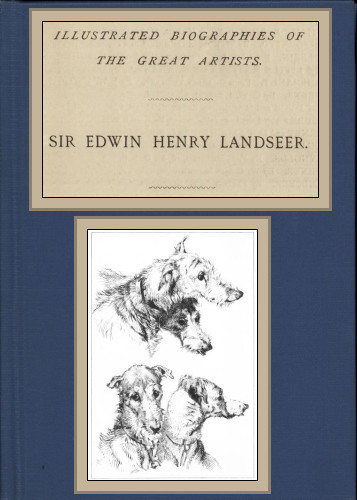
The Project Gutenberg eBook of Sir Edwin Landseer
Title: Sir Edwin Landseer
Author: Frederic George Stephens
Release date: July 24, 2018 [eBook #57574]
Most recently updated: January 24, 2021
Language: English
Credits: Produced by Chuck Greif and the Online Distributed
Proofreading Team at http://www.pgdp.net (This file was
produced from images available at The Internet Archive)
|
1. Contents. 2. List of Illustrations (In certain versions of this etext [in certain browsers] clicking on the image will bring up a larger version.) 3. Chronology of Edwin Henry Landseer 4. Chronological List of Pictures by Sir Edwin Landseer, Mentioned in this Volume. 5. Index of Names. (etext transcriber's note) |
ILLUSTRATED BIOGRAPHIES OF
THE GREAT ARTISTS.
/\/\/\/\/\/\/\/\/\/\/\/\/\/\/\/\/\/\/\/\/\/\/\/\/\
SIR EDWIN HENRY LANDSEER.
/\/\/\/\/\/\/\/\/\/\/\/\/\/\/\/\/\/\/\/\/\/\/\/\/\
ILLUSTRATED BIOGRAPHIES
OF THE GREAT ARTISTS.
The following volumes, each illustrated with from 14 to 20 Engravings,
are now ready, price 3s. 6d.
- LEONARDO DA VINCI. By Dr. J. Paul Richter.
- MICHELANGELO. By Charles Clement.
- RAPHAEL. From J. D. Passavant. By N. D’Anvers.
- TITIAN. By Richard Ford Heath, M.A., Oxford.
- TINTORETTO. By W. Roscoe Osler. From researches at Venice.
- HOLBEIN. From Dr. A. Woltmann. By Joseph Cundall.
- THE LITTLE MASTERS OF GERMANY.[1] By W. B. Scott.
- REMBRANDT. From Charles Vosmaer. By J. W. Mollett.
- RUBENS, By C. W. Kett, M.A., Oxford.
- VAN DYCK and HALS. By Percy R. Head, Lincoln Coll., Oxford.
- FIGURE PAINTERS OF HOLLAND. By Lord Ronald Gower, F.S.A.
- VERNET and DELAROCHE. By J. Ruutz Rees.
- HOGARTH. By Austin Dobson.
- REYNOLDS. By F. S. Pulling, M.A., Oxford.
- TURNER. By W. Cosmo Monkhouse.
- LANDSEER. By Frederick G. Stephens.
The following volumes are in preparation:—
- FRA ANGELICO. By Catherine M. Phillimore.
- FRA BARTOLOMMEO. By Leader Scott.
- VELAZQUEZ. By Edwin Stowe, M.A., Oxford.
- GAINSBOROUGH. By G. M. Brock Arnold, M.A., Oxford.
- ALBRECHT DÜRER. By R. F. Heath, M.A.
- GIOTTO. By Harry Quilter, M.A., Trinity College, Cambridge.
“The whole world without Art would be one great wilderness.”
————
SIR EDWIN LANDSEER
By FREDERICK G. STEPHENS,
AUTHOR OF “MEMORIALS OF MULREADY,” ETC.
LONDON:
SAMPSON LOW, MARSTON, SEARLE, & RIVINGTON,
CROWN BUILDINGS, FLEET STREET.
1880.
(All rights reserved.)
TO
HENRY WALLIS, PAINTER,
THE
THANK-OFFERING OF AN
OLD FRIEND.
PREFACE TO THE THIRD EDITION.
The text of a former work on the early productions of Sir Edwin Landseer has been, for the second time, revised and extended by the author; and the subject has been continued to the death of the artist.
The biographer’s aim is achieved if he has successfully shown the course of the artist’s studies, and their result in success of an extraordinary kind.
June, 1880.
CONTENTS.
| CHAPTER I. | |
|---|---|
| PAGE | |
| Origin of the Landseer family—Parentage of Edwin Henry Landseer—Thomas Landseer | 1 |
| CHAPTER II. | |
| Early life—Landseer’s first studio—Etchings—First picture at the Royal Academy—Haydon’s studio | 16 |
| CHAPTER III. | |
| A fully-developed painter—Early paintings—British Institution—The Cat’s Paw | 39 |
| CHAPTER IV. | |
| At St. John’s Wood—Chevy Chase—Chief’s Return from Deer-stalking—Made Royal Academician (1830)—Lassie herding sheep | 58 |
| CHAPTER V. | |
| Suspense—Highland Shepherd Dog—Bolton Abbey—Drover’s departure—Shepherd’s Chief Mourner—Dignity and Impudence—Otters and Salmon—The Sanctuary | 72 |
| CHAPTER VI. | |
| Windsor Castle in the present time—Not caught yet—The Otter speared—Shoeing—The random shot—Dialogue at Waterloo—Landseer knighted | 87 |
| CHAPTER VII. | |
| Sir Edwin Landseer—The Monarch of the Glen—Midsummer Night’s Dream—Maid and Magpie—The Flood in the Highlands | 94 |
| CHAPTER VIII. | |
| Man proposes, God disposes—The Connoisseurs—The Swannery invaded—Closing Years—Death of Landseer | 105 |
LIST OF ILLUSTRATIONS.
From Etchings by Edwin Landseer and C. G. Lewis.
| PAGE | ||||
| 1. | Dogs worrying a Frog. | Etched by Edwin Landseer | (1822), | xii |
| 2. | Low Life. | ” ” ” | (1822), | 7 |
| 3. | A Shepherd’s Dog. | ” ” ” | (1824), | 13 |
| 4. | The Beggars. | ” ” ” | (1824), | 19 |
| 5. | Donkeys on a Common. | ” ” ” | (1824), | 25 |
| 6. | Four Irish Greyhounds. | ” ” ” | (1825), | Front. |
| 7. | Eagle and Red Deer. | ” ” ” | (1825), | 31 |
| 8. | The Rabbit Warren. | ” ” ” | (1826), | 37 |
| 9. | Return from Deer-Stalking. | ” ” ” | (1826), | 43 |
| The Mothers. Drawn by Edwin Landseer in 1837. | ||||
| 10. | Highland Nurse. | Etched by C. G. Lewis | (1847) | 49 |
| 11. | Mare and Foal. | ” ” ” | (1847), | 55 |
| 12. | Dog and Pups. | ” ” ” | (1847), | 61 |
| 13. | Cow and Calf. | ” ” ” | (1847), | 69 |
| 14. | Donkey and Foal. | ” ” ” | (1847), | 77 |
| 15. | Goat and Kids. | ” ” ” | (1847), | 85 |
| 16. | Sow and Pigs. | ” ” ” | (1847), | 93 |
| 17. | Sheep and Lambs. | ” ” ” | (1847), | 101 |
The head and tail pieces are from Etchings by Edwin Landseer for the Game Card at Woburn Abbey (1825).
CHRONOLOGY OF EDWIN HENRY LANDSEER.
| PAGE | ||
| 1802 | Born at 83, Queen Anne Street East | 16 |
| 1812 | Studied at Hampstead | 17 |
| 1815 | Exhibited pictures at Royal Academy | 28 |
| Attended Haydon’s Studio | 32 | |
| 1818 | Exhibited “Fighting Dogs” | 42 |
| 1822 | Received a premium of £150 from the Directors of the British Institution | 51 |
| 1824 | First visit to the Highlands | 55 |
| 1825 | Took the house in St. John’s Wood | 58 |
| 1826 | Made Associate of the Royal Academy | 60 |
| 1830 | Made Royal Academician | 62 |
| 1850 | Knighted | 93 |
| 1859 | Received the Commission for the Lions for the Nelson Monument | 108 |
| 1860 | Exhibited “Flood in the Highlands” | 100 |
| 1866 | The “Lions” were placed in Trafalgar Square | 108 |
| 1869 | The Swannery invaded | 108 |
| 1873 | Died October 1st | 112 |
| Buried in St. Paul’s, October 11th | 112 | |
SIR EDWIN LANDSEER.
CHAPTER I.
ORIGIN AND PARENTAGE.
So much of the family history of this artist as it is needful to repeat, or the reader will care to learn, may be briefly told: it begins with his grandfather, who was a jeweller settled in London, where, in 1761,[2] his father, John Landseer, was born. The senior was on intimate terms with Peter, father of the lawyer and politician, Sir Samuel Romilly. Peter Romilly was descended from a distinguished French family, the first of whom known in this country settled near London after the revocation of the Edict of Nantes, and acquired a fortune as a wax-bleacher. This Peter was a jeweller of note and wealth, established in Frith Street, Soho, and it is probable that common interest in a craft which is so closely allied to art had much to do with directing the minds of John, and consequently those of his family, to design. It is certain that in the early life of Sir Samuel Romilly he gave considerable attention to painting and its sister studies—architecture, and anatomy as applied to the arts. His biographer tells us that the future lawyer attended the lectures delivered on these subjects by Dr. William Hunter and James Barry at the Royal Academy, and doubtless those which, as we shall presently see, John Landseer, his friend—for the affection of the fathers was continued with the sons—pronounced with noteworthy effect at the Royal Institution. These discourses of John Landseer’s, as printed and published at a later date, and entitled “Lectures on the Art of Engraving,” 1807, still supply the body of one of the best text-books in our language on the principles and practice of that art.
How John Landseer became an engraver may not be difficult to understand when we recollect that the art which he fortunately illustrated, was, for modern use at least, first exercised if not invented by a jeweller and goldsmith, and that most of the early European artists in gold and jewellery not only worked in their proper crafts, but, for the service of the printing-press, incised silver and copper plates with the graver and needle. From Holbein to Stothard, before and since their days, some of the greatest artists have applied their genius to the designing of jewellery. Hogarth engraved on household plate before he etched or cut copper to immortal uses. As etchers, or autographic artists on metal, both John Landseer and his son Edwin distinguished themselves. Conversely, the best etchers have been and are painters, from Dürer, and Rembrandt, and Van Dyck, to MM. Rajon and Palmer of our own day. The etchings of our chief subject are among his least known yet most admirable works; Thomas, Edwin’s senior, another son of John Landseer, was one of the most eminent engravers of this age.
Observing the ability of his son John, Landseer the jeweller obtained for him the assistance of William Byrne, one of the best instructors of that period, who, with Hearne, had been engaged in the production of “The Antiquities of Great Britain,” and singly, in preparing many topographical works, such as “Views of the Lakes of Cumberland,” and “Italian Scenery.” Sea-pieces by Vernet, landscapes by Both and Claude Lorrain, Turner’s contributions to “Britannia Depicta,” and a fine “View of Niagara,” by Wilson, occupied this venerable artist, who was one of the ablest in his profession, and a pupil of Aliamet and Wille, as Hearne, his partner in “The Antiquities,” had been a pupil of William Woollett.[3]
William Byrne was one of those stout “out-siders” of the Royal Academy who, with Woollett, Schiavonetti, Sharp, Hall, and Strange, refused to place their names as candidates for the half-honours of the Associateship to that body so long as the upper grade of Academicianship in full was denied to members of their profession. Some of the more eminent English engravers, among whose names that of Mr. John Pye is distinct, held themselves aloof from the Academical body on this as well as on other accounts. This exclusion of engravers from their full professional honours had, as we shall see, great effect on the career of John Landseer, and the law by which it was produced has only within the last ten years been modified by the admission without reserve of Mr. S. Cousins to the Academicianship, after he, with Mr. Doo, had passed through the anomalous grade of Academician-Engravers, which seemed to have been instituted in order to draw the line sharply between members of their profession and those other artists who practised painting, sculpture and architecture. This line was drawn with such emphasis that Bartolozzi was elected, not as an engraver, but as a painter, he having painted a picture in order to evade the law of the Academy. Byrne, like his pupil, John Landseer, was earnest in charitable works for his fellow-artists; thus, we find his name as one of the Directors of the Society of Engravers for the benefit of poor professors of the art, their widows and orphans. John Landseer was one of the founder-members of the Artists’ Fund, and associated therein with the Schiavonettis, Raimbach, and Heath, to whom as painters, Mulready, Mr. Linnell, and others of good standing were joined. Mr. John Pye was among the most active members of this society, its ablest expositor, and practically its founder.
No artist among Englishmen, not even Turner, Stothard, Wilkie, nor Hogarth himself, owed so much of his popular honours to engraving as Edwin Landseer; in Mr. Thomas Landseer’s hands, and by the hands of other skilful engravers, the pictures of the distinguished animal-painter obtained a popularity which would otherwise be impossible; and it may be said, with but little strain on the terms, that the engravers have repaid his son for the devotion of John Landseer to their art. Not only was the popularity of Sir Edwin immensely extended by engravings, but the greater part of his fortune accrued by means of copyrights and the sale of prints.
Having got over the early difficulties of his profession, the first works of John Landseer were vignettes after De Loutherbourg’s landscapes; intended, says the author of an excellent article in “The Literary Gazette,” to which we are indebted for some of the facts of this biography of the engraver, for the “Bible” of Macklin, the once “great” publisher. These plates were produced in the heat of the contest between Alderman Boydell and Macklin, who struggled which should employ the ablest artists to paint for their respective ventures in engraving. The “Shakespeare” of the former enthusiastic speculator is the best known of these publications. To him, indirectly, we owe the establishment of the now defunct British Institution, and all the knowledge of ancient and modern art which it diffused during more than sixty years.
One of Boydell’s efforts to establish his large venture secured the aid of Sir Joshua Reynolds, who was considered not only the ablest portrait-painter of that day, but acceptable to the public as a producer of historical and fancy subjects. As to the last, it is not too much to state that the cost was thrown away. It would have been better for Reynolds’s reputation if he had restricted himself to that mode of art in which he was a master. It is said that a bank-note for fifty pounds slipped in the hand of Sir Joshua had much to do in dispelling the apathy with which he was supposed to regard the schemes of Boydell. This statement may be believed by those who choose to do so, not by us. Nevertheless, Reynolds did paint pictures for Boydell, and among these was the famous “Puck,” which is noteworthy for producing the enormous sum of 980 guineas when sold, with the Rogers Collection, to Earl Fitzwilliam; Rogers bought it at Boydell’s sale for 215l. 5s. It is now at Wentworth House, and very much faded. Boydell gave Reynolds 100 guineas for this painting, of which—when exhibited at the Royal Academy in 1789, about the time John Landseer was working from De Loutherbourg’s vignettes—Walpole wrote that it was “an ugly little imp, with some character, sitting on a mushroom as big as a millstone.” Reynolds likewise painted for Boydell “The Death of Cardinal Beaufort,” of which there is a version in the Dulwich Gallery. For the former of these the Earl of Egremont gave, at the publisher’s sale, 530l. 8s.; Boydell paid Reynolds 500 guineas for it, June 22, 1789. The well-known painting of “The Witches meeting Macbeth” is noted in Reynolds’s ledger as “not yet begun,” although, June 1786, the President received 500 guineas for it. These were the three pictures produced by Reynolds for Boydell’s “Shakespeare;” their painting is closely connected with our story.
In publishing large and boldly-illustrated works Boydell’s rival was Macklin, who, as he contemplated a “Bible” of even greater pretensions than those of his antagonist’s “Shakespeare,” needed the countenance of the President of the Royal Academy as much as his aldermanic antagonist.[4] Of Reynolds Macklin bought “Tuccia, the Vestal Virgin,” an illustration of Gregory’s “Ode to Meditation,” for which he paid, says Northcote, 300 guineas, though Reynolds’s ledger refers to the receipt of 200 guineas only; Macklin bought for 500 guineas “The Holy Family,” which is now in the National Gallery; and, for a still larger sum,—which it would be difficult to ascertain, as the entry in Reynolds’s ledger confuses it with the prices of various works, in all more than two thousand pounds—a painting which is sometimes called “Macklin’s Family Picture,” or “The Cottagers,” otherwise “The Gleaners,” and represents an Arcadian scene, such as Macklin would have rejoiced to realize as it might appear before the door of a cottage, with the publisher, his wife, and their daughter seated in domestic happiness, with Miss Potts,[5] a dear and beautiful friend of theirs,
standing with a sheaf of corn on her head; the last-named figure claims the greatest interest from all who admire the works of the Landseers; because, in a short time after the damsel sat to Sir Joshua in this charming guise, she was married to John, the young engraver, and thus became the mother of Thomas, Charles, Edwin Henry, and four daughters of his name.[6] It is understood that John Landseer and Miss Potts were first acquainted in the house of Macklin, and it is believed that the marriage was, in more than a single sense, an artistic one. Bartolozzi engraved, in 1794, the portrait of a Miss Emily Pott, after Reynolds, as “Thais.” This was not the lady now in question.
The introduction of these lovers to each other occurred, we believe, through the employment of John Landseer by Macklin to execute plates for his “Bible.” In these works, several of the best engravers of that time were associated with him; among them Bromley, Heath, and Skelton. Not long after this, that is, in 1792, we find John Landseer exhibiting at the Royal Academy, the only year, we believe, ere he became an Associate of that body, in which he vouchsafed to do so. His contribution was “View from the Hermit’s Hole, Isle of Wight” (No. 541), and his address was given at 83, Queen Anne Street East.[7] A few years later he was occupied in the production of plates from drawings by Turner and Ibbetson, styled “Views in the Isle of Wight,” a series which came to an early end. John Landseer’s share of this work was confined to “Orchard Bay,” “Shanklin Bay,” and “Freshwater Bay.” He engraved “High Torr,” after Turner, for Whitaker’s “History of Richmondshire,” a very fine specimen of his skill; this book was published by Longmans in 1823; and, for “The Picturesque Tour in Italy,” he executed “The Cascade of Terni,” which is one of Turner’s best pictures. These were, we believe, all Landseer’s transcripts from the works of the great master of English landscape art. His largest series of plates was styled “Twenty Views of the South of Scotland,” and made after drawings by James Moore: another group of engravings was executed from drawings of animals by the Dutch masters, Rubens, Snyders, Rembrandt, and others; these plates show not only his remarkable skill, but the current of his mind towards animal subjects, such as his sons, Thomas and Edwin Henry, have pre-eminently illustrated. In addition to the above we have “A Series of Engravings illustrating those important events recorded in the Sacred Scriptures,” “which have been selected from Raphael, &c., with critical notices,” 1833; and six plates to “Vates, or the Philosophy of Madness,” 1840.
Having disposed of our materials about the professional and family lineage of the Landseers, it will be desirable, before entering upon the chief subject of this text, to draw together all it is needful to state of his very remarkable parent, the engraver and engravers’ champion. We shall do so without regard to the chronological parallelism of their lives; a course of treatment which admits simplicity of arrangement. The births of three able sons are important facts in the history of any man who might be so honoured in parentage. Thomas, the eldest son, was born, we believe, in 1796; Charles, the second son, Aug. 2, 1799; Sir Edwin Henry, in 1802; March 7th was the date given on his coffin-plate, but there are doubts about this matter, even among the Landseer family. Including the daughters, the names of this family ran thus in the order of their births:—Jane, who married Mr. Charles Christmas, and died at the birth of her first child; Thomas, Charles, Anna Maria, Edwin, Jessica, i.e. the present Miss Landseer, and Emma, now Mrs. Mackenzie. The last two survive.
According to the original constitution of the Academy, engravers had no place in it. Thus they were denied the privilege of considering themselves artists at all. This absurdity was not much reduced when, in the third year of its existence, the body decided on admitting six “Associate Engravers” as a distinct and inferior class.[8]
As we have thus noted, the position of engravers in the honour-bestowing body of their profession had been anomalous, and beneath the pretences, as well as the merits and reputations, of many distinguished men, who, while not unwilling to join the academical association, declined to do so on conditions which at once marked their alleged inferiority to the professors of other branches of art, and placed them in a lower grade than the painters, sculptors, and architects with whom, nevertheless, they claimed to be equal. They complained especially, that, in addition to the above-given sources of discontent, a law of the Academy restricted them from more than one of the privileges and advantages of the exhibitions:—1st, of that law which declared that “each Associate-Engraver shall have the liberty [an unfortunate form of expression] of exhibiting two prints, either compositions of his own, or engravings from other masters.” Thus, while other members were entitled to contribute eight pictures, sculptures, or what not, without limitation as to the size of each example, the engravers might exhibit not more than two, which, by the very conditions under which they were produced, must be small. 2ndly, the engravers objected to the concluding section of the same law, which ran thus: “and these shall be the only prints admitted to the Royal Exhibition.” By these measures the engravers were affected, and their art depreciated. This state of things has been mended now, and engravers are admitted to the full academical honours. The history of the earliest phases of the contest, and a statement of the case are in Mr. John Pye’s “Patronage of British Art,” where the exertions of John Landseer and others are described. It is strange that although this measure of justice has been vouchsafed, the lots of honour fell to two of the staunchest “outsiders” who refused to become candidates for the Associateship until the standing of their profession was recognized: while John Landseer remained an Associate for nearly fifty years, and died without further distinction in 1852, but five years before the election of Mr. Cousins. Mr. Doo’s election occurred the next year after that of Mr. Cousins. The latter became an Associate thirty years later than John Landseer; the former was an Associate but one year, being elected A.R.A. in 1856, and R.A. in 1857. Mr. Cousins resigned his R.A.ship, and became a Retired Royal Academician in 1879. The first to accept honour was John Landseer.
It was with the intention of putting the true position of the engraver’s art and its professors before the world, and of doing so in the most effectual fashion, that John Landseer, in 1806, delivered lectures on engraving to large audiences at the Royal Institution, and thus laid out those broad and high views of art for which he has been justly honoured. He defined engraving as a species of sculpture performed by incision, and, by defending that view with spirit and skill, became the champion of his profession. Mr. H. Crabb Robinson described John Landseer’s lecturing on “The Philosophy of Art,” at a later occasion, December 5, 1813, at the Surrey Institution. “He is animated in his style,” said Mr. Robinson, “but his animation is produced by indulgence in sarcasms and in emphatic diction. He pronounces his words in italics, and by colouring strongly he produces an effect easily.”[9] In the year in which the lectures on engraving were delivered, John Landseer was elected A.-E.R.A., under protest, as it were, from himself, that he received the distinction with a view to more effective action in favour of his fellow-sufferers. In furtherance of this object he, with very little effect, presented a memorial to the Academicians, and, as he said, experienced from Sir Martin Archer Shee and others “a very great deal of illiberality, and was finally repulsed in a most ungracious way.”[10] After this, says the author of a biography of John Landseer,[11] the disappointment preyed upon his mind so deeply that he turned his attention from the practice of his profession to the study of archæology. This statement requires a considerable quantity of salt. No doubt this failure of so many hopes and efforts embittered his memory for a long time. It is said, though, as Mr. Pye told us, it would be difficult to verify the assertion, that an Associate-Engravership in the total number of six, which became vacant on the death of John Brown, in 1801, remained vacant because no outsider offered himself until Landseer’s election in 1806. There were only five such members of the Academy during the interval in question, and Val. Green, Collyer, James Heath, Anker Smith, and James Fittler were tenants of the five posts. The intensity of professional feeling on the subject may be surmised from this fact.
There is this much to be said about John Landseer’s alleged neglect of his own profession for the studies of an archæologist: he published “Observations on the Engraved Gems brought from Babylon to England by Abraham Lockett, Esq., considered with reference to Scripture History;” but this was not done until 1817, or ten years after the memorializing of the Royal Academy. The object of this work was to show that Babylonian cylinders, the “gems” in question, were not used as talismans or amulets, but as signets of monarchs or princes—a conclusion which is not far from the now accepted truth. He next issued “Sabæan Researches,” 1823, a work founded on remains brought from “Babylon,” by the above-named traveller, comprising letters on antiquities, and lectures delivered at the Royal Institution. These works have been superseded by later ones, and more scientific studies than were to be expected from an author who had been bred to another profession. He likewise published a discursive “Description of Fifty of the Earliest Pictures in the National Gallery,” 1834. He produced twenty plates by way of contribution to the “Antiquities of Dacca” (begun in 1816), a work which was never completed; this imperfectness likewise marked that book on the National Gallery which bears “End of Vol. I.” by way of “Finis,” to a tome which has no successor. He issued “The Review of Publications of Art,” 1808, a periodical of trenchant quality, but brief career; and he promoted a second periodical styled “The Probe,” 1837, which seemed—for it ran to not more than half-a-dozen numbers—designed to oppose the then recently-established “Art-Union” journal. The chief task of his later years was engraving his son Edwin’s famous picture of “The Dogs of St. Bernard,” on which he wrote a small explanatory pamphlet styled “Some Account of the Dogs and the Pass of St. Bernard.” In 1826 he was appointed one of the “Engravers to his Majesty.” Later, he exhibited at the Royal Academy some studies in water-colours from so-called Druidical Temples. He died on the 29th of February, 1852, aged eighty-three. It is a curious fact that on his death, and the vacancy caused in the Academy by that event, Leslie proposed that the disabilities of engravers should be removed.
The chief work of John Landseer was the bringing-up of his sons; in this he was thoroughly successful, and worthy of more