
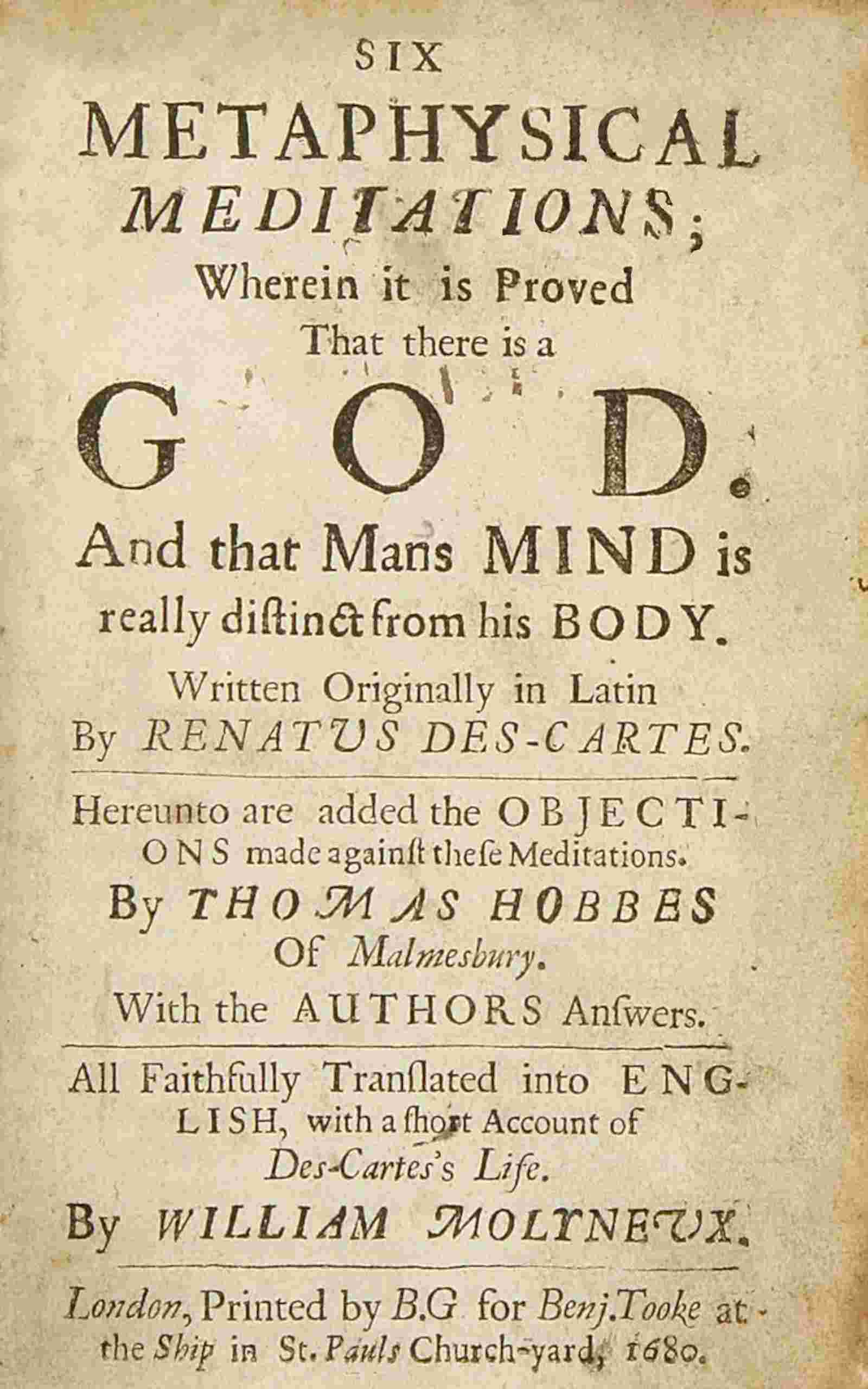
Among seven Parcels of Objections made by Divers Learned Persons against these Meditations, I have made choise of the Third in the Latine Copy, as being Penn’d by Thomas Hobbs of Malmesbury, a Man famously known to the World abroad, but especially to his own the English Nation; and therefore ’tis likely that what comes from Him may be more acceptable to his Countrymen, then what proceeds from a Stranger; and as the strength of a Fortification is never better known then by a Forcible Resistance, so fares it with these Meditations which stand unshaken by the Violent Opposition of so Potent an Enemy. And yet it must be Confess’d that the Force of these Objections and Cogency of the Arguments cannot be well apprehended by those who are not versed in other Pieces of Mr. Hobbs’s Philosophy, especially His Book De Corpore and De Homine, The former whereof I am sure is Translated into English, and therefore not Impertinently refer’d to Here in a Discourse to English Readers. And this is the Reason that makes the Great Des-Cartes pass over many of these Objections so slightly, Who certainly would have Undermined the whole Fabrick of the Hobbian Philosophy had he but known upon What Foundations it was Built.
About This Book
A sequence of six reflections subjects customary opinions to radical, systematic doubt to discover indubitable truths. The thinker discards sensory and speculative certainties via skeptical scenarios, arriving at a foundational assertion of self-awareness as a thinking substance. From clear and distinct perceptions the argument moves to proofs for a benevolent deity as guarantor of truth, and to arguments distinguishing immaterial mind from extended body, illustrated by analytic examples such as the wax experiment and the hypothesis of a deceiving intellect. The work progresses from methodological skepticism to metaphysical claims about knowledge, God, and the real distinction between mind and body.