
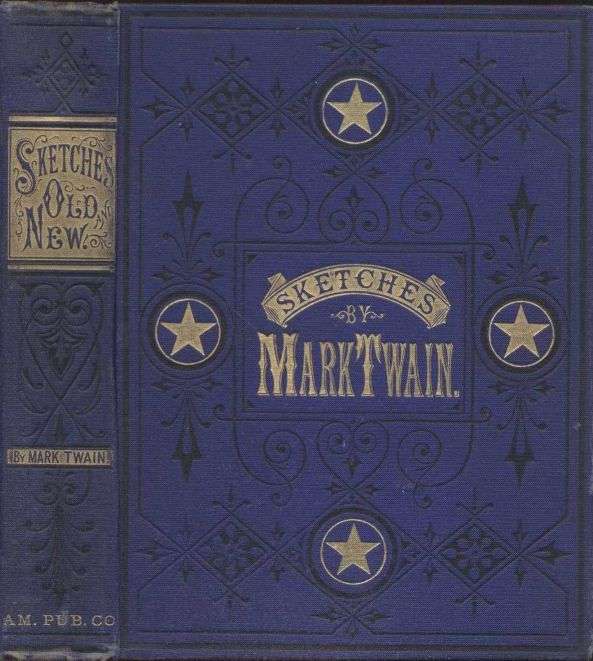
—[Some years ago, about 1867, when this was first published, few people believed it, but considered it a mere extravaganza. In these latter days it seems hard to realize that there was ever a time when the robbing of our government was a novelty. The very man who showed me where to find the documents for this case was at that very time spending hundreds of thousands of dollars in Washington for a mail steamship concern, in the effort to procure a subsidy for the company—a fact which was a long time in coming to the surface, but leaked out at last and underwent Congressional investigation.]
This is history. It is not a wild extravaganza, like “John Wilson Mackenzie’s Great Beef Contract,” but is a plain statement of facts and circumstances with which the Congress of the United States has interested itself from time to time during the long period of half a century.
I will not call this matter of George Fisher’s a great deathless and unrelenting swindle upon the government and people of the United States—for it has never been so decided, and I hold that it is a grave and solemn wrong for a writer to cast slurs or call names when such is the case—but will simply present the evidence and let the reader deduce his own verdict. Then we shall do nobody injustice, and our consciences shall be clear.
On or about the 1st day of September, 1813, the Creek war being then in progress in Florida, the crops, herds, and houses of Mr. George Fisher, a citizen, were destroyed, either by the Indians or by the United States troops in pursuit of them. By the terms of the law, if the Indians destroyed the property, there was no relief for Fisher; but if the troops destroyed it, the Government of the United States was debtor to Fisher for the amount involved.
George Fisher must have considered that the Indians destroyed the property, because, although he lived several years afterward, he does not appear to have ever made any claim upon the government.
In the course of time Fisher died, and his widow married again. And by and by, nearly twenty years after that dimly remembered raid upon Fisher’s corn-fields, the widow Fisher’s new husband petitioned Congress for pay for the property, and backed up the petition with many depositions and affidavits which purported to prove that the troops, and not the Indians, destroyed the property; that the troops, for some inscrutable reason, deliberately burned down “houses” (or cabins) valued at $600, the same belonging to a peaceable private citizen, and also destroyed various other property belonging to the same citizen. But Congress declined to believe that the troops were such idiots (after overtaking and scattering a band of Indians proved to have been found destroying Fisher’s property) as to calmly continue the work of destruction themselves; and make a complete job of what the Indians had only commenced. So Congress denied the petition of the heirs of George Fisher in 1832, and did not pay them a cent.
We hear no more from them officially until 1848, sixteen years after their first attempt on the Treasury, and a full generation after the death of the man whose fields were destroyed. The new generation of Fisher heirs then came forward and put in a bill for damages. The Second Auditor awarded them $8,873, being half the damage sustained by Fisher. The Auditor said the testimony showed that at least half the destruction was done by the Indians “before the troops started in pursuit,” and of course the government was not responsible for that half.
2. That was in April, 1848. In December, 1848, the heirs of George Fisher, deceased, came forward and pleaded for a “revision” of their bill of damages. The revision was made, but nothing new could be found in their favor except an error of $100 in the former calculation. However, in order to keep up the spirits of the Fisher family, the Auditor concluded to go back and allow interest from the date of the first petition (1832) to the date when the bill of damages was awarded. This sent the Fishers home happy with sixteen years’ interest on $8,873—the same amounting to $8,997.94. Total, $17,870.94.
3. For an entire year the suffering Fisher family remained quiet—even satisfied, after a fashion. Then they swooped down upon the government with their wrongs once more. That old patriot, Attorney-General Toucey, burrowed through the musty papers of the Fishers and discovered one more chance for the desolate orphans—interest on that original award of $8,873 from date of destruction of the property (1813) up to 1832! Result, $10,004.89 for the indigent Fishers. So now we have: First, $8,873 damages; second, interest on it from 1832 to 1848, $8,997.94; third, interest on it dated back to 1813, $10,004.89. Total, $27,875.83! What better investment for a great-grandchild than to get the Indians to burn a corn-field for him sixty or seventy years before his birth, and plausibly lay it on lunatic United States troops?
4. Strange as it may seem, the Fishers let Congress alone for five years—or, what is perhaps more likely, failed to make themselves heard by Congress for that length of time. But at last, in 1854, they got a hearing. They persuaded Congress to pass an act requiring the Auditor to re-examine their case. But this time they stumbled upon the misfortune of an honest Secretary of the Treasury (Mr. James Guthrie), and he spoiled everything. He said in very plain language that the Fishers were not only not entitled to another cent, but that those children of many sorrows and acquainted with grief had been paid too much already.
5. Therefore another interval of rest and silence ensued—an interval which lasted four years—viz till 1858. The “right man in the right place” was then Secretary of War—John B. Floyd, of peculiar renown! Here was a master intellect; here was the very man to succor the suffering heirs of dead and forgotten Fisher. They came up from Florida with a rush—a great tidal wave of Fishers freighted with the same old musty documents about the same immortal corn-fields of their ancestor. They straight-way got an act passed transferring the Fisher matter from the dull Auditor to the ingenious Floyd. What did Floyd do? He said, “IT WAS PROVED that the Indians destroyed everything they could before the troops entered in pursuit.” He considered, therefore, that what they destroyed must have consisted of “the houses with all their contents, and the liquor” (the most trifling part of the destruction, and set down at only $3,200 all told), and that the government troops then drove them off and calmly proceeded to destroy:—
Two hundred and twenty acres of corn in the field, thirty-five acres of wheat, and nine hundred and eighty-six head of live stock! [What a singularly intelligent army we had in those days, according to Mr. Floyd—though not according to the Congress of 1832.]
So Mr. Floyd decided that the Government was not responsible for that $3,200 worth of rubbish which the Indians destroyed, but was responsible for the property destroyed by the troops—which property consisted of (I quote from the printed United States Senate document):
| Dollars | |
| Corn at Bassett’s Creek, | 3,000 |
| Cattle, | 5,000 |
| Stock hogs, | 1,050 |
| Drove hogs, | 1,204 |
| Wheat, | 350 |
| Hides, | 4,000 |
| Corn on the Alabama River, | 3,500 |
| Total, | 18,104 |
That sum, in his report, Mr. Floyd calls the “full value of the property destroyed by the troops.”
He allows that sum to the starving Fishers, TOGETHER WITH INTEREST FROM 1813. From this new sum total the amounts already paid to the Fishers were deducted, and then the cheerful remainder (a fraction under forty thousand dollars) was handed to them and again they retired to Florida in a condition of temporary tranquillity. Their ancestor’s farm had now yielded them altogether nearly sixty-seven thousand dollars in cash.
6. Does the reader suppose that that was the end of it? Does he suppose those diffident Fishers were satisfied? Let the evidence show. The Fishers were quiet just two years. Then they came swarming up out of the fertile swamps of Florida with their same old documents, and besieged Congress once more. Congress capitulated on the 1st of June, 1860, and instructed Mr. Floyd to overhaul those papers again, and pay that bill. A Treasury clerk was ordered to go through those papers and report to Mr. Floyd what amount was still due the emaciated Fishers.
This clerk (I can produce him whenever he is wanted) discovered what was apparently a glaring and recent forgery in the papers; whereby a witness’s testimony as to the price of corn in Florida in 1813 was made to name double the amount which that witness had originally specified as the price! The clerk not only called his superior’s attention to this thing, but in making up his brief of the case called particular attention to it in writing. That part of the brief never got before Congress, nor has Congress ever yet had a hint of forgery existing among the Fisher papers. Nevertheless, on the basis of the double prices (and totally ignoring the clerk’s assertion that the figures were manifestly and unquestionably a recent forgery), Mr. Floyd remarks in his new report that “the testimony, particularly in regard to the corn crops, DEMANDS A MUCH HIGHER ALLOWANCE than any heretofore made by the Auditor or myself.” So he estimates the crop at sixty bushels to the acre (double what Florida acres produce), and then virtuously allows pay for only half the crop, but allows two dollars and a half a bushel for that half, when there are rusty old books and documents in the Congressional library to show just what the Fisher testimony showed before the forgery—viz., that in the fall of 1813 corn was only worth from $1.25 to $1.50 a bushel. Having accomplished this, what does Mr. Floyd do next? Mr. Floyd (“with an earnest desire to execute truly the legislative will,” as he piously remarks) goes to work and makes out an entirely new bill of Fisher damages, and in this new bill he placidly ignores the Indians altogether—puts no particle of the destruction of the Fisher property upon them, but, even repenting him of charging them with burning the cabins and drinking the whisky and breaking the crockery, lays the entire damage at the door of the imbecile United States troops down to the very last item! And not only that, but uses the forgery to double the loss of corn at “Bassett’s Creek,” and uses it again to absolutely treble the loss of corn on the “Alabama River.” This new and ably conceived and executed bill of Mr. Floyd’s figures up as follows (I copy again from the printed United States Senate document):
The United States in account with the
legal representatives of George
Fisher, deceased.
| 1813— | DOL |
| To 550 head of cattle, at 10 dollars, | 5,500 |
| To 86 head of drove hogs, | 1,204 |
| To 350 head of stock hogs, | 1,750 |
| To 100 ACRES OF CORN ON BASSETT’S CREEK, | 6,000 |
| To 8 barrels of whisky, | 350 |
| To 2 barrels of brandy, | 280 |
| To 1 barrel of rum, | 70 |
| To dry-goods and merchandise in store, | 1,100 |
| To 35 acres of wheat, | 350 |
| To 2,000 hides, | 4,000 |
| To furs and hats in store, | 600 |
| To crockery ware in store, | 100 |
| To smith’s and carpenter’s tools, | 250 |
| To houses burned and destroyed, | 600 |
| To 4 dozen bottles of wine, | 48 |
| 1814— | |
| To 120 acres of corn on Alabama River, | 9,500 |
| To crops of peas, fodder, etc | 3,250 |
| Total, | 34,952 |
| To interest on $22,202, from July 1813 | |
| to November 1860, 47 years and 4 months, | 63,053.68 |
| To interest on $12,750, from September | |
| 1814 to November 1860, 46 years and 2 months, | 35,317.50 |
| Total, | 133,323.18 |
He puts everything in this time. He does not even allow that the Indians destroyed the crockery or drank the four dozen bottles of (currant) wine. When it came to supernatural comprehensiveness in “gobbling,” John B. Floyd was without his equal, in his own or any other generation. Subtracting from the above total the $67,000 already paid to George Fisher’s implacable heirs, Mr. Floyd announced that the government was still indebted to them in the sum of sixty-six thousand five hundred and nineteen dollars and eighty-five cents, “which,” Mr. Floyd complacently remarks, “will be paid, accordingly, to the administrator of the estate of George Fisher, deceased, or to his attorney in fact.”
But, sadly enough for the destitute orphans, a new President came in just at this time, Buchanan and Floyd went out, and they never got their money. The first thing Congress did in 1861 was to rescind the resolution of June 1, 1860, under which Mr. Floyd had been ciphering. Then Floyd (and doubtless the heirs of George Fisher likewise) had to give up financial business for a while, and go into the Confederate army and serve their country.
Were the heirs of George Fisher killed? No. They are back now at this very time (July, 1870), beseeching Congress through that blushing and diffident creature, Garrett Davis, to commence making payments again on their interminable and insatiable bill of damages for corn and whisky destroyed by a gang of irresponsible Indians, so long ago that even government red-tape has failed to keep consistent and intelligent track of it.
Now the above are facts. They are history. Any one who doubts it can send to the Senate Document Department of the Capitol for H. R. Ex. Doc. No. 21, 36th Congress, 2d Session; and for S. Ex. Doc. No. 106, 41st Congress, 2d Session, and satisfy himself. The whole case is set forth in the first volume of the Court of Claims Reports.
It is my belief that as long as the continent of America holds together, the heirs of George Fisher, deceased, will still make pilgrimages to Washington from the swamps of Florida, to plead for just a little more cash on their bill of damages (even when they received the last of that sixty-seven thousand dollars, they said it was only one fourth what the government owed them on that fruitful corn-field), and as long as they choose to come they will find Garrett Davises to drag their vampire schemes before Congress. This is not the only hereditary fraud (if fraud it is—which I have before repeatedly remarked is not proven) that is being quietly handed down from generation to generation of fathers and sons, through the persecuted Treasury of the United States.
DISGRACEFUL PERSECUTION OF A BOY
In San Francisco, the other day, “A well-dressed boy, on his way to Sunday-school, was arrested and thrown into the city prison for stoning Chinamen.”
What a commentary is this upon human justice! What sad prominence it gives to our human disposition to tyrannize over the weak! San Francisco has little right to take credit to herself for her treatment of this poor boy. What had the child’s education been? How should he suppose it was wrong to stone a Chinaman? Before we side against him, along with outraged San Francisco, let us give him a chance—let us hear the testimony for the defense.
He was a “well-dressed” boy, and a Sunday-school scholar, and therefore the chances are that his parents were intelligent, well-to-do people, with just enough natural villainy in their composition to make them yearn after the daily papers, and enjoy them; and so this boy had opportunities to learn all through the week how to do right, as well as on Sunday.
It was in this way that he found out that the great commonwealth of California imposes an unlawful mining-tax upon John the foreigner, and allows Patrick the foreigner to dig gold for nothing—probably because the degraded Mongol is at no expense for whisky, and the refined Celt cannot exist without it.
It was in this way that he found out that a respectable number of the tax-gatherers—it would be unkind to say all of them—collect the tax twice, instead of once; and that, inasmuch as they do it solely to discourage Chinese immigration into the mines, it is a thing that is much applauded, and likewise regarded as being singularly facetious.
It was in this way that he found out that when a white man robs a sluice-box (by the term white man is meant Spaniards, Mexicans, Portuguese, Irish, Hondurans, Peruvians, Chileans, etc., etc.), they make him leave the camp; and when a Chinaman does that thing, they hang him.
It was in this way that he found out that in many districts of the vast Pacific coast, so strong is the wild, free love of justice in the hearts of the people, that whenever any secret and mysterious crime is committed, they say, “Let justice be done, though the heavens fall,” and go straightway and swing a Chinaman.
It was in this way that he found out that by studying one half of each day’s “local items,” it would appear that the police of San Francisco were either asleep or dead, and by studying the other half it would seem that the reporters were gone mad with admiration of the energy, the virtue, the high effectiveness, and the dare-devil intrepidity of that very police-making exultant mention of how “the Argus-eyed officer So-and-so” captured a wretched knave of a Chinaman who was stealing chickens, and brought him gloriously to the city prison; and how “the gallant officer Such-and-such-a-one” quietly kept an eye on the movements of an “unsuspecting, almond-eyed son of Confucius” (your reporter is nothing if not facetious), following him around with that far-off look of vacancy and unconsciousness always so finely affected by that inscrutable being, the forty-dollar policeman, during a waking interval, and captured him at last in the very act of placing his hands in a suspicious manner upon a paper of tacks, left by the owner in an exposed situation; and how one officer performed this prodigious thing, and another officer that, and another the other—and pretty much every one of these performances having for a dazzling central incident a Chinaman guilty of a shilling’s worth of crime, an unfortunate, whose misdemeanor must be hurrahed into something enormous in order to keep the public from noticing how many really important rascals went uncaptured in the mean time, and how overrated those glorified policemen actually are.
It was in this way that the boy found out that the legislature, being aware that the Constitution has made America an asylum for the poor and the oppressed of all nations, and that, therefore, the poor and oppressed who fly to our shelter must not be charged a disabling admission fee, made a law that every Chinaman, upon landing, must be vaccinated upon the wharf, and pay to the state’s appointed officer ten dollars for the service, when there are plenty of doctors in San Francisco who would be glad enough to do it for him for fifty cents.
It was in this way that the boy found out that a Chinaman had no rights that any man was bound to respect; that he had no sorrows that any man was bound to pity; that neither his life nor his liberty was worth the purchase of a penny when a white man needed a scapegoat; that nobody loved Chinamen, nobody befriended them, nobody spared them suffering when it was convenient to inflict it; everybody, individuals, communities, the majesty of the state itself, joined in hating, abusing, and persecuting these humble strangers.
And, therefore, what could have been more natural than for this sunny-hearted-boy, tripping along to Sunday-school, with his mind teeming with freshly learned incentives to high and virtuous action, to say to himself:
“Ah, there goes a Chinaman! God will not love me if I do not stone him.”
And for this he was arrested and put in the city jail.
Everything conspired to teach him that it was a high and holy thing to stone a Chinaman, and yet he no sooner attempts to do his duty than he is punished for it—he, poor chap, who has been aware all his life that one of the principal recreations of the police, out toward the Gold Refinery, is to look on with tranquil enjoyment while the butchers of Brannan Street set their dogs on unoffending Chinamen, and make them flee for their lives.
—[I have many such memories in my mind, but am thinking just at present of one particular one, where the Brannan Street butchers set their dogs on a Chinaman who was quietly passing with a basket of clothes on his head; and while the dogs mutilated his flesh, a butcher increased the hilarity of the occasion by knocking some of the Chinaman’s teeth down his throat with half a brick. This incident sticks in my memory with a more malevolent tenacity, perhaps, on account of the fact that I was in the employ of a San Francisco journal at the time, and was not allowed to publish it because it might offend some of the peculiar element that subscribed for the paper.]
Keeping in mind the tuition in the humanities which the entire “Pacific coast” gives its youth, there is a very sublimity of incongruity in the virtuous flourish with which the good city fathers of San Francisco proclaim (as they have lately done) that “The police are positively ordered to arrest all boys, of every description and wherever found, who engage in assaulting Chinamen.”
Still, let us be truly glad they have made the order, notwithstanding its inconsistency; and let us rest perfectly confident the police are glad, too. Because there is no personal peril in arresting boys, provided they be of the small kind, and the reporters will have to laud their performances just as loyally as ever, or go without items.
The new form for local items in San Francisco will now be: “The ever-vigilant and efficient officer So-and-so succeeded, yesterday afternoon, in arresting Master Tommy Jones, after a determined resistance,” etc., etc., followed by the customary statistics and final hurrah, with its unconscious sarcasm: “We are happy in being able to state that this is the forty-seventh boy arrested by this gallant officer since the new ordinance went into effect. The most extraordinary activity prevails in the police department. Nothing like it has been seen since we can remember.”
THE JUDGE’S “SPIRITED WOMAN”
“I was sitting here,” said the judge, “in this old pulpit, holding court, and we were trying a big, wicked-looking Spanish desperado for killing the husband of a bright, pretty Mexican woman. It was a lazy summer day, and an awfully long one, and the witnesses were tedious. None of us took any interest in the trial except that nervous, uneasy devil of a Mexican woman—because you know how they love and how they hate, and this one had loved her husband with all her might, and now she had boiled it all down into hate, and stood here spitting it at that Spaniard with her eyes; and I tell you she would stir me up, too, with a little of her summer lightning, occasionally. Well, I had my coat off and my heels up, lolling and sweating, and smoking one of those cabbage cigars the San Francisco people used to think were good enough for us in those times; and the lawyers they all had their coats off, and were smoking and whittling, and the witnesses the same, and so was the prisoner. Well, the fact is, there warn’t any interest in a murder trial then, because the fellow was always brought in not guilty,’ the jury expecting him to do as much for them some time; and, although the evidence was straight and square against this Spaniard, we knew we could not convict him without seeming to be rather high-handed and sort of reflecting on every gentleman in the community; for there warn’t any carriages and liveries then, and so the only ‘style’ there was, was to keep your private graveyard. But that woman seemed to have her heart set on hanging that Spaniard; and you’d ought to have seen how she would glare on him a minute, and then look up at me in her pleading way, and then turn and for the next five minutes search the jury’s faces, and by and by drop her face in her hands for just a little while as if she was most ready to give up; but out she’d come again directly, and be as live and anxious as ever. But when the jury announced the verdict—Not Guilty—and I told the prisoner he was acquitted and free to go, that woman rose up till she appeared to be as tall and grand as a seventy-four-gun ship, and says she:
“‘Judge, do I understand you to say that this man is not guilty that murdered my husband without any cause before my own eyes and my little children’s, and that all has been done to him that ever justice and the law can do?’
“‘The same,’ says I.
“And then what do you reckon she did? Why, she turned on that smirking Spanish fool like a wildcat, and out with a ‘navy’ and shot him dead in open court!”
“That was spirited, I am willing to admit.”
“Wasn’t it, though?” said the judge admiringly.
“I wouldn’t have missed it for anything. I adjourned court right on the spot, and we put on our coats and went out and took up a collection for her and her cubs, and sent them over the mountains to their friends. Ah, she was a spirited wench!”
INFORMATION WANTED
"WASHINGTON, December 10, 1867.
“Could you give me any information respecting such islands, if any, as the government is going to purchase?”
It is an uncle of mine that wants to know. He is an industrious man and well disposed, and wants to make a living in an honest, humble way, but more especially he wants to be quiet. He wishes to settle down, and be quiet and unostentatious. He has been to the new island St. Thomas, but he says he thinks things are unsettled there. He went there early with an attache of the State Department, who was sent down with money to pay for the island. My uncle had his money in the same box, and so when they went ashore, getting a receipt, the sailors broke open the box and took all the money, not making any distinction between government money, which was legitimate money to be stolen, and my uncle’s, which was his own private property, and should have been respected. But he came home and got some more and went back. And then he took the fever. There are seven kinds of fever down there, you know; and, as his blood was out of order by reason of loss of sleep and general wear and tear of mind, he failed to cure the first fever, and then somehow he got the other six. He is not a kind of man that enjoys fevers, though he is well meaning and always does what he thinks is right, and so he was a good deal annoyed when it appeared he was going to die.
But he worried through, and got well and started a farm. He fenced it in, and the next day that great storm came on and washed the most of it over to Gibraltar, or around there somewhere. He only said, in his patient way, that it was gone, and he wouldn’t bother about trying to find out where it went to, though it was his opinion it went to Gibraltar.
Then he invested in a mountain, and started a farm up there, so as to be out of the way when the sea came ashore again. It was a good mountain, and a good farm, but it wasn’t any use; an earthquake came the next night and shook it all down. It was all fragments, you know, and so mixed up with another man’s property that he could not tell which were his fragments without going to law; and he would not do that, because his main object in going to St. Thomas was to be quiet. All that he wanted was to settle down and be quiet.
He thought it all over, and finally he concluded to try the low ground again, especially as he wanted to start a brickyard this time. He bought a flat, and put out a hundred thousand bricks to dry preparatory to baking them. But luck appeared to be against him. A volcano shoved itself through there that night, and elevated his brickyard about two thousand feet in the air. It irritated him a good deal. He has been up there, and he says the bricks are all baked right enough, but he can’t get them down. At first, he thought maybe the government would get the bricks down for him, because since government bought the island, it ought to protect the property where a man has invested in good faith; but all he wants is quiet, and so he is not going to apply for the subsidy he was thinking about.
He went back there last week in a couple of ships of war, to prospect around the coast for a safe place for a farm where he could be quiet; but a great “tidal wave” came, and hoisted both of the ships out into one of the interior counties, and he came near losing his life. So he has given up prospecting in a ship, and is discouraged.
Well, now he don’t know what to do. He has tried Alaska; but the bears kept after him so much, and kept him so much on the jump, as it were, that he had to leave the country. He could not be quiet there with those bears prancing after him all the time. That is how he came to go to the new island we have bought—St. Thomas. But he is getting to think St. Thomas is not quiet enough for a man of his turn of mind, and that is why he wishes me to find out if government is likely to buy some more islands shortly. He has heard that government is thinking about buying Porto Rico. If that is true, he wishes to try Porto Rico, if it is a quiet place. How is Porto Rico for his style of man? Do you think the government will buy it?
SOME LEARNED FABLES,
FOR GOOD OLD
BOYS AND GIRLS
IN THREE PARTS
PART FIRST
HOW THE ANIMALS OF THE WOOD SENT OUT A SCIENTIFIC
EXPEDITION
Once the creatures of the forest held a great convention and appointed a commission consisting of the most illustrious scientists among them to go forth, clear beyond the forest and out into the unknown and unexplored world, to verify the truth of the matters already taught in their schools and colleges and also to make discoveries. It was the most imposing enterprise of the kind the nation had ever embarked in. True, the government had once sent Dr. Bull Frog, with a picked crew, to hunt for a northwesterly passage through the swamp to the right-hand corner of the wood, and had since sent out many expeditions to hunt for Dr. Bull Frog; but they never could find him, and so government finally gave him up and ennobled his mother to show its gratitude for the services her son had rendered to science. And once government sent Sir Grass Hopper to hunt for the sources of the rill that emptied into the swamp; and afterward sent out many expeditions to hunt for Sir Grass, and at last they were successful—they found his body, but if he had discovered the sources meantime, he did not let on. So government acted handsomely by deceased, and many envied his funeral.
But these expeditions were trifles compared with the present one; for this one comprised among its servants the very greatest among the learned; and besides it was to go to the utterly unvisited regions believed to lie beyond the mighty forest—as we have remarked before. How the members were banqueted, and glorified, and talked about! Everywhere that one of them showed himself, straightway there was a crowd to gape and stare at him.
Finally they set off, and it was a sight to see the long procession of dry-land Tortoises heavily laden with savants, scientific instruments, Glow-Worms and Fire-Flies for signal service, provisions, Ants and Tumble-Bugs to fetch and carry and delve, Spiders to carry the surveying chain and do other engineering duty, and so forth and so on; and after the Tortoises came another long train of ironclads—stately and spacious Mud Turtles for marine transportation service; and from every Tortoise and every Turtle flaunted a flaming gladiolus or other splendid banner; at the head of the column a great band of Bumble-Bees, Mosquitoes, Katy-Dids, and Crickets discoursed martial music; and the entire train was under the escort and protection of twelve picked regiments of the Army Worm.
At the end of three weeks the expedition emerged from the forest and looked upon the great Unknown World. Their eyes were greeted with an impressive spectacle. A vast level plain stretched before them, watered by a sinuous stream; and beyond there towered up against the sky a long and lofty barrier of some kind, they did not know what. The Tumble-Bug said he believed it was simply land tilted up on its edge, because he knew he could see trees on it. But Professor Snail and the others said:
“You are hired to dig, sir—that is all. We need your muscle, not your brains. When we want your opinion on scientific matters, we will hasten to let you know. Your coolness is intolerable, too—loafing about here meddling with august matters of learning, when the other laborers are pitching camp. Go along and help handle the baggage.”
The Tumble-Bug turned on his heel uncrushed, unabashed, observing to himself, “If it isn’t land tilted up, let me die the death of the unrighteous.”
Professor Bull Frog (nephew of the late explorer) said he believed the ridge was the wall that inclosed the earth. He continued:
“Our fathers have left us much learning, but they had not traveled far, and so we may count this a noble new discovery. We are safe for renown now, even though our labors began and ended with this single achievement. I wonder what this wall is built of? Can it be fungus? Fungus is an honorable good thing to build a wall of.”
Professor Snail adjusted his field-glass and examined the rampart critically. Finally he said:
“‘The fact that it is not diaphanous convinces me that it is a dense vapor formed by the calorification of ascending moisture dephlogisticated by refraction. A few endiometrical experiments would confirm this, but it is not necessary. The thing is obvious.”
So he shut up his glass and went into his shell to make a note of the discovery of the world’s end, and the nature of it.
“Profound mind!” said Professor Angle-Worm to Professor Field-Mouse; “profound mind! nothing can long remain a mystery to that august brain.”
Night drew on apace, the sentinel crickets were posted, the Glow-Worm and Fire-Fly lamps were lighted, and the camp sank to silence and sleep. After breakfast in the morning, the expedition moved on. About noon a great avenue was reached, which had in it two endless parallel bars of some kind of hard black substance, raised the height of the tallest Bull Frog above the general level. The scientists climbed up on these and examined and tested them in various ways. They walked along them for a great distance, but found no end and no break in them. They could arrive at no decision. There was nothing in the records of science that mentioned anything of this kind. But at last the bald and venerable geographer, Professor Mud Turtle, a person who, born poor, and of a drudging low family, had, by his own native force raised himself to the headship of the geographers of his generation, said:
“‘My friends, we have indeed made a discovery here. We have found in a palpable, compact, and imperishable state what the wisest of our fathers always regarded as a mere thing of the imagination. Humble yourselves, my friends, for we stand in a majestic presence. These are parallels of latitude!”
Every heart and every head was bowed, so awful, so sublime was the magnitude of the discovery. Many shed tears.
The camp was pitched and the rest of the day given up to writing voluminous accounts of the marvel, and correcting astronomical tables to fit it. Toward midnight a demoniacal shriek was heard, then a clattering and rumbling noise, and the next instant a vast terrific eye shot by, with a long tail attached, and disappeared in the gloom, still uttering triumphant shrieks.
The poor camp laborers were stricken to the heart with fright, and stampeded for the high grass in a body. But not the scientists. They had no superstitions. They calmly proceeded to exchange theories. The ancient geographer’s opinion was asked. He went into his shell and deliberated long and profoundly. When he came out at last, they all knew by his worshiping countenance that he brought light. Said he:
“Give thanks for this stupendous thing which we have been permitted to witness. It is the Vernal Equinox!”
There were shoutings and great rejoicings.
“But,” said the Angle-Worm, uncoiling after reflection, “this is dead summer-time.”
“Very well,” said the Turtle, “we are far from our region; the season differs with the difference of time between the two points.”
“Ah, true. True enough. But it is night. How should the sun pass in the night?”
“In these distant regions he doubtless passes always in the night at this hour.”
“Yes, doubtless that is true. But it being night, how is it that we could see him?”
“It is a great mystery. I grant that. But I am persuaded that the humidity of the atmosphere in these remote regions is such that particles of daylight adhere to the disk and it was by aid of these that we were enabled to see the sun in the dark.”
This was deemed satisfactory, and due entry was made of the decision.
But about this moment those dreadful shriekings were heard again; again the rumbling and thundering came speeding up out of the night; and once more a flaming great eye flashed by and lost itself in gloom and distance.
The camp laborers gave themselves up for lost. The savants were sorely perplexed. Here was a marvel hard to account for. They thought and they talked, they talked and they thought. Finally the learned and aged Lord Grand-Daddy-Longlegs, who had been sitting in deep study, with his slender limbs crossed and his stemmy arms folded, said:
“Deliver your opinions, brethren, and then I will tell my thought—for I think I have solved this problem.”
“So be it, good your lordship,” piped the weak treble of the wrinkled and withered Professor Woodlouse, “for we shall hear from your lordship’s lips naught but wisdom.” [Here the speaker threw in a mess of trite, threadbare, exasperating quotations from the ancient poets and philosophers, delivering them with unction in the sounding grandeurs of the original tongues, they being from the Mastodon, the Dodo, and other dead languages.] “Perhaps I ought not to presume to meddle with matters pertaining to astronomy at all, in such a presence as this, I who have made it the business of my life to delve only among the riches of the extinct languages and unearth the opulence of their ancient lore; but still, as unacquainted as I am with the noble science of astronomy, I beg with deference and humility to suggest that inasmuch as the last of these wonderful apparitions proceeded in exactly the opposite direction from that pursued by the first, which you decide to be the Vernal Equinox, and greatly resembled it in all particulars, is it not possible, nay certain, that this last is the Autumnal Equi—”
“O-o-o!” “O-o-o! go to bed! go to bed!” with annoyed derision from everybody. So the poor old Woodlouse retreated out of sight, consumed with shame.
Further discussion followed, and then the united voice of the commission begged Lord Longlegs to speak. He said:
“Fellow-scientists, it is my belief that we have witnessed a thing which has occurred in perfection but once before in the knowledge of created beings. It is a phenomenon of inconceivable importance and interest, view it as one may, but its interest to us is vastly heightened by an added knowledge of its nature which no scholar has heretofore possessed or even suspected. This great marvel which we have just witnessed, fellow-savants (it almost takes my breath away), is nothing less than the transit of Venus!”
Every scholar sprang to his feet pale with astonishment. Then ensued tears, handshakings, frenzied embraces, and the most extravagant jubilations of every sort. But by and by, as emotion began to retire within bounds, and reflection to return to the front, the accomplished Chief Inspector Lizard observed:
“But how is this? Venus should traverse the sun’s surface, not the earth’s.”
The arrow went home. It carried sorrow to the breast of every apostle of learning there, for none could deny that this was a formidable criticism. But tranquilly the venerable Duke crossed his limbs behind his ears and said:
“My friend has touched the marrow of our mighty discovery. Yes—all that have lived before us thought a transit of Venus consisted of a flight across the sun’s face; they thought it, they maintained it, they honestly believed it, simple hearts, and were justified in it by the limitations of their knowledge; but to us has been granted the inestimable boon of proving that the transit occurs across the earth’s face, for we have SEEN it!”
The assembled wisdom sat in speechless adoration of this imperial intellect. All doubts had instantly departed, like night before the lightning.
The Tumble-Bug had just intruded, unnoticed. He now came reeling forward among the scholars, familiarly slapping first one and then another on the shoulder, saying “Nice (’ic) nice old boy!” and smiling a smile of elaborate content. Arrived at a good position for speaking, he put his left arm akimbo with his knuckles planted in his hip just under the edge of his cut-away coat, bent his right leg, placing his toe on the ground and resting his heel with easy grace against his left shin, puffed out his aldermanic stomach, opened his lips, leaned his right elbow on Inspector Lizard’s shoulder, and—
But the shoulder was indignantly withdrawn and the hard-handed son of toil went to earth. He floundered a bit, but came up smiling, arranged his attitude with the same careful detail as before, only choosing Professor Dogtick’s shoulder for a support, opened his lips and—
Went to earth again. He presently scrambled up once more, still smiling, made a loose effort to brush the dust off his coat and legs, but a smart pass of his hand missed entirely, and the force of the unchecked impulse slewed him suddenly around, twisted his legs together, and projected him, limber and sprawling, into the lap of the Lord Longlegs. Two or three scholars sprang forward, flung the low creature head over heels into a corner, and reinstated the patrician, smoothing his ruffled dignity with many soothing and regretful speeches. Professor Bull Frog roared out:
“No more of this, sirrah Tumble-Bug! Say your say and then get you about your business with speed! Quick—what is your errand? Come move off a trifle; you smell like a stable; what have you been at?”
“Please (’ic!) please your worship I chanced to light upon a find. But no m(e-uck!) matter ’bout that. There’s b(’ic !) been another find which—beg pardon, your honors, what was that th(’ic!) thing that ripped by here first?”
“It was the Vernal Equinox.”
“Inf(’ic!)fernal equinox. ’At’s all right. D(’ic !) Dunno him. What’s other one?”
“The transit of Venus.
“G(’ic !) Got me again. No matter. Las’ one dropped something.”
“Ah, indeed! Good luck! Good news! Quick what is it?”
“M(’ic!) Mosey out ’n’ see. It’ll pay.”
No more votes were taken for four-and-twenty hours. Then the following entry was made:
“The commission went in a body to view the find. It was found to consist of a hard, smooth, huge object with a rounded summit surmounted by a short upright projection resembling a section of a cabbage stalk divided transversely. This projection was not solid, but was a hollow cylinder plugged with a soft woody substance unknown to our region—that is, it had been so plugged, but unfortunately this obstruction had been heedlessly removed by Norway Rat, Chief of the Sappers and Miners, before our arrival. The vast object before us, so mysteriously conveyed from the glittering domains of space, was found to be hollow and nearly filled with a pungent liquid of a brownish hue, like rainwater that has stood for some time. And such a spectacle as met our view!