
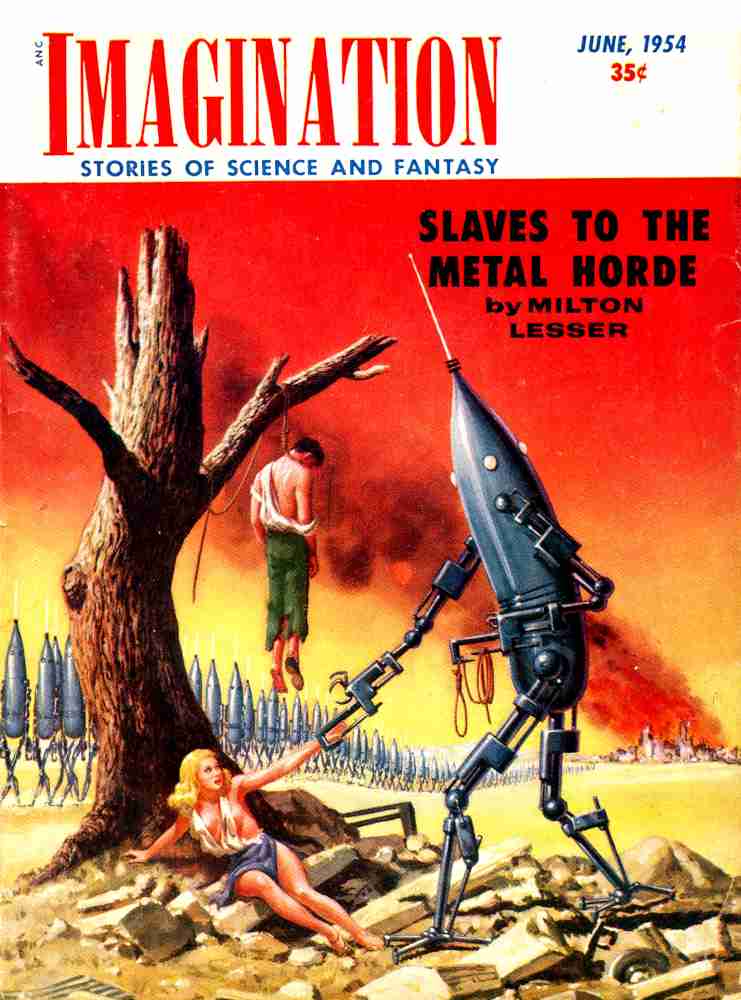
The Project Gutenberg eBook of Slaves to the Metal Horde
Title: Slaves to the Metal Horde
Author: Stephen Marlowe
Illustrator: W. E. Terry
Release date: September 20, 2021 [eBook #66351]
Most recently updated: October 18, 2024
Language: English
Credits: Greg Weeks, Mary Meehan and the Online Distributed Proofreading Team at http://www.pgdp.net
Johnny Hope knew the robot armies had
been created to serve Man. But war and a plague
had destroyed civilization, leaving humans as—
Slaves To The Metal Horde
By Milton Lesser
[Transcriber's Note: This etext was produced from
Imagination Stories of Science and Fantasy
June 1954
Extensive research did not uncover any evidence that
the U.S. copyright on this publication was renewed.]
Johnny Hope backed off warily, retreating toward the sun-dried creek bed, a jagged brown scar across the parched grassland. He carried no weapon and as the others closed in about him in a tightening semi-circle his eyes darted furtively in all directions. But all the faces were stamped, as from a mold, with uncompromising hostility.
Johnny licked his lips and said, "I want to bury them. Let me bury them and then I'll go. I promise."
DeReggio, the mayor, brandished his club—which was an old rifle stock with half the jagged, corroded barrel forming a handle. "Go," he said. He took a long stride toward Johnny, then changed his mind when the youth held his ground. "They cannot be buried, Johnny Hope. You know your parents must be burned as the law dictates."
Blinking sweat from his eyes, Johnny felt the sun scorching down through the glaring midsummer heat-haze. "It was the last wish of my father," he said softly, his voice hardly more than a whisper. "That I should take them forth from the village and bury them with a prayer for their Christian souls."
"No!" DeReggio bellowed. He was a great-chested man with sloping shoulders and almost no neck. "We cannot deliver their bodies to you. We cannot let you come back into Hamilton Village and take them, for you comforted them in their last hours and are therefore a victim of the Plague yourself." He pointed with the rifle stock toward the far hills, purple with distance. "Go."
Johnny shook his head, planting his feet firmly, wiping sweat-dampened hands on the worn fabric of his denim trousers. Then he held his palms up and said, "Where? Where is the Plague?"
"You've been contaminated."
Nearly the entire village had gathered behind their mayor now, and the mutterings were angry. When Johnny began to walk toward them, his hands outstretched to show no plague scars marked their skin, someone hurled a stone. Instinctively, Johnny hunched his shoulder and caught the missile on his collar bone. It jarred him and left an angry red mark where the capillaries had burst beneath the skin.
Staggering back toward the creek bed, Johnny was felled by a fusillade of stones. He crouched on all fours at the edge of the dry brown earth, head spinning, vision blurring with pain. He expected more stones to usher in the final blackness, but when he could again see clearly, DeReggio's muscle-corded legs straddled him and the mayor cried, "Enough! Let Johnny Hope depart with his life." It was a brave gesture DeReggio had made, approaching within inches of Johnny, whose parents had been slain by the Plague. But DeReggio and Johnny's father had been close friends all their lives and had fought together in the last days of World War III before the Plague brought warfare—and civilization to an abrupt halt.
Johnny forced himself upright on trembling legs. "I thank you for my life," he said, "but not for how you treat your dead companion-in-arms."
The color drained from DeReggio's olive-skinned face. "Think what you will, Johnny. Think it but go while you still can. And remember that our first concern is with the living. The dead are beyond recall and the Plague victims can spread carnage in their wake. You know I loved your father like a brother, and your mother...."
DeReggio and Johnny's dead mother were cousins, had been raised together under the same roof in the long-gone days before the War. Except for Johnny himself, the death of his parents could have disturbed no one more than DeReggio.
"All right," said Johnny. "I'll go." There was a loud sucking in of breaths—relief—from the crowd. "But first I have this to say. I have visited the old, ruined cities. I have seen Philadelphia on its river and once I went north as far as New York, the great stumps of its buildings coming right down to the water's edge on the island called Manhattan. I have seen these things and although I am young I tell you this: we will not return to our greatness unless we strike out boldly instead of sitting, huddled in fear, at the thought of the Plague."
"It is what his father always said," someone whispered from the edge of the crowd.
"The Robots will cure the Plague," someone else, a woman, declared.
Johnny laughed and had never heard such a sound before, from his lips or any others. "The Robots will cure nothing," he said. "Has anyone here ever seen the Robots?"
The faltering wave of sound from the crowd was in the negative.
"I have seen them," Johnny told his people, with whom he could no longer live. "My father wanted it that way. He sent me to the cities and to the mysterious places between the cities, the gleaming, white-surfaced roads which we use no longer, to see the Robots. And I tell you this: they will not cure the Plague. If anything they'll spread it."
A hushed silence fell, like a pall, on the assembly. None of them had ever seen the Robots, but that was because it is not proper for a mortal to see a deity. "This was the truth my father could not tell you in his lifetime," Johnny went on. "He knew you would have laughed and mocked—or worse. In his death I tell it to you for him. Along with his wish to be interred in the ground, it was his final thought."
DeReggio did not look Johnny squarely in the eye. "I think you had better go, lad. You have no right to talk like that."
Johnny shrugged, feeling the weight of a knowledge and wisdom beyond his years. "I am twenty-three," he said. "I was an infant when the War ended. Yet my father could teach me certain things and other things I could see for myself because he taught me to be curious and take nothing for granted. You could learn the same. Someday, perhaps...."
"By the Robots!" DeReggio swore softly, hissing the words almost in Johnny's ears. "Go before you antagonize them. If they start throwing things again, I won't be able to save you."
Johnny turned his back and squared his shoulders in a gesture compounded as much of defiance as contempt. He told DeReggio, "At least do one thing for me."
"If I can."
"When they are burned, say a prayer. One of the old prayers, if you remember." Johnny did not wait for an answer. He set forth in long strides, his sandal-shod feet powdering the sun-baked ridges on the dry creek bed. He did not once look back over his shoulder, but now, with the people gone and his pride no longer a barrier, he sobbed softly, thinking of his parents who had died because they had to venture forth from Hamilton Village to learn some of the truths which were hidden from their people, and so had come down with the Plague. Hours later, as the sun sank toward the western horizon and the heat of the day became less intense, Johnny heard the distant baying of dogs as the village hounds picked up his spoor and followed it. As prescribed by law, Mayor DeReggio was making certain Johnny did not double back to Hamilton Village.
He was alone in a hostile world which, in twenty years, had seen civilization come tumbling down like a house of cards in a hurricane.
That night, he slept uneasily on the bare ground, the soft-footed padding of foraging animals all around him under the dark moonless sky. He awoke with a tremendous hunger and a parching thirst. The latter he slaked in a swift-gushing stream which flowed clean and cool even in the heat of midsummer. Presently he came upon a huge black hawk, its pinions flapping, its talons sunk into the flesh of a dead cottontail rabbit as it prepared to fly off. Johnny waved his arms and shouted, frightening the bird of prey which rose without its breakfast, circled uncertainly, and then wheeled off to the east, a soaring black ghost graceful as a feather.
Johnny built a fire with brush and dry twigs and ate his meal in silence, feeling like a scavenger. He drank again from the stream and began to fashion himself a spear by uprooting a sapling and ripping off its branches and rubbing its tapering top to a fine point on the edge of a small flat boulder. He hardened the point in the embers of his dying fire, hefted the makeshift weapon experimentally, and headed north in the general direction of New York.
Two days later the joints of his knees and elbows began to stiffen. It came upon him slowly and he thought it was from too much walking and not enough food, but when the stiffness spread to ankles, wrist and neck and giddiness struck him suddenly, he began to suspect the Plague.
It was early afternoon and he sat down at the base of a thick-trunked oak tree, propping himself against the bole. He hurled his useless spear away and wondered how long it would take before he sank into the final coma and death. He ran swollen fingers across his knees and realized they had puffed to twice their normal size. He could now feel nothing from his knees down, and it was an effort to move his hands. A faint purple color suffused his limbs and any doubt he may have harbored about the Plague vanished.
DeReggio was right. Johnny tried to rise and failed, rolling over helplessly to lie half in and half out of the cooling shade shed by the oak. The chills rushed up from his feet, and engulfed him, followed at once by fever. By the time he began mumbling in delirium, the sun was going down in the west, casting long red cloud fingers into the darkening sky.
CHAPTER II
Diane darted from the stream with a glad little cry, shaking the water from her long, tawny hair, the droplets of water sparkling on her bronzed skin like diamonds, the long, lithe lines of her body clothed only in the moisture until she found her buckskin shorts and halter and dressed. Life was comparatively simple and uncomplicated among the Shining Ones, and she, of all their encampment, remembered no other way. The others might look back with bitter longing or curse softly and futilely at the silver patches of skin at elbow and knee which marked them as survivors of the Plague, but not Diane.
So what if they were shunned by others, by the non-afflicted people who clung so doggedly to their mean existence in the small villages? She had but to hunt and fish and evade the bands of roving Robots lest they conscript her in their services. The only other bane in her life was Harry Starbuck and she could take care of herself where he was concerned. She could....
Something stirred in the undergrowth to her left and Diane could barely make out the flash of skin which said it was a man and not an animal. She finished fastening her halter as if she had seen or heard nothing, then abruptly picked up her hunting knife and said, "I hear you in there. I'll count three and then come in after you."
She did not have to count. The bushes parted and Harry Starbuck emerged, his skin scratched by brambles, his boyish face ridiculously out of place atop an over-muscled body, his knees and elbows covered by buckskin guards, an affectation common among the Shining Ones but which Diane had always thought as silly as wearing eye patches because you did not like the color of your eyes.
"You were watching me," Diane said angrily. "I warned you before, Harry."
"There's no law," he boomed sullenly, his deep voice belonging to the over-developed body and not the boyish face. "I can go where I want to."
Diane slapped the flat of her knife against her palm slowly. "Someday," she predicted, "this blade is going to feast on Starbuck. I mean that."
Starbuck roared his laughter. "Then I'll be careful," he promised. "But meanwhile, you realize you can't marry anyone but a Shining One, and who of our people suits you more than...."
"None of them suit me."
"You're young. You have no family, no close friends to protect you. I should take you...."
Diane shrugged, then regretted it as Starbuck's small eyes feasted hungrily on the smooth play of muscle beneath the taut, bronzed skin. "Then go ahead, Harry. But you won't sleep nights, because I'll be waiting and if you do sleep you can forget all about waking up. I mean that, too."
Starbuck was still laughing. "I've half a mind to turn you over to the Robots and let them tame you a little before I claim what I want."
Diane let her voice do the shrugging. "You can always try."
"Must we always argue?" Starbuck demanded abruptly, petulance drawing down the corners of his lips. "I don't want to fight with you. I want to...."
"I know what you want. You can forget it. I'm going to take a walk and maybe do some hunting. If you'll excuse me."
"With a knife."
"I'm not hunting for wild horses."
"I think I'll go with you."
Diane scowled at him, then girdled her knife. "As you wish, but be quiet."
Grinning, Starbuck shortened his strides and matched her pace as she cut away from the stream and the undergrowth and headed toward the foothills of the Pocono Mountains in the distance, where plump, juicy rabbits hid behind every blade of grass.
They walked in silence, the man's steps ponderous, the girl's so quick and lithe her bare feet hardly seemed to touch the ground. In an hour they had reached another stream, wider than the first and running deep with swift, cool water. Diane immediately dived in and swam, then continued walking on the other side while Starbuck carefully searched out a ford and splashed across with the water up to his waist. By the time he overtook Diane she was crouching, sitting on her bare heels, the line of her back, damp under the buckskins, a long, graceful curve.
"Take a look at this," she said, and pointed.
Starbuck looked and saw the remains of a camp fire at her feet. "Warm?" he asked.
Diane shook her head. "But not completely cold. Several hours old. Probably made this morning. Probably there's someone nearby."
"So what?"
"So if he's alone he's probably a Shining One and...."
"We have enough people in our camp now."
"You always think competitively, Harry. One more man won't hurt your position in our tribe."
"Well, if he's young and if he ... well, if you...."
"I'm not promised to you or anyone, and don't forget that. Besides, it doesn't have a thing to do with this." Diane peered expertly at the ground and soon picked up the stranger's spoor where he had come out of the stream himself—probably after bathing—and started out on his day's journey.
"Come on," she said and Starbuck could either forgo her company or follow her.
He followed.
The spoor became erratic. It wandered in circles, doubled back on itself, seemed either headed for no goal or incapable of reaching one. "He must have been hurt somehow," Diane mused. "He can't be very far."
"What are you so curious about?"
"Curious? I don't know. I'm just interested. I—Hello! Up there."
Diane sprinted up a short rise, leaving a surprised Starbuck pounding along several paces behind her. She found the man lying, face down near a large oak tree. Although it was comparatively cool, his body was drenched with perspiration. Diane shook her head sadly at the swollen joints and purple discolorations.
"They say it's a terrible thing," she told Starbuck as he panted up. "I don't remember; I was a baby."
Starbuck shuddered. "I remember. Watch out, don't go near him."
"What's the matter with you? We're immune."
Starbuck nodded morosely. "Yes. Immune. But he'll die anyway, so why don't we...."
"Why don't we take him back with us, that's what. Don't kid me, Harry Starbuck. You're acting sympathetic only because you think I'll like that. Well, I happen to feel sorry for this man. I think we'll feel better if we help him."
"Help him? He's as good as dead."
"Are you dead? You had the Plague. Am I?"
"No, but maybe one out of a hundred live. That isn't much of a chance for him."
"It's a chance, though. Here, carry him."
"What? Who, me? Now listen, Diane...."
Maybe a moon-struck Starbuck had his advantages. "Suit yourself, but don't expect me to speak to you again, ever."
Starbuck considered this, then mumbled something under his breath which Diane could not hear. "All right," he said finally. "But I'm telling you it's a waste of time."
"I'll be the judge of that."
Still grumbling, Starbuck picked the man up by one arm and one leg, staggered until he balanced his burden across one shoulder, then started back down toward the stream.
"That's right," said Diane. "We could reach camp in a few hours if we hurry."
"He'll never live through the day," said Starbuck. "I only had the Plague a few years ago. I lived in the villages, so I know. He'll never live through the day."
"Just keep walking. If he dies, we can bury him."
By the time they reached the stream again, Starbuck was covered with sweat. He forded the water carefully, Diane behind him to keep the stricken man's head above water. Despite its fever-flush, she liked the man's face. He was young, not much older than Diane herself, with dark hair and regular features, neither too boyish like Starbuck's, nor too craggy like most of the older men she knew.
Occasionally the man would mutter something unintelligible, and when they got to the other side of the stream he opened his eyes, stared at Diane without seeing her and said in a croaking whisper, "Water."
They stopped. Starbuck dropped his burden thankfully. "I can't carry him all the way back," he said.
"Then don't. Go ahead. I'll stay here." Diane cupped some water in her hand, trickled it between the dry lips. She was not even aware of Starbuck when he left.
She made a bed of leaves for the man's head and studied him. The denim trousers suggested village life, but she never suspected otherwise. The face still appealed to her, strong in appearance despite the fever, yet not overbearing. She hoped the youth would recover. "This is fantastic," Diane said aloud. "It may take days before he recovers ... or dies." She thought of calling to Starbuck before he retreated beyond earshot, but her pride forbade that.
Shrugging and making herself as comfortable as she could, she bathed the man's flushed face with water.
Day and night, the touch of the ground, the cool water which bathed him, the patient hands which kept the blood flowing through his swollen joints—all became as unreal to Johnny Hope as the shadowy remembrance of some half-forgotten nightmare. His lucid moments were few: there was this person, face unseen but comforting; there was a little food and all the water he wanted; and there was the fever which came and departed, leaving an icy chill behind.
Once Johnny mumbled, "Go away. You'll catch it yourself." And there was laughter, soft-murmuring, feminine, he thought. Was the woman insane to expose herself so?
The fever retreated stubbornly, in no great hurry to depart. The lucid moments became more frequent and of longer duration. The girl was beautiful.
There came a time when Johnny sat up weakly, his back propped against the bole of a tree. The face smiled at him. He willed the toes of his left foot to move and watched them wiggle. He could just barely feel them.
With long, easy strokes, the girl massaged his legs. Acutely conscious of her now, Johnny was embarrassed. "I'm all right," he said. He struggled to sit up but as yet had no real control over his limbs.
The girl placed the flat of her palm against his chest and pushed gently, easing him back against the tree. "You stay still," she told him. "You'll be up and around in a day or so, but don't hurry things."
"I ought to thank you. You're crazy. Why did you expose yourself like this? Why...."
He watched her as she sat before him and drew her legs up, knees thrust up. He saw the slim bronzed line of her calves and the metallic silver of knees.
"A Shining One!" he cried, recoiling involuntarily. The Shining Ones had survived the Plague, but remained carriers of it for all their days.
The girl smiled at him. "As are you. You're a very lucky young man to live through this."
The silver coated his own knees, Johnny saw, and his elbows. It would take some adjustment. All his life he had been told to walk in fear of the Shining Ones, who often swept down on the villages, forcing the townsfolk to flee or face the Plague, and taking what they wanted of the stores of food and supplies.
"I see you're a little afraid of yourself. It's common enough. I was lucky to have the Plague as an infant. I remember no other life, you see. When you're well and strong enough to walk, I'll take you back to our encampment."
"I don't know," Johnny said doubtfully.
"Just be patient with yourself. Adjustment will come."
"All my life they said the Shining Ones were monsters. When I was a little boy I had to be good because my mother said otherwise the Shining Ones would come and get me, carrying me off to kill me with the Plague."
"You've had the Plague yourself. You've got to remember that. Besides," the girl laughed easily, "you're a big boy now to believe in bogey men."
"Well," Johnny continued stubbornly, "there are other things. The Shining Ones are scavengers. They don't work themselves or grow their own crops. Instead they invade the peaceful villages. Then the natives, my people, have to flee or become contaminated. The Shining Ones take all the loot they want."
"Some of us. I have been a Shining One all my life but have never taken part in such a raid. We do not grow crops because we are not an agricultural people. We are nomadic and hunters."
"Why?"
"The Robots," the girl told him. "Some of our people join them voluntarily, many others are forced into bondage. If we don't keep on the move, they'll find us. Agriculture is an impossible art when your encampment is always on the move."
It gave Johnny food for thought, and something of the girl's own frankness made him do his thinking aloud. "If I remain alone, I'll be a hermit. I've seen the hermit Shining Ones wandering through the hills, alone and friendless, wild men. If I go with you, I become almost an enemy of my own people."
"They are no longer your people. You must realize that."
"And if I go with you, I can learn about the Robots and perhaps one day bring the truth back to my people. Tell me, do the Robots cure the Plague or spread it?"
"They spread it."
Johnny smiled grimly. "I will go with you."
Two days and half a dozen good meals later, the girl helped him to his feet and nursed him along for his first few uncertain steps. But strength flowed back into his legs rapidly. He was walking without support by the time they reached the wide stream and saw the girl's nod of silent approval as he swam across it with her, matching swift stroke for stroke.
An hour went by and Johnny became amazed at the speed of his recovery. He almost wanted to return to Hamilton Village and shout, "See? I survived. I'm back." But he was a Shining One, a carrier, forever an exile from the people and the life he knew. And his own parents were dead, mute testimony of the havoc he might wreak among his people if he returned to them.
They walked from the stream and shook the water from themselves and looked at each other, wet like that, and smiled. "I don't even know your name," said Johnny.
"It's Diane."
"I'm Johnny Hope. I want to—"
"Johnny! Get down!"
He stood there, surprised, staring foolishly. They were on a small rise of ground above the stream. The girl, who had fallen flat even as she hissed the command at him, was tugging at his legs. He dropped prone beside her, although he still failed to see the reason for her sudden alarm. She parted the undergrowth in front of them with her hands and said the one word, "Look."
Johnny had never seen the Robots this close before. For all their ungainly bulk they trod the ground softly, walking as he had always seen them at greater distances, in a long, single file column. They were huge antenna-topped creatures, their great cylindrical head sections bigger than a man and gleaming a polished silver-blue, their eyes, four of them evenly spaced around the cylinder a foot or so below the antenna, white and bulging, with neither pupil nor lid, their limbs many-jointed and metallic, various tool-ends fastened securely instead of hands. The legs were attached to the small body, but one fifth the size of the head; the arms came from the head itself, just below the unblinking eyes.
"They must be twelve feet tall," Johnny whispered.
"Shh! Softly. We're close to our encampment and I don't want them to find us. They average twelve feet, Johnny."
Johnny would never forget the sight. Many times he had watched the robots parading in thin-lined silence down the long, silent roads which men no longer used, but now he could have almost reached out and touched them. The absolute quiet was unnerving. The Robots must have weighed close to a ton each but walked with the stillness of stalking jungle cats.
"Where are they going, Diane?"
"I don't know. Who understands the ways of Robots? Who can say...." Abruptly, Diane was still. Her eyes went big and wide but she wasn't watching the Robots.
Directly in front of her face and staring at her from unblinking eyes, its body half-coiled and dappled with the sunlight which filtered down through the foliage, was a copperhead. The tongue darted out in a quick, blurring red streak, the head cleared the loose coils and swayed slightly from side to side.
"Don't move," Johnny barely formed the words with his lips and hoped Diane would retain her presence of mind and obey him. A sudden motion would set the snake to striking.
The file of robots paraded by just in front of them, an occasional joint creaking, metal skins polished to keen reflection. The copperhead was fully coiled now, head cocked flat and ugly and perfectly still. Johnny placed his hand on Diane's thigh and let it crawl upwards, as if of its own volition, with an agonizing lack of speed. Now his fingers had reached the edge of the buckskin shorts and now they climbed on the smooth pelt. He could feel Diane trembling faintly, the motion unseen but felt. And now his fingers climbed to the girdling belt, grasped the haft of the hunting knife, slowly withdrew it, tiny fraction of an inch at a time.
At last he had drawn the knife clear, easing it slowly toward his own body. He balanced it on his palm, trying to judge the weight. He would have only one chance, for the quick motion of his arm would make the copperhead strike if he missed.
Sweat rolled down his forehead and into his eyes, half blinding him. He cursed soundlessly, held his hand out flat, squinted, whipped it forward. A sigh escaped Diane's lips.
There was an angry thrashing as the copperhead uncoiled. But the blade had pinned it to the ground, piercing the body just below the flat head. Ignoring the column of Robots now, Johnny crawled forward swiftly, grasped the knife and drew it cleanly toward him. The head was severed from the body. The body thrashed furiously, then lay still in death. The Robots marched on, oblivious of the drama which had unfolded at their metal-clawed feet.
The last Robot glided by, the long line retreated into the woodland, vanished.
Diane stood up, still trembling. "It took me three days to save your life," she said. "You saved mine in seconds."
Johnny handed her the knife. "Let's find your people," he said.
CHAPTER III
It was Harry Starbuck who met them when they emerged from a long, winding defile overgrown with vegetation. The defile opened into a depression, perhaps half a mile wide, surrounded on all sides by low hills, steep-sloped and blue green with pine. Unless the Robots happened upon the almost hidden defile, Diane's Shining Ones could not have selected a better hiding place for their present encampment.
Starbuck greeted Diane with, "In this case you had more luck than brains. I see he has survived."
"He's one of us now."
When she said that, Johnny looked down at his silver knees self-consciously. In time, he hoped, he would grow accustomed to it. But right now he felt himself somehow between two worlds, divorced from his own people but not ready to accept the nomadic existence of the Shining Ones.
Starbuck grinned without humor. "Well, then he's in time to help us move, although I'm opposed to it."
"To what?" Diane demanded angrily. "To Johnny? That's just too bad."
"Will you let me finish? Not to Johnny, if that's his name. To the move. Keleher has decided we have to move because a band of Robots trooped through earlier today. Maybe you saw them."
"We certainly did," Diane informed him.
"Well, I don't like it. Every time the Robots pass we have to start all over. What's so bad about the Robots anyway? They never bother us, do they?"
"They conscript us, whether we like it or not."
"Well, what of it? Rumor has it the conscriptees live like kings anyhow. We've got nothing to fear from the Robots."
"That's a matter of opinion, Harry."
At that moment, another man joined them. Johnny hardly had time to realize that he did not like the man named Harry. The newcomer was a big man, bigger than DeReggio, with huge shoulders almost three feet across and a long mane of graying hair almost reaching them. He wore a beard, spade-shaped and also gray, and covered his legs not with the expected buckskin but with khaki trousers he had probably stolen from one of the villages.
He greeted Diane briefly, then said, "Starbuck here told me how you were going to nurse a Plague victim back to health. Is this the man?"
Diane nodded and Keleher stuck out a powerful hand which Johnny pumped vigorously. "Glad to have you with us, son. In time you'll learn we're not the monsters you were led to believe all your life. But mark me—you owe your allegiance to us henceforth—provided you decide to stay." Johnny did not have to be introduced. Starbuck had mentioned a man named Keleher as their leader, and the newcomer spoke not with the bluster and arrogance of a leader unsure of his position, but with the calm self-assurance of a respected and powerful chieftain. Keleher would make a first-rate friend but a terrible enemy.
"He'll stay," Diane spoke for Johnny. "He doesn't look like a hermit, does he?"
"Never can tell. Where are you from, son?"
"Hamilton Village."
Keleher's smile was wry, almost rueful. "Will you put in with us?"
"I guess so."
Keleher shrugged, then took Diane aside and whispered to her. After that the big man turned and walked away. Diane was quiet.
"What's the matter?" Johnny wanted to know. "Does he always smile like that?"
"No, Johnny."
"Then tell me."
"We're going to leave this area because of the Robots. Starbuck already told you that. We're going to travel light but we're still going to restock some of our supplies for the journey."
"I still don't see—"
"I don't know how to tell you this. The nearest village is Hamilton."
"So?"
"So we're going to raid it. We're going to raid your village, Johnny."
Starbuck's laughter carried through the entire encampment of conical tents, each flying its clan-standard from the central ridge pole.
Johnny wanted to hit the man, then realized he would be striking out at his own mixed up emotions. Diane was staring at him with genuine sympathy, but that hardly helped. She said, "What are you going to do, Johnny?"
"I'm not sure yet. I have to think."
"Remember, you're one of us now. Any time you doubt that, look at your knees or elbows. You are a Shining One, make no mistake."
"Yes, a Shining One." But Hamilton Village had been his home.
"We don't harm anyone," Diane explained. "I told you I take no part in the raids. I don't know why, for they're harmless."
"I saw one once, when I was a young boy. Before my people came to Hamilton Village to build their homes. The Shining Ones came down from the hills and simply walked into the village. There was no resistance. Our sentries gave us warning, but it hardly helped. We packed what we could and fled, leaving most of our supplies and equipment behind, leaving an entire village which we had called home but which we could never see again. The Shining Ones contaminate."
"Yes—we do. You do. The villagers can't fight us. We could walk down there unarmed and take what we want. Maybe that's why I prefer to hunt instead. I'm not sure, Johnny. What are you going to do?" She took his hand impulsively in hers and squeezed it. They hardly knew each other but they had saved each other's life.
"I wish I knew." He withdrew his hand awkwardly. He liked Diane, perhaps too much. But until he made up his mind she was a potential enemy.
Soon Keleher returned to them, not alone this time. A dozen men crowded behind him and others were leaving the tents of the various clans to join them. "Did you tell me his name?" Keleher asked Diane.
"No. He's Johnny Hope."
"Well, Hope, get a good meal under your belt and we're off. We leave for Hamilton Village later this afternoon. You ought to be able to tell us exactly where to find whatever we want once we get there."
Could a man change his allegiance overnight because he now was different physically? Johnny's heart was still in Hamilton, even if he had been stoned from the Village and his parents had been burned, as prescribed by law. But the rest of his life he would be a Shining One.
For a time he watched while Diane fixed his venison dinner, savoring the rich, gamey aroma. Then he slipped silently from the encampment.
Often DeReggio would come to the large boulder half a mile north of Hamilton Village and sun himself contentedly, forgetting for the time at least the problems of his office. This rock was no secret. Any villager, not finding DeReggio in Hamilton itself, would know where to look for him.
Now he had almost drifted off into slumber. He always found this half-awake time most pleasant for dreaming. Then he could conjure visions of the old days, of the lost cities with the beat of their traffic pulse and the winking kaleidoscope of their electric lights, and the driving madness of their people which kept them seething with activity around the clock. He never traveled to the deserted cities himself as youngsters like Johnny Hope did, because their crumbling masonry and bomb-scarred streets saddened him. And besides, the Robots had taken over many of the cities and since no one had ever bothered to tabulate them, you were never sure when a city was deserted and when it was not. Better to dream of the old days....
"DeReggio! Wake up."
It was Sheldon Hope, his old comrade-in-arms, who had fought halfway across a world with him while civilization crumbled to ruin all about them.
"Shel ... Shell, boy."
"Wake up, DeReggio. It's Johnny Hope."
DeReggio sat bolt-upright, circles of light floating on blackness before his eyes from too much sun. "Johnny! Go away. They'll kill you if they find you here. Are you crazy? Keep away from me." DeReggio stood up and backed off, watching Johnny. "You have no business coming here. You—"
DeReggio saw the shining knees, the silver elbows. "The Plague. You survived it. You're a—"
"Shining One," Johnny finished for him as the mayor's voice trailed off.
"A carrier, that's even worse."
"I was hoping I would find you here. I knew I couldn't go down into Hamilton. You haven't much time."
"What are you talking about?"
"Shining Ones," Johnny said quickly. "Hundreds of them coming to raid Hamilton Village. They are on their way now. You'll have to leave, but I thought if I warned you you could have some time to take your belongings."
DeReggio accepted the fact without question but with sadness. He shook his head from side to side, thinking of the neatly laid out streets, the small, compact bungalows, the field planted with hay for the cattle, with grain, asparagus, beans and tall corn waving green in the summer sun, ready for harvest.
"How much time do we have?"
"Four or five hours, I think."
"We'll have to hurry." DeReggio was already trotting back down the trail toward Hamilton, Johnny maintaining the pace with him but hanging back half a dozen long strides.
"I want to see the village once more, then I'll go."
"What are you going to do?"
"I don't know. The Shining Ones want me to stay with them, but I had to warn you. If they find out...."
"For my people, I thank you, Johnny."
First person plural. My people. Johnny no longer was included. If the Shining Ones discovered his treachery, he would indeed be homeless. He wondered what Diane would think.
"Look at the Village and then go, Johnny. If they find you, I won't be able to do a thing. And I wanted to tell you, I said the prayer."
A figure appeared on the path up ahead. As he came closer the man's face was familiar, but his name eluded Johnny. "Mayor DeReggio!" he called. "I wanted to tell you my wife thinks...." His voice trailed off. He scuffed his feet in the dust of the path and squinted. "Johnny Hope!" he cried. "By the Robots, keep away. I have a wife and children."
"I only wanted to see Hamilton once more."
"We don't care what you wanted."
"He brought a warning," Mayor DeReggio explained. "The Shining Ones are coming."
The man held his distance, but spat on the ground in disgust. "Look at him? You heed his warning? Look. He's a Shining One himself. It's some kind of a trick you've fallen for."
DeReggio shrugged hopelessly. "You'll have to go, Johnny."
Already the man was sprinting back down the path toward Hamilton. "I'll bring some of my friends," he called back over his shoulder. "We'll see about this. We'll see if a damned Shining One can go parading around Hamilton Village any time he wants. And you've got some explaining to do, DeReggio."
Then the man was gone. DeReggio turned to Johnny, almost shaking hands with him from force of habit, then drawing away in self-conscious confusion. "Good luck, boy. We'll be moving, despite what Lawford said. Don't try to follow us."
"I hope I haven't got you into any trouble."
"It won't be the first time."
"Thanks for the prayer. They would have liked that."
When DeReggio looked up, Johnny Hope had vanished into the woods.
Starbuck led one party of Shining Ones toward Hamilton from the north while Keleher took the main band in from the east. They never reached the Village though. Each leader saw the black pall of smoke rising long before he reached Hamilton. Each knew the Village had been put to the torch.
They met on high ground north-east of the flaming town and watched the fire, fanned by a strong summer wind, burn itself to embers and leave the charred skeleton of a village behind it.
"They got word," Starbuck said, waiting for Keleher to draw his own conclusions.
"It's happened before, but now—has anybody seen the new man, Johnny Hope?"
None of their followers had even heard of him.
"Diane would know," Starbuck suggested.
"She rarely joins our raiding parties." And Keleher checked, but as he suspected, Diane was not present. "Well, we move on empty handed. Starbuck, you take your men back to the encampment and round up stragglers or anyone who remained behind. We'll wait here."
"You're as bad as the people of Hamilton. Always on the run. I don't mean to argue, but—"
"Then don't. Men who want to be conscripted by the Robots are free to leave our encampment at any time, get that straight. But I don't want forced conscription of all of us, Starbuck. Understand? The Robots are around."
"Well, I was just letting you know how I felt. What about Johnny Hope?"
"Time enough to see about him later, if he's still with the encampment. Naturally, if he's guilty he won't go unpunished."
"If he's guilty?"
"That's what I said."
"You're growing soft, Keleher."
"Yes? We don't elect our leaders, Starbuck. Any time you think you want the job, you can try to take it."
Starbuck blanched. "I didn't mean it that way. I was only giving my opinion."
"Don't, unless you're prepared to defend it—and yourself."
"I'm sorry." But Starbuck's eyes were smouldering.
"Get back to the encampment, then. I'll expect you here with the rest of our people day after tomorrow. Can't make up your mind where you belong, can you?" Keleher pointed with amusement to the buckskin kneepads.
"I know you're trying to goad me," Starbuck whined.
"Maybe."
"You don't like me."
"As a type, Starbuck. Personally, I'm indifferent."
That was goading of a more subtle sort, but it was lost on Starbuck. Diane's indifference would irk him; Keleher's indifference was at times preferable. "We ought to be friends," Starbuck boomed. "I'm generally recognized as your second in command."
"Only because I want it that way. Amos Westler, for example has forgotten more than you will ever learn."
"That's clever," declared Starbuck. "That's expert. You play us off one against another and keep the power for yourself."
Keleher shrugged massive shoulders. "It wasn't original with me. But you're unusually perceptive today, Starbuck. And I'll say this: you've got more spunk than Westler, for all his brains."
"He's soft."
"You bring our people. I'll wait. Tell your men that since they have to pack our tents and cart our belongings, they'll be able to rest when we reach our new encampment. My group will set the place up."
"He ought to be a hermit, that Amos Westler."
Keleher shook his head. "Too scholarly. No outdoor know-how. Give him a book and he's happy. He wouldn't last a week. But he's still a good man, Starbuck. We need men like Amos Westler."
"And we need men like me."
Keleher grinned. "You should have let me say that. Trouble with you is you try to ape me. I'm always a step ahead of you, though. And don't forget it."
"Maybe someday I'll catch up."
"That would be interesting," admitted Keleher, dismissing Starbuck with a shrug and issuing instructions as his men began to assemble their bivouac.
Starbuck sensed he had been bested in the verbal battle, but was too petulantly egotistical to admit it even to himself. Instead, he made plans for his return to the encampment. He hoped the new Shining One, that Johnny Hope kid who Diane had nursed back to health, would be foolish enough to return. Without Keleher around to steal the show, Starbuck might make himself a hero.
If it weren't for the tawny-haired girl who had saved his life, Johnny Hope never would have returned to the encampment of the Shining Ones. He left DeReggio with the intention of again heading north toward New York, but his way led him close by the encampment and he remembered the sudden touch of the girl's hand and before that the vision of her face, lovely and comforting, while he burned with the fever. Calling himself a fool, he entered the encampment warily, half-expecting a dozen men to leap at him with the word traitor on their lips.
But the camp was almost deserted and no one paid him any heed. He found Diane returning from the hunt with a small deer, its antlers not yet branching, slung across her shoulders. She dropped the dead animal with a happy shout and ran to Johnny.
"I'm so glad you're back."
"I'm glad to see you, too."
Then the smile left her face. "Did you—warn them?"
Johnny considered his answer. Well, he had returned because he wanted to see the girl. It would be senseless if he were not honest with her. "I had to," he said.
She nodded slowly. "It isn't hard for me to understand. They were your people. But tell me, does anyone know?"
"I'm not sure. When they find the village deserted and probably burned, though, they'll know."
"Yes," Diane agreed with him, then snapped her fingers. "But not if I say you were with me all the time. See, you even went out hunting with me. We caught this fawn together."
"You'd be lying to protect me. You may get yourself into trouble."
"How? It's my word against a lot of guessing."
"I can't let you take the chance."
"It's no chance at all. I want to do it. I want you to be one of us, Johnny. We all don't raid the villages. I don't raid them, do I?"
"No, but I—"
"But nothing. You came back here, didn't you? No one forced you."
"I came back to see you, I guess."
"Well, you're going to stay with us. A man wasn't meant to live alone like a hermit. Here." Diane took his hand and led him forward, "you can stay in my tent for now. It would be silly to build yourself one since we're going to move the encampment as soon as Keleher returns from the raid."
"I can't—I mean—"
"Can't, nothing. I'm a good girl, Johnny Hope. Make no mistakes. Touch me at night and I'll scream. But I trust you. I like you."
Her frankness was both charming and unnerving. He wanted to say he liked her too, but could not bring himself to utter the words. Instead he slipped his arm about her waist and walked with her to the tent, where she skinned the fawn expertly and prepared it for cooking. By then Johnny was sound asleep and did not wake up until Diane stirred him and offered him a platter of tender young venison.
Shortly after noon the next day, Starbuck returned with his men. Those who had remained behind were disappointed because the raiding party had come back empty-handed. Starbuck wasted no time adding fuel to the fire. "Has anyone seen that traitor, Johnny Hope?" he demanded.
"You mean the new man, the one Diane brought?" someone asked him. "He's here."
"The ingrate, the dirty ingrate," Starbuck boomed so all the encampment heard him. "One of us saved his life and first chance he gets he turns traitor. Next thing you know he'll want us to be conscripted by the Robots."
"You should talk," Diane cried as she and Johnny emerged from her tent. "You're always talking about how nice it would be to live with the Robots. Johnny Hope isn't like that at all."
Starbuck raised a finger to his lips and whispered, "Keep it quiet. If they hear about this, they'll lynch Johnny."
"All of a sudden you want to keep it quiet," Diane hissed at him.
"That's right, softly."
"Well, for your information, Johnny was with me all along. We went hunting yesterday, just the two of us. Didn't we, Johnny?"
Johnny mumbled something under his breath and waited for Starbuck to speak. Suddenly the man was shouting again. He slapped Diane on the shoulder, smiled, roared: "Thank you, Diane, thank you. I thought so. Did you all hear her? Diane told me she saw this man sneak off to warn Hamilton Village yesterday."
"That's a rotten lie!" Diane cried.
But Starbuck smiled blandly. "That's all right. I know you didn't want him to know you told me, but there's nothing to worry about. You all heard her, didn't you?"
"We heard her whispering something to you," one of the men admitted.
"She whispered because she didn't want the traitor to hear. She was afraid. She should have known we'd protect her. I'm surprised at you, Diane."
For answer, she flew at him with her knife. He laughed softly, so softly that only she heard it. A shocked look appeared on his face as he parried the blow, twisted her arm up, spun her around and held her that way while she writhed helplessly and dropped the knife to the ground. "I don't know what's the matter with you," he said. He still looked shocked.
"That should be proof enough," she panted. "I never told Starbuck what he claims."
"If you're covering up I can only assume you went with him. I am deeply shocked."
"I did not go with him. I was hunting."
"Then you admit he went!"
"I didn't admit anything. You are hurting me."
Starbuck's big hand had twisted her wrist painfully. He gave no indication of letting her go.
"She said you're hurting her," Johnny snarled. "Let her go!"
"I'm all right," Diane said.
Starbuck was going to let her go, but Johnny did not wait. He circled Starbuck's arm with his hand and wrenched until the bigger man bellowed and released Diane.
"Good," Johnny said. "I have no fight with you, but—" He had turned to look at Diane when Starbuck's balled fist slammed against the side of his jaw, knocking him down.
He sat there dazed, uncomprehending because he had not seen the blow coming. But Starbuck stood above him, fists clenched, and that was enough to tell him. "I still have no fight with you," Johnny said softly. He thought he could have taken the bigger man and at this moment could think of nothing he would rather do, but Starbuck had already accused Diane of being his accomplice and he did not want to involve the girl further. He hoped Starbuck would be content to boast about this one-punch victory instead.
"Scared?" Starbuck leered down at him, prodding his ribs with one foot.
"Get up and punch his teeth in," Diane pleaded.
But Johnny remained sitting on the ground, and shook his head. He explored his jaw gingerly with the fingers of one hand as if the thought of rising to take more of the same frightened him. His time of reckoning with Starbuck would come, he promised himself but now wasn't the time, not when it might involve Diane.
"You're not going to sit there?" Diane insisted. "Don't just sit there!"
Johnny shrugged. "Fighting him won't prove anything." He climbed to his feet and retreated out of Starbuck's range. He was the picture of abject cowardice and hoped it would inflate Starbuck's ego sufficiently to make him forget the charges he had brought against Diane. Starbuck was smiling smugly and booming something about letting Keleher decide what to do about Johnny Hope after they moved the encampment. But when Johnny stalked away from him toward Diane, calling her name, she presented him only with a stiff, haughty back and by the time he reached the tent the flap was down and tied securely. Johnny heard sobbing from within.
A few moments later Starbuck and another man came and led him to a different tent where he remained under guard until the encampment had been broken, the tents and equipment packed and ready to move, the people assembled in the square clearing which now was dotted with folded tents and bedding rolls.
"Let's move it!" Starbuck roared in his booming voice. The men stooped for their burdens, the few horses carried three and four times their normal loads. Starbuck waved the group forward dramatically, aware of his moment and making the most of it. They marched double-file into the narrow ravine and were soon well on their way toward where Keleher waited.
CHAPTER IV
63-17-B was twenty years old, but a trip to the repair bays every time he returned to New York City kept his beryl-steel body gleaming as if it had rolled but yesterday from the assembly lines. Now 63-17-B could sense a stiffness in the second joint of his left leg and suspected corrosion. He was looking forward with keen anticipation to the time, in the near future, when he would stretch out in the repair bay and have his worn parts exchanged.
That, however, was not on his primary level of thought. While not unique with 63-17-B, the secondary level was not universal among the robots, for the idea of individual sentience had crept into the original plans only accidentally. On his primary level of thought, 63-17-B was in closer rapport with Central Intelligence than the three-hundred robots stretched out in a long, sun-reflecting line behind him. Like Central Intelligence itself, and unlike the few humans who thought of such things, 63-17-B believed that matter and energy are not merely components of one another but are actually the same thing. Thus he explained his greater primary level of thought by saying that the energy-matter bridge connecting him with Central Intelligence, invisible but measurable in quanta as was his body, was stronger than most. On the social level, this gave 63-17-B leadership of the three-hundred.
Thought-quanta crackled back and forth between 63-17-B and Central Intelligence in New York and, as on all such occasions, 63-17-B was not sure how much of the conversation reached the other Robots. "Hamilton Village is aflame," 63-17-B thought.
"Did you fire it?" The answer was immediate—and angry.
"Certainly not. We arrived too late to prevent it."
"Yet your scouts reported the Village was going to move out. You know a moving Village may or may not remain together. As often as not, it separates into small bands, which will spread out and find their way to distant communities. An ideal means of spreading the Plague, although I need not remind you of that."
"I am aware—"
"The error is unpardonable, unless the Villagers have not yet fled."
"Unfortunately, they have."
"Then another opportunity slips through our fingers. 63-17-B, upon your return you are to report to the Intelligence bays for a re-examination of your rapport synapses."
"But—"
"But nothing." The thought-communication crackled to silence.
63-17-B made the mental equivalent of a sigh. Such re-examinations, he knew from bitter experience, were shams. Re-shuffling was more like it. At a whim of Central Intelligence he might become nothing but a second-class Robot. On the surface, Intelligence would discover a flaw in his synapses. Actually, Intelligence would produce the flaw and pass his mantle of leadership down the line to some other Robot.
Sullenly, 63-17-B called a halt. Like all Robots, he was vindictive. Constructed originally as machines of war, the Robots had had revenge built into their mind-patterns as a strong factor. Actually, second-class Robots were not aware of this. The feelings merely existed and they acted accordingly. But 63-17-B was only too acutely aware: it pained him. The Robots had never actually functioned as machines of war, for the War had taken a bacteriological turn before the mechanical infantry could march off to battle.
The Robots had been stored as useless while disease swept Earth—with the development of the Plague itself making all further fighting impossible on an international scale. But the Plague got out of hand, 63-17-B remembered dimly. The slightest contact meant almost certain contamination and mankind prepared grimly for the end of its brief dominion over the Earth—until someone thought of the Robots. Let them cure the Plague; the antidote was known, they merely had to apply it. 63-17-B's memory coils tightened angrily. Until that time, the Robots had been slighted, although they had waited patiently to serve their masters. Masters, indeed. 63-17-B recognized the vindictive pattern of his thoughts for what it was: mankind had had its chance, had failed. After man, the Robots. It was as simple as that.
But now 63-17-B was seething. He'd been advancing steadily in the Robot-hierarchy and had even expected himself to be assigned to Central Intelligence itself before too long. Because the impetuous people of Hamilton Village had set their city to the torch before he could arrive, all was lost.
He scanned the surrounding countryside with photo-retinal cells. Far below, just leaving the edge of the burning town, were a pair of stragglers—man and woman, he thought, but couldn't be sure at this distance. Well, revenge on two individuals would be better than nothing....
Strong hauling ropes were prepared, and now 63-17-B could see the figures were not two, but three. Since his photo-retinal cells could not perceive color except as shades of black and white, he had no way of telling the three figures were not Villagers but Shining Ones.
"We're approaching Hamilton Village," said Starbuck over his shoulder as Diane overtook him at the head of the column to get her first look at the place. "You can see the flames."
"I thought you said the fire was almost out when you left Keleher and the others."
"I did, but you can't predict those things. Apparently it has started again. See?"
They had reached a rise of ground and could see what was left of the village in a broad valley below them, a great pall of black smoke rising from it sluggishly. Starbuck saw something else a few miles off to the north, but said nothing. It was a long, thin column, gleaming metallically. At this distance he could not be sure, but it looked like a line of Robots.
"Keleher and the others are close by," Starbuck said mechanically. He was not thinking of Keleher. The trouble with this group of Shining Ones was, no one understood Starbuck. Not only were his talents for leadership unappreciated, he was actually made fun of. He'd been sullen ever since his mental rebuff at the hands of Keleher. He'd acted inconsistently. His anger had been a free-floating thing, and he'd very nearly got Diane in trouble for it.
That was ridiculous. The answer seemed obvious enough: if one is not appreciated in a particular place, one should go elsewhere. There was Thomas Burwood, a youngster whose father had been chief before Keleher and who had been killed by Keleher. Burwood almost certainly would join Starbuck. And Diane could be taken by force if necessary.
Starbuck put the stocky man named Gilbert in charge of the column and sought out Burwood. He found the younger man on a fringe of the column, plodding listlessly along.
"Listen, Tom," said Starbuck in a confidential voice. "We've often talked about life among the Robots, but we're letting our years fritter away. What would you do if the opportunity presented itself?"
Like Starbuck himself, Burwood was an over-sized young man given to fits of temperament. "What's the use?" he said. "You can't just walk into the Robot Citadel. They would kill you first and ask questions afterwards."
"No, but you could join Robots in the field. It's done that way most of the time, since the Robots venture forth either to spread the Plague or gain conscripts among the Shining Ones." Starbuck whispered in his best confidential voice, "And, Tom, there's a group of Robots two or three miles from here right now. What do you say to that?"
"Let me think." Burwood frowned. "I don't know. It's one thing to talk about it but another to—"
"Keleher didn't give your father a chance to think, did he? Not when your father was growing old and Keleher knew he could take him. He killed him, struck him down like an animal, don't forget that, Tom."
"That's true, but—"
"You're worrying about life among the Robots, are you? From every rumor I've heard, you can live like a king, like the days before World War III ruined our civilization. What do you say, Tom? An opportunity like this doesn't often come."
"Well—"
"Of course, if you're afraid ... but I thought you were made of the same stuff as your father, the only leader I have ever served faithfully."
"That's enough, Harry!" Young Burwood's voice broke. "I'll go with you."
"I knew you would. You're just like your father, Tom. There's one thing I want to do first...." The two whispered together for a time, then Starbuck drifted back toward the rear of the column and permitted himself to straggle until he was out of sight of the rear guard, first making arrangements for the prisoner, Johnny Hope, to be taken off the trail into the woods. Tom Burwood, meanwhile, double-timed up toward the head of the column.
"Diane, I was looking for you."
"Hello, Tom. What is it?"
"Some one wants to see you. Rear of the column."
"Who?" All through their march, Diane had wanted to make her peace with Johnny Hope, but the opportunity had never presented itself.
"I'm not at liberty to say," Burwood told her slyly, and winked.
"Is it Johnny Hope?"
Burwood smiled affably. "I can't say. Please, Diane. I was only told to fetch you. It's been arranged temporarily, but he can't remain back there indefinitely."
"I'm coming. Lead the way," Diane said eagerly, and fell into step with Burwood. Johnny Hope must have had his reasons for not fighting with Starbuck. He was not the cowardly type, unless Diane had suddenly become a bad judge of people. Perhaps he thought, in some strange way, he was protecting her....
"Where is he, Tom? I don't see anyone."
"A little further."
"But we've already left the column."
"Just around that clump of trees, I think."
Something rustled in the undergrowth. "Johnny?" Diane called expectantly.
He stepped out into the trail and faced her. It was Harry Starbuck.
"What kind of a joke is this?" Diane demanded angrily, turning to rejoin the column. "I thought I was coming back here to meet Johnny Hope."
Burwood laughed easily. "I never said that."
"Well, whatever you're planning you can count me out. Of all the nerve, bringing me back here like this—"
"Would you like to see Johnny Hope alive?" Starbuck asked in a conversational tone.
"What do you mean by that?"
"That you had better cooperate with me, Diane. The three of us are leaving the column now, you, Tom and I. If you don't, I can't guarantee anything about Johnny Hope."
Diane did not know whether to believe him or not, but would hardly endanger Johnny Hope's life on a notion. "I'll go with you," she said.
Less than an hour later, they approached the vanguard of the file of Robots. Burwood and Diane saw them at the same time, contempt filling Diane's eyes as she began to understand what had been on Starbuck's mind. Fear was there too, threatening to unnerve her at any moment, but the scorn she felt for Starbuck prevented it from overpowering her. "Of all the cheap tricks," she said. "You—you wanted to join the Robots, but you also wanted me. Johnny Hope was never in any danger. It was all a lie, to get me here. Well, if you think I'm going with you—" Diane crouched abruptly, came up with a handful of dry earth and flung it at Starbuck's face, blinding him. Then she began to run.
"Get her, Burwood!" Starbuck roared. "Don't let her escape."
It wasn't Burwood's fight, but if he had thrown in with Starbuck he wanted to remain in the man's good graces, at least until he could figure things out for himself. Besides, his first sight of the Robots had almost choked him with fear. Chasing Diane would take his mind off them. He set out after her, aware that a still half-blinded Starbuck was circling around in another direction.
Diane guessed her best chance for escape would lie along the very edge of the file of Robots. She did not relish the idea, but she had seen the look on Burwood's face when the creatures of metal had appeared and figured he would be loathe to follow her in that direction.
Did the Robots see her? She ran in their direction, her clothing catching and tearing on the undergrowth. She neared the head of the file, could hear Burwood stumbling along behind her. The metal figures stood there, unmoving—watching her? Each one twelve feet tall, they could have stamped her to death.
Behind her, Diane heard a hoarse scream. She whirled instinctively, lost her footing, fell. One of the Robots had taken Burwood, who was thrashing and kicking helplessly as it bore him aloft and held him feet pounding on air, two yards off the ground.
She didn't like Burwood, but she had nothing against him. He screamed again, his voice breaking.
"Put him down," Diane shouted. She might as well have been talking to the ingots from which the Robots had been fashioned for all the heed they paid her. She whirled again, sought Starbuck, couldn't find him. Starbuck always talked of the Robots, perhaps he knew how to communicate with them.