
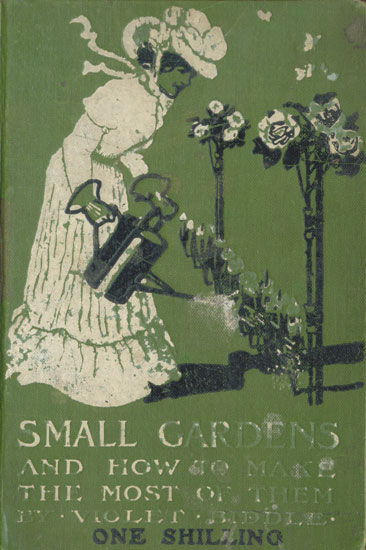
The Project Gutenberg eBook of Small gardens, and how to make the most of them
Title: Small gardens, and how to make the most of them
Author: Violet Purton Biddle
Release date: August 2, 2010 [eBook #33323]
Language: English
Credits: Produced by David Clarke and the Online Distributed
Proofreading Team at http://www.pgdp.net.
SPECIAL NOTICE.
IF YOU WANT
REALLY GOOD BULBS & SEEDS
AT MODERATE PRICES,
SEND TO
Mr. ROBERT SYDENHAM,
44, Tenby Street, Birmingham.
No One will serve you Better.
HIS UNIQUE LISTS
Are acknowledged by all to be the Best, Cheapest, and most Reliable
ever published. They contain only the Best
VEGETABLES, FLOWERS, AND BULBS
WORTH GROWING.
Being the Selections of the Largest Seed Growers, Market Gardeners, and the most celebrated Professional Gardeners and Amateurs in the kingdom.
They also contain very useful cultural instructions.
Mr. SYDENHAM’S Bulbs and Seeds were represented and gained First Prizes at London, Birmingham, Preston, Newcastle-on-Tyne, Shrewsbury, Edinburgh, etc., etc., in 1893, 1894, 1895, 1896, 1897, 1898, 1899 and 1900.
SWEET PEAS A SPECIALITY.
No Flowers give so much cut bloom at so little cost
and trouble if treated as instructions sent with each collection.
12 good varieties, 50 seeds of each, 1s. 6d.; 12 choice varieties, 50 seeds of each, 2s.; or the Two Collections for 2s. 6d.; a Third Collection of the 12 best varieties for Exhibition, 3s.; or the Three Collections, 5s., post free, with a packet each of the four best striped varieties added free of charge. Generally sold at twice or three times the money.
THE BEST TOMATOES, 3d. per packet of 200 Seeds.
THE BEST CUCUMBERS, 6d. per packet of 10 Seeds.
ALL OTHER SEEDS equally cheap and good.
FULL LISTS POST FREE ON APPLICATION.
PUT IT ON TOP of your Fowlhouse, Tool or Bicycle Shed, or anything in the shape of a shed that you are building. Ask your ironmonger for our handy booklet, which will help you considerably with useful hints on building all kinds of structures, and roofing them with RED HAND ROOFING FELT
If your ironmonger has not got it, you can get it free, and name of nearest holder, from D. ANDERSON & SON, Ld., Lagan Works, BELFAST.
SPECIAL NOTICE.
LAXTON’S
GRAND NEW LARGE-FRUITED, EARLY STRAWBERRY
FOR 1901.
The “Laxton,”
THE IDEAL AMATEURS’ AND MARKET GROWERS’ FRUIT.
The Fruit that everyone must Grow!
A DARKER, FIRMER, AND IMPROVED “ROYAL SOVEREIGN.”
We believe this to be by far the finest of our many introductions, and in it we claim to have combined all the good points of those two fine varieties from which it was raised, viz, “Royal Sovereign” and “Sir J. Paxton,” and believe it to be the most wonderful Strawberry for earliness, size, firmness, quality, hardiness, and vigour of plant combined.
The following are some of its good points—
Earliness.—In earliness it is as early as “Royal Sovereign.”
Size.—In size it is as large as, if not larger than, “Sovereign,” and certainly larger than “Sir J. Paxton.”
Colour.—But in colour it is much darker and brighter than “Sovereign,” partaking of the rich colour and taking appearance of “Sir J. Paxton.”
Flavour.—In flavour it is quite as rich as “Royal Sovereign.”
Firmness.—It is also much firmer than “Sovereign,” does not rot on the ground in damp weather, and is a far better traveller.
Cropping Qualities.—Its cropping qualities are prodigious, heavier than either “Sovereign” or “Paxton,” throwing its bold tresses well above the foliage.
Constitution.—A very hardy and vigorous grower, retaining its foliage well in winter.
Fast Selling Out for 1901.—The demand for this variety has been already very large, and as the stock is small and is fast selling out, we must ask for early orders or we shall be unable to execute until 1902. PLANTS IN POTS ONLY SUPPLIED.
PRICE 18s. per doz.; £5 per 100.
(Not less than ½ at the doz. and 100 rates.) As the demand is very great, and the stock limited, the price cannot be much lower for several years. A Handsome Coloured Plate, and full descriptive Catalogue published shortly.
Free on application.
LAXTON BROTHERS,
Strawberry Plant Growers
and Specialists,
BEDFORD.
SMALL GARDENS
Green’s Lawn Mowers
Imitated by Many!
Equalled by None!
Over 270,000 Sold!
GREEN’S GARDEN ROLLERS ARE UNSURPASSED!
Known and appreciated throughout the World.
THOS. GREEN & SON, Ltd.,
Blackfriars Road, LONDON, S.E., and LEEDS.
Please write for List, S. G., 1901. May be had from Local Ironmongers and Seedsmen.
Small Gardens
and
How to make the most of them
By
Violet Purton Biddle
London
C. Arthur Pearson Ltd.
Henrietta Street
W.C.
NOTICE.
DON’T STAKE YOUR CARNATIONS
TILL YOU HAVE SEEN THE
Patent Improved Coil Stake.
No Tying required. Stakes last a Lifetime.
The Greatest Boon ever offered to Growers. Only wants seeing.
Prices (Cash with Order):—
| 20in., 7/6 | per 100, | 1/- | per doz. |
| 25in., 10/6 | " | 1/6 | " |
| 30in., 13/6 | " | 2/- | " |
| 36in., stouter, 17/6 | " | 2/6 | " |
A. PORTER, Stone House, MAIDSTONE.
THE FINEST APPLE ON EARTH IS UNDOUBTEDLY
BRAMLEY’S SEEDLING,
Unequalled for Productiveness and Quality.
ALL KINDS OF FRUIT TREES ON OFFER TO SUIT EVERY PLANTER.
THE ROSE (the Queen of Flowers),
All new varieties stocked.
FLOWERING AND ORNAMENTAL SHRUBS A SPECIALITY.
My Flower and Vegetable Seeds cannot be excelled.
Send for my lists which contain valuable remarks on Profitable Fruit
Growing. Free on application to—
Henry Merryweather, The Nurseries, Southwell, Notts.
TANNED GARDEN NETTING.
Protect your Strawberry Beds, Seeds, &c., from the ravages of birds.
NETS OILED AND DRESSED; 36 SQUARE YARDS FOR 1/-.
Can be sent any width or length; carriage paid on orders over 6s.
HENRY ROBINSON,
GARDEN NET WORKS, RYE, SUSSEX.
SMALL GARDENS AND HOW TO MAKE THE MOST OF THEM
(COUNTRY OR SUBURBAN).
Send a small Rough Plan of your Garden, showing points of the compass, and stating whether in town, country, or suburb, to Mr. WOOD, and he will give you a list of PLANTS sufficient and suitable for the different positions. Communication in regard to Rockeries and Rock Plants is specially invited. List of
ALPINES, Hardy HERBACEOUS PLANTS and AQUATICS
on application to
J. WOOD, Woodville, Kirkstall, LEEDS.
SYNOPSIS OF CONTENTS
| CHAPTER I |
| The General Arrangement of the Garden |
| What to go in for, and what to avoid—Brick walls—Trees, their advantages and disadvantages, etc. |
| CHAPTER II |
| Lawns, Paths, Beds, and Border |
| How to keep the lawns level—Paths, and how to lay them—Beds and bedding—The new style VERSUS the old—Flower borders and their backgrounds—Improvement of the soil. |
| CHAPTER III |
| On the Duty of Making Experiments |
| Description of a small yet lovely garden—Colour schemes—A novel way of growing flowers, the spring dell—Variety in the flower-garden. |
| CHAPTER IV |
| Some Neglected but Handsome Plants |
| The sweet old columbine—Bocconia cordata at Hampton Court—Campanulas as continuous bloomers—The heavenly larkspurs—Christmas roses—The tall and brilliant lobelias—Chinese-lantern plants—Tufted pansies. |
| CHAPTER V |
| The Conservatory and Greenhouse |
| Mistakes in staging—Some suitable climbers—Economical heating—Aspect, shading, etc.—The storing of plants—No waste space—Frames. |
| CHAPTER VI |
| The Tool Shed and Summer-House |
| Spades and the Bishop—Weeding a pleasure—Trusty thermometers—Summer-houses and their adornment. |
| CHAPTER VII |
| Roses for Amateurs |
| Teas—Hybrid perpetuals—Bourbons—Rose-hedges—Pillar roses—Suitable soil. |
| CHAPTER VIII |
| Enemies of the Garden |
| Slugs, and how to trap them—Blight or green fly—Earwigs—Wireworms—Snails—Mice—Friends or Foes? |
| CHAPTER IX |
| The Rockery |
| A few hints on its construction—Aspect and soil—A list of alpines—Other suitable plants. |
| CHAPTER X |
| Trees, and How to Treat Them—Shrubs |
| Some good plants for growing beneath trees—List of hardy shrubs—Climbers—Enriching the soil. |
| CHAPTER XI |
| The Ins and Outs of Gardening |
| Planting—Watering—“Puddling”—Shelter—Youth and age, in relation to plants—Catalogue defects—A time for everything. |
| CHAPTER XII |
| The Profitable Portion |
| Fruit, best kinds for small gardens—Size minus flavour—Vegetables—Herbs. |
| CHAPTER XIII |
| Annuals and Biennials |
| Why they fail—Table of good annuals—Table of biennials. |
| CHAPTER XIV |
| Window-Boxes |
| How to make them—Relation of box to residence they are intended to adorn—Suitable soil—Window-plants for different aspects. |
| CHAPTER XV |
| Table Decoration |
| Graceful arrangement—Thick-skinned stems—Preserving and resuscitating flowers—Colour schemes—Table of flowers in season. |
| CHAPTER XVI |
| The Propagation of Plants |
| By division—By cuttings—By seeds—By layers. |
| CHAPTER XVII |
| The Management of Room Plants |
| Best kinds for “roughing it”—Importance of cleanliness—The proper way of watering them. |
| CHAPTER XVIII |
| Various Hints |
| Artificial manures—Labelling—Cutting off dead flowers—Buying plants—Tidiness in the garden, etc. |
TERMS USED BY GARDENERS
Mulching—Term used for applying manure in a thick layer round the roots of shrubs, as a protection from frost.
Pricking off—Transplanting seedlings into separate pots.
“Eyes”—Incipient leaf-buds.
“Heel”—The hardened part of a cutting, formed where it is joined to the original plant.
Annual—Lasting one year.
Biennial—Lasting two years.
Perennial—Lasting several years.
Herbaceous—Term applied to plants which die down completely every winter.
Deciduous—Not ever-green; this term is applied to trees the leaves of which fall off every autumn.
Suckers—Shoots that spring up from the common stock, as distinct from those which belong to the engrafted portion.
Pegging down—Bending branches down close to the ground, and securing them with a peg.
Runners—Separate little plants, issuing from the parent, and ultimately rooting for themselves.
Spit—A spade’s depth.
“Strike”—A term applied to cuttings making roots.
Pinching out—Rubbing off undesirable shoots.
“Blind”—A term applied to plants which turn out flowerless.
Heeling in—The process of temporarily covering plants with soil, till the weather is suitable for setting them out in their permanent quarters.
Carpet-bedding—The geometrical arrangement of plants.
All Seeds and Bulbs sent carriage and packing free on receipt of remittance.
The Best Seeds in the World for securing a supply of Vegetables “the year round,” and for keeping the Flower Garden and Greenhouse always gay, and with abundance of Flowers to cut for vases and bouquets.
BARR’S
21/-Collection of Vegetable Seeds
Contains a liberal assortment of the following useful Vegetables:—Beans (Broad and French), Beet, Borecoli, Broccoli, Brussels Sprouts, Cabbage, Capsicum, Carrot, Cauliflower, Celery, Colewort, Corn Salad, Cucumber, Cress, Endive, Herbs, Leek, Lettuce, Melon, Mustard, Onions, Parsley, Parsnips, Peas, Radish, Salsify, Savoy Cabbage, Scorzonera, Spinach, Tomato, Turnip, and Vegetable Marrow.
Other Collections of Barr’s Superior Vegetable Seeds:—5/6, 7/6, 12/6, 42/-, 63/-, and 105/-. Full particulars sent on application.
BARR’S CHOICE FLOWER SEEDS
BARR’S SEED GUIDE contains a Select List of all the most beautiful Annuals and Perennials. Special Collections for all purposes and many Sterling Novelties.
| 12 | Packets of the Best Hardy | Annuals | 2/6 |
| 25 | """" | " | 5/6 |
| 10 | """" | Perennials | 2/6 |
| 25 | """" | " | 7/6 |
For Collections of Half-hardy Annuals or Perennials, and Seeds of Plants for
Rockwork, &c., see Barr’s Seed Guide, free on application.
BARR’S Seed Guide, containing many useful notes on culture, which will be found of great value to Gardeners, Amateurs and Exhibitors, free on application.
BARR’S Catalogue of Hardy Perennials and Alpines, Ready in February, Free.
BARR’S Catalogue of Bulbs and Tubers for Spring Planting, Ready in February, Free.
BARR’S List of Autumn-flowering Bulbs, Ready 1st July, Free.
BARR’S Catalogue of Beautiful Daffodils, Ready in August, Free.
BARR’S Catalogue of Bulbs for Garden and Greenhouse, Ready 1st September, Free.
BARR & SONS,
11, 12 & 13, KING ST.,
COVENT GARDEN,
LONDON
Nurseries—Long Ditton, Near Surbiton, Surrey.
“HOW STOUT YOU ARE GETTING.”
There is too often a scarcely veiled reproach in that exclamation: “How stout you are getting!” At any rate, the corpulent one is generally sensitive on that point, and perhaps feels a reproach where none is intended. Certain it is that to lose the svelte symmetry of youth, to broaden out, to “swell wisibly,” as Sam Weller has it, and finally to become “fat and scant of breath,” is a process at once humiliating and distressing, especially to those who possess that keen appreciation of personal appearance which is a part of what is termed good breeding. There is now, however, no excuse for those who have resigned themselves to carry to the grave the rotund proportions of a Falstaff. The perusal of a little book entitled “Corpulency and the Cure,” by F. Cecil Russell, has afforded us not a little interest and instruction on a subject that has hitherto received but superficial attention from the medical profession. Mr. Russell has made the cure of obesity his life’s study, and judging from the record of his achievements—over a thousand grateful letters from his patients are printed in the book—he has been singularly successful. The author’s treatment is not by “wasting.” There is no “sweating”; there are no stringent restrictions as to eating and drinking; no drastic conditions of any kind. The medicine prescribed is simple and pleasant, purely vegetable, and perfectly harmless.
Its action is two-fold; it reduces the abundant fatty tissue at a very rapid rate—in some cases to the extent of over 1lb. or 2lbs. in twenty-four hours—usually from 3lbs. to 4lbs. in a week (sometimes considerably more), and at the same time it acts as a refreshing and invigorating tonic, promoting a healthy appetite, and dispelling the feeling of depression and extreme malaise experienced by the majority of corpulent people. “Does the fat return after cessation of the treatment?” is a question that many will ask. No, under normal conditions it does not.
Mr. Russell’s treatment goes to the root of the malady, and, without having the slightest pernicious effect even on the most delicate persons, eliminates the cause of the tendency to corpulence.
“Corpulency and the Cure,” a dainty little book of some 256 pages, is now in its eighteenth edition. We would cordially recommend such of our readers who are troubled with what we will call, for the sake of euphony, “exaggerated embonpoint,” to procure a copy by sending two penny stamps to Mr. F. C. Russell, Woburn House, Store Street, Bedford Square, London. This well-known specialist can claim the unique distinction of having successfully treated over 10,000 cases of obesity.
| A UNIQUE TREATMENT. The “Russell” treatment is a marvellously efficacious and radical cure which is not only not harmful, but extremely vitalising and strengthening, promoting appetite and aiding digestion, assimilation and nutrition. Meanwhile the reduction of adipose matter goes steadily on until normal weight is reached. No Noxious Drugs. No Stringent Dietary. No Drastic Restrictions. | AN UNFAILING TEST. The weighing machine will prove that the reduction of fat commences within 24 hours, the loss of weight varying from ½ to 2lb.; even more than this in severe cases of obesity. The compound forming the basis of the treatment is purely vegetable, & wholly free from objectionable ingredients. Whilst permanently reducing the body to normal weight and size, the “Russell” treatment has a wonderfully strengthening & invigorating effect upon the system. |
Mr. Russell will be pleased to give to all readers suffering from Obesity a copy of his book, “Corpulency and the Cure,” 256 pages. When writing for the Book, enclose two penny stamps to cover its postage. The Book will be forwarded in a sealed plain envelope.
ADDRESS:—
Woburn House, 27, Store Street, Bedford Square, London, W.C.
SMALL GARDENS
CHAPTER I
The General Arrangement of the Garden
What to go in for, and what to avoid—Brick walls—Trees, their advantages and disadvantages, etc.
It is imperative that a small garden, such as one generally finds attached
to suburban or small houses, should be made the very most of. Frequently,
however, its owners seem to think that to attempt to grow anything in such
a little plot of ground is a veritable waste of time and money, as nothing
ever comes of it. The aim of this book is to show that even the tiniest
piece of land can be made pretty and even profitable, if due attention be
given it.
WELL BEGUN IS HALF DONE. To begin with, it is well to remember that the tenant of a small garden should not endeavour to represent every feature he sees in large grounds; the poverty-stricken shrubbery and pond just about large enough for a nice bath, are too often seen, and only call forth ridicule. Some landscape gardeners have even objected to the presence of a lawn, where the space at disposal is very limited indeed, but to my mind a little turf is always advisable, for it not only entices people into the fresh air for a game, but forms a good foil for flowering plants, and above all looks so well during the winter.
A long narrow garden is always easier to deal with than a square plot of land, the range of vision not being “brought up short,” as it were. It is well to take heed of this fact where there is any choice in the matter. Good brick walls are a great help in gardening, though alas! in these hurried days they are becoming much rarer, the wooden fence being run up so quickly, and at far less expense.
As regards the walks, it is better to have one path wide enough for two people abreast than several unsociably narrow ones. Each path should lead somewhere, to the summer-house, or a gate, for instance: otherwise it looks inconsequent.
Besides the flower-garden proper, a nursery for making experiments, sowing seeds, and striking cuttings, should find a place, if possible; a rubbish-heap is invaluable, too, where all decayed vegetable refuse, road-scraping, soapsuds, etc., should be thrown. In autumn, all the leaves the gardener sweeps up should be placed near by, both heaps being frequently turned over to allow of the noxious gas escaping, and to assist decomposition. The rubbish corner should be at the furthest extremity of the garden, though it need not be unsightly if a screen is placed around it. Privet is certainly the quickest growing shrub for that purpose, but, as it is so common, other shrubs, such as pyrus japonica, arbutus, barberry, and pyracantha, may be used.
THE JOYS OF A GREENHOUSE. If there is no greenhouse, try to obtain one; it is such an infinite delight all through the dark months of the year, and this without any great cost for fuel. A Rippingille oil-stove, with one four-inch wick, will suffice to keep the frost out of a structure measuring 16 × 10, if a lean-to (that is, attached to a dwelling-house). Even this expense may be avoided where it is built against a kitchen wall, though, if the wall happened to face north, only ferns and just a few flowers would thrive. But even these would form a great interest, especially to invalids, who often find their greatest pleasure in pottering about under their “little bit of glass.”
A VEXED QUESTION. The vexed question of lopping one’s neighbours’ trees is sure to crop up sooner or later. However much detriment the trees may be doing, by preventing the free access of sun and air, tenants should know that the law only justifies them in cutting down those branches which actually overhang their own domains. This being the case, it is often the best “to grin and bear it,” and lop the trees as little as possible, for we must acknowledge that the fine form of a tree is always spoilt when interfered with to any great extent. If the border would, in any case be shady, so much the better; it will only require a little more attention in the matter of watering, etc. After all, shade from the hot summer sun is absolutely necessary if we would enjoy a garden, therefore it is always well to hesitate over an act which takes but a few minutes to do, but may need years to repair. Where the trees overhang a good south or west wall the matter is more serious; it is then advisable to cut back as far as possible, for roses, peach-trees, and, indeed, most climbers resent the constant drip they are obliged to endure in wet weather. A list of plants which do well under trees in various aspects is given in another chapter.
BREAKING UP. As the eye wearies of the straight piece of lawn with gravel path and border surrounding it, where practicable the ground should be broken up a bit. Some wide trellis-work, painted dark-green, with an arch-way on either side, helps to do this, and lends a pleasant sense of mystery to what might otherwise be a prosaic garden. It should be covered with all manner of creepers, such as clematis, jasmine, roses in variety, and some of the hardy annuals. Very tender plants should not be put on a trellis, as it does not by any means take the place of a wall, being more draughty than the open ground, though such things as the ceanothus will often live through several winters, and bloom beautifully every summer in such a spot, till an unusually hard frost kills them outright. Mulching, however, of which more anon (see Glossary), materially aids in preserving them.
In gardening it is the little things that tell. A mere trifle often makes the difference between failure and success. People will hardly believe, for instance, how important it is that certain plants should only receive soft water, and continue giving the water laid on by the company when all the time gallons and gallons of precious rain from heaven are running to waste. It is only a question of a tank to preserve it, which should be in an unobtrusive situation, though easily get-at-able. Where alpines are concerned, rainwater should be the only beverage, and this reminds me that a rockery on which to grow these gems of other countries is not such an impossibility in a town garden as might be thought by their scarcity.
HOW NOT TO DO IT. The rockery, as seen in most gardens, both public and private, is too often an example of “how not to do it.” A heterogeneous mass of clinkers, planted here and there with ivy, and exposed to the full force of sun and wind, is not to be named in the same breath with those at Kew, for instance. Of course, these are not made with bricks at all, but of soft grey stone, rather difficult to obtain by amateurs. Nevertheless, the shape and general characteristics may be copied; indeed, a day every now and then spent in the Royal Gardens at Kew or in any other well planned gardens, is a liberal education in such matters, and a great help in laying out a garden to good effect, though, naturally, everything must be considerably modified.
CHAPTER II
Lawn, Paths, Beds, and Border
How to keep a lawn level—Paths, how to lay them—Beds and bedding—The new style versus the old—Flower-borders and their backgrounds—Improvement of the soil.
THE AUTOCRAT OF THE GARDEN. We have spoken of the general arrangement of
the suburban garden, and must now proceed to particularize. First as to
the lawn: It might often be described as a thing invented to keep the
journeyman gardener in constant work, for where that individual only comes
for a day or even half a day each week (on which basis this book is
written) he generally seems to occupy his time in rolling, mowing, and
sweeping the grass. An endeavour should a made to curtail this lengthy
business, if it can be done without hurting his very sensitive feelings.
When a boot-boy is kept, he can be set to roll the grass before and after
it is mown, and also assist in the tidying up, thus giving the man leisure
to attend to other matters. Where tennis or more especially croquet is
played, great care should be taken to keep the turf level; inequalities
can always be remedied in the winter or early spring. Fine soil should be
scattered over each depression where these are only slight, and a little
seed sown about March; but when the turf is very uneven it is a better
plan to lift it, fill up underneath with soil, and re-lay, rolling well so
that it may settle down properly. To keep a lawn even constant rolling is
most necessary. Even when the lawn is smooth, it is as well to some seed
in the spring of every year, for there are sure to be weeds to eradicate,
and this is apt to leave bare patches which mar the beauty of any lawn.
During hot, dry summers, water must be regularly applied or the grass
will wither and perhaps die out altogether. Grassy slopes especially
should be looked after, as they are the first to show signs of distress.
Where there is no hose, a “spreader” will be found a most useful adjunct
to a water-can, and is quite inexpensive. The knives of a mowing-machine
should not be set too low in warm weather, as close cutting of grass is
often responsible for it turning brown.
The paths of a garden can be composed of several substances, gravel possibly being the best, as it is so easily renewed and kept in order. In cottage gardens delightful pebble walks with an edging of tiles can be sometimes seen, but unless plants having a mossy or cushion-like growth are allowed to fall over the tiles, this arrangement is rather stiff. When laying gravel down, see that it is of a “binding” quality, and laid fairly thick, as this method is economical in the long run, because it can be easily turned. The paths must be kept clear of weeds, and, except in the wild portion, free also of moss, a difficult thing where the growth of trees is very rank. Picking up the path constantly with a rake and scattering common salt over it, is one way of keeping moss down. It is important that the centre of a path be higher than the sides, so that it should dry quickly after rain.
BEDS AND BEDDING. As regards the beds in the garden, these are usually all on the lawn, though a long raised bed with a path on either side looks extremely well if filled with flowers, and can be easily got at on dewy mornings without wetting the feet. Fantastic shapes are not advisable, unless carpet-bedding[1] is the style aimed at. Rose-trees look best in round or oblong beds, and do not lend themselves to filling up stars, though a crescent-shaped bed suits the low-growing kinds very well. As a rule only one or two different kinds of flowers should be used in the same bed, and if a good display of blossom is required these must be frequently changed. Cuttings a year old make the best bedding-plants in a general way, for, though the quantity of bloom may not be quite so great the habit is more bushy, the individual flower far finer, and the period of blossoming greatly prolonged. It has been found that many of the old-fashioned flowers bloom much better if they also are divided and new soil added. This is particularly noticeable in such flowers as delphiniums, campanulas, and japonica anemones. Once every two or three years, however, is often enough for these hardy denizens of our gardens.
MAKING THE MOST OF THE LAND. A new style of bedding has cropped up lately, or rather a lesson that Nature has always been teaching us has at last been taken to heart, for the idea is really as old as the hills. Two plants flowering at different seasons are placed together where formerly each would have had a separate piece of ground; thus, a tall, autumn phlox will be seen rearing its panicles of flowers from a carpet of aubrietia, alyssum, or forget-me-not, which all flower in spring. In this way each foot of ground has something to interest us at all seasons of the year. Lilies have been planted amongst rhododendrons and azaleas for some time past, and now the system has been extended. When once we have made up our minds to have no bare soil, various schemes will present themselves to us. Bulbs can be treated so, to the great improvement of the garden, as when they grow out of some hardy herbaceous plant, their dying leaves which present such an untidy appearance are nearly hidden. This double system of planting is especially necessary in beds which are in full view of the house, as these must never look empty.
WANTED—AN EYE FOR COLOUR. Borders are not so much trouble in this way, as, if the wall or fence at the back is well covered with a succession of flowering shrubs, this makes a very good back-ground, and, as every artist knows, that is half the battle. The colours, however, must be carefully chosen, so that the plants in front blend with the creepers on the wall. The inconsistency of people in this matter is very noticeable, for they will mix shades in their borders which they would not dream of allowing on their dinner-tables. Who has not had his teeth set on edge by the sight of a pinkish-mauve everlasting pea in juxtaposition with a flaming red geranium! it is repeated every year in scores of gardens, to the great offence of every artistic eye. Colours that quarrel so violently with each other should never be visible from the same point of view, but kept rigorously apart.
It is important that the soil of the border be of fairly good quality; if the staple be poor and rocky, plenty of loam must be incorporated with a small proportion of manure. On the other hand, if it is heavy, cold, and clayey, sand must be added to make it porous, and thus improve the drainage. Where the soil is not improved, some trouble should be taken to choose only those plants which will do really well in the particular soil the garden possesses.
CHAPTER III
On the Duty of Making Experiments
Description of a small yet lovely garden—Colour schemes—The spring dell—A novel way of growing flowers—Variety in flower-gardens.
“Be original!” is a motto that every amateur gardener should adopt. Far
too few experiments are made by the average owner of a garden; he jogs
along on the same old lines, without a thought of the delightful
opportunities he misses. Each garden, however small, should possess an
individuality of its own—some feature that stamps it as out of the common
run.
I remember seeing a tiny strip in a large town quite fairy-like in its loveliness, and it has always been a lesson to me on what enthusiasm can do. The old lady to whom it belonged was not rich, but an ardent lover of all that is beautiful in nature and art; moreover, she did nearly all the work herself. Though it was situated amid smoke and dirt, it almost invariably looked bright and pretty, reminding one somehow, from its quaintness, of the “days of long ago,” for there were no geraniums, no calceolarias, no lobelias, and not a single Portugal laurel in the whole place. Gardeners of the red, white, and blue school, if any read this book, will open their eyes at all this, and wonder, maybe, how a proper garden could manage to exist without these indispensable plants. But then it was not a proper garden in their sense of the term; paths were winding instead of straight, flowers grew so well, and bloomed so abundantly that they even ran into the walks occasionally, and, what was yet more reprehensible, there was not a shadow of a box edging to restrain their mad flight! Roses and jasmine threw their long flower-laden shoots over the arches in wild luxuriance, and were a pretty sight, as viewed from the seat hidden in a bower near by.
There was a small fernery, too, containing some of the choicest specimens that can be grown in this country. Altogether it was a most charming little garden, and gave infinite pleasure to the owner and her friends; indeed, I for one have often been much less pleased with formal ground of several acres in extent, though the latter might cost a mint of money to keep up.
Experiments in the way of colour-schemes are most interesting, and should appeal to ladies, who may gain ideas for their costumes from the blending of shades in their garden, or vice-versâ. Here a word of warning will not be out of place; do not rely too much on the coloured descriptions in the catalogues, for, as they are usually drawn up by men, they are frequently inaccurate; so many men are partially colour-blind, and will describe a crushed strawberry as a carmine! Frequently a flower will change its colour, however, when in different soil and position, even in the same district.
THE DELL AT CHERTSEY. A novel way of growing plants is to open up a spring dell. I wonder if any of my readers have ever seen the one on St. Ann’s Hill, Chertsey? I will try to picture it here. A large basin is scooped out of the hill, and on the slopes of this basin are grown masses of rhododendrons and azaleas. Round the rim at the top is some light rustic fencing, partially covered with climbing plants, and there was also a narrow bridge of the same material. This dell could not be copied in very small gardens, because it should be so placed as to come upon one rather in the way of a surprise, but where there are any corners not quite in view of all the windows, a little ingenuity will make a lovely thing of it. The shrubs used need not be identical; less expensive plants may be grown in just the same way. Those on the slope of the dell will do best; the plants for the bottom must be carefully chosen, as, of course, they will get much moisture and little sun. Wall-flowers would run to leaf in that position; and so, I am afraid, would forget-me-not; daisies (double ones) would revel there, however, particularly if the soil were made fairly rich; they are extremely reasonable in price, and easily obtained. Bluebells, wood anemones, doronicums, hepaticas, narcissus, snowdrops, all like such a situation, but perhaps the queen of them all is dicentra spectabilis, or “lady’s locket,” as it is sometimes called; it has pink drooping racemes and finely-cut foliage, and is generally found under glass, though it is never seen to such advantage as when well grown out of doors. This dell is the very place for it, as, when out in the open ground, rough winds injure its precocious blooms. The hardy cyclamen would do admirably, too, but these must be planted on the slope of the dell, as they need perfect drainage. In summer it should be a mass of filmy ferns, foxgloves, and hardy orchids; the best of the orchids is cypripedium spectabile, and it should be planted in peat and leaf-mould, and in such a way that it is fairly dry in winter and well watered in summer. Experiments in the way of growing uncommon plants are always interesting; in the next chapter, therefore, I will mention a few unreasonably neglected plants, including some novelties which I can personally testify to as well worth obtaining.