
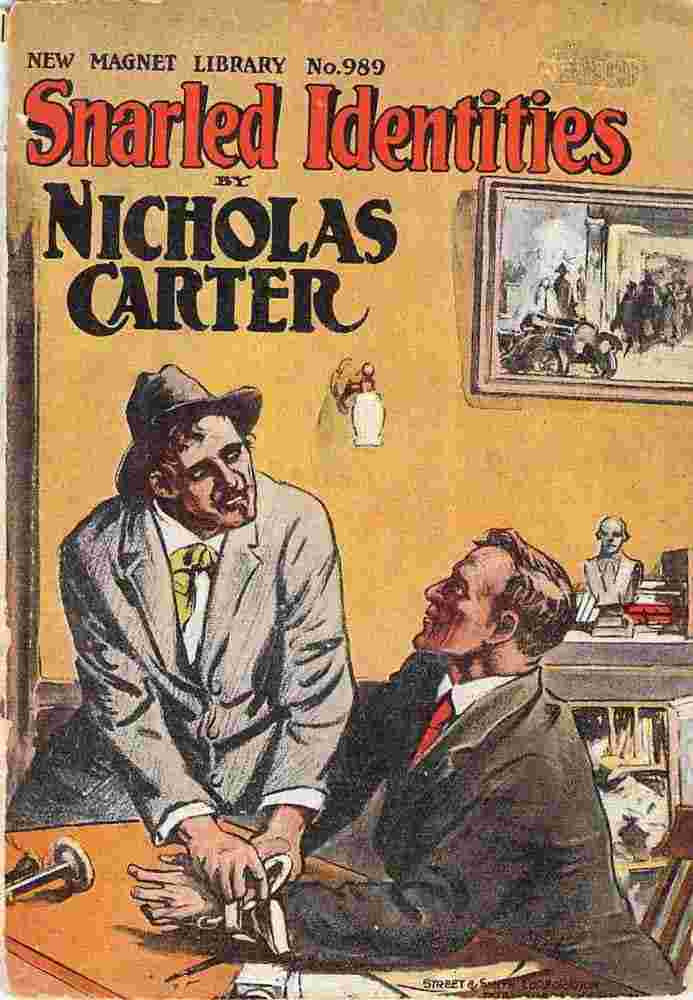
CHAPTER VII.
THE RASCAL’S FIRST CLIENT.
Green Eye’s decision had been an immediate one when he heard the second man’s name, for Lane A. Griswold was several times a millionaire, and the owner of the New York Chronicle and Observer, one of the biggest and most influential of the country morning papers—the first and most conspicuous link in the chain of daily publications which now stretched all the way across the continent.
Millionaires were worth cultivating, according to Gordon’s philosophy, and he reasoned that if he could get any sort of a hold upon this one, it might mean the greatest stroke of luck in his life.
It was well to be on the safe side, however, and he knew that Cray sometimes exhibited an unexpected degree of intelligence. In the light of that thought, he took an automatic from one of the open drawers, examined it to make sure that it was loaded and in first-class condition, and then dropped it into the right-hand pocket of his coat.
After that he closed the drawers, darkened the room, took up his cigar, and leaned back in his chair.
“Nick Carter” was ready for another case—as ready as a spider is for a fly.
The face of the man was calm, his expression indifferent, but it is probable that his heart was beating at an unusually rapid rate, and that more or less fear was lurking behind that noncommittal exterior.
It would have been strange, indeed, had it not been the case, for, with all his daring, this was no commonplace, everyday affair for Ernest Gordon. He might remind himself as much as he pleased that he was “officially” dead, burned in the fire at Clinton Prison, and that no one would be looking for him for that reason, but the many months he had spent within those grim walls had told upon him physically and mentally.
In other words, he was not yet his old self. The unnatural conditions of prison life so lately left behind had incapacitated him to a certain extent for this abrupt plunge into the life outside, especially a plunge of such an interesting character, yet he gave no sign of all this, and, unless something unforeseen developed, he would doubtless gain confidence and ability as time went on.
For that matter, he had already planned and begun to carry out a scheme which would have daunted any other criminal in the country.
The supposed detective regarded his visitors with lowered eyes as he rose languidly from his chair.
Jack Cray’s red face was redder than usual with excitement, and there was something about his manner that suggested he had brought the famous newspaper owner there for no trivial reason.
The latter was a man rather over medium height, dressed in the very latest fashion, but with a trace of untidiness that suggested a careless valet. His face was inclined to be sallow, and the light eyes, prominent and rather jerky in their movements, had heavy bags under them, despite the fact that their owner must still have been under fifty.
For the rest, his chin was firm, perhaps a little pugnacious, and his bearing was that of a man who fully realizes his importance.
“This is Mr. Lane A. Griswold, the owner of the Chronicle and Observer, you know, Carter,” explained the flustered Cray. “Mr. Griswold, my friend, Nicholas Carter.”
Gordon kept his eyelids partially drawn down as he greeted the millionaire. It was a trick of Carter’s when thinking. In fact, the detective often closed his eyes altogether at such times. Gordon had noted this, and was making use of it in order to conceal the color of his eyes, the one weak point about his impersonation, physically considered.
Cray was inclined to clip his words short, and leave out as many of them as he could, thereby giving an impression of unusual directness, and a haste that cannot stop for trifles.
“Very important case, this one, Mr. Griswold has brought me,” he said. “Delicate matter, too—decidedly. Did little job for him once, so he brought me this. Thought I’d better let you in on it, though.”
Gordon nodded slightly, as if all this was quite a matter of course.
“I shall be glad to hear what it is about, Mr. Griswold,” he said. “Of course, I’m very busy, as always, but——”
“I understand that,” the newspaper proprietor broke in. “I’ll make this well worth while for both of you, though, if you can handle it without publicity.”
Green Eye smiled. “That sounds rather strange from the lips of our greatest apostle of publicity,” he commented.
Griswold gave a gesture of impatience. “Perhaps so,” he admitted. “I can’t help that, though. Facts are facts, and this would be most embarrassing to me if any of my competitors should get hold of it, or even if it were spread by word of mouth.”
He fixed Gordon with his eyes, looking him up and down, as if scrutinizing an applicant for the position of office boy—supposing a millionaire would descend to such trivialities.
But the bogus detective stood the scrutiny very well. To tell the truth, Ernest Gordon was really beginning to enjoy himself. Griswold’s first words could hardly have sounded more promising. They suggested all sorts of delightful and golden possibilities.
It seemed perfectly plain that this was just the sort of thing he was looking for—the case of a wealthy, prominent man, who had something to hide, and was willing to pay liberally to those who would keep his secret.
“I can trust you implicitly, whether you succeed or fail, to reveal no word of what I’m about to tell you?” Griswold asked sharply.
The man behind the desk shrugged his shoulders in a way that was characteristic of Nick Carter on occasion.
“I’ve been in the confidence of presidents and senators, ambassadors and noblemen—and millionaires,” he returned, tacking on the word “millionaires” as if it were an afterthought. “In fact, I may claim some knowledge of the secrets of royalty.”
It was all perfectly true from Nick Carter’s standpoint, but the detective himself would not have put it in that way, or boasted of it at all.
“Of course, you may confide in me or not, as you please,” Green Eye continued, warming up as he gained self-confidence.
“Tut-tut!” ejaculated Griswold, with a somewhat pained expression. He had come, with reason, to believe that wealth would buy anything, and he was not quite prepared for this show of indifference. “I meant no offense, Mr. Carter, you may be sure. As I said, though, this is a very ticklish business——”
“We’ll take that for granted,” Gordon quietly interrupted. “Were you going to give me the details, Mr. Griswold?”
His cool, almost insolent tone gave no hint of the turmoil of impatience raging within.
What was he about to hear, and what use would he make of it—in other words, how much could he make it yield him in cold, hard cash, or crackling bank notes?